lessons learned from a large scale, long term co-design
project
AVRAM, Gabriela, CIOLFI, Luigina <http://orcid.org/0000-0003-4637-8239>
and MAYE, Laura
Available from Sheffield Hallam University Research Archive (SHURA) at:
http://shura.shu.ac.uk/24002/
This document is the author deposited version. You are advised to consult the
publisher's version if you wish to cite from it.
Published version
AVRAM, Gabriela, CIOLFI, Luigina and MAYE, Laura (2019). Creating tangible
interactions with cultural heritage: lessons learned from a large scale, long term
co-design project. CoDesign.
Copyright and re-use policy
See http://shura.shu.ac.uk/information.html
Full Terms & Conditions of access and use can be found at
https://www.tandfonline.com/action/journalInformation?journalCode=ncdn20
International Journal of CoCreation in Design and the Arts
ISSN: 1571-0882 (Print) 1745-3755 (Online) Journal homepage: https://www.tandfonline.com/loi/ncdn20
Creating tangible interactions with cultural
heritage: lessons learned from a large scale, long
term co-design project
Gabriela Avram, Luigina Ciolfi & Laura Maye
To cite this article: Gabriela Avram, Luigina Ciolfi & Laura Maye (2019): Creating tangible interactions with cultural heritage: lessons learned from a large scale, long term co-design project, CoDesign, DOI: 10.1080/15710882.2019.1596288
To link to this article: https://doi.org/10.1080/15710882.2019.1596288
© 2019 The Author(s). Published by Informa UK Limited, trading as Taylor & Francis Group.
Published online: 17 Apr 2019.
Submit your article to this journal
Article views: 248
Creating tangible interactions with cultural heritage: lessons
learned from a large scale, long term co-design project
Gabriela Avram a, Luigina Ciolfi band Laura Mayea
aDepartment of Computer Science and Information Systems, University of Limerick, Limerick, Ireland; bCommunication and Computing Research Centre, Sheffield Hallam University, Sheffield, United Kingdom
of Great Britain and Northern Ireland
ABSTRACT
We reflect on the process, outcomes and value generated by applying co-design to a large scale, long-term (4 years) collabora-tion involving designers, developers and cultural heritage profes-sionals, with the goal of creating a platform for the realisation of tangible interactive installations. The project was pioneering in establishing and sustaining co-design for the introduction of sec-tor-changing technology into the museum domain. We gathered extensive data about the co-design process itself, including inter-views investigating the participants’experiences and the impact on their practices. The paper provides insights from such case study, particularly with respect to value co-creation.
ARTICLE HISTORY Received 8 January 2018 Accepted 13 March 2019
KEYWORDS
Co-design; cultural heritage; museums; value co-creation; qualitative study
1. Introduction
We report the lessons learned from a large scale, long-term project that was built on co-design in the heritage domain. It involved co-designers, technologists, social scientists and cultural heritage professionals, and had the goal of creating a platform to realise tangible interactive installations in exhibition settings. Co-design was inscribed into the project, meaning that a variety of activities, participants and goals characterising co-design practices shaped the decision-making, progress and impact of the project, thus interweaving many sensibilities, skills and requirements. Co-design was our way of working for a full 4 years. Thorough documentation and analysis helped us understand how such process unfolded, and the challenges, risks, advantages and outcomes of adopting such strategy in the domain of cultural technologies. Scale and duration gave us insights on how various participants and stakeholders perceived and felt impacted by their participation. Understanding the impact of co-design on the cultural heritage sector (particularly on museums) is important, for this domain entertains a complex relationship with both digital technology and participatory approaches. The former is increasingly present at heritage sites, but is often the product of design by external experts responding to a set of requirements established by an institution, and it can be perceived as being outside the realm of exhibition design and heritage interpretation despite being a very important part of it. The latter have been adopted, to various
CONTACTLuigina Ciolfi l.ciolfi@shu.ac.uk
© 2019 The Author(s). Published by Informa UK Limited, trading as Taylor & Francis Group.
degrees, by many institutions to engage stakeholders in shaping or contributing to archives/exhibitions; participatory approaches also featured in digital technology pro-jects leading to interactive installations. These have been, however, short-term exercises often driven by technologists.
Here we draw from the body of data we collected to document this process so to understand how co-design impacted our team and their practices, and how the value generated by the participatory approach was perceived and acknowledged.
Withvaluewe refer to the articulation ofvalue co-creationproposed by Sanders and Simons (2009), resulting from the collective creativity of actors in co-design projects linking research, development and the creative and cultural sectors, as it occurred in our project. Sanders and Simons note that such endeavours should lead to use or experience value (i.e. the creation of effective and useful design outcomes), social value (i.e. the value generated for the team and for the greater set of stakeholders),
monetary value (i.e. the economic benefit for a participating organisation, such as a museum). We will adopt this articulation of value co-creation to reflect on the results and impact of the co-design approach as practiced in our project.
We now examine related literature on co-design in technology design/Human-Computer Interaction for cultural heritage; we then present the case study and the methodology adopted;finally, we discuss relevantfindings and key lessons learned.
2. Related work
groups (in terms of age, nationality, interests, etc), students and teachers, local amateurs or enthusiasts, experts in the heritage in question can all be meaningful actors to engage.
Overall, there is a trend in facilitating greater engagement by various actors in designing interactive systems for cultural heritage, also including end-user program-ming toolkits aimed at heritage professionals (Ardito et al. 2010), leading to intended end-users gaining new roles (Kanstrup2012). All this is important when devising long-term participatory strategies that engage cultural institutions and professionals, aiming to deliver a series of projects (rather than just one-offprototypes), and to significantly impact on the practices of participants. While such examples in the heritage domain are–as we said–few, issues arising from long-lived co-design have been examined by several researchers. To the examples listed earlier, we must also add the investigations of how the balance of power and the mechanisms of decision making operate in co-design teams (Bratteteig and Wagner 2014); the establishment and configuration of various roles and related responsibilities (McCarthy and Wright2015); the relationships among them (Vines et al. 2013); the role that technological prototypes play in devel-oping design concepts (Ciolfiet al. 2016).
In parallel to HCI and PD research, participatory methods have been adopted and discussed by heritage practitioners (Simon2010), who reconsidered the set of skills and techniques to deploy in light of increased participation (Marty 2006), and reflected upon the benefits of participatory initiatives for cultural institutions and their audiences (Bienkowski 2016; Silvia, Jaebker, and Leason 2014). However, almost always these initiatives had visitors and local communities (or linked institutions) take part in projects designed by the institution itself, rather than co-design them. These examples are, in other words, instances of one type of participatory strategy (e.g. audiences invited to contribute in part to projects designed by institutions), rather than pervasive co-design exercises.
From such state-of-the-art, several issues emerge. The relationship with technology in a sector often struggling to find resources and bring in new skills is evolving from something that is usually outsourced and/or commissioned to external experts, to something that is more pervasively built into the skillset of heritage professionals. The Do-It-Yourself trend also enables heritage professionals to play a greater role, by providing them with tools and peer support for developing projects, while at the same time creating new demands and expectations.
to how co-design unfolds and what kinds of impact it has in terms of skills, concerns and understandings. We shed light on these issues through our case study as part of the European research project called meSch.
3. The case study: co-design in meSch
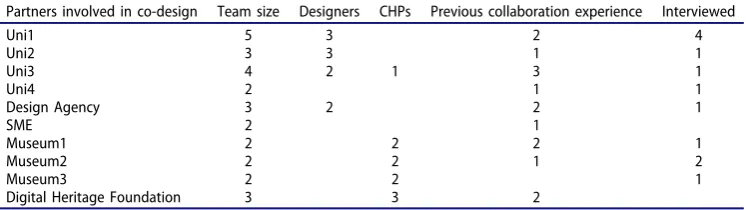
Our case study is the European Project Material EncounterS with Digital Cultural Heritage-meSch (2013–2017). meSch had the goal of co-designing a toolkit enabling cultural heritage professionals (CHPs) to create tangible interactive installations (Petrelli et al.2013). The team included twelve partners across six countries (Table 1). The heritage sector was well represented: three partners were museums and one was a digital heritage foundation. Other partners were six universities/research institutes, a design foundation, and a small-medium enterprise (SME) specialising in services for tourism and the cultural sector. The academic members represented many skills and disciplines: computer science, engineering, social science, heritage studies, interaction and product design. All academic teams were multi-disciplinary and had previous experience of working with heritage institutions, including on the design of interactive technologies. On the other hand, the heritage partners’previous experiences were more varied: only some of them had worked with academics and embarked on significant technology development projects. The practitioners from industry and from the design foundation similarly had a breadth of expertise regarding heritage projects, and both had previously worked with academics and museums.
Additionally, several heritage institutions that were not formally members of meSch participated as external collaborators in dedicated co-design events, enabling the team to involve a wider range of heritage bodies.
As we mentioned, meSch worked through co-design for its entire duration, with the heritage partners and collaborators fully contributing to developing the technology and toolkit. Co-located‘intensive‘events alternated with sustained asynchronous collabora-tions between subgroups of partners (also maintained through shared blogs and documentation, and regular online meetings, given the team’s geographical distribu-tion). We term‘intensive‘those events that were fully dedicated to co-design activities (such as workshops for generating design concepts, and hands-on exploratory labs devoted to rapid prototyping), lasting for 2–3 days, and which had an important role in the progression of the co-design.
[image:6.493.61.439.541.646.2]The heritage full partners in the consortium were: an archaeological museum- Allard Pierson Museum, an educational museum oriented toward families and schools–Museon
Table 1.Organisations and teams involved in co-design.
Partners involved in co-design Team size Designers CHPs Previous collaboration experience Interviewed
Uni1 5 3 2 4
Uni2 3 3 1 1
Uni3 4 2 1 3 1
Uni4 2 1 1
Design Agency 3 2 2 1
SME 2 1
Museum1 2 2 2 1
Museum2 2 2 1 2
Museum3 2 2 1
(both in The Netherlands), and a historical museum- Museo Storico Italiano della Guerra (in Italy). These partners received project funding and had responsibilities for delivering various aspects of the project. The group of external collaborating institutions included two historic cemeteries (UK and Germany), local city-based museums of arts and antiquities (Ireland, The Netherlands, Spain), one historic house museum (The Netherlands), and a second educational museum (UK).
Some of the intensive co-design workshops included only the consortium partners (particularly earlier in the project so to set up the team, shared goals and strategy in the best possible way), whereas others were open to external collaborators. Furthermore, meSch featured three major case studies, where full-scale interactive exhibitions were designed, developed and opened to the public. Each case study was led by the corre-sponding museum partner, which had final say on every aspect of the case study delivery, as they were part of their official programme and targeted at their intended audiences. Both co-located intensive co-design events and longer-term activities through shared collaboration tools took place to realise the case studies.
Roles and power relationships within the team werefirst and foremost shaped by the project work plan, with clear assignment of leadership for tasks and deliverables shared by all partners, according to their expertise. Given its prominence, conducting, mon-itoring and analysing, the co-design process corresponded to a separate unit of work with allocated resources. It was led by one of the academic partners, specialising in interaction design and co-design, and partners with previous experience of managing co-design (four universities, two museums and the design foundation) were assigned roles in organising, facilitating and documenting activities. For all participants, meSch was thefirst experience of working on such an extensive co-design effort and with such a configuration of collaborators/expertise.
Goal setting and skills mapping activities within the team started since the prepara-tion of the project funding proposal, and involved representatives from all partners. These exercises continued as the project started in earnest with a full team.
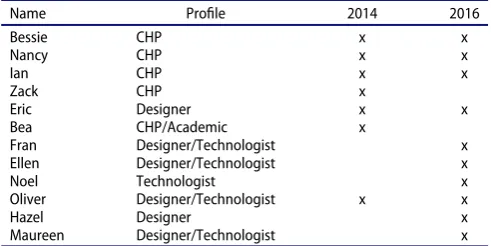
[image:7.493.124.370.522.645.2]The co-design process was carefully monitored and extensively documented throughout. The intensive co-design workshops were documented through observa-tions, analysis of the materials produced, post-event questionnaires and interviews with participants (seeTable 2). The longer-term collaborations within the team were docu-mented through shared blogs (each relating to a case study being co-designed by
Table 2.Interview Participants.
Name Profile 2014 2016
Bessie CHP x x
Nancy CHP x x
Ian CHP x x
Zack CHP x
Eric Designer x x
Bea CHP/Academic x
Fran Designer/Technologist x
Ellen Designer/Technologist x
Noel Technologist x
Oliver Designer/Technologist x x
Hazel Designer x
partners), self-documentation by the key project personnel, and through interviews with project participants.
Data sets collected are:
● Documentation of co-design activities: notes, photographs, video recordings of all co-design activities; follow-up notes written as a thorough descriptions of the activity within one week of each event;
● Case studies: each team involved in the exhibitions at the three partner museums used a closed access blog to keep notes (in Italian, Dutch and English). Self-documentation involved photo-taking, videoing, audio recording.
● Interviews in the Spring of 2014 (midway through the project) with seven cultural heritage professionals and designers involved in co-design (Table 2); focus group on co-design held in Germany in the summer of 2014.
● Semi-structured follow-up interviews with ten key participants (i.e. people involved in most co-design activities, particularly regarding the case studies) conducted close to the end of the project (late 2016) (Table 2).
The data were analysed thematically during the life of the project in correspondence to milestones, and used for reporting on progress in meSch. We now reflect on the process and discuss the insights drawn from the thematic analysis of the co-design data. We particularly make use of excerpts from the reflective interviews as they shed light on the participants’views, reflections and comments on the entire process.
4. Co-design as the medium for mesch
After the initial co-design activities, when the time came to move towards the three case studies, Zack (an experienced curator leading a case study) expressed the need for more than reaching common understanding. He spoke about ‘bridge figures’, who could bring one world into the other:
The short [co-design] sessions are good as a start, but in the end we really need to bridge these domains and that means really working side-by-side. And that may be one of the lessons we are already learning, because I really appreciate it now that they’re bringing D. [a postgraduate research student from a technical partner] in for a long-term project. I think that’s something that later on will really be helpful, because he can now be some sort of ambassador for the museums in his team. And that’s what we need(. . .) I think we need to look for these kind of keyfigures in the project: the people who are really bridging the different domains. (Zack, CHP, 2014)
We now examine some key aspects emerged from our data that shed light onto less-researched aspects of the impact of
co-design. We refer to participants through pseudonyms.
4.1. The role of technology in co-design
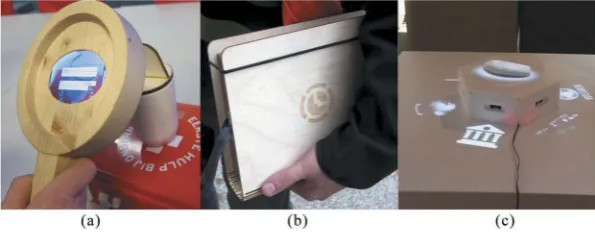
Digital technology was not just the intended‘product’of the co-design process, but it impacted and shaped the process in several other ways. In thefirst 20 months, inspired by the earlier activities and the well-known settings of the participating museums, several interactive prototypes were developed: these included, for example, a magnifying glass-shaped device (‘The Loupe’, shown inFigure 1 (a)) that visitors could use to explore paths in the museum; an interactive book (Figure 1 (b)) where visitors could choose the theme of the audio content accompanying their visit (e.g. history, architecture, local legends, etc.) by placing a bookmark on a particular page; an interactive plinth (Figure 1 (c)) that could sense approaching visitors and display information about the object it held.
[image:9.493.97.395.510.626.2]These early prototypes were meant not asfinal products, but as prompts to stimulate discussion and to inspire future developments such as the case studies. These proto-types and related interaction concepts were also seen asblueprints, and a way to build the toolkit from the ground-up: i.e. what would CHPs need to know in order to create a similar prototype in their own museum?
The prototypes were therefore used as examples/templates in further co-design activities (including those with local collaborating institutions) and in hands-on build-ing and prototypbuild-ing events calledexploratory labs. As examples, one local collaborating museum developed its own version of the Loupe prototype; the interaction template of the book prototype was adapted to create a version suitable for an outdoor heritage site. Only some of the co-design activities (particularly the exploratory labs) included experimentation with technology at this level, but due to the aim of meSch, technology was a constant presence in everybody’s mind:
For me, co-design is a way to get a hold of a project for seeing the possibilities of technology. (. . .) it helps to make it more concrete; to explore the possibilities, and to have ideas of the possibilities that the project offers. And I think that should be the aim of these co-creation sessions. (Ian, CHP, 2014)
Designers and technologists saw the prototypes as means for supporting dialogue and understanding the CHPs needs in building narratives for their own museums, as with the examples we mentioned. Prototypes made things more concrete and pro-vided an ‘entry point’ to what could actually be done in the settings that they work in:
For me the prototypes are a means of creating a dialogue because if you proposed something to a museum then they can say‘I like this’, or‘I would have liked it if it had done this’. So then it becomes less open, but it triggers other questions because it is something you can use, rather than it being just a discussion in words where everything is possible (. . .). (Eric, designer, 2014)
Technology was used as a demonstrator and -importantly- as a way of bridging frames of mind:
We had a sort of empty shell of a piece of technology or an idea, and the curators didn’t know what that was until we sort of sold it to them–we explained what it was, and then they could make their own mind up about how to implement it. And what was good about that session was that we had two sets of very-very focused use for that technology or product. So they immediately bonded with that technology, they thought“I could do this!” and“this is my concept”. (Oliver, designer and technologist, 2014)
The two rounds of exploratory labs saw designers, technologists and CHPs (from both inside and outside the consortium) using the concepts and prototypes developed thus far, and repurposing them to be used in their own heritage institutions. Physical shape, media content and behaviours were altered on the spot under the eyes of CHPs. For example, a prototype called ‘The Way Detector’(a hand-held egg-shaped object that would vibrate with different intensity depending on its proximity to relevant exhibits) was adapted into a variation suited to a historic house museum: a pie dish designed to guide the visitor from the groundfloor kitchen, where the visit started, through all the rooms of the house. This prototyping together (for the benefit of the process and for demonstrating that indeed such activities could be performed by CHPs with confi -dence) showed how co-design activities using technological artefacts could impact the practices of CHPs. The actual impact is emphasised in the quote below:
technology, those kinds of tools, to enhance the visitor experience. . . From my per-spective, that was the most productive. . . The second exploratory lab was also with curators [external to meSch]. I heard that they really liked it, and that it was really good to have a dialogue with designers, and that’s really crucial part of the success. Because design, technology, and curators are parallel worlds and we really need to bridge that. . .. you can only do that if you are in a dialogue and looking at the same solution in a way. (Zack, CHP, 2014)
At the same time, some designers were concerned that technology might have been introduced too early and might have hampered creativity, allowing technological feasibility to play a major role in dictating the outcomes:
At the time of the co-design workshop we had in Amsterdam in the summer of 2013, due to what happened in my own group, I had the feeling that we had betrayed the museums. Tech took over the show. As a designer, I felt we lost control. (. . .) But looking back, nothing was lost, we learnt from experience and this episode proved useful. (Hazel, designer, 2016)
While the rationale for focusing on the prototypes was that of enabling the CHPs to become as familiar as possible with the technology, this could have had some ill effects in terms of creativity. However, as we discussed in (Ciolfi et al. 2016), open brain-storming (as it happened in some of the very early workshops) also required a significant amount of bridging and supporting by both designers and co-design facilitators.
4.2. Embedding co-design into heritage practice
Designers and technologists became acutely aware that the design of new exhibitions, tours, or learning experiences does not revolve around technologies, and that the CHPs’ narratives must come first. While all designers and technologists adopted a user-centred view before meSch, and most of them had had experience of prior (albeit smaller) co-design exercises, facing the complexities of integrating interactive components into a wider exhibition narrative was a steep learning curve, particularly due to the role of cultural institutions as co-designers and to the novelty of the interaction modalities and relationship to exhibition settings (e.g. tangible interac-tion, avoiding screens as input or output displays, etc.). This was particularly affected by the diversity of the heritage partners, meaning diverse physical set-ups, audiences, narratives and priorities. Earlier in the co-design process (2013–2014), interaction concepts (including those in earlier examples) were developed, and then reshaped, changed, or abandoned altogether. Needs and preferences took a while to emerge and become clear, and some of the participants’ individual perspectives diverged as the scope and aims of meSch were shaped by working together and finding agreement:
a more important place (. . .) but it drove us to create stuffthat you put between the object and the visitor rather than letting the object talk (. . .) So in that sense I feel that the museums could’ve been more vocal about what they need. In retrospect it doesn’t feel like they got something out of it. (Eric, designer, 2014)
Furthermore, as some initial concepts changed shape and functionality to become technically feasible prototypes, some of the initial CHPs’contributions were superseded. Technical explanations were provided for these changes, but frustration persisted and required tending to by means of reviewing the decision making process and ensuring that the heritage partners shared the motivations:
From speaking with some of the museum professionals (. . .) I get the impression that they are delighted to have all of these co-design activities, but the same time I have the feeling that they are somehow frustrated at how the actual prototypes are finally being imple-mented, somehow they are cut out off [from] the equation. (Bea, researcher and CHP, 2014)
Additionally, consolidating concepts into functional prototypes required further facil-itation to ensure everyone’s contributions were acknowledged, for example regarding the type of digital content to support and the materials used to realise the physical components. Understanding the language and the actual challenges of CHPs in their institutions at an even deeper level, and more pervasive ways of working together and sharing insights long-term became vital in the second part of meSch, in order to design actual exhibitions.
4.3. Maintaining working relationships
Multidisciplinary collaboration on this scale was a novel experience for everyone involved. Clear value was perceived by all participants, not only in being able to voice their concerns, skills and goals, but in understanding others’ way of thinking and in mutual learning.
Although the idea of co-design could suggest that all the participants are on equal footing, previous research showed how various roles are articulated in terms of deci-sion-making power. In our case, designers and technologists stated that the ideas and existing practices of cultural heritage professionals guided and inspired the process, and the CHPs served as ultimate arbiter for interactions underpinning the leading narra-tives. Designer and technologist Ellen recalled strongly supporting the idea of an interactive walking stick for guiding visitors while the curators didn’t regard it with the same enthusiasm, and thus it was not realised. At the same time, Oliver felt like he acted as ‘creative tool’ during the second exploratory workshop, where a number of concepts and prototypes were transformed to suit the ideas of participating museums. This gave him–and the whole consortium–a better sense of the functionalities of the meSch toolkit to be developed:
For Oliver, in that particular instance, co-design felt like mainly supporting others, while still significantly contributing to the process.
Another interesting aspect was the feeling that by virtue of the work even non-CHPs
‘fitted’in the museum:
When we were installing in Museon, the ladies who looked after coats came to us and asked us ‘what museum are you from?’ And you know, you got me and [colleagues] putting the objects in the cases, and I just thought that it was nice that they thought we had the same approach, wefitted in a museum setting. And I think that’s only coming about from the work that we’ve done over the last year and understanding the sensitivity of what we are handling, understanding the environment, understanding the people, how they work how, we have concessions with each other; it is a very interesting question who benefits more, who’s learning more, who’s going to get more out of this? (Oliver, designer and technologist, 2014)
However, not all the participants felt comfortable with this way of collaborating. Bea, researcher and CHP, who, however, only took part in one consortium-wide co-design workshop, felt that the lack of a common background was possibly making the con-versation counterproductive:
Another thing about this exercise was that, the point was to put together people of different specialisations, and in my group this became difficult because, for example, the way that the technical person would approach a situation is completely different to how a museum professional would approach the situation (. . .) It feels that sometimes teams of mixed expertise (. . .) lead to confused outcomes. . . (Bea, 2014)
This perception raises the question of how to ensure that the team shares enough experiences to feel like they are part of the dialogue, rather than outsiders. Overall, the long-term engagement through co-design was seen as a win-win situation for all those involved in a sustained way:
(. . .) The CHPs also admitted to building new skills and knowledge. While they admitted toward the end they still had a lot to learn, they also acknowledged that they had learned a lot about creating an interactive tour for the museum. . .. Overall, I believe we learned something of value that went beyond this project. For me as a designer, I feel I have learned what can be done to build an effective design collaboration with a museum, and the museum learned a bit more about their visitor base. (Maureen, designer and technol-ogist, 2016)
4.4. The value of long term engagement
believe what comes out will have value’ (Maureen, designer and technologist, 2016). Initially, making a connection between experimenting with interaction concepts and actual future exhibitions that would incorporate them was not straightforward: for example imagining the concept of a ‘smart’ replica museum object that can unlock digital content (as it was proposed for the Allard Pierson Museum case study) becom-ing implemented and playbecom-ing a part in an exhibition, rather than just bebecom-ing part of brainstorming. Additionally, it appeared that things were moving too slowly: Ian (CHP) in his 2014 interview stated that there had been enough work done in workshops and it was time to‘focus on real cases and on real stuffthat we’re going to implement’. The replicas were indeed fully realised for the Allard Pierson Museum case study.
A way to sustain the process is to make other forms of value generation visible; while the end goal is not immediately achieved, however this depends on establishing a strong relationship:
(. . .)it’s not just about putting a designer and a curator into one space to come up with a solution, it’s a relationship. It’s about recognising opportunities, it’s about appreciating creativity, maybe thinking out-of-the-box? (. . .) You need to invest in it. (Zack, CHP, 2014)
Ellen recalled this challenge in relation to the co-design of an exhibition for Museo della Guerra on the theme of World War 1, where those involved worked together before:
We spent thefirst day discussing all kinds of ideas; nothing seemed to work; none of the scenarios worked; we were all disappointed and someone even mentioned they felt we wasted the day. However, the next day, as a result of these alternatives explored, Bessie [the curator] and her colleague arrived at a completely new approach, and we all knew in a matter of minutes that this was the solution we needed. (Ellen, designer and technologist, 2016)
When asked, all the participants said they would use co-design again if the situation allowed, and would recommend it to others. Almost everybody agreed in the inter-views that co-design takes more time, but can produce better results, especially in long-term collaborations. Participants valued co-creation more when examining the phases of the project retrospectively, therefore building these into the process may be beneficial. During the mid-project interviews in 2014, the perceived meanderings of the process made some participants anxious; in 2016, closer to the end of the project, they valued the whole co-creation process as an important enabler of mutual learn-ing and the concrete outcomes of the project. Unfortunately, Bea, who had been so negative in her 2014 interview, could not be interviewed again to see whether her perception changed.
Consortium workshops, local activities, exploratory labs and research on co-design all fed into the process, even if how each pushed it forward was never explicitly discussed:
(. . .) I thought that the co-design workshops were not only a means of getting the scenarios
The resulting documentation was used to develop a booklet of co-design techniques and templates, made freely available online. This was not a planned outcome of the co-design, but rather another form of value-creation that emerged as the work was conducted and was recognised as a major outcome of the process.
5. Conclusions and lessons learned
After discussing four dimensions of the meSch co-design process, we focus on how the impact and value generated were perceived, recognised and acknowledged. To con-clude, we reflect upon the Sanders and Simons (2009) ‘value co-creation’dimensions: use or experience value, social value, and monetary value (skills, expertise).
Regarding the use or experience value, what was created was a very positive user experience for the CHPs using the toolkit, and– consequently–for the visitors of the museums featuring the installations. It took time and dedicated efforts to bridge between understandings, languages and concerns, but the results from co-creation were perceived to have added value to the institutions. Also, the non-heritage partners felt that this process truly took into account the experience value of the intended users, on a scale that is unusual even in research. The experience value therefore refers not only to the experience of the technology that was developed, but to that of co-design itself.
Regarding social value, mutual learning and understanding were two of the most acknowledged forms of value co-creation. We illustrated how team building and the forging of relationships that helped deal with occasional tensions and conflicts were highly appreciated. Importantly, while many views expressed in the 2014 interviews were quite critical and even sceptical, the 2016 interviews (in light of the successful case studies) offer a significantly more positive perception of roles and contributions. This illustrates the key importance of the co-design extended time frame and of highlighting intermediate achievements to sustain a challenging process. A number of smaller, unplanned collaborations among certain participants also emerged, demonstrating the benefits of social value building within the team.
Finally, regarding themonetary valueof co-creation, obviously all the partners aimed at generating economic value out of meSch, particularly the museums that embarked on a project quite unlike the ones they normally conduct. The participants emphasised that they gained new skills in the process, akin to professional training. Furthermore, when discussing the sustainability of using co-design after meSch, CHPs were positive and confident that the experience acquired will allow them to involve other colleagues and/ or external collaborators in future. In the case of small museums with limited resources, the involvement of volunteers (such as interns) in co-design was seen as a viable alternative.
developers led), while driving the definition of goals and requirements for their heritage institution. During that phase we saw leadership negotiations in terms of what could be technically realised as well as what could fit in a museum. As the process evolved, however, and particularly as the case studies approached, the CHPs shouldered more responsibility and leadership. While this was in part due to the project formal workload allocation, the fact that CHPs could confidently lead the process was also by virtue of how much they felt they had learned. Mutual trust had also increased, and this was echoed in the second round of interviews (after the case studies). Beyond trust, value was also generated in terms of knowledge and understanding: participants expressed their appreciation for being able to‘fit in’, by recognising and communicating issues in a domain that was not their own at the beginning of meSch.
While we showed how such extensive process presented challenges in terms of establishing, maintaining and rewarding these relationships, we also saw the extent of what was gained, in terms of co-design outcomes (prototypes, exhibitions), and experi-ence, knowledge and skill. This demonstrates that the participants attribute co-creation a higher value as time goes by–after mutual understandings emerge, shared goals are negotiated and results begin to materialise, compared to the initial phases, when the level of required effort is high and results uncertain. There is a real tension between choosing co-creation as the core approach for a new collaboration project, and the requirements to demonstrate early in the process that the project is on track. However, co-design should not be seen as a universal solution for any project, and the decision of adopting must be made with proper consideration.
What we presented is of course the result of a particular study setting, which might be difficult to replicate. Another limitation is that the researchers monitoring and reflecting on co-design were also involved in other meSch activities, meaning an insider’s perspective throughout. However, despite these limitations, the study presents, in our view, a significant instance of long-term co-design for cultural heritage technol-ogies, populating a space of case studies where examples of this scale are few, and contributes useful knowledge about the broader challenges of long-term and large-scale participatory initiatives.
Our empirical study shows how in such a co-design approach it is more difficult to perceive intermediate achievements, while it is instrumental to establish stronger, and indeed life-changing partnerships.
Disclosure statement
No potential conflict of interest was reported by the authors.
Funding
ORCID
Gabriela Avram http://orcid.org/0000-0001-5648-1059 Luigina Ciolfi http://orcid.org/0000-0003-4637-8239
References
Ardito, C., M. F. Costabile, R. Lanzilotti, and A. L. Simeone. 2010. “Combining Multimedia Resources for an Engaging Experience of Cultural Heritage”. InProceedings of the 2010 ACM Workshop on Social, Adaptive and Personalized Multimedia Interaction and Access(SAPMIA ’10). New York, NY: ACM. doi:10.1145/1878061.1878077.
Bienkowski, P., Ed.2016.No Longer Us and Them: How to change into a participatory museum and gallery. London: Paul Hamlyn Foundation.https://www.phf.org.uk/wp-content/uploads/ 2016/07/Our-Museum-Report_April-2016-double-page.pdf.
Bødker, S., and P.-O. Zander.2015. “Participation in Design between Public Sector and Local Communities.”InC&T‘15 - Proceedings of the 7th International Conference on Communities & Technologies, 49–58. New York, NY: ACM.
Bossen, C., C. Dindler, and O. S. Iversen.2012. “Impediments to user gains: Experiences from a critical participatory design project.” In Proceedings of the 12th Participatory Design Conference: Research Papers - Volume 1 (PDC ‘12), edited by K. Halskov, H. Winschiers-Theophilus, Y. Lee, J. Simonsen, and K. Bødker, Vol. 1. 31–40. New York, NY: ACM. Bowen, S., A. Dearden, P. Wright, D. Wolstenholme, and M. Cobb. 2010. “Participatory
Healthcare Service Design and Innovation.”InProceedings of the 11th biennial Participatory Design Conference, 155–158. New York, NY: ACM.
Bratteteig, T., and I. Wagner.2014.Disentangling Participation: Power and Decision-Making in Participatory Design. London: Springer.
Ciolfi, L., G. Avram, L. Maye, N. Dulake, M. Marshall, D. VanDijk, and F. McDermott.2016. “Articulating Co-Design in Museums: Reflections on Two Participatory Processes.” In Proceedings of the 19th ACM Conference on Computer Supported Cooperative Work & Social Computing (CSCW’16), 13–25. New York, NY: ACM.
Dindler, C., O. S. Iversen, R. Smith, and R. Veerasawmy. 2010. “Participatory Design at the Museum: Inquiring into Children’s Everyday Engagement in Cultural Heritage.” In Proceedings of the 22Nd Conference of the Computer-Human Interaction Special Interest Group of Australia on Computer-Human Interaction, (OZCHI ’10). 72–79. New York, NY: ACM. doi:10.1145/1952222.1952239.
Ehn, P.2008.“Participation in Design Things.”InProceedings of the Tenth Anniversary Conference on Participatory Design 2008, edited by D. Hakken, 92–101. Bloomington, IN: ACM.
Fuks, H., H. Moura, D. Cardador, K. Vega, W. Ugulino, and M. Barbato.2012.“Collaborative museums: An approach to co-design.” In Proceedings of the ACM 2012 conference on Computer Supported Cooperative Work (CSCW ‘12), 681–684, New York, NY: ACM. doi:10.1097/PHM.0b013e31825a0a1b
Greenbaum, J., and M. Kyng, editors. 1991. Design at Work: Cooperative Design of Computer Systems. Hillsdale, NJ: Lawrence Erlbaum Associates.
Kanstrup, A. M.2012.“A Small Matter of Design: An Analysis of End Users as Designers.”In Proceedings of the 12th Participatory Design Conference: Research Papers (PDC), edited by K. Halskov, H. Winschiers-Theophilus, Y. Lee, J. Simonsen, and K. Bødker, 109–118. Roskilde, Denmark: ACM. doi:10.1177/1753193411419439
Lyons, N., D. M. Schaepe, K. Hennessy, M. Blake, C. Pennier, J. R. Welch, K. McIntosh, et al.
2016. “Sharing deep history as digital knowledge: An ontology of the Sq’éwlets website
project.”Journal of Social Archaeology16 (3): 359–384. doi:10.1177/1469605316668451. Marty, P. F.2006.“Finding the skills for tomorrow: Information literacy and museum
informa-tion professionals.” Museum Management and Curatorship 21 (4): 317–335. doi:10.1080/ 09647770600702104.
McCarthy, J., and P. Wright.2015.Taking [A]part: The politics and aesthetics of participation in experience-centred design. Cambridge, Mass: MIT.
McDermott, F., L. Maye, and G. Avram. 2014. “Co-designing a Collaborative Platform with Cultural Heritage Professionals.”InProceedings of the 8th Irish Human–Computer Interaction Conference, 18–24. Dublin.
Petrelli, D., L. Ciolfi, D. Van Dijk, E. Hornecker, E. Not, and A. Schmidt. 2013. “Integrating material and digital: A new way for cultural heritage.”Interactions: New Visions of Human-computer Interaction20 (4): 58–63. doi:10.1145/2486227.
Roussou, M., E. Kavalieratou, and M. Doulgeridis.2007. “Children Designers in the Museum: Applying Participatory Design for the Development of an Art Education Program.” in Proceedings of the 6th International Conference on Interaction Design and Children (IDC ’07), 77–80, New York, NY: ACM. doi:10.1145/1297277.1297292.
Rowley, S. 2013. “The Reciprocal Research Network: The Development Process.” Museum Anthropology Review7 (1–2): 22–43.
Sanders, L., and G. Simons.2009.“A Social Vision for Value Co-creation in Design”,Technology Innovation Management Review.Accessed 16 November 2017.http://timreview.ca/article/310 Silvia, F. F., K. Jaebker, and T. Leason2014.“Participatory Experiences in Art Museums: Lessons from Two Years of Practice.”MW2014: Museums and the Web 2014.http://mw2014.museum sandtheweb.com/paper/participatory-experiences-in-art-museums-lessons-from-two-years-of-practice/
Simon, N. (2010)“The Participatory Museum”. Museum 2.0
Taxén, G. 2004. “Introducing Participatory Design in Museums.” In Proceedings of the Eighth Conference on Participatory Design: Artful Integration: Interweaving Media, Materials and Practices - Volume 1, (PDC 04) 204–213. New York, NY: ACM. doi:10.1145/1011870.1011894. Vines, J. , R. Clarke, P. Wright, J. McCarthy, and P. Olivier.2013.“Configuring Participation: On