
A Dynamic Multiple Watermarking Algorithm
Based on DWT and HVS
Li Zhang1,2, Xilan Yan1, Hongsong Li1, Minrong Chen1
1
Information Engineering College, Shenzhen University, Shenzhen, China
2
Shenzhen City of Modern Communication and Information Processing Laboratory, Shenzhen, China Email: [email protected], [email protected], [email protected], [email protected]
Received June 14, 2012; revised July 31, 2012; accepted August 12, 2012
ABSTRACT
In this paper, a dynamic robust multiple watermarking algorithm is proposed based on Discrete Wavelet Transform (DWT) and Human Visual System (HVS). Watermark image is transformed by Arnold transform. Original image is divided into blocks with 8 by 8 and each block is transformed by DWT. By adopting the Just Noticeable Difference (JND) of HVS and changing low frequency coefficients, binary string message can be embedded into the decomposed original image. Watermark can be extracted blindly. Experimental results have shown that the proposed watermarking has robust against many attacks such as JPEG compressing, cropping, additive noise, line removal, median filter and related attacks with sinStirMark.
Keywords: Dynamic Multiple Watermarking; JND
1. Introduction
Digital watermarking is a new technology of information hiding and it has effective effect for Copyright Protection. The conception of digital watermarking appeared firstly in the conference of image processing in 1994. Many experts made a lot of research for digital watermarking based on spatial [1] and transform domain [2,3].
From the view of image processing, embedding wa-termark information can be seemed that a puny signal overlap in a strength signal. Human will not feel the ex-istence of information if the embed strength is lower than the threshold of HVS [4,5].
Robustness of watermarking is important for many applications. Compared with spatial domain methods, transform domain methods have stronger robust. Water-marking based on DWT [6] is an important transform domain method. Compared with the Discrete Cosine Transform (DCT), DWT has a better performance. Firstly, it has good time-frequency decomposition in ac-cordance with the characteristic of HVS. Moreover, DWT has good compatibility for JPEG compression. Embedding watermark information in the DWT domain [7] has better robust against JPEG compression.
In this paper, an algorithm for data hiding by using DWT and JND model of HVS is proposed. It is a dy-namic multiple blind watermarking algorithm, since more than one watermarks can be embedded into the original image. Original image is divided into 8*8 blocks
and each block is transformed by DWT. A visual model [8] is used to calculate JND threshold. Watermark can be embedded by changing the LL-coefficient of original image.
The paper is organized as follows: Related work is in-troduced in Section 2. In Section 3 the proposed water-marking algorithm is discussed in detail. Section 4 is experimental results and at last conclusions are drawn.
2. Related Work
JND is defined as a measure referring to the capability of a human observer to detect noise or distortion in the field of view. It is related to characteristics of HVS and adap-tive to contents of visual signal under consideration. With a HVS model, accessory information can be em-bedded in the regions with the least HVS sensitivity to the incurred changes. JND model in the essay of Podil-chuk [9] is used. Original image of size M × N is first divided into 8 × 8 blocks (Bm) and each block is de-composed by DWT (Bm). The formula is as follow:
, , 1, 2,
8 *
8
m m
B f x y m M N (1)
DWT ,
m m m
B B F x y
0.178
0.1
, 5.05 u v u v 1
C u v e e
(2) Contrast sensitivity can be calculated in DWT domains by the formula following:
(3)
where u, v is frequency. Noise sensitive visual can be calculated by using Contrast Sensitivity. The formula is as follow:
DWT , , u v S C
u v FDWTu v, 2DWT
lnS
(4) where FDWT is DWT of each block. JND can be calcu-lated by:
JND (5) where is strength which can be obtained by
experi-ment.
3. Proposed Watermarking Algorithm
Original image is decomposed into four sub-band images by DWT. Approximate sub-image (LL) is stable since it contains the majority of image energy. In order to gain-ing a better robustness, the watermark is embedded into approximate sub-image.
3.1. Watermark Embedding Process
By altering coefficients of approximate sub-image blocks, watermark is embedded. Watermark embedding is im-plemented through the following procedures.
Step 1: Generate watermark
In our scheme, two binary images are used as original watermarks W. It is transformed into W by Arnold transform. is scanned on-line and then transformed into one-dimensional sequence
W
1,
W w w j K
1
m
W W
0,1 , 2,
m j j , where K is the num-
ber of watermark sequence. Two watermarks are consid- ered for embedded labeled as watermark1 and wa- termark 2 m2.
Step 2: Divide original image
Original image of size M × N is divided into 8 × 8 blocks which are scanned into one-dimensional horizon-tal blocks (Bk).
Step 3: Calculate JND
JND calculation for the coefficient in the low-fre- quency domains can be finished according to the For-mula (5).
Step 4: Generate number sequence
Put a secure key X into a random number generator to produce random number sequence I.
MN 64
,B u v B
u v,
v Wi2
1, 2,
I i , if i = k, then I(i) = I(k). Step 5: choose image blocks to be embedded
Transform each blockinto DWT coefficient matrix block . Sub-block I i 1 is selected to embed and is selected to embed
2 , I i B u kWi1 .
Step 6: Embed Watermarking
Let k denotes LL sub-band coefficient of
sub-block k, Coefficients and
If Wik1 k1, 2
and Dk
1, 2 Dk
4, 3
, exchangecoefficients of Bk
1, 2 and Bk
4, 3 . Else if
ik 0 1, 2 and
W k Dk 1, 2
Dk
4, 3
, exchange coef-ficients of Bk
1, 2 Bk
4, 3Embedding is done as Equations (6) and (7): and .
1 1, 2
mk
W k and D0 If
,D u v
B Dk
1, 2 Dk
4, 3 are selected to be embedded. Embedding rule is:
1, 2 1, 2 2 4
4, 3 4, 3 2 4
k k
k k
D D D D
D D D D
(6)
JNDk 1, 2 4, 3
D D D .
where
0 1, 2
mk
W k and D0
If
1, 2 1, 2 2 4
4, 3 4, 3 2 4
k k
k k
D D D D
D D D D
(7)
JND 4, 3 1, 2
D D D
JND D u vk
, Wmkwhere k
Where k is JND value of . is
watermarking signals.
.
Step 7: Obtain watermarked image
Inverse DWT(IDWT) is applied to obtain the water-marked image I.
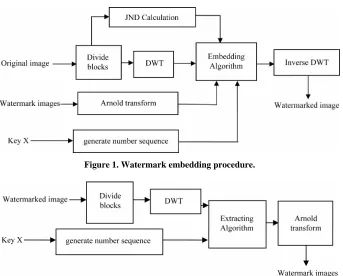
Watermark embedding procedure is shown in Figure 1.
Step 8: Dynamic watermark embedding
By using the same watermark Embedding process as Step 1 - Step 7, more than one watermarks can be em-bedded into original image at any time, which can achieve the dynamic watermarking embedding.
3.2. Watermark Extraction Process
Watermark can be extracted blindly without original im-age. The steps are as follows.
Step 1: Apply DWT I
Divide watermarked image into 8 × 8 sub-blocks. Each block is scanned and sorted as embedding process. DWT is done to obtain decomposed sub-block B u vk
, .Step 2: Regenerate number sequences
Regenerate number sequences using the same key to select B u vk
,Step 3: Extract Watermark .
Let
denotes LL sub-band coefficient of sub- block . Extract the one-dimensional sequence W as:, k
D u v
k
B
1, if 1, 2 4, 3 0, if 1, 2 4, 3
k k k k D D W D D W (8)
Step 4: Obtain the perfect watermarks
Transform into two-dimensional watermark im-age. The perfect watermarks are obtained after Arnold transform.
Figure 1. Watermark embedding procedure.
Figure 2. Watermark embedding procedure.
4. Experimental Results
Experimental results are simulated by programming in Matlab. Different cover images are used as original im-ages and two binary watermark imim-ages for the test. Ex-perimental results with 256 × 256 of original Lena image are given. Original image and watermark images are shown in the Figure 3. Embedded and extracted
water-marks are shown in the Figure 4. (a) (b) (c) Figure 3. (a) Original image; (b) Watermark 1; (c) Water-mark 2.
4.1. Robustness
This section examines the robustness against some at-tacks. Normative Correlation (NC) is employed to meas-ure the similarity of extracted and original watermark defined as:
1 1
1 1
NC , i j
M N M i j
W i j W W
W i j
2 21 1
, ,
, ,
M N
N i j
W i j
W i j
(9)
(a) (b) (c)
where W is original watermark and W is extracted watermark with size M × N. The bigger NC is, the better similarity between W and W is.
Figure 4. (a) Watermarked image; (b) Extracted watermark 1; (c) Extracted watermark 2.
of the extracted watermarks are good, this performance is better than the method in [10]. To demonstrate proposed method resistance to noise, gaussian niose was added. The experimental results in Table 1 show that the algo-rithm can resist this noise att very well. It can also be Performance analysis results are cited in Table 1. The
proposed method is compared to the method of Refer-ence [10] based on DCT and HVS. From the Table 1 we see that the proposed method performs well against
[image:3.595.317.531.530.637.2] [image:3.595.75.288.578.632.2]Table 1. The performance results for the proposed method and the method in [10].
Proposed method Method in [10]
Attacks Attacked
watermarked image Extracted watermark 1 Extracted watermark 2 Extracted watermark 1 Extracted watermark 2
JPEG (Q = 40)
Painting
Crop in the upper right corner 1/4
Gaussian noise (2%)
Line removal
Histogram equalization
Median filtering (3 × 3)
observed from Table 1 that the proposed method out-performs in many cases. The proposed method provides better results in painting, line removal, histogram equali-zation, median filtering and cropping attack.
4.2. Invisibility
Peak signal noise ratio (PSNR) is used to evaluate the
invisibility which is given in Equation (10):
2
2
1 1 255 PSNR 10 lg
MSE 1
MSE , ,
N M i j
I i j I i j M N
(10)
,
i j, stand for the pixel values of I i j and ITable 2. PSNR values of proposed method with different original image (db).
Watermarked image
Lena Cameraman Sailboat Peppers Barbara
[image:5.595.65.538.96.217.2]PSNR 41.26 37.39 38.41 36.70 38.19
Table 3. Comparison between the proposed scheme and the scheme of reference [10].
The proposed scheme Reference scheme [10] Attacks
PSNR NC1 NC2 PSNR NC1 NC2
No attack 39.973 1 1 38.384 1 1
JPEG (Q = 40) 39.376 0.927 0.935 35.512 0.833 0.820
Painting 30.901 0.953 0.954 30.534 0.905 0.896
Crop in the upper right corner 1/4 33.316 0.871 0.828 33.005 0.783 0.775
Gauss noise (2%) 36.958 0.923 0.942 35.571 0.881 0.894
Line removal 38.709 0.949 0.944 37.631 0.793 0.752
Histogram equalization 20.69 0.930 0.927 16.69 0.765 0.716
Median filtering (3 × 3) 39.554 0.873 0.869 39.017 0.631 0.627
original and watermarked image respectively. M and N are height and width of image.
Table 2 shows PSNR of the proposed scheme for dif-ferent watermarked images. Table 3 represents PSNR of watermarked attacked images and NC values of extracted watermark1 and extracted watermark 2 between the pro-posed method and the method of Reference [10].
5. Conclusion
In this paper, an effective robust dynamic multiple blind watermarking algorithm is presented based on DWT do-main. Robust is guaranteed because watermark is em-bedded into low-frequency with JND model of DWT. Experiment results show that the watermark algorithm can provide a high tolerance to noise, compression, crop-ping, painting, histogram equalization, filtering, noise attacks. Compared with the scheme of Reference [9], our method shows greater robustness against these attacks.
6. Acknowledgements
This work is partly supported by Shenzhen Internet in-dustry to develop special fund (C201005250085A) and National Nature Science Foundation of China (Grant NO.61005049).
REFERENCES
[1] S. W. Weng, et al., “Reversible Watermarking Based on Invariability and Adjustment on Pixel Pairs,” Signal Processing Letters, Vol. 15, 2008, pp. 721-724.
doi:10.1109/LSP.2008.2001984
[2] S. K. Bhagyashri and M. Y. Joshi, “All Frequency Band DWT-SVD Robust Watermarking Technique for Color Images in YUV Color Space,” IEEE International Con- ference on CSAE, Vol. 3, 2011, pp. 295-299.
[3] J. C. Patra, A. K. Kishore and C. Bornand, “Improved CRT-Based DCT Domain Watermarking Technique with Robustness against JPEG Compression for Digital Media Authentication,” 2011 IEEE International Conference on Systems, Man, and Cybernetics, Anchorage, 9-12 October 2011, pp. 2940-2945,
[4] S. Zhu and L. Jianming, “A Novel Adaptive Watermark-ing Scheme Based on Human Visual System and Particle Swarm Optimization,” Springer-Verlag, Berlin, 2009, pp. 136-146.
[5] Y. Zhang, “Blind Watermark Algorithm Based on HVS and RBF Neural Network in DWT Domain,” WSEAS Transactions on Computers, Vol. 8, No. 1, 2009, pp. 174- 183.
[image:5.595.60.539.244.437.2]2010 Chinese Conference on CCPR, Chongqing, 21-23 October 2010.
[7] A. Salama, R. Atta, R. Rizk and F. Wanes, “A Robust Digital Image Watermarking Technique Based on Wave-let Transform,” 2011 IEEE International Conference on System Engineering and Technology, Shah Alam, 27-28 June 2011, pp. 100-105.
doi:10.1109/ICSEngT.2011.5993429
[8] S. Zhu and J. M. Liu, “A Novel Adaptive Watermarking Scheme Based on Human Visual System and Particle
Swarm Optimization,” Springer-Verlag, Berlin, 2009, pp. 136-146.
[9] P. Christine and W. J. Zeng, “Image-Adaptive Water-making Using Visual Models,” IEEE Journal on Selected Areas in Communications, Vol. 16, No. 4, 1998, pp. 525- 539.doi:10.1109/49.668975
![Table 3. Comparison between the proposed scheme and the scheme of reference [10].](https://thumb-us.123doks.com/thumbv2/123dok_us/9295215.426788/5.595.60.539.244.437/table-comparison-proposed-scheme-scheme-reference.webp)
