Efficiently measuring a quantum device using machine
learning
D. T. Lennon†1, H. Moon†1, L. C. Camenzind2, Liuqi Yu2, D. M. Zumb¨uhl2, G. A .D. Briggs1, M. 1
A. Osborne3, E. A. Laird4 & N. Ares1 2
1Department of Materials, University of Oxford, Parks Road, Oxford OX1 3PH, United Kingdom 3
2Department of Physics, University of Basel, 4056 Basel, Switzerland 4
3Department of Engineering, University of Oxford, Parks Road, Oxford OX1 3PJ, United Kingdom 5
4Department of Physics, Lancaster University, Lancaster, LA1 4YB, United Kingdom 6
Scalable quantum technologies such as quantum computers will require very large num-7
bers of quantum devices to be characterised and tuned. As the number of devices on chip 8
increases, this task becomes ever more time-consuming, and will be intractable on a large 9
scale without efficient automation. We present measurements on a quantum dot device per-10
formed by a machine learning algorithm in real time. The algorithm selects the most infor-11
mative measurements to perform next by combining information theory with a probabilis-12
tic deep-generative model that can generate full-resolution reconstructions from scattered 13
partial measurements. We demonstrate, for two different current map configurations that 14
the algorithm outperforms standard grid scan techniques, reducing the number of measure-15
ments required by up to 4 times and the measurement time by 3.7 times. Our contribution 16
goes beyond the use of machine learning for data search and analysis, and instead demon-17
learning-based automated measurement of quantum devices. 19
Introduction 20
Semiconductor quantum devices hold great promise for scalable quantum computation. In par-21
ticular, individual electron spins in quantum dot devices have already shown long spin coherence 22
times with respect to typical gate operation times, high fidelities, all-electrical control, and good 23
prospects for scalability and integration with classical electronics1. 24
A crucial challenge of scaling spin qubits in quantum dots is that electrostatic confinement 25
potentials vary strongly between devices and even in time, due to randomly fluctuating charge traps 26
in the host material. Characterising such devices, which requires measurements of current or con-27
ductance at different applied biases and gate voltages, can be very time consuming. It is normally 28
carried out following simple scripts such as grid scans, which are sequential measurements taken 29
from a 2D grid for a pair of voltages. We call a set of voltages that defines the state of a quantum 30
dot a configuration. Measurement of some configurations is more informative for characterising a 31
quantum dot than the other configurations; measuring uncertain signals is more informative than 32
measuring predictable signals. However, grid scans do not prioritise measurement of informative 33
signals, instead just acquiring measurements according to simple rules (e.g. following a raster pat-34
tern). Current efforts in the field of automation of quantum dot are focused on tuning2–9, a large 35
portion of these relying on grid scanning techniques for measurement. An optimised measurement 36
method that can prioritise and select important configurations is thus key for fast characterisation 37
and holds the potential to increase the efficiency of these approaches when combined. 39
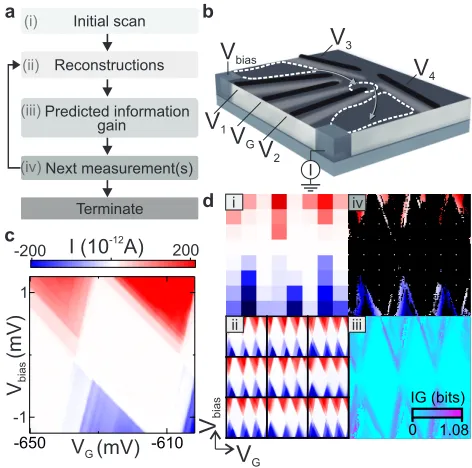
In this paper, we present an algorithm that performs efficient real-time data acquisition for 40
a quantum dot device (Fig. 1a). It starts from a low-resolution uniform grid of measurements, 41
creates a set of full-resolution reconstructions, calculates the predicted information gain (i.e. the 42
acquisition map), selects the most informative measurements to perform next, and repeats this 43
process until the information gain from new measurements is marginal. 44
In order to select measurements based on information theory, we require a corresponding 45
uncertainty measure (of random variables)10–12, and hence a probabilistic model of unobserved 46
variables. One typical approach is to use a Gaussian process13. Here, we use a conditional vari-47
ational auto-encoder (CVAE) 14, which is capable of generating high-resolution reconstructions 48
given partial information and is fast enough for real-time decisions. Deep generative models such 49
as adversarial networks (GAN)15, the variational auto-encoder (VAE)16 and its extensions, such 50
as CVAE, have shown great success in multi-modal distributions and complex non-stationary pat-51
terns of data17, 18, similar to those of observed in quantum device measurements. These are the 52
main advantages of CVAE over a basic Gaussian process. Also, CVAE is more computationally 53
efficient at generating multiple full-resolution reconstructions. Although progress has been made 54
addressing the limitations of Gaussian processes, deep generative models are overall a better fit to 55
the requirements for efficient quantum device measurements. Deep generative models have been 56
used for: speech synthesis19; generating images of digits and human faces20, 21; transferring image 57
scientific research to optimise molecular structures25–28. In spite of their suitability, these models 59
have not previously been applied to efficient data acquisition. An advantage of deep generative 60
models over simple interpolation techniques, such as nearest-neighbour and bilinear interpolation, 61
is that deep generative models can learn likely patterns from training data and incorporate them 62
into its reconstructions. Our method, as it is data-driven, it is generalizable to different transport 63
regimes, measurement configurations, and more complex device architectures if an appropriate 64
training set is available. 65
Results 66
The device Our device is a laterally defined quantum dot fabricated by patterning Ti/Au gates 67
over a GaAs/AlGaAs heterostructure containing a two-dimensional electron gas (Fig. 1b). In this 68
device, electrons are subject to the confinement potential created electrostatically by gate voltages. 69
Gate voltagesV1toV4tune the tunneling rates whileVGmainly shifts the electrical potential inside 70
the quantum dot. The current through the device is determined both by these gate voltages and by 71
the bias voltageVbias. Measurements were performed at30mK. 72
The quantum dot is characterised by acquiring maps of the electrical current as a function of a 73
pair of varied voltages, which we call a current map configuration. We first focus on varyingVGand 74
Vbias for fixed values ofV1 toV4. Figure 1c) shows a typical example. Diamond-shaped regions or 75
‘Coulomb diamonds’ indicate Coulomb blockade, where electron tunnelling is suppressed29. Most 76
ments in these regions slow down informative data acquisition. Our algorithm must therefore give 78
measurement priority to the informative regions of the map. An overview of an algorithm-assisted 79
measurement of a current map is shown in Fig. 1d. 80
Training the reconstruction model The role of the reconstruction model is to characterise likely 81
patterns in a training data set, given by a mixture of measured and simulated current maps. We can 82
utilise these likely patterns to predict the unmeasured signals from partial measurements. 83
Deep generative models represent this pattern characterisation in a low-dimensional real-84
valued latent vector z, which can be decoded to produce a full-resolution reconstruction. The 85
latent space representation and the decoding are learned during training. Our CVAE consists of 86
two convolutional neural networks, an encoder and a decoder. The encoder is trained to map full-87
resolution training examples of current mapsY to the latent space representationz. The encoder 88
also enforces that the distributionp(z)of training examples in latent space is Gaussian. 89
The decoder is trained to reconstruct Y, from the representationzcombined with an8×8
90
subsample ofY. As a result,zattempts to represent all the information that is missing from the 91
subsampled data. In a plain VAE, the input of a decoder is onlyz. If a decoder takes additional 92
input exceptz, then it is called CVAE, and we found that CVAE generates better reconstructions 93
than VAE for the considered measurements. The chosen loss function, which the CVAE tries to 94
minimise, is a measure of the difference between the training data and the corresponding recon-95
struction. To avoid blurry reconstructions, we define a contextual loss function that incorporates 96
descrip-(i)
(ii)
(iii)
(iv) a
c
Vbias
VG
b
d
V2
VG
V1
Vbias
V3
[image:6.612.187.423.72.306.2]V4
Figure 1: Overview of the algorithm and the quantum dot device. a, Schematic of the
al-gorithm’s operation. Low-resolution measurements (i) are used to produce reconstructions (ii),
which are used to infer the predicted information gain acquisition map (iii). Based on this map,
the algorithm chooses the location of the next measurement (iv). The process is repeated until a
stopping criterion is met.b, Schematic of the device. A bias voltageVbiasis applied between ohmic
contacts to the two-dimensional electron gas. We apply gate voltages labelledV1toV4andVG. c, A
measured current map as a function ofVbiasandVG. The Coulomb diamonds are the white regions
where electron transport is suppressed, and most of the information necessary to characterise a
device is contained just outside these diamonds. d, Sequential decision algorithm inaillustrated
with an example of a specific current map. In panel (iv), unmeasured pixels are plotted in black;
however, initial measurements (i) are represented so as to fill the entire panel (that is, the sparse
tion of these networks and their training can be found in the Supplementary sections Training and 98
loss function, and Network specification. 99
The model is trained using both simulated and measured current maps. We choose to work 100
with current maps of resolution128×128. The simulation is based on a constant-interaction model 101
(see Methods). To measure the current maps for training, we set the bias and gate voltage ranges 102
randomly from a uniform distribution. The training data set consists of 25,000 simulations and 103
25,000 real examples generated by randomly cropping 750 measured current maps. The current 104
maps were subjected to random offsets, rescaling, and added noise to increase the variability of the 105
training set. 106
Generating reconstructions from partial data After training, only the trained decoder network 107
is used in the algorithm of Fig. 1a to reconstruct full-resolution current maps from partial data. 108
At each stage, the known partial current map is denoted Yn, where n ≤ 1282 = 16,384 is the
109
number of pixels to be measured. To generate a reconstruction, the decoder takes as input the 110
initial8×8grid scanY64, together with a latent vectorzsampled from the posterior distribution 111
p(z|Yn)(see Methods for detail equations and Fig. S1 for the decoder diagram). Note that the
pos-112
terior density is calculated by the prior densityp(z)and a likelihood function, which is comparing 113
reconstructions and the partial data. Multiple posterior samples are drawn from p(z|Yn) by the
114
Metropolis-Hastings (MH) method to approximatep(z|Yn). From these multiple sampleszm,
cor-115
responding reconstructions are then generated, denotedYˆm. In this paper we setm = 1, . . . ,100.
116
The continuous posteriorp(z|Yn)is then approximated by a discrete posterior of samplesPn(m),
which denotes how probableYˆm is. We refer toPn(m)as the posterior distribution of
reconstruc-118
tions. 119
Making measurement decisions With each iteration of the decision algorithm, an acquisition 120
map is computed from the accumulated partial measurements and the resulting reconstructions. 121
This acquisition map assigns to each potential measurement location (i.e. to each pixel location 122
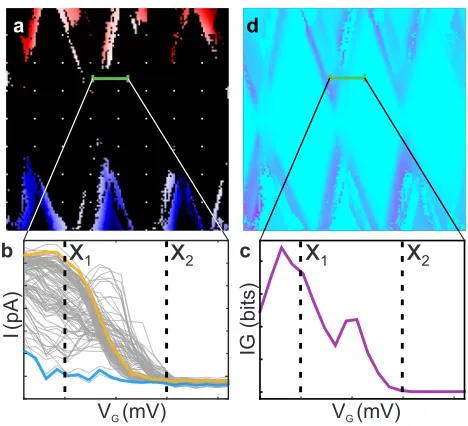
in the current map) an information value for the posterior distribution of reconstructions (Fig. 2). 123
The(n+ 1)th measurement, whose result isyn+1, is one pixel taken from the true current map and 124
changes our posterior distribution from Pn(m) to Pn+1(m), rendering different reconstructions 125
more or less probable. 126
The acquisition map is the expected information gain IG(x)at each potential measurement 127
locationx. Our algorithm calculates it by a weighted sum over reconstructions: 128
IG(x)≡X m
Pn(m)×IGm x
, (1)
whereIGm(x) is the Kullback-Leibler divergence between the distributionsPn and Pn+1, calcu-129
lated such thatyn+1 at locationxis taken from reconstruction Ymˆ . The most informative point is 130
x∗n+1 ≡ argmaxxIG(x). This criterion is equivalent both to minimising the expected information 131
entropy of the posterior distribution and to Bayesian active learning by disagreement (BALD10, 132
see Methods). The difference of the proposed method and BALD is that the proposed method uses 133
random reconstructions of data, which can be multi-modal, whereas BALD assumes that data is 134
I(pA)
IG (bits)
V (mV)G
x
1x
2b
V (mV)G
x
1x
2a
[image:9.612.189.423.124.337.2]c d
Figure 2: Computing the acquisition map. a, Partial current map. To illustrate the first step in
the computation of the acquisition map, we consider a trace (green) through an unmeasured region
of the map. b, For the unmeasured trace in a, reconstructions provide 100 different predictions.
Blue and yellow traces highlight two of these predictions. The objective is to determine the most
informative measurement location. Atx2, all predictions are similar, so measuring here will have
little impact on the posterior distribution of reconstructions. Atx1, predictions are dissimilar and
therefore x1 is a more informative measurement location, with a larger effect on the posterior
distribution of reconstructions. c, Information gain computed for the unmeasured trace in a. d,
Acquisition map of information gain computed from the partial measurements in a, and plotted
We devised two methods to make decisions based on the acquisition map; a pixel-wise 136
method, and a batch method. The pixel-wise method selects the single best location in the ac-137
quisition map. In practice, this is often not optimal in terms of measurement time, because it 138
does not take account of the time needed to ramp the gate voltage between measurement locations 139
(which is limited by details of the measurement electronics and the device settling time). To take 140
account of this limitation, we also devised a batch method, which selects multiple locations from 141
the acquisition map, and then acquires measurements by taking a fast route between them. This 142
reduces the measurement time compared with the pixel-wise method. 143
Experiments To test the algorithm, it was used to acquire a series of current maps in real time. 144
First, the device was thermally cycled, to randomise the charge traps and therefore present the 145
algorithm with a configuration not represented in its training data. Gate voltagesV1-V4 were set 146
to a combination of values, and the algorithm was tasked to measure the corresponding current 147
map using both the batch and the pixel-wise methods. This step was repeated for ten different 148
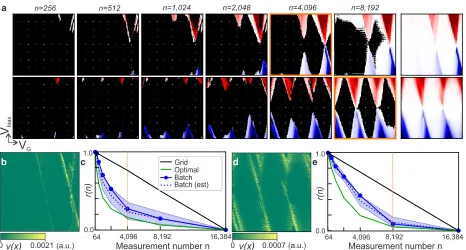
combinations of bias and gate voltages. Fig. 3 presents data acquired by the algorithm at selected 149
acquisition stages, together with selected reconstructions. As expected, reconstructions become 150
less diverse as more measurements are acquired. The reconstructions do not necessarily replicate 151
the measured current map for large n. This is because reconstructions have a limited variability 152
given by the training data. Decisions are made based on the learned patterns from the training 153
data, which implies that this training data should contain at least general patterns which are to be 154
n=64
n=512
n=2,048
n=4,096
n=8,192
n=16,384
n=64
n=512
n=2,048
n=8,192
n=16,384
[image:11.612.190.418.141.432.2]Ŷ Yn
Figure 3: Updating reconstructions using information from new measurements. In each
row, the first column shows the algorithm-assisted measurements, using the batch method, for a
givenn. The remaining three columns contain example reconstructions given the correspondingn
measurements. As nincreases, the diversity of the reconstructions is reduced and their accuracy
increased. As expected, the uncertainty is almost eliminated in the last row. The residual remaining
As seen, the algorithm gives high priority to regions of the map where the current is rapidly 156
varying, and avoids regions of nearly constant current, such as the interiors of Coulomb diamonds. 157
This strategy is an emergent property of the algorithm and is wise; little information about the 158
device characteristics can be found in low-current gradient regions of the current map. This pref-159
erence derives from the comparison between reconstructions, which exhibit the greatest disagree-160
ment outside Coulomb diamonds. This is also seen in Fig. 4a, which shows two representative 161
measurement sequences using the batch method. The batch method collects grouped measure-162
ments while the pixel-wise method distributes measurements more uniformly, given that in this 163
case, the acquisition map is more frequently updated to take account for recently acquired infor-164
mation. Results for other current maps, including for the pixel-wise method, are shown in the 165
Supplementary Figures 2 to 6. 166
We compared the performance of the algorithm with an alternating grid scan method. This 167
type of grid scan starts with 8×8 measurements and alternately increases the vertical and the hori-168
zontal grid size by 2 (i.e. 16×8, 16×16, 32×16, etc.), without performing the same measurement 169
twice. Over the ten different current maps, the average time for full-resolution data acquisition 170
with the alternating grid scan method is 554 seconds. This time is limited by our bias and gate 171
voltage ramp rate and chosen settling time. The batch method can be implemented with any batch 172
size however for direct comparison with the alternating grid scan we selected increasing batches 173
of 32×2b, wherebis the batch number starting from 1.
174
structions using the MH method, and constructing the acquisition map. One MH sampling iteration 176
takes 63 ms. For experiments, multiple sampling iterations are performed after each batch decision 177
and measurement while acquisition is suspended. Since sampling can be performed simultaneously 178
with measurement acquisition, from now on our measurement times exclude the time for sampling. 179
To compute a single acquisition map takes approximately 50 ms using a NVIDIA GTX 1080 Ti 180
graphics card and Tensorflow30implementation. The acquisition map must be computed for every 181
batch or every pixel measurement, except for the initial8×8 grid scan and the final acquisition 182
step (which has no choice of which pixel(s) to measure). To acquire a full resolution current map 183
thus requires 7 computations (350 ms) for the batch method, and 16,319 computations (816 s) for 184
the pixel-wise method. For the batch method, the computation time is negligible compared to the 185
measurement time, but for the pixel-wise method it is a limiting factor in the measurement rate. 186
To quantify the algorithm’s performance, we have devised a measure based on the observa-187
tion that the most informative regions of the current map are those where the current varies strongly 188
withVGandVbias. We therefore define the local gradient of the current map at each locationxas 189
v(x)≡ k∇Y(x)k2 =
s
∂I(x) ∂VG
2 +
∂I(x)
∂Vbias
2
, (2)
whereI(x)is current measurement atx, and the derivatives are calculated numerically. The error 190
measurer(n)of a partial current map is the fraction of the total gradient that remains uncaptured, 191
i.e. 192
r(n)≡1− V(n)
V(N) (3)
whereV(n) ≡Pn
n=512 n=1,024 n=2,048 n=4,096 n=8,192 n=256
a
Grid Optimal Batch Batch (est) c
b Vbias
VG
e d
0
v(x)
0 0.0021 v(x) 0.0007
0.0 1.0
r(n)
Measurement number n
4,096 8,192 16,384
64 0.0
1.0
r(n)
4,096 8,192 16,384
64
(a.u.)
[image:14.612.74.540.118.368.2](a.u.) Measurement number n
Figure 4: Measurements of Coulomb diamonds performed by the algorithm. a, Sequential
batch measurement in two different experiments. Each row displays algorithm assisted
measure-ments of the current map as a function ofVbias and VG for different values of n. The last plot in
each row is the full-resolution current map. b, d, Current gradient map (defined by Eq. (2)) for
each example ina. c, e, Measure of the algorithm’s performancer(n), real-time estimate ofr(n)
across reconstructions (with 90% credible interval shaded), and optimalr(n)for both examples in
a. The black line is the value ofr(n)corresponding to the alternating grid scan method. The
ver-tical orange line indicates the value ofndetermined by the stopping criterion. The corresponding
ment. This error can only be calculated after all measurements have been performed. However, 194
we can utilise the mth reconstruction to generate an estimate r˜m(n) in real time by replacing
195
k∇Y(x)k2withk∇Yˆm(x)k2. The estimates from multiple reconstructions yield a credibility inter-196
val forr(n). For an optimal algorithm, the error would ber(n) = 1.0¯ − VV∗((Nn)), whereV∗(n)is the 197
sum of the largestn values of v(x). This would be achieved if each measurement location were 198
chosen knowing the full-resolution current map, and thus the location of the the highest unmea-199
sured current gradient. No decision method can exceed this bound. For the real time estimates of 200
r(n), we have increased the number of reconstructions to 3,000 by adding different noise patterns 201
that are present in typical measured current maps (see Supplementary section Noisy reconstruc-202
tion). This increase in the variability of the reconstructions is needed to avoid an overconfident 203
estimation ofr(n). 204
Performances for two experiments are shown in Fig. 4c, e. Grid scans reducer(n)linearly 205
with increasingn. The decision algorithm outperforms a simple grid scan and is nearly optimal. 206
When most of the current gradient is localised, the grid scan is far from optimal and even the 207
decision algorithm has room for improvement. In this case, the performance of the algorithm is 208
determined by how representative the training data is. Quantitative analysis of all 10 experiments 209
is in Supplementary Figures 5 and 6. 210
We propose a simple stopping criterion that uses the estimated reduction of the errorr(n)to 211
determine when to stop measuring a given current map, in a scenario where more experiments are 212
next measurement batch is estimated for reconstructionmto ber˜m(n+ ∆), where∆is the size of
214
the batch. Thus the estimated rate at which the error decreases isβm ≡
r˜m(n+ ∆)−r˜m(n)|/∆.
215
In the worst case among the candidate reconstructions, this rate is β ≡ minmβm. However, if
216
the algorithm begins to measure a new map, for which no reconstructions yet exist, the error of 217
that map will decrease at a rate of at least α ≡ 1/N; this is the slope achieved by a grid scan 218
and the worst case of the decision algorithm (black lines in Fig. 4c, e). Hence whenβ < α, it is 219
beneficial to halt measurement and move onto a new current map that is awaiting measurement. 220
Sinceαandβare the worst-case estimates for each case, the criterion is conservative. The stopping 221
points by this criterion are shown in Fig. 4c, e, with orange dashed lines. The total average time 222
(measurement time plus decision time) to reach the stopping criterion was 237 s, compared with 223
554 s to measure the complete current map by grid scan, reducing the time needed by a factor 224
between 1.84 and 3.70 across all 10 test cases. A more sophisticated stopping criterion utilising 225
the number of remaining unmeasured current maps and a total measurement budget is presented in 226
Methods. 227
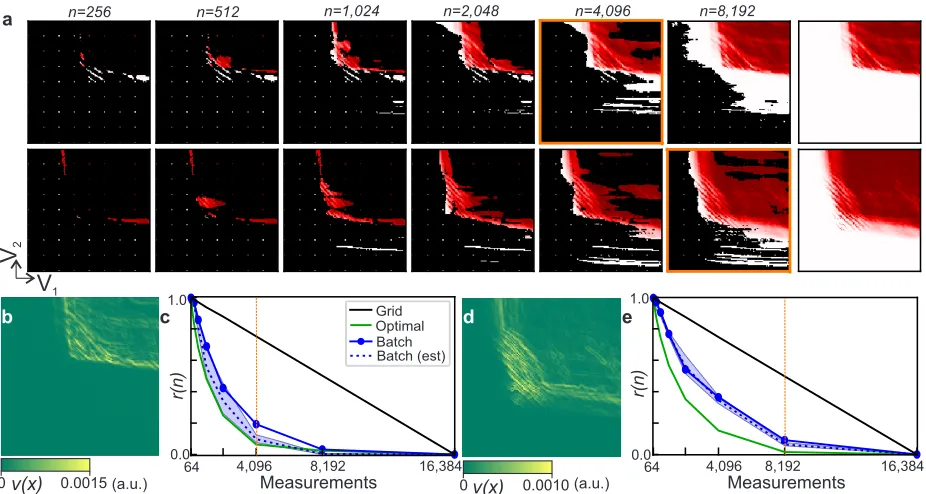
Generalising the algorithm The algorithm described here does not require assumptions about 228
the physics of the acquired data, such as requiring that it show Coulomb diamonds. Provided that 229
training data are available, it should also work for other kinds of measurements. To test this, we 230
applied it to a different current map configuration also encountered in quantum dot tuning. In this 231
case the current flowing through the device is measured as a function of two gate voltages (V1 232
andV2), while keeping other voltages fixed (VG,Vbias,V3 andV4). In these current maps, Coulomb 233
current. For the training set, we measured 382 current maps with a resolution of251×251which 235
we randomly cropped to a resolution of128×128 and subjected to simple image augmentation 236
techniques (as for the previous training set). 237
We tested the performance of the algorithm in this new scenario by taking two different 238
combinations of VG, Vbias, V3 and V4 and measuring the corresponding current maps in real time 239
(Fig. 5). The device was thermally cycled after the training set was acquired and also between the 240
acquisition of the two current maps in Fig. 5. The algorithm focuses on measuring regions of high 241
current gradient, the corner edges and, in particular, the Coulomb peaks close to these. 242
In the top row of Fig. 5a,n= 4,096was chosen by the stopping criterion. In the bottom row, 243
the corners edges extended further in the current map and the stopping criterion chosen = 8,192. 244
This reduced the time needed to measure the current maps by 3.36 and 1.50, respectively, for the 245
two test cases when compared with the alternating grid scans. 246
Discussion 247
The proposed measurement algorithm makes real-time informed decisions on which measurements 248
to perform next on a single quantum dot device. Decisions are based on the disagreement of 249
competing reconstructions built from sparse measurements. The algorithm outperforms grid scan 250
in all cases, and in the majority of cases shows nearly optimum performance. The algorithm 251
reduced the time required to observe the regions of finite current gradient by factors ranging from 252
16,384 Measurements
64 4,096 8,192 0.0
1.0
Grid Optimal Batch Batch (est)
r(n)
Measurements
64 4,096 8,192 16,384 0.0
1.0
r(n)
n=512 n=1,024 n=2,048 n=4,096 n=8,192 n=256
a
c b
V2 V1
e d
0 0.0010
[image:18.612.74.537.106.353.2]0v(x) 0.0015(a.u.) v(x) (a.u.)
Figure 5: Measuring a different current map. a, Sequential batch measurement. Each row
displays the algorithm-assisted measurements of a current map as a function of V1 and V2 for
different values of n. The last plot in each row is the full-resolution current map. b, d, Current
gradient map for both examples ina. c, e, Measure of the algorithm’s performancer(n), average
real-time estimate ofr(n)with 90% credible interval, and optimalr(n)for both current maps ina.
The black line is the value ofr(n)corresponding to the alternating grid scan method. The dashed
orange line indicates the value of n determined by the stopping criterion. The corresponding
current map in ais highlighted in orange. The alternating grid scan took 2,267 s and 2,333 s to
acquire all measurements in the two cases. The batch method took 673 s and 1,552 s to reach the
further, however, the performance gain is limited by the spread of the information gain over the 254
scan range. This is evidenced in both Figs 4c,e and Fig 5c,e, where we show that even an optimal 255
algorithm does not significantly outperform the algorithm. 256
Our algorithm with no modifications can be re-trained to measure different current maps. It 257
simply requires a diverse data set of training examples from which to learn. The decision algorithm 258
performed well even when trained on a small data set of only 382 current maps (at a resolution of 259
251×251), implying that it is robust to limited training data sets. Our algorithm focused on observ-260
ing all informative regions present in the current map, making it generalisable to different types 261
of measurements and devices. The acquisition function can still be specifically designed to focus 262
on specific transport features such as Coulomb peaks or Coulomb diamond edges. In additional 263
experiments we demonstrate how this can be achieved by applying additional transformations to 264
the reconstructions (see Supplementary Section Context-aware decision for stability diagrams). 265
We believe that our algorithm represents a significant first step in automating what to measure 266
next in quantum devices. For a single quantum dot it provides a means of accelerating what can 267
currently be achieved by human experimenters and other automation methods. When provided 268
with an appropriate training data set our algorithm can be applied to a large variety of experiments. 269
In particular, in any conventional qubit tuning method for which time-consuming grid scans are 270
performed, our algorithm would allow for an improvement in measurement efficiency. It will not 271
be long before this kind of approach enables experiments to be performed, and technology to be 272
Methods 274
Distribution of reconstructions and sampling Since it is known that deep generative models 275
work well when the data range is from -1 to 1, all measurements are rescaled so that the maximum 276
value of the absolute value of the initial measurement is 1. LetY be a random vector containing 277
all pixel values. ObservationYn, wheren ≥ 1, is the set of pairs of locationxj and measurement
278
yj: Yn ={(xj, yj)|j = 1, . . . , n}. Also, a subset of measurements is defined:Yn:n0 ={(xj, yj)|
279
j =n, . . . , n0}. The likelihood of observations givenY is defined by 280
p(Yn|Y)∝exp −λΣ(x,y)∈Yn|y−Y(x)|
, (4)
whereY(x)is the pixel value ofY at x, andλis a free parameter that determines the sensitivity 281
to the distance metric and is set to 1.0 for all experiments in this paper. The posterior probability 282
distribution is defined by Bayes’ rule: 283
p(Y |Yn)∝p(Yn |Y)p(Y). (5)
Likewise, we can find the posterior distribution of z given measurements instead of Y. Let z0 284
denote another input of the decoder, which is set to Y64 in the experiments. Then the posterior 285
distribution ofzcan be expressed withz0whenn≥64: 286
p(z|Yn,z0)∝p(z|z0)p(Yn |p(z,z0)
∝p(z) Z
Y
p(Yn |Y)p(Y |p(z,z0)dY
∝p(z)p(Yn |Y = ˆYz),
where Yˆz is the reconstruction produced by the decoder given z and z0. Since all inputs of the
287
aszandz0 are assumed independent. Proposal distribution for MH is set to a multivariate normal 289
distribution having centered mean and a covariance matrix equal to one quarter of the identity 290
matrix. For the experiments in this paper, 400 iterations of MCMC steps are conducted when 291
n = 32×2b, whereb is any integer larger than or equal to 1. We found that 400 iterations result
292
in good posterior samples. If (xn+1, yn+1) is newly observed, then the posterior can be updated 293
incrementally: 294
p(z|Yn+1,z0) =
p(xn+1, yy+1 |z,z0)
p(xn+1, yn+1|Yn,z0)
p(z|Yn,z0)
= p(xn+1, yy+1 | ˆ Yz)
p(xn+1, yn+1|Yn,z0)
p(z|Yn,z0),
because each term in (4) can be separated. 295
Decision algorithm In this section, we derive a computationally simple form of the information 296
gain and the fact that maximising the information gain is equal to minimising the entropy. Let 297
pn(·) = p(·|Yn,z0), and any probabilistic quantity of yn+1 has the conditionxn+1, but omitted for 298
brevity. 299
The continuous version of the information gain equation is
Eyn+1 h
KL pn(z|yn+1)kpn(z) i
= Z
yn+1
pn(yn+1)KL pn(z|yn+1)kpn(z)
dyn+1
= Z
yn+1
pn(yn+1)
Z
z
pn(z|yn+1) log
pn(z|yn+1)
pn(z)
dzdyn+1 (6)
= Z
yn+1 Z 0
z
pn(z, yn+1) log
pn(z, yn+1)
pn(z)pn(yn+1)
dzdyn+1
where KL is Kullback-Leibler divergence, I(·;·) is mutual information. Since I(z | Yn; yn+1 | 300
Yn) = H(z | Yn)−H(z | Yn, yn+1), maximising the expected KL divergence is equivalent to 301
minimisingH(z|Yn, yn+1), which is the entropy ofzafter observingyn+1. 302
Since this integral is hard to compute, we approximate probability density functions (PDFs) 303
with samples and substitute them into (6). Letnsdenote the number of measurements that are used
304
for sampling reconstructionszˆ1, . . . ,ˆzM (the samples are converted toYˆ1, . . . ,YˆM). Thenpns(z)≈
305
1
M P
mδˆzm(z), or with the sample indexm, Pns(m) = 1/M. For any n ≥ ns, the probability is
306
updated with the new measurements afterns: Pn(m;ns) =
p(Yns+1:n|Yˆm)
Σmp(Yns+1:n|Yˆm), which can be derived
307
from importance sampling. For brevity, the sampling distribution information ns is omitted for
308
the remaining section. Likewise,pn(yn+1) =
R
zpn(yn+1 | z)pn(z) ≈
P
mPn(m)pn(yn+1 | zm).
309
Lastly, we use the value of Yˆm at xn+1 for a sample of pn(yn+1 | zm) for simple and efficient
310
computation. As a result, the information gain is approximated by: 311
Eyn+1 h
KL pn(z|yn+1)kpn(z) i
≈X
m
Pn(m)KL(Pn+1kPn).
Simulator for Training data To aid the training of the model simulated training data was used to 312
prevent over-fitting. Simulated data produced via a simple implementation of the constant inter-313
action model29 was used along with basic data augmentation techniques. These techniques were 314
not intended to be physically accurate but instead to produce quickly a diverse set of examples that 315
electrons within the dot can be captured by a simple constant capacitance CΣ which is given by 318
CΣ = CS +CD +CG where CS, CD and CG are capacitances to the source, drain and gate re-319
spectively. Making this assumption the total energy of the dot U(N)where N is the number of 320
electrons occupying the dot, isU(N) = (−|e|(N−N0)+CSVS+CDVD+CGVG)2
2CΣ +
N P
n=1
EnwhereN0 compen-321
sates for the background charge andEn is a term that represents occupied single electron energy
322
levels that is characterised by the confinement potential. 323
Using this we derive the electrochemical potential µ(N) = U(N)−U(N −1) = e2 CΣ(N −
324
N0− 12)−
|e|
CΣ(VSCS+VDCD+VGCG) +En.
325
To produce a training example random values are generated forCS,CDandCG. The energy 326
levels within a randomly generated gate voltage window and source drain bias window are then 327
counted. To aid generalisation to real data we randomly generated energy level transitions (which 328
are also counted) as well as slightly linearly scaledCΣ,CS,CD, andCGwithN. This linear scaling 329
was also randomly generated and results in produced diamonds that vary in size with respect toVG. 330
Examples of the training data produced by this simulator can be seen in Supplementary Figure 1. 331
Stopping criterion Utility, denoted byu, is the ratio of total measured gradient to the total gra-332
dient of a stability diagram: u(n) = 1.0−r(n). Here, we assume that we haveK more stability 333
diagrams to be measured. The location of each diagram is defined by a different voltage range, and 334
k = 0, . . . , K is the index of the diagrams, wherek = 0 is the index of the diagram that we are 335
currently measuring. 336
In this paper we assume that a unit budget for measuring one pixel is 1.0. The total utility is 338
utot=
K X
k=0
uk(tk)
=u0(t0) +unxt(T −t0),
where uk(·) is the utility from measuring kth diagram, tk is the planned budget for kth diagram
339
satisfyingPK
k=0tk =T, andunxt(T −t0) =PKk=1uk(tk). 340
Lettdenote the already spent budget on the current diagram,t ≤t0. If we stop the measure-341
ment thent0 =t, ort0 =t+ ∆if we decide to continue the measurement, where∆is a predefined 342
batch size. For the decision, the utilities of two cases are compared: whent0 =t, 343
utot=u0(t) +unxt(T −t). (7)
Otherwise,t0 =t+ ∆and 344
utot=u0(t+ ∆) +unxt T −(t+ ∆)
. (8)
If (8)<(7), it is better to stop and move to the next voltage range. Rearranging the inequality leads 345
to 346
u0(t+ ∆)−u0(t)< unxt(T −t)−unxt T −(t+ ∆)
. (9)
The left-hand-side (lhs) of (9) means the difference of utility if we invest ∆budget more on the 347
current diagram, and the right-hand-side the difference when∆more budget is used for remaining 348
diagrams. As we discussed in Results section, we can calculate multiple slope estimates βm for
349
spending∆to the current diagram: u0(t+ ∆)−u0(t)≈βm∆.
The right-hand-side (rhs) of (9) can be approximated byα∆ifK =∞, whereα= 1/16,384
351
is the slope of grid scan measuring a new stability diagram. Note thatα can be considered as the 352
empirical worst case performance of the decision algorithm measuring a new diagram as it holds 353
for all the experiments we have conducted. If∆ =N, this approximation is the exact quantity for 354
any algorithms as all algorithms satisfyr(0) = 1.0andr(N) = 0.0. Sinceαcan be interpreted as 355
the worst case estimate, we also approximate lhs of (9) with the worst case estimateβ = minmβm.
356
IfK <∞, and the remaining budgetT−tis more than the budget to measure all of remain-357
ing diagrams, there is no utility after all measurements are finished. Hence, the approximation is 358
capped: 359
unxt(T −t) =αmin(T −t, N ×K), (10)
whereK is the number of remaining diagrams to be measured. 360
As a result, the stopping criterion whenK =∞is 361
β < α . (11)
The stopping criterion whenK <∞is 362
β < α(min(T −t, N ×K)−min(T −(t+ ∆), N ×K))
∆ . (12)
The rhs of (12) is always less than or equal toα, and more total budgetT makes it low, which leads 363
to late stopping or no stopping. 364
Data Availability The data sets used for the training of the model are available from the corre-367
sponding author upon reasonable request. 368
Acknowledgements We acknowledge discussions with J.A. Mol and S.C. Benjamin. This work was
sup-369
ported by the EPSRC National Quantum Technology Hub in Networked Quantum Information Technology 370
(EP/M013243/1), Quantum Technology Capital (EP/N014995/1), Nokia, Lockheed Martin, the Swiss NSF 371
Project 179024, the Swiss Nanoscience Institute and the NCCR QSIT. This publication was also made pos-372
sible through support from Templeton World Charity Foundation and John Templeton Foundation. The 373
opinions expressed in this publication are those of the authors and do not necessarily reflect the views of 374
the Templeton Foundations. We acknowledge J. Zimmerman and A. C. Gossard for the growth of the Al-375
GaAs/GaAs heterostructure. 376
Author Contributions D.T.L. and N.A. and the machine performed the experiment. H.M. developed the
377
algorithm under the supervision of M.A.O. The sample was fabricated by L.C.C., L.Y., and D.M.Z. The 378
project was conceived by G.A.D.B., E.A.L., M.A.O., and N.A. All authors contributed to the manuscript 379
and commented and discussed results. 380
Competing Interests The authors declare that there are no competing interests.
381
Correspondence Correspondence and requests for materials should be addressed to Natalia Ares (email:
382
384 1. Vandersypen, L. M. K. et al. Interfacing spin qubits in quantum dots and donors-hot, dense, 385
and coherent. npj Quantum Information3, 34 (2017). 386
2. Baart, T. A., Eendebak, P. T., Reichl, C., Wegscheider, W. & Vandersypen, L. M. K. Computer-387
automated tuning of semiconductor double quantum dots into the single-electron regime. Ap-388
plied Physics Letters108, 213104 (2016). 389
3. Ito, T. et al. Detection and control of charge states in a quintuple quantum dot. Scientific 390
Reports6, 4–6 (2016). 391
4. Van Diepen, C. J. et al. Automated tuning of inter-dot tunnel coupling in double quantum 392
dots. Applied Physics Letters113(2018). 393
5. Volk, C. et al. Loading a quantum-dot based ”Qubyte” register 1–12 (2019). Preprint at 394
http://arxiv.org/abs/1901.00426. 395
6. Stehlik, J.et al.Fast charge sensing of a cavity-coupled double quantum dot using a Josephson 396
parametric amplifier. Physical Review Applied4, 1–10 (2015). 397
7. Kalantre, S. S.et al. Machine Learning techniques for state recognition and auto-tuning in 398
quantum dots 1–15 (2017). Preprint at https://arxiv.org/abs/1712.04914. 399
8. Frees, A.et al. Compressed optimization of device architectures for semiconductor quantum 400
devices. Physical Review Applied11, 1 (2019). 401
9. Teske, J. D.et al. A machine learning approach for automated fine-tuning of semiconductor 402
10. Houlsby, N., Husz´ar, F., Ghahramani, Z. & Lengyel, M. Bayesian Active Learning for Classi-404
fication and Preference Learning (2011). Preprint at https://arxiv.org/abs/1112.5745. 405
11. Ankenman, B., Nelson, B. L. & Staum, J. Stochastic Kriging for Simulation Metamodeling. 406
Operations Research58, 371–382 (2010). 407
12. Sacks, J., Welch, W. J., Mitchell, T. J. & Wynn, H. P. Design and Analysis of Computer 408
Experiments. Statistical Science4, 409–423 (1989). 409
13. Rasmussen, C. E. & Williams, C. K. I. Gaussian Processes for Machine Learning (Adaptive 410
Computation and Machine Learning)(The MIT Press, 2005). 411
14. Sohn, K., Lee, H. & Yan, X. Learning structured output representation us-412
ing deep conditional generative models. In Advances in Neural Informa-413
tion Processing Systems (2015). URL http://papers.nips.cc/paper/
414
5775-learning-structured-output-representation-using-deep-conditional-generative-models.
415
pdf. 416
15. Goodfellow, I. et al. Generative adversarial nets. In Advances in Neural In-417
formation Processing Systems (2014). URL http://papers.nips.cc/paper/
418
5423-generative-adversarial-nets.pdf.
419
16. Kingma, D. P. & Welling, M. Auto-encoding variational bayes. InInternational Conference 420
17. Mescheder, L., Nowozin, S. & Geiger, A. Adversarial variational bayes: Unify-422
ing variational autoencoders and generative adversarial networks (2017). Preprint at 423
http://arxiv.org/abs/1701.04722. 424
18. Srivastava, A., Valkov, L., Russell, C., Gutmann, M. & Sutton, C. VEEGAN: Reducing mode 425
collapse in GANs using implicit variational learning. In Advances in Neural Information 426
Processing Systems(2017). 427
19. van den Oord, A. et al. WaveNet: A generative model for raw audio (2016). Preprint at 428
http://arxiv.org/abs/1609.03499. 429
20. Makhzani, A., Shlens, J., Jaitly, N., Goodfellow, I. & Frey, B. Adversarial autoencoders 430
(2015). Preprint at http://arxiv.org/abs/1511.05644. 431
21. Huang. Huaibo, H. R. S. Z. T. T., Li. Zhihang. IntroVAE: Introspective Vari-432
ational Autoencoders for Photographic Image Synthesis 1–20 (2018). Preprint at 433
http://arxiv.org/abs/1807.06358. 434
22. Zhu, J.-Y., Park, T., Isola, P. & Efros, A. A. Unpaired image-to-image translation using cycle-435
consistent adversarial networks. InInternational Conference on Computer Vision(2017). 436
23. Taigman, Y., Polyak, A. & Wolf, L. Unsupervised cross-domain image generation. In Inter-437
national Conference on Learning Representations(2017). 438
24. Iizuka, S., Simo-Serra, E. & Ishikawa, H. Globally and locally consistent image completion. 439
25. Sanchez-Lengeling, B. & Aspuru-Guzik, A. Inverse molecular design using machine learning: 441
Generative models for matter engineering. Science361, 360–365 (2018). 442
26. G´omez-Bombarelli, R.et al. Automatic chemical design using a data-driven continuous rep-443
resentation of molecules. ACS Central Science4, 268–276 (2018). 444
27. Kusner, M. J., Paige, B. & Hern´andez-Lobato, J. M. Grammar variational autoencoder. In 445
International Conference on Machine Learning(2017). 446
28. Dai, H., Tian, Y., Dai, B., Skiena, S. & Song, L. Syntax-directed variational autoencoder for 447
structured data. InInternational Conference on Learning Representations(2018). 448
29. Hanson, R., Kouwenhoven, L. P., Petta, J. R., Tarucha, S. & Vandersypen, L. M. Spins in 449
few-electron quantum dots. Reviews of Modern Physics79, 1217–1265 (2007). 450
30. Abadi, M.et al. Tensorflow: A system for large-scale machine learning. InUSENIX Sympo-451