15
Robust H∞ Controller Design for the Nuclear Reactor
Systems
Rehab M. Saeed
Nuclear Research Center
Egyptian Atomic Energy
Authority
Gamal M. El Bayoumi
Aerospace Engineering Dept.
Cairo University
Ibrahim E. Zeidan
Computers and Systems
Engineering Dept.
Zagazig University
ABSTRACT
As it is important to improve the response of the nuclear reactor power system, many approaches tried to find the best way to design the suitable robust controller .This paper introduces the solution of H∞ control problem of the nuclear
reactor systems as a robust controller that achieves both the robustness and performance improvement.
Keywords
H∞, Robust control, nuclear reactor systems, robustness
1.
INTRODUCTION
The first mission of the design of the H∞controller is to make the system insensitive towards the externals disturbances .this means that it is important to make the output independent of the external disturbance as possible [1].
The solution of the H∞ problem can be formulated in many
ways [2], one is the Glover-Doyle algorithm which is the classic formulation as it achieves the basic mixed performance and robustness objectives through solving a family of stabilizing controllers such that 𝐹𝑙(𝑃, 𝐾) ≤ 𝛾
Where
P(s) represents the plant nominal transfer function, K(s) represents feedback controller and 𝛾 is the H∞ norm.
Another techniques are used for the design of the H∞
controllers such as two transfer function method and three transfer function method [2].
The properties of designing a controller using H∞ method can
be summarized as that the stabilizing feedback low u(s) =K(s) y(s) minimizes the norm of the closed loop transfer function, and it is suitable for the weighted mixed sensitivity problem where H∞ controller always cancels the stable poles
of the plant with its transmission zeroes so the unstable poles of the plant inside the specified bandwidth will be shifted to its mirror image once a H∞ feedback loop is closed, another
property is that using suitable weighting functions will allow very precise frequency domain loop shaping [3].
Mixed weight H-infinity controllers [4] will provide a closed loop response of the system according to the design specifications such as model uncertainty, disturbance attenuation at high frequencies,….etc. The H∞ controllers are
of high order this may lead to large control requirements, also additional frequency dependent weights are augmented to the system.
The selection of the additional frequency dependent weights depends on what stability and performance design specifications are required to be shown [5].
Conventionally, H∞ controller employs two transfer functions
which divide a complex control problem into two separate sections, one deals with stability and the other deals with the performance. So the objective of designing H∞ controller is to
find a controller K, which based on the information v, generates a control signal u, which compensates the influence of w on z and minimizes the closed loop norm w to z.
The paper is organized as follow, section 2 represents the nuclear reactor model (actual and nominal plants).Section3 introduce the H∞ optimal control while the simulation results
are represented in section 4 and the conclusion is introduced in section 5.
2.
NUCLEAR REACTOR MODELING
The model used in this paper is the nominal Pressurized Water Reactor model (PWR-type) TMI nuclear power plant reactor and its kinetic equation with one delayed neutron group and temperature feedback.
The actual system equations can be summarized in the following equations [6]:
dn dt =
δρ−β
∧ n −λc (1) dc
dt=
β
∧n −λc (2)
Where,
n ≡ neutron density (n
cm 3
)
c ≡ neutron precursor density atom
cm3
λ≡ effective precursor radioactive decay constant s−1
∧≡ effective prompt neutron lifetime(s) β≡ fraction of delayed fission neutrons
k ≡ keff≡ effective neutron multiplication factor
δρ≡k−1k ≡ reactivity (Since k≈1.000,δρ ≈k-1 ; at steady state k=1 , δρ= 0)
For computational purposes the normalized versions of equations (1) and (2) will be used so the normalized equations will be as follow:
dnr
dt =
δρ−β
∧ nr+
β
∧cr (3) dcr
dt =λnr−λcr (4)
n0≡ initial equilibrium steady − state neutron density,
16
𝑛𝑟≡ 𝑛/𝑛0, neutron density relative to equilibrium density
𝑐𝑟≡ 𝑐/𝑐0, precursor density relative to initial equilibrium
density
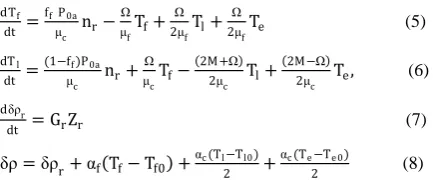
As the reactor temperatures vary as a function of power generated and heat transfer and it affects the reaction chain so it has to be included in the normalized point-kinetic equations for accurate calculation of the output power ( nr).
Reactor temperatures can be expressed as following,
dTf
dt = ff P0a
μc
nr−
Ω μf
Tf+
Ω
2μf
Tl+
Ω
2μf
Te (5) dTl
dt = (1−ff)P0a
μc nr+
Ω μcTf−
2M+Ω
2μc Tl+ 2M−Ω
2μc Te, (6) dδρr
dt = GrZr (7)
δρ=δρr+αf Tf− Tf0 +
αc(Tl−Tl0)
2 +
αc(Te−Te 0)
2 (8)
The described model has five states which appear in the nominal model. These Five states are the relative reactor power (nr), the relative precursor density (cr), the average fuel
temperature Tf, the average coolant temperature leaving the
reactor Tl and the reactivity 𝛿𝜌𝑟 respectively. The model is
nonlinear because total reactivity 𝛿𝜌 which is composed of the rod reactivity 𝛿𝜌r and temperature feedback reactivity
from equation (8) multiplies the reactor power state to determine the reactor power rate change [6].
The linearized system can be represented by the following state space equations,
x = Ax + Bu ,y = Cx + Du (9)
Where,
x =
δnr
δcr
δTf
δTc
δρr
, y = δnr , and u = zr
And
A =
−βν β ν nr0
αf
ν nr0 αc
2ν
nr 0
ν
λ –λ 0 0 0
ffP0a
μf
0 −μΩ
f
2Ωμ
f
0
1−ff P0a
μc
0 μΩ
c
− (2M +Ω)/2μc 0 0 0 0 0 0
B = 0 0 0 0 Gr
, C = 1 0 0 0 0 and D = 0
δρr≡ Control rod reactivity,
δρ ≡𝛿𝜌𝑟 for a system without temperature feedback,
zr ≡ Control rod speed in units of fraction of core length per
second,
Gr≡ The reactivity worth of the control rod per unit length.
With zr in units of fraction of core length per second and Gr is
the total worth of the rod.
The simulation has been done by applying the controller to the nonlinear system while the linearized reactor model is used to design the suitable controller.
[image:2.595.54.271.177.267.2]3.
H
∞CONTROLLER DESIGN
Figure 1 Design of H infinity controller
The model in figure (1) consists of P(s) and K(s), where P(s)
has the multi inputs of disturbances vector w that contains the system uncertainty and the measurement noise plus the control input u while the output is y and z.
As H∞ controller design depends on solving two Riccati
equations one for the state feedback control and the second for the estimation problem so the problem can be similar to Linear Quadratic Gaussian control (LQG). However there is a difference between H∞ control and LQG control as the
standard H∞ optimal control problem is concerned with
constructing a dynamic feedback controller u=K(s)y to minimize the H∞ norm of the transfer function from w to z,
[8].
Assume the state space equations of the system are in the following form
x = Ax + B1w + B2u (10)
z = C1x + D11w + D12u (11)
y = C2x + D21w + D22u (12)
And can be packed in G(s) as one matrix represents the system parameters where,
G s =
A B1 B2
C1 D11 D12
C2 D21 D22
(13)
Some important assumptions have to be done as [8]:
The pair (A, B2) are stabilizable and the pair (C2,A) are
detectable.
D11=0 and D22=0 in order to simplify the solution.
Dimension (x), dimension (w)=m1 while dimension
(u)=m2, also dimension (z)=p1 and dimension (y)=p2,
then the rank of D12=m2 and the rank of D21=p2. These
assumptions will ensure that the controllers are proper
RankA − jwI B2
C1 D12 = n + m2 for all frequencies.
Rank A − jwI B1
17 Now the new system will be describes as:
G s =
A B1 B2
C1 0 D12
C2 D21 0
(14)
The solution of this equation (equ 14) requires solving two Riccati equations one for the controller and the other for the observer and the control law is given by
u = −Kcx (15)
And the state estimator equation is
x = Ax + B2u + B1w + Z∞Ke(y − y ) (16)
Where
w =γ−2B 1TX∞x
y = C2x +γ−2D21B1TX∞x
And the controller gain Kc is
Kc= D12(B2TX∞+ D12T C1
Where,
D12= (D12TD12)−1
And the estimator gain is Z∞Ke instead of Ke where,
Ke= y∞C2T+ B1D21T )D21, D21= (D21D21T )−1 , Z∞=
(I −γ−2Y
∞X∞)−1 and the terms X∞ and
Y∞ are the solution of the controller and estimator Riccati
equations,
X∞= Ric A − B2D12D12
T C
1 −γ−2B1B1T− B2D12
−C 1TC 1 −(A − B2D12D12T)C1
(17)
Y∞= Ric (A − B1D21
T D
21C2)T −γ−2C1TC1− C2TD21C2
−B1B1T −(A − B1D21T D21)C2
(18)
With
B1= B1(I − D21D21D21T )and C 1= B1(I − D12D12D12T)
The above calculations are not easy to be done by hand but it is done using the Matlab subroutines.
When the H∞ optimal control technique is applied to a plant
an additional frequency dependent weights are to be augmented in the plant and these weights are selected to show particular stability and performance specifications.
The problem now becomes a mixed weight H-infinity controller design which provides a closed loop response of the system.
The added weight functions are Ws and Wt, and they have to
be specified to meet the system specifications, where Ws is the
performance weighting function which limits the magnitude of S the sensitivity function and Wt is the robustness
weighting function to limit the magnitude of T the complementary sensitivity function.
4.
SIMULATION AND RESULTS
The following values represent the parameters of the TMI pressurized water Reactor [6]
According to the assumptions taken into account the following parameters are used for the simulation using Matlab Toolbox [10].
D11= 0 00 0 and D22= 0,
D12= 01 and D21= 0 −1 ,
B1= 0000000010 T
, which represents the disturbance acts on
the system,
C1= 1000000000 and C2= −1 0 0 0 0
The normalized system transfer function is:
Gs = 100s3+173.6s2+52.82s+4.085
s5+66.74s4+151.8s3+90.17s2+7.8845s
And the designed controller K has the following form
1:Ks =-369.3s
4-5.395e04s3-9.278e04s2-2.824e04s-2185
s5+66.75s4+152.5s3+91.83s2+8.845s+0.08435
2:Ks =-2.789e04s4-1.861e06s3-4.161e06s2-2.411e06s-2.116e05
s5+66.75s4+152.5s3+91.83s2+8.845s+0.08435
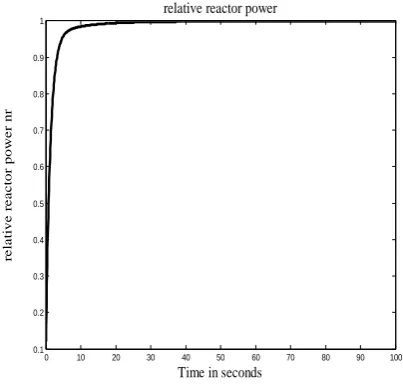
[image:3.595.322.524.512.704.2]And by applying the designed controller to the augmented plant the following results are obtained
Figure 2 Relative reactor power
0 10 20 30 40 50 60 70 80 90 100
0.1 0.2 0.3 0.4 0.5 0.6 0.7 0.8 0.9 1
relative reactor power
Time in seconds
re
la
ti
ve
r
e
a
c
tor
pow
e
r
nr
β =0.0065 λ= 0.125 s-1
∧=0.0001 s ff =0.98
Gr=0.01 total rod reactivity Te =290 C
P0a=2500 MW μc =70.5 MW s/C
μf =26.3 MWs/c M=92.8 MW/C
Ω =6.53 MW/C αf =-0.00005 reactivity /C
18
[image:4.595.319.515.72.457.2]Figure 3 Relative precursor density
Figure 4 Fuel temperature
Figure 5 Coolant temperature
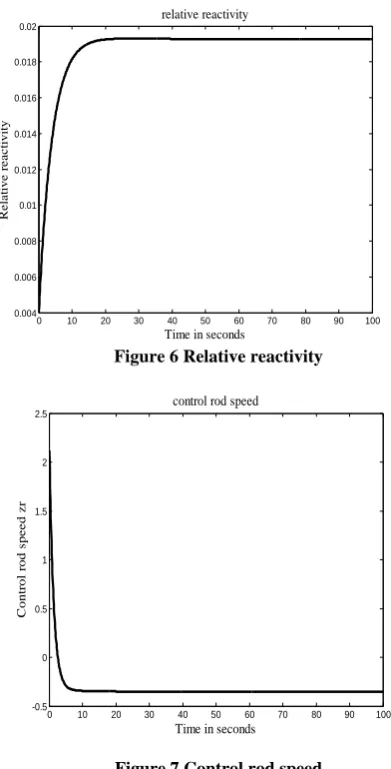
Figure 6 Relative reactivity
Figure 7 Control rod speed
5.
CONCLUSION
Simulation results show that the time response of the output power and the control input as well. From these results it is observable that the system reaches its steady state in about 60 seconds and the maximum control rod speed does not exceed 2cm/sec which is a constraint for the control rod speed [9]. Also it is noticeable from the results that H-infinity controller achieves both robustness and good performance as it rejects the disturbances effectively.
Also the results show that the suggested control technique improves the fuel and temperature responses and the responses do not suffer from any overshoots.
Comparing the obtained results in this paper by the results obtained in H2 controller of the nuclear reactor [11] paper one can find that both of the techniques satisfy sufficient control requirements of the nuclear reactor.
It is recommended to apply the same technique to the reactor in the case of changing the power level by increasing or decreasing and also in case of low power (10%) to achieve a good control of the system in these cases.
0 10 20 30 40 50 60 70 80 90 100
0.65 0.7 0.75 0.8 0.85 0.9 0.95 1
relative precursor denisty
Time in seconds
R
e
la
ti
ve
pr
e
c
ur
sor
de
ns
it
y
0 10 20 30 40 50 60 70 80 90 100
400 450 500 550 600 650 700
Fuel temperature
Time in seconds
F
ue
l
te
m
pe
ra
tur
e
T
f
0 10 20 30 40 50 60 70 80 90 100
302 304 306 308 310 312 314 316 318
coolant temperature
Time in seconds
C
ool
a
nt
T
e
m
pe
ra
tur
e
T
l
0 10 20 30 40 50 60 70 80 90 100
0.004 0.006 0.008 0.01 0.012 0.014 0.016 0.018 0.02
relative reactivity
Time in seconds
R
e
la
ti
ve
r
e
a
c
ti
vi
ty
0 10 20 30 40 50 60 70 80 90 100
-0.5 0 0.5 1 1.5 2 2.5
control rod speed
Time in seconds
C
ont
rol
r
od
s
pe
e
d
z
[image:4.595.58.253.90.672.2]19
6.
REFERENCES
[1] J. Treunicht, May 15,2007, “H∞ control”
[2] Ian R.Petersen,Valery A.Ugrinovski and Andrey v.Savkin,2000, “Robust Control design using H∞
methods”.
[3] Gerald a.Hartley,master thesis 1990,”Robust control design using H2 and H∞ methods”
[4] Ankit Bansal,Veena Sharma,”Design and Analysis of Robust H-infinity Controller”.
[5] Zames G,1981, “feedback of optimal sensitivity Model reference transformation ,Multiplicative semi-norms and approximate Inverse”, IEEE Trans, Ac vol Ac-26.
[6] Robert M.Edwards, Kwange Y.Lee and Asok Ray ,1991 .Robust optimal control of nuclear reactors and power plants, University Park, Pennsylvania.
[7] Doyle J. C., Glover K., Khargonekar P. P and Francis B. A., 1988, “state space solution to standard H2 and H∞
control problems”, American control conference, Atlanta.
[8] Zhou K. and Khargonerkar P. P , 1988, “An algebraic Riccati Equation Approach to H∞ optimization” systems
and control letters.
[9] Yoon-Joon lee and Jung-In Choi, 1997, “Robust Controller Design for the Nuclear Reactor Power Control System”, Journal of the Korean Nuclear Society.
[10] Richard Y. Chiang and Michael G. Safono, 1997,”Matlab Robust Control Toolbox”.
[11] Rehab M.Saeed and Gamal.M. El-bayoumi, 2017, “Robust H2 control of the nuclear reactor”,IJCA.