Mining Minimal Infrequent Intervals
D. I. Mazumder
Department of IT
Ibri College of Technology
Ibri, Oman
D. K. Bhattacharyya
Dept. of Computer Science
Tezpur University
Assam, india
M. Dutta
Dept. of CSE
IIIT Guwahati
Assam, india
ABSTRACT
Many real world data are closely associated with the interval of time and distance. Mining infrequent intervals from such data allows users to group transactions with less similarity while mining frequent interval allows user to group the transaction with a similarity above a certain measure. In [1], the notion of mining maximal frequent interval in either a discrete domain or continuous domain is introduced. This paper presents an effective minimal infrequent interval finding algorithm (MII) based on two maximal frequent interval finding techniques represented in [1] and [2] the proposed MII has been established to be effective both theoretically and experimentally.
General Terms
Data mining , I-Tree, Pre-Order Traversal (PT) algorithm.
Keywords
Data mining, maximal frequent interval, minimal infrequent interval, minimum support, discrete and continuous domain.
1.
INTRODUCTION
Data mining has received considerable attention during the past few years due to the accumulation of large amounts of data evolving in time, and the need of utilizing these data for analysis. Many techniques and applications have been developed, and among them, mining frequent and infrequent patterns is often used to discover the patterns existing in the data. The most notable applications are association rules, sequential patterns etc. in [4], [5], [6], [7] and [8]. Most of the real world data however, are associated with duration events instead of point events. A record in such data typically consists of the starting time and the ending time. A transaction with starting time‘𝑠’ and ending time‘𝑒’ supports an interval
[𝑎, 𝑏] only if 𝑠 ≤ 𝑎 and 𝑏 ≤ 𝑒. If the number of transactions supporting the interval [𝑎, 𝑏] exceeds a predefined threshold, then [𝑎, 𝑏] is called a frequent interval and an interval is said to be infrequent if it is not frequent. Mining infrequent intervals can be applied to many areas. As for an example, a cellular phone company records the time and length of each phone call for billing purposes. Mining infrequent intervals from such data allows the company to discover the intervals during which very few numbers of users are making phone calls and provides information about the degree of accessibility of the network for the customers. As a result the cellular phone company can take a decision about the next status of the channel (ie. running / idle) for those particular periods or even can share the channel with some other networks.
As another example, a web based learning system records the times at which each student logs on and off the system. Mining infrequent intervals enables the system to discover the intervals during which a very few number of students are online. The system may provide this information to the
students especially to the research scholars for downloading and uploading their important documents to promote research in respective area of interest. In the examples above, mining infrequent intervals plays an important role on the overall data mining process.
The rest of the paper is organized as follows. Section 2 reviews related works. Section 3 defines the problem of MII. Section 4 includes some properties of maximal frequent intervals and minimal infrequent intervals. Section 5 proposes our MII algorithm. Section 6 represents the experimental result and section 7 concludes the paper.
2.
RELATED WORKS
In [1] the notion of frequent and maximal frequent intervals for a given database of intervals is defined and an algorithm is presented for the determination of the maximal frequent interval. The algorithm consists of two stages. First the database is scanned once to count the frequency of each interval occurring in the database. These interval frequencies are stored in a so-called I-Tree. Second a Pre-Order Traversal (PT) algorithm is used to discover all maximal frequent intervals. The worst case complexity for constructing the I-Tree is 𝑂(𝑛𝑥(|𝐿| + |𝑅|))and that for the PT algorithm is
𝑂(𝑚𝑎𝑥{𝑛𝑥(|𝐿| + |𝑅|), |𝐿|𝑥|𝑅|}), where |𝐿| and |𝑅| are the number of distinct left, right end points of the given intervals respectively. The worst space complexity is 𝑂(|𝐿|𝑥|𝑅|). In [2] an improved method of constructing the I-Tree was given which has the worst case time complexity 𝑂(𝑛 log 𝑛). This was a considerable improvement since in general log 𝑛 is far less than |𝐿| + |𝑅|. In the tests with experimental data with synthetic dataset as mentioned in [1], the construction of I-Tree has taken the most amount of time in the whole algorithm. Therefore the method in [2] leads to a considerable improvement in the amount of time taken in the execution of the entire algorithm.
In [3] the notion of minimal infrequent interval was defined for multidimensional intervals. It was shown that the problem of generating all minimal infrequent multidimensional intervals can be solved in Quasi-Polynomial time. In this paper as shown in the following sections, we have given a method of obtaining the minimal infrequent intervals for a given database of intervals, after obtaining the maximal frequent intervals. The work in [1] and [2] are for databases of intervals in single dimension only. As mentioned in [1] extension to multi-dimensional intervals will be done in future. Therefore we have also used intervals in single dimension only which have large number of applications as discussed in section [1].
3.
PRELIMINARIES
Let DB be a database of ‘𝑛’ transactions 𝑡𝑖 for 1 ≤ 𝑖 ≤ 𝑛,
where each transaction ‘𝑡’ contains an interval [𝑙𝑡, 𝑟𝑡] over a
intervals occurring in the transactions in DB. For given a transaction ‘𝑡’ and an interval [𝑎, 𝑏] we introduce the following definitions.
3.1
Definition 1:
A transaction ’𝑡’ supports [𝑎, 𝑏] if [𝑎, 𝑏] ⊆ [𝑙𝑡, 𝑟𝑡] ie if
𝑙𝑡≤ 𝑎 ≤ 𝑏 ≤ 𝑟𝑡 . For a given interval [𝑎, 𝑏], 𝑠𝑢𝑝([𝑎, 𝑏]) will denote the number of transactions in DB that supports [𝑎, 𝑏].
3.2
Definition 2:
For a given support threshold 𝑚𝑖𝑛_𝑠𝑢𝑝 with 0 < 𝑚𝑖𝑛_𝑠𝑢𝑝 < 𝑛 an interval is called frequent if its support is ≥ 𝑚𝑖𝑛_𝑠𝑢𝑝. Obviously if [𝑙, 𝑟] is frequent, then 𝑙𝑚𝑖𝑛 ≤ 𝑙 ≤ 𝑟 ≤ 𝑟𝑚𝑎𝑥. It is
also clear that if [𝑙, 𝑟] ⊆ [𝑙’, 𝑟′] then [𝑙, 𝑟] is frequent if [𝑙′, 𝑟′]
is frequent.
3.3
Definition 3:
[image:2.595.46.294.526.573.2]A maximal frequent interval is a frequent interval which is not properly contained in any frequent interval ie. if an interval
[𝒍, 𝒓] is a maximal frequent interval and [𝒍, 𝒓] ⊂ [𝒍′, 𝒓′] then
[𝒍′, 𝒓′] is not frequent.
3.4
Definition 4:
An interval [𝒍, 𝒓] will be called infrequent if 𝒍𝒎𝒊𝒏≤ 𝒍 ≤ 𝒓 ≤ 𝒓𝒎𝒂𝒙 and it is not frequent.
3.5
Definition 5:
A minimal infrequent interval is an infrequent interval which does not properly contain any infrequent interval ie. if an interval [𝑙, 𝑟] is minimal infrequent and [𝑙′, 𝑟′] ⊂ [𝑙, 𝑟] then
[𝑙′, 𝑟′] is not infrequent.
The problem of mining maximal frequent interval is to discover all the frequent intervals that are maximal and the problem of mining minimal infrequentintervals is todiscover all the infrequent intervals that are minimal. Below is an example.
Example1: Consider the database shown in Table 1. Suppose that we only consider the intervals whose end points are in the discrete domain 𝐷 = {𝑣|1 ≤ 𝑣 ≤ 13, and 𝑣 is an integer}. If
𝑚𝑖𝑛_𝑠𝑢𝑝 is 4, then clearly the maximal frequent intervals are
[2,4], [7,10] and [8,11] and the minimal infrequent intervals are [1,1], [5,5], [6,6], [7,11], [12,12] and [13,13].
Table 1. Database for Example 1
Tid 1 2 3 4 5 6 7 8
[lti,rti] [1,5] [1,4] [2,6] [2,5] [6,10] [6,11] [7,12] [8,12]
Based on these definitions we prove some properties using which the proposed minimal infrequent interval finding algorithm has been developed. Next we report those properties
4.
SOME PROPERTIES OF THE
MAXIMAL FREQUENT AND MINIMAL
FREQUENT INTERVALS
In this section we prove certain properties of the minimal infrequent intervals in terms of the maximal frequent intervals. We first note that if [𝑙, 𝑟] and [𝑙’, 𝑟’] be two distinct maximal frequent intervals then either (i) 𝑙 < 𝑙′ and 𝑟 < 𝑟′ or (ii) 𝑙′ < 𝑙 and 𝑟′ < 𝑟. This is so because otherwise one of them will be properly contained in the other contradicting the fact that both are maximal frequent. The same kind of statement will be true for minimal infrequent intervals also. Because of this for any ′𝑎′ with 𝑙𝑚𝑖𝑛 ≤ 𝑎 ≤ 𝑟𝑚𝑎𝑥 there can be
at most one maximal frequent or minimal infrequent interval with ‘𝑎’ as a left end point. Hence the maximal frequent intervals [𝑙1, 𝑟1], 𝑙2, 𝑟2 , … , [𝑙𝑘, 𝑟𝑘] can be so arranged such
that 𝑙1, < 𝑙2< ⋯ < 𝑙𝑘and 𝑟1< 𝑟2< ⋯ < 𝑟𝑘. The following
theorem gives an important connection between frequent and maximal frequent intervals. The result is stated and used in [1] without proof.
4.1
Theorem 1:
Every frequent interval is contained in some maximal frequent interval.
Proof: Let [𝑙, 𝑟] be a frequent interval. If [𝑙, 𝑟] is not maximal frequent then [𝑙, 𝑟] ⊂ [𝑙′, 𝑟′] where [𝑙′, 𝑟′] is frequent. If
[𝑙′, 𝑟′] is not maximal frequent, [𝑙′, 𝑟′] ⊂ [𝑙′′, 𝑟′′] where
[𝑙′′, 𝑟′′] is frequent. Since there are only a finite number of possible intervals with end points between 𝑙𝑚𝑖𝑛 and
𝑟𝑚𝑎𝑥, the above process cannot continue indefinitely and
we will get some maximal frequent interval [𝑙𝑖, 𝑟𝑖] such that [𝑙, 𝑟] ⊂ [𝑙𝑖, 𝑟𝑖]. Hence every frequent interval is
contained in some maximal frequent interval.
We can now prove the following theorems.
4.2
Theorem 2:
For every ′𝒂′ such that 𝒍𝒎𝒊𝒏≤ 𝒂 ≤ 𝒍𝟏, [𝒂, 𝒂] is a minimal
infrequent interval.
Proof: Since [𝑎, 𝑎] is not contained in any maximal frequent interval [𝑙𝑖, 𝑟𝑖] for 1 ≤ 𝑖 ≤ 𝑘, [𝑎, 𝑎] is not frequent. Also
it does not properly contain any interval. Hence [𝑎, 𝑎] is a minimal infrequent interval
The proof of the following theorem is similar.
4.3
Theorem 3:
For every ′𝑎′ such that 𝑟𝑘< 𝑎 ≤ 𝑟𝑚𝑎𝑥 [𝑎, 𝑎] is a minimal
infrequent interval.
4.4
Theorem 4:
If 𝑟𝑖< 𝑙𝑖+1− 1 then for any ‘𝑎’ with 𝑟𝑖< 𝑎 < 𝑙𝑖+1, [𝑎, 𝑎] is a minimal infrequent interval.
Proof: Since 𝑎 > 𝑟𝑖 , [𝑎, 𝑎] is not contained in any [𝑙𝑖, 𝑟𝑗] for 𝑗 ≤ 𝑖 and since 𝑎 < 𝑙𝑖+ 1, [𝑎, 𝑎] is not contained in any
[𝑙𝑖, 𝑟𝑗] for 𝑗 ≥ 𝑖 + 1. Thus [𝑎, 𝑎] is not contained in any
maximal frequent interval. Hence [𝑎, 𝑎] is not frequent and since it does not properly contain any interval, by Definition 5 it is a minimal infrequent interval
4.5
Theorem 5:
If 𝑟𝑖≥ 𝑙𝑖+1− 1 then the interval [𝑙𝑖+1− 1, 𝑟𝑖+ 1] is a
minimal infrequent interval.
Proof: Since 𝑟𝑖+ 1 > 𝑟𝑖 , 𝑟𝑖+ 1 > 𝑟𝑗 for all 𝑗 ≤ 𝑖 and
hence [𝑙𝑖+1− 1, 𝑟𝑖+ 1] cannot be contained in [𝑙𝑗, 𝑟𝑗]
for any 𝑗 ≤ 𝑖. Since 𝑙𝑖+1− 1 < 𝑙𝑖, 𝑙𝑖+1− 1 < 𝑙𝑗 for any 𝑗 ≥ 𝑖 and hence [𝑙𝑖+1− 1, 𝑟𝑖+ 1] cannot be contained in [𝑙𝑖, 𝑟𝑗] for 𝑗 ≥ 𝑖. Thus [𝑙𝑖+1− 1, 𝑟𝑖+ 1] is not contained
in any maximal frequent interval and hence it is not frequent. Suppose [𝑙𝑖+1− 1, 𝑟𝑖+ 1] is not a minimal
infrequent interval. Then it properly contains an infrequent interval [𝑎, 𝑏]. If 𝑎 > 𝑙𝑖+1− 1, then [𝑎, 𝑏] ⊆ [𝑙𝑖+1, 𝑟𝑖+ 1]. But 𝑟𝑖< 𝑟𝑖+1 and therefore 𝑟𝑖+ 1 ≤ 𝑟𝑖+1.
Hence [𝑎, 𝑏] ⊆ [𝑙𝑖+1, 𝑟𝑖+1] and hence is frequent. This
MII(DB) {
M=empty.
For 𝑎 = 𝑙𝑚𝑖𝑛 𝑡𝑜 𝑙1− 1
M M∪ {[𝑎, 𝑎]} //by Theorem 2 For 𝑖 = 1, to 𝑘 − 1
if 𝑟𝑖< 𝑙𝑖+1− 1
{
for 𝑎 = 𝑟𝑖+ 1 to 𝑙𝑖+1− 1
M=M∪ {[𝑎, 𝑎]} //by Theorem 4
} else
M=M∪ { 𝑙𝑖+1− 1, 𝑟𝑖+ 1 } //by Theorem 5
For 𝑎 = 𝑟𝑘+ 1 𝑡𝑜 𝑟𝑚𝑎𝑥
M=M∪ {[𝑎, 𝑎]} //by Theorem 3
return M }
Fig: 1 Pseudo code of MII
is frequent. This contradicts the fact that 𝑎, 𝑏 isinfrequent. Hence [𝑙𝑖+1− 1, 𝑟𝑖+ 1] is a minimal
infrequent interval.
In the next section, we propose an algorithm for finding all the minimal infrequent intervals, which simply obtains the intervals as given by Theorem 2,3,4 and 5. For a proof of the completeness of this procedure, we introduce the following lemmas and completeness Theorem 6.
4.6
Lemma1:
If 𝑙𝑘≤ 𝑙 ≤ 𝑟𝑘, there is no minimal infrequent interval with ‘𝑙’
as the left end-point.
Proof: Suppose there is a minimal infrequent interval [𝑙, 𝑟]
with 𝑙𝑘 ≤ 𝑙 ≤ 𝑟𝑘. We cannot have 𝑟 ≤ 𝑟𝑘 because then [𝑙, 𝑟] ⊆ [𝑙𝑘, 𝑟𝑘] and hence will be frequent. If 𝑟 > 𝑟𝑘then [𝑙, 𝑟] will properly contain [𝑟, 𝑟] and by definition of infrequent interval 𝑟 ≤ 𝑟𝑚𝑎𝑥. Hence [𝑟, 𝑟] is infrequent
by Theorem2 and thus [𝑙, 𝑟] cannot be a minimal infrequent interval which is a contradiction. This proves the lemma,
4.7
Lemma 2:
If 𝑖 < 𝑘, 𝑟𝑖< 𝑙𝑖+1− 1 and 𝑙𝑖≤ 𝑙 ≤ 𝑟𝑖 then there is no minimal
infrequent interval with left end point ‘l’.
Proof: Here 𝑖 < 𝑘, 𝑟𝑖< 𝑙𝑖+1− 1 and 𝑙𝑖≤ 𝑙 ≤ 𝑟𝑖 and let [𝑙, 𝑟]
be any minimal infrequent interval with left end point 𝑙. if 𝑟 ≤ 𝑟𝑖 then [𝑙, 𝑟] ⊆ [𝑙𝑖, 𝑟𝑖] and hence is frequent. If 𝑟 > 𝑟𝑖, [𝑙, 𝑟] properly contains [𝑟𝑖+ 1, 𝑟𝑖+ 1]. But 𝑟𝑖+ 1
satisfies 𝑟𝑖< 𝑟𝑖+ 1 < 𝑙𝑖+1. Hence by Theorem 3 [𝑟𝑖+ 1, 𝑟𝑖+ 1] is infrequent and therefore [𝑙, 𝑟] is not
minimal infrequent. Thus there is no minimal infrequent interval with left end point ‘𝑙’.
4.8
Lemma 3:
If 𝑖 < 𝑘, 𝑟𝑖≥ 𝑙𝑖+1− 1 and 𝑙𝑖≤ 𝑙 < 𝑙𝑖+1− 1 then there is no
minimal infrequent interval with left end point ‘𝑙’.
Proof: Let [𝑙, 𝑟] be an interval with left end point 𝑙. If 𝑟 ≤ 𝑟𝑖then [𝑙, 𝑟] ⊆ [𝑙𝑖, 𝑟𝑖] and hence frequent. If 𝑟 > 𝑟𝑖, [𝑙, 𝑟]
properly contains [𝑙𝑖+1− 1, 𝑟𝑖+ 1] which is infrequent according to Theorem 4. Thus [𝑙, 𝑟] cannot be minimal infrequent and hence there is no minimal infrequent interval with left end point 𝑙.
The following theorem now characterizes all the minimal infrequent intervals.
4.9
Theorem 6:
The minimal infrequent intervals given in Theorems 2, 3, 4
and 5 completely determine all the minimal infrequent intervals.
Proof: We have already noted that for any ′𝑎′ with 𝑙𝑚𝑖𝑛 ≤ 𝑎 ≤ 𝑟𝑚𝑎𝑥, there is at most one minimal infrequent
interval with left end-point ′𝑎′. If 𝑎 < 𝑙1 then there is one
minimal infrequent interval given by Theorem 2. If
𝑎 > 𝑟𝑘 then there is one minimal infrequent interval
given by Theorem 3. If 𝑙𝑘≤ 𝑎 ≤ 𝑟𝑘 then there is no
minimal infrequent interval with left end point ′𝑎′ as proved in Lemma 1. That leaves us to examine the case
𝑙𝑖≤ 𝑎 < 𝑙𝑖+1 for 𝑖 = 1,2, … 𝑘 − 1. For 𝑙𝑖≤ 𝑎 < 𝑙𝑖+1, if
𝑟𝑖< 𝑙𝑖+1− 1, then there is no minimal infrequent
interval with left end point ′𝑎′ for 𝑙𝑖≤ 𝑎 ≤ 𝑟𝑖 by Lemma
2 and one minimal infrequent interval with left end point
′𝑎′ for every ′𝑎′ satisfying 𝑟𝑖< 𝑎 < 𝑙𝑖+1, by Theorem 4. If on the other hand 𝑟𝑖≥ 𝑙𝑖+1− 1 there is no minimal
infrequent interval with left end point ′𝑎′ for 𝑙𝑖 ≤ 𝑎 < 𝑙𝑖+1− 1 by Lemma 3 and one minimal infrequent
interval with left end point 𝑙𝑖+1− 1 by Theorem 5. This covers all the possible values for ′𝑎′ and hence provides the proof of completeness
5.
THE PRPOSED MINIMALINFREQUENT INTERVAL (MII)
ALGORITHM
At first in the first part of the algorithm the maximal frequent intervals are determined using algorithms given in [1] and [2]. After that in the second part, the following algorithm determines the minimal infrequent intervals by scanning all the possible left end points of such intervals which range from
𝑙𝑚𝑖𝑛 to 𝑟𝑚𝑎𝑥 and identifying those that are given by Theorems 2,3,4 and 5. During the execution of the algorithm, a set of intervals M is maintained which is initially empty and the minimal infrequent intervals are inserted one by one into M as those are determined. In the first phase of the second part, for every value of ′𝑎′ such that 𝑙𝑚𝑖𝑛 ≤ 𝑎 < 𝑙1, we insert an
interval [𝑎, 𝑎] (by Theorem 2).
In the second phase of the second part, for 𝑖 = 1,2, . . . , 𝑘 − 1
we insert intervals into M as follows
if 𝑟𝑖< 𝑙𝑖+1− 1 then for every ′𝑎′ such that 𝑟𝑖< 𝑎 < 𝑙𝑖+1,
the interval [𝑎, 𝑎] is inserted into M (by Theorem 4). else we insert 𝑙𝑖+1− 1 , 𝑟𝑖+ 1 into M (by Theorem 5).
In the last phase of the second part for every ′𝑎′ such that
𝑟𝑘< 𝑎 ≤ 𝑟𝑚𝑎𝑥 , we insert [𝑎, 𝑎] into M (by Theorem 3).
The soundness of MII follows from Theorems 2, 3, 4 and
5 and its completeness is established in Theorem 6.
5.1
MII algorithm
5.2
Complexity analysis of the algorithm of
MII
After the maximal frequent intervals are determined, the minimal infrequent intervals are determined one by one, each in 𝑂(1) time. Since each minimal infrequent interval must have a distinct left end point, there cannot be more than
𝑟𝑚𝑎𝑥 − 𝑙𝑚𝑖𝑛 + 1 of them. Without loss of generality using a
translation of the intervals we can take 𝑙𝑚𝑖𝑛 = 1. Hence the complexity for the determination of the minimal infrequent intervals is 𝑂(𝑟𝑚𝑎𝑥) which is 𝑂(𝑛) when 𝑟𝑚𝑎𝑥 is 𝑂(𝑛). This is
in addition to the time required to determine the maximal frequent intervals. Once the maximal frequent intervals are determined, the rest of the work can be completed in the memory since 𝑟𝑚𝑎𝑥 is usually quite small and no further
database scan is required.
The space complexity for this additional work is 𝑂(𝑟𝑚𝑎𝑥)
since we simply need the space for the arrays containing the maximal frequent and minimal infrequent intervals which are at most 𝑟𝑚𝑎𝑥 in number.
6.
EXPERIMENTAL RESULTSFollowing environment and datasets were used to test the effectiveness of MII experimentally.
6.1
Environment UsedMII was implemented in a workstation having Intel(R) Xeon(R) CPU X5470 of speed 3.33GHz, with a 4 GB RAM in a Linux environment using C++.
6.2
Dataset Used
To test the correctness of MII we use synthetic data generator. We developed a data generator based on [1] and generated several data sets (as reported in the first column of Table 2) by
varying the number of records. For each data set, the number of transactions is 𝑛, the left end points of the intervals are distributed uniformly between 1 and 𝑙𝑚𝑎𝑥, and the length of
these intervals is in Poisson distribution with mean 𝑚. Minimum support is measured in percentage of 𝑛.
6.3
Results
The algorithm is experimentally tested with fixed values of
𝑙𝑚𝑎𝑥 and 𝑚. Size of the data set is varied and the
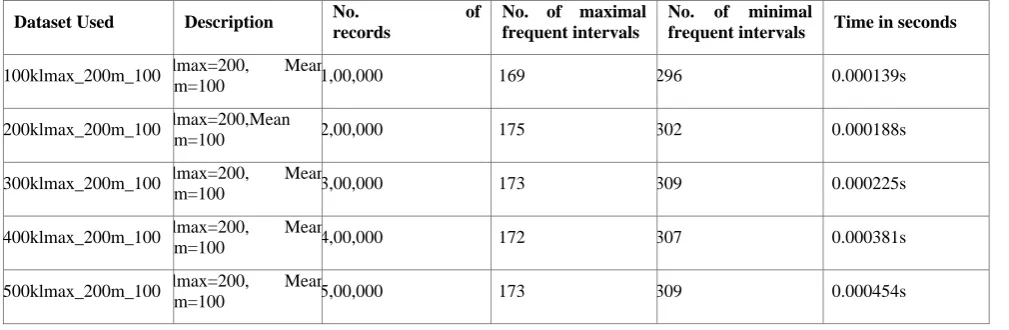
identification of number of frequent and infrequent intervals are recorded. The running time of the algorithm also noted with the variation of the size of the dataset. It is observed that the running time of the algorithm is directly proportional to the size of the dataset irrespective of the presence of number of frequent and infrequent intervals. The observations are listed in the Table 1.
The graphical representation of the results are shown in fig. 2 in which four different variations are considered as explained below:
[image:4.595.47.552.446.611.2]In fig. 2(a), the graph is drawn between number of transactions and time taken in seconds. It is observed from the graph that with increase of number of transactions, time consumption also increased. Similarly, in fig. 2(b), the graph is drawn by varying Imax with number of maximal frequent and minimal infrequent intervals. The graph in fig. 2(c) represents the effect of the algorithm by varying the values of mean and in fig. 2(d), the graph signifying the behavior of the algorithm by varying minimum support.
Table 1. Experimental results over synthetic dataset
Dataset Used Description No. of records
No. of maximal frequent intervals
No. of minimal
frequent intervals Time in seconds
100klmax_200m_100 lmax=200, Mean
m=100 1,00,000 169 296 0.000139s
200klmax_200m_100 lmax=200,Mean
m=100 2,00,000 175 302 0.000188s
300klmax_200m_100 lmax=200, Mean
m=100 3,00,000 173 309 0.000225s
400klmax_200m_100 lmax=200, Mean
m=100 4,00,000 172 307 0.000381s
500klmax_200m_100 lmax=200, Mean
7.
CONCLUSIONS AND FUTURE
WORK
An effective method of mining infrequent interval (MMI) is reported in this paper. The effectiveness of MII is established theoretically as well as experimentally. 𝑂(𝑛) time complexity and 𝑂(𝑟𝑚𝑎𝑥) space complexity makes the algorithm more
effective. There is a possibility that the mining infrequent interval can be extended for a continuous domain also. Work is going on towards the extension of MII for handling continuous valued data for finding minimal infrequent intervals.
8. REFERENCES
[1] Lin, J. (2003). Mining Maximal Frequent Intervals. In the Proceedings of ACM symposium on Applied Computing, pp. 426-431. ACM, New York.
[2] Dutta, M. and Mahanta, A.K. 2010. An efficient method for construction of I-tree. In: Proceedings of National
workshop on Design and Analysis of
Algorithm(NWDA).
[3] Elbassioni, Khaled M. Finding All Minimal Infrequent
Multi-dimensionalIntervals:Max-Planck-Institutf¨ur Informatik, Saarbr¨ucken, Germany.
[4] Agrawal, Rakesh and Srikant, Ramakrishnan 1994. Fast Algorithms for Mining Association Rules in Large Databases, Proceedings of the 20th International Conference on Very Large Data Bases, p.487-499, September 12-15.
[5] Agrawal, Rakesh and Srikant, Ramakrishnan 1995. Mining Sequential Patterns, Proceedings of the Eleventh International Conference on Data Engineering, p.3-14, March 06-10.
[6] Lu, H., Han, J. and Feng, L 1998. Stock movement and n-dimensional inter-transaction association rules. In Proc. 1998 SIGMOD Workshop on Research Issues on Data Mining and Knowledge Discovery (DMKD'98).
[7] Liu, B., Hsu, W., and Ma Y. 1998. Integrating classification and association rule mining. In KDD p. 80-86.
[8] Mannila, Heikki and Toivonen, Hannu 1997. Levelwise Search and Borders of Theories in KnowledgeDiscovery, Data Mining and Knowledge Discovery, v.1 n.3, p.241-258, [doi>10.1023/A:1009796218281]
31
Authors Biographies
D. I. Mazumder, received his Master Degree in Mathematics from Gauhati University, India in 2003. He received his M.Tech in Information Technology, from Tezpur University, India in 2010. Currently He is working as a Lecturer of Mathematics in the Dept. of Information Technology in IBRI College of Technology, OMAN. His major Research interests include Data mining and Cryptography.
D. k. Bhattacharyya, received his MCA from Dibrugarh University, India in 1991. He received PhD Degree in Computer Science from Tezpur University, India in 1999. Presently he is working as a Professor in the Department of Computer Science and Engg, Tezpur University, India. His
Major research interests include Cryptography, Error correction/ detection, Content based image retrieval, Data mining and Network Security.