ISSN Online: 2163-9418 ISSN Print: 2163-940X
DOI: 10.4236/ojrd.2018.82003 Apr. 10, 2018 21 Open Journal of Respiratory Diseases
Evaluation of Asthma Symptoms to Assess
Asthma Control Status in a Primary Care
Setting: An Exploratory Analysis of
Pooled Data from Three Trials
Soichiro Hozawa, Michikazu Terada, Maki Hozawa
Hiroshima Allergy and Respiratory Clinic, Hiroshima, Japan
Abstract
Background: Primary care physicians in Japan see many patients in a given day; consequently, they find it challenging to devote sufficient time for de-tailed clinical consultation and evaluation of asthma control status. The aim of this study was to investigate asthma symptoms that reveal the presence of in-adequately controlled asthma. Methods: A pooled analysis of baseline data from 100 patients with asthma treated with inhaled corticosteroid(s) (ICS) alone or ICS/long-acting beta-agonist who participated in three previous clin-ical trials was performed. Asthma control status and asthmatic symptoms were determined using a five-item Asthma Control Questionnaire, and whether asthmatic symptoms reflect clinical markers was investigated. Re-sults: Nocturnal awakening owing to asthmatic symptoms was observed only in the uncontrolled asthma group. Patient-reported wheezing was not ob-served in the group with well-controlled asthma, but was obob-served in all pa-tients in the uncontrolled asthma group. Virtually all papa-tients, irrespective of asthma control status, reported symptoms in the morning, limitation of nor-mal daily activities, and shortness of breath. Conclusions: The presence of nocturnal awakening due to asthma and wheezing likely reflected uncon-trolled asthma. These results will lead to re-recognition that clinical interview, querying nocturnal awakening from asthma and wheezing is a simple and useful approach to assess asthma control status in a primary care setting.
Keywords
Asthma Control Status, Asthma Control Questionnaire, Nocturnal Awakening, Wheezing, Primary Care
How to cite this paper: Hozawa, S., Tera-da, M. and Hozawa, M. (2018) Evaluation of Asthma Symptoms to Assess Asthma Control Status in a Primary Care Setting: An Exploratory Analysis of Pooled Data from Three Trials. Open Journal of Respi-ratory Diseases, 8, 21-32.
https://doi.org/10.4236/ojrd.2018.82003
Received: March 2, 2018 Accepted: April 7, 2018 Published: April 10, 2018
Copyright © 2018 by authors and Scientific Research Publishing Inc. This work is licensed under the Creative Commons Attribution International License (CC BY 4.0).
DOI: 10.4236/ojrd.2018.82003 22 Open Journal of Respiratory Diseases
1. Introduction
The Japanese Guidelines for Adult Asthma (JGL) and the Global Initiative for Asthma (GINA) guidelines recommend appropriate treatment based on an ac-curate assessment of asthma severity and control status, which are reflected by symptoms and respiratory function, to achieve current control and reduce future risk [1] [2]. However, in reality, many patients with asthma do not achieve good asthma control even with long-term medications [3]. In addition, many patients regard their asthma as somewhat controlled despite the presence of asthma symptoms [4]; moreover, some asthma symptoms may not be reported to physi-cians. Therefore, it is conceivable that asthma control status in many patients is not accurate.
Several tests, including assessment of lung function(s), small-airway dysfunc-tion and airway inflammadysfunc-tion, are recommended for determining asthma con-trol status [1] [2]. However, specific tests, such as spirometry, are insufficiently used in clinical practice to assess asthma control [5]. A more convenient tool for a general physician to assess a patient’s control status is a questionnaire such as the Asthma Control Questionnaire (ACQ). Each item in the ACQ is assessed on a seven-point scale, with the mean score of the seven items representing asthma control status [6] [7]. The utility of the five-item ACQ (ACQ5), which comprises the five most typical symptoms of asthma, has also been established [7]. Howev-er, even simple questionnaires are less frequently used in clinical practice in Ja-pan because primary care physicians usually treat a large number of patients in a given day, which results in short consultation times [8]. Therefore, a less cum-bersome, more time-efficient method of assessing asthma control status is re-quired.
In the present exploratory study, we used baseline data from patients who participated in three previous clinical studies [9] [10] [11], to evaluate the asth-ma symptoms that should, at least, be confirmed to assess asthasth-ma control status within a short-duration consultation in a real-world clinical setting. In addition, we investigated whether these symptoms reflected asthma pathology including airway inflammation and small airway dysfunction(s).
2. Methods
2.1. Subjects
A pooled analysis of 100 patients with asthma, who participated in three pre-vious randomized clinical trials [9] [10] [11], was performed. The present and these previous studies were conducted at Hiroshima Allergy and Respiratory Clinic (Hiroshima, Japan) in accordance with the principles of the Declaration of Helsinki, and was approved by the Ethical Review Board of the Hiroshima Allergy and Respiratory Clinic. All subjects provided written informed consent before participating in these studies.
DOI: 10.4236/ojrd.2018.82003 23 Open Journal of Respiratory Diseases their baseline fraction of exhaled nitric oxide (FeNO) was >35 ppb, if they had no history of smoking, if they did not have any respiratory infection in the pre-vious 8 weeks, and if they underwent prepre-vious treatment for at least 12 or 10 consecutive weeks with medium-dose inhaled corticosteroid (ICS) alone, or a combination of ICS and long-acting beta-agonist (LABA).
2.2. Measurements
Asthma control status was determined according to ACQ5 score (≤0.75 [well controlled]; 0.75 - 1.5 [partly controlled]; and ≥1.5 [uncontrolled]) [6] [7]. Asthma symptom scores were determined according to ratings on a 7-point scale (0 - 6; higher is worse) for each of the items in the ACQ5 (1) nocturnal awaken-ing by asthma; 2) symptoms in the mornawaken-ing; 3) limitation of normal daily activi-ties; 4) shortness of breath; and 5) wheezing) and assessed in each asthma con-trol level. In addition, FeNO, impulse oscillometry (IOS) parameters (difference between respiratory resistance at 5 Hz and 20 Hz [R5-20], resonance frequency [Fres], and integrated area of low-frequency reactance [AX]), and percentage of the predicted forced expiratory volume in one second (% FEV1) in each asthma control level or asthma symptom score was assessed. An FeNO level of 40 ppb was used as the cutoff value of risk for a rapid annual decline in FEV1[12]; per-centages of patients with FeNO ≥ 40 ppb in each asthma symptom score catego-ry were also evaluated. Each measurement was assessed as described previously [9] [10] [11].
2.3. Statistical Analysis
The data used in the present study were baseline measurements (week 0) from each trial. The results are presented as mean values. Differences were compared using analysis of variance, chi-square test, Fisher’s exact test, and Student’s t-test. A p-value <0.05 was considered to be statistically significant.
3. Results
3.1. Comparison of Patient Background Data
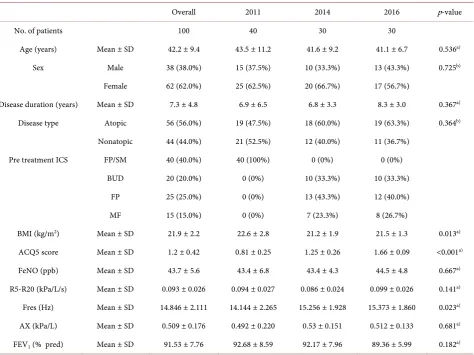
Table 1 summarizes the background data from all 100 patients (overall), which included 40 patients from a trial reported in 2011 [9], 30 from a trial reported in 2014 [10], and 30 from a trial reported in 2016 [11]. The overall mean values were as follows: ACQ5 score, 1.20; FeNO, 43.7 ppb; R5-20, 0.993 kPa/L/s; Fres, 14.846 Hz; AX, 0.509 kPa/L; and % FEV1, 91.53%. On comparing patient back-ground data, significant differences were observed in body mass index (BMI), ACQ5 score, and Fres between the groups.
3.2. Asthma Symptoms Determined from ACQ5 Item Scores
DOI: 10.4236/ojrd.2018.82003 24 Open Journal of Respiratory Diseases
Table 1. Patient characteristics.
Overall 2011 2014 2016 p-value
No. of patients 100 40 30 30
Age (years) Mean ± SD 42.2 ± 9.4 43.5 ± 11.2 41.6 ± 9.2 41.1 ± 6.7 0.536a)
Sex Male 38 (38.0%) 15 (37.5%) 10 (33.3%) 13 (43.3%) 0.725b)
Female 62 (62.0%) 25 (62.5%) 20 (66.7%) 17 (56.7%)
Disease duration (years) Mean ± SD 7.3 ± 4.8 6.9 ± 6.5 6.8 ± 3.3 8.3 ± 3.0 0.367a) Disease type Atopic 56 (56.0%) 19 (47.5%) 18 (60.0%) 19 (63.3%) 0.364b)
Nonatopic 44 (44.0%) 21 (52.5%) 12 (40.0%) 11 (36.7%)
Pre treatment ICS FP/SM 40 (40.0%) 40 (100%) 0 (0%) 0 (0%)
BUD 20 (20.0%) 0 (0%) 10 (33.3%) 10 (33.3%)
FP 25 (25.0%) 0 (0%) 13 (43.3%) 12 (40.0%)
MF 15 (15.0%) 0 (0%) 7 (23.3%) 8 (26.7%)
BMI (kg/m2) Mean ± SD 21.9 ± 2.2 22.6 ± 2.8 21.2 ± 1.9 21.5 ± 1.3 0.013a) ACQ5 score Mean ± SD 1.2 ± 0.42 0.81 ± 0.25 1.25 ± 0.26 1.66 ± 0.09 <0.001a) FeNO (ppb) Mean ± SD 43.7 ± 5.6 43.4 ± 6.8 43.4 ± 4.3 44.5 ± 4.8 0.667a) R5-R20 (kPa/L/s) Mean ± SD 0.093 ± 0.026 0.094 ± 0.027 0.086 ± 0.024 0.099 ± 0.026 0.141a) Fres (Hz) Mean ± SD 14.846 ± 2.111 14.144 ± 2.265 15.256 ± 1.928 15.373 ± 1.860 0.023a) AX (kPa/L) Mean ± SD 0.509 ± 0.176 0.492 ± 0.220 0.53 ± 0.151 0.512 ± 0.133 0.681a) FEV1 (% pred) Mean ± SD 91.53 ± 7.76 92.68 ± 8.59 92.17 ± 7.96 89.36 ± 5.99 0.182a) Mean (±SD) and number of patients (%) are shown. 2011, 2014, and 2016 indicate patient group of each individual trial reported in 2011 [9], 2014 [10] and 2016 [11] respectively. a)analysis of variance, b)chi-square test. Abbreviations: FP, fluticasone propionate; SM, Salmeterol; BUD, budesonide; MF,
mometa-sone furoate; BMI, body mass index; ACQ5, Asthma Control Questionnaire (five items); FeNO, fraction of exhaled nitric oxide; R5, respiratory resistance at 5 Hz; R20, respiratory resistance at 20 Hz; Fres, resonant frequency; AX, integrated area of low-frequency reactance; FEV1, forced expiratory volume in 1 s.
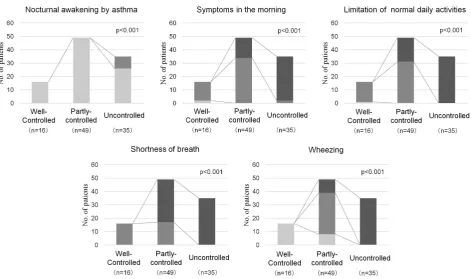
asthma (p < 0.001) (Figure 1). Evaluation of the symptom score distribution re-vealed that nocturnal awakening from asthma symptoms in a week was observed in 9 patients in the group with uncontrolled asthma (Figure 2). Symptoms in the morning, limitation of normal daily activities, and shortness of breath were severe in many patients in the group with uncontrolled asthma. In addition, these symptoms were also observed in nearly all patients in the group with well-controlled asthma (Figure 2).
The scores for wheezing were high in many patients in the group with uncon-trolled asthma, whereas wheezing was not observed in any of the patients in the group with well-controlled asthma (Figure 2).
3.3. Relationships between Asthma Symptoms and FeNO
DOI: 10.4236/ojrd.2018.82003 25 Open Journal of Respiratory Diseases
Figure 1. Scores for asthma symptoms according to asthma control status. The scores for
asthma symptoms covered by the ACQ5 were assessed in each asthma control level (ACQ5: ≤0.75, 0.75 - 1.5, and ≥1.5 were defined as well controlled, partly controlled, and uncontrolled, respectively). p-values were determined using analysis of variance. ***p < 0.001.
Figure 2. Symptom score distribution of patients among the asthma control levels. The numbers of patients by the scores of
asth-ma symptoms covered by ACQ5 were assessed in each asthasth-ma control status (ACQ5: ≤ 0.75, 0.75 - 1.5, and ≥ 1.5 were defined as well-controlled, partly-controlled, and uncontrolled, respectively). p-values were determined using Fisher’s exact test.
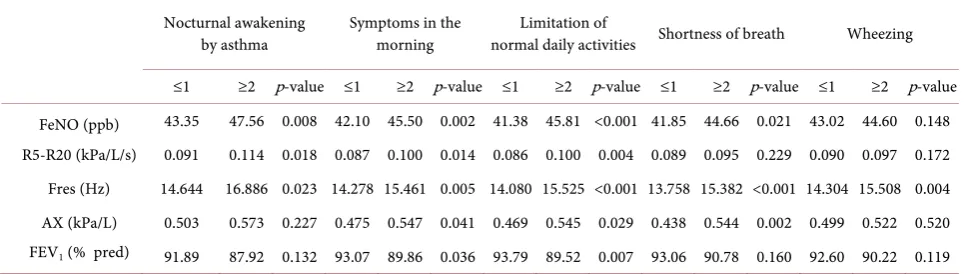
[image:5.595.63.535.360.639.2]DOI: 10.4236/ojrd.2018.82003 26 Open Journal of Respiratory Diseases symptom item revealed higher FeNO levels in the groups with higher scores for nocturnal awakening from asthma, symptoms in the morning, limitation of normal daily activities, and shortness of breath; however, no significant differ-ence was observed between the high-score and low-score groups for wheezing (Table 3). In the high-score groups for symptoms in the morning, limitation of normal daily activities, and shortness of breath, a significantly high percentage of patients exhibited FeNO levels ≥ 40 ppb; in the high-score groups for nocturnal awakening and wheezing, the percentage of patients with FeNO levels ≥ 40 ppb was numerically higher (Figure 3).
3.4. Relationships between Asthma Symptoms and IOS
Parameters
[image:6.595.59.541.344.481.2]Comparison of IOS parameters, based on asthma control status, revealed signif-icantly low values of Fres and AX in the well-controlled asthma group, but no significant difference was observed for R5-20 (Table 2). A comparison of the IOS parameters according to scores for each symptom revealed that R5-20 was
Table 2. Outcome measures by asthma control status.
Well-controlled Partly-controlled Uncontrolled p-value
No. of patients 16 49 35
ACQ5 score 0.56 ± 0.08 1.07 ± 0.21 1.66 ± 0.09 <0.001
FeNO (ppb) 39.13 ± 4.11 44.29 ± 5.80 45.06 ± 4.79 <0.001
R5-R20 (kPa/L/s) 0.085 ± 0.024 0.092 ± 0.025 0.099 ± 0.026 0.162
Fres (Hz) 12.896 ± 1.195 15.039 ± 2.139 15.466 ± 1.911 <0.001
AX (kPa/L) 0.396 ± 0.126 0.535 ± 0.199 0.525 ± 0.143 0.017
FEV1 (%pred) 94.69 ± 8.16 91.97 ± 8.33 89.46 ± 6.21 0.070
Mean (±SD) and number of patients (%) are shown.Parameters are presented according to asthma control status (ACQ5: ≤0.75, 0.75-1.5, and ≥1.5 were defined as well controlled, partly controlled, and uncontrolled, respectively). p-values were determined using analysis of variance. Abbreviations:ACQ5, Asthma Control Questionnaire (five items); FeNO, fraction of exhaled nitric oxide; R5, respiratory resistance at 5 Hz; R20, respiratory resistance at 20 Hz; Fres, resonant frequency; AX, integrated area of low-frequency reactance; FEV1, forced expiratory volume in 1 s.
Table 3. Outcome measures by asthma control status.
Nocturnal awakening
by asthma Symptoms in the morning normal daily activities Shortness of breath Limitation of Wheezing
≤1 ≥2 p-value ≤1 ≥2 p-value ≤1 ≥2 p-value ≤1 ≥2 p-value ≤1 ≥2 p-value
FeNO (ppb) 43.35 47.56 0.008 42.10 45.50 0.002 41.38 45.81 <0.001 41.85 44.66 0.021 43.02 44.60 0.148 R5-R20 (kPa/L/s) 0.091 0.114 0.018 0.087 0.100 0.014 0.086 0.100 0.004 0.089 0.095 0.229 0.090 0.097 0.172 Fres (Hz) 14.644 16.886 0.023 14.278 15.461 0.005 14.080 15.525 <0.001 13.758 15.382 <0.001 14.304 15.508 0.004 AX (kPa/L) 0.503 0.573 0.227 0.475 0.547 0.041 0.469 0.545 0.029 0.438 0.544 0.002 0.499 0.522 0.520 FEV1 (% pred) 91.89 87.92 0.132 93.07 89.86 0.036 93.79 89.52 0.007 93.06 90.78 0.160 92.60 90.22 0.119
[image:6.595.59.546.554.691.2]DOI: 10.4236/ojrd.2018.82003 27 Open Journal of Respiratory Diseases
Figure 3. Percentages of patients with FeNO ≥ 40 ppb. Percentages of patients with FeNO ≥ 40 ppb are displayed according to the
scores for asthma symptoms covered by ACQ5. p-values were determined using Fisher’s exact test.
significantly higher in the groups with higher scores for nocturnal awakening from asthma, symptoms in the morning, and limitation of normal daily activi-ties. Moreover, Fres was significantly high in the groups with higher scores for all symptoms (Table 3). In addition, AX was significantly higher in the groups with higher scores for symptoms in the morning, limitation of normal daily ac-tivities, and shortness of breath (Table 3).
3.5. Relationship between Asthma Symptoms and Spirometry
Parameters
No significant differences were observed in % FEV1 among the groups with well- controlled asthma (94.69%), partly controlled asthma (91.97%), and
uncon-trolled asthma (89.46%) (Table 2). According to scores for each symptom
item, % FEV1 was significantly lower in the group with a higher score for symp-toms in the morning and limitation of normal daily activities (Table 3). Com-parisons of the % FEV1 among patients who reported wheezing scores of 0 (94.88%), 1 (90.83%), and ≥2 (90.22%) revealed a significant difference (p = 0.049).
4. Discussion
DOI: 10.4236/ojrd.2018.82003 28 Open Journal of Respiratory Diseases LABA for ≥10 weeks, their asthma control was not uniform as determined by the ACQ5 score. Confirmation of the subjects’ asthma symptoms based on the asthma control status revealed that nocturnal awakening from asthma occurred in patients with uncontrolled asthma alone, while subjects who exhibited subjec-tive wheezing were labeled to potentially have inadequately controlled asthma. Therefore, to avoid underestimation of asthma control status in a primary care setting, clinical efforts at least to confirm whether patients with asthma have nocturnal awakening from asthma symptoms and wheezing are required to identify inadequately controlled asthma.
Asthma symptoms are known to be prone to exacerbation from night to early morning [13]. In the present study, patients who experienced nocturnal awa-kening from asthma demonstrated significantly high FeNO levels, indicating potential aggravation of eosinophilic airway inflammation. In patients with asthma who experienced nocturnal awakening, the number of eosinophils in the peripheral airways has been reported to be increased at night [14]. In the present study, FeNO values of all patients with nocturnal awaking were ≥40 ppb, a level which has been reported to be a risk factor for rapid annual decline in FEV1[12], which may in turn require suitable anti-inflammatory therapy. In assessments of severity and control level of asthma in the JGL and GINA guidelines, the pres-ence of symptoms at night and sleep disturbances, even if they occur less fre-quently than daytime symptoms, are crucial indicators [1] [2]. Moreover, pa-tients who experience symptoms at night and sleep disturbances are reported to have a lower quality of life [15]; thus, detecting nocturnal awakening from asth-ma is especially important. Patients with asthasth-ma who experience nocturnal awakening from symptoms should be recognized to have uncontrolled asthma. When such patients do not demonstrate problems with inhalation technique or medication adherence, and have a confirmed diagnosis of asthma and adequate-ly managed comorbidities, asthma treatment by appropriate treatment steps will be required.
An analysis of the wheezing scores revealed that all patients in the group with well-controlled asthma reported a score of 0, whereas all patients in the group with uncontrolled asthma reported a score ≥ 2; in the group with partly con-trolled asthma, scores between 0 and 2 were observed. These results may suggest that the wheezing score reflects asthma control status as determined by the ACQ5 score. The wheezing symptoms assessed by the ACQ are reported by the patient and, may therefore, represent wheezing during resting expiration rather than forced expiration. Wheezing during resting expiration is considered to be a more severe symptom than that during forced expiration [16]; thus, if the pa-tient is found to have wheezing in a clinical interview, which is assumed that asthma is inadequately controlled, the treatment strategy would be re-evaluated.
DOI: 10.4236/ojrd.2018.82003 29 Open Journal of Respiratory Diseases of Fres and AX remains unclear. Both Fres and AX were high, not only in the groups with inadequately controlled asthma, but also in the high-score groups for limitation of normal daily activities and shortness of breath, which are cise-induced symptoms. In addition to nocturnal asthma and ACQ score, exer-cise-induced asthma may be associated with small-airway dysfunction, which is related to exacerbation risk [18] [19]. Despite the importance of improving small airway dysfunction, it is difficult to assess in a primary care setting. Thus, if these symptoms are confirmed, considering the possibility of hidden small-airway dysfunction in these patients would be recommended to manage asthma and minimize future risk.
Because well-controlled asthma judged by the ACQ5 was related to GINA as-sessment of asthma control [6], patients who exhibit symptoms can be assessed as being well-controlled if those symptoms occur less than twice in a week [2], although this does not imply total control. In fact, in the present study, nearly all patients assessed to have well-controlled asthma based on ACQ5 score demon-strated mild symptoms in the morning, limitation of normal daily activities, and shortness of breath. Such patients were included in the trial that was reported in 2011 [9]. In that trial, changing the treatment in the same treatment step yielded significant improvements in ACQ5 scores, IOS parameters and FeNO levels, and these improvements were correlated with one another. Even if symptoms are mild, clinical efforts to achieve total control involving not only confirmation of asthma management following the guidelines [1] [2], but also considering a change in the medications―even in the same treatment step―are important.
One limitation of the present study was that spirometry and other tests were conducted at our clinic and, thus, the test values may have reflected a stable asthma status. However, asthma is characterized by variable airway narrowing and, during the manifestation of asthma symptoms detected by questionnaires, such as ACQ5, the airway is thought to undergo narrowing, leading to a decline in lung function(s); thus, a greater degree of caution may be necessary, especially in patients who exhibit symptomatic asthma.
Moreover, subjects in the present study were individuals included in clinical trials; thus, it is conceivable that the characteristics of the patient population were affected by the trials’ inclusion and exclusion criteria. Before inclusion in the trials that formed the basis of the present study, the patients were assessed to ensure good adherence, based on their entries in asthma diaries. Based on treat-ment content and asthma control status, it is conceivable that this study may have included many patients with moderate persistent asthma; however, only those who exhibited an FeNO level > 35 ppb were included [9] [10] [11]. Pa-tients in whom treatment before randomization improved airway inflammation were not included in our analysis. Further study in real-world clinical settings is preferable.
5. Conclusion
set-DOI: 10.4236/ojrd.2018.82003 30 Open Journal of Respiratory Diseases ting, a patient’s asthma control status can be extrapolated from confirming noc-turnal awakening from asthma and self-reported wheezing. Confirming these symptoms may be an easy and useful approach to assess asthma control status by primary care physicians who have some difficulties in assessing several parame-ters, including airway inflammation and small-airway dysfunction, in routine practice. One possible technique to confirm nocturnal awakening from asthma and subjective wheezing with avoiding underestimation is the instruction to the patients to record or, at least remember, whether they experience these symp-toms before their next visit. Other sympsymp-toms should also be confirmed whenev-er possible. When these asthma symptoms are obswhenev-erved, as recommended by the asthma guidelines [1] [2], it is recommended to confirm the diagnosis of asthma, inhalation technique and medication adherence, manage comorbidities (e.g., al-lergic rhinitis, sinusitis, and gastroesophageal reflux disease), and confirm/exclude potential risk factors (e.g., viral infections, weather, psychological stress, and dust). If asthma symptoms persist, even after these interventions, adjustment of pharmacological treatment should be considered necessary. In a primary care setting, confirming at least nocturnal awakening from asthma and subjective wheezing would be meaningful, and thus required, to assess not only current asthma control status, but also future exacerbation risk.
Acknowledgements
Assistance in reporting this article was provided by MC&P Co., Ltd. (Osaka, Ja-pan). This assistance was funded by AstraZeneca K.K. (Osaka, JaJa-pan).
Competing Interests
S. Hozawa has, within the previous 3 years, received honoraria for lectures from: Astellas Pharma, AstraZeneca K.K., Nippon Boehringer Ingelheim, Kyorin Pharmaceutical, Merck Sharp & Dohme K.K., Novartis Pharma K.K., Sanofi K.K., Teijin Pharma, and Torii Pharmaceutical.
References
[1] Ichinose, M., Sugiura, H., Nagase, H., Yamaguchi, M., Inoue, H., Sagara, H., et al. (2017) Japanese Guideline for Adult Asthma. Allergology International, 66, 163-189.
https://doi.org/10.1016/j.alit.2016.12.005
[2] Global Initiative for Asthma (2017) Global Strategy for Asthma Management and Prevention. http://www.ginasthma.org
[3] Demoly, P., Annunziata, K., Gubba, E. and Adamek, L. (2012) Repeated Cross-Sectional Survey of Patient-Reported Asthma Control in Europe in the Past 5 Years. European Respiratory Review, 21, 66-74.
https://doi.org/10.1183/09059180.00008111
[4] Iwanaga, T., Kumar, M., Goren, A., Mukai, I. and Hattori, T. (2015) Cross Sectional Patient-Reported Survey on Asthma Control and Associated Burdens in Japanese Patients with Asthma in 2013. Therapeutic Research, 36, 235-246.
DOI: 10.4236/ojrd.2018.82003 31 Open Journal of Respiratory Diseases
among Adults with COPD or Asthma: A Cross-Sectional Register-Based Study. NPJ Primary Care Respiratory Medicine, 26, 16027.
https://doi.org/10.1038/npjpcrm.2016.27
[6] Juniper, E.F., O’Byrne, P.M., Guyatt, G.H., Ferrie, P.J. and King, D.R. (1999) De-velopment and Validation of a Questionnaire to Measure Asthma Control. Euro-pean Respiratory Journal, 14, 902-907.
https://doi.org/10.1034/j.1399-3003.1999.14d29.x
[7] Juniper, E.F., Bousquet, J., Abetz, L., Bateman, E.D., GOAL Committee (2006) Identifying “Well-Controlled” and “Not Well-Controlled” Asthma Using the Asth-ma Control Questionnaire. Respiratory Medicine, 100, 616-621.
https://doi.org/10.1016/j.rmed.2005.08.012
[8] Takemura, Y. (2003) Family Medicine: What Does It Mean in Japan? Asia Pacific Family Medicine, 2, 188-192. https://doi.org/10.1111/j.1444-1683.2003.00094.x
[9] Hozawa, S., Terada, M. and Hozawa, M. (2011) Comparison of Budesonide/Formo- terol Turbuhaler with Fluticasone/Salmeterol Diskus for Treatment Effects on Small Airway Impairment and Airway Inflammation in Patients with Asthma. Pulmonary Pharmacology & Therapeutics, 24, 571-576.
https://doi.org/10.1016/j.pupt.2011.05.004
[10] Hozawa, S., Terada, M. and Hozawa, M. (2014) Comparison of the Effects of Bude-sonide/Formoterol Maintenance and Reliever Therapy with Fluticasone/Salmeterol Fixed-Dose Treatment on Airway Inflammation and Small Airway Impairment in Patients Who Need to Step-Up from Inhaled Corticosteroid Monotherapy. Pulmo-nary Pharmacology & Therapeutics, 27, 190-196.
https://doi.org/10.1016/j.pupt.2013.12.003
[11] Hozawa, S., Terada, M., Haruta, Y. and Hozawa, M. (2016) Comparison of Early Effects of Budesonide/Formoterol Maintenance and Reliever Therapy with Flutica-sone Furoate/Vilanterol for Asthma Patients Requiring Step-Up from Inhaled Cor-ticosteroid Monotherapy. Pulmonary Pharmacology & Therapeutics, 37, 15-23.
https://doi.org/10.1016/j.pupt.2016.01.005
[12] Matsunaga, K., Hirano, T., Oka, A., Ito, K. and Edakuni, N. (2016) Persistently High Exhaled Nitric Oxide and Loss of Lung Function in Controlled Asthma. Allergology International, 65, 266-271. https://doi.org/10.1016/j.alit.2015.12.006
[13] Smolensky, M.H., Lemmer, B. and Reinberg, A.E. (2007) Chronobiology and Chronotherapy of Allergic Rhinitis and Bronchial Asthma. Advanced Drug Delivery Reviews, 59, 852-882. https://doi.org/10.1016/j.addr.2007.08.016
[14] Kraft, M., Djukanovic, R., Wilson, S., Holgate, S.T. and Martin, R.J. (1996) Alveolar Tissue Inflammation in Asthma. American Journal of Respiratory and Critical Care Medicine, 154, 1505-1510. https://doi.org/10.1164/ajrccm.154.5.8912772
[15] Siroux, V., Boudier, A., Anto, J.M., Cazzoletti, L., Accordini, S., Alonso, J., et al. (2008) Quality-of-Life and Asthma-Severity in General Population Asthmatics: Re-sults of the ECRHS II Study. Allergy, 63, 547-554.
https://doi.org/10.1111/j.1398-9995.2008.01638.x
[16] Jónsson, S., Kjartansson, G., Gíslason, D. and Helgason, H. (1988) Comparison of the Oral and Intravenous Routes for Treating Asthma with Methylprednisolone and Theophylline. Chest, 94, 723-726. https://doi.org/10.1378/chest.94.4.723
[17] Shirai, T. and Kurosawa, H. (2016) Clinical Application of the Forced Oscillation Technique. Internal Medicine, 55, 559-566.
https://doi.org/10.2169/internalmedicine.55.5876
DOI: 10.4236/ojrd.2018.82003 32 Open Journal of Respiratory Diseases
Small-Airways Dysfunction Associates with Respiratory Symptoms and Clinical Features of Asthma: A Systematic Review. Journal of Allergy and Clinical Immu-nology, 131, 646-657. https://doi.org/10.1016/j.jaci.2012.12.1567
[19] Farah, C.S., King, G.G., Brown, N.J., Downie, S.R., Kermode, J.A., Hardaker, K.M.,
et al. (2012) The Role of the Small Airways in the Clinical Expression of Asthma in Adults. Journal of Allergy and Clinical Immunology, 129, 381-387.