RESEARCH ARTICLE
PREBIOTICS: IT’S IMPACT ON COLONIC FUNCTION OF CONSTIPATED ELDERLY
Sridevi Sivakami, PL* and Subhashree
Department of Food Service Management and Dietetics Coimbatore-641
ARTICLE INFO ABSTRACT
Twenty first century is often called the “age of ageing”. Reduced fertility and rapid dwindling of mortality rates due to biomedical advances, has le
the ageing population and decline of the youth of the nation. The variable slowing of the organ systems make the elderly more susceptible to many lifestyle and gastrointestinal disorders of which constipation is very predominant. The advent of functional foods like prebiotics shows a promising way ahead. To assess the impact of prebiotics on colonic function of constipated elderly, thirty females above 50 years were chosen for the intervention study. They were assessed on their nutritional st
mix using dietary sources like whole
was prepared and packed in hygienic packages. All the samples consumed 10g of the prebiotic mix everyday for a period of
assessed. Conclusively, it was found that the formulated drink had profound impact on the colonic function, thereby reducing constipation among the elderly. Positive signs like semisolid stools, increased frequency, lack o
time was taken during defecation.
INTRODUCTION
Ageing of population is one of the most important developments of the 20th century all over the world and will be one of the major challenges for the next millennium. In India, the elderly population is likely to increase from 70 million in 1995 to 141 million by 2020 and 508 million by 2100 according to World Bank projections (2000).
With a gradual reduction in the fertility rate and a rapid reduction of mortality rate due to medical interventions, the youth population has declined and the elderly numbers have increased. The twenty-first century is often called the age of ageing. Since 1950, the
*Corresponding author: [email protected]
proportion of the world’s population aged 60 and over has changed from one in thirteen to one in ten, with some developing countries ageing faster than developed countries. Marked
Elderly, represent the fastest growing population in the world. The rapidly growing number of older people in both developed and developing countries mean that more and more people will be entering the age when the risk o
significantly higher.
function in a variety of organ systems, thus making elderly persons of the same chrono
from each other. Besides this, the additional negative impact of chronic substance
and alcohol intake), lack of physical activity, and adverse socioeconomic factors, makes the elderly a repository of
ISSN: 0975-833X
International Journal of Current Research
Vol.9, pp.020-024, October
Key words:
Nutritional status Diet pattern Bowel habits Prebiotic health
Wheat, Oats, Saamai. Soyabean Artichoke
Article History: Received 17th August, 2010
Received in revised form 12th September, 2010
Accepted 23rd September, 2010
Published online 1st October, 2010
ARTICLE
PREBIOTICS: IT’S IMPACT ON COLONIC FUNCTION OF CONSTIPATED ELDERLY
* and Subhashree, S**
Dietetics, Avinashilingam University for Women, 641 043
Twenty first century is often called the “age of ageing”. Reduced fertility and rapid dwindling of mortality rates due to biomedical advances, has led to a rise in the ageing population and decline of the youth of the nation. The variable slowing of the organ systems make the elderly more susceptible to many lifestyle and gastrointestinal disorders of which constipation is very predominant. The of functional foods like prebiotics shows a promising way ahead. To assess the impact of prebiotics on colonic function of constipated elderly, thirty females above 50 years were chosen for the intervention study. They were assessed on their nutritional status, diet pattern and bowel habits. Prebiotic health mix using dietary sources like whole wheat, oats, saamai. soyabean and artichoke was prepared and packed in hygienic packages. All the samples consumed 10g of the prebiotic mix everyday for a period of 60 days as a drink and its impact . Conclusively, it was found that the formulated drink had profound impact on the colonic function, thereby reducing constipation among the elderly. Positive signs like semisolid stools, increased frequency, lack of strain and less time was taken during defecation.
proportion of the world’s population aged 60 and over has changed from one in thirteen to one in ten, with some developing countries ageing faster than developed countries. Marked differences exist between regions. Elderly, represent the fastest growing population in the world. The rapidly growing number of older people in both developed and developing countries mean that more and more people will be entering the age when the risk of developing certain chronic and debilitating diseases is significantly higher.
The ageing process causes a variable decline in function in a variety of organ systems, thus making elderly persons of the same chronological age different from each other. Besides this, the additional negative impact of chronic substance-abuse (principally smoking and alcohol intake), lack of physical activity, and adverse socioeconomic factors, makes the elderly a repository of ternational Journal of Current Research
October, 2010
INTERNATIONAL JOURNAL
OF CURRENT RESEARCH
poor health parameters (Troisi, 2005). It is therefore not surprising that they are more vulnerable to chronic illnesses and also to acute sudden deterioration of health, as compared to younger people. Acute illnesses, unlike chronic problems, are amenable to therapy, but only if they are recognized early. Nutrition is an important factor contributing to health and functional ability. The effect of nutritional status on physical and psychological well being is especially high in elderly. With the increasing longevity, nutrition status plays a significant role in the quality of life in the elderly. Physical conditions common in elderly like disability, medication induced anorexia, poor dentition, restrictive diets, gastrointestinal diseases and metabolic disorders affect nutrients intake and metabolic demands. Furthermore, cultural and psychological issues such as living alone, bereavement, situational depression and religious beliefs may reduce nutrients intake and affect their health status (Baweja, 2008).
During old age numerous changes that affect the nutrient intake, digestion, absorption and metabolism occur in the gastrointestinal tract (Macfarlane, 2006). Gastrointestinal disorders constitute the most frequent complaint of this population, of which constipation dominates (Annals, 2003). Constipation is a common problem in elderly characterised by hard stools and difficulty in defecation with prevalence ranging from 15 to 20 percent in the community dwelling elderly and upto 50 percent in nursing home residents (Bosshara, 2001). Low dietary fibre, lowered physical activity and inadequate fluid intake may be the contributing factors for constipation. India underwent a transition. Nutritional transition from a diet rich in minerals and vitamins to one rich in carbohydrates and fat has taken place in our country. Food is no longer consumed only for its nutrients. But food has been looked upon for its ability to foster good health and well being among the consumers. This has led to the advent of Functional Foods. Functional food is a part of an everyday diet and is demonstrated to offer health benefits and to reduce the risk of chronic disease beyond the widely accepted nutritional effects. Among the best known functional compounds probiotics and prebiotics form the best examples.
The term functional foods comprise some bacterial strains and products of plant and animal origin containing physiologically active compounds, beneficial for human health and reducing the risk of chronic diseases (Grajek, 2005).Probiotics are “live microbial feed supplements that beneficially affect the host by improving the intestinal microbiota”. Prebiotics, on the
other hand are non-digestible oligosaccharides that enhances the colonization of gut friendly organisms. Among the identified prebiotic components, inulin is found as a natural component in several edible fruits and vegetables. The average daily consumption has been estimated to be one to four grams in the United States (Moshfegh et al., 1999). Many studies have proved that prebiotics are colonic foods that confer many health benefits on the host. Inulin type fructan primarily enhance calcium absorption and had an effect on colonic absorption in humans (Abrahams and Hamthrone, 2007). Holloway et al., (2007), also concluded that there was a five percent increase in the mean absorptive efficiency of calcium among 15 elderly. Inspite of proven benefits of prebiotics on the gut, lack of sufficient research in India has made its implementation futile. Hence with the aim of improving the colonic function of elderly, this study was undertaken to study the impact of a self formulated prebiotic health drink on constipated elderly.
MATERIALS AND METHODS
A total of 30 elderly female in the age group of 50 to 85 years were chosen as the sample by purposive sampling for the conduct of the study. All the selected samples had constipation, characterized by hard stool consistency and decreased bowel movements. The study was undertaken at a small hamlet in Coimbatore, TamilNadu. A self formulated interview schedule was used as a tool to collect information regarding socio-economic data, diet pattern, hygiene and sanitary practices and bowel habits of the elderly. Nutritional assessment was carried out using the after ABCD technique. Anthropometric measurements namely height, weight was measured and BMI computed. Clinical evaluation was done to identify visible signs of malnutrition with the help of a clinician. 24 hour dietary recall for three consecutive days was collected in order to assess their diet composition. A food frequency questionnaire was also used to understand the frequency of consumption of selected Indian prebiotic foods.
mix in 100ml of warm milk. Health drink was the most ideal form of supplementation as it did not require chewing and was easy to prepare. Measuring spoons were also distributed along with the health mix packets to measure the accurate amount of the mix. The intervention study was done for a period of 60 days. During the supplementation, normal home diet was followed. At the end of the supplementation parameters like stool consistency, frequency of bowel movements, difficulty while defecation etc were studied
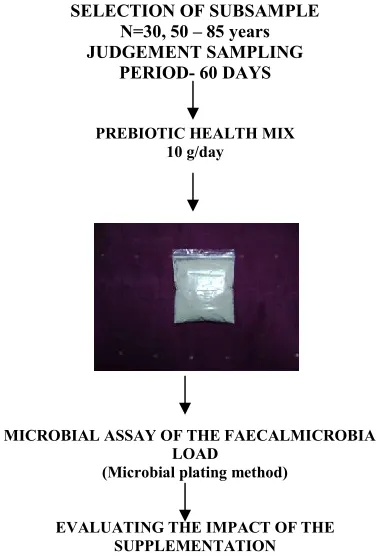
SELECTION OF SUBSAMPLE N=30, 50 – 85 years JUDGEMENT SAMPLING
PERIOD- 60 DAYS
PREBIOTIC HEALTH MIX 10 g/day
MICROBIAL ASSAY OF THE FAECALMICROBIAL LOAD
(Microbial plating method)
EVALUATING THE IMPACT OF THE SUPPLEMENTATION
Fig. 1. Schematic representation of the suppplementation
RESULTS AND DISCUSSION
Demographic profile
Majority of the selected elderly fall in the age group of 60 to 69 years (33%).About 37 % were involved in sedentary activity like scavenging, shop keeping, flower selling and performing their day to day household chores. About 20 percent of the selected elderly were involved in heavy work, which included stone tenders and coolie workers. However majority was unemployed (30%) and did not do much of physical activity. Most of the elderly (87%) in the selected area earn less than
Rs.4500 a month and only three percent come under the high income category.
Nutritional status
[image:3.504.42.230.186.466.2]The elderly (17%) in the age group of 50 to 59 years had a normal BMI from 18.5 to 24.9 and three percent were class I obese. Signs of pale conjunctiva and mouth ulcer were seen in 20 percent and 17 percent of the selected elderly respectively. Ten percent of the elderly reported falling of teeth and pitting pedal oedema was observed in 20 percent. Three percent and seven percent of the elderly had Bitot’s spot and angular stomatitis respectively. Hypertension was the most common with prevalence in about 12 out of 30 elderly, followed by diabetes mellitus in seven. Three persons suffered from arthritis, two each from osteoporosis and cardiovascular diseases and one each from ulcer and asthma.
Fig. 2. Body Mass Index
Dietary habits
Microbial analysis of data collected with regard to the dietary habits of the selected elderly revealed that, 90 percent were non-vegetarians and the rest ten percent of the elderly were vegetarians. However of the 90 percent non-vegetarians only 60 percent of the elderly consume non-vegetarian foods presently.
A. Consumption of prebiotic foods
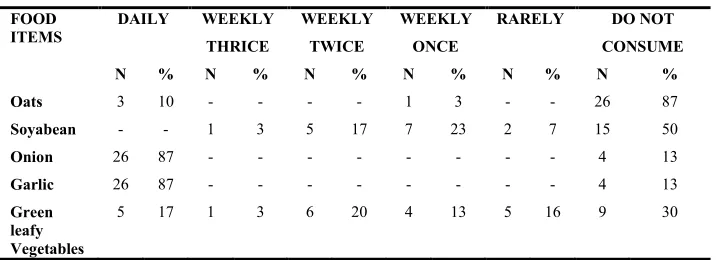
On studying the consumption of prebiotic food (Table 1), it was found that onion and garlic were the most commonly consumed prebiotic foods with 87 percent consuming them everyday. Onion and garlic were added in almost all the accompaniments like sambhar, rasam, kulambu, chutney, poriyal and gravies. Ten percent had the habit of consuming oats daily in the form of porridge or with buttermilk. Yet another prebiotic food, soyabean was consumed by 23 percent of the selected elderly atleast once a week. It was eaten in the form of a sundal or added to gravies and sambhar. A study by Seth et al.,
3 3 3
0 17
10 17
7 7
17
3 3 3
0 3
0 0
3
0 0 0
2 4 6 8 10 12 14 16 18
PE
R
C
E
N
T
A
G
E
17-18.49 18.5-24.9 25-29.9 30-34.9 35-39.9
BMI
BODY MASS INDEX
50-59 60-69 70-79 80-89
[image:3.504.260.469.265.394.2](2007), also concluded that 88 percent of the selected female elderly in Vadodara district consumed curd and onion more frequently. However the consumption of garlic ranged from daily to fortnightly by a majority of the elderly
B. Mean nutrient intake of selected sample
The computed mean energy, protein and carbohydrates intake were lower than the Required Dietary Allowances by 42 percent, 30 percent and 61 percent respectively. The fat intake of the selected sample met the RDA as they used oil for cooking and consumed meat varieties. The mean fibre intake was grossly less than the RDA. The low fibre intake was due to the inclusion of low fibre foods and avoidance of high fibre foods like green leafy vegetables in the diet. The mean intake of vitamin-C, calcium, iron, carotene, thiamine and riboflavin were very much deficient than the Required Dietary Allowance. The reason for this deficiency was lack of inclusion of sufficient seasonal fruits and vegetables in their diet.
Colonic function of the selected elderly
20 percent of the selected elderly always strained during defecation. An incomplete emptying sensation was often felt by 27 percent. The stool consistency of 27 percent was always hard. Manual handling was reported in about 40 percent of the selected elderly. About 34 percent of the selected elderly spent more than ten minutes to pass stool always. All the selected samples had strain while defecation before the supplementation. But post supplementation, 80% did not experience any strain during defecation. Hard stool, a characteristic of constipation was experienced by all samples before supplementation.
[image:4.504.76.435.153.283.2]Whereas after consumption of prebiotic drink for 2 month, a drastic change was noted in 80% having semi- solid stools. The mean time taken to defecate was 25
Fig. 3. Frequency of consuming prebiotic foods
Impact of supplementation
STRAIN WHILE DEFECATION
PERCENT
BEFORE AFTER
YES 100 20
NO - 80
mins, before supplementation which had decreased to 15 mins mid way, at 15 days. At the end of 30 days, there was a statistically significant change in the mean time taken to 10 mins which indicated non existence of constipation and difficulty in defecation. Bowel
movements less than 3 times a week is considered a characteristic of constipation. All the selected samples
had bowel movements only twice a week. Post supplementation, the frequency increased to five times a
0 20 40 60 80 100
Oats Soyabean Onion Garlic Green leafy
vegetable
PREBIOTIC FOODS
P
E
R
C
E
N
T
AGE
DAILY WEEKLY THRICE WEEKLY TWICE
WEEKLY ONCE RARELY DO NOT CONSUME
Table 1. Consumption pattern of probiotic and prebiotic foods
(N=30)
FOOD ITEMS
DAILY WEEKLY
THRICE
WEEKLY
TWICE
WEEKLY
ONCE
RARELY DO NOT
CONSUME
N % N % N % N % N % N %
Oats 3 10 - - - - 1 3 - - 26 87
Soyabean - - 1 3 5 17 7 23 2 7 15 50
Onion 26 87 - - - 4 13
Garlic 26 87 - - - 4 13
Green leafy Vegetables
week which was statistically significant at one percent level.
Fig.4. Frequency of defecation by the selected sample
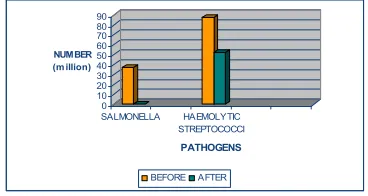
Fig. 5. Microbial load of the selected sample
On microbiologically analysing the faecal samples of the elderly it was found that one sample each had moderate counts of haemolytic streptococci and salmonella. Whereas, after supplementation salmonella was absent and there was a reduction in the streptococci count as shown in the figure
CONCLUSION
The study clearly indicated that prebiotics especially dietary prebiotics had a potential role in reducing constipation and thereby improving the colonic function in old age, the age group that was most affected with gastrointestinal problems. This has also opened a galore of opportunities for further in depth research in the field of functional foods.
REFERENCE
Abrahms, S.A., Griffin.I.J., Hawthorne.K.M., Liang.L., Gunn.S.K., Darlington.G. and Ellis.K.J. 2005. A combination of prebiotic short- and long-chain-type fructans enhances calcium absorption and bone mineralization in young adolescents. Am J Clin Nutr, 82, 471–476.
Annal, S. P. 2003. Gastrointestinal disorders in the elderly, Annals of long term care. Clinical Care and Ageing., 11(7): 33-39
Baweja, S. 2008. Assessment of Nutritional Status and Related Risk Factors in Community Dwelling Elderly in Western Rajasthan. Journal of The Indian Academy of Geriatrics, 1:5-13
Bosshara, W. and Dreker. R. 2001. The treatment of chronic constipation in elderly people-An update, drugs and Ageing, 21(14): 911-930.
Grajek, W., Oleynik. A. and Sip. A. 2005. Probiotics, orebiotics and antioxidants as functional foods. Acta Biochemical Polonica., 52(3), 665-671
Holloway, L. and Moynihan. S. 2007. Effects of Oligofructose enriched inulin on calcium and magnesium intestinal absorption and bone turnover markers in post-menopausal women. British Journal of Nutrition., 97, 365-372.
Macfarlane, S. , Macfarlane G.T. and Cummings. J. H. 2006. Prebiotics in gastrointestinal tract. Alimentary Pharmacology and Therapeutics., 24(5): 701-714. Moshfegh, A.J. and Friday, J.E. 1999. Presence of Inulin
and oligofructose in the diets of Americans. J Nutr., 129 (7S), 1407S-1411S
Shethi, H., Parnami, S. and Bhumra, S. 2007. Consuption pattern of probiotic and prebiotic foods and determining the gut health of young adult females,Asian Journal of Home Science.,2007,2,20-24 Troisi, J. 2005. Ethical Issues in Old Age, Journal of
The Indian Academy of Geriatrics, 2: 70-76.
2
5
0 1 2 3 4 5
BEFORE AFTER
FREQUENCY OF DEFECATION
0 10 20 30 40 50 60 70 80 90
NUMBER (m illion)
SALMONELLA HAEMOLYTIC STREPTOCOCCI
PATHOGENS
BEFORE AFTER