ISSN Print: 2327-5952
DOI: 10.4236/jss.2018.65007 May 16, 2018 81 Open Journal of Social Sciences
Learner Attitude towards EFL Learning:
A Response from Art and Design
Amina Asghar, Iqra Jamil, Afeefa Iqbal, Musarat Yasmin
Department of English, University of Gujrat, Gujrat, Pakistan
Abstract
The study is conducted to evaluate the attitudes of the students of University of Gujrat towards ESL about emotional, behavioral and cognitive factors. It is also investigated what attitudes students show towards ESL regarding their gender. There were 158 (95 females and 63 males) students from three differ-ent departmdiffer-ents including Fine Arts, Design, and Architecture. The ques-tionnaire is used as an instrument that contains 30 items to meet our goal. Findings reveal that the students of the University of Gujrat have a negative attitude to learn English as a second language. Moreover, gender has no such effect on attitude because there is no significant difference between male and female attitude towards ESL.
Keywords
Learner Attitude, Communication Skills, Emotional Factors, Behavioral Factors, Cognitive Factors
1. Introduction
“Language learning is considered as the keystone of human survival. As language can state our opinions, hopes and even our dreams.” [1]. Some factors such as motivation, attitude, anxiety, learning achievements, aptitudes, intelligence, age, and personalities influence the learning process. The most important factor that influences on language learning is learners’ attitudes [2]. The objective of present study is to demonstrate the concept of attitude as one of the key features of learning the English language as second language. Moreover, this study particu-larly examines the attitudes of the students of Fine arts, Design, and Architecture from the University of Gujrat (UOG) towards learning ESL considering three factors of attitude i.e., behavioral, emotional and cognitive. Also, this study in-vestigates the effect of learners’ demographic profile i.e., age, gender, medium of
How to cite this paper: Asghar, A., Jamil, I., Iqbal, A. and Yasmin, M. (2018) Learner Attitude towards EFL Learning: A Re-sponse from Art and Design. Open Journal of Social Sciences, 6, 81-88.
https://doi.org/10.4236/jss.2018.65007
Received: April 4, 2018 Accepted: May 13, 2018 Published: May 16, 2018
Copyright © 2018 by authors and Scientific Research Publishing Inc. This work is licensed under the Creative Commons Attribution International License (CC BY 4.0).
DOI: 10.4236/jss.2018.65007 82 Open Journal of Social Sciences
previous education and mother tongue on their attitudes regarding learning ESL. Reference [3] argued, “Opinion and beliefs have a significant effect on learners’ attitudes towards learning English as a Second language.” Positive belief leads to a positive attitude towards ESL, and negative beliefs would lead to the negative attitude.
2. Literature Review
The English language has become the most powerful language all over the world. Most of the countries with their own languages have picked up English as a for-eign language [4]. These countries adopted the English language as their official language to meet their economic needs at the global level. The English language is extremely used in educational institutions as well. Language learning is highly influenced by learners’ attitude and motivation.
Attitude is defined as “A psychological tendency that is expressed by evaluat-ing a particular entity with some degree of favor or disfavor” [5]. Moreover, Reference [6] said, from last 50 years works on language attitude has been con-ducted to show the relation of the significant use of language and individual at-titudes. Learning a second language does not only depend upon language learn-ing method but on learners’ attitude towards it. Accordlearn-ing to reference [7] atti-tudes to any language in the world are vital in its restoration, preservation, decay or death. The language attitude is what natives of various languages show to-wards other languages and also toto-wards’ their own language. Language attitude also indicates the state of mind of the people towards that particular language. Optimistic attitude towards the second language would lead the successful learning of the second language. If learners would not communicate with the na-tive speakers of the target language, they would have a pessimistic attitude and not learn the target language conveniently.
Learning criteria brings more positive alternations in the persons’ attitude, about emotional, behavioral and cognitive fields, because when a person learn a particular subject, he is expected to behave in a quite in a different way than others. Moreover, learning criteria has social and behavioral aspects in compar-ison to cognitive approach. All three fields have particular features regarding the outcome of language attitude. All these fields are briefly described in the below.
Behavioural aspect refers to the way in which a learner behaves in specific conditions. Positive language learning helps the learner to classify themselves to a native of that language and implement the behavioral aspects that distinguish the target language members. According to reference [3], positive attitude fos-ters positive behavior towards studying. Such learners are witnessed to demon-strate more eagerness to resolve problems and to involve themselves emotional-ly.
DOI: 10.4236/jss.2018.65007 83 Open Journal of Social Sciences
previous knowledge and the new one, creating new knowledge, checking new knowledge and applying the new knowledge in many situations.
Whereas emotional aspect is concerned, reference [8] stated that learning process is an emotional process influenced by several factors. It helps to specify the liking and disliking of the learners. The Inner state of mind affects the atti-tude of learner regarding foreign language.
DOI: 10.4236/jss.2018.65007 84 Open Journal of Social Sciences
year of study. Reference [14] work on Libyan students showed that due to the strong influence of L1, students have deprived inspiration and pessimistic atti-tudes towards ESL. Poor acceptance of English in the Libyan nation is due to lack of motivation and negative attitude of both teachers and students towards that language. Study of reference [15] consisted of 123 students of Tehran High Schools in the East. It reports that the female learners of Tehran High School Students are closer to L2 than male learners. They considered the English lan-guage is adding new knowledge to their existing knowledge. This study empha-sizes on two types of motivation i.e. instrumental and integrative. While regard-ing gender factor, reference [2] found no significant difference in learners’ atti-tudes towards learning English.
Above review showed that most of the studies were conducted in non-native countries of the world including Malaysia, Iran, and Libya with learners of high school, business and marketing. Besides, researchers observed that students of Fine Arts in UOG do not show an interest in learning a foreign language, partic-ularly as a core subject. Though English language serves as official and academic language in Pakistan [16] [17], their teachers reported them more interested in their practical work: drawings, sketches, designing, etc. An absence of any such study conducted with students of arts motivated researchers to examine these learners’ attitudes towards learning English and present study intends to fill this gap by asking the following question.
1) What are the attitudes of Arts students towards learning the English lan-guage about behavioral, cognitive and emotion aspects?
2) What is the significant difference between male and female students’ atti-tude towards English as Second Language?
3. Research Design
The research design of this study is quantitative by nature. The adopted instru-ment is questionnaire used to evaluate learners’ attitude towards the English Language. The sample was mandatory to attempt this questionnaire according to their own vision in relation to emotional, cognition and behavioral attitudes.
3.1. Method of Data Collection
DOI: 10.4236/jss.2018.65007 85 Open Journal of Social Sciences
level 1: Strongly Agree to level 5: Strongly Disagree. The survey was admini-strated during classes to ensure 100% results rate. All participants deliberately participated in the survey. Their answers to the questionnaire were evaluated in term of descriptive and inferential statistics.
3.2. Method of Data Analysis
All the questions were investigated in term of learners’ attitude towards the Eng-lish Language. For further analysis of data SPSS software used aiming to answer the research questions quantitatively. Independent sample T-test and one sample T-Test are also applied for descriptive analysis. 90 mean score is considered as a neutral response, and less than 90 mean score shows negative results and more than 90 shows positive results.
4. Results and Discussion
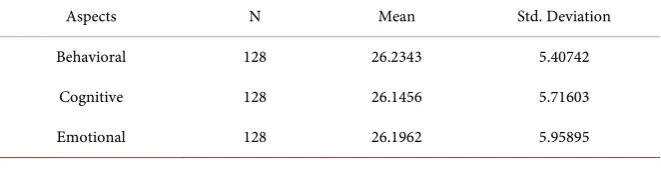
The result of first research question by applying the One-Sample T-test shows an overall mean score of students’ attitudes as shown in Table 1.
It reveals that the students have a negative attitude towards learning the Eng-lish language. Mean score (78.2215) is less than 90 that is insignificant. Fur-thermore, the mean scores of three aspects of attitude as revealed in Table 2
show behavioral aspect (26.2343), cognitive aspect (24.8799), and emotional as-pect (27.1076). The difference between these three asas-pects is insignificant be-cause no noteworthy difference. Moreover, learners of Architecture were found least positive about learning English (mean-76.07) as compared to those of Fine Arts and Design with their mean score 79.54 and 78.15 respectively.
Learner Attitude and Gender
As for as the second question is concerned, this study examined the attitudes of male and female students of UOG. Learners’ attitudes on the base of gender are shown in Table 3.
[image:5.595.208.539.643.730.2]As mentioned above mean score of males (80.8871) is slightly higher than fe-males (76.4421). Thus, gender does not influence the attitudes of the students
Table 1. Attitudes of male and female learners.
N Mean Std. Deviation
Sum 128 78.2215 12.83537
Table 2. Behavioural, cognitive and emotional attitudes of male and female learners.
Aspects N Mean Std. Deviation
Behavioral 128 26.2343 5.40742
Cognitive 128 26.1456 5.71603
DOI: 10.4236/jss.2018.65007 86 Open Journal of Social Sciences
Table 3. Attitudes of male and female learners.
Gender of Respondents N Mean Std. Deviation
Female 65 76.4421 12.35014
Male 63 80.8871 13.28885
towards ESL substantially. This finding is in line with the earlier findings of ref-erence [2] and in contrast with reference [13], [12] and [15] who established that attitudes of female learners are higher than those of male towards EFL learning. Regarding three aspects of attitudes, the mean score of males (26.3065) is rela-tively higher than females (25.5895) regarding behavioral attitude aspects. In Other two aspects (cognitive and emotional) also males have higher mean score accordingly (27.0323) and (27.5484) as compared to females (25.5895) and (25.2632). This descriptive analysis shows males attitude towards ESL compara-tively higher than that of females.
This study aims at examining the attitude of students of the first semester at UOG, assuming that students have distinctive attitudes. Outcomes of current study contradict with the assumptions of heterogeneous attitudes of students. It supports the findings of reference [13] that students are not motivated to learn English. The present study also confirms the findings of a study of reference [14]
regarding three aspects of attitude. Students have a negative attitude in term of behavioral, cognitive and emotional aspects of attitude. On the other hand, this study denies the works of reference [9] [10] [12]. According to these studies students have overall a positive attitude towards ESL learning. May be they are well aware of the significance of English that is why they are interested in learn-ing English. The negative attitudes of SADA students at UOG might be related to their lack of awareness about the importance of English in their professional lives and their complete focus on practical work. Another reason may be they do not have any external motivation such as lack of instructor’s encouragement
[18], instructions given in native language and less use of English language in their classrooms.
5. Conclusions
This article reports on a study that examined the female and male students’ atti-tude towards English as a Second Language regarding three aspects of attiatti-tude,
i.e. behavioral, cognitive and emotional. Although, overall students have nega-tive attitudes, but the mean scores of males in all aspects show that males have slightly higher attitudes towards ESL. The findings of the current study showed insignificant demographic (gender) difference. Gender does not regulate atti-tudes of ESL learners. Moreover, students of Architecture showed the least in-terest in learning the English language.
Pakis-DOI: 10.4236/jss.2018.65007 87 Open Journal of Social Sciences
tan. Present study implies that teachers who teach English in SADA department should add some events to show explicitly the importance of English language so that students could be motivated to learn English as these students will have to develop their verbal communication in the English language to present their work at international level.
Moreover, as attitudes are not static, present research does not claim to cap-ture a change in learners’ attitude due to its limited scope. Besides, further re-search is needed to uncover the reasons and investigate the ways to enhance po-sitivity in learners’ attitude.
References
[1] Tavil, Z. (2009) Parental Attitudes towards English Education for Kindergarten Students in Turkey. Kastamonu Education Journal, 17, 331-340.
[2] Fakeye, D. (2010) Students’ Personal Variables as Correlates of Academic Achieve-ment in English as a Second Language in Nigeria. Journal of Social Sciences, 22, 205-211. https://doi.org/10.1080/09718923.2010.11892803
[3] Kara, A. (2009) The Effect of a ‘Learning Theories’ Unit on Students’ Attitudes to-wards Learning. Australian Journal of Teacher Education, 34, 100-113.
https://doi.org/10.14221/ajte.2009v34n3.5
[4] Bernaus, M. (2005) What Keeps Teaching Going? Motivation and Attitudes. Un-iversitat Autònoma de Barcelona, Spain.
[5] Eagly, A.E. and Chaiken, S. (1993) The Psychology of Attitudes. Harcourt Brace, Orlando.
[6] Saidat, A.M. (2010) Language Attitude: The Case of Jordan. International Journal of Academic Research, 2, 235-243.
[7] Baker, C. (1992) Attitudes and Language. Multilingual Matters, Clevedon.
[8] Feng, R. and Chen, H. (2009) An Analysis on the Importance of Motivation and Strategy in Postgraduates English Acquisition. English Language Teaching, 2, 93-97.
https://doi.org/10.5539/elt.v2n3p93
[9] Al Noursi, O. (2013) Attitude towards Learning English: The Case of the UAE Technology High School. Education Research Journal, 4, 21-27.
[10] Ahmad, S. (2015) Attitude towards English Language Learning among EFL Learners at UMSKAL. Journal of Education and Practice, 6, 6-15
[11] Harmer, J. (2002) How to Teach English. Longman, London.
[12] Eshghinejad, S. (2016) EFL Students’ Attitudes toward Learning English Language: The Case Study of Kashan University Students. Cogent Education, 3, 1-13.
https://doi.org/10.1080/2331186X.2016.1236434
[13] Abidin, D.M.J.Z., Pour-Mohammadi, M. and Alzwari, H. (2012) EFL Students’ At-titude towards Learning the English Language: The Case of Libyan School Students. Asian Social Science, 8, 119-134.
[14] Youssef, A.M.S. (2012) Role of Motivation and Attitude in Introduction and Learn-ing of English as a Foreign Language in Libyan High School. International Journal of Linguistics, 4, 366-373.
DOI: 10.4236/jss.2018.65007 88 Open Journal of Social Sciences
[16] Yasmin, M., Sarkar, M. and Sohail, A. (2016) Exploring English Language Needs of Hotel Industry in Pakistan: An Evaluation of Existing Teaching Material. Journal of Hospitality & Tourism Education, 28, 202-213.
https://doi.org/10.1080/10963758.2016.1226846
[17] Yasmin, M., Sohail, A., Sarkar, M. and Hafeez, R. (2017) Creative Methods in Transforming Education Using Human Resources. Creativity Studies, 10, 145-158.
https://doi.org/10.3846/23450479.2017.1365778