Running title: Worms in Space for Outreach on Earth
Full Title: Worms in Space for Outreach on Earth: Space Life Science Activities for the Classroom
Authors: Christopher J. Gaffney*1,3, Amelia K. Pollard*2, Colleen S. Deane3, Michael Cooke2,3, Michele Balsamo4, Jennifer Hewitt5, Siva A. Vanapalli5, Nathaniel J. Szewczyk2, Timothy Etheridge3, & Bethan E. Phillips2
*These authors contributed equally to the work
Affiliations:
1Lancaster Medical School, Furness College, Lancaster University, Lancaster, LA1 4YG, UK
2MRC/ARUK Centre for Musculoskeletal Ageing Research and NIHR Nottingham BRC, University of Nottingham, Royal Derby Hospital, Derby, DE22 3DT, UK
3Sport and Health Sciences, University of Exeter, St Luke’s Campus, Exeter, EX1 2LU, UK
4Kayser Italia, Livorno, 57128, Italy
5Departments of Chemical Engineering and Mechanical Engineering, Texas Tech University, Lubbock, Texas, 79409-3121, USA
Corresponding author: Dr Bethan Phillips, 2MRC/ARUK Centre for Musculoskeletal Ageing Research, University of Nottingham, Royal Derby Hospital, Derby, DE22 3DT, UK. Email: [email protected]; Telephone: +44 (0) 1332 724 676.
ABSTRACT
Long term spaceflight is associated with the loss of skeletal muscle mass and function. The Molecular Muscle Experiment (MME) seeks to identify the causes of muscle decline in space and test potential therapies to attenuate this in the microscopic worm, C. elegans. This is the first UK-led experiment in the almost two-decade history of the International Space Station. We therefore intend to complete significant and widespread educational outreach activities to promote interest in science, technology, engineering and maths (STEM), and to increase engagement with our space life science experiment. This paper describes three education outreach activities relating to our MME experiment that are suitable for use in the classroom, including: (i) observing normal and mutant worms; (ii) observing the effect of unloading (simulation of microgravity); and (iii) handling spaceflight hardware. Activity packs are provided at a ‘starter’ and ‘advanced’ level to support these activities. This paper also provides three posters that may be used as learning resources for educators that give information on: (i) why worms are used for research; (ii) spaceflight human physiology; and (iii) the specifics of our MME. Details of further planned engagement activities are outlined to increase the awareness of the MME.
INTRODUCTION
Our current spaceflight experiment, the Molecular Muscle Experiment (MME) builds on previous work showing that C. elegans can grow and reproduce in space with no major health problems (Nelson et al., 1994; Oczypok et al., 2012). Previous work has also shown that these worms show similar changes to humans during spaceflight, including changes in muscle properties and energy metabolism (Higashibata et al., 2006, 2016), establishing C. elegans as an excellent model to study the mechanisms of muscle atrophy during spaceflight. Based on this, our current (MME) study will utilise C. elegans to investigate: (i) the mechanisms underlying spaceflight-induced muscle decline and (ii) whether drug-based countermeasures can alleviate spaceflight-induced muscle decline.
As MME is the first UK-led experiment in the history of the International Space Station (ISS), we want to capitalise on the novelty of this experiment, and recent media and public interest in spaceflight (stimulated through Timothy Peake’s Principia mission (as the first British European Space Agency astronaut (ESA, 2017)), by organising significant and widespread educational outreach activities. These activities include visits to schools, science fairs and museums across the UK using the activities described in this paper. More broadly, we are increasing our outreach through the use of social media (Twitter: @worms_space) and a website (https://www.mme-spaceworms.com). Specifically, this paper outlines three space life science activities based on C. elegans that are suitable for use by educators in a classroom-type setting. The overall learning objective of these activities is to increase understanding of spaceflight-induced changes in muscle.
LIFE SCIENCE ACTIVITIES USING THE WORM C. elegans as a Useful Educational Resource
Our educational outreach activities use the microscopic roundworm, C. elegans. The use of C. elegans in education has proved valuable and attractive for similar reasons to the research lab environment, including its’ short life-cycle, small size, transparency, ease of cultivating, and similarities to the human genome (Kaletta and Hengartner, 2006, WormClassroom, 2018). In addition, C. elegans can also taste, smell, and respond to light and temperature (WormClassroom, 2018).
Education using C. elegans is well-supported with large online resources including: WormClassroom (www.wormclassroom.org), a specific C. elegans education portal; WormBook (www.wormbook.org) that contains peer-reviewed information on the biology of C. elegans and other nematodes; and WormBase (www.wormbase.org) a resource detailing the genetics and biology of C. elegans. For educators wishing to develop practical activities with C. elegans, strains can be obtained from the Caenorhabditis Genetics Center (CGC: https://cgc.umn.edu).
Spaceflight Related Outreach Activities
Activity 1: Observing wild-type and muscle mutant worms
The first MME outreach activity involves the set-up of two bright field microscope stations for the visualisation of either wild-type (i.e. normal healthy worms) or mutant (i.e. worm with muscle dysfunction) worms. As spaceflight causes the loss of muscle mass and strength in worms (and rodents and humans), this outreach activity provides an overt example of muscle dysfunction. A schematic of the experimental set-up and anticipated observations are shown in Figure 1.
The main learning objectives of the experiment are to assess the differences between worms grown on earth (wild-type) and mutant worms which simulate the effect of spaceflight. The experiment aims to inform learners about the importance of maintaining muscle health and the challenges associated with spaceflight. To replicate the learning objectives in the classroom, we have developed two activity packs for learners. These packs contain images and videos from the outreach activity that show how wild-type worms are healthy and represent ‘before spaceflight’, while the mutant worms (unc-105) show loss of muscle size and movement ability and are somewhat representative of changes that would be seen ‘after spaceflight’.
In the starters’ pack, learners are asked to measure worm size and convert movement units. Learners are also asked to determine whether movement is better in worms on Earth or those in space; and finally, to determine whether green fluorescent protein (GFP) images of muscle are from wild-type or mutant worms. Learners should be able to identify that wild-type worms are longer, show good sinusoidal movement (S-type shape of crawling), and show good reproductive capacity by laying a large number of eggs. In contrast, the mutant worms are smaller and hypercontracted, meaning that they appear paralysed displaying little or no movement and lay very few eggs.
Figure 1: Activity 1 set-up for outreach events; observing wild-type (i.e. healthy/ normal) and mutant (i.e. dysfunctional/ diseased) worms using a microscope and wireless tablet setup. Activity pack 1 provides data derived from this experimental set-up.
Activity 2: The effect of ‘unloading’ on Duchenne Muscular Dystrophy Worms
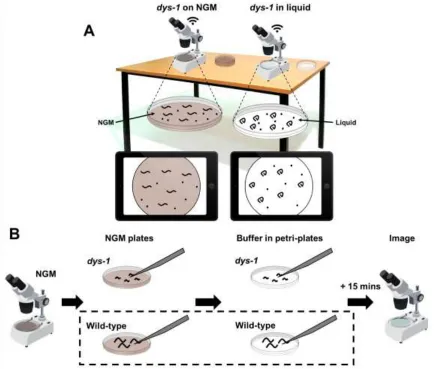
The second activity we use for MME outreach is exploring the visible differences in worms that are on solid culture media (nematode growth media (NGM)) or in liquid media. The premise of this experiment is to mimic the effects of microgravity (with liquid) and determine the effect of unloading. To best demonstrate the effect of unloading, we use a DMD worm (the dys-1 mutant strain BZ33). On solid media, this mutant displays abnormal movement patterns, whereas in liquid media, the dys-1 mutant stops displaying movement patterns and instead coils demonstrating how microgravity can impact the motility of an organism. This activity can be run in one of two ways (Figure 2). Either dys-1 worms are prepared on solid media and in liquid buffer the night before or the morning of the activity and learners can observe the difference in the worm movement (Figure 2A) or dys-1 worms (and if time allows, wild-type) are transferred from solid media to buffer during the activity so that learners can watch more individual worms losing movement with time (Figure 2B). Note that for the later set up lack of movement starts to occur 15-30 minutes after transfer with more and more individual worms showing loss of movement over the next 24 hours.
[image:4.595.133.462.78.370.2]of coiled worms following unloading, plot these data and answer a final question on the causes of coiling in dys-1. For higher level learners, statistical analyses can be completed on the movement coiling data to further increase the complexity of, and transferable skills achieved by completion of the activity. Similarly, for higher level learners the choice of dys-1 enables further learning around the use of C. elegans as a disease model and for drug discovery (Gaud et al., 2004).
Figure 2: Activity 2 set-up for outreach events; observing the effect of unloading on wild-type and mutant worms. (A) Mutant worms (e.g. dys-1) are observed whilst on NGM and in liquid within petri plates. (B) For an acute treatment, worms are transferred to buffer in petri plates, are left for 15 minutes before imaging. This can also be done with wild-type as an optional extra activity.
Activity 3: Spaceflight hardware
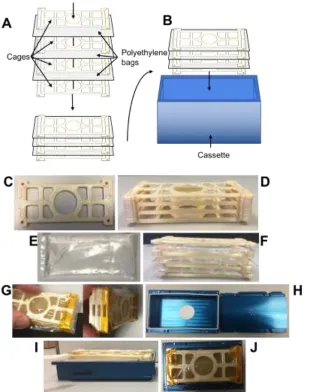
For the third activity, we have a physical collection of hardware from the current spaceflight experiment (MME) and from previous spaceflight experiments (ICE-FIRST; CSI-1; CERISE). Part of this collection is the experiment cassette, cage and bags (developed by Kayser Italia under a European Space Agency (ESA) contract) that will be used to house the worms during the MME in 2018 (Figure 3). During education outreach, different aspects of the hardware collection are introduced, including the purpose and history (or future purpose) of each item. Outreach attendees are then allowed to handle the hardware and, where possible construct items that are made from multiple components.
for spaceflight experiments. To replicate the learning objectives in the classroom, we have provided an activity pack with pictures of the spaceflight hardware to be used for the MME. This comprises three major components: (i) the experiment cassette that encases the scientific experiment and protects it during launch and landing; (ii) the cage that is made up of four pieces that hold the bags between them and fit together in the experiment cassette; and (iii) the bags that contain the worms and the liquid food that they live in.
For the starters’ pack, learners are given photographs of all of the components required for the MME hardware, with a task to identify how to assemble the components in the correct order so that the worm bags are secure and protected, and that they fit within the experiment cassette.
Figure 3: Spaceflight hardware. (A) Diagram of how cages and polyethylene bags come together and are then (B) inserted into the cassette. Photographs of MME spaceflight hardware components: (C) a single cage; (D) four cage compartments connected without bags; (E) polyethylene bags; (F) cages with three polyethylene bags enclosed; (G) corners of polyethylene bags taped to ensure a good seal within the cassette; (H) a single cassette; (I) lateral view of cassette with cage and bags in situ; (J) aerial view of cassette with cage and bags in situ. Activity pack 3 provides questions based on these images and photographs. Cassette dimensions are (height x length x depth as depicted in (A)) 24 x 91 x 56mm. Hardware was developed by Kayser Italia under an ESA contract.
DISCUSSION
In both the UK (Department of Education, 2018) and the US (U.S. Department of Education, 2016), strategies are in place to increase the uptake of STEM with a view to foster growth and innovation in our future economies. Spaceflight offers an area of appeal to those with a broad interest in STEM areas with the success of the MME flight dependent upon successes linked to each of these STEM areas. The activities described in this paper engage learners in all STEM areas, with a particular focus on the science aspect of STEM. The activity packs given as part of this paper provide an opportunity to engage learners in spaceflight-based life sciences at very minimal cost. Beyond these activities, the C. elegans field in particular, makes it easy for educators to obtain and culture strains, and access online educational resources to support further activities in the classroom with relatively low-cost implications.
[image:7.595.146.455.70.462.2]significant impact of each activity from the following categories: (i) requests for further information; (ii) audience reported changed views/opinions; (iii) plans for future engagement activities (iv) own/colleagues reported changed views/opinions; (v) decision made or influenced; and (vi) not aware of any impact. Since the beginning of 2017, we have taken part in 22 engagement opportunities ranging from science fairs to broadcast communications. Our audiences have included, and are not limited to, the general public, undergraduates, postgraduates and school students. The majority of our engagement activities have resulted in requests to bring our activity to other engagement events and so fall into the ‘plans for future activities’ impact category. Based upon feedback from events, we have also occasionally reported changes to our audience’s views with learners becoming more interested in STEM subjects. However, it remains to be seen whether these are long term changes and we are not measuring if they are. Lastly, at one event a decision was made that local government would support local schools in conducting pollution monitoring to shape local air quality enforcement.
While we are required to report our own engagement activities’ impact, it may also be useful for those using our resources to measure the impact of the activities on learners. The nature of how this assessment would take place will clearly depend upon both the country and the setting in which our activities are used. At a basic level, this might involve using surveys to ask students before and after carrying out the activities their interest in STEM subjects and to see if the resources have influenced the learner’s opinions and views. At more advanced levels, this might include prospectively following STEM uptake amongst participants, use of various active learning assessment tools (for example, (Brame, 2016)), and/or integration of these activities into local curricular based teaching.
The MME flight is currently scheduled for late 2018 and the majority of educational outreach activity will take place in close proximity to the scheduled launch, to capitalise upon media attention surrounding the flight. In addition to activities at science fairs and museums, and the use of online resources such as the MME website and Twitter, a video documentary will be produced to report on the preparations for, and the execution of the flight. Promotion using mass media conduits (i.e. television) will hopefully engage new audiences that may not otherwise engage in the experiment through outreach visits or targeted online materials. These additional resources can also be used by educators to increase the interest and knowledge of learners around space life sciences.
ACKNOWLEDGEMENTS
This work was supported by the BBSRC [grant numbers BB/N015894/1, BB/P025781/1]; the UK Space Agency and the STFC [grant number ST/R005737]; and the ESA [designations Molecular Muscle Experiment and ESA-14-ISLRA_Prop-0029]. JH and SAV were supported by NASA [NASA NNX15AL16G]. Figures were constructed using openly available clipart that can be accessed at: clipart-library.com.
REFERENCES
Brame, C. (2016) Active Learning, Vanderbilt University Center for Teaching. Available at: https://cft.vanderbilt.edu//cft/guides-sub-pages/active-learning/ (Accessed: 3 July 2018).
Buckey, J. C. (1999) ‘Preparing for Mars: the physiologic and medical challenges.’, European journal of medical research, 4(9), pp. 353–6. Available at: http://www.ncbi.nlm.nih.gov/pubmed/10477498 (Accessed: 21 February 2016).
Etheridge, T., Rahman, M., Gaffney, C. J., Shaw, D., Shephard, F., Magudia, J., Solomon, D. E., Milne, T., Blawzdziewicz, J., Constantin-Teodosiu, D., Greenhaff, P. L., Vanapalli, S. A. and Szewczyk, N. J. (2015) ‘The integrin-adhesome is required to maintain muscle structure, mitochondrial ATP production, and movement forces in Caenorhabditis elegans.’, FASEB journal : official publication of the Federation of American Societies for Experimental Biology, 29(4), pp. 1235–46. doi: 10.1096/fj.14-259119.
Fitts, R. H., Trappe, S. W., Costill, D. L., Gallagher, P. M., Creer, A. C., Colloton, P. A., Peters, J. R., Romatowski, J. G., Bain, J. L. and Riley, D. A. (2010) ‘Prolonged space flight-induced alterations in the structure and function of human skeletal muscle fibres.’, The Journal of physiology, 588(Pt 18), pp. 3567–92. doi: 10.1113/jphysiol.2010.188508.
Freeman, S., Eddy, S. L., McDonough, M., Smith, M. K., Okoroafor, N., Jordt, H. and Wenderoth, M. P. (2014) ‘Active learning increases student performance in science, engineering, and mathematics.’, Proceedings of the National Academy of Sciences of the United States of America. National Academy of Sciences, 111(23), pp. 8410–5. doi: 10.1073/pnas.1319030111.
Gaffney, C. J., Bass, J. J., Barratt, T. F. and Szewczyk, N. J. (2014) ‘Methods to assess subcellular compartments of muscle in C. elegans.’, Journal of visualized experiments : JoVE, (93), p. e52043. doi: 10.3791/52043.
Gaffney, C. J., Fomina, E., Babich, D., Kitov, V., Uskov, K. and Green, D. A. (2017) ‘The effect of long-term confinement and the efficacy of exercise countermeasures on muscle strength during a simulated mission to Mars: data from the Mars500 study’, Sports Medicine - Open, 3(1), p. 40. doi: 10.1186/s40798-017-0107-y.
Gaffney, C. J., Shephard, F., Chu, J., Baillie, D. L., Rose, A., Constantin-Teodosiu, D., Greenhaff, P. L. and Szewczyk, N. J. (2016) ‘Degenerin channel activation causes caspase-mediated protein degradation and mitochondrial dysfunction in adult C. elegans muscle’, Journal of Cachexia, Sarcopenia and Muscle, 7(2), pp. 181–192. doi: 10.1002/jcsm.12040.
Gaud, A., Simon, J.-M., Witzel, T., Carre-Pierrat, M., Wermuth, C. G. and Ségalat, L. (2004) ‘Prednisone reduces muscle degeneration in dystrophin-deficient Caenorhabditis elegans’, Neuromuscular Disorders, 14(6), pp. 365–370. doi: 10.1016/j.nmd.2004.02.011.
Graveley, A., Vlasov, A., Freeman, A., Wu, K., Szewczyk, N. J., D’Cruz, R. and Batt, J. (2018) ‘Levels of acid sphingomyelinase (ASM) in Caenorhabditis elegans in microgravity’, Gravitational and Space Research, In Press.
Higashibata, A., Hashizume, T., Nemoto, K., Higashitani, N., Etheridge, T., Mori, C., Harada, S., Sugimoto, T., Szewczyk, N. J., Baba, S. A., Mogami, Y., Fukui, K. and Higashitani, A. (2016) ‘Microgravity elicits reproducible alterations in cytoskeletal and metabolic gene and protein expression in space-flown Caenorhabditis elegans’, NPJ Microgravity, 2, p. 15022.
Higashibata, A., Szewczyk, N., Conley, C., Imamizo-Sato, M., Higashitani, A. and Ishioka, N. (2006) ‘Decreased expression of myogenic transcription factors and myosin heavy chains in Caenorhabditis elegans muscles developed during spaceflight.’, The Journal of Experimental Biology, 209, p. 3209– 18. Available at: https://www.ncbi.nlm.nih.gov/pubmed/16888068.
Higashitani, A., Hashizume, T., Sugimoto, T., Mori, C., Nemoto, K., Etheridge, T., Higashitani, N., Takanami, T., Suzuki, H., Fukui, K., Yamazaki, T., Ishioka, N., Szewczyk, N. and Higashibata, A. (2009) ‘C. elegans RNAi space experiment (CERISE) in Japanese Experiment Module KIBO.’, Uchu Seibutsu Kagaku. NIH Public Access, 23(4), pp. 183–187. doi: 10.2187/bss.23.183.
organism’, Nature Reviews Drug Discovery, 5, pp. 387–399.
Nelson, G. A., Schubert, W. W., Kazarians, G. A. and Richards, G. F. (1994) ‘Development and chromosome mechanics in nematodes: results from IML-1.’, Advances in space research : the official journal of the Committee on Space Research (COSPAR), 14(8), pp. 209–14. Available at: http://www.ncbi.nlm.nih.gov/pubmed/11537919 (Accessed: 26 March 2018).
Oczypok, E. A., Etheridge, T., Freeman, J., Stodieck, L., Johnsen, R., Baillie, D. and Szewczyk, N. J. (2012) ‘Remote automated multi-generational growth and observation of an animal in low Earth orbit.’, Journal of the Royal Society, Interface. The Royal Society, 9(68), pp. 596–9. doi: 10.1098/rsif.2011.0716.
Park, E. C. and Horvitz, H. R. (1986) ‘C. elegans unc-105 mutations affect muscle and are suppressed by other mutations that affect muscle.’, Genetics, 113(4), pp. 853–67. Available at: http://www.ncbi.nlm.nih.gov/pubmed/3744029 (Accessed: 26 March 2018).
Rand, J. B. and Russell, R. L. (1984) ‘Choline acetyltransferase-deficient mutants of the nematode Caenorhabditis elegans.’, Genetics, 106(2), pp. 227–48. Available at: http://www.ncbi.nlm.nih.gov/pubmed/6698395 (Accessed: 28 March 2018).
Szewczyk, N. J., Tillman, J., Conley, C. A., Granger, L., Segalat, L., Higashitani, A., Honda, S., Honda, Y., Kagawa, H., Adachi, R., Higashibata, A., Fujimoto, N., Kuriyama, K., Ishioka, N., Fukui, K., Baillie, D., Rose, A., Gasset, G., Eche, B., Chaput, D. and Viso, M. (2008) ‘Description of International Caenorhabditis elegans Experiment first flight (ICE-FIRST)’, Advances in Space Research, 42(6), pp. 1072–1079. doi: 10.1016/j.asr.2008.03.017.
Trappe, S., Costill, D., Gallagher, P., Creer, A., Peters, J. R., Evans, H., Riley, D. A. and Fitts, R. H. (2009) ‘Exercise in space: human skeletal muscle after 6 months aboard the International Space Station.’, Journal of applied physiology (Bethesda, Md. : 1985). American Physiological Society, 106(4), pp. 1159–68. doi: 10.1152/japplphysiol.91578.2008.
U.S. Department of Education (2016) Science, Technology, Engineering and Math: Education for Global Leadership, US Department of Education. Available at: https://www.ed.gov/stem.
Wang, C., Sang, C., Higashibata, A., Ishioka, N., Rong, L., Yang, C., Sun, Y., Yi, Z.-C. and Zhuang, F.-Y. (2008) ‘Changes of Muscle-related Genes and Proteins After Spaceflight in Caenorhabditis elegans’, Progress in Biochemistry and Biophysics, 35(10), pp. 1195–1201. Available at: http://www.pibb.ac.cn/pibben/ch/reader/create_pdf.aspx?file_no=20080192&flag=1&journal_id=pibb en (Accessed: 26 March 2018).
Warren, P., Golden, A., Hanover, J., Love, D., Shephard, F. and Szewczyk, N. J. (2013) ‘Evaluation of the Fluids Mixing Enclosure System for Life Science Experiments During a CommercialCaenorhabditis elegansSpaceflight Experiment.’, Advances in space research : the official journal of the Committee on Space Research (COSPAR). NIH Public Access, 51(12), pp. 2241–2250. doi: 10.1016/j.asr.2013.02.002.