www.wjpr.net Vol 3, Issue 3, 2014. 4586
FORMULATION AND EVALUATION OF SUSTAINED RELEASE
TABLET OF ACEBROPHYLLINE
Abhinav Shahi*, Dharmendra Kumar2
*Department of Pharmacy, Pranveer Singh Institute of Technology, Bhauti , Kanpur, Uttar Pradesh, India.
2
D. J College of Pharmacy, Modinagar, Ghaziabad, Uttar Pradesh, India
ABSTRACT
In the present study development of a polymer-based matrix tablet was undertaken to produce a sustained-release dosage form of Acebrophylline, since this dosage forms is relatively simple and cheap to produce when compared to other. Different batches of drug Acebrophylline tablets were manufactured by wet granulation technique, and evaluated for Pharmacopoeial and non-Pharmacopoeial specifications. Dissolution testing was undertaken using USP Apparatus 2 (Paddle Type), which allowed for a more realistic assessment and prediction of in vitro drug release rates. Samples were analysed using a high performance liquid chromatographic method (HPLC). Formulation F5 shows optimum drug release. Drug and rate retarding polymers ratio used in this formulation were Methocel K100 LV (14.86% w/w) and Methocel K4M (10.14%w/w), in ratio (5.4:1.34:1). The results of in vitro drug release studies were treated with zero order, first order kinetics, Higuchi, Hixon-Crowell and Korsemeyer‐Peppas model. In our experiments, the in‐vitro release profiles of drug from all the formulations could be best expressed by Higuchi’s equation, as the plots showed high linearity (r2= 0.972 to 0.999 ) to confirm the diffusion mechanism. The data were fitted into Korsemeyer‐Peppas model. All formulations F1 to F6 showed high linearity (r2= 0.969 to 0.998), with slope (n) values ranging from 0.383 to 0.683. This indicates that F1,F2 and F3 shows purely diffusion and F4, F5 and F6 shows coupling of diffusion and erosion mechanism so called anomalous diffusion. Stability testing was carried out at 400C ± 20C/75% ± 5% and 250C ± 20C/ 60% ± 5% and indicated that the product was stable.
Volume 3, Issue 3, 4586-4597. Research Article ISSN 2277 – 7105
Article Received on 08 March 2014,
Revised on 30 March 2014, Accepted on 23April 2014
*Correspondence for
Author
Abhinav Shahi
Department of Pharmacy,
Pranveer Singh Institute of
Technology, Bhauti , Kanpur,
www.wjpr.net Vol 3, Issue 3, 2014. 4587 Keywords: Acebrophylline, Methocel K100 LV, Methocel K4M, Higuchi’s equation,
First order kinetics.
INTRODUCTION
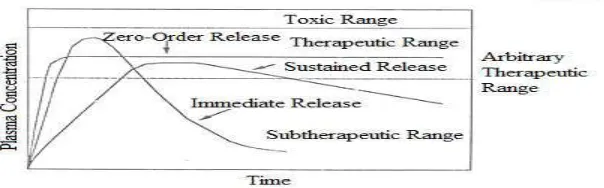
In the recent years considerable attentions has been focused in the development of extended release drug delivery system (ERDDS). The basic rationale of ERDDS optimizes biopharmaceutical, pharmacokinetic and pharmacodynamic properties of drug in such a way that its utility is maximized, side effects were reduced and control of condition as well as cure, in the shortest possible time by using minimum quantity of drug administered by the most suitable route becomes possible. Sustained drug release system includes any drug delivery system which achieves slow release of drug over an extended period of time, and includes both prolonged and controlled drug release system. If such a release system is effective in maintaining substantially constant drug level in the blood or target tissues, it is considered as controlled release drug delivery system. If, however, a drug delivery system is unsuccessful at achieving substantially constant blood or tissue drug levels, but nevertheless extend the duration of action of drug over that achieved by conventional delivery, it is considered a prolonged release system ( fig. 1).([1])
Fig. 1: Plasma drug concentration profiles for conventional tablets formulation, a sustained release formulation and a zero order controlled release formulation.
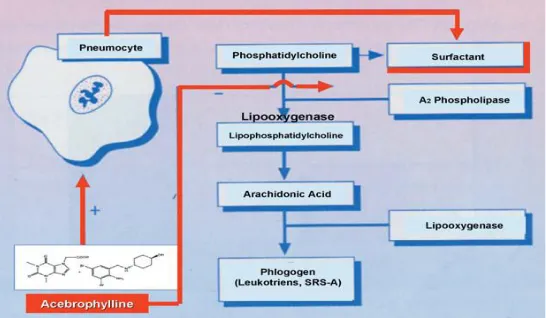
[image:2.595.142.444.428.522.2]www.wjpr.net Vol 3, Issue 3, 2014. 4588 Fig. 2:Effects on mucus and antiinflammatory action of acebrophylline. (Modified from G Cocco, GIMT (Suppl 1); 1992: 103-107)
Acebrophylline is therapeutically effective in patients with chronic obstructive or asthma-like bronchitis, acute or chronic bronchitis, and recurrence of chronic bronchitis; it reduces the frequency of episodes of bronchial obstruction. The success of therapy depends on selection of appropriate delivery systems as much as it depends on drug itself. Sustained release formulation of Acebrophylline can reduce the fluctuation in plasma drug concentration, thus minimizing or preventing plasma peak related adverse event, and allow prolongation of dosing interval, thus allowing once daily administration with inherent benefits in term of patient compliance.
The objective of the present study is to design a sustained release tablets containing Acebrophylline using different grades of HPMC as matrix former by aqueous wet granulation technique for drug delivery through GIT.
MATERIALS AND METHODS
Acebrophylline, Methocel K100 LV & Methocel K4M were received as a gift sample from Akums Drugs & Pharmaceuticals Ltd. Haridwar, Uttarakhand. Other materials used were of analytical grade, and procured from commercial sources.
PREFORMULATION STUDIES
DRUG- EXCIPIENTS COMPATIBILITY STUDY
www.wjpr.net Vol 3, Issue 3, 2014. 4589 for colour change, and odours after 7, 15, and 21 days. The IR spectra was taken after 10 days and 15 days and analyzed for any shift in major peaks. The primary objective of this investigation was to identify any incompatibility existing between ingredients.
FORMULATION DEVELOPMENT
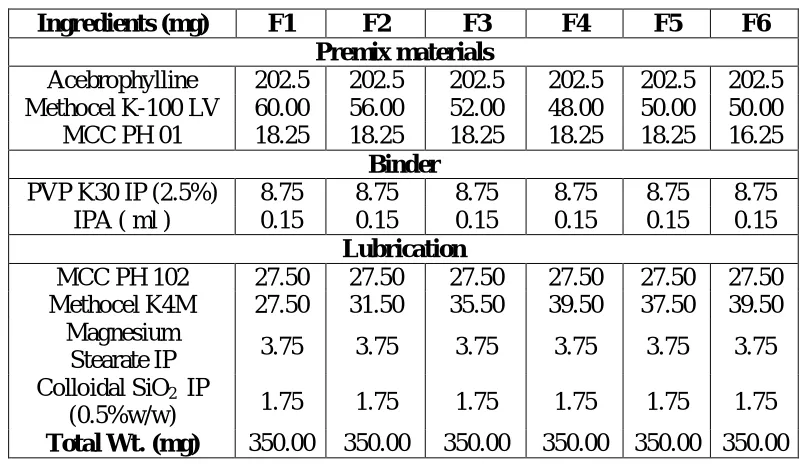
[image:4.595.96.498.261.493.2]Preparation of acebrophylline tablet was carried out by wet granulation method. A batch size of one thousand tablets was planned for each formulation based on trial-error method and the quantity for each tablet was expressed in milligram ( Table 1).
Table 1: Formulation development of different trial batches.
Ingredients (mg) F1 F2 F3 F4 F5 F6
Premix materials
Acebrophylline 202.5 202.5 202.5 202.5 202.5 202.5 Methocel K-100 LV 60.00 56.00 52.00 48.00 50.00 50.00 MCC PH 01 18.25 18.25 18.25 18.25 18.25 16.25
Binder
PVP K30 IP (2.5%) 8.75 8.75 8.75 8.75 8.75 8.75 IPA ( ml ) 0.15 0.15 0.15 0.15 0.15 0.15
Lubrication
MCC PH 102 27.50 27.50 27.50 27.50 27.50 27.50 Methocel K4M 27.50 31.50 35.50 39.50 37.50 39.50
Magnesium
Stearate IP 3.75 3.75 3.75 3.75 3.75 3.75 Colloidal SiO2 IP
(0.5%w/w) 1.75 1.75 1.75 1.75 1.75 1.75 Total Wt. (mg) 350.00 350.00 350.00 350.00 350.00 350.00 PREPRATION OF GRANULES
www.wjpr.net Vol 3, Issue 3, 2014. 4590 on drying was recorded by use of IR moisture balance at 65 0C for 10 minutes. The dried granules were first passed through sieve of 18 mesh size using a vibro sifter. The granules retained on sieve no.18 were then passed through Cad mill using screen of 1.5 mm with knives in forward orientation at slow speed. Methocel K4M, MCC and Colloidal silicon dioxide were passed through sieve of mesh size 100. Magnesium stearate was passed through sieve of mesh size 40. The granules were added into mixer along with Methocel K4M, colloidal silicon dioxide and blended for 15 min. MCC was then added and mixing was carried out for another 20 minutes. Finally the powder blend was transferred to a polyethylene bag and magnesium stearate, was added and mixed for 15 min. to obtain a uniform blend.
EVALUATION OF ACEBROPHYLLINE GRANULES
The flow properties of granules were characterized in terms of bulk density, tapped density, angle of repose, Carr’s index and Hausner ratio.
COMPRESSION
The lubricated granules were compressed in 12 station rotatory punching machine by applying 6-8 Kg/ cm2 pressure at 12-15 rpm speed with the following specifications. Punch type- D- tooling. Upper punch- 10.7 mm × 4.6 mm (concave and scored). Lower punch- 10.7 mm × 4.6 mm (concave and plain). Die- 10.7 mm × 4.6 mm, round.
EVALUATION OF TABLETS
Tablets of all batches were evaluated for different parameters like physical description, hardness, thickness, friability, drug content, disintegration time and in-vitrodrug release.
HARDNESS
The tablets from various trials were evaluated for hardness using the Monsanto hardness tester (Cadmach). Six tablets were used for hardness testing from each batch.
FRIABILITY
www.wjpr.net Vol 3, Issue 3, 2014. 4591 formula:
F = [1- W / W0] x 100
Where: W0 = weight of the tablets before the test & W = weight of the tablets after the test.
THICKNESS
The thickness of the tablet was measured by Vernier calipers.
DISINTEGRATION TIME
Six tablets was taken and introduced individually in each tube at same time and disc was added to each tube. Assembly was suspended in beaker containing 900 ml purified water and apparatus was operated for specified time. Assembly was removed from the liquid and observation taken.
WEIGHT VARIATION
Twenty tablets were selected at a random and average weight was calculated. Then individual tablets were weighed and the individual weight was compared with an average weight.
IN VITRO DISSOLUTION
In-vitro dissolution of tablet was studied in USP Type-2 dissolution apparatus (Electrolab) employing a paddle stirrer. The dissolution medium used was 900 ml of phosphate buffer pH 6.8. The stirrer was adjusted at a speed of 50 rpm. The temperature of dissolution media was previously warmed to 37 ± 0.5 °C and was maintained throughout the experiment. Five millilitre sample of standard and test solution were withdrawn from dissolution medium by means of syringe at known time intervals and filtered through 0.45 micron nylon membrane filter and analyzed for drug release by measuring the absorbance at 274 nm after suitable dilution in HPLC for chromatogram recording. The volume withdrawn at each time interval was replaced with fresh quantity of dissolution medium to maintain sink condition. Cumulative percentage amount of Acebrophylline released was calculated.
Percentage drug release =
DRUG RELEASE KINETICS
www.wjpr.net Vol 3, Issue 3, 2014. 4592 order, Higuchi matrix, Korsemeyer-Peppas and Hixson Crowell model. In this by comparing the r-values obtained, the best-fit model was selected.
STABILITY STUDIES
The optimized sustained release tablet of Acebrophylline (F5) was placed in containers covered and stored at ambient humidity conditions at 400C and at room temperature i.e. 250C for a period of 90 days. The samples were assayed for drug content at regular intervals of 15 days.
RESULTS AND DISCUSSION
DRUG- EXCIPIENTS COMPATIBILITY STUDY
Drug-excipients compatibility study revealed that physical mixture of drug and excipients were compatible upon exposure to room temperature (25°C±2°C/60%±5%), accelerated condition (40°C±2°C/75%±5% RH) and at extreme condition (60°C) at intervals of 1, 2 and 3 weeks. By using these excipients prototype formulation was developed.
EVALUATION OF GRANULES
Wet granulation method was used to prepare formulations by utilizing the compatible ingredients. A total of six trial batches were prepared. Prepared granules were evaluated for bulk density, tapped density, compressibility index, angle of repose and Hausner’s ratio and results are presented in table 2. Batch F1 had higher Hausner’s ratio and percentage compressibility index than other batches because of lower concentration of lubricant than others hence having comparatively poor flow properties.From table 2 it is clear that batch F5 exhibited lowest Hausner’s ratio and percentage compressibility index compared to other batches. Angle of repose of batch F5 was < 25 which shows excellent flow properties in comparison to other batches ( Table 2).
Table 2: Precompression results for trial batches.
Batches
Precompression Parameters Bulk density
(gm/cm3)
Tapped density (gm/cm3)
www.wjpr.net Vol 3, Issue 3, 2014. 4593 EVALUATION OF UNCOATED TABLETS
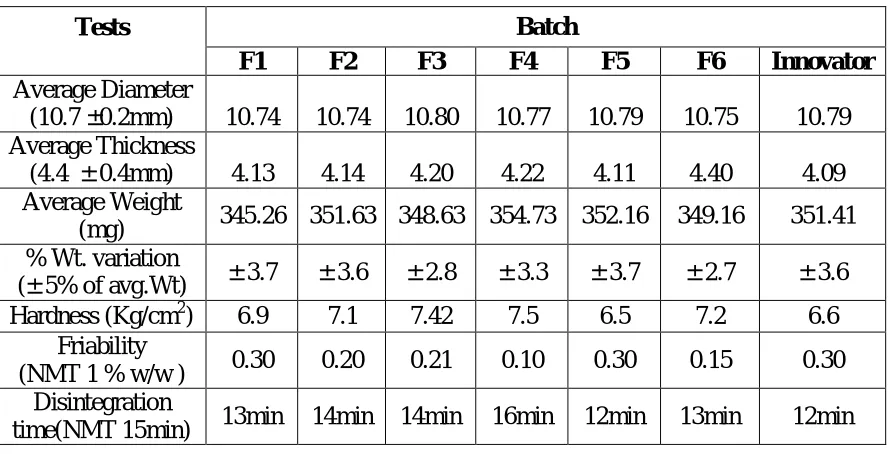
The in-process quality control parameters like average diameter, thickness, weight variation, hardness, friability and disintegration were evaluated and result are shown in table 3. The average length, width, and thickness were found to be within limit (10.70 mm± 0.2 mm, and 4.4 mm ± 0.4 mm respectively) ( Table 3).
Table 3: In-process quality control parameters of the trial batches
Tests Batch
F1 F2 F3 F4 F5 F6 Innovator
Average Diameter
(10.7 ±0.2mm) 10.74 10.74 10.80 10.77 10.79 10.75 10.79 Average Thickness
(4.4 ± 0.4mm) 4.13 4.14 4.20 4.22 4.11 4.40 4.09 Average Weight
(mg) 345.26 351.63 348.63 354.73 352.16 349.16 351.41 % Wt. variation
(± 5% of avg.Wt) ± 3.7 ± 3.6 ± 2.8 ± 3.3 ± 3.7 ± 2.7 ± 3.6 Hardness (Kg/cm2) 6.9 7.1 7.42 7.5 6.5 7.2 6.6
Friability
(NMT 1 % w/w ) 0.30 0.20 0.21 0.10 0.30 0.15 0.30 Disintegration
time(NMT 15min) 13min 14min 14min 16min 12min 13min 12min
IN VITRO DISSOLUTION
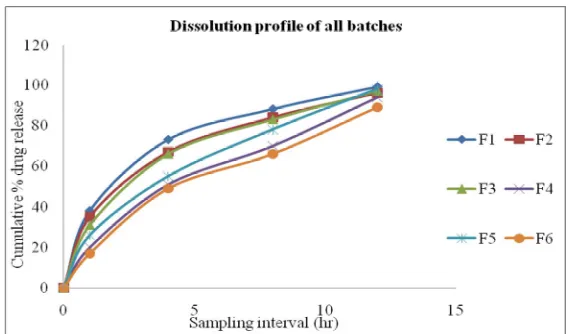
[image:8.595.77.522.207.434.2]Cumulative percentage drug release of uncoated sustained release tablets was estimated for the all six batches at different time intervals and it was showed in ( Table 4 ).
Table 4: In-vitro dissolution of tablets of various trial batches
*Dissolution of each batch was taken by means of average value (cumulative release)
In batch F5 drug release was much more controlled & found to be maximum when compared to other batches. Thus in comparison to other batches, batch F5 showed excellent release profile ( fig. 3 ).
Test Time (In House Specification)
Batches
F1 F2 F3 F4 F5 F6 Dissolution
* (6.8 Buffer)
Medium Apparatus-IP Type 1
1sthr (NMT 30 %) 38 35 31 20 26 17 4thhr (30-65 %) 73 67 66 51 55 49 8thhr (50-80 %) 88 84 83 70 78 66
www.wjpr.net Vol 3, Issue 3, 2014. 4594 Fig. 3: Comparative cumulative drug releases of trial batches
DRUG RELEASE KINETICS
The correlation coefficients for the different drug release kinetic models are shown in
[image:9.595.155.441.69.236.2]( Tables 5 ). Models with the highest correlation coefficient were judged to be the most appropriate model for the dissolution data.
Table 5: In vitro drug release model of different trial batches
S. No
Formulation/model and parameter Formulation Zero
order (r2)
First order (r2)
Higuchi (r2)
Korsemeyer - Peppas (r2)/n
Hixon - Crowell
(r2) 1 F1 0.637 0.951 0.972 0.969/0.383 0.978 2 F2 0.691 0.985 0.984 0.974/0.404 0.976 3 F3 0.747 0.970 0.989 0.982/0.464 0.983 4 F4 0.914 0.937 0.991 0.997/0.614 0.979 5 F5 0.873 0.914 0.999 0.992/0.523 0.978 6 F6 0.918 0.966 0.987 0.998/0.683 0.985
www.wjpr.net Vol 3, Issue 3, 2014. 4595 diffusion. It might be concluded that the drug release is controlled by more than one mechanism i.e. diffusion coupled with erosion mechanism. As all formulation shows high linearity (r2= 0.969 to 0.985) in case of Hixon-Crowell plot this shows that surface area continuously decreases with time ( Table 6 ). In our study from all kinetic data we conclude that F5 containing methocel K-100 LV and methocel K4M in 14.28 and 10.71 percent respectively is our best formulation.
Table 6: Release mechanism with variation of n* values
‘n’ Mechanism
<0.5 Fickian diffusion
0.5 < n < 1 Non Fickian diffusion or anomalous release
>1 Case II Transport
*The diffusional exponent is based on Korsemeyer‐Peppas equation, Mt/M∞ = Ktn
EVALUATION OF ACCELERATED STABILITY
Stability study was conducted on tablets of Batch F5 stored at 25°C ± 2°C/60% RH ± 5% RH (Room temperature) and 40°C ± 2°C/75% RH ± 5% RH (Accelerated condition) for 90 days. Tablets were evaluated for drug content and in-vitro release profile. No significant changes were observed in any of the studied parameters during the study period, thus it could be concluded that formulation of Batch F5 was stable ( Table 7 ).
Table 7: Stability data of optimized batch (F5) of Acebrophylline sustained release tablet
S. No.
Sampling Interval
(days)
% Residual Drug Contents* Physical Appearance 400C / 75%RH Room
temperature
400C / 75%RH
Room temperature 1. 0th 99.96 ± 0.010 99.96 ± 0.010 + +
www.wjpr.net Vol 3, Issue 3, 2014. 4596 CONCLUSION
A stable and effective sustained release (SR) tablet containing Acebrophylline in combination with retarding agent Methocel K100 LV (14.86% w/w) and Methocel K4M (10.14%w/w) was successfully developed.
REFERENCES
1. Thomas, W.Y.L. and Joseph, R.R. Controlled Release Drug Delivery System In The Science and Practice Pharmacy 2001;1(20):906-920.
2. Saraswathi, D., Priyadharisini, J., Niraimathi, V. and Suresh, A.J, Pectrophotometric estimation of Acebrophylline in bulk and capsule formulation, International Journal of Chemical Science 2010; 8(2):973-976.
3. Dr. Arjun, P. and Dr. Nair, V., Drug profile Acebrophylline (www.imakmj.com ) pp.258-259.
4. Pozzi, E. Acebrophylline: an airway mucoregulator and anti-inflammatory agent. Monaldi Arch Chest Dis, 2007; 67(2):106-115.
5. Cooper J and Gunns C, “Powder flow and compaction” Carter SJ, eds. Tutorial Pharmacy. New Delhi, India. CBS Publishers and Distributors, 1986, pp. 211-233.
6. Aulton ME , Wells TI, Pharmaceutics: “The Science of Dosage Form Design”, London, England:Churchill Livingston, 1988.
7. Leon, L. Lieberman, H.A. and Kiang, J.L. The Theory and Practice of Industrial Pharmacy. Bombay (India), Varghese Publishing House, 1991; 3:762-763.
8. The United State Pharmacopoeia 24, NF 19, United State Pharmacopoeia convention, Rockville, M.D. Asian Edition, 2000:1462-1465, 1913-1914.
9. Suvakanta Dash, Padala Narasimha, Murthy Lilakantanath and Prasanta Chowdhury,” Kinetic Modeling on Drug Release from Controlled Drug Delivery Systems”, Acta Poloniae Pharmaceutica ñ Drug Research, 2010; 67:217-223.
10.Indian Pharmacopoeia, Ghaziabad, Indian Pharmacopoeia Commission, 2007; Vol. I & II 11.Asian guideline on stability study of drug product. 9th ACCQS-PPWG Meeting,
Philippines, 2005:21-24.
12.Asian Journal of Pharmaceutical and Health Sciences, 1(4):181-186.
13.ICH harmonized tripartite guideline, stability testing of new drug substances and product Q1A (R2), pp. 1-15.
www.wjpr.net Vol 3, Issue 3, 2014. 4597 15.FDA. Guidelines for Submitting Documentations for the Stability of Human Drugs and