Acta Cryst.(2002). E58, m691±m693 DOI: 10.1107/S1600536802019888 Filipe A. Almeida Pazet al. [Co(C12H12N2)(H2O)4](C12H6O4)
m691
metal-organic papers
Acta Crystallographica Section E Structure Reports Online
ISSN 1600-5368
A one-dimensional Co
IIcoordination
polymer exhibiting an unusual conformation
for 1,2-bis(4-pyridyl)ethane
Filipe A. Almeida Paz, Andrew D. Bond, Yaroslav Z. Khimyak and Jacek Klinowski*
Department of Chemistry, University of Cambridge, Lensfield Road, Cambridge CB2 1EW, England
Correspondence e-mail: [email protected]
Key indicators
Single-crystal X-ray study
T= 180 K
Mean(C±C) = 0.006 AÊ
Rfactor = 0.042
wRfactor = 0.109 Data-to-parameter ratio = 7.9
For details of how these key indicators were automatically derived from the article, see http://journals.iucr.org/e.
#2002 International Union of Crystallography Printed in Great Britain ± all rights reserved
The title compound,catena-poly[[[tetraaquacobalt(II)]- -1,2-bis(4-pyridyl)ethane-2N:N] 2,6-naphthalenedicarboxylate], {[Co(C12H12N2)(H2O)4](C12H6O4)}n or {[Co(BPE)(H2O)4 ]-(NDC)}n [BPE is 1,2-bis(4-pyridyl)ethane and NDC is 2,6-naphthalenedicarboxylate], denoted CUmof-4, was synthe-sized under mild hydrothermal conditions. The crystal structure contains one-dimensional [Co(BPE)(H2O)4]n2n+ coordination polymers, which stack along the b direction, alternating with uncoordinated NDC anions. The Co atom is located on a centre of symmetry. Hydrogen bonds between the cationic polymer and the anions give rise to a three-dimensional network.
Comment
We are interested in the synthesis of novel coordination compounds which contain both carboxylate and 4-pyridyl groups coordinated to metal centres (Almeida Paz et al., 2002). In particular, the use of 1,2-bis(4-pyridyl)ethane (BPE), which has increased ¯exibility compared to 4,40-bipyridine
(BPY), due to the two methylene (ÐCH2±) groups between the 4-pyridyl rings, may lead to supramolecular isomerism (Hennigaret al., 1997).
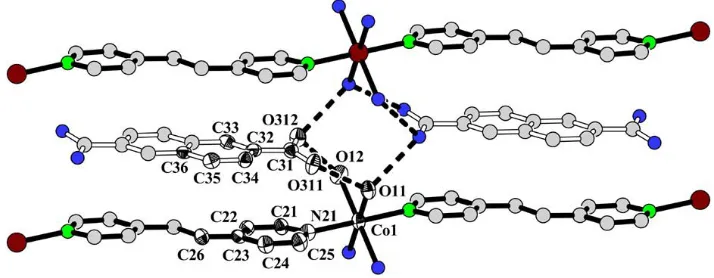
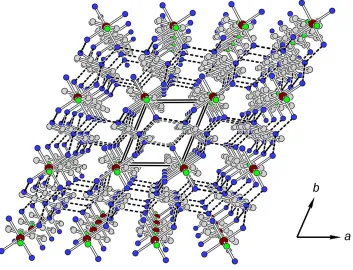
The title compound, CUmof-4, (I), contains one crystal-lographically unique cobalt(II) centre, which occupies a centre of symmetry in P1 and exhibits an almost ideal octahedral environment, composed of four water molecules in the equatorial plane and twotrans-coordinated 4-pyridyl N atoms in axial positions (Fig. 1 and Table 1). A one-dimensional cationic [Co(BPE)(H2O)4]n2n+ coordination polymer runs along the c direction (Fig. 2, top), with BPE ligands estab-lishing bridges between metal centres [Co1 Co1i = 13.529 (2) AÊ; symmetry code: (i) x, y, zÿ1]. These one-dimensional polymers alternate with NDC ions along the b
direction (Fig. 1), with the anions being brought into close face-to-face contact with the BPE ligands (the average separation between adjacent aromatic rings is ca 3.5 AÊ) (Fig. 2). These interactions may account for the unusual conformation of the BPE ligand, within which both 4-pyridyl
metal-organic papers
m692
Filipe A. Almeida Pazet al. [Co(C12H12N2)(H2O)4](C12H6O4) Acta Cryst.(2002). E58, m691±m693 groups lie in the same plane. OÐH Oÿ hydrogen bondsconnect the NDC anions to the coordinated water molecules, giving rise to a three-dimensional network (Fig. 3 and Table 2).
Experimental
All chemicals were obtained from commercial sources and were used without further puri®cation. To a solution of Co(NO3)26H2O
(0.476 g, Aldrich) in distilled water (12.4 g), 1,2-bis(4-pyridyl)ethane (BPE, 0.378 g, Aldrich), 2,6-naphthalenedicarboxylic acid (H2NDC,
0.437 g, Aldrich) and triethylamine (TEA, 0.388 g, Avocado) were added, and the mixture was stirred thoroughly for 1 h at ambient temperature. The suspension, with an H2NDC:Co2+:BPE:TEA:H2O
ratio of 1.01:1.00:1.02:1.91:343, was placed in a Parr stainless steel te¯on-lined vessel (21 ml, 50% full). The reaction was performed under autogeneous pressure and static conditions in a pre-heated oven at 418 K for 3 h. The vessel was then cooled slowly inside the oven to 298 K at a rate of 5 K hÿ1before opening. The crystalline
product was collected by vacuum ®ltration and crystals of the title compound were manually separated and preserved in a portion of the autoclave solution.
Crystal data
[Co(C12H12N2)(H2O)4](C12H6O4)
Mr= 529.40 Triclinic,P1
a= 6.3586 (12) AÊ
b= 7.0047 (10) AÊ
c= 13.529 (2) AÊ
= 88.463 (11)
= 77.165 (8)
= 68.056 (9)
V= 543.91 (15) AÊ3
Z= 1
Dx= 1.616 Mg mÿ3 MoKradiation Cell parameters from 6957
re¯ections
= 1.0±22.5
= 0.85 mmÿ1
T= 180 (2) K Plate, colourless 0.180.120.01 mm
Data collection
Nonius KappaCCD diffractometer Thin-slice!and'scans Absorption correction: multi-scan
(SORTAV; Blessing, 1995)
Tmin= 0.943,Tmax= 0.992 3625 measured re¯ections 1374 independent re¯ections
1189 re¯ections withI> 2(I)
Rint= 0.063
max= 22.3
h=ÿ6!6
k=ÿ7!7
l=ÿ14!14
Re®nement
Re®nement onF2
R[F2> 2(F2)] = 0.042
wR(F2) = 0.109
S= 1.20 1374 re¯ections 173 parameters
H atoms treated by a mixture of independent and constrained re®nement
w= 1/[2(F
o2) + (0.052P)2 + 0.0618P]
whereP= (Fo2+ 2Fc2)/3 (/)max= 0.007
max= 0.37 e AÊÿ3 min=ÿ0.42 e AÊÿ3
Table 1
Selected geometric parameters (AÊ,).
Co1ÐO11 2.103 (3)
Co1ÐN21 2.111 (3)
Co1ÐO12 2.141 (3)
O311ÐC31 1.264 (5)
O312ÐC31 1.265 (5)
O11ÐCo1ÐN21 92.29 (11)
O11iÐCo1ÐN21 87.71 (11)
O11ÐCo1ÐO12 94.68 (10)
O11iÐCo1ÐO12 85.32 (11)
N21ÐCo1ÐO12 91.82 (11)
N21iÐCo1ÐO12 88.18 (11)
Symmetry code: (i)ÿx;ÿy;ÿz.
Table 2
Hydrogen-bonding geometry (AÊ,).
DÐH A DÐH H A D A DÐH A
O11ÐH11A O312ii 0.82 (2) 2.03 (3) 2.846 (4) 170 (4) O11ÐH11B O311 0.82 (2) 1.83 (3) 2.654 (4) 174 (5) O12ÐH12A O312i 0.83 (2) 2.05 (3) 2.867 (4) 170 (4) O12ÐH12B O311iii 0.83 (2) 1.96 (3) 2.777 (4) 170 (4)
Symmetry codes: (i)ÿx;ÿy;ÿz; (ii)ÿx;ÿ1ÿy;ÿz; (iii)ÿ1ÿx;ÿy;ÿz.
Figure 3
Perspective view of CUmof-4 along thec direction, showing the OÐ H Oÿhydrogen-bonding network (dashed lines). H atoms have been
omitted for clarity. Figure 1
View approximately along theadirection, showing alternation alongb between one-dimensional cationic [Co(BPE)(H2O)4]n2n+ coordination polymers and NDC anions. Hydrogen bonds are drawn as dashed lines. The asymmetric unit of CUmof-4 is represented with ellipsoids drawn at the 50% probability level. H atoms have been omitted for clarity. Colour scheme: C grey, N blue, O blue, Co brown.
Figure 2
Perspective view of CUmof-4 along the bdirection. CoII centres are
H atoms bound to carbon were placed in calculated positions and allowed to ride during subsequent re®nement, with Uiso(H) =
1.2Ueq(C). Aqua H atoms were located in difference Fourier maps
and re®ned with a single isotropic displacement parameter common to all H atoms, and OÐH and H H distances restrained to ensure a reasonable geometry for the water molecules.
Data collection:COLLECT(Nonius, 1998); cell re®nement:HKL SCALEPACK(Otwinowski & Minor, 1997); data reduction:HKL DENZO (Otwinowski & Minor, 1997) and SCALEPACK; program(s) used to solve structure:SIR92 (Altomareet al., 1994); program(s) used to re®ne structure: SHELXTL (Bruker, 2001); molecular graphics: XP in SHELXTL; software used to prepare material for publication:SHELXTL.
We are grateful to the Portuguese Foundation for Science and Technology (FCT) for ®nancial support through PhD scholarship No. SFRH/BD/3024/2000 (to FAAP), to the
Cambridge Oppenheimer Fund for a research fellowship (to YZK), and to the EPSRC for funding (to ADB) and ®nancial assistance towards the purchase of the CCD diffractometer.
References
Almeida Paz, F. A., Khimyak, Y. Z., Bond, A. D., Rocha, J. & Klinowski, J. (2002).Eur. J. Inorg. Chem.pp. 2823±2828.
Altomare, A., Cascarano, G., Giacovazzo, C., Guagliardi, A., Burla, M. C., Polidori, G. & Camalli, M. (1994).J. Appl. Cryst.27, 435.
Blessing, R. H. (1995).Acta Cryst.A51, 33±58.
Bruker (2001). SHELXTL. Version 6.12. Bruker AXS Inc., Madison, Wisconsin, USA.
Hennigar, T. L., MacQuarrie, D. C., Losier, P., Rogers, R. D.. & Zaworotko, M. J. (1997).Angew. Chem. Int. Ed.36, 972±973.
Nonius (1998).COLLECT. Nonius BV, Delft, The Netherlands.
Otwinowski, Z. & Minor, W. (1997). Methods in Enzymology, Vol. 276,
Macromolecular Crystallography, Part A, edited by C. W. Carter Jr and R. M. Sweet, pp. 307±326. New York: Academic Press.
supporting information
sup-1
Acta Cryst. (2002). E58, m691–m693
supporting information
Acta Cryst. (2002). E58, m691–m693 [doi:10.1107/S1600536802019888]
A one-dimensional Co
IIcoordination polymer exhibiting an unusual
conformation for 1,2-bis(4-pyridyl)ethane
Filipe A. Almeida Paz, Andrew D. Bond, Yaroslav Z. Khimyak and Jacek Klinowski
S1. Comment
We are interested in the synthesis of novel coordination compounds which contain both carboxylate and 4-pyridyl groups
coordinated to metal centres (Almeida Paz et al., 2002). In particular, the use of 1,2-bis(4-pyridyl)ethane (BPE), which
has increased flexibility compared to 4,4′-bipyridine (BPY), due to the two methylene (–CH2–) groups between the
4-pyridyl rings, may lead to supramolecular isomerism (Hennigar et al., 1997).
The title compound, CUmof-4, (I), contains one crystallographically unique cobalt(II) centre, which occupies a centre
of symmetry in P1 and exhibits an almost ideal octahedral environment composed of four water molecules in the
equatorial plane and two trans-coordinated 4-pyridyl nitrogen atoms in axial positions (Fig. 1 and Table 1). A
one-dimensional cationic [Co(BPE)(H2O)4]n2n+ coordination polymer runs along the c direction (Fig. 2, top), with BPE ligands
establishing bridges between metal centres [Co1···Co1i = 13.529 (2) Å; symmetry code: (i) x, y, z − 1]. These
one-dimensional polymers alternate with NDC ions along the b direction (Fig. 1), with the anions being brought into close
face-to-face contact to the BPE ligands (the average separation between adjacent aromatic rings being ca 3.5 Å) (Fig. 2).
These interactions may account for the unusual conformation of the BPE ligand, within which both 4-pyridyl groups lie
in the same plane. O—H···O− hydrogen bonds connect the NDC anions to the coordinated water molecules, giving rise to
a three-dimensional network (Fig. 3 and Table 2).
S2. Experimental
All chemicals were obtained from commercial sources and were used without further purification. To a solution of
Co(NO3)2·6H2O (0.476 g, Aldrich) in distilled water (12.4 g), 1,2-bis(4-pyridyl)ethane (BPE, 0.378 g, Aldrich),
2,6-naphthalenedicarboxylic acid (H2NDC, 0.437 g, Aldrich) and triethylamine (TEA, 0.388 g, Avocado) were added, and the
mixture was stirred thoroughly for 1 h at ambient temperature. The suspension, with an H2NDC:Co2+:BPE:TEA:H2O ratio
of 1.01:1.00:1.02:1.91:343, was placed in a Parr stainless steel teflon-lined vessel (21 ml, filling rate 50%). The reaction
was performed under autogeneous pressure and static conditions in a pre-heated oven at 418 K for 3 h. The vessel was
then cooled slowly inside the oven to 298 K at a rate of 5 K h−1 before opening. The crystalline product was collected by
vacuum filtration and crystals of the title compound were manually separated and preserved in a portion of the autoclave
solution.
S3. Refinement
H atoms bound to carbon were placed in calculated positions and allowed to ride during subsequent refinement, with
Uiso(H) = 1.2Ueq(C). Aqua H atoms were located in difference Fourier maps and refined with a single isotropic
displacement parameter common to all H atoms, and O—H and H···H distances restrained to ensure a reasonable
supporting information
sup-2
[image:5.610.126.483.73.212.2]Acta Cryst. (2002). E58, m691–m693 Figure 1
View approximately along the a direction, showing alternation along b between one-dimensional cationic [Co(BPE)
(H2O)4]n2n+ coordination polymers and NDC anions. Hydrogen bonds are drawn as dashed lines. The asymmetric unit of
CUmof-4 is represented with ellipsoids drawn at the 50% probability level. H atoms have been omitted for clarity. Colour
scheme: C gray, N green, O blue and Co brown.
Figure 2
Perspective view of CUmof-4 along the b direction. CoII centres are represented as octahedra, BPE ligands with black and
[image:5.610.123.492.303.389.2]supporting information
sup-3
[image:6.610.131.484.73.343.2]Acta Cryst. (2002). E58, m691–m693 Figure 3
Perspective view of CUmof-4 along the c direction, showing the O—H···O− hydrogen-bonding network (dotted lines). H
atoms have been omitted for clarity.
catena-poly[[[tetraaquacobalt(II)]-µ-1,2-bis(4-pyridyl)ethane-κ2N:N] 2,6-naphthalenedicarboxylate]
Crystal data
[Co(C12H12N2)(H2O)4](C12H6O4) Mr = 529.40
Triclinic, P1 a = 6.3586 (12) Å b = 7.0047 (10) Å c = 13.529 (2) Å α = 88.463 (11)° β = 77.165 (8)° γ = 68.056 (9)° V = 543.91 (15) Å3
Z = 1 F(000) = 275 Dx = 1.616 Mg m−3
Mo Kα radiation, λ = 0.7107 Å Cell parameters from 6957 reflections θ = 1.0–22.5°
µ = 0.85 mm−1 T = 180 K Plate, colourless 0.18 × 0.12 × 0.01 mm
Data collection
Nonius KappaCCD diffractometer
Radiation source: fine-focus sealed tube Graphite monochromator
Thin–slice ω and φ scans
Absorption correction: multi-scan (SORTAV; Blessing, 1995) Tmin = 0.943, Tmax = 0.992
3625 measured reflections 1374 independent reflections 1189 reflections with I > 2σ(I) Rint = 0.063
θmax = 22.3°, θmin = 3.5° h = −6→6
supporting information
sup-4
Acta Cryst. (2002). E58, m691–m693 Refinement
Refinement on F2
Least-squares matrix: full R[F2 > 2σ(F2)] = 0.042 wR(F2) = 0.109 S = 1.20 1374 reflections 173 parameters 6 restraints
Primary atom site location: structure-invariant direct methods
Secondary atom site location: difference Fourier map
Hydrogen site location: inferred from neighbouring sites
H atoms treated by a mixture of independent and constrained refinement
w = 1/[σ2(F
o2) + (0.052P)2 + 0.0618P]
where P = (Fo2 + 2Fc2)/3
(Δ/σ)max = 0.007
Δρmax = 0.37 e Å−3
Δρmin = −0.42 e Å−3
Special details
Geometry. All e.s.d.'s (except the e.s.d. in the dihedral angle between two l.s. planes) are estimated using the full covariance matrix. The cell e.s.d.'s are taken into account individually in the estimation of e.s.d.'s in distances, angles and torsion angles; correlations between e.s.d.'s in cell parameters are only used when they are defined by crystal symmetry. An approximate (isotropic) treatment of cell e.s.d.'s is used for estimating e.s.d.'s involving l.s. planes.
Refinement. Refinement of F2 against ALL reflections. The weighted R-factor wR and goodness of fit S are based on F2,
conventional R-factors R are based on F, with F set to zero for negative F2. The threshold expression of F2 > σ(F2) is used
only for calculating R-factors(gt) etc. and is not relevant to the choice of reflections for refinement. R-factors based on F2
are statistically about twice as large as those based on F, and R- factors based on ALL data will be even larger.
Fractional atomic coordinates and isotropic or equivalent isotropic displacement parameters (Å2)
x y z Uiso*/Ueq
Co1 0.0000 0.0000 0.0000 0.0222 (3)
O11 −0.2032 (5) −0.1818 (4) 0.0287 (2) 0.0266 (7)
H11A −0.171 (8) −0.264 (5) 0.073 (2) 0.049 (8)*
H11B −0.207 (9) −0.241 (6) −0.022 (2) 0.049 (8)*
O12 −0.2844 (5) 0.2830 (4) 0.0577 (2) 0.0296 (7)
H12A −0.240 (7) 0.359 (6) 0.086 (3) 0.049 (8)*
H12B −0.420 (5) 0.303 (6) 0.087 (3) 0.049 (8)*
O311 −0.2476 (5) −0.3552 (4) −0.1335 (2) 0.0298 (7)
O312 0.1401 (5) −0.5207 (4) −0.1781 (2) 0.0284 (7)
N21 −0.0504 (5) 0.0475 (5) −0.1492 (2) 0.0235 (8)
C21 0.1358 (7) 0.0030 (6) −0.2266 (3) 0.0230 (9)
H21A 0.2834 −0.0280 −0.2113 0.028*
C22 0.1263 (7) −0.0006 (5) −0.3267 (3) 0.0228 (9)
H22A 0.2648 −0.0349 −0.3786 0.027*
C23 −0.0877 (7) 0.0463 (5) −0.3518 (3) 0.0214 (9)
C24 −0.2827 (7) 0.1028 (6) −0.2721 (3) 0.0258 (10)
H24A −0.4332 0.1430 −0.2856 0.031*
C25 −0.2590 (7) 0.1009 (6) −0.1733 (3) 0.0273 (10)
H25A −0.3952 0.1387 −0.1199 0.033*
C26 −0.1130 (7) 0.0341 (6) −0.4595 (3) 0.0238 (9)
H26A −0.2166 0.1715 −0.4748 0.029*
H26B −0.1909 −0.0632 −0.4640 0.029*
C31 −0.0592 (7) −0.4456 (6) −0.1980 (3) 0.0238 (10)
supporting information
sup-5
Acta Cryst. (2002). E58, m691–m693
C33 0.1213 (7) −0.5191 (5) −0.3845 (3) 0.0222 (9)
H33A 0.2687 −0.5556 −0.3682 0.027*
C34 −0.2949 (7) −0.4070 (5) −0.3320 (3) 0.0233 (9)
H34A −0.4323 −0.3670 −0.2792 0.028*
C35 −0.3108 (7) −0.4131 (5) −0.4308 (3) 0.0234 (10)
H35A −0.4598 −0.3767 −0.4454 0.028*
C36 −0.1113 (6) −0.4722 (5) −0.5118 (3) 0.0206 (9)
Atomic displacement parameters (Å2)
U11 U22 U33 U12 U13 U23
Co1 0.0172 (5) 0.0300 (5) 0.0187 (5) −0.0079 (3) −0.0051 (3) 0.0032 (3)
O11 0.0246 (17) 0.0350 (16) 0.0217 (17) −0.0117 (13) −0.0076 (14) 0.0037 (13)
O12 0.0196 (17) 0.0344 (16) 0.0327 (18) −0.0079 (13) −0.0051 (14) −0.0023 (14)
O311 0.0236 (18) 0.0413 (16) 0.0220 (16) −0.0111 (14) −0.0016 (14) −0.0053 (14)
O312 0.0214 (17) 0.0364 (15) 0.0264 (16) −0.0080 (13) −0.0084 (13) 0.0020 (13)
N21 0.018 (2) 0.0281 (17) 0.024 (2) −0.0086 (14) −0.0053 (16) 0.0019 (15)
C21 0.019 (2) 0.027 (2) 0.020 (2) −0.0059 (17) −0.0036 (19) 0.0034 (18)
C22 0.020 (2) 0.023 (2) 0.022 (2) −0.0055 (17) −0.0015 (18) 0.0012 (18)
C23 0.025 (2) 0.0188 (19) 0.021 (2) −0.0083 (17) −0.007 (2) 0.0051 (17)
C24 0.020 (2) 0.031 (2) 0.026 (2) −0.0077 (18) −0.008 (2) 0.0037 (19)
C25 0.018 (2) 0.035 (2) 0.025 (2) −0.0082 (18) −0.0014 (19) 0.0042 (19)
C26 0.024 (2) 0.026 (2) 0.022 (2) −0.0094 (17) −0.0084 (17) 0.0042 (17)
C31 0.027 (3) 0.024 (2) 0.023 (2) −0.0125 (19) −0.007 (2) 0.0034 (19)
C32 0.022 (2) 0.0172 (19) 0.025 (2) −0.0052 (16) −0.0045 (19) 0.0015 (17)
C33 0.020 (2) 0.022 (2) 0.025 (2) −0.0071 (17) −0.009 (2) 0.0050 (18)
C34 0.021 (2) 0.025 (2) 0.021 (2) −0.0074 (17) −0.0026 (18) −0.0002 (17)
C35 0.014 (2) 0.025 (2) 0.029 (3) −0.0045 (17) −0.006 (2) 0.0009 (19)
C36 0.018 (2) 0.0149 (19) 0.025 (2) −0.0031 (16) −0.0032 (18) 0.0028 (17)
Geometric parameters (Å, º)
Co1—O11 2.103 (3) C23—C26 1.509 (5)
Co1—O11i 2.103 (3) C24—C25 1.378 (6)
Co1—N21 2.111 (3) C24—H24A 0.950
Co1—N21i 2.111 (3) C25—H25A 0.950
Co1—O12 2.141 (3) C26—C26ii 1.520 (8)
Co1—O12i 2.141 (3) C26—H26A 0.990
O11—H11A 0.82 (2) C26—H26B 0.990
O11—H11B 0.82 (2) C31—C32 1.515 (6)
O12—H12A 0.83 (2) C32—C33 1.368 (5)
O12—H12B 0.83 (2) C32—C34 1.420 (5)
O311—C31 1.264 (5) C33—C36iii 1.422 (5)
O312—C31 1.265 (5) C33—H33A 0.950
N21—C21 1.337 (5) C34—C35 1.366 (5)
N21—C25 1.349 (5) C34—H34A 0.950
C21—C22 1.370 (5) C35—C36 1.413 (5)
supporting information
sup-6
Acta Cryst. (2002). E58, m691–m693
C22—C23 1.393 (5) C36—C33iii 1.422 (5)
C22—H22A 0.950 C36—C36iii 1.429 (7)
C23—C24 1.385 (6)
O11—Co1—O11i 180.00 (9) C22—C23—C26 123.2 (4)
O11—Co1—N21 92.29 (11) C25—C24—C23 120.2 (4)
O11i—Co1—N21 87.71 (11) C25—C24—H24A 119.9
O11—Co1—N21i 87.71 (11) C23—C24—H24A 119.9
O11i—Co1—N21i 92.29 (11) N21—C25—C24 122.7 (4)
N21—Co1—N21i 180.00 (17) N21—C25—H25A 118.7
O11—Co1—O12 94.68 (10) C24—C25—H25A 118.7
O11i—Co1—O12 85.32 (11) C23—C26—C26ii 115.4 (4)
N21—Co1—O12 91.82 (11) C23—C26—H26A 108.4
N21i—Co1—O12 88.18 (11) C26ii—C26—H26A 108.4
O11—Co1—O12i 85.32 (11) C23—C26—H26B 108.4
O11i—Co1—O12i 94.68 (11) C26ii—C26—H26B 108.4
N21—Co1—O12i 88.18 (11) H26A—C26—H26B 107.5
N21i—Co1—O12i 91.82 (11) O311—C31—O312 124.9 (4)
O12—Co1—O12i 180.0 O311—C31—C32 117.0 (3)
Co1—O11—H11A 114 (3) O312—C31—C32 118.1 (4)
Co1—O11—H11B 114 (3) C33—C32—C34 119.0 (4)
H11A—O11—H11B 110 (3) C33—C32—C31 120.7 (3)
Co1—O12—H12A 111 (3) C34—C32—C31 120.3 (4)
Co1—O12—H12B 130 (3) C32—C33—C36iii 122.0 (3)
H12A—O12—H12B 108 (3) C32—C33—H33A 119.0
C21—N21—C25 116.7 (3) C36iii—C33—H33A 119.0
C21—N21—Co1 119.0 (2) C35—C34—C32 120.5 (4)
C25—N21—Co1 124.0 (3) C35—C34—H34A 119.7
N21—C21—C22 123.9 (4) C32—C34—H34A 119.7
N21—C21—H21A 118.1 C34—C35—C36 121.7 (4)
C22—C21—H21A 118.1 C34—C35—H35A 119.1
C21—C22—C23 119.6 (4) C36—C35—H35A 119.1
C21—C22—H22A 120.2 C35—C36—C33iii 123.2 (3)
C23—C22—H22A 120.2 C35—C36—C36iii 118.3 (5)
C24—C23—C22 116.8 (4) C33iii—C36—C36iii 118.5 (4)
C24—C23—C26 120.0 (3)
O11—Co1—N21—C21 −126.5 (3) Co1—N21—C25—C24 −170.7 (3)
O11i—Co1—N21—C21 53.5 (3) C23—C24—C25—N21 0.7 (6)
O12—Co1—N21—C21 138.7 (3) C24—C23—C26—C26ii −178.7 (4)
O12i—Co1—N21—C21 −41.3 (3) C22—C23—C26—C26ii 0.1 (6)
O11—Co1—N21—C25 46.5 (3) O311—C31—C32—C33 167.6 (3)
O11i—Co1—N21—C25 −133.5 (3) O312—C31—C32—C33 −11.0 (5)
O12—Co1—N21—C25 −48.3 (3) O311—C31—C32—C34 −11.0 (5)
O12i—Co1—N21—C25 131.7 (3) O312—C31—C32—C34 170.4 (3)
C25—N21—C21—C22 −3.2 (5) C34—C32—C33—C36iii 0.5 (5)
Co1—N21—C21—C22 170.3 (3) C31—C32—C33—C36iii −178.1 (3)
supporting information
sup-7
Acta Cryst. (2002). E58, m691–m693
C21—C22—C23—C24 2.5 (5) C31—C32—C34—C35 177.9 (3)
C21—C22—C23—C26 −176.3 (3) C32—C34—C35—C36 0.2 (5)
C22—C23—C24—C25 −3.2 (5) C34—C35—C36—C33iii 179.8 (3)
C26—C23—C24—C25 175.6 (3) C34—C35—C36—C36iii 0.5 (6)
C21—N21—C25—C24 2.5 (5)
Symmetry codes: (i) −x, −y, −z; (ii) −x, −y, −z−1; (iii) −x, −y−1, −z−1.
Hydrogen-bond geometry (Å, º)
D—H···A D—H H···A D···A D—H···A
O11—H11A···O312iv 0.82 (2) 2.03 (3) 2.846 (4) 170 (4)
O11—H11B···O311 0.82 (2) 1.83 (3) 2.654 (4) 174 (5)
O12—H12A···O312i 0.83 (2) 2.05 (3) 2.867 (4) 170 (4)
O12—H12B···O311v 0.83 (2) 1.96 (3) 2.777 (4) 170 (4)