15
Multiple inheritance
F
ull application of inheritance requires an important extension to the framework defined in the preceding chapter. In studying the basics of the mechanism we have encountered the notion that a class may need more than one parent. Known as multiple inheritance (to distinguish it from the more restrictive case of single inheritance), this possibility is necessary to build robust object-oriented architectures by combining different abstractions.Multiple inheritance, in its basic form, is a straightforward application of the principles of inheritance already seen; you just allow a class to include an arbitrary number of parents. More detailed probing brings up two interesting issues:
• The need for feature renaming, which in fact has useful applications in single inheritance too.
• The case of repeated inheritance, in which the ancestor relation links two classes in more than one way.
15.1 EXAMPLES OF MULTIPLE INHERITANCE
The first task is to form a good idea of when multiple inheritance is useful. Let us study a few typical examples from many different backgrounds; a few will be shown in some detail, others only sketched.
This review is all the more necessary that in spite of the elegance, necessity and fundamental simplicity of multiple inheritance, obvious to anyone who cares to study the concepts, this facility has sometimes been presented (often, as one later finds out, based solely on experience with languages or environments that cannot deal with it) as complex, mysterious, error-prone — as the object-oriented method’s own “goto”. Although it has no basis in either fact or theory, this view has been promoted widely enough to require that we take the time to review a host of cases in which multiple inheritance is indispensable.
What not to use as an introductory example
To dispel a frequent confusion, we must first consider an example whose use (with some variants) by many introductory papers, books and lectures may account for some of the common mistrust of multiple inheritance. Not that there is anything fundamentally wrong with the example; it is simply inadequate for an introductory presentation, since it is not typical of simple, straightforward uses of multiple inheritance.
The standard form of this example involves classes TEACHER and STUDENT, part of the model for some university system; you will be invited to note that some students are also teachers, prompting a new class TEACHING_ASSISTANT that inherits from both TEACHER and STUDENT.
Is this example an improper use of inheritance? Not necessarily. But as an introduction to multiple inheritance it is about as bad as they can get. The problem is that TEACHER and STUDENT are not separate abstractions but variations on a common theme: person, or more accurately UNIVERSITY_PERSON. So if we draw the full picture we see a case of not just multiple but repeated inheritance — the scheme, studied later in this chapter, in which a class is a proper descendant of another through two paths or more:
Repeated inheritance is a special case; as will be noted when we get to it, using this facility requires good experience with the more elementary forms of inheritance, single and multiple. So it is not a matter for beginners, if only because it seems to create conflicts (what about a feature name or subscribe_to_health_plan which TEACHING_ASSISTANT inherits
A case of multiple inheritance…
TEACHING_ ASSISTANT
STUDENT TEACHER
… that is a case
of repeated inheritance
TEACHING_ ASSISTANT UNIVERSITY_
PERSON
STUDENT TEACHER
§15.1 EX AMPL ES OF M ULTIPLE INHE RIT ANCE 521
from both of its parents, even though they are really in each case a single feature coming from the common ancestor UNIVERSITY_PERSON?). With a well-reasoned approach we will be able to remove these conflicts simply. But it is a serious mistake to begin with such exceptional and seemingly tricky cases as if they were typical of multiple inheritance.
The truly common cases do not raise any such problem. Instead of dealing with variants of a single abstraction, they combine distinct abstractions. This is the form that you will need most often in building inheritance structures, and the one that introductory discussions should describe. The following examples belong to that pattern.
Can an airplane be an asset?
Our first proper example belongs to system modeling more than to software construction in the strict sense. But it is typical of situations that require multiple inheritance.
Assume a class AIRPLANE describing the abstraction suggested by its name. Queries may include passenger_count, altitude, position, speed; commands may include take_off, land, set_speed.
In a different domain, we may have a class ASSET describing the accounting notion of an asset — something which a company owns, although it may still be paying installments on it, and which it can depreciate or resell. Features may include purchase_ price, resale_value, depreciate, resell, pay_installment.
You must have guessed where we are heading: companies may own company planes. For the pilot, a company plane is just a plane with its usual features: it takes off, lands, has a certain speed, flies somewhere. From the viewpoint of the accountant (the one who grumbles that the money would have been better kept in the bank or spent on more productive ventures) it is an asset, with a purchase value (too high), an estimated resale value (too low), and the need to pay interest on the loan each month.
To model the notion of company plane we can resort to multiple inheritance:
class COMPANY_PLANE inherit PLANE
ASSET feature
… Any feature that is specific to company planes
(rather than applying to all planes or all assets) … end
Company planes
COMPANY_ PLANE
To specify multiple parents in the inherit clause, just list them one after the other. (As usual, you can use semicolons as optional separators.) The order in which you list parents is not significant.
Cases similar to COMPANY_PLANE abound in system modeling. Here are a few: • Wristwatches (a special case of the notion of watch, itself specializing the general
notion of clock — there are a few inheritance links here) provide commands such as setting the time, and queries such as the current time and date. Electronic calculators provide arithmetic features. There also exist some (quite handy) watch-calculators, elegantly modeled through multiple inheritance.
• Boats; trucks; AMPHIBIOUS_VEHICLE. A variant is: boats; planes; HYDROPLANE. (There is a hint of repeated inheritance here, as with TEACHING_ASSISTANT, since both parents may themselves be descendants of some VEHICLE class.)
• You eat in a restaurant; you travel in a train car. To make your trip more enjoyable, the railway company may let you eat in an instance of EATING_CAR. A variant of this example is SLEEPING_CAR.
• On an instance of SOFA_BED you may not only read but also sleep. • A MOBILE_HOME is a VEHICLE and a HOUSE.
And so on. Multiple inheritance is the natural tool to help model the endless combinations that astute people never tire of concocting.
For a software engineer the preceding examples may at first appear academic, since we get paid not to model the world but to build systems. In many practical applications, however, you will encounter similar combinations of abstractions. A detailed example, from ISE’s own graphical development environment appears later in this chapter.
Numeric and comparable values
The next example is much more directly useful to the daily practice of object-oriented software construction. It is essential to the buildup of the Kernel library.
Some of the Kernel library’s classes — that is to say, classes describing abstractions of potential use to all applications — require arithmetic features: operations such as
infix "+", infix "–", infix "∗", prefix "–" as well as special values zero (identity element for "+") and one (identity element for "∗"). Kernel library classes that use these features include INTEGER, REAL and DOUBLE; but many non-predefined classes may need them too, for example a class MATRIX describing matrices of some application-specific kind. It is appropriate to capture the corresponding abstraction through a deferred class NUMERIC, itself a part of the Kernel library:
deferred class NUMERIC feature
… infix "+", infix "–", infix "∗", prefix "–", zero, one …
§15.1 EX AMPL ES OF M ULTIPLE INHE RIT ANCE 523
Mathematically, NUMERIC has a precise specification: its instances represent members of a ring (a set equipped with two operations, both of which separately give it the structure of a group, one commutative, with distributivity between the two operations). Some classes also need an order relation, with features for comparing arbitrary elements: infix "<", infix "<=", infix ">", infix ">=". Again this is useful not only to some Kernel library classes, such as STRING whose instances are comparable through lexical ordering, but also to many application classes; for example you may write a class TENNIS_CHAMPION which takes into account the ranking of professional tennis players, with a feature "<" such that tc1 < tc2 tells us whether tc2 is ranked ahead of tc1. So it is appropriate to capture the corresponding abstraction through a deferred class COMPARABLE, itself a part of the Kernel library:
deferred class COMPARABLE feature
… infix "<", infix "<=", infix ">", infix ">=" …
end
COMPARABLE has a precise mathematical model: its instances represent members of a set ordered by a total order relation.
Not all descendants of COMPARABLE should be descendants of NUMERIC: in class STRING, we need the order features for lexicographical ordering but not the arithmetic features. Conversely, not all descendants of NUMERIC should be descendants of COMPARABLE: the set of real matrices has addition, multiplication, zero and one, giving it a ring structure, but no total order relation. So it is appropriate that COMPARABLE and NUMERIC, representing completely different abstractions, should remain distinct classes, neither of them a descendant of the other.
Objects of certain types, however, are both comparable and numeric. (In mathematical terms. the structures modeled by their generating classes are totally ordered rings.) Example classes include REAL and INTEGER: integers and real numbers can be compared for "<=" as well as added and multiplied. These classes should be defined through multiple inheritance, as in (see the figure on the next page):
expanded class REAL inherit NUMERIC
COMPARABLE feature
…
end
Types of objects that need to be both comparable and numeric are sufficiently common to suggest a class COMPARABLE_NUMERIC, still deferred, covering the merged abstraction by multiply inheriting from COMPARABLE and NUMERIC. So far this solution has not been adopted for the library because it does not bring any obvious advantage and seems to open the way to endless combinations: why not COMPARABLE_ HASHABLE, HASHABLE_ADDABLE_SUBTRACTABLE? Basing such deferred classes on well-accepted mathematical abstractions, such as ring or totally ordered set, seems to yield the right level of granularity. Related issues in the methodology of inheritance are discussed in detail in chapter 16.
Windows are trees and rectangles
Assume a window system that allows nesting windows to an arbitrary depth:
In the corresponding class WINDOW, we will find features of two general kinds: • Some deal with a window as a member of a hierarchical structure: list of
subwindows, parent window, number of subwindows, add or remove a subwindow. • Others cover its properties as a graphical object occupying a graphical area: height,
width, x position, y position, display, hide, translate.
INTEGER
NUMERIC COMPARABLE
REAL
DOUBLE
Multiple structure inheritance
§15.1 EX AMPL ES OF M ULTIPLE INHE RIT ANCE 525
It is possible to write the class as a single piece, with all these features mixed together. But this would be bad design. To keep the structure manageable we should separate the two aspects, treating class WINDOW as the combination of two abstractions:
• Hierarchical structures, which should be covered by a class TREE. • Rectangular screen objects, covered by a class RECTANGLE.
In practice we may need more specific class names (describing some particular category of trees, and a graphical rather than purely geometrical notion of rectangle), but the ones above will be convenient for this discussion. WINDOW will appear as:
class WINDOW inherit TREE [WINDOW] RECTANGLE feature
… Specific window features … end
Note that class TREE will be generic, so we need to specify an actual generic parameter, here WINDOW itself. The recursive nature of this definition reflects the recursion in the situation modeled: a window is a tree of windows.
This example will, later on in the discussion, help us understand the need for a feature renaming mechanism associated with inheritance.
A further refinement might follow from the observation that some windows are purely text windows. Although we might represent this property by introducing a class TEXT_WINDOW as a client of STRING with an attribute
text: STRING
we may prefer to consider that each text window is also a string. In this case we will use multiple inheritance from WINDOW and STRING. (If all windows of interest are text windows, we might directly use triple inheritance from TREE, RECTANGLE and STRING, although even in that case it is probably better to work in two successive stages.) The general question of how to choose between heir and client relations, as in the case of TEXT_WINDOW, is discussed in detail in the chapter on inheritance methodology.
Trees are lists and list elements
Class TREE itself provides a striking example of multiple inheritance.
A tree is a hierarchical structure made of nodes, each containing some information. Common definitions tend to be of the form “A tree is either empty or contains an object called the root, together with (recursively) a list of trees, called the children of the root”, complemented by a definition of node, such as “An empty tree has no nodes; the nodes of a non-empty tree comprise its root and (recursively) the nodes of its children”. Although useful, and reflective of the recursiveness inherent in the notion of tree, these definitions fail to capture its essential simplicity.
To get a different perspective, observe that there is no significant distinction between the notion of tree and that of node, as we may identify a node with the subtree of which it is the root. This suggests aiming for a class TREE [G] that describes both trees and nodes. The formal generic parameter G represents the type of information attached to every node; the tree below, for example, is an instance of TREE [INTEGER].
Now consider a notion of LIST, with a class that has been sketched in earlier chapters. A general implementation (linked, for example) will need an auxiliary class CELL to describe the individual elements of a list.
These notions suggest a simple definition of trees: a tree (or tree node) is a list, the list of its children; but it is also a potential list element, as it can be made into a subtree of another tree.
Although this definition would need some refinement to achieve full mathematical rigor, it directly yields a class definition:
deferred class TREE [G] inherit LIST [G]
CELL [G] feature
…
end
From LIST come the features to find out the number of children (count), add a child, remove a child and so on.
From CELL come the features having to do with a node’s siblings and parents: next sibling, add a sibling, reattach to a different parent node.
Definition: tree
A tree is a list that is also a list element.
A tree of integers
89
235 –2
0 –1
30 5 1000
(CELL)
§15.1 EX AMPL ES OF M ULTIPLE INHE RIT ANCE 527
This example is typical of the reusability benefits of multiple inheritance. Writing specific features for subtree insertion or removal would needlessly replicate the work done for lists. Writing specific features for sibling and parent operations would needlessly replicate the work done for list elements. Only a facelift is needed in each case.
In addition you will have to take care, in the feature clause, of the specific features of trees and of the little mutual compromises which, as in any marriage, are necessary to ensure that life together is harmonious and prolific. In a class TREE derived from these ideas, which has been used in many different applications (from graphics to structural editing), these specific features fit on little more than a page; for the most part, the class is simply engendered as the legitimate fruit of the union between lists and list elements.
This process is exactly that used in mathematics to combine theories: a topological vector
space, for example, is a vector space that also is a topological space; here too, some
connecting axioms need to be added to finish up the merger.
Composite figures
The following example is more than an example; it is a design pattern useful in many different contexts.
Consider an inheritance structure containing classes for various graphical figures, such as the one used in the preceding chapter to introduce some of the fundamental concepts of inheritance — FIGURE, OPEN_FIGURE, POLYGON, RECTANGLE, ELLIPSE and so on. So far, as you may have noted, that structure used single inheritance. Assume that we have included in this hierarchy all the basic figure patterns that we need. That is not enough yet: many figures are not basic. Of course we could build any graphical illustration from elementary shapes, but that is not a convenient way to work; instead, we will want to build ourselves a library of figures, some basic, some constructed from the basic ones. For example, from basic segment and circle figures
we may assemble a composite figure, representing a wheel
which someone may in turn use as a predefined pattern to draw, say, a bicycle; and so on.
Elementary figures
We need a general mechanism for adding a new figure type which will be built from previously defined ones but, once defined, will be on a par with them. Computer drawing tools provide a Group command for this purpose.
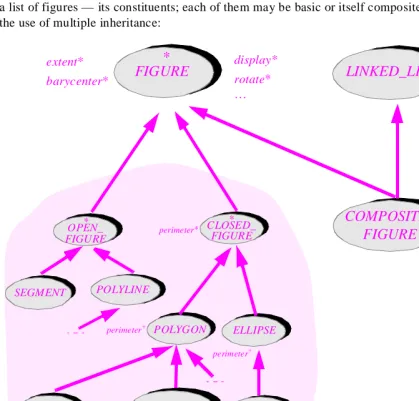
Let us call the corresponding notion COMPOSITE_FIGURE. A composite figure is clearly a figure; so COMPOSITE_FIGURE should inherit from FIGURE, achieving the goal of treating composite figures “on a par” with basic ones. A composite figure is also a list of figures — its constituents; each of them may be basic or itself composite. Hence the use of multiple inheritance:
To get an effective class for COMPOSITE_FIGURE we choose an implementation of lists; LINKED_LIST is just one possibility. The class declaration will look like this:
A composite figure is a figure and a list of figures
OPEN_ FIGURE
SEGMENT POLYLINE
POLYGON ELLIPSE
QUADRANGLE
[image:10.612.26.445.156.557.2]CIRCLE TRIANGLE
display* rotate* extent*
…
barycenter*
perimeter*
perimeter+
diagonal
SQUARE
perimeter++
perimeter++ perimeter+
CLOSED_ FIGURE
FIGURE
RECTANGLE
perimeter++ side1, side2
∗
∗
∗
COMPOSITE_
FIGURE
LINKED_LIST
BASIC
FIGURES
(see previous
§15.1 EX AMPL ES OF M ULTIPLE INHE RIT ANCE 529
class COMPOSITE_FIGURE inherit FIGURE
LINKED_LIST [FIGURE] feature
…
end
The feature clause is particularly pleasant to write. An operation on a composite figure is, in many cases, an operation on all of its constituents taken in sequence. For example, procedure display will be effected as follows in COMPOSITE_FIGURE:
display is
-- Display figure by displaying all its components in turn.
do from
start until
after loop
item●display forth end end
As in earlier discussions, we assume that our list classes offer traversal mechanisms based on the notion of cursor: start moves the cursor to the first element if any (otherwise after
is immediately true), after indicates whether the cursor is past all elements, item gives the value of the element at cursor position, and forth advances the cursor by one position.
I find this scheme admirable and hope its beauty will strike you too. Almost everything is concentrated here: classes, multiple inheritance, polymorphic data structures (LINKED_LIST [FIGURE]), dynamic binding (the call item●display will apply the proper variant of display based on the type of each list element), recursion (note that any list element — any item — may itself be a composite figure, with no limit on the degree of nesting). To think that some people will live an entire life and never see this!
It is in fact possible to go further. Consider other COMPOSITE_FIGURE features such as rotate and translate; because they all must apply the corresponding operation to every member figure in turn, their body will look very much like display. For an object-oriented designer this is cause for alert: we do not like repetition; we transform it, through encapsulation, into reuse. (This could yield a good motto.) The technique to use here is to define a deferred “iterator” class, whose instances are little machines able to iterate over a COMPOSITE_FIGURE. Its effective descendants may include DISPLAY_ITERATOR and so on. This is a straightforward scheme and is left to the reader as an exercise.
The technique describing composite structures through multiple inheritance, using a list or other container class as one of the parents, is a general design pattern, directly useful in widely different areas. Make sure to look at the exercise asking you to apply similar reasoning to the notion of submenu in a window system: a submenu is a menu, but it is also a menu entry. Another deals with composite commands in an interactive system. For the details see
“ACTIVE DATA STRUCTURES”, 23.4, page 774.
Exercise E15.4, page 567.
The marriage of convenience
In the preceding examples the two parents played a symmetric role. This is not always the case; sometimes each parent brings a contribution of a different nature.
An important application of multiple inheritance is to provide an implementation of an abstraction defined by a deferred class, using facilities provided by effective class.
Consider the implementation of stacks as arrays. Since classes are available to cover stacks as well as arrays (deferred for STACK, effective for ARRAY, both seen in earlier chapters), the best way to implement class ARRAYED_STACK, describing stacks implemented as arrays, is to define it as an heir to both STACK and ARRAY. This is conceptually right: an arrayed stack is a stack (as seen by clients) and is also an array (internally). The general form is:
indexing
description: "Stacks implemented as arrays" class ARRAYED_STACK [G] inherit
STACK [G]
ARRAY [G]
… A rename subclause will be added here (see page 540) …
feature
… Implementation of the deferred routines of STACK in terms of ARRAY operations (see below)…
end
ARRAYED_STACK offers the same functionality as STACK, effecting its deferred features such as full, put, count through implementations relying on array operations.
Here is an outline of some typical features: full, count and put. The condition under which a stack is full is given by
A marriage of convenience
ARRAYED_
STACK
∗
STACK
ARRAY
The deferred STACK class appeared on page 501; class
§15.1 EX AMPL ES OF M ULTIPLE INHE RIT ANCE 531
full: BOOLEAN is
-- Is stack representation full?
do
Result := (count = capacity) end
Here capacity, inherited from class ARRAY, is the number of positions in the array. For count we need an attribute:
count: INTEGER
This is a case of effecting a deferred feature into an attribute. Here finally is put: put (x: G) is
-- Push x on top.
require not full do
count := count + 1 array_put (x, count) end
Procedure array_put, inherited from ARRAY, assigns a new value to an array element given by its index.
The array features capacity and array_ put had different names in class ARRAY: count and
put. The name change is explained later in this chapter.
ARRAYED_STACK is representative of a common kind of multiple inheritance, called the marriage of convenience. It is like a marriage uniting a rich family and a noble family. The bride, a deferred class, belongs to the aristocratic family of stacks: it brings prestigious functionality but no practical wealth — no implementation worth speaking of. (What good is an effective change_top with a deferred put and remove?) The groom comes from a well-to-do bourgeois family, arrays, but needs some luster to match the efficiency of its implementation. The two make a perfect match.
Besides providing effective implementations of routines deferred in STACK, class ARRAYED_STACK may also redefine some which were not deferred. In particular, with an array representation, change_top (x: G), implemented in STACK as remove followed by put (x), may be implemented more efficiently as
array_put (x, count)
To make this redefinition valid, do not forget to announce it in the inheritance clause:
class ARRAYED_STACK [G] inherit STACK [G]
redefine change_top end
… The rest as before … The invariant of the class might read See “Using a
invariant
non_negative_count: count >= 0 bounded: count <=capacity
The two parts of the assertion are of a different nature. The first expresses a property of the abstract data type. (It was in fact already present in the parent class STACK, and so is redundant; it is included here for pedagogical purposes, but should not appear in a final version of the class.) The second line involves capacity, that is to say the array representation: it is an implementation invariant.
You might take a minute to compare ARRAYED_STACK, as sketched here, with STACK2 of an earlier discussion, and see how dramatically inheritance simplifies the class. This comparison will be pursued in the discussion of the methodology of inheritance, which will also address some of the criticisms occasionally heard against marriage-of-convenience inheritance and, more generally, against what is sometimes called implementation inheritance.
Structure inheritance
Multiple inheritance is indispensable when you want to state explicitly that a certain class possesses some properties beyond the basic abstraction that it represents.
Consider for example a mechanism that makes object structures persistent (storable on long-term storage). You may have to request that the lead object in a storable structure be equipped with the corresponding store and retrieve operations: in addition to its other properties such an object is “storable”. In the Kernel library, as we have seen, this property is captured by a class STORABLE, from which any other class can inherit. Clearly, such classes may have other parents as well, so this would not work without multiple inheritance. This form of inheritance, from a class that describes a general structural property — often with a name that ends with -ABLE — is similar to inheritance from classes COMPARABLE and NUMERIC seen earlier in this chapter. The discussion of inheritance methodology will define it as inheritance of the structural kind.
Without multiple inheritance, there would be no way to specify that a certain abstraction must possess two structural properties — numeric and storable, comparable and hashable. Selecting one of them as the parent would be like having to choose between your father and your mother.
Facility inheritance
Here is another typical case. Many tools need “history” facilities, enabling their users to perform such operations as:
• Viewing the list of recent commands. • Executing again a recent command.
• Executing a new command defined by editing a recent one and changing a few details.
“Implementation invariants”, page 377.
The methodological discussion is “It feels so good, but is it wrong?”, page 844.
STACK2 appeared on page 350.
On STORABLE see “Deep storage: a first view of persis-tence”, page 250.
§15.1 EX AMPL ES OF M ULTIPLE INHE RIT ANCE 533
• Undoing the effect of the last command not yet undone
Such a mechanism makes any interactive tool nicer to use. But it is a chore to write. As a result, only a few tools (such as certain “shells” under Unix and Windows) support it, often partially. Yet the general techniques are tool-independent. They can be encapsulated in a class, from which a session-control class for any tool can then inherit. (A solution based on the client relation may be possible, but is less attractive.) Once again, without multiple inheritance such an inheritance link would conflict with other possible parents.
A similar case is that of a class TEST encapsulating a number of mechanisms useful for testing a class: getting and storing user input, printing and storing output, comparing with expected values, recording all the results, comparing with earlier test runs (regression testing), managing the testing process. Although a client-based solution may be preferable in some cases, it is convenient to have the possibility, for testing a class X, of defining a class X_TEST that inherits from X and from TEST.
In later chapters we will encounter other cases of such facility inheritance, whereby a class F encapsulates a set of related facilities, such as constants or routines from a mathematical library, which any class can then obtain by inheriting from F.
Although the use of inheritance in such cases is sometimes viewed with suspicion, it is in fact a perfectly legitimate application of the concept. It does differ in one respect from the other examples of multiple inheritance reviewed in this chapter: in the cases just reviewed, we could achieve our goals, albeit less conveniently, with a client rather than inheritance link.
Buttonholes
Here is a case in which, as in earlier ones, multiple inheritance is indispensable. It is similar in spirit to “company planes”, “sleeping cars” and other examples of the combination-of-abstractions type encountered earlier. Rather than using concepts from some external model, however, this one deals with genuine software abstractions. The reason why it has been moved to the end of this review of multiple inheritance examples is that understanding it requires a little background preparation.
Like other graphical applications, many tools of the development environment presented in the last chapter offer “buttons”, on which you can click to trigger certain operations. They also use a “pick and throw” mechanism (a variation on traditional “drag-and-drop”), through which you can select a visual object, causing the mouse cursor to change into a “pebble” that indicates the type of the object, and bring it to a hole of a matching shape. You can “throw” the pebble into the hole by right-clicking; this causes some operation to occur. For example, a Class Tool, which you use to explore the properties of a class in the development environment, has a “class hole” into which you can drag-and-drop a class pebble; this causes the tool to retarget itself to the selected class. See chapter 24.
In the figure, a user has picked somewhere — in a Feature Tool — the class INTEGER, by right-clicking on its name. He is moving it towards the class hole of the Class Tool currently targeted to (showing the text of) class ARRAY. Note the row of format buttons at the bottom; clicking on one of them will show other information for ARRAY; for example if you left-click on you will get the short form. The pick-and-throw (unless canceled by a left-click) will end when the user right-clicks on the class hole, whose shape, representing Class, matches that of the pebble. This will retarget the Class Tool on the right to the selected class — INTEGER.
In some cases it may be convenient to let a hole act as button too, so that you can not only throw an object into it but also, independently of any pick-and-throw, left-click on it to produce a certain effect. For example the class hole, in which the small dot suggests the presence of a current target (first ARRAY, then INTEGER) can serve as a button; left-clicking on it retargets the tool to its current target, which is useful if the display was overwritten. Such holes which double up as buttons are called buttonholes.
As you will have guessed, class BUTTONHOLE multiply inherits from BUTTON and from HOLE. The new class simply combines the features and properties of its parents, since a buttonhole reacts like a button to the operations on buttons, and like a hole to the operations on holes.
An assessment
The examples accumulated so far are representative of the power and usefulness of multiple inheritance. Experience in building general-purpose libraries confirms that multiple inheritance is needed throughout.
Whenever you must combine two abstractions, not having multiple inheritance would mean that you choose one of them as the official parent, and duplicate all the other’s features by copy-and-paste — making the new class, as it were, an illegitimate child. On the illegitimate side, you lose polymorphism, the Open-Closed principle, and all the reusability benefits of inheritance. This is not acceptable.
The pebble being dragged The class hole
Format buttons
INTEGER
Pick-and-throw
See [M 1994a] on
§15.2 FE ATUR E REN AMIN G 535
15.2 FEATURE RENAMING
Multiple inheritance raises an interesting technical problem: name clashes. The solution, feature renaming, turns out to have applications far beyond that original problem, and leads to a better understanding of the nature of classes.
Name clashes
A class has access to all the features of its parents. It can use them without having to indicate where they come from: past the inherit clause in class C inherit A …, a feature f of C is known just as f. The same is true of clients of C: for x of type C in some other class, a call to the feature is written just x●f, without any reference to the A origin of f. If the metaphors were not so incompatible, we could view inheritance as a form of adoption: C adopts all the features of A.
It adopts them under their assigned names: the set of feature names of a class includes all of its parents’ feature name sets.
What then if two or more parents have used the same name for different features? We have relied on the rule of no intra-class overloading: within a class, a feature name denotes only one feature. This could now be violated because of the parents. Consider
class SANTA_BARBARA inherit LONDON
NEW_YORK feature
…
end-- class SANTA_BARBARA
What can we do if both LONDON and NEW_YORK had a feature named the same, say foo (for some reason a favorite name in programming examples)?
Do not attach too much importance to the names in this example, by the way. No useful abstraction is assumed behind the class names, especially none that would justify the inheritance structure. The names simply make the example easier to follow and remember than if we called our classes A, B and C.
Under no circumstances should we renounce the no-overloading rule, essential to keep classes simple and easy to understand. Within a class, a name should mean just one thing. So class SANTA_BARBARA as shown is invalid and the compiler must reject it.
This rule seems rather harsh. In an approach emphasizing construction-box-like combination of modules from several sources, we may expect attempts to combine separately developed classes that contain identically named features.
What can be done? You should not have to go back to the parents. You may not have access to the source text of LONDON and NEW_YORK; you may have access to it, but not be permitted to change it; you may be permitted but unwilling, as LONDON comes from an external supplier and you know there will be new releases, which would force you to do the work all over again; and most importantly you know about the Open-Closed principle, which says one should not disturb modules when reusing them for new extensions, and you are rightly wary of changing the interface of classes (LONDON and NEW_YORK) which may already have numerous clients that rely on the old names.
It is a mistake to blame the parents for a name clash occurring in inheritance: the problem is in the would-be heir. There too should the solution be.
The language solution to name clashes follows from these observations. A class that inherits different but identically named features from different parents is invalid, but will become valid by including one or more rename subclauses in the inheritance clause. A
rename subclause gives a new local name to one or more inherited features. For example:
class SANTA_BARBARA inherit LONDON
rename foo as fog end
NEW_YORK
feature
…
end -- class SANTA_BARBARA
Both within SANTA_BARBARA and in its clients, the foo feature from LONDON will be referred to as fog, and the one from NEW_YORK as foo. Clients of LONDON, of course, will still know the feature as foo.
This is enough (assuming there is no other clash, and no other feature of LONDON or NEW_YORK is called fog) to remove the clash. Of course, we could have renamed the NEW_YORK feature instead; or we could have renamed both for symmetry:
class SANTA_BARBARA inherit LONDON
rename foo as fog end
NEW_YORK
rename foo as zoo end
feature
…
end -- class SANTA_BARBARA
The rename subclause follows the name of a parent and comes before the redefine
§15.2 FE ATUR E REN AMIN G 537
class TREE [G] inherit
CELL [G]
rename item as node_item, put as put_right end
which removes clashes between features of CELL and their namesakes in the other parent, LIST. The clause renames the item feature from CELL as node_item, since this feature denotes the item attached to the current node, and similarly renames put as put_right.
Effects of renaming
Let us make sure we fully understand the results of a renaming. Assume the last form of class SANTA_BARBARA (the one that renames both inherited versions of foo):
(Note the graphical symbol for renaming: .) Assume entities of the three types: l: LONDON; n: NEW_YORK; s: SANTA_BARBARA
Then l●foo and s●fog are both valid; after a polymorphic assignment l := s they would have the same effect, since the feature names represent the same feature. Similarly n●foo and s●zoo are both valid, and after n := s they would have the same effect.
None of the following, however, is valid:
• l●zoo, l●fog, n●zoo, n●fog since neither LONDON nor NEW_YORK has a feature called fog or zoo.
• s●foo since as a result of the renaming SANTA_BARBARA has no feature called foo. Artificial as the names are, this example also illustrates the nature of the name clash issue. Believe it or not, I have heard it presented as a “deep semantic problem”. It is neither semantic nor deep; rather, a simple syntactical problem. Had one of the class authors been led by the local context to choose the name fog in the first class or zoo in the second, no clash would have occurred; yet in each case the change is just one letter. The name clash is, as it were, a case of bad luck; it does not reveal any intrinsic problem with the classes or their ability to be combined. If you think of multiple inheritance as marriage, this is not a dramatic case, discovered at the last minute, of a rare blood incompatibility; it is more like realizing that the spouses’ mothers are both called Tatiana, making life a little more complicated for their grandchildren to come, but easy to solve through proper naming conventions.
A name clash,
removed foo
foo fog
SANTA_ BARBARA
LONDON NEW_YORK
foo
Renaming and redeclaration
In the last chapter we studied another inheritance mechanism: redeclaration of an inherited feature. (Remember that redeclaration includes the redefinition of an already effective feature, and the effecting of a deferred one.) It is illuminating to compare the effect of renaming and redeclaring a feature:
• Redeclaration changes the feature, but keeps its name. • Renaming changes the name but keeps the feature.
With redeclaration you can ensure that the same feature name refers to different actual features depending on the type of the object to which it is applied (that is to say, the dynamic type of the corresponding entity). This is a semantic mechanism.
Renaming is a syntactic mechanism, allowing you to refer to the same feature under different names in different classes.
In some cases you may want to do both:
class SANTA_BARBARA inherit LONDON
rename foo as fog redefine
fog end
…
Then assuming l: LONDON; s: SANTA_BARBARA as before, and the polymorphic assignment l := s, the calls l●foo and s●fog will both trigger the redefined version (whose declaration must appear in a feature clause of the class).
You will have noted that the redefine subclause uses the new name. This is normal since that name is the only one under which the feature is known in the class. Accordingly, the rename clause appears before all other inheritance subclauses (redefine, and others yet to be studied: export, undefine, select). Past the rename clause, the feature — like an immigrant given a new identity at Ellis Island by a customs officer who found the old name too hard to pronounce — has shed its ancestral name and will be known under its new one to class, clients and descendants alike.
Local name adaptation
The ability to rename an inherited feature is interesting even in the absence of a name clash. It allows the designer of a class to define the appropriate name for every feature, whether immediate (declared in the class itself) or inherited.
§15.2 FE ATUR E REN AMIN G 539
suggest its own naming conventions. To provide this abstraction it finds the ancestor’s features useful, but not necessarily the feature names. Renaming, which enables us to distinguish features from feature names, provides the solution.
The construction of class WINDOW as an heir of TREE provides a good example. TREE describes the hierarchical structure, common to general trees and windows; but the tree names may not be desirable for the interface that WINDOW presents to its clients. Renaming provides the ability to put these names in tune with the local context:
class WINDOW inherit TREE [WINDOW]
rename
child as subwindow, is_leaf as is_terminal, root as screen,
arity as child_count, … end
RECTANGLE feature
… Specific window features …
end
Similarly, TREE inheriting from CELL may rename right as right_sibling and so on. Through renaming, a class may offer its clients a consistent set of names for the services it offers, regardless of how these services were built from facilities provided by ancestors.
The game of the name
The use of renaming for local name adaptation highlights the importance of naming — feature naming, but also class naming — in object-oriented software construction. A class is formally a mapping from feature names to features; the feature names determine how it will be known to the rest of the world.
In a later chapter we will see a number of systematic rules for choosing feature names. Interestingly, they promote a set of across-the-board names — count, put, item, remove, … — to emphasize commonalities between abstractions over the inevitable differences. This style, which increases the likelihood of name clashes under multiple inheritance, decreases the need for “vanity” renaming of the kind illustrated with WINDOW. But whatever general naming conventions we follow, we must have the flexibility to adapt the names to the local needs of each class.
Using a parent’s creation procedure
Let us see one more example of renaming, illustrating a typical scheme where the renamed feature is a creation procedure. Remember ARRAYED_STACK, obtained by inheritance from STACK and ARRAY; the creation procedure of ARRAY allocates an array with given bounds:
make (minb, maxb: INTEGER) is
-- Allocate array with bounds minb and maxb -- (empty if minb > maxb)
do … end
To create a stack, we must allocate the array so that it will accommodate a given number of items. The implementation will rely on the creation procedure of ARRAY:
class ARRAYED_STACK [G] inherit STACK [G]
redefine change_top end ARRAY [G]
rename
count as capacity, put as array_put, make as array_make end
creation make
feature -- Initialization make (n: INTEGER) is
-- Allocate stack for at most n elements.
require
non_negative_size: n >= 0 do
array_make (1, n) ensure
capacity_set: capacity = n empty: count = 0
end
… Other features (see “The marriage of convenience”, page 530) …
invariant
count >= 0; count <= capacity end -- class ARRAYED_STACK
Note that here our naming conventions — the use of make as the standard name for basic creation procedures — would cause a name clash, which, however, does not occur thanks to renaming.
§15.3 FL ATTE NIN G THE S TRUC TURE 541
15.3 FLATTENING THE STRUCTURE
Renaming is only one of the tools that the inheritance craftsman can use to build rich classes satisfying the needs of his clients. Another is redefinition. Later in this chapter, and in the next one, we will see a few more mechanisms: undefinition, join, select, descendant hiding. The power of these combined mechanisms makes inheritance sometimes obtrusive, and suggests the need for a special, inheritance-free version of a class: the flat form.
The flat form
In the view that we see emerging, inheritance is a supplier technique more than a client technique. It is primarily an internal tool for constructing classes effectively. True, the client side will need to know about the inheritance structure if it is to use polymorphism and dynamic binding (with a1: A; b1: B you need to know that B is a descendant of A if you are to use the assignment a1 := b1); apart from that case, however, the inheritance structure that led to a particular class is none of the clients’ business.
Like a good car mechanic, we are entirely led by the needs of our customers, but how we go about taking care of them in the back of the garage is our responsibility.
As a consequence, it should be possible to present a class in a self-contained manner, independent from any knowledge of its ancestry. This is particularly important in the case of using inheritance to separate various components of a composite abstraction, such as the tree and rectangle parts of the window concept.
The flat form of a class serves that purpose. It is not something you will ever write; instead, you will rely on a tool of the software development environment to produce it for you, through a command-line script (flat class_name) or when you click on a certain icon. The flat form of a class C is a valid class text which has exactly the same semantics as C when viewed from a client, except for polymorphic uses, but includes no inheritance clause. It is what the class would have looked like had its author not been able to use inheritance. To produce a flat form means:
• Removing the entire inherit clause if any.
• Keeping all the feature declarations or redeclarations of C.
• Adding declarations for all inherited features, copied from the declarations in the applicable parents and taking into account all the inheritance transformations that were specified in the inheritance clause: renaming, redefinition, undefinition,
select, feature join.
• Adding to each inherited feature a comment line of the form from ANCESTOR
indicating the name of the proper ancestor from which the current version is derived: the closest one that declared or redeclared the feature (and, in the case of a feature join, described later in this chapter, the winning side).
• Reconstructing the full invariant, by anding all the parents’ invariants, after applying the proper transformations if they use any renamed or selected feature.
The resulting class text shows all the features of the class at the same level, not making any difference (except for the from ANCESTOR comments) between immediate and inherited features. If present, the labels of feature clauses — as in feature -- Access
— are retained; clauses with identical labels, whether from parents or the class itself, are merged. Within each feature clause the features appear alphabetically.
The illustration below shows the beginning of the flat form of the Base library class LINKED_TREE, produced in a Class Tool of ISE’s development environment (and scrolled past the indexing clause). To obtain this result, you target the Class Tool to the class, and click on the Flat format button.
Uses of the flat form
The flat form is a precious tool for developers: it enables them to see the full set of properties of a class, all together in one place, ignoring how these features were derived in the inheritance games. A potential drawback of inheritance is that when reading a class text you may not immediately see what a feature name means, since the declaration can be in any ancestor. The flat form solves this problem by giving you the full picture.
The flat form may also be useful to deliver a stand-alone version of a class, not encumbered by the class history. That version will not be usable polymorphically.
An “immediate” feature is one intro-duced in the class itself.
Displaying a flat form
§15.4 RE PEAT ED IN HERITAN CE 543
The flat-short form
The flat form is a valid class text. So in its just mentioned role as documentation, it is of interest for the supplier side — for developers working on the class itself or a new descendant. The client side needs more abstraction.
In an earlier chapter we saw the tool that provides this abstraction: short
(corresponding in the last figure to the second button to the right of flat.)
Combining the two notions yields the notion of flat-short form. Like the short form, the flat-short form of a class only includes public information, removing any non-exported feature and, for exported features, removing any implementation aspects, do clauses in particular. But like the flat form, it treats all features, immediate or inherited, as peers — whereas for a class with parents the non-flat short form only shows information about immediate features.
The flat-short form is the primary mechanism for documenting classes, in particular reusable library classes, for the benefits of their users (client authors). The book presenting the Base libraries [M 1994a] provides all the class specifications in that form.
15.4 REPEATED INHERITANCE
As noted at the beginning of this chapter, repeated inheritance arises whenever a class is a descendant of another in more than one way. This case causes some potential ambiguities, which we must resolve.
Repeated inheritance will only arise explicitly in advanced development; so if you are only surveying the key components of the method you may skip directly to the next chapter.
Sharing ancestors
As soon as multiple inheritance is allowed into a language, it becomes possible for a class D to inherit from two classes B and C, both of which are heirs, or more generally descendants, of the same class A. This situation is called repeated inheritance.
See “Using asser-tions for documen-tation: the short form of a class”, page 390.
Repeated
inheritance A
D
B C
A
D
If B and C are heirs of proper descendants of A (case 1 in the figure), the repeated inheritance is said to be indirect. If A, B and C are all the same class (case 2), the repeated inheritance is direct; this is achieved by writing
class D inherit A
A
…
feature
…
end
Intercontinental drivers
The following system modeling example will enable us to see under what circumstances repeated inheritance may occur and to study the problem that it raises. Assume a class DRIVER with attributes such as
age: INTEGER address: STRING
violation_count: INTEGER -- The number of recorded traffic violations
and routines such as
pass_birthday is do age := age + 1 end pay_ fee is
-- Pay the yearly license fee.
do … end
An heir of DRIVER, taking into account the specific characteristics of US tax rules, may be US_DRIVER. Another may be FRENCH_DRIVER (with reference to places where cars are driven, not citizenship).
Now we may want to consider people who drive in both France and the US, perhaps because they reside in each country for some part of the year. A simple way to express this situation is to use multiple inheritance: class FRENCH_US_DRIVER will be declared as heir to both US_DRIVER and FRENCH_DRIVER. As shown by the figure at the top of the facing page, this causes repeated inheritance.
To make sure that the example is a proper use of inheritance we assume that US_DRIVER
and FRENCH_DRIVER are not just distinguished by the value of some attribute representing the country of driving, but are indeed distinct abstraction variants, each with its specific features. Chapter 24 discusses in depth the methodology of using inheritance.
Sharing and replication
The first and principal problem of repeated inheritance appears clearly in the intercontinental driver example:
§15.4 RE PEAT ED IN HERITAN CE 545
Consider a feature such as age. It is inherited from DRIVER by both US_DRIVER and FRENCH_DRIVER; so at first sight the name clash rule seems to require renaming. But this would be too stringent: there is no real conflict since age from US_DRIVER and age from FRENCH_DRIVER are not really different features: they are one feature, from DRIVER. Unless you are trying to hide something from someone, you have the same age wherever you happen to be driving. The same applies to procedure pass_birthday.
If you read carefully the rule about name clashes, you will have noted that it does not preclude such cases. It stated:
A class that inherits different but identically named features from different parents is invalid.
Here the versions of age and pass_birthday that FRENCH_US_DRIVER inherits from its two parents are not “different ” features, but a single feature in each case. So there is no real name clash. (An ambiguity could still exist if one of the features was redeclared in an intermediate ancestor; we will see shortly how to resolve it. For the moment we assume that nothing is redeclared.)
In such cases, when a feature coming from a repeated ancestor is inherited under the same name from two or more parents, the clear rule is that it should give a single feature in the repeated descendant. This case will be called sharing.
Is sharing always appropriate? No. Consider address, pay_ fee, violation_count: our dual drivers will most likely declare two different addresses to the respective Departments of Motor Vehicles; paying the yearly fee is a separate process for each country; and traffic violations are distinct. For each of these features inherited from DRIVER, class FRENCH_ US_DRIVER needs not one but two different features. This case will be called replication.
FRENCH_US_ DRIVER DRIVER
US_ DRIVER FRENCH_
DRIVER
pass_birthday pay_ fee age
address violation_count
Kinds of driver
What the example — and many others — also shows is that we could not get what we need with a policy that would either share all features of a repeated ancestor or replicate all of them. This is too coarse a level of granularity. We need the ability to tune the policy separately for each repeatedly inherited feature.
We have seen how to obtain sharing: just do nothing — inherit the original version from both parents under the same name. How do we obtain replication? By doing the reverse: inheriting it under two different names.
This idea is consistent with the general rule, simple and clear, that we apply to features and their names: within a class, a feature name denotes only one feature; two separate names denote two separate features. So to replicate a repeatedly inherited feature we simply make sure that some renaming occurs along the way.
This rule applies to attributes as well as routines. It gives us a powerful replication mechanism: from one feature of a class, it is possible in a descendant to get two or more features. For an attribute, this means an extra field in all the instances; for a routine, it means a new routine, initially with the same algorithm.
Except in special cases involving redeclaration, the replication can be conceptual only: no code actually gets duplicated, but the repeated descendant has access to two features.
The rule gives us the desired flexibility for combining classes. For example the class FRENCH_US_DRIVER may look like this:
class FRENCH_US_DRIVER inherit FRENCH_DRIVER
rename
address as french_address,
violation_count as french_violation_count, pay_ fee as pay_ french_ fee
end US_DRIVER
rename
address as us_address,
violation_count as us_violation_count, pay_ fee as pay_us_ fee
end feature
…
end -- class FRENCH_US_DRIVER
Repeated Inheritance rule
§15.4 RE PEAT ED IN HERITAN CE 547
The renaming occurs here at the last stage — in the repeated descendant — but some or all of it could also have been done by intermediate ancestors FRENCH_DRIVER and US_DRIVER; all that counts is whether in the end a feature is repeatedly inherited under one name or more.
The features age and pass_birthday, which have not been renamed along any of the inheritance paths, will remained shared, as desired.
A replicated attribute such as address will, as noted, yield a new field in each of the instances of the repeated descendant. So assuming there are no other features than the ones listed, here is how instances of the classes will look:
(Instances of FRENCH_DRIVER and US_DRIVER have the same composition as those of DRIVER as shown.)
This is the conceptual picture, but with a good implementation it must be the concrete representation too. Particularly important is the ability not to replicate the fields for shared attributes such as age in FRENCH_US_DRIVER. A naïve implementation would replicate all fields anyway; some fields, such as the duplicate age field, would simply never be used. Such waste of space is not acceptable, since it would accumulate as we go down inheritance
FRENCH_US_ DRIVER DRIVER
US_ DRIVER FRENCH_
DRIVER
pass_birthday pay_ fee age
address violation_count
pay_ fee pay_ french_ fee violation_count
french_violations_count
address french_address
pay_ fee pay_us_ fee violation_count
us_violations_count
address us_address
Sharing and replication
Attribute replication
violation_count address
age
(DRIVER)
(FRENCH_US_DRIVER)
french_violation_count french_address
age
hierarchies, and lead to catastrophic space inefficiency. (As a general rule, one must be very careful with attributes, as every attribute field will be present at run time in each one of the potentially many instances of a class and its descendants.)
The compiling mechanism of the development environment described at the end of this book indeed makes sure that no attribute space is lost: conceptually shared attributes are shared physically too. This is one of the most difficult parts of implementing inheritance and the calling machinery of dynamic binding, especially under the additional requirement that repeated inheritance must not affect the performance achievements described in earlier chapters:
• Zero cost for genericity.
• Small, constant-bounded cost for dynamic binding (that cost must be the same whether or not a system includes repeated inheritance).
The implementation meets these goals, making repeated inheritance a technique that any system can use at no extra cost.
Repeated inheritance in C++ follows a different pattern. The level of granularity for deciding to share or duplicate is the class. So if you need to duplicate one field from the repeated ancestor, you will need to duplicate all. For that reason, C++ users tend to stay away from this mechanism altogether. Java has eliminated the problem — by eliminating multiple inheritance.
Unobtrusive repeated inheritance
Cases of repeated inheritance similar to the “transcontinental drivers”, with duplicated features as well as shared ones, do occur in practice, but not frequently. They are not for beginners; only after you have reached a good level of sophistication and practice in object technology should you encounter any need for them.
If you are writing a straightforward application and end up using repeated inheritance, you are probably making things more complicated than you need to.
The figure shows a typical beginner’s (or absent-minded developer’s) mistake: D is made an heir of B, and also needs facilities from A; but B itself inherits from A. Forgetting that inheritance is transitive, the developer wrote
Redundant inheritance
A
§15.4 RE PEAT ED IN HERITAN CE 549
class D… inherit
B
A
…
This case causes repeated inheritance, but what it really shows is redundant inheritance. One of the pleasant consequences of the conventions discussed so far, and of the corresponding implementation, is that they will yield the expected behavior in such a case: in the absence of renaming, all features will be shared; no new features will be introduced, and there will be no performance overhead. Even if B renames some attributes, the only consequence will be some waste of space.
The only exception is the case in which B has redefined a feature of A, which causes an ambiguity in D. But then, as explained below, you will get an error message from the compiler, inviting you to select one of the two versions for use in D.
A case of redundant but harmless inheritance may occur when A is a class implementing general-purpose facilities like input or output (such as the class STD_FILES from the Kernel library), needed by D as well as B. It is enough for D to inherit from B: this makes D a descendant of A, giving it access to all the needed features. Inheriting redundantly will not, however, have any harmful consequences — in fact, it will have no consequences at all.
Such involuntary and innocuous cases of repeated inheritance may also occur as a result of inheritance from universal classes ANY and GENERAL, studied in the next chapter.
The renaming rule
(This section introduces no new concept but gives a more precise formulation of the rules seen so far, and an explanatory example.)
We can now give a precise working of the rule prohibiting name clashes:
Definition: final name
The final name of a feature in a class is:
• For an immediate feature (that is to say, a feature declared in the class itself), the name under which it is declared.
• For an inherited feature that is not renamed, its final name (recursively) in the parent from which it is inherited.
• For a renamed feature, the name resulting from the renaming.
Single Name rule
Two different effective features of a class may not have the same final name. See “THE GLOBAL
A name clash occurs if two different features, both effective, still have the same name even after renaming subclauses have been taken into account. Such a name clash makes the class invalid, but is easy to correct by adding the proper renaming subclause.
The key word is different features. If a feature from a repeated ancestor is inherited from both parents under the same name, the sharing rule applies: only one feature is being inherited, so there is no name clash.
The prohibition of name clashes only applies to effective features. If one or more homonymous features are deferred, you can actually merge them since there is no incompatibility between implementations; the details will be seen shortly.
The rules are simple, intuitive and straightforward. To check our understanding one final time, let us build a simple example showing a legitimate case and an invalid case:
class A feature
this_one_OK: INTEGER end
class B inherit A feature portends_trouble: REAL end
class C inherit A feature
portends_trouble: CHARACTER end
class D inherit
-- This class is invalid!
B C end
That class D inherits this_one_OK twice — once from B, once from C — does not cause a name clash, since the feature will be shared; it is indeed the same feature, coming from A, in each case.
The two features called portends_trouble, however, deserve their name: they are different features, and so they cause a name clash, making class D invalid. (They have different types, but giving them the same type would not affect this discussion.)
It is easy to make class D valid through renaming; for example:
class D inherit
-- This class is now quite valid.
B
rename portends_trouble as does_not_portend_trouble_any_more end
C end
A
D
B C
this_one_OK
§15.4 RE PEAT ED IN HERITAN CE 551
Conflicting redefinitions
In the cases seen so far only names could change along the various inheritance paths. What if some intermediate ancestor, such as B or C on the last figure, redeclares a feature that is then repeatedly inherited? Under dynamic binding there may be an ambiguity in D.
Two simple mechanisms, undefinition and selection, will solve the issue. As usual you will be invited to participate in the development of these mechanisms and will see that once a problem is stated clearly the language solution follows immediately.
Assume that somewhere along the way a repeatedly inherited feature gets redefined:
Class B redefines feature C (this is the conventional meaning of the ++ symbol, as you will recall). So now you have two variants of f available in D: the redefined version from B, and the version from C, which here is the original version from A. (We might assume that C also redefines f in its own way, but this would bring nothing to the discussion except more symmetry.) This is different from all the previous cases, in which there was only one version of the feature, possibly inherited under different names.
What are the consequences? The answer depends on whether D inherits the two versions of f under the same name or different names, that is to say whether the repeated inheritance rule implies sharing or replication. Let us review the two cases in turn.
Conflicts under sharing: undefinition and join
Assume first that the two versions are inherited under the same name. This is the sharing: case: with just one feature name, there must be exactly one feature. Three possibilitie