LEABHARLANN CHOLAISTE NA TRIONOIDE, BAILE ATHA CLIATH
TRINITY COLLEGE LIBRARY DUBLIN
OUscoil Atha Cliath
The University of Dublin
Terms and Conditions of Use of Digitised Theses from Trinity College Library Dublin
Copyright statement
All material supplied by Trinity College Library is protected by copyright (under the Copyright and
Related Rights Act, 2000 as amended) and other relevant Intellectual Property Rights. By accessing
and using a Digitised Thesis from Trinity College Library you acknowledge that all Intellectual Property
Rights in any Works supplied are the sole and exclusive property of the copyright and/or other I PR
holder. Specific copyright holders may not be explicitly identified. Use of materials from other sources
within a thesis should not be construed as a claim over them.
A non-exclusive, non-transferable licence is hereby granted to those using or reproducing, in whole or in
part, the material for valid purposes, providing the copyright owners are acknowledged using the normal
conventions. Where specific permission to use material is required, this is identified and such
permission must be sought from the copyright holder or agency cited.
Liability statement
By using a Digitised Thesis, I accept that Trinity College Dublin bears no legal responsibility for the
accuracy, legality or comprehensiveness of materials contained within the thesis, and that Trinity
College Dublin accepts no liability for indirect, consequential, or incidental, damages or losses arising
from use of the thesis for whatever reason. Information located in a thesis may be subject to specific
use constraints, details of which may not be explicitly described. It is the responsibility of potential and
actual users to be aware of such constraints and to abide by them. By making use of material from a
digitised thesis, you accept these copyright and disclaimer provisions. Where it is brought to the
attention of Trinity College Library that there may be a breach of copyright or other restraint, it is the
policy to withdraw or take down access to a thesis while the issue is being resolved.
Access Agreement
By using a Digitised Thesis from Trinity College Library you are bound by the following Terms &
Conditions. Please read them carefully.
Analysis of the MARK pathways,
in silico and
in vitro.
Thesis subm itted to the University of Dublin
for the degree of Doctor of Philosophy
By
Daniel Richard Caffrey
Department of Biochemistry
Trinity College Dublin
Declaration
This thesis is submitted by the undersigned to the University o f Dubiin for
the examination of Doctorate in Philosophy. The work herein is entirely my
own and has not been submitted as an exercise for a degree to any other
university. The library of Trinity College has my permission to lend or copy
this thesis upon request.
Summary
1
Acknowledgments
iii
Abbreviations
iv
List of Figures
V
List of Tables
vii
Chapter 1
1
Introduction
1
A Bioinformatic approach
1
Protein evolution and Sequence analysis
1
Neutral and adaptive protein evolution
2
Phylogenetic trees
4
Predicting functional sites in proteins
4
THE MAPK pathvi^ays
8
O bjective of thesis
11
Chapter 2
15
Introduction
15
Material and Methods
17
Sequences used in analysis
17
Multiple sequence alignments.
18
Phylogenetic tree reconstruction.
18
Bootstrapping
21
Additional information
21
Results
22
Term inology and evolutionary interpretation
22
Evolution of the MAPK family
22
Evolution of the MEK family
36
Evolution of the MEKK family
48
Evolution of the STE20/PAK family
60
Discussion
72
Yeast hyper-osm olarity and mammalian stress pathway evolution
72
Novel substrate specificities tend to evolve over long periods
75
An evolutionary model for the yeast pherom one and the mammalian ERK pathway
76
The yeast hypo-osm olarity pathway and the mammalian oxidative stress pathway
78
The yeast sporulation pathway
79
Conclusions
80
Introduction
82
Materials and methods
87
Multiple alignm ent and Prediction of ancestral sequences
87
Calculation of Burst After Duplication (BAD) scores
88
Calculation of subfam ily scores (SS) which ignore ancestral nodes
92
Analysis of BADT and SST predictions versus experimental evidence
93
Solvent accessibility and residue contacts
94
Results
96
Comparison of p38 and ERK
96
Comparison of p38 and JNK
111
Relationships between BAD / BADT scores and structure
124
Sites identified in MKK3/6, MKK4, and MKK7
126
Discussion
138
C h a p t e r 4
143
Introduction
143
Materials and Methods
146
Plasmids
146
Plasmid purification for Cloning
146
DNA Ligation and transform ation into competent cells
147
PCR conditions for Chimera construction
148
Chimera construction
151
Plasmid purification for transfection
154
Culture and transfection OF 293RI cells
155
Bradford assay
157
Immuno-precipitation protein kinase assay
157
Western blot procedure for detection of substrate phosphorylation
159
Western blot procedure for detection of flag-tagged protein expression
160
Results
161
Chimeric proteins require upstream activation in order to activate downstream targets
166
Activation of chim eric MAPKs by upstream MKKs.
173
Inhibition of MAPK signal by over-expression of JIP.
184
Discussion
186
C h a p t e r 5
iss
Final conclusions and com m ents
198
C h a p t e r 6
201
References
201
Appendix II
List of sup p liers
207
Summary
This thesis takes a combined computational and experimental approach to
study the MARK pathways. These proteins were chosen as they are highly
conserved in both sequence and function across all eukaryotes.
An evolutionary analysis demonstrated that the MARK pathways in
animals arose largely, by a co-ordinated set of gene duplications. This involved
the JNK and p38 pathways at the MARK and MKK levels. These pathways are
primarily involved in stress and immune responses. The gene duplications
occurred after the divergence of animals from fungi. However, a more ancient
cross talk involving STE11 has been retained in both animals and fungi.
A novel prediction method was developed in an attempt to delineate the
residues that were conferring pathway specificity between JNK and p38. The
method compared predicted ancestral residues at the gene duplication node with
the first animal speciation node, to identify sites of interest. The method was also
applied to predicting residues conferring functional differences between p38 and
ERK. This allowed a partial assessment of the method, as several experiments
analysing p38 and ERK specificity had been previously published. It was found
that the method improved differentiation between subfamily specific sites and
other sites, compared with an almost identical method that did not use ancestral
information. There were other predicted sites that represented either false
positives or uncharacterised sites. The prediction method was also applied to the
MKK components of the p38 and JNK pathways. It was found that all predictions,
also distinct results. This suggested that a similar region of these proteins were
involved in protein-protein interactions.
The p38 and JNK predictions were used to design p38/JNK chimeric
proteins. Some of these chimeras failed to express in cells and their role could
not be assessed. However, a key residue was identified as being important for
both upstream and downstream specificity in the JNK pathway. Introduction of
additional residues often disturbed this specificity, suggesting that they may have
been indirectly involved but not essential to subfamily specificity. The results
suggested that the prediction method was useful but also likely to give many
Acknowledgements
This work would not have been realised without the kind help and guidance of
Abbreviations
ERK
Extracellular Regulated Kinase
JNK
c-Jun-N-terminal Kjnase
MEK
MAPK/ERK Kinase
MEKK
MEK Kinase
MKK
Mitogen Activated Protein Kinase Kinase
MARK
Mitogen Activated Protein Kinase
PAK
p21 Activated Kinase
SAPK
Stress Activated Protein Kinase
IL1
Interleukin
1
.
DMSO
Dimethyl sulphoxide
DTT
Dithiothreitol
EDTA
Etylene-diamine-tetra-acetic acid
PCS
Foetal calf serum
List of Figures
Figure 1.1
A proposed model of residue types involved in protein-protein interactions.
7
Figure 1.2
A schematic diagram of the MARK pathways for S.
cerevisiae.
12
Figure 1.3
A schematic diagram of the MARK pathways for animals.
13
Figure 1.4
The three dimensional structures for p38 (A), JNK (B), and ERK (C).
14
Figure 2.1
Alignm ent of the MARK family.
34
Figure 2.2
Rhylogenetic tree for the MARK family.
35
Figure 2.3
Alignm ent for the MEK family.
46
Figure 2.4
Rhylogenetic tree for the t\/IEK family.
47
Figure 2.5
.Alignment for the MEKK family.
58
Figure 2,6
Phylogenetic tree for the MEKK family.
59
Figure 2.7
Alignment for the Ste20-PAK family.
70
Figure 2.8
Rhylogenetic tree for the STE20-RAK family.
71
Figure 3.1
Schematic diagram of the stress Induced MAR kinase pathways in
animals and yeast at the MARK and MKK levels.
85
Figure 3.2
Rhylogenetic trees for the JN K/p38 pathway.
86
Figure 3.3
Example of ancestral residues with multiple probabilities for a site
91
Figure 3.4
Alignm ent of sequences used in comparison between ERK and p38.
106
Figure 3.5
Prediction of sites conferring functional differences between ERK
and p38.
107
Figure 3.6
Prediction of sites conferring functional differences between ERK
and p38 as adapted from [29],
108
Figure 3.7
Alignm ent of JNK, p38, and ERK with structural features.
109
Figure 3.8
Alignm ent of sequences used in comparison between JNK and p38.
119
Figure 3.9:
Prediction of regions that have evolved functional differences in JNK
since its duplication from the Ik ' ancestor.
120
Figure 3.10
Prediction of regions that have evolved functional differences in p38
since its duplication from the 1k"ancestor.
121
Figure 3.11
Prediction of regions conferring functional differences between JNK
122
133
134
135
136
137
142
145
165
169
170
176
177
178
179
180
181
182
183
185
191
192
193
194
195
196
and p38.
Alignm ent of sequences used in comparison between MKKs.
Prediction of regions that have evolved functional differences in MKK7
since its duplication from the 2k"ancestor.
Prediction of regions that have evolved functional differences in MKK4
since its duplication from the 2k” ancestor.
Prediction of regions that have evolved functional differences in
MKK3/6 since its duplication from the 2k' ancestor.
Prediction of regions conferring functional differences between
MKK7, MKK4, and tVlKK3/6.
Carbon alpha trace of the p38 structure.
Schematic diagrams of the MAPK chimeras.
Aligned sequences for chimeric (C1-C9) and wild type proteins as
inferred from DNA sequence.
Substrate specificity of p38, JNK and JNK/p38 chimeras.
Residues differing between p38 and JNK/p38 chimeras.
Activation of p38 and JNK by various MKKs.
Activation of p38, JNK, and
p38/JNK chim eras by MKK3.
Activation of p38, JNK, and
p38/JNK chimeras by MKKS.
Activation of p38, JNK, and
p38/JNK chimeras by MKK4.
Activation of p38, JNK, and
p38/JNK chimeras by MKK7.
Activation of C5 by various MKKs.
Activation of C2 by various MKKs.
Activation of C4 by various MKKs.
The effect of JBD on p38, JNK, and JN K/p38 chim era activity.
Schem atic summ ary of experimental results.
List of Tables
Table 3.1
Sequences used in analysis
Table 3.2
Relationships between evolutionary change in physicochemical
properties and structural function for selected residues across
ERK (top) and p38 (bottom).
Table 3.3
Relationships between evolutionary change in physicochemical
properties and structural function for selected residues across
JNK (top) and p38 (bottom).
Table 3.4
The relationship between BADT values and exposed/buried for
JNK and p38.
Table 4.1
Primers used in study.
Table 4.2
The PCR conditions for chimera construction.
Table 4.3
Residues that differ between chimera 9 and chimera 2.
Table 4.4
Residues that differ between chimera 2 and chimera 4.
95
110
123
125
149
150
171
172
Chapter 1
Introduction
A Bioinformatic approach
One of the main challenges facing biologists, is to extract meaningful
knowledge from the wealth of information that is generated from various genomic
and proteomic projects. For example, it is relatively easy to sequence a genome,
but more difficult to identify the genes from the rest of the DNA [1], It is also
difficult to predict the function of a protein encoded by a gene unless it has
sequence similarity with another protein that has already been biochemically
characterised. It is likely that the most successful post genomic science will
involve a team of biologists and computational biologists, where a computer
based prediction will be made based on a biologists prior knowledge. This
prediction will in turn be tested by the biologist and reported back so as
eventually a reliable predictive model will exist for biologists to exploit. Similarly,
this project attempts to take a combined computational and experimental
approach.
Protein evolution and Sequence analysis
The majority of techniques applied in the following chapters are founded
on our knowledge of protein evolution and sequence analysis. The first matrices
for amino acid replacements were derived in the 1970’s [2]. PAM (Percentage
Accepted Mutations) matrices are based on the assumption that all sites in a
protein evolve independently and are essentially a matrix of weights that is
derived from how often different amino acids replace other amino acids as
observed in related proteins. In other words, matrices allow for a quantitative
measure of evolutionary distances between proteins and tell us how likely it is
that a particular residue will be replaced by another. Several other matrices have
been constructed since the pioneering work of Margaret Dayhoff. Weights have
been constructed on the basis of chemical and structural features of the different
amino acids [3 , 4]. The BLOSUM matrices [5] were constructed from alignments
of different percentage identities, such that a BLOSUM 45 (derived from
alignment of 45% identity) is more tolerant of non-conservative substitutions than
a BLOSUM 80 (derived from alignment of 80% identity). Almost all sequence
analysis programs use a substitution matrix, and their role is paramount.
The sequence families that were originally identified by Dayhoff relied
heavily on manual editing and were not automated. It was only in 1987, that
progressive multiple alignment schemes were devised [6-8] and a year later
before such programs became available for the microcomputer [9, 10]. All of
these methods use a substitution matrix to align their sequences. Since then,
multiple alignments have been used to various applications. For example, to
search for distantly related proteins [11], to predict secondary structure [12], to
predict protein 3D structure, (reviewed in [13 ]), to reconstruct phylogenetic trees
[14], and to predict contact maps [15].
Neutral and adaptive protein evolution
reconstructed from multiple alignments. Tree reconstruction is founded on some
fundamental theories of evolution that were developed in the 1960’s. As
sequence data for haemoglobins and cytochrome c became available, it was
observed that the rate of amino acid substitution was
approximately the
same
across different mammals [16-18]. This approximately constant rate of evolution
is referred to as the molecular clock. It is an important observation, as these
constant rates facilitate reconstruction of phylogenetic relationships between
different species and gene families. This in part led to the neutral mutation
hypothesis [19]. It argues that the majority of molecular changes in evolution are
the result of neutral mutations or random genetic drift rather than natural
selection. Of course, there are striking exceptions, where Darwinian selection is
the dominant form of evolution, e.g. the binding sites of the MHC molecules [20].
Positive selection or convergent evolution can cause the incorrect reconstruction
of a tree, e.g. the lysozyme family [21, 22]. In the case of the lysozymes, they
function as a bacteriolytic enzyme in both ruminents (e.g. cows) and colobine
monkeys (e.g. langur). This required that the proteins adapt to the harsh
environment of the stomach. Thus, lysozyme had undergone similar selective
changes in both ruminents and colobine monkeys such that the colobine
sequences cluster with ruminents rather than primates in the wrong tree.
However, it is likely that the mutation rates for most proteins are approximately
constant with only slight periodic changes in rates that will usually be reflected in
the branch length of the reconstructed tree. These changes in rates may reflect a
relaxation in constraint, particularly in a duplicated gene that is free to evolve as
the other copy remains conserved so that it can perform its function.
Phylogenetic trees
There are several methodologies for constructing trees, such as maximum
parsimony methods e.g. [23], maximum likelihood methods e.g. [24], and
distance based methods e.g. [14]. The latter method is used to reconstruct the
trees in this project, and generally performs well when the distances are
estimated accurately. However, accurate estimation of distances can be difficult
when the rate varies greatly among sites [25]. The primary application of trees in
this work is to distinguish between paralogues (arose by gene duplcation) and
orthologues (arose by speciation events). It is assumed that in general,
paralogues will have slightly different functions and that orthologues will have the
same function. It also allows investigation of the possibility that interacting
proteins arise by co-ordinated gene duplication events (as reviewed in [26 ]).
Predicting functional sites in proteins
This project also uses multiple alignment to predict residues conferring
functional differences between related proteins. Other groups have looked at
similar problems. In general, the underlying assumption is that a functionally
important site will be conserved through out evolution. The Valencia group
extended their idea of correlated mutations [15] to the problem of predicting sites
involved in protein-protein interactions [27]. Correlated mutations are essentially
sites that co-evolve due to their functional interaction. For example, a mutation in
one site will cause a compensatory mutation in another site that interacts with it.
The same group also developed a method for identifying tree determinant
residues [28]. These are essentially residues that are conserved within a
subfamily but differ from other subfamilies. Livingstone and Barton took a similar
approach, although their methodology for measuring differences between
subfamilies was more vague and was implemented in AMAS [29]. A similar
method using profiles and entropy as a measure of conservation has also been
described [30]. Armon
et al used phylogenetic information (evenly distributed
taxonomic sampling) to get a more informed measure of conservation for
predicting functional sites [31]. An alternative approach was taken by Gallet
et al
who analysed hydrophobicity distribution along linear stretches of sequences to
predict interacting sites [32]. Jones ef a/claim 66% accuracy in predicting the
"surface patch" of the protein that forms the protein-protein interface. [33].
Lichtarge ef a/developed a method that attempts to predict binding sitesby
mapping alignment information to a known three-dimensional structure [34].
Despite the encouraging results that these different methods yielded, it is clear
that predicting sites involved in protein-protein interactions is not trivial. A recent
analysis of 621 protein-protein interfaces by Glaser ef a/suggests that the
residue composition does not differ significantly from other regions of the protein
[35], They also looked at residue-residue contact preferences and their
observations were similar to previous studies. The most common residue pairing
was between 2 hydrophobic residues. They found that arginine and tryptophan
were the most common hydrophobic-charged pairing. The interaction of two
oppositely charged residues (salt-bridge) are also quite common, and previous
studies suggest that these account for 13% of residue interactions [36], Contacts
between two positive residues were more common than contacts between two
negative residues. There is an average of 18 Water molecules found between the
protein-protein interface, these often form hydrogen bonds between the protein-
protein interface, thus increasing the complexity of the protein-protein interaction
[37]. Taken together, these studies suggest that accurate prediction of functional
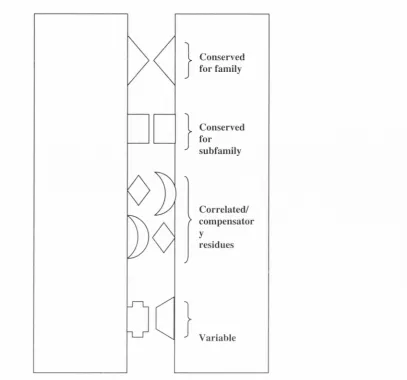
or binding sites in proteins will be a difficult task. A proposed model of the
different types of residues involved in protein-protein interaction is shown in
Figure 1.1
Conserved
for family
Conserved
for
subfamily
Correlated/
compensator
residues
[image:22.529.108.516.36.416.2]Variable
Figure
1 . 1:A proposed of model of residue types involved in protein - protein interactions.
The most critical residues are likely to be conserved across the fam ily (triangles) or conserved
across a subfam ily (squares). Other interacting sites will be variable across a fam ily but their
interacting proteins will have compensatory mutations (diamond/wedge) to maintain the
interaction. It is likely that variable residues are less important for interactions. It is possible that
conserved residues interact with variable residues but this is probably quite rare. It is not clear if
indirect interactions through water molecules are more prominent in conserved or variable
residues.
THE MARK pathways
The Mitogen Activated Protein Kinase (MARK) signalling pathways were
chosen as the proteins to model for a number of reasons. The signalling
pathways, the specificity of their protein-protein interactions, and biochemistry
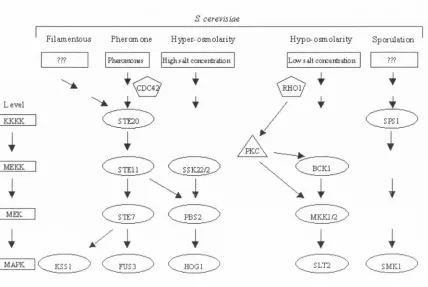
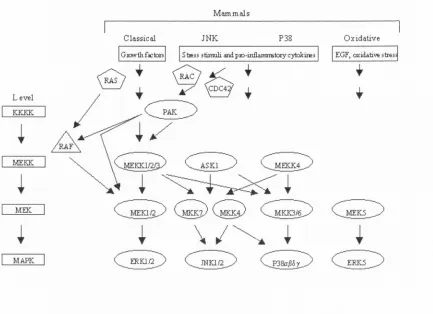
are reasonably well characterised and are summarised in Figures 1.2 and 1.3.
Sequences are available from a large and diverse number of eukaryotes, but
have remained relatively conserved. This means that they can be aligned to
provide a rich source of evolutionary information that can be potentially exploited.
The high degree of similarity is reflected in the three dimensional structures that
are illustrated in Figure 1.4. Despite the availability of structures for the MAPKs,
the multiple alignment is the primary source of information used in the analysis.
This is due to the simple fact that the number sequences exceeds the number of
structures. Indeed, this will be the case for any protein family, thus the need to
develop tools that can extract important information form such alignments.
A typical MARK pathway (MEKK->MEK->MARK) consists of a
serine/threonine MARK that is activated by its upstream dual specificity MARK /
ERK Kinase (MEK), which is activated by its upstream serine / threonine MEK
Kinase (MEKK). The MARK modules appear to be fundamental in relaying a
diverse set of signals into the cell. Depending on the cell type or organism a
MARK pathway can be activated by a diverse range of extra-cellular signals and
the downstream effect is also context dependent. Extracellular signals such as
pheromones, mitogens, osmotic stress, UV stress, and pro-inflammatory
number of activators. Likewise, the best known effects include mitosis and
programmed cell death, but it is clear that many genes are increased and
decreased in expression and the physiological effects will be cell and context
dependent. Some of the characterised examples are outlined below.
There are five distinct pathways within the budding yeast
S.cerevisiae.
In
mammals, there are several more MAP kinases. These cascades are
summarised in Figure 1.2 and Figure 1.3 and reviewed in [38-41]. The resulting
activation of the MAPKs allows them to bind and phosphorylate a wide variety of
substrates. Their translocation to the nucleus and subsequent activation of
transcription factors is probably documented best [42-44]. Other substrates of
MAPKs include the cytoplasmic phosphlipase A2 [45], and the EGF receptor [46],
The yeast pheromone and filamentation MAPK pathways are almost
identical with the exception of their preference at the MAPK level for FUS3 and
KSS1 respectively [47, 48]. Kinases belonging to these pathways share closest
sequence similarity with the animal classical (mitogenic) pathway, but the
physiological activators and responses are not necessarily similar [42]. For
example, mitogens and growth factors activate the classical pathway that leads
to multiple differentiation and developmental processes, while the pheromone
activated cascade causes cell arrest, morphogenic changes, and transcription of
genes necessary for mating. In yeast, the serine/threonine kinase STE20 has
been shown to act upstream of the MEKK STE11 [49]. It was proposed that
CDC42 is upstream of this pathway [50, 51]. An alternative view is that STE20
may be activated in the pheromone pathway by the Gpy protein complex via the
adapter protein STE5 and that CDC42 binding to STE20 is only essential for
pseudohyphal growth and cytokinesis [49]. In animals, the STE20 relatives are
called P21-Activated protein Kinases (PAKs) and were shown to interact with
Rac and human CDC42 to varying extents [52-54], The PAKs are likely to
activate MEKK1/2/3 (similarity to STE11). However, subsequent activation of the
classical pathway in this context is unclear as it appears that MEKK1 then
activates the p38 and JNK pathways [52, 55-60]. In the classical pathway, the
small G-protein RAS recruits a RAF kinase to the cell membrane, thus resulting
in its activation [61-64]. The activated RAF acts as a MEKK in the classical
pathway but sequence similarity with MEKK1/2/3/4 in not significant.
Interestingly, PAK3 has been shown to activate RAF [65].
Like the yeast hyper-osmolarity pathway, the animal JNK and p38
pathways are also activated by high salt concentrations [66]. It is unclear if the
upstream osmo-sensing components are ancestrally shared. In addition, the p38
and JNK pathways are activated by LPS, UV light, and cytokines [66]. The yeast
hyper-osmolarity pathway leads to activation of transcription factors that initiate
transcription of glycerol phosphate dehydrogenase, while the known targets of
JNK and p38 are necessary for mitotic arrest, expression of cytokines, and
apoptosis [42, 44].
The yeast hypo-osmolarity pathway is activated by PKC1, which lies
downstream of Rho1 [67]. PKC may by-pass BCK1 in the activation of this
pathway [68]. It is not known what genes are expressed as a result of this
pathway being activated. There are no clear orthologues identified in animals to
date and activation of the mammalian MARK pathways by PKC isoforms may
simply reflect its promiscuity
in vitro [69, 70].
Other potential activators of animal MARK pathways include: Mixed
lineage kinases (MLK3/SPRK/PTK-1) [71, 72], (DLK/MUK/LZK/ZPK) [73-75],
(MST/MLK2) [76], Ste20-like oxidant stress response kinase-1 (S0K-1/YSK-1)
[77, 78], Tpl-2 [79], TGPp activate kinase (TAK1) [80], and Apoptosis signal-
regulating kinase 1 (ASK1) [81]. Meanwhile, more recently discovered MAPK
components such as the MEK5-ERK5 pathway appear to be involved in
response to hyper-osmolarity, oxidative stress and EGF [82, 83]. Similarly, ERK3
and ERK4 are relatively uncharacterised [84, 85].
Objective of thesis
This project attempts to understand the evolution of the MARK pathways.
The evolutionary model is put in the context of kinase and pathway function.
Sites that confer functional differences between kinase subfamilies are then
predicted by exploiting the evolutionary model. The predictions are then tested
by standard experimental procedures.
S cerevisiae
Filam entous
Pheromone
H yper-osm olari^
H ypo-osm olarity
Sporulation
??? Pheromones H ig h $ a ll concentration L o w 5 alt concentration ???Level
K K K Ki
M E K K
i
M E KMAPK
1
1
( s i B O1
▼X ^ S T E 1 1 _ SSK22/2
C ^ S T E ? PBS2
i
* C ^ r u s 3 ^ H O G l
RHOl,
PKC
BCKl
4
SPSl
[image:27.528.72.500.114.401.2]T
Figure
1.2:
A schematic diagram of the MAPK pathways for S.
cerevisiae.
Kinases that are studied in this thesis are surrounded by ovals, other kinases are
in triangles, small G proteins are in pentagons, and arrows denote
phosphorylation. Many other activators of the MAPK modules have been omitted
for simplicity. Reviews or individual citations within the text should be consulted
for a more comprehensive description of the pathways, as experimental evidence
for activation of substrates is often ambiguous.
Mammals
C la s s ic a l J N K P38 O x id a tiv e G icw tli factors Sbfiss siiitTuh andpio-irifUimBtorycytokuies EGF, oxidative stress
RAS
Level
PAK.
KKKK
RAF
MEKK
MEKK1/2J
ASKl
MEKK4
MEK.
M EK1/2V V M K K V VMKK^
I
MAPK
Figure 1.3:
A schematic diagram of the i\/IAPK pathways for animals.
Kinases
that are studied in this thesis are surrounded by ovals, other kinases are in
triangles, small G proteins are in pentagons, and arrows denote phosphorylation.
Many other activators of the MAPK modules have been omitted for simplicity.
Reviews or individual citations within the text should be consulted for a more
comprehensive description of the pathways, as experimental evidence for
activation of substrates is often ambiguous.
[image:28.528.44.477.63.377.2]Chapter 2
Introduction
The first objective of the thesis was to establish the evolutionary
relationship between the kinases at different levels. This would allow the
distinction between orthologues and paralogues, that is, proteins that have arisen
by speciation events and those that have arisen by gene duplication respectively.
The reasoning behind this is that orthologues (often but not always) have similar
function, while paralogues often allow for novel or slightly different function to be
acquired.
The second objective was to establish if gene duplication patterns at
different levels in the cascade correlated with pathway and substrate specificity.
There are many examples of two interacting proteins being duplicated so that
there are two sets of interacting proteins, as reviewed in [26].
Thirdly, there are several so-called isoforms in the MAPK pathways that
have subtle differences in function. It was hoped that evolutionary analysis might
provide insight into their functional differences.
Briefly, a select number of kinases from each level and pathway were
searched against a copy of the non-redundant protein database to identify
candidate homologues. The kinases from each level were aligned using clustalw.
Alignments were then edited manually to ensure a correct and optimal alignment
was used for construction of evolutionary trees. Upon tree construction,
sequences that appeared to be evolving abnormally (long-branch attraction) were
omitted to allow reconstruction of a more stable and accurate tree. A bootstrap
analysis was performed as an assessment of the reliability of the tree
construction.
Material and Methods
Sequences used in analysis
The catalytic domains of 35 kinases belonging to the PAK-MEKK-MEK-
MAPK pathways were searched against the Non-redundant Protein database at
NCBI on November 1®'1998 using the NETBLAST program [86]. The search
data-set consisted of
Dictyostelium discoideum: ERK1 (SP P42525);
Saccharomyces cerevisiae: H0G1 (SP P32465), FUSS (SP P16892), KKQ1 (SP
P36005), KSS1 (SP P14681), SLT2 (SP Q00772), SMK1 (SP P41808), MKK1
(SP P32490), MKK2 (SP P32491), PBS2 (SP P08018), STE7 (SP P06784),
SSK2 (SP P53599), SSK22 (SP P25390), CLA4 (SP P48562), K 0L3 (SP
Q12469), SPS1 (SP P08458), STE20 (SP Q03497);
Schizosaccharomyces
pombe : BYR2 (SP P28829):Canc//da
albicans: STE20 (SP Q92212);
Homo
sapiens: ERK5 (SP Q13164), MEK2 (SP P36507), MKK3 (SP P46734), MEKK3
(SP Q99759), ASK1 (GB D84476), PAK1 (GB U51120), PAK3 (GB U25975) ;
xenopus laevis: p38 (SP P47812), MEK2 (SP Q07192);
Caenorhabditis elegans
SUR1 (SP P39745);
Mus muscuiis
(SP P47809), MEKK1 (SP P53349),
MEKK2 (SP Q61083), MEKK3 (SP Q61084), MEKK4a (GB U85607);
Rattus
norvegicus: PAK2 (SP Q62829). All proteins with P values of 1e-65, 1e-50, 1e-
40, 1e-50 or less (a raw score of approximately 250++) for MAPK, MEK, MEKK,
or PAK searches respectively were fetched locally from the
EMBI_/SWISSPROT/PIR databases at the Irish National Centre for
Bioinformatics.
Multiple sequence alignments.
Residues that were N and C terminal to the kinase catalytic domain could
not be aligned very well and were consequently removed as this would distort
tree construction. The catalytic domain for each kinase was identified using
previously described criteria as a guide [87], The catalytic domain of each protein
was aligned to a structural alignment that was held fixed using the
CLUSTALW1.7 package [88]. The structural alignment was based on the crystal
structures of the catalytic domains for Rat ERK2, Human Insulin receptor, Human
CDK2, Mouse p38, Human SRC, Mouse cAMP, Rabbit Phosphorylase B Kinase,
S Pombe casein Kinase, Rat Casein Kinase (SP P27703 [89]; SP P06213 [90];
SP P06213 [91]: SP P24941 [92]; SP P47811 [93]; SP P12931 [94], SP P05132
[95], SP P00518 [96]; SP P40233 [97]).
Phylogenetic tree reconstruction.
A neighbour-joining tree was drawn for the entire dataset using the
CLUSTALW tree drawing option [14]. The tree consisted of four major groupings
that coincided with the MAPK family, the MEK family, the MEKK family, and the
STE20-PAK family. Alignments for MAPK, MEK, MEKK, and STE20-PAK families
were extracted from the large alignment. To reduce errors in the tree
construction, the alignments were edited by hand before neighbour-joining trees
were constructed using the bootstrap option in CLUSTALW. All trees were
constructed with gaps excluded and corrected for multiple substitutions. Human
CDK2 (SP P24941) was used to root the MAPK and the MEK tree. The MEKK
and STE20-PAK trees were rooted with yeast STE20 (SP Q03497) and STE11
(SP P23561) respectively. Similar, redundant, outlying, unalignable, or fast
evolving sequences were removed and the trees were re-constructed using the
same options described above. The final trees were derived from the following
sequences that can be accessed at the Genbank™/EMBL (GB), Swissprot (SW),
and PIR (PIR) databases: SMK1_SC (SP P41808), MKC1_CA (SP P43068),
MPS1_MG (GB AF020316), SPM1_SP (SP Q92398), SLT2_SC (SP Q00772),
ERK5_HS (SP Q13164), SUR1_CE (SP P39745), ERKA_DM (SP P40417),
ERK1_HS (SP P27361), ERK2_HS (SP P28482), FUS3_SC (SP P16892),
KSS1_SC (SP PI 4681), SPK1_SP (SP P27638), ERK1_CA (SP P28869),
MAPK_PNC (GB AF043941), FSMAPK_NH (GB U52963), PMK1_MG (GB
U70134), ERK1_DD (SP P42525), MPK6_AT (SP Q39026), MAPK_PS (SP
Q06060), NTF4_NT (SP Q40532), MPK_AS (PIR S56638), MPK3_AT (SP
Q39023), MAPK1_PC (GB Y12785), NTF6_NT (SP Q40531), MPK5_AT
(Q39025), MPK4_AT (SP Q39024), MMK2_MS (SP Q40353), MPK7_AT (SP
Q39027), MPK1_AT (SP Q39021), MPK2_AT (SP Q39022), STY1_SP (SP
Q09892), H0G1_CA (SP Q92207), H0G1_SC (SP P32485), H0G2_ZR (GB
AB012088), H0G1_ZR (GB AB012146), B0218_CE (GB U58752), F42G8.3_CE
(GB AF038618), P38G_HS (SP P53778), P38D_HS (GB Y10488), P38_DM (GB
U86867), P38_CC (SP Q90336), P38_XL (SP P47812), P38A_HS (SP Q16539),
P38B_HS (SP Q15759), P38B2_HS (GB AF031135), B0478_CE (GB U57054),
JNK_DM (GB U73196), JNK2_HS (SP P45984), JNK1_HS (SP P45983),
JNK3_RN (SP P49187), MEK1_ZM (GB U83625), MEK1_LE (GB AJ000728),
MEK1_AT ( GB AF000977), MKK1_SC (SP P32490), MKK2_SC (SP P32491),
K08A8_CE (GB U38377), HEP_DM (SP Q23977), YR62_CE (SP Q20347),
VZC3741_GE (GB Z95122), MEK2_XL (SP Q07192), MKK4_HS (SP P45985),
MKK4_MM (SP P47809), R03G5_CE (GB U51994), MKK3_MM (SP 009110)
MKK3_HS (SP P46734), MKK6_HS (SP P52564), MKK6_MM (SP P70236),
PBS2_SC (SP P08018), WIS1_SP (SP P33886), MEK5 ANIMAL MEK5B_HS
(GB U71087), MEK5_RN (SP Q62862), MEK2_CE (PIR A56466), DSOR_DM
(SP Q24324), MEK2_RN (SP P36506), MEK2_HS (SP Q63932), MEK1_XL (SP
Q05116), MEK1_HS (SP Q02750), BYR1_SP (SP PI 0506), FUZ7_UM (GB
U07801), STE7_SC (SP P06784), STE7_CA (SP P46599), CDC7_SP (SP
P41892), CDC15_SC (SP P27636), MEKK4A_MM (GB U85607), MTK1_HS (GB
AF002715), SSK22_SC (SP P25390), SSK2_SC (SP P53599), WAK1_SP (GB
Y11989), WIN1+_SP (GB AJ223190), F9A6_CE (GB U41994), ASK1_HS (GB
D84476), MEKK5_DM (PIR JC4673), ATMEKK1_AT (GB D50468), MAP3KG_AT
(GB D50468), PMK1_SP (SP Q10407), BCK1_KL (GB AJ005079), BCK1_SC
(SP Q01389), BYR2_SP (SP P28829), NRC1_NCGB (AF034090), STE11_SC
(SP P23561), MEKK2_MM (SP Q61083), MEKK3_MM (SP Q61084),
MEKK3_HS (SP Q99759), MEKK1_HS (GB AF042838), MEKK1_MM (SP
Q62925), NPK1_NT ( PIR A48084), ANP1_AT (GB AB000796), NRK1_SC (SP
P38692), STE20_DD (GB U51923), DDPAK_DD (GB Y10158), MIHCK_AC (GB
U67056), SHK2_SP (SP Q10056), CLA4_CA (GB U87996), CLA4_SC (SP
P48562), SHK1_SP (GB L41552), PAK1_SP (SP P50527), STE20_SC (SP
Q03497), STE20_CA (SP Q92212), DPAK_DM (GB U49446), PAKLIKE_CE (GB
D83215), CEPAK_CE (GB U63744), PAK1_XL (GB AF000239), PAK1_RN (SP
P35465), PAK1_HS (SP Q13153), PAK3_HS (SP Q13177), PAK3_RN (SP
Q64303), PAK2_MM (SP Q61036), PAK2_RN (SP Q64303), LOK_MM (GB
D89728), KIAA020_HS (GB D86959), SLK_MM (GB AF039574), ZC_CE (GB
U55363), SIK1_AT (GB U96613), PRKSD_SD (GB Y13101), KRS1_RN (GB
U60206), KRS2_HS (GB U60207), SPAC9_SP (GB Z98763), SEVERIN_DD (GB
AF059534), T19A5_CE (GB U53153), S0K1_HS (GB X99325), YSK1_HS (GB
D63780), MST3_HS (GB AF024636), SPS1_SC (SP P08458), and SPAC_SP
(GB Z99259).
Bootstrapping
Bootstrapping is a standard statistical technique used to assess the
confidence in an inferred branching order. The bootstrap percentage corresponds
to the level of statistical confidence in the branching order, assuming that amino
acid positions are independent. This may be violated when correlated changes
occur or when there are alignment errors. In general, a bootstrap of 70% is likely
to be correct at the 95% level [98]
Additional inform ation
All sequences included and excluded from the analysis, the alignments,
their respective trees, plus additional information can be found at
http://acer.gen.tcd.ie/~dcaffrey/mapk/
Results
Terminology and evolutionary interpretation
Sequences are defined as orthologous, when the duplication arose via
speciation. Thus, a yeast kinase and a mammalian kinase are orthologous if they
were encoded by the same gene in their common ancestor, and non-orthologous
if they were encoded by two separate genes in their common ancestor. In
inferring relationships, it was generally assumed that mammalian kinases did not
have yeast orthologues that were deleted, in order to keep the interpretation
simple. In order to help interpret the trees, we arbitrarily chose a kinase that
would lie outside of the main cluster. This outgroup provides a root for the
sequences of interest, which indicates the branching order within the group since
the divergence from the last common ancestor.
Evolution of the MARK family
The MARK alignment (Figure 2.1) consists of 52 sequences along with
human CDK2. The CDK2 sequence was included to indicate the root of the
MARK tree that is shown in Figure 2.2. The branch length represents the inferred
number of amino acid replacements over evolutionary time. The rate of evolution
is more or less constant across the different lineages. Exceptions such as KKQ1
do not appear to represent alignment error, so that this acceleration may reflect
reduced functional constraints or else adaptation to a novel function.. The tree
falls into two broad groups, one including H0G1 FUNGI group, the animal groups
for p38 and JNK (F42G8 ANIMAL, P38DG ANIMAL, P38AB ANMAL, JNK
ANIMAL); the other containing everything else.
The H0G1 FUNGI group clusters with the F42G8 ANIMAL, P38DG
ANIMAL, P38AB ANIMAL, and JNK ANIMAL groups (70% bootstrap). Since the
JNK and p38 clusters form a very distinct group from the H0G1 FUNGI group
(96% bootstrap), this suggests that a H0G1 like progenitor duplicated to give the
present day JNK and p38 found in animals. For the single budding yeast H0G1
gene there are at least seven human relatives. While the greatest sequence
identity is with the p38 isoforms, this is simply because the JNK genes have
undergone a more rapid evolution. It is clear that this accelerated evolution in
JNK occurred after the divergence from yeast but before the
C. elegans
and
mammalian split. This accelerated evolution in JNK most likely represents a
selection for novel function, given our biochemical knowledge of JNK in each
organism.
The absence of any animal sequences along with the SMK1 FUNGI and
the SLT2 FUNGI cluster suggest that SMK1 duplicated from SLT2 since the
animal/fungal split, although this grouping is weakly supported. Similarly, it
appears that KKQ1 and SLT2 duplicated after the animal/fungal split. ERK5
ANIMAL does not cluster strongly with any of the yeast members. This suggests
that either the tree topology is incorrect so that its yeast orthologue is one of the
ungrouped yeast kinases (such as SLT2 FUNGI) or a deletion of the yeast
orthologue occurred. The duplication of KSS1 and FUS3 appears to have
occurred after the animal/fungal split (92% bootstrap), but before the speciation
of many fungal groups. Thus, it is unlikely that there is a mannmalian orthologue
for both KSS1 and FUSS of the filamentous and pheromone pathways
respectively. Instead, the ERK1 ANIMAL group is orthologous to both KSS1 and
FUSS.
B0478_CE ... ... ... YQNLRLIG- - SGAQG1 VC SAF DT...
JNK_DM ... ....YINLRPIG--SGAQGIVCAAYDT--...
JNKl.HS --- --- YQNLKPIG--SGAQGIVCAAYDA...
JNK^_RN -... YQNLKPIG--SGAQGIVCAAYDA-...
JNK2_HS -...- - YQOLKPIG- -SGAQGIVCAAFDT...
B0218_HS -.... -... ... YINLTPIG-
-TGAYGTVCAAECT---F42G8 . 3_CE -... YNSLKPLG--EGAYGWCTAEYE-...
P3 8G_HS -... ... YRDLQPVG- -SGAYGAVCSAVDG-...
P3 8D_HS --- --- --- YVSPTHVG--SGAYGSVCSAIDK ....
P3 8_XL -.... --- --- YQNLTPVG- SGAYGSVCSSFDT ...
-P38A_HS -.... YQNLSPVG-
-SGAYGSVCAAFDT---P38_CC -...
YQNLSPVG--SGAYGTVCSAYDE---P3 8B_HS LQGLRPVG - - SGAYGSVCSAYDA...
P38_I»! -... -...
YQGLQPVG--SGAYGQVSKAWR---H0G2_ZR -... -... YTDLNPVG-
-MGAFGLVCSATDT---HOGl.ZR YTDLNPVG-
-MGAFGLVCSATDT---H0G1_SC --- ---
---YNDLNPVG--MGAFGLVCSATDT---H0G1_CA ... ... ...YTELNPVG- -MGAFGLVCSAVDR- -
-STYl.SP -... -YSDLQPIG-
-MGAFGLVCSAKDQ---ERK5_HS -... ...YEI lETIG- -NGAYGWSSARRR...
ERK1_HS -... YTQLQYIG- - EGAYGMVSSAYDH -...
ERK2_HS -YTNLSYIG- -EGAYGMVCSAYDN...
ERKA_DM -...
YIKLAYIG--EGAYGMWSADDT---SUR1_CE -... -... YVNLSYIG- -EGAYGMVASALDT ...
FSMAPK_NH -... - -YDIQDWG- -EGAYGWCSAIHK...
PMK1_MG -... -... Y DIQ D W G - - EGAYGWCSAIHK...
MAPK_PNC YEILDV1G--EGAYGIVCSAIHK...
ERK1_CA -... - - YQILEIVG- -EGAYGIVCSAIHK...
KSS:_SC ... YKLVDLIG--EGAYGTVCSAIHK...
SPKl.SP -...-YEMINLIG-'QGAYGWCAALHK...
FUS3_SC ... FQLKSLLG- -EGAYGWCSATHK ....
ERKi_DD YSIVKCIG--HGAYGWCSAKDN...
MAPK_PS RPPIMPIG--KGAYGIVCSAHNS...
NTF4_NT
-KPPIMPIG--KGAYGIVCSALNS---MPK6_AT KPPIMPIG--KGAYGIVCSAMNS... ...
MPK3.AT -... RPPIIPIG--RGAYGIVCSVLDT...
MAPKi_PC RPPIMPIGRGAYGIVCSIMNT...
-MPK^AS -...
QPPIMPIG--RGAYGIVCSVMNF---MPK4_AT -... - - VPPLRPIG-
-RGAYGIVCAATNS---MMK2_MS ... VPPIRSVG-
-RGAYGIVCAAVNA---MPK5_AT
VPPIRPIG--RGAYGFVCPAVDS---NTF6_NT
IPPIQPVG--RGAYGMVCCATNS---MPK1_AT
YMP1KPIG--RGAYGWCSSVNS---MPK2_AT
YMPIKPIG--RGAYGWCSSVNR.-MPK7_AT
--YVPIKPIG--RGAYGWCSSINR---MPS 1_MG -... -...-... YTVTKELG - - QGAYGIVCAAVNN ...
-SPM1_SP ... ...
...FKWKELG--QGAYGIVCAARNVAS---MKC1_CA -... FKIVKELG--HGAYGIVCSAKYDNGSKKVPDS
SLT2_SC ... ...FQLIKEIG--HGAYGIVCSARFAEA...
KKQ1_SC ... FHLTGKIG--RGSHSLICSSTYTES...
SMK1_SC -... -.... - YEIIQFLG- - KGAYGTVCSVKFKGR...
P38B2_HS ... LQGLRPVG--SGAYGSVCSAYDAR...
CDK2_HS MENFQKVEKIG--EGTYGWYKARNK...
-B0478_CE FONVTHAKRAYRELKLMSLVN-JNK_DM FQNVTHAKRAYREFKLMKLVN-JNK1_HS FQNQTHAKRAYRELVLMKCVN-JNK3..RN -FQNOTHAKRAYRELVLMKCVN-JNK2_HS FQNOTllAKRAYRELVLLKCVN-B0218_HS FQSIIHARRTYRELRLLRCMC-F42G8.3_CE FQSTIHAKRTYRELKLLRTLQ--P38G_HS FQSELFAKLAYRELRLLKHMR--P38D_HS FQSEIFAKRAYRELLLLKHMQ--P38_XL FQSIIHAKRTYRELRLLKHMK--P38A_HS FQSIIHAKRTYRELRLLKHMK-P3 8_CC FQSIIKAKRTYRELRLLKHMK-P38B_HS FQSLIHARRTYRELRLLKHLK-P38_DM FQSAVHAKRTYRELRLLKHMA--H0G2_ZR FSTAVLAKRTYRELKLLKHLR--H0G1_ZR FSTAVLAKRTYRELKLLKHLR--H0G1_SC FSTAVLAKRTYRELKLLKHLR--H0G1_CA FSTSVLAKRTYRELKLLKHLK-STY1_SP FSTPVLAKRTYRELKLLKHLR-• ERK5_HS AFDWTNAKRTLRELKILKHFK--ERK1_HS FEHQTYCQRTLREIQILLRFR--ERK2_HS FEHQTYCQRTLREIKILLRFR--ERKA_DM -FEHQTYCORTLREITILTRFK--SUR1_CE FEHQTFCQRTLREIKILNRFK-• FSMAPK_NH FDHSMFCLRTLREMKLLRYFN-• PMK1_MG FDHSMFCLRTLREMKLLRYFN--MAPK.PNC FDHSMFCLRTLREMKLLRYFN-• ERK1_CA FERSMLCLRTLRELKLLKHFN--KSS1_SC FSKKLFVTRTIREIKLLRYFHE-SPK1_SP -FNHPVFCLRTLREIKLLRHFR- • FUS3_SC FDKPLFALRTLREIKILKHFK-• ERK1_DD AFDNLKDTKRTLREIHLLRHFK--MAPK_PS AFDNKIDAKRTLREIKLVRHMD--NTF4_NT ---- AFDNKIDAKRTLREIKLLRHMD--MPK6_AT .... AFDNKIDAKRTLREIKLLRHMD--MPK3_AT .... AFDNHMDAKRTLREIKLLRHLD--MAPK1_PC .... AFDNYMDAKRTLREIKLLRHLD--MPK_AS ---- AFDNNMDAKRTLREIKLLRHLD--MPK4_AT AFDNIIDAKRTLREIKLLKHMD--MMK2_MS AFDNRIDAKRTLREIKLLRHMD--MPK5_AT AFDNKVDAKRTLREIKLLRHLE--NTF6_NT AFENRIDAKRTLREIKLLSHMD--MPK1_AT VYENR1DALRTLRELKLLRHLR--MPK2_AT VFENRIDALRTLRELKLLRHLR--MPK7_AT VFENRVDALRTLRELKLLRHVR--MPS1_MG VFSKKILAKRALREIKLLQHFRG-SPMl.SP VFSKSILTKRALREIKLLIHFRN-MKC1_CA IFSKNILCKRALRELKLLQFFRG-SLT2_SC VFSKTLLCKRSLRELKLLRHFRG-KKQ1_SC AFGNKLSCKRTLRELKLLRHLRG-SMK1_SC IFNKEILLKRAIRELKFMNFFKG-P38B2_HS FQSLIHARRTYRELRLLKHLK--CDK2_HS
TETEGVPSTAIREISLLKELN--•HKNIIGILNCFTPQKK... LDEFNDL ■ HKNIIGLLNAFTPORN... LEEFQDV -HKNIIGLLNVFTPQKS... LEEFQDV ■HKNIISLLNVFTPQKT... --LEEFQDV ■HKNIISLLNVFTPQKT-.... --LEEFQDV ■HENIIDLLDVFTPNEN--- VNDIEDV •HDNVLBMIDVFTPDPD... ASSLNNV -HENVIGLLDVFTPDET--... LDDFTDF -HENVIGLLDVFTPASS- -.... -LRNFYDF -HENVIGLLDVFSPAKS... FEEFNDV •HENVIGLLDVFTPARS--... LEEFNDV -HENVIGLLDVFTPATS--... LEEFNDV •HENVIGLLDVFTPATS--... lEDFSEV •HENVIGLLDIFHPHPA---- NGSLENFQQV •HENLICLQDIFLSP--- LED---•HENLICLQDIFLSP HENLICLQDIFLSP... LED---•HENLITLDDIFISP--- LED---HENIISLSDIFISP ... FED--•HDNIIAIKDILRPTVP--- YGEPKSV •HENVIGIRDILRAST LEAMRDV -HEN IIGINDIIRAPT... IEQMKDV •HENIIDIRDILRVDS IDQMRDV •HENIINIQEIIRSET... VDSLKDI HENIISILDIQKPRN... YESFNEV •HENIISILDIQKPRS... YETFNEV •HENIISILDIQQPQD--- FESFSEV HENIISILAIQRPIN...-YESFNEI HEN 11SILDK VR PVS... IDKLNAV HENIISILDILPPPS... YQELEDV HENIITIFNIQRPDS... FENFNBV HENLISIKDILKPNSK... EQFEDV HENWAIRDIVPPPQR.... ....EVFNDV HENIVAIRDIIPPPQR.... EAFNDV HENIVAIRDIIPPPLR... N AFNDV HENIIAIRDWPPPLR... RQFSDV HENVIAITDVIPPPLR... REFTDV HENIVGLRDVIPPSIP... QSFNDV HENVIAVKDIIKPPQR... ENFNDV HENVMS1KDIIRPPQK--- ENFNHV HENVWIKDIIRPPKK...---EDFVDV HENIIKIKDIVRPPDR--- EEFNDV HENVIALKDVMMPIHK... MSFKDV HENWALKDVMMANHK--- RSFKDV HENVIALKDVMLPANR... TSFKDV HRNITCLYDMDIPRPD... NFNET HRNITCIYDLDIINPY--- NFNEV HKNITCLYDLDIIPNP... MTGEFNEI HKNITCLYDMDIVFYP--- DGSINGL HPNIVWLFDTDIVFYP---- N---GALNGV HKNIVNLIDLEIVTSS-... PYDGL HENVIGLLDVFTPATS---lEDFSEV HPNIVKLLDVIHTEN ... KL
B0478_CE JNK_DM JNK1_HS JNK1.RN JNK2_HS B0218_HS F42G8.3_C) P38G_HS P38D_HS P38_XL P38A_HS P38_CC P38B_HS P38_DM HOG2_2R H0G1_ZR H0G1_SC H0G1_CA STY1_SP ERK5_HS ERK1_HS ERK2_HS ERKA_DM SUR1_CE FSMAPK.NH PMK1_MG MAPK_PNC ERK1_CA KSS1_SC SPK1_SP njs3_sc ERK1_DD MAPK_PS NTF4_NT MPK6_AT MPK3_AT MAPK1_PC MPK_AS MPK4.AT MMK2_MS MPK5_AT NTF6_NT MPK1_AT MPK2_AT MPK7_AT MPS1_MG SPMl.SP MKC1_CA SLT2_SC KKQ1_SC SMK1_SC P38B2_HS CDK2_HS
YIVMELMDANLCQVIQMD- -... LDHERLSYLLYQMLCGIR- - -... YLVMELMDANLCQVIQMD... -LDHDRMSYLLYQMLCGIK-.. YIVMELMDANLCOVIQME...LDHERMSYLLYQMLCGIK... YLVMELMDANLCQVIQME...LDHERMSYLLYQMLSAIK-... . YLVMELMDANLCQVIHME... -LDHERMSYLLYQMLCGIK-... YFVSMLMGADLSNILKIQR--- --- LNDDHIQFLVYQILRGLK-... YFVSVLMGSDLQNIMKIQR... LTDEQIQLLIYQVLRGLKYMSHQNFNS YLVMPFMGTDLGKLMKHEK... --LGEDRIQFLVYQMMKGLR---YLVMPFMQTDLQKIMGMEF... -SEEKIQYLVYQMLKGLK... YLVTHLMGADLNNIVKCQK... LTDDHVQFLIYQILRGLK... -YLVTHLMGADLNNIVKCQK... LTDDHVQFLIYQILRGLK--... YLVTHLMGADLNNIVKCQK-...LTDDHVQFLIYQILRGLK... YLVTTLMGADLNNIVKCQAGAHQG---ARLALDEHVQFLVYQLLRGLK---YLVTHLMDADLNNIIRMQH ... LSDDHVQFLVYQILRGLK---YFVTELQGTDLHRLLQTRP--... LEKQFVQYFLYQILRGLK---YFVTELQGTDLHRLLQTRP...LEKQFVQYFLYQILRGLK-.... - - -YFVTELQGTDLHRLLQTRP-... LEKQFVQYFLYQILRGLK-... YFVNELQGTDLHRLLNSRP...LEKQFIQYFTYQIMRGLK---YFVTELLGTDLHRLLTSRP- --- LETQFIQYFLYQILRGLK---YWLDLMESDLHQIIHSSQP- ... LTLEHVRYFLYQLLRGLK---YIVQDLMETDLYKLLKSQQ... LSNDHICYFLYQILRGLK---YIVQDLMETDLYKLLKTQH-... LSNDHICYFLYQILRGLK... YIVQCLMETDLYKLLKTQR... LSNDHICYFLYQILRGLK.... .... YIVQCLMETDLYKLLKTQK--- -LSNDHVCYFLYQILRGLK---YLIQELMETDMHRAIRTQD-... -LSDDHCQYFIYQTLRALK... . YLIQELMETDMHRVIRTQD --- LSYDHCQYFIYQTLRALK.... .... YLIQELMETDMHRVIRTQD... LSDDHCQYFIYQILRALK... YLIQELMETDLHRVIRTQN... LSDDHIQYFIYQTLRALK.... .... YLVEELMETDLQKVINNQNSG---... FSTLSDDHVQYFTYQILRALK... YIVQELMETDLYRVIRSQP--- LSDDHCQYFTYQILRALK.... .... YIIQELMQTDLHRVISTQM... LSDDHIQYFIYQTLRAVK... . YIVSELMDTDLHQIITSPQP... LSDDHCQYFVYQMLRGLK... YIAYELMDTDLHQIIRSNQ...ALSEEHCQYFLYQILRGLK... YIAYELMDTDLHQIIRSNQG...LSEEHCQYFLYQILRGLK... YIAYELMDTDLHQIIRSNQ...ALSEEHCQYFLYQILRGLK... YISTELMDTDLHQIIRSNQS- - -.... LSEEHCQYFLYQLLRGLK... YIATELMDTDLHQIIRSNQG... . . LSEEHCQYFLYQLLRGLK... YIATELMDTDLHHIIRSNQE- -... LSEEHCQYFLYQLLRGLK... YIVYELMDTDLHQIIRSNQP... LTDDHCRFFLYQLLRGLK... YIVSELMDTDLHQIIRSNQP--...MTDDHCRYFVYQLLRGLK... YIVFELMDTDLHQI1RSNQS... LNDDHCQYFLYQI LRGLK... YIVYELMDTDLHQIIRSSQ... ALTDDHCQYFLYQLLRGLK-- -...* YLVYELMDTDLHQIIKSSQR--... -LSNDHCQYFLFQLLRGLK... YLVYELMDTDLHQIIKSSQ...VLSNDHCQYFLFQLLRGLK... YLVYELMDTDLHQIIKSSQS--- LSDDHCKYFLFQLLRGLK... YLYEELMECDLAAHRSGQP... LTDAHFQSFIYQILCGLK...-YIYEELMEADLNAIIKSGQP... LTDAHFQSFIYQILCGLK---YLYEELMECDMHQIIRSGQP- -... ... LSDQHYQSFIYQVLCGLN... YLYEELMECDMHQIIKSGQP--- LTDAHYQSFTYQILCGLK---YLYEELMECDLSQIIRSEQR... ... LEDAHFQSFIYQILCALK---YCYQELIDYDLAKVIHSSVQ... LSEFHIKYFLYQILCGLK---YLVTTLMGADLNNIVKCQA... LSDEHVQFLVYQLLRGLK---YLVFEFLHQDLKKFMDASALTG...
B0478_CE HLHSA-GIIHRDLK--PSNIWR... -... JNK_DM -... HLHSA-GIIHRDLK--PSNIWK... . JNK1_HS -... HLHSA-GIIHRDLK- - P S N I W K ... -... JNK3..RN HLHSA-GI1HRDLK--PSNIWK... ... ... JNK2_HS -...- -HLHSA-GIIHRDLK- -PSNIWK ... .... B0218_HS YIHSA-DIIHRDLK--PSNIAVN-... F42G8.3_CE TIILKKLMHPFQRRNTRFRLYIHSA-GIIHRDLK--PSNIAVNERCEVKVFLSFSQLSFL P38G_HS YIHAA-GIIHRDLK--PGNLAVN---- ---P38D_HS YIHSA-GWHRDLK--PGNLAVN... ... ... P38_XL YIHSA-GIIHRDLK--PSNLAVN... ... P38A_HS --- ---YIHSA-DIIHRDLK--PSNLAVN... P38_CC YIHSA-DIIHRDLK--PSNLAVN... ... -.... P38B_HS YIHSAGIIHRDLKPSNVAVN... -P38_DM ---... -... YIHSA-GVIHRDLK- -PSNIAVN ... H0G2_ZR --- ---YVHSA-GVIHRDLK--PSNILIN-... H0G1_2R --- --- ---YVHSA-GVIHRDLK--PSNILIN ... H0G1_SC --- --- YVHSA-GVI HRDLK--PSNI LIN---H0G1_CA ... ... YIHSA-GVIHRDLK--PSNILIN... STY1_SP ... ... FVHSA-GV1HRDLK--PSNILIN... ERK5_HS --- --- YMHSA-QVIHRDLK--PSNLLVN... ERK1_HS -.... -... YIHSA-NVLHRDLK- - PSNLLIN ---- -... ERK2_HS -... YIHSA-NVLHRDLK--PSNLLLN... ERKA_DM -... -YIHSA-NVLHRDLK- - PSNLLLN ... SUR1_CE -... - -YIHSA-NVLHRDLK- - PSNLLLN... -... FSMAPK_NH -... - - AMHSA-NVLHRDLK- - PSNLLLN ... PMKl.MG AMHSA-NVLHRDLK--PSNLLLN... MAPK_PNC ... AMHSA-DILHRDLK--PSNLLLN... ERK1_CA ... - - AMHSA-NVLHRDLK- - PSNLLLN- -.... ... KSS1_SC ... SIHSA-OVIHRDIK--PSNLLLN... ... SPK1_SP -... - -AMHSA-GWHRDLK- - PSNLLLN... FUS3_SC VLHGS-NVIHRDLK--PSNLLIN... ... ERKl.DD ... ... HIHSA-NVLHRDLK--PSNLLIN... MAPK_PS -.... --YIHSA-NVLHRDLK--PSNLLLN... NTF4_NT ---... YIHSA-NVLHRDLK--PSNLLLN -... MPK6_AT -... YIHSA-NVLHRDLK- - PSNLLLN... MPK3_AT .. ... -YIHSA-NI IHRDLK--PSNLLLN-... MAPK1_PC -...YIHSA-NI IHRDLK--PSNLLLN... MPK_AS ... ... YIHSA-NVIHRDLK- - PSNLLLN...
MPK4_AT -YVHSA-NVLHRDLK--PSNLLLN...
MMK2_MS ... - YVHSA-NVLHRDLK - - PSNLLLN... MPK5_AT ... ... YIHSA-NVLHRDLK--PSNLLLN... ... NTF6_NT ... ... YVHSA-NVLHRDLK--PSNLLLN-- ---- ---MPKl^AT ... ... YIHSA-NILHRDLK- - PGNLLVN... --- ---MPK2_AT ... ... - - - YIHSA-NILHRDLK- - PGNLLVN... MPK7_AT ... YLHSA-NILHRDLK- - PGNLLVN... -...-.... MPS 1_HG -... YIHSA-NVLHRDLK- - PGNLLVN... -... SPM1_SP YIHSA-NVIHRDLK--PGNLLVN---- ---MKC1_CA ... ....FIHSA-DVLHRDLK--PGNLLVN... -... SLT2_SC ... ... YIHSA-DVLHRDLK--PGNLLVN ... ... KKQ1_SC -YIHSA-NVLHCDLK--PKNLLVN... ... SMK1_SC YIHSA-DVIHRDLK--PGNILCT... ... P3 8B2_HS -...YIHSA-GI IHRDLK--PSNVAVN... CDK2_HS ... FCHSH-RVLHRDLK- - PQNLLIN... -... ...
B0478_CE JNK_DM JNK1_HS JNK3_RN JNK2_HS B0218_HS F42G8.3_C1
P3 8G_HS
P38D_HS
P38_XL
P3 8A_HS
P3 6_CC
P38B_HS P3B_DM H0G2_ZR HCX31_ZR H0G1_SC H0G1_CA STY1_SP ERK5_HS ERK1_HS ERK2_HS ERKA_DM SUR1_CE FSMAPK_NH PMK1_MG MAPK_PNC ERK1_CA KSS1_SC SPK1_SP FUS3„SC ERK1_DD KAPK_PS
N T K 4 _ N T
MPK6.AT MPK3.AT MAPKi.PC MPK_AS MPK4_AT MMK2_MS MPK5_AT NTF6_NT MPK1_AT MPK2_AT MPK7_AT MPSl.MG SPMl.SP MKC1_CA SLT2.SC KKQ1_SC SMK1_SC P38B2_HS CDK2_HS
SDCTLKILDFGLAR --TAIE-A--... -... FMMTPYWT
ADCTLKILDFGLAR... -TAGT-T... FMMTPYWT
SDCTLKILDFGLAR...TAGT-S ... -... FMMTPYWT
S DCTLKILDFG L AR... TAGT - S... ...- FMMT P Y W T
SDCTLKILDFGLAR... -TACT-N - -.-... FMMTPYWT
EDCELKILDFGLAR... (JTDS- E... -... MTGYVAT
ILSFFKILDFGLAR--....AQDA- E--- -... MTGYVAT
EDCELKILDFGLAR... QADS-E- -... -.... -... M T G Y W T
EDCELKILDFGLAR...KADA-E--- M T G Y W T
EDCELKILDFGLAR- -... HTDE-E... -... MTGYVAT
EDCELKILDFGLAR...HTDD-E... -... MTGYVAT
EDCELKILDFGLAR...HTDD- E... -... MTGYVAT
EDCELRILDFGLAR---QADE-E--... -... MTGYVAT
EDCELRILDFGLAR- - PTEN-E... -...-... MTGYVAT
ENCDLKICDFGLAR... IQDP-Q- -... -... MTGYVST
ENCDLKICDFGLAR---lODP-Q- -... MTGYVST
ENCDLKICDFGLAR--- IQDP-Q- -... -...MTGYVST
ENCDLKICDFGLAR---LQDP-Q--- -MTGYVST
ENCDLKICDFGLAR---IQDP-Q--- -MTGYVST
ENCELKIGDFGMAR---GLCTSPAEHQY --- F-MTEYVAT
TTCDLKICDFGLAR--....lADPEHDHT... F-LTEYVAT
TTCDLKICDFGLAR--- VADPDHDHTG-... -... F-LTEYVAT
KTCDLKICDFGLAR---lADPEHDHTG... F-LTEYVAT
TTCDLKICDFGLAR---VTDPQTDHTG... ...F - LTEYVAT
ANCDLKVCDFGLAR-...SAASQEDNSG--- F-MTEYVAT
ANCDLKVCDFGLAR-...SAASQENNSG... F-MTEYVAT
ANCDLKVCDFGLAR-... SAVSTEDSSS... -.... F-MTEYVAT
SNCDLKICDFGLAR...SIASQEDNYG-... -... F-MTEYVAT
SNCDLKVCDFGLAR--- CLASSSDSRETLVG... F-MTEYVAT
ANCDLKVADFGLAR...STTAQGGNPG-... F-MTEYVAT
SNCDLKVCDFGLAR---IIDESAADNSEPTG(MSG... MTEYVAT
EDCLLKICDLGLAR...VED.... ATHQG... F-MTEYVAT
ANCDLKICDFGLAR...VTS.... ETD... F-MTEYWT
ANCDLKICDFGLAR...VTS.... ETD... F - M T E Y W T
ANC DLKIC DFGLAR -.... VTS.... ESD... F - MTE Y W T
ANCDLKICDFGLAR...PTS.... END... F-MTEYWT
ANCDLKICDFGLAR... HNT DDE ... -... F-MTEYWT
ANCDLKICDFGLAR...PSS.... ESD---... M-MTEYWT
ANCDLKLGDFGLAR... TKS ETD... -... F-MTEYWT
ANCDLKIGDFGLAR... TTS ETD--... -... F-MTEYWT
SNCDLKITDFGLAR... TTS ETE... - -Y-MTEYWT
ANCDLKICDFGLAR...TTS.... EAD... F-MTEYWT
ANCDLKICDFGLAR... ASNT KGQ... -... F-MTEYWT
ANCDLKICDFGLAR--- TSNT--- KGQ... F-MTEYWT
ANCDLKICDFGLAR... TSQG NEQ... -... F-MTEYWT
ADCELKICDFGLAR... -GFSVDPEENAG-... Y-MTEYVAT
ADCELKICDFGLAR... GCSENPEENPG... F-MTEYVAT
ADCELKICDFGLAR... GFSENPDENAG... -... F-MTEYVAT
ADCQLK ICDFGLAR -....GYSENPVENSQ --- F-LTEYVAT
SDCQLKICNFGLSC... SYSENHKVNDG... -... --F-IKGYITS
LNGCLKICDFGLAR--- GIHAGFFKCHSTVQP--- H-ITNYVAT
EDCELRILDFGLAR--- QADEE... -... MTGYVAT
TEGAIKLADFGLAR.... - - AFGVPVRT... YTH E W T
C-KYYSTAVDIWS--LGCIFAEMVTRR-ALFPGDSEID-B0478_CE QWTRIIEO--- L--- GTP---DRSFLERLQPTV--RN... -.... -... JNK_EW QVmKI lEQ L GTP- - -SPSFMQRLQPTV- - RN... -... JNK1_HS QWNKVIEQ--- L--- GTP---CPEFMKKLQPTV--RT... JNK3 _RN QWNKVIEQ-L- - - OTP- - -CPEFMKKLQPTV- - KN... ... JNK2_HS OWNKVIEQ L GTPSAEFMKKLQPTVRN... .... ... -B0218_HS QLTRIMSV--- T --- GTP--- DEEFLKKISSEE-ARN... ... F4 2G8. 3_CE QLTKIMSV--- V --- GTP---KEEFWSKIQSEE-ARN-.... ... P3 BG_HS QLKEIMKV--- T --- GTP---PAEFVQRLOSDE-AKN... P3 8D_HS QLTQILKV--- T --- GVP---GTEFVQKLNDKA-AKS... P3 8_XL QLKLILRL--- V --- GTP---EPELLQKISSEA-ARN... -.... P3 8A_HS QLKLILRL--- V --- GTP---GAELLKKISSES-ARN... ... P38_CC QLQQIMRL--- T --- GTP- - - PASLISRMPSHE-ART... -...-... P36B_HS QLKRIMEV--- V --- GTP---SPEVLAKISSEH-ART... P38_DM QLNLIMEM--- L--- GTP-- - PAEFLKKISSES-ARS-.... -... H0G2_ZR QFSIITDL--- L--- GSP---PRDVINTICSENTLK... ... H0G1_ZR QFSIITDL--- L--- GSP---PRDVIITICSEDTLK... H0G1_SC QFSIITDL--- L--- GSP---PKDVINTICSENTLK--... H0G1_CA QFSIITEL--- L--- GSP---PADVIDT1CSENTLR--- -STY1_SP QFSIITEL--- L--- GTP---PMEVIETICSKNTLR-- ---ERK5_HS QLQLIMMV--- L--- GTP---SPAVIQAVGAER-VRA... ... ERK1_HS QLNHILGI----L--- GSP---SQEDLNCIINMK-ARN-... ... ... ERK2_HS QLNHILGI--- L--- GSP---SQEDLNCIINLK-ARN... ERKA_DM QLNHILGV--- L--- GSP SRDDLECIINEK-ARJJ-... ... . SUR1_CE QLNLILAV--- V --- GSP---SNADLQCIINDK-ARS... ... FSMAPK.NH QLTLILDV--- L --- GTP---TMEDYYGIKSRR-ARE--... PMK1_MG QLTLILDV--- L --- GTP---TMEDYYGIKSRR-ARE... -.... MAPK_PNC QLMLILDV---- L--- GTP---TMEDYYGIKSRR-ARE... ERK1_CA QLWLIMEV--- L --- GTP-- NMEDYYNIKSKR-ARE... ... KSSl. SC QLWLILEV--- L--- GTP- - -SFEDFNQIKSKR-AKEYIA--- ---SPK1_SP QITLILNI--- L--- GTP---TMDDFSRIKSAR-ARK--- ---FUS3_SC QLLLIFGI--- 1--- GTP- --HSDNDLRCIESP-RAR... -... ERK1_DD QITLIIET--- 1--- GSP---SEEDICNIANEQ-ARQ... MAPK_PS QLRLLMEL--- I--- GTP---SEADLGFLNEN--AKRY... NTF4_NT QLRLLMEL--- I--- GTP---SEAEMEFLNEN--AKRY... MPK6_AT QLRLLMEL--- I--- GTP---SEEELEFLNEN--AKRY... MPK3.AT QMRLLTEL--- L --- GTP---TESDLGFTHNED-AKR... ... MAPK1_PC QMRLLTEL--- L--- GSP---TEADLGFVRNED-AKR... MPK_AS QMRLITEV--- I--- GTP---TDDDLGFIRNED-ARR-- ---MPK4.AT QLRLITEL--- 1--- GSP---DDSSLGFLRSDN-ARR... .... MMK2_MS QLRLVTEL--- I--- GSP-- -DDASLGFLRSEN-ARR... MPK5_AT QLKLITEL--- 1--- GSP---DGASLEFLRSAN-GGK... NTF6_NT QLGLI lAL---- L--- GSP- - -EDSDLGFLRSDN-ARK... MPK1_AT QLKLIVNI---- 1--- GSQ REEDLEFIVNPK-AKR... MPK2_AT QIKLIINI---- L--- GSQ REEDLEFIDNPK-AKR ... .... MPK7_AT QLKLIINV--- V --- GSQ---QESDIRFIDNPK-ARR... MPS1_MG QLNQILHI---- L--- GTP NEETLSRIGSPR-AQE- ---SPMl.SP QLNLILHQ---- L--- GTP DEETLSHISSSR-AQE... MKC1_CA QLNQILMI----L --- GTP-- PESTLQRIGSHR-AQN--- ---SLT2_SC QLNQILQV--- L--- GTP- - - PDETLRRIGSKN-VQD... -... .... KKQ1_SC HLNHILQI--- L--- GTP---PEETLQEIASQK-VYN--- -... SMK1_SC QIFEIIKV L GTP DKDILIKFGTIKAWNLG... -P38B2_HS QLKRIMEV--- V--- GTP---SPEVLAKISSEH-ART.... .... ... CDK2_HS QLFRIFRT---- L--- GTP DEWWPGVTSMP-DYK---
B0478_CE JNK_DM JNK1_HS JNK3_RN JNK2_HS B0218_HS F42G8.3_CE P38G_HS P38D_HS P38_XL P38A_HS P38_CC P38B_HS P38_DM H0G2_ZR H0G1_ZR H0G1_SC H0G1_CA STY1_SP ERK5_HS ERK1_HS ERK2_HS ERKA_DM SUR1_CE FSMAPK_NH PMK1_MG MAPK_PNC ERKl.CA KSS1_SC SPK1_SP FUS3_SC ERK1_DD MAPK_PS NTF4_NT MPK6_AT MPK3_AT MAPK1_PC MPK_AS MPK4_AT MMK2_MS MPK5_AT NTF6_NT MPKl.AT MPK2_AT MPK7_AT MPS1_MG SPMl.SP MKC1_CA SLT2_SC KKQ1_SC SMK1_SC P38B2_HS CDK2_HS
YVENRPRYQATPFEVLFSDNMFPMTADSS RLTGAQARDLLSRMLVI ---YVENRPRYTGYSFDRLFPDGLFPNDNNQNS--RRKASDARNLLSKMLVI ---YVENRPKYAGYSFEKLPPDVLFPADSEHN---KLKASQARDLLSKMLVI ---YVENRPKYAGLTFPKLFPDSLFPADSEHN---KLKASQARDLLSKMLVI •--YVENRPKYPGIKFEELFPDWIFPSESERD---KIKTSQARDLLSKMLVI - - -YIRNLPKMTRRDFKRLFAQAT--- PQAIDLLEKMLHL - - -YIKNRSPIIRODFVTLFPMAS--- PYALELLEMMLIL YMKGLPELEKKDFASILTNAS ... PLAVNLLEKMLVL YIOSLPQTPRKDFTOLFPRAS--- PQAADLLEKMLEL - • - YIQSLPYMPKMNFEDVFLGAN ... PQAVDLLEKMLVL - - - YIQSLTQMPKMNFANVFIGAN---PLAVDLLEKMLVL - - - YINSLPQMPKRNFSEVFIGAN--- PQAVDLLEKMLVL - - - YIOSLPPMPQKDLSSIFRGAN ... PLAIDLLGRMLVL - - - YIQSLPPMKGRSFKNVFKNAN--- PLAIDLLEKMLEL - - -FVTSLPHRDPVPFQERFKTVE--- PDAVOLLRRMLVF - - -FVTSLPHRDPVPFQERFKAVE--- PDAVDLLGRMLVF ---FVTSLPHRDPIPFSERFKTVE...PDAVDLLEKMLVF - - -FVQSLPHRDPIPFSERFASCT- -... HVEPEAIDLLAKLLVF FVQSLPQKEKVPFAEKFKNAD...PDAIDLLEKMLVF - - - YIQSLPPRQPVPWETVYPGAD ... RQALSLLGRMLRF - - -YLQSLPSKTKVAWAKLFPKSD-... SKALDLLDRMLTF - - - YLLSLPHKNKVPWNRLF PNAD... SKALDLLDKMLTF - - - YLESLPFKPNVPWAKLFPNAD ... ALALDLLGKMLTF YLISLPHKPKQPWARLYPGAD...PRALDLLDKMLTF ---YIRSLPFKKKVPFRTLFPKTS ... DLALDLLEKLLAF YIRSLPFKKKVPFRTLFPQDF --- GSRLDLLEKLLAF - - -YIRSLPFKKRVSFASIFPRAN... -.... PLALDLLEKLLAF ---YIRSLPFCKKIPFSELFANTNNNTSTSNTGGRTNINPLALDLLEKLLIF
NLPMRPPLPWETVWS-KTDLN- -... -... PDMIDLLDKMLQF - - -YIKSLPFTPKVSFKALFPQAS- -...- PDAIDLLEKLLTF - -EYIKSLPMYPAAPLEKMFPRVN ... -PKGIDLLQRMLVF -FIRSLNMGNQPKVNFANMFPKAN...-PDAIDLLERMLYF 1RQLPLYRRQSFOEKFPHVH... PEAIDLVEKMLTF IRQLPLYRROSFVEKFPHVN---...PAAIDLVEKMLTF IRQLPPYPRQSITDKFPTVH... PLAIDLIEKMLTF YIRQLPNFPRQPLAKLFSHVN... PMAIDLVDRMLTF ---FILQLPRHPRQPLROLYPQVH--- PLAIDLIDKMLTF - - - YMRHLPQFPRRPFPGQFPKVQ... PAALDLIERMLTF - - - YVRQLPQYPRQNFAARFPNMS... -.... AGAVDLLEKMLVF - - - YVRQLPQYPKQNFSARFPNMS-... -... PGAVDLLEKMLIF YVXELPKFPRQNFSARFPSMN ... STAIDLLEKMLVF - - -YVKHLPRVPRHPFSQKFPDVS---PLALDLAERMLVF YIRSLPYSPGMSLSRLYPCAH--- VLAIDLLQKMLVF ---YIESLPYSPGISFSRLYPGAN... VLAIDLLQKILVL FIKSLPYSRGTHLSNLYPQAN---...PLAIDLLQRMLVF YVRNLPFMAKKPFPTLFPNAN ... PDALDLLDRMLAF YVRSLPKQRPIPFETNFPKAN -... PLALDLLAKLLAF YVRSLPITRKASYEELFPDAN... PLALDLLERMLTL YIHQLGFIPKVPFVNLYPNAN... -... SQALDLLEQMLAF YIFQFGNIPGRSFESILPGAN---PEALELLKKMLEF KNSNNPVYKKIPWSNIFPFAS--- HEAINLIESLLHW ---YIQSLPPMPQKDLSSIFRGAN-...PLAIDLLGRMLVL PSFPKWARQDFSKWPPLD... EDGRSLLSQMLHY
B0478_CE DPERRIS-JNK^DM DPEQRIS-JNK1_HS DASKRIS JNK3_ RN DPAKBIS-JNK2_HS DPDKRIS B0218_HS DPDRRPT-F4 2G8.3_CE DPDRRIS-P3 8