" late one-half of the rumours which are afloat, and which are fully
" credited too, "by the most intelligent and discreet members of the " bar, we should draw a picture as appalling as anything to be found " in the books of the prophets Amos and Micah."* If amalgamation produces a system and a body of men capable of so great scandals, save us from such a curse.
In the next place, of the nine European countries (including Wurtemburg in Germany), mentioned in the report as possessing legal professions, amalgamation holds in five \ and if to the four re-maining we add Great Britain, there is an end of the precedent, without even considering the great relative importance of those five to the rest of Europe.
The present system has the sanction of two thousand years. It is the result of natural growth. It has outlived all dynastic changes. It flourished under the Roman Empire, the Carlovingian kings, and the French Empire and Republic; and it is part of the historical de-velopment and social life of England and Ireland. From the time of Sir John Davis, the Irish have utilized it, and " there is no rea-son to believe that they are dissatisfied with it," or wearied of a profession which O'Connell, Holmes, Sheil, Curran, Whiteside, and Butt were proud to adorn. Who are its assailants ] Certain mem-bers of the other branch of the legal profession—I am too well con-vinced of the good sense, good feeling, and pride in their honorable path of life, to believe that the solicitors of Ireland will join in the attack—whose motto would appear to be " take all, give nought," and who, instead of approaching the bar for redress of any grievances, if such there be, prefer to take a "hostile" course, to pose before the public as its champions, and cast a slur upon a profession of which they appear to be envious, and which might reply in sorrow and in truth—"First cast out the beam out of thine own eye, and then shalt " thou see clearly to cast out the mote out of thy brother's eye."
IV.—American Railways. By Charles Eason, Jun., M.A. Read Tuesday, 23rd February, 1886.
AMERICAN railways have attracted a great deal of attention during the past twelve months. The fall in th,e prices of stocks, the decrease of dividends, the bankruptcies of some companies, the war of rates and the general decrease in earnings, have all indicated a more than ordinary disturbance in the economic condition of the companies. The capital invested in these undertakings, is very large—the stocks and bonds amounted to about 1,000 millions of pounds sterling in 1880, and to not less than 1,450 millions in 1883. Such a field for investment must obviously comprise securities of widely different character, and it is important to ascertain how the good may be distinguished from the bad.
1886.]
American Railways.47
It will be my aim in this paper, first to exhibit a summary view of the railways as a whole ; second, to show from an examination of the accounts of some leading lines, the peculiarities of the finan-cial circumstances of American railways ; and third, to review the control exercised over rates in the different States of the Union.GENERAL YIEW OF THE EAILWAY SYSTEM OF THE UNITED STATES. Sources of Information.
The central government of the United States has no control over the railways. Certain companies have received grants of land and money from the national treasury, and are on this account subject to some control as to the keeping of their accounts; and as to the arrangements entered into with other companies—a report upon their lines is issued annually by the Commissioner of Railroads. Many of the States have special laws affecting the railroads within their own borders, and require statements of account to be furnished in specified forms; but such regulations differ from state to state. Thus, there is no provision in America for an annual publication of railway statistics, such as the railway returns issued by the Board of Trade for the United Kingdom. This want is to a large extent supplied by the private enterprise of Messrs. H. Poor and Company. Their Railway
Manual contains all the information that can be procured from the
companies; but the returns being made up in all sorts of ways by different lines, the summaries cannot extend to more than a few facts stated in the most general form. We have not however, exhausted our means of information. The Census of the United States, taken by the authority of the central government, comprises information on a vast number of topics, and includes among them a detailed account of every railway—describing:—(i.) its physical characteris-tics, i.e. dates of construction, mileage, grades and curves, composition of track, etc., and (ii.) statistics of traffic as to quantity and value of work done, and earnings ; (iii.) financial condition—liabilities and assets; (iv.) rolling stock; (v.) employes; and (vi.) accidents.
These figures are for the year ending 30th June, 1880, but these general features of the railway system of a country are not subject to sudden variation, and we may therefore use them with confidence for our purpose.
TABLE I.—GROWTH OF THE EAILWAY SYSTEM.
Year, Dec. 31. 1839 1849 1859 1869 1879 * Miles 2,265 7,310 27,420 43,5io 84,965 * Increase of Mileage. 2,265 5,O45 20,110 16,090 41,455 Percentage increase m ten
years. Mile-age. _ 222*7 275-I 5«-7 95*3 Popu-lation. 32-7 35*9 35'5 22*6 3O'I Popula-per mile of road. 6,194 2,7O5 1,087 784 571 Year. 1879 1880 1881 1882 1883 tMiles. 86,280 93,454 103,242 114,838 121,592 Increase1 tNum-ber. 4,721 7,i74 9J88 11,596 6,754 Per cent. 5-8 8-3 10-5 11*2 5'9
The construction of railways in the United States commenced about 1830, at the end of which year 40 miles had been built; in 1839, 2?2^5 miles were in operation, or in the proportion of one mile
to 6,194 persons; in the ten years ending 1849, 5?O45 miles w e r e
constructed; and in the following decade 20,110. Construction slackened during the Civil War, so that only 16,090 miles had been added by the end of 1869; but in the ten years preceding the census
of 1880, construction went on very rapidly, 41,455 additional miles being opened. From 1879 to 1882 the process of extension has gone on with still greater rapidity, reaching its culmination in that year, when over 11,000 miles were opened.
Thus the railway system of the United States is still in process of formation, while that of the United Kingdom is practically com-plete. The increase of mileage in the United Kingdom in the ten years, 1869-79, was 16*8 per cent, compared with an increase of 95*3 per cent, in the United States, and since 1879 the increase has averaged only 234 miles per annum.
The United States Census distributes the railways into six groups. Group I.: New England States, viz.—Maine, New Hamp-shire, Vermont, Massachusetts, Ehode Island, and Connecticut. Group I I . : Middle States, viz.—New York, Pennsylvania, Ohio, Michigan, Indiana, Maryland, Delaware, New Jersey, and District of Columbia. Group III. : Southern States, viz.—Virginia, West Virginia, Kentucky, Tennessee, Mississippi, Alabama, Georgia, Florida, and North and South Carolina. Group IV. : Central Western States, viz.—Illinois, Iowa, Wisconsin, Missouri, and Minnesota. Group V.: Louisiana, Arkansas, and Indian Territory. Group V I . : Western Trans-Mississippi States, viz.—Nebraska, Kansas, Texas, Colorado, California, Nevada, Oregon, and The Territories.
Increase of mileage in each group in the six months, from January 1st, to June 30th, 1880, was as follow :—Group L, 4 miles to 5,945; group II., 360 miles to 28,042; group III., 113 miles to 14,203 ; group IV., 517 miles to 22,446 ; group V , 95 miles to S^ miles; group VI., 1,749 miles to 13,474 miles. Thus the only group which can be considered to have a complete system is the New England group. The railways of this group resemble those of the United Kingdom more closely than any other of the United States railways.
The length of line on the 30th June, 1880, was 87,801—4,562 miles being double, and 83,239 single. The total length of all lines, including third and fourth pairs of rails and sidings, was 108,070 miles. This length of track was composed of 37,329 miles of steel rails, and 70,741 miles of iron rails.
1886.]
By Charles Eason, Jun, M.A. 49 the 4 feet 8 J inch guage. The three-foot guage can not be con-sidered a violation of the principles of uniformity of guages, as it is only adopted in localities for which it is specially suitable.TABLE II.—MILEAGE AND GUAGE.
Single, Double, Miles. ... 83,239 ... 4,562 Total, 87,801 Miles of Track. Main Line, ... ... 87,801 Second Track, ... ... 4,5 6 2 Third and Fourth Track
and Sidings, ... ... i5,7°7 Total Track, 108,070 Composition of-Track. Miles. Per Cent. Steel Rails, ... 37>329 35 Iron „ ... 70,741 65
GUAGH3. Width of Guage. S c k f 4 feet 8J inches, ... 71,403 4 „ 9 » - I2>335 Sundry from 4 ft. 8 in.
to 4 ft. 9I in. ... 2,366 Of the above guages combined with others, 3,597
Per Cent. 663 11-4 2'2 3'3 Total of Guages,' 3 feet, . 5 feet, All others,
Standard
89,701 83-0
5 9 4*8
12,282 II*4 897 o-8
108,070 ioo-o
The total capital of the railways of the United States on 30th June, 1880, was £1,000,904,333, consisting of funded debt, i.e., mortgage bonds answering to our debentures £478,183,080; pre-ferred stock, £60,894,388 ; and common stock, £461,826,865. The
TABLE III.—CAPITAL OF ALL RAILWAYS.
Common Stock,... Preferred Stock, Funded Debt, ... Unfunded Debt, Total,
Of United States Year ending June 30,1880. £ 461,826,865 60,894,388 478,183,080 1,000,904,333 84,240,179 1,085,144,512 Per cent. 46-o|_ 6-oj 48-0 IOO'O
Of United States 1883. £ 741,612,117 691,008,076 66,474,069 1,499,094,262
Of the United Kingdom, Year end'gDec.31,1883. £ 5 293,437^06 1*295,561,021 195.923,185 784,921,312 Per cent. 37*o 38-0 25-0 IOO'O
* Including guaranteed.
percentages were, funded debt, 48 per cent.; preferred stock, 6 per cent. ; and common stock, 46 per cent. I n the United Kingdom the percentages of the different classes of capital were—debenture stock, 25 per cent.; preferential and guaranteed stock, 38 per cent; ordinary stock, 37 per cent. Important practical consequences follow from the proportions of the various classes of capital. Public opinion, in regard to the success or failure of a railway, is determined to a great extent by the simple fact that the line pays a dividend upon its share capital. But the smaller the percentage of capital subject to interest, the greater the likelihood of some
dividend being paid on the share capital.* Thus, if we refer to Table X., we see that the proportion of capital upon which no divi-dend is paid is twice as great (19*53 per cent.) in the United States as in the United Kingdom (9*66 per cent.). A large percentage of interest bearing capital has another very important consequence, viz., that it renders the line more susceptible of becoming bankrupt or falling into a receiver's hands, or being wound up as the case may be. A loss of earnings which in the case of a line with 25 per cent, of bonds, would only involve a diminution of the dividend, might in the case of a line with 50 per cent, of bonds, involve the appointment of a receiver. Now the defaults which have occurred on American lines have been-one of the causes of the prevalent distrust of American railway securities. Thus a practical means of improving the credit of American railways would be by raising further capital, when required, by the issue of shares instead of bonds. So far, we have been considering only the results from different proportions of share and bond capital, without regard to whether the shares are preferred or ordinary.
The difference between English and American railways is even more marked in this respect. In the United Kingdom rather more than half the share capital consist of guaranteed and preference shares; while in the United States only about 13 per cent, of the stock is preferred. If we go back to 1857 we find that the percen-tage of interest bearing capital in the United Kingdom was the same as at present, viz., 25 per cent.; but the proportions of ordi-nary and preferred stocks were then 75 and 25 per cent. Thus, since 1857 the English companies have considered it more bene-ficial to raise capital *by the creation of preferred stock. A too large creation of preferential stock has disadvantages. It renders the ordinary stock more exposed to variations of dividend,f and the
* For instance, let there be two companies, each having a capital of £10,000,000 and net receipts of £4,000,000, but the capital consisting of bonds and stock in different proportions, as follows :—
A. Per cent. B. Per cent. Bonds, ... ... £5,000,000 ... 50 ... £2,500,000 25 Stock, ... ... 5,000,000 ... 50 ... 7,500,000 75 Net receipts, ... 400,000 ... — ... 400,000 Interest charges at 5
percent., ... 250,000 ... — ... 125,000 Margin of earnings, 150,000 ... — ... 275,000
Thus, if the net receipts decreased one-half, Line A would pass into the hands of a receiver, while Line B would simply pay a reduced dividend.
fFor instance, let there be two companies, each having £7,500,000 of stock, but having different proportions of ordinary and preferential stock :—
C. D. Preferential stock, ... ... £5,000,000 £2,500,000 Ordinary „ ... ... 2,500,000 5,000,000 Available for dividend,... ... 275,000 275,000 Preference dividend at 5 per cent. 250,000 125,000 Balance for dividend on ordinary
1886.] By Charles Eason, Jim. M.A. 51 company more liable to the discredit of not paying full dividend on pre-ference shares and also impairs the control of the line by the ordinary shareholders, who are most interested in its successful management.
It is not clear to me why the American lines have created so little preferred stock : for example, the Pennsylvania railway com-pany has no preferred stock. Now, this comcom-pany would find the same advantages from raising capital by means of preferred stock, as are obtained by, say, the London and North Western. The ad-vantages are (i) as against the issue of debenture stock it has the advantage of giving additional security to the payment of interest upon the existing debentures, and (2) as against ordinary stock, it has the advantage of not tending to reduce the dividend upon the ordinary stock, which a creation of ordinary stock would have unless the capital expended yielded the full rate of dividend already being paid upon the ordinary shares. Thus, suppose £1,000,000 of capi-tal to be required. The net revenue yielded will in no way be affected by the mode in which the money is raised, whether, let-us say, by debentures at 34 per cent., or preference stock at 4 per cent., or ordinary stock on which a 7 per cent, dividend is being paid. Let us suppose that the expenditure yields a net revenue of £30,000. In case 1, the debenture interest is increased by £35,000, there is £5,000 less for division among preference and ordinary shareholders, and the margin of earnings over interest is diminished to this extent. In case 2, the preference stock requires an additional £40,000 per annum. Thus the sum available for ordinary shareholders is dimin-ished by £10,000 ; but, on the other hand, the margin of earnings over interest is increased by £30,000. In case 3, the margin over earnings is increased as in case 2 ; but the net revenue is deficient by £40,000 of the sum required to pay 7 per cent dividend upon ordinary stock, and the dividend must therefore be diminished. The course to be adopted in any particular case must depend upon the proportions of the capital already existing, and the dividends that are being paid. Taking the case of the Pennsylvania railway, a preference stock would be the best, for the proportion of bonds is large enough, and as it is not likely that the new capital will earn 8 per cent., the creation of preference stock would tend to maintain the dividend. It is an obvious objection that a new stock might be less marketable on account of its novelty, custom having a great deal of influence in such matters; but the essential soundness of the policy would soon be perceived by investors. It is a sine qua non of a sound issue of preference stock that a dividend should have been for some time steadily paid upon ordinary stock, otherwise the
preference is one in name only.
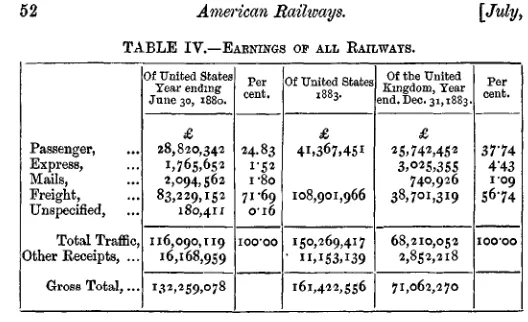
The traffic receipts of the American railways for the year ending 30th June, 1880, were £116,090,119, made up from different sources as follows:—passengers, £28,820,342 ; express, i.e,, carriage of parcels, £1,765,652 ; mails, £2,094,562 ; freight, £83,229,152; and unspecified, £180,411. The figures for the railways of the United Kingdom are shown in Table IV. The receipts classed as express are those given in the Board of Trade returns as excess luggage, parcels, carriages, horses, dogs, etc.
TABLE IV.—EABNINGS OF ALL BAILWAYS.
Passenger, Express, Mails, Freight, Unspecified,
Total Traffic, Other Receipts, ...
Gross Total,...
Of United States Year ending June 30, 1880.
£
28,820,342 1,765,652 2,094,562 83,229,152 180,411
116,090,119 16,168,959
132,259,078 Per cent.
24.83 1-52 i-8o 71-69 016
IOO'OO
Of United States 1883.
£
41,367,451
108,901,966
150,269,417 ' n,i53,i39
161,422,556
Of the United Kingdom, Year end. Dec. 31,1883.
£
25,742,452 3,025,355 740,926 38,701,319
68,210,052 2,852,218
71,062,270 Per cent.
3774 4'43 i 09 5674
IOO'OO
[image:7.368.72.326.341.460.2]The proportion of goods traffic in the United States (71*697 per cent.) is much larger than in the United Kingdom (5674 per cent.). As goods traffic is more fluctuating than passenger, this is one cause why the fluctuations of the dividends are greater in the United States. In addition to the traffic receipts, the American lines receiv-ed over £16,000,000 from other sources, viz., rents for use of roads, £10,708,742; and interests, dividends, receipts from ferries, horse railroads, elevators, etc., £5,460,217. The receipts from passenger traffic (24-83 per cent.) include 16*94 per cent, from local and 7.89 per cent, from through passengers. The receipts from goods traffic, (71*69 per cent.) include 40*26 per cent, from local and 31*43 per cent, from through freight.
TABLE V.—STATISTICS OF TEAFFIC.
Tons of Freight carried, ... ... ... Tons, 290,897,395 ,, „ carried 1 mile .. ... Ton miles, 32,348,846,693 Average distance carried, ... ... .,. ... Miles, 111 Receipts from Freight Traffic, ... ... ... ... £83,229,152 „ ,, „ per Ton mile, . ... ... 1*29 cts. ... '63d. Cost per Ton mile, ... ... ... ... 0-76 cts. ... '37d. Net Receipts, ... ... ... ... 0-53 cts. ... *26d. Passengers carried, ... ... ... ... No. 269,583.340 „ ,, 1 mile, ... ... Passenger miles, 5,740,112,502 Average Distance carried, ... ... ... ... vMiles, 21 Receipts from Passenger Traffic,... ... ... ... £28,820,342 „ per Passenger mile, ... ... 2*51 cts. ... i*23d. Cost „ „ ... ... ... 1*71 cts. ... *84d. Net Receipts, „ „ ... ... ... o-8octs. ... *39d.
1886.]
By Charles Eason, Jun. M.A. 53 freight and 30 per cent for passengers; and it is by applying these percentages to the total expenses that the results in this table are arrived at. The average receipts from freight are 1*29 cents per ton mile; but for fifteen of the* principal trunk lines the receipts per ton mile are only 1*05 cents, the receipts on individual lines being as follows :— Pennsylvania, and Baltimore and Ohio, each '89 cents; New York Central, '86 cents; Erie, -84 cents ; Michigan Central and Wabash, each *8o cents; Lake Shore and Michigan Southern, 76 cents; Central Pacific, 2-49 cents; Union Pacific, 1*99 cents; Atchison Topeka and Santa Fe, 2*09 cents; Chicago, Milwaukee, and St. Paul, 172 cents; Chicago and North Western, 1-47 cents; Chicago and Eock Island, 1*21 cents; and Chicago Burlington and Quincy, I * I I cents. The receipts per passenger mile on the same lines are nearer the general average. The western lines are highest. Atchison and Topeka, 6*o6 cents; Union Pacific, 3*20 cents; and Central Pacific, 3*03 cents. The North-western lines are— Milwaukee and St. Paul, 3.02 cents; Eock Island, 2*81 cents; North-western, 2.60 cents; and Burlington and Quincy, 2*40 cents. The trunk lines are—Wabash, 271 cents; Pennsylvania, 2*42 cents (these being higher than some in preceding group); Michigan Cen-tral, 2#i6 cents; Lake Shore, 2*14 cents ; Baltimore and Ohio, 2*06cents; Erie, 2*04 cents ; New York Central, 2.00 cents
TABLE VI.—CLASSIFICATION OF FKEIGHT.
Article.
Coal,
Merchandise and Mis cellaneous, Grain,
Lumber and othei Forest Products, .. Manufactures, Pig, Bloom, and Rail
road Iron, Live Stock,
Tons.
89,622,899 58,295,918 42,003,504
25,474,349 17,733,566 11,663,372 10,814,219
Article.
Stone, Lime, Cement, Clay, and Sand, ... Petroleum,... Flour, Provisions,... Cotton, Unspecified,
Total,
Tons.
9,000,322 7,714,892 7»449>7X7 7,°99>525 3,958,395 66,717
29°>897,395
Table VI. gives some indication of the character of the freight carried; but it is not to be taken as giving actual weight carried, as, though one and the same ton may have been carried by several companies, the totals are obtained by adding the tonnage reported by each company.
TABLE VII.—WORKING EXPENSES OP ALL RAILWAYS.
Maintenance of Way, Locomotive Power, Boiling Stock Repairs, Traffic Expenses,
General Charges, Taxes, ... Compensation, Legal, ... Miscellaneous,
Total,
Of the United States, Year ending June 30,
1880.
£
'7,859,845 17,610,108 6,630,875 16,115,357 58,216,185 4,n4,36i 2,656,764 691,253 49^581 4,389,880 70,560,024
Per cent.
IS'38 15-17 5.71 1388
5O # I4 355 2-29 o-6o 0-42 3.78
6 0 7 8
Of the United Kingdom, Year ending Deo. 31,
1883.
£ 6,743,798 9,331,267 3,310,826 11,213,164
30,599,055 1,623,741 2,600,105 444,973 373,i85 402,547 36,043,606
Per cent.
9-89
13*68 4*85 16-44
44'86
2-38 3'8i 0-65 0*55 o*59 52*84
.£17,859,845, or 15.38 per cent, which exceeds the corresponding percentage for the United Kingdom by 5 -49 per cent. Locomotive expenses come next, .£17,610,108, or 15*17 per cent., which is 1.49 per cent, more than in the United Kingdom. The principal items are—fuel, 5*66 per cent.; wages, 4-69 per cent.; and repairs, 376 per cent. Traffic charges amount to £16,115,357, or 13*88; which is 2*56 per cent, less than the United Kingdom. Eepairs of rolling stock amount to £6,630,875, or 571 per cent., an excess of -86 per cent, over, the percentage for the United Kingdom, repairs for freight and passenger cars being 3*89 and 1*82 per cent. The total of these expenses is 50.14 per cent, in the United States, and 44*86 in the United Kingdom. The larger percentage of expenditure upon main-tenance of way would appear to be in part due to charging to working expenses some expenditure upon lines open for traffic, which in England would be charged to capital account.
The miscellaneous expenditure probably includes most of those expenses which are incurred in earning the "other receipts," and if these' were deducted the percentage would probably not be very different from that for the United Kingdom.
Accidents.
The number of accidents to persons in the year was 8,215, of which 2,541 were fatal; 61 passengers and 260 employes were killed through causes beyond their control, and 82 passengers and 663 employes were killed through their own carelessness; 331 passengers and 1,004 employes were injured through causes beyond their control, and 213 passengers and 2,613 employes through their own carelessness.
1886.] By Charles Eason, Jun. M.A. 55 TABLE V I I I NET EECEIPTS AND THEIE APPROPEIATION.
Net Receipts.
Traffic Receipts, ... 116,090,119 Working Expenses, ... 70,560,024
Net Receipts, ... 45>53°,°95 Other Receipts, ... 16,168,959
Amount available for
distribution, ... 61,699,054
Appropriation.
£ General Expenses of
Lesser Companies, ... 375>9^9 InterestonFundedDebt, 25,288,462 „ Floating „ 1,807,559 Rentals, ... ... 10,358,144
37,83<V34 Dividend on Preferred
Stock, ... ... 1,3)8,653
Total Fixed Charges, ... 39J2°8,787
Dividends on Common
Stock, ... ... 12,731,416 Surplus, ... ... 9,758,851
61,699,054
for payment of interest, dividends, etc., £61,699,054 Eentals and interest absorbed .£37,830,134; dividends on preferred stock, £1,378,653; and on common or ordinary, £12,731,416, and there remained a suplus of £9,758,851. The payments in the United Kingdom in 1883 were—interest, £8,254,643 ; dividends on preferred and guaranteed stock, £12,601,797; and on ordinary stock, £13,725,933. Here we see very striking differences in (1) The relative amounts of interest and dividends, and (2) The undivided surplus. The figures do not correspond exactly, for the payments of interest and dividends for the United King-dom are calculated from the known rates of interest and divi-dend paid. Thus, rentals are not given as a separate item, but appear in their ultimate form as dividends or interest as the case may be. For example : the Dublin, Wicklow and Wexford Eail-way paid £36,000 in 1883 as rental to the Dublin and Kingstown Eailway Company, which paid 4 per cent, on the loans, and 9^ per cent, on the stock of that company. Such a payment would appear as rental in the United States table, but in the United Kingdom table in its ultimate form of dividend and interest. This prevents an exact comparison of the percentage of the appropriation of net receipts under different heads; but the tables clearly show that the interest charges absorb a much larger percentage in the United States than in the United Kingdom. The percentage in the United King-dom is only 24 per cent., but the percentage in the United States cannot be less than 60 per cent. The effect of this large proportion of interest charges has already been referred to sufficiently in connec-tion with the statistics of capital.
amounted to £313,633, and at end of 1883 to £303,624; thus these companies divided £10,009 more than their net earnings in 1883. It must be observed that the surplus of £9,758,851 is not the total of the balances carried forward by the American companies, but only the total of the addition to these balances in 1880. What, then, are the advantages of carrying forward these large balances, and how are they employed 1 They are required to give additional security to the bondholders, and are rendered necessary by the excessive proportion of interest bearing capital, and consequent interest char-ges. They are employed as capital, but as they do not bear interest, whatever they yield goes to increase the surplus for interest and dividend. The value of this protection can only be estimated by examining the facts regarding the principal companies, as recorded in their annual reports.
Examine the case of the Baltimore and Ohio railway—It has an income balance of £9,152,696. It has expended on way and equip-ment £2,333,898 more than the amount of its capital, and it has purchased stocks and bonds of various companies to the amount of
£5A74,55 2- The earnings from this expenditure are included in the
T A B L E IX.—FINANCIAL CONDITION : BALANCES OP CAPITAL AND INCOME ACCOUNTS, ETC.
Name of Company.
Atchison, Topeka, and Santa F£, Baltimore and Ohio,
Central Pacific, Chicago and N. Western, Chicago, Burlington, and Quincy, Chicago, Milwaukee, and St. Paul, Illinois Central,
Lake Shore and Michigan Southern, Michigan Central,
Missouri Pacific, New York Central,
New York, Lake Erie, and Western, ... Pennsylvania,
Philadelphia and Reading, Union Pacific,
Amount of Income Balance
at end of 1883.
£ 1,150,896 9,152,696 4,995,798 1,837,424 3,016,086 1,015,816 1,020,418 990,336 1,132,704 1,012,903 3,225,440 1,424,071 2,722,637 122,038 1,651,024 How applied. *Permanent Expenditure charged to Capital Acct. £ 377,986 2,333,898 3,878,026 Cr. 35,779 2,976,738 475,284 i34,47o Cr. 853,130 967,771 1,083,626 2,326,351 782,323 1,182,328 Cr. 1,600,954 Cr. 330,668 t Securities, i.e., Stocks and
Bonds of other companies. £ 964,142 5,474.552 5O,95I 2,HO,337 232,396 1,127,434 1,995,022 27,740 699'583 640,694 Surplus % Earnings, year 1883. £ 104,427 371,164 D e l 85,323 152,251 516,687 29^934 31,382 n,i35 33,3io 85,880 157,228 I 29,995 283,709 449,012 252,375 Total Capital. £ 16,560,050 8,929,659 29,101,066 28,475,247 29,411,947 28,743,449 13,429,000 18,893,200 7,162,841 H,37l,425 27,885,106 32,217,307 32,666,586 26,275,192 38,556,477 Capital Expenditure.
On Road and Equipment. £ 7,570,126 11,208,896 30,642,653 28,439,468 27,345,982 29,218,733 13,563,471 17,469,720 8,130,612 7,990,188 30,211,457 32,999,630 14,782,571 11,403,245 31,478,328 On Securities. £ 9,367,9™ 5,042,703 57O,35I 4,464,863 19,066,343 13,270,993 6,747,481
* This column is the difference between the total capital and the total expenditure, charged to capital account. The letters 'Cr.' mean that the capital received exceeds the expenditure,
t Not included in capital expenditure.
important point for consideration is what will be the effect upon the net revenue. If the additional expenditure will yield net revenue sufficient to pay the interest upon the sum expended, there is no reason why it should not be provided for by the issue of an additional capital. If it is provided for out of income, the additional net revenue would become available for payment of dividend upon the existing stock, and the rate of dividend would increase. .But it may happen that competition may so reduce rates that the earning power of the capital may diminish, so that the yield on total expenditure may not be increased. In this case, if the expenditure had been provided for by creation of fresh capital, the dividend must dimin-ish, but if provided for out of income the rate of dividend may be maintained, and this has been the case with the Baltimore and Ohio railroad. The sum required to pay 10 per cent, interest upon com-mon stock, 6 per cent, on preferred, and all interest upon bonds was somewhat less in 1882-3 ^a n in x873-4. The same dividend (10 per
cent.) was paid in both years, though in the interval £2,723,864 of surplus income had been expended upon the lines, or invested in securities of other lines. Thus all this expenditure has been neces-sary to maintain the earning power of the line, and it does not in any way constitute a reserve available to meet loss of earning power in the future.
It is necessary to consider what is meant by earning power. It may be that the capital expended has really added to the earning power of the line—that is to say, has increased its capacity for carrying traffic, and it may be that the increased traffic has been obtained, but the net revenue may have remained stationary in consequence of a decline in the rates of carriage, and it may well be that it was recognition of the liability to a loss of profit from this cause, which led the company to devote surplus income to permanent expenditure. The company adopting such a policy has a clear advantage over a rival company which has no surplus income, and has to obtain the funds for capital expenditure by the creation of additional capital. This latter company may be gradually driven into default from competition with a strong company adopt-ing this policy.
1886.] By Charles Eason, Jun, M.A. 59 ,£2,275,380 had been applied to capital expenditure out of surplus earnings, but while in 1874 the undivided surplus of earnings amounted to £515,294, in 1883 it amounted to only £35,805. Thus, but for the large expenditure out of revenue, the net earn-ings would not have been maintained. In the four years since 1880, the earnings have fallen short of the sum necessary to pay the 8 per cent, dividend, and hence the dividend has now been reduced, and it is necessary to raise capital to pay for capital expenditure which has been defrayed out of the surplus income.
Next let us examine the account of the Illinois Central Railway. Here we find that between 1874 and 1883 there was no change in the stock, and the alteration in the Funded debt, was unimportant. The dividend paid was 8 per cent, in 1874, and 10 per cent, in 1883. In these comparisons all references to branch, lines are omitted. It is the effect upon the remuneration of the capital of the main line which is the subject of comparison.
In these four instances we can distinguish different methods of dealing with expenditure on permanent additions to way and equip-ment, such, expenditure, that is to say, as is invariably charged to capital account in the United Kingdom.
(1) Charged to revenue.
(2) Provided for out of surplus revenue, but added to capital account.
(3) Provided for by issue of stock. (4) Provided for by issue of bonds.
When a new line is built it is undoubtedly right to charge the cost to capital account, and provide for the cost by the issue of fresh capital; but a continual outlay also takes place upon lines already open for traffic—a second line of rails is laid, or additional sidings are constructed, or new stations are built, or wooden bridges are replaced by stone or iron, and all these expenditures ought to increase the permanent value of a line, and therefore in principle they may rightly be charged to capital account, and provided for by issue of capital. Such is the invariable practice in the United Kingdom.
The first method is adopted by the Illinois Central Eailway. In the four years ending last December, it expended £560,230 upon permanent construction in Illinois, and charged it to revenue in addition to the ordinary expenditure of the year. Mr. John Dunn, of the President's office, says—
" Our experience has been that these permanent expenditures do not lead to any such increase in the earning capacity as to justify the increased charge (which would be the consequence of providing for the expenditure by the issue of fresh capital), but only enable us to operate more economically ; which is an absolute necessity, looking to the gradual and steady reduction which has taken place, and is still taking place, in the rates of transportation."
The second method is the one followed by very many American lines. But it is necessary to distinguish between a mere temporary provision for such expenditure out of revenue, and a settled policy not to raise capital for such expenditures. Yery many English companies have incurred capital expenditure beyond the amount of capital raised, and therefore may to some extent be said to have provided for such expenditure out of revenue; but this is only a temporary expedient. It is always intended to issue capital against such expenditure. Not so with the American lines —the Baltimore and Ohio for example. It has kept unappropriated a large balance of earnings, and has employed it in defraying per-manent expenditures. The difference between this practice and that of the Illinois Central is that in the one case the fact of the expenditure having been made is kept permanently recorded, and the nominal value of the line is correspondingly increased, while in the other the amount of the expenditure is written off the balance ; in both cases the line gets the benefit of the expenditure without any increase in the burden of capital, but in the latter case, there appears to remain some reserve of value available in the future, but as we have seen, this is apparent only.
The second, third, and fourth methods are adopted in various degrees by all companies. Thus, the Pennsylvania increased the expenditure charged to capital by £9,662,831 in the nine years ending 1883, and in the same period increased its stock £4,780,070, and its funded debt £2,031,813, and raised by "Trust Certificates" ,£1,828,600; total £8,640,483. The rest it has taken from surplus earnings—having increased its income balance £918,308.
TABLE X.—PROFIT UPON CAPITAL STOCK.
No Profits, Not exceeding 5 % Above 5 %, not exceeding 10 „
,, I 0, , ,, X5 „ „ 15,, „ 2O „ » 2 0»
Of the United States, 1880.
£
102,107,604
184,072,580 124,312,844 95,871,404 13,474,757 2,882,064 522,721,253
Per cent.
I9'53 35*2° 2378 i8'35 2-58 0*56 IOO'OO
Of the United Kingdom 1883.
£
56,899,605 383,191,329 147,316,690 44,067 1,546,436 588,998,127
Per cent.
9-66 6506 25-01 O'OI 0-26
100*00
This table shows the amount of stock upon which no dividend was paid, and the amount of stock receiving different rates of divi-dend. Out of the total of £522,721,253 of stock (common and preferred) in the United States in 1880, £102,107,604, or 19.53 per cent., received no dividend. This is double the percentage of stock which received no dividend in the United Kingdom in 1883. ^n
1886.] By Charles Eason, Jun. M.A. 61 Kingdom "being 65.06 per cent.* The proportion of stock receiving above 5, and not above 10 per cent., was about the same; but the amount of stock receiving above 10 per cent, in the United Kingdom is quite insignificant, while in the United States over 20 per cent, of the stock appeared in this class in 1880. The year 1880 was an exceptionally prosperous one for the United States Eailways. In fact, the United States Census year almost coincided with the most prosperous period for trade in that country during the past decade. The extraordinary fall in the dividends and prices of the stocks of many American railways during the past two years, has led to a widespread distrust of all railway stocks. Thus the dividend of the New York Central Eailway was 8 per cent, up to 1883 j it fell to 7^ in 1884, a n (i to 3^ in 1885, and is now being paid at the rate of 2
per cent, per annum. The Lake Shore and Michigan Southern paid 8 per cent, from 1880 to 1883, 7 per cent, in 1884, and nil in 1885. The Michigan Central paid 6 | per cent, in 1881, nil in 1882, 5 per cent, in 1883, 3 per cent, in 1884, and nil in 1885. The Central Pacific paid 6 per cent, from 1880 to 1883, 3 per cent, in 1884, and nil in 1885. Union Pacific paid 6, 6£, 7, and 7 suc-cessively in 1880 to 1883, 32 *n I884, and nil in 1885.
Pennsyl-vania paid 8 | per eent. in 1882 and 1883, 7 per cent, in 1884, and 5 per cent, in 1885. ^n e Prices of ordinary stocks varied
enor-mously. The lowest prices of stocks ranged as follows in the six years ending December, 1885 :—New York Central, from $130^ in 1881 to $81J in 1885 ; Lake Shore and Michigan Southern, from $ i i 2 f i n 1881 to $ 5 o | in 1885; Michigan Central, from $84! in 1881 to $46^ in 1885 ; Central Pacific, from $82f in 1882 to $26^ in 1885 ; Union Pacific, from $105^ in 1881 to $28 in 1884. I t is unnecessary to refer to the fluctuations in the stocks of the Erie, Philadelphia and Eeading, Wabash, and Grand Trunk Eailways, as they have (for many years, at any rate) had no value as investments. The dominant cause of the fall in dividends and values has been the decrease in receipts. Thus the gross receipts of the New York Central fell from 33f million dollars in 1883 to 28 millions in 1884, and 24^ millions in 1885; and the sum available for payment of dividends fell from 10J million dollars in 1880 to 7 £ millions in 1881, 4f millions in 1884, and 21 millions in 1885. The Lake Shore receipts fell from 18^ millions in 1883 to 14 millions in 1885. The receipts of the Pennsylvania fell from 51 million dollars in 1883 ^° 45i millions in 1885, and the net receipts fell from 19J millions in 1883 t o J6 millions in 1885 ; and further, the
balance of earnings of the Pennsylvania Company's Western lines fell from a surplus of 2\ millions in 1881 to a deficiency of 1 mil-lion in 1885, a deficiency which the Pennsylvania Eailway had to
make good.
These fluctuations in the receipts render the values of stocks un-certain, andthus fit them for being the subjects of speculation. It
is this, combined with the small proportion of stocks to bonds, which enables a small combination of capitalists, or even a single capitalist, to control entire railways, and manipulate them at pleasure. It is important to observe how the various circumstances combine to facilitate such operations. First, the actual traffics and real earning power of the railways are liable to great variations; second, this renders manipulation of the traffic and earnings diffi-cult to detect; third, the small percentage of share capital renders the dividends very sensitive to variations in earnings ; and, fourth, this causes a large proportion of lines to pay no dividends or very small dividends; fifth, the value of the shares being depreciated, and standing very much below par, only a small amount relatively is necessary to purchase a majority of the stock, and thus obtain control of a line 5 sixth, the non-existence of any large quantity of preference stock further facilitates such operations. Voting power attaches to preference stock, but not to bonds. Hence a large quantity of preference stock would make it more difficult to get a preponderance of voting power. Seventh, bonds, being payable to bearer, can be transferred with secrecy, which is im-possible with debenture stock. Thus, directors can traffic in the bonds of their own lines in a way quite impossible in the United Kingdom. These are the conditions which render possible the ex-tensive power exercised over the railways of America by the " Eailway Kings," and the only practical way to mitigate the evils arising from such personal government is by operating upon the causes which form the basis of their power.
It is all important to know whether all American lines are liable to similar fluctuations of earnings. There are two groups of lines whose dividends have been well maintained. The Chicago Burling-ton and Quincy and the Chicago and AlBurling-ton have each paid 8 per cent., and the Chicago Eock Island and Pacific has paid 7 per cent, in each year from 1881 to 1885. The Illinois Central paid 7 per cent in 1881 and 1882, 8 per cent, in 1883,* 10 per cent, in 1884, and 8 per cent, in 1885. The Chicago and North Western paid 6 per cent, in 1881, 7 per cent, from 1882 to 1884, and 6J per cent, in 1885. The Chicago, Milwaukee, and St. Paul paid 7 per cent, from 1881 to 1884, but paid only 4 per cent, in 1885.
The second group in which dividends have been maintained com-prises the principal lines of the New England States. The Boston and Albany, Boston and Maine, and the Boston and Providence, have each paid 8 per cent, from 1881 to 1885. The New York, New Haven, and Hartford has paid 10 per cent, from 1881 to 1885. The Boston and Lowell paid 4 per cent, in 1881 and 1882, 5 per cent, in 1883, 5^ in 1884, and 6 in 1885. The Old Colony paid 6 per cent, in 1881, 6\ in 1882, and 7 per cent, from 1883 to 1885. The Fitchburg paid 7 per cent, in 1881, 6 per cent, in 1882 and 1883, 5^ in 1884, and 5 per cent, in 1885.
The principal cause of the falling off in earnings which has been so disastrous to the Eastern Trunk lines, has been the excessive
1886.] By Charles Eason, Jun. M.A. 63 competition arising from the multiplication of routes, or, in other words, the increase in the means of conveyance out of propor-tion to the traffic to be carried. Up to the present the extension of railways in the lines west of Chicago has not gone beyond the in-crease of traffic; but there is, as far as I know, nothing to prevent the excessive construction of lines in this region, and therefore there is no security that their dividends will not fall in future years. It is otherwise with the railways in the New England States, for there, as we have already stated, extension has practically ceased. The injurious effects of the excessive competition have been so obvious, that there has been much discussion over the question whether a check should not be put by law on the building of parallel lines. The State of Massachusetts is the only state which has a law that no line can be made till the commissioners have certified that pub-lic convenience requires it. The obvious argument for permitting unrestrained building of lines is that this is the only way to keep down the charges of the companies. In Massachusetts the citizens rely upon the railway commissioners to see that the companies make reasonable charges, and the system appears to work satisfac-torily to all parties. The trade and agriculture of America are more liable to sudden and extreme fluctuations than those of the United Kingdom, and upon these legislation can exert but little influence. Eailways cannot escape the ordinary alternations of prosperity and depression ; but apart from these, the value of railway property cannot become more stable till the building of new lines is placed under regulation, and the public may reasonably take the opportu-nity of granting this protection, to require the companies to submit their proceedings to an effective supervision for the protection of the interests of the people. I shall now proceed to consider the efforts which have been made by different states to control the charges made by the companies.
Railway rates,
Numerous complaints are made in America as in the United Kingdom against the rates charged by railway companies. They are accused (i) of charging excessive rates, (2) of giving special advantages to towns where there is competition, (3) of carrying some goods at a loss, or at an unduly small profit, and making up for the loss by higher charges on other commodities, and (4) of « giving advantages by low through rates to foreign producers over home traders. I am not prepared to say that none of these charges are well founded. Errors of judgment may be committed in some cases; but the principles upon which the rates objected to are fixed are sound. They are—(1) That regard should be paid to what the traffic will bear; (2) that the rate per mile should be reduced with the distance ; (3) that rates may be specially reduced to meet com-petition at particular points.
rate is given. The cost of the service is ignored. It is insisted that the rate should be fixed to suit the circumstances. But when traders object to the rate upon some article, in regard to which this cannot be said, they compare the rate with some low rate, and argue that the cost of carrying the article is not at all or only slightly greater in the one case than in the other, and that rates should be fixed according to cost of service. They denounce as most outrageous the principle that the company is entitled to charge a higher rate, simply because the article is more valuable and can bear a higher rate without injury to its sale ; and they frequently misrepresent this principle by stating that the companies claim a right to charge as much as an article will bear, while all that a com-pany claims is, that they have a right to take into account what the traffic will bear, and charge something above the average cost of service on this account.
The second principle is that upon which through rates are founded. Here, again, all traders claim the benefit of it when it tells in their favour, but are most anxious to repudiate it when it gives an advantage to a competitor. To forbid through rates would cause immense injury to trade. The utmost that can be said is that in some cases they may be injudiciously fixed.
1886.] By Charles Eason, Jim. M.A. 65 Two questions must be distinguished :—(i) The bare right of the State to take such steps, and (2) the expediency of the State adopt-ing any particular step which may be proposed to it. As to the first, it is sufficient to say that the whole course of legislation and political thought show that the people will not consider them-selves bound by past legislation, if considered inconsistent with their view of public interest. The question is then narrowed down to the expediency of any proposed restrictions, and I think it would be best for all parties to concentrate examination upon this point.
Summing up ; I would say that in regard to all the current com-plaints of excessive and unequal charges, of through rates, of unfair advantages given to competing centres, and of neglect of public in-terest, what is first required is a thorough examination of the facts ; at present there is no means of making such an examination. A trader may appeal to the public through the press, or he may bring an action at law or before the railway commissioners, or inquiry may be made by a parliamentary committee. None of these pro-cesses are efficient. Such matters are too complicated to discuss in letters to the press. A railway company could not make all its proceedings public; it may correct palpable mis-statements, but cannot explain its reasons. Nor is the editor of a newspaper in a position to weigh calmly all the facts. He has not leisure to acquire the requisite knowledge, nor would it be reasonable to expect that he could devote the requisite time to the examination of such com-plaints. The second remedy is no less inapplicable; because in the first place it is not generally alleged that the companies are acting beyond their legal rights; and in the second place, to take legal proceedings, requires the trader to place himself in a false position. The question is not one of strict right. A wise trader wrould not
assume that the company must be wrong. He would admit that he cannot know all the facts and motives of the company ; but he claims that the matter appears prima facie unreasonable, and that some impartial tribunal should decide whether the company's action is right. The third method of investigation—by a parliamentary committee, also fails, because the true facts cannot thus be fully brought to light. The process is too circuitous. Complaints are made, railway companies are invited to make explanations, and their officials are examined ; but they cannot go beyond the most general statement of principles. A full statement of the circumstances of each case would go too far into minute particulars, and any such statement could not be adequately examined into without access to documents and personal inquiry on the spot.
It would seem as if matters must be left to take their course ; but this would be a mistake. There is widespread dissatisfaction with railway management, and unless a better state of feeling can be brought about, the end will be rash legislation, which will pro-bably do more harm than good. It is here that I think the expe-rience of the States of America is of value to us.
In America the regulation of railways is a matter for the State governments, not for the Federal government. The States have
tried different plans, and the knowledge of their experiments can hardly fail to be of advantage to us.
The methods adopted may be classified as follow :—
i. Specific legislation as to charges—that is, fixing rates by statute.
- 2. Appointment of railway commissioners with authority to fix rates obligatory upon the companies.
3. Appointment of railway commissioners with authority to draw up schedules of rates ; such rates not to be binding upon the companies, but only prima facie evidence of what charges are reasonable. The procedure in this case is that if a rate higher than that fixed by the commissioners is charged, the aggrieved party brings an action against the company, and the latter must prove that the rate fixed by the commis-sioners is not reasonable.
4. Appointing railway commissioners with authority to in-vestigate all complaints, and pass judgment upon them. The decisions of the commissioners are not binding upon the com-panies, they are only prima facie evidence of what charges are reasonable. The respect paid to them depends upon the power of the Commissioners to influence public opinion, and so direct legislation. The decisions are reported in the press and in their annual reports, with such information and arguments as they think fit to furnish. Thus if the companies were systematically to ignore their decisions, they would be likely to see the authority of the commissioners extended.
Such railway commissioners are not to be confounded with the Eailway Commission in these countries. Our Eailway Commission is a judicial body—a sort of branch of the courts of justice, but having a lay and expert element side by side with the legal element —which hears cases, gives decisions, and requires suitors to come before it with all the procedure of a court of justice. In America the commissions have no judicial authority. Complaints are made to them without any formality whatever, and if their decisions are not complied with—the ordinary courts must be applied to. I t should be observed that these methods of regulating rates are not mutually exclusive, but may be combined with one another.
1886.] By Cliarles Eason, Jun. M.A. 67 in force five years it is too soon to speak positively as to its results. The commissioners are not unanimous in their mode of applying it. The Central Pacific Eailway protests against the rates fixed. They assert that the commissioners have acted under the dictation of the mob, and that all projects for further extension of railways must be postponed. They add that they are not " apprehensive of serious evil from an enlightened, unprejudiced, and untrammelled commis-sion/'
In Missouri freight is classified, and maximum rates for each class are fixed by statute, and the commissioners are authorized to revise the classification and fix schedules of rates, which the companies must conform to. This law has been in force for some years, but the commissioners appear to have only recently found out the full extent of their powers. The classification fixed by the commis-sioners does not give complete satisfaction, and the remarks of the commissioners show that they do not feel quite satisfied with their own handiwork. So far the practice is much the same as in Cali-fornia ; but in Missouri the rates are not obligatory. The enforce-ment of the rates fixed by the commissioners is left to private persons. The commissioners have sought to obtain an enlargement of their powers, and especially to be enabled to prosecute suits against companies not observing their orders ; but four General Assemblies in succession, each one fresh from the people, have deliberately refused to grant such increase.
The railway commissioners of Georgia, Illinois, and Kansas have also power to fix schedules of rates, and their rates are to be accepted as prima facie evidence of what charges are just and reasonable. If a company makes a higher charge, the trader must bring an action in the ordinary courts. The commissioners of Georgia lay stress upon the fact that their decisions are subject to such revision by a court of justice, and they recommend that a power of appeal to a higher court should be granted. The commissioners of Illinois assert that the railways readily comply with their decisions, and that—
"The inclination now apparent in railroad management to avoid pro-secutions and to foster friendly relations with the public, demonstrated the wisdom and efficiency of the present system of state control of trans-portation."
Yet the difficulty of laying down definite rules in regard to rates is well illustrated by their experience. There is a rule very common, in some form or another, in the States, and very generally approved of by critics of railways, viz., that a company should not charge more for a less distance than for a greater. One% form of it is that
a company should not charge more to a way station than to a ter-minus. Some States permit .competition at a point to justify an ex-ception ;• but the law in Illinois expressly says that competition is not a sufficient reason for breaking it. In carrying out this rule, the commissioners were obliged to give two decisions in 1884, which they considered injurious to the interest of the public as well as of the companies.
The States of Iowa, Kentucky, Maine, Massachusetts, Michigan, and New York, have railway commissioners, with authority to
hear and determine complaints as to rates ; but their decisions are not ipso facto binding upon the companies, although as a rule they are complied with. The Massachusetts commission may be taken as the type of this class, and it appears to have worked satisfactorily. It does justice to the rights and necessities of the companies, and it exerts a powerful influence upon the companies, to ensure that they regard the public interest in the exercise of their powers, and fulfil the obligations arising out of the possession of special powers conferred by the State. One example may be given to illustrate their jurisdiction. The citizens of Pittsfield complained that the Boston and Albany Eailway charged only one dollar per ton for coal from East Albany to Pittsfield, a distance of 50 miles, while they charged one dollar 25 cents per ton for coal from Hudson to Pittsfield, a distance of 43 miles. The commissioners say that the rate of one dollar from East Albany is the company's share of the through rate from the mine—the local rate from East Albany to Pittsfield being one dollar 25 cents, or the same as from Hudson. They report that the rate is given in order to supply cheap bitumi-nous, coal, and that to forbid the rate would have the effect of raising the price of coal. They accordingly declined to make any recommendation to the company.
The existence of such a commission is of advantage to traders in many ways. (1) It furnishes information as to rates. A trader can learn from the commissioners what rate he ought to be charged, and thus he can check any statement made by the officials of the companies; and the knowledge of this fact tends to insure that the trader will get fair and equal charges in all cases. (2) A trader, without any trouble or expense, gets the opinion of a competent and impartial person, as to whether the charges made in any par-ticular case are regular. (3) The trader has a simple and inexpensive machinery for gettimg a skilled tribunal to inquire into the fairness of any charge made by a company. It cannot be too carefully borne in mind that in this country if a dispute arise between a trader and a railway company as to the legality of any charge, the trader can only ascertain, at the cost of an action at law, whether the company's charge is legal or not. He has no means of ensuring that a company gives a thorough consideration of any complaint of excessive charge. I do not doubt that as a rule railway managers do endeavour to meet the requirements of traders ; but it is only in accordance with human nature that they would do this more thoroughly, if their decisions were subject to an appeal. The Massachusetts commissioners conclude their report for 1884 with the words:—
" The citizens of Massachusetts feel pride in the thought that the humblest of her people may find without delay and without cost redress against the most powerful class of her corporations."
1886.] By Charles Eason, Jun. M.A. 69 by diffusing information, and by expounding the principles upon which rates are fixed. The companies would come to be regarded more favourably by the people, when impartial investigators had approved their policy, and the public would find that in cases of real hardship they would be able to obtain redress. The force of public opinion would cause the companies to respect the decisions of the commissioners, when based upon principles which would com-mand general assent.
In addition to powers over rates, the commissioners should have transferred to them the powers now exercised by the Board of Trade, in regard to the certifying of new lines and inquiring into railway accidents in Ireland, and they should also be authorized to require the companies to furnish returns of traffic and expenditure and financial condition, as they think necessary.
V.—On Fiscal Relations of the United Kingdom and Ireland, with
special reference to the State Purchase of Land. By W. F.
Bailey, Esq. Barrister-at-Law.
[Read Tuesday, 13th April, 1886.]