James A. Crowder · Shelli Friess
Agile Project
James A. Crowder • Shelli Friess
ISBN 978-3-319-09017-7 ISBN 978-3-319-09018-4 (eBook) DOI 10.1007/978-3-319-09018-4
Springer Cham Heidelberg New York Dordrecht London
Library of Congress Control Number: 2014945570
© Springer International Publishing Switzerland 2015
This work is subject to copyright. All rights are reserved by the Publisher, whether the whole or part of the material is concerned, specifi cally the rights of translation, reprinting, reuse of illustrations, recitation, broadcasting, reproduction on microfi lms or in any other physical way, and transmission or information storage and retrieval, electronic adaptation, computer software, or by similar or dissimilar methodology now known or hereafter developed. Exempted from this legal reservation are brief excerpts in connection with reviews or scholarly analysis or material supplied specifi cally for the purpose of being entered and executed on a computer system, for exclusive use by the purchaser of the work. Duplication of this publication or parts thereof is permitted only under the provisions of the Copyright Law of the Publisher’s location, in its current version, and permission for use must always be obtained from Springer. Permissions for use may be obtained through RightsLink at the Copyright Clearance Center. Violations are liable to prosecution under the respective Copyright Law.
The use of general descriptive names, registered names, trademarks, service marks, etc. in this publication does not imply, even in the absence of a specifi c statement, that such names are exempt from the relevant protective laws and regulations and therefore free for general use.
While the advice and information in this book are believed to be true and accurate at the date of publication, neither the authors nor the editors nor the publisher can accept any legal responsibility for any errors or omissions that may be made. The publisher makes no warranty, express or implied, with respect to the material contained herein.
Printed on acid-free paper
Springer is part of Springer Science+Business Media (www.springer.com)
Raytheon Denver , CO , USA
v
Pref ace
Dr. Crowder has been involved in the research, design, development, implementa-tion, and installation of engineering systems from several thousand dollars up to a few billion dollars. Both Dr. Crowder and Ms. Friess have been involved in raving successes and dismal failures (ok, let’s call them learning opportunities) not only in development efforts but in team building and team dynamics as well. Having been involved in agile development projects and team building exercises, both have seen the major pitfalls associated with trying to build teams and, in particular, create successful agile development teams. A general lack of management commitment to the agile development process and a lack of training provided for people working in devel-opment teams are two of the major reasons agile teams so often falter or fail. Here we endeavor to discuss some of the major topics associated with team dynamics, individual empowerment, and helping management get comfortable with a new paradigm that is not going away.
Having taught both classical program management methods and agile develop-ment and managedevelop-ment methods for many years, there are always argudevelop-ments as to whether the proper term is program management or project management. To settle the matter and not create issues, in the course of this book, we will use the term program/project management. It may seem redundant, but it covers both bases.
There are several case studies throughout the book. These case studies came from a variety of government, aerospace, and commercial companies/groups, and no company should be inferred from a given case study, unless the company name is specifi cally mentioned. In some instances, the case study may represent a collec-tion of very similar stories from several different companies.
Lastly, we want to emphasize that this is not a book on how to perform agile devel-opment, but how to manage the process of agile development and how managers can facilitate successful and effi cient agile development programs/project. This book is written to give managers the tools required to be successful as an agile manager.
Denver, CO James A. Crowder
vii
1 Introduction: The Agile Manager ... 1
1.1 Agile Development Demands Agile Management ... 2
1.2 Software and Systems Engineering: Where Did They Come From? ... 4
1.2.1 Software Engineering History ... 4
1.2.2 System Engineering History ... 4
1.3 The Need for New Leadership ... 5
1.3.1 Agile Management: Leader, Manager, Facilitator ... 6
1.4 Layout of the Book ... 7
2 The Psychology of Agile Team Leadership ... 9
2.1 Individuals over Process and Tools ... 9
2.2 The Agile Manager: Establishing Agile Goals ... 12
2.3 Independence and Interdependence: Locus of Empowerment ... 15
2.3.1 Locus of Empowerment ... 15
2.4 Overall, Individual, and Team Goals: Locus of Control ... 17
2.5 Self-Organization: The Myths and the Realities ... 19
2.6 Creating a Stable Team Membership: Containing Entropy ... 20
2.7 Challenging and Questioning Sprints: Individual Responsibility ... 22
2.8 Mentoring, Learning, and Creativity: Creating an Environment of Growth ... 23
2.9 Keeping the Vision in Front of the Team: Ensuring System Integration ... 23
3 Understanding the Agile Team ... 27
3.1 Agile Team Dynamics ... 30
3.2 Team Member Dynamics ... 34
3.2.1 Differences Between Classical and Agile Team Dynamics ... 34
3.2.3 Cultural and Diversity Differences ... 38
3.2.4 Virtual Team Dynamics ... 40
3.2.5 Diversity and Inclusiveness ... 40
4 Productivity Tools for the Modern Team ... 43
4.1 Productivity Tools for the Agile Manager ... 43
4.1.1 Agile Management Software ... 44
4.2 Productivity Tools for the Agile Developer ... 44
4.3 The Future of Agile Development Productivity Tools ... 46
5 Measuring Success in an Agile World: Agile EVMS ... 49
5.1 Brief History of the Earned Value Management System ... 49
5.2 Assessing Agile Development: Agile EVMS ... 53
5.2.1 Disconnects Between Classical EVMS and Agile Development ... 55
5.2.2 Factors That Can Derail Agile EVMS ... 57
5.2.3 Agile EVMS Metrics... 58
5.3 Entropy as an Earned Value Metric for Agile Development ... 60
5.3.1 Entropy Measures ... 60
5.3.2 Volatility of Teams ... 61
5.3.3 Volatility of Software Defects ... 62
6 Conclusion: Modern Design Methodologies—Information and Knowledge Management ... 65
References ... 67
1 © Springer International Publishing Switzerland 2015
J.A. Crowder, S. Friess, Agile Project Management: Managing for Success, DOI 10.1007/978-3-319-09018-4_1
Chapter 1
Introduction: The Agile Manager
Modern productivity teams demand modern leadership, one that understands modern development needs, stresses, teams, and other aspects of agile development team dynamics [ 22 ]. The purpose of the book is to introduce managers to the new productivity environments, including geographically, culturally, and generationally diverse teams. The Agile development paradigm embodies a set of principles which at fi rst may seem contrary to classical business practices:
1. Satisfy the customer through early and continuous delivery of software capabilities and services through short software “sprints,” lasting from 2 weeks to 2 months, with a preference toward shorter sprints.
2. Embracing the environment of change. The Agile development process harnesses change to gain a competitive advantage in the software development marketplace [ 28 ].
3. Business development, management, and developers must cooperate and collaborate throughout the development project.
4. Communication needs to be face-to-face, even if that means teleconferencing over diverse geographical locations. Face-to-face communication is essential for effi ciently and effectively conveying necessary information across an agile development team.
5. The Agile development process is designed to allow a sustainable, constant pace development throughout the entire development project.
6. The primary measure of success (Earned Value) is working software and capabilities, NOT Equivalent Software Lines of Code (ESLOC).
7. Agile development does NOT mean a lack of design. A good design (architecture) enhances agility and allows continuous attention to technical excellence.
8. Simplicity is essential in agile development. The importance of agile software development demands the art of maximizing the work NOT done.
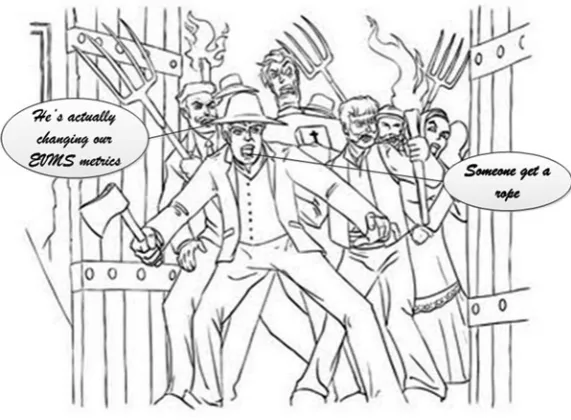
The following illustrates this notion, as well as the results of not following these concepts in managing agile development teams (Figs. 1.1 and 1.2 ).
1.1
Agile Development Demands Agile Management
Agile software design methods are now commonplace; however, management skills, in general, have not kept pace with the advances in software development practices. There is a major push among companies, both government and commer-cial, to embrace the concepts of diversity and inclusiveness. Managers need to
Communication Responsibility Collaboration Teamwork
Fig. 1.1 What Agile development projects are supposed to teach you
Communication Responsibility Collaboration Teamwork Trust No One
3
be trained in how to manage teams of diverse personnel. Much has been made of managing different personalities, but managers need to be aware of soft people skills, how to manage them, use them effectively, and how they affect people of different backgrounds [ 29 ].
It is commonplace to have to work with teams across geographically, ethnically, generationally, and culturally diverse backgrounds within the same team, not to mention a range of skill levels. This book will be helpful in understanding how to manage an agile development team that includes such dynamics [ 30 ]. This book will take the project/program manager beyond the concepts of transformational leadership, which provides methodologies to connect to employees’ sense of iden-tity, to include human psychological concepts such as “Locus of Control,” which will help the manager understand team members’ view of how to manage their “world” contributes (enhances or detracts) from their ability to work within team dynamics.
Agile design methods have been utilized since the mid-1990s, and yet program/ project managers have been slow to adapt to the changes required for effective agile development [ 31 ]. And while there are basic management techniques like Scrum available for the mechanics of managing agile teams, none of these address the dynamics agile development, which include:
• How to choose the right agile development team • How to facilitate, not control, an agile team
• How to trust your team: trust is an important factor in change [ 18 ]
The agile development process demands trust, transparency, accountability, communication, and knowledge sharing [ 50 ]. Allowing agile teams to develop these qualities requires understanding and allowing people to evolve and exercise aspects of their internal development processes like Locus of Control. Locus of Control refers to the extent to which individuals believe that they can control events that affect them. Individuals with high Locus of Control believe that events result pri-marily from their own behavior and actions. Those with a high external Locus of Control believe that powerful others, or chance, primarily determine events that affect them [ 62 ].
The purpose of the book is not to emphasize any particular Agile Development Management style (e.g., Scrum), but instead to investigate and present methods for effective Agile team development and management philosophies. Just because you use Scrum does not mean you are Agile. Scrum is a one of many methods for man-aging Agile Software Development teams, assuming you have an agile development team. Many management organizations confuse this, with disastrous results. To overcome this and to provide the Agile Manager with the skills required to effi -ciently manage agile development teams, the book includes discussion agile man-agement techniques [ 18 ], the psychology of agile management (Locus of Empowerment [ 53 ]), as well as new metrics and methodologies for measuring the effi cacies of Agile Development teams (agile EVMS).
1.2
Software and Systems Engineering:
Where Did They Come From?
Many think the discipline of Software Engineering is relatively new, and that before the invention of “modern” software techniques, the discipline was nothing more than structured coding. But actually, the fi rst two conferences on Software Engineering were sponsored by the NATO Science Committee in 1968 and 1969 in Garmisch, Germany [ 58 , 74 ].
1.2.1
Software Engineering History
In 1968 and 1969, the NATO Science Committee sponsored two conferences on software engineering, seen by many as the offi cial start of formal discipline of Software Engineering. The discipline grew, based on what has been deemed the “Software Crisis” of the late 1960s, 1970s, and 1980s, in which very many major software projects ran over budget and over schedule; many even caused loss of life and property. Part of the issues involved in software engineering efforts throughout the 1970s and 1980s is that they emphasized productivity, often at the cost of quality [ 75 ]. Fred Brooks, in the Mythical Man Month [ 14 ], admits that he made a multi-million dollar mistake by not completing the architecture before beginning software development, a major problem that has been repeated over and over, even today. We will discuss the notion of the importance of having a complete architecture on agile development later in the book. This does not mean that the architecture can’t change, as it often does throughout the project, but system’s engineering must keep up with changes so that the development teams clearly understand the architecture they are developing to during every sprint [ 19 ]. We will discuss this at length in subsequent chapters, as the intent here is just to provide a brief history.
1.2.2
System Engineering History
5
overall system functionality, utilizing weighted objectives and trade-offs in order to achieve overall system compatibility and functionality [ 19 ]. During the 1970s and 1980s as engineering systems continued to increase in complexity, it became increasingly diffi cult to design each new system with a blank page. As system qual-ity attributes like reliabilqual-ity, maintainabilqual-ity, re-usabilqual-ity, availabilqual-ity, etc. became more and more important, the concept of Object-Oriented design techniques was developed. The fi rst Object-Oriented languages began to emerge during the 1970s and 1980s. By the 1990s, the fi rst books on Object-Oriented Analysis and Design (OOAD) were published and available. Unfortunately there were many different OOAD methodologies. There was no consistency among methods. At one point in the 1990s, there were over 50 different OOAD methods. This became increasingly diffi cult for the Department of Defense (DoD), because contract proposals from competing contractors utilized entirely different OOAD methods to design their systems, making comparison between proposals nearly impossible. Finally, in 1993, the Rational Software Company began the development of a Unifi ed Modeling Language (UML), based on methodologies by Grady Booch [ 13 ], James Rumbaugh [ 64 ], and Ivar Jacobsen [ 41 ], coupled with elements of other methods. Here the Rational Software Company simplifi ed current methods from several authors into a set of OOAD methods that included Class Diagrams, Use Case Diagrams, State Diagrams, Activity Diagrams, Data Flow Diagrams, and many others.
1.3 The Need for New Leadership
While Software and Systems Engineering has matured and evolved over the decades to accommodate a faster-paced, ever-changing development environment, program/ project management still tends to cling to rigid management techniques and princi-ples that critically hamper the agile process [ 51 ]. A great example is described below:
Case Study #1: The Non-Agile Manager
Project Length 12 months Number of Sprints 8 Sprints Number of Teams 4 Teams Average Sprint Duration 6 weeks
Description During the planning for Sprint #4, Team #3 discovered that team #4 had a capability scheduled for Sprint #5 that Team #3 needed for their development in Sprint #5 to accommodate their sprint #5 development. Team #3 negotiated with team #4 and they found a set of capabilities that team #4 had scheduled for sprint #4 that were not needed till sprint #6. The capabilities team #3 needed constituted the same number of story-points, and similar complexities, and therefore would not overly tax team #4’s sprint work to swap the work between sprint #4 and #5 to accommodate team #3. Team #4 accomplished all of their development for sprint #4. During the progress evaluation with the program manager, the manager was very
upset that the planned work had not been accomplished, but it had been changed, with work moved from Sprint #4 to Sprint #5. Team #4 explained that the work represented the same number of story-points and similar complexity, therefore not perturbing the overall cost and schedule of the program. When the manager pushed back, still upset that the work scheduled had not been accomplished, both Team #3 and Team #4 explained that this is a classical part of the Agile Development Process, being fl exible to move capability development around, based on changing needs and requirements. The manager’s reply was (and hence the reason for the book), “Then I guess we need a more rigid agile process.”
1.3.1 Agile Management: Leader, Manager, Facilitator
Many mangers shudder at the thought of agile development projects, feeling like their authority has been eroded. I have heard more than one project manager declare, when the agile methodology is explained, ask, “So what am I going to do?” Many managers are used to being intimately involved in the development process, even though they may, or may not, actually have been software developers [ 34 ]. It is true that project/program managers must learn to adapt and take on different roles in the world of agile development, becoming facilitators and leaders and not so much traditional managers. The notion of classical line management, or boss, which many managers still cling to, is no longer relevant in the paradigm of agile software devel-opment projects. Figure 1.3 illustrates this, albeit a bit dramatically.
For effective management of agile development projects, the manager (we’ll refer to the manager as the Agile Manager throughout the book) needs to have many skills [ 33 ], including effective communication, a diplomat, and other skills shown in Fig. 1.4 , and will be explained in detail in Chap. 2 .
7
The rest of the book is dedicated to an in-depth discussion of the new management paradigm required to enable, encourage, and fully embrace Agile Software Development and make them the successes they can be. To accomplish this, the structure of the book is outlined in the next section.
1.4
Layout of the Book
We have arranged the book to build up to new methods for Agile Software Program/ Project management.
Chapter 2 —The Psychology of Agile Team Leadership This describes the new “soft” people skills required for modern managers, and how they add/detract from modern agile development. How to recognize the skills, how to utilize the skills, and how to build teams with the right “mix” of personalities and soft people skills for effective and effi cient development efforts.
Chapter 3 —Understanding the Agile Team Success in the modern development era needs managers and leaders who truly understand what agile development means and how agile teams collaborate, cooperate, and function in various situations, par-ticularly in geographically and culturally diverse environments. Understanding the variety of personalities and soft people skills, coupled with how these manifest them-selves across gender, ethnic backgrounds, and cultural and generational diversities, and other considerations, will become essential for modern development leadership
Fig. 1.4 Skills of the Agile
and management. This includes discussion of overall inclusiveness and diversity within the agile development process. Diversity and Inclusiveness are important dynamics that companies are embracing. Building development teams that are not just effective but embrace the concepts of diversity and inclusiveness are important [ 35 ], but most leaders and managers have not been trained for the dynamics these bring (both good and bad) to teams.
Chapter 4 —Productivity Tools for the Modern Team Providing an agile devel-opment team with tools to be productive goes beyond handing each one of them a laptop with compilers. Communication and collaboration tools, whether face-to-face or geographically diverse, are crucial in modern teams. Here we discuss col-laboration tools and other tools that will be crucial today and in the future. The proper use of Information Systems can provide management and leadership with effective ways of monitoring and managing teams. Here we discuss the new man-agement information systems environments and tools that are available, will be available in the future, and need to be utilized within the new agile development paradigm.
Chapter 5 —Measuring Success in an Agile World: Agile EVMS The Earned Value Measurement System (EVMS) has become a mainstay in Commercial and Government groups to measure progress and success of a project. EVMS is effec-tive (albeit subjeceffec-tive) measure, but does not play well with agile development efforts, due to its requirement of static schedules and work plans. Here we introduce a new paradigm for EVMS that will accommodate and be effective in measuring progress and problems within agile development efforts.
9 © Springer International Publishing Switzerland 2015
J.A. Crowder, S. Friess, Agile Project Management: Managing for Success, DOI 10.1007/978-3-319-09018-4_2
Chapter 2
The Psychology of Agile Team Leadership
For modern managers, one has to adopt a new philosophy, or psychology, for dealing with agile development teams. While process is important to ensure the team delivers quality software that meets customer requirements, it is important to understand that the Agile Method is geared around more of an informal approach to management, while putting more time, effort, and emphasis on fl exibility, communication, and transparency between team members and between the team and management. It pro-motes an environment of less control by managers and more facilitation by manag-ers. The role of the manager takes on a new psychological role, one of removing roadblocks, encouraging openness and communication, and keeping track of the change-driven environment to ensure that the overall product meets in goals and requirements, while not putting too much control on the ebb and fl ow of the agile development process. Change is no longer wrong, the lack of ability to change is now wrong. Here we discuss the new “soft” people skills required for modern managers, and how they add/detract from modern agile development. How to recognize the skills, how to utilize the skills, and how to build teams with the right “mix” of person-alities and soft people skills for effective and effi cient development efforts [ 71 ].
2.1
Individuals over Process and Tools
Companies have spent decades designing, creating, implementing, and executing tools required to bid and manage development projects. One major category of tools is prediction tools like CiteSeer © and COCOMO © (Constructive Cost Model) that
have been used since the late 1900s to provide “objective” cost bids for software development. A later version of COCOMO, COSYSMO © (Constructive Systems
bug- fi xes, and maintenance of the software. But ultimately it comes down to Software Lines of Code/Month (SLOC/Month). While many will claim these are objective tools for helping to determine the staff loading necessary for a software/ systems development project. In each tool there are dozens of parameters which are input by the operator, each of which has an effect on the outcome of the cost model. Parameters like effi ciency (average SLOC/Month), familiarity with the software language used, average experience level, etc., can be manipulated, and usually are, to arrive at the answer that was determined before the prediction tool was used [ 43 ]. Many other tools are utilized to measure the performance (cost and schedule) of projects once they are in execution. These measurement tools measure how the project is progressing against its preestablished cost and schedule profi le, deter-mined in the planning phase of the program/project. What none of these tools, cost estimation, performance metrics tools, etc., take into account is the actual agile team and their dynamics. The makeup of the each agile team and the facilitation of each team is as important, if not more important, than the initial planning of the project. If the Agile Manager/Leader is not cognizant of the skills necessary not to just write code, but to work cohesively as an agile team, then success is as random as how the teams were chosen (usually by who is available at the time). Grabbing the available software engineers, throwing them randomly into teams, and sending them off to do good agile things will usually result in abject failure of the project, or at least seri-ously reduced effi ciency. This may sound like an extreme example, but you would be surprised how many agile development projects are staffed in just this fashion. Many managers point to the following graph (Fig. 2.1 ) as the reasons not to go to the expense of changing all their processes to accommodate agile development.
While in each category agile development produces a higher effi ciency than tradi-tional software development methods, the increase is not as dramatic as the promises made by agile advocates and zealots. Classical managers fi nd this graph disturbing and feel smugly justifi ed in their classical software development/execution/control methods. This is especially true for large teams. The data for this graph was taken from
11
50 of each size project, both agile and traditional. What are not taken into illustrated by this graph are the management methods utilized across the traditional vs. agile programs/projects: the team makeup, how the teams were chosen, or any discussion of the types of issues that were encountered during the development process. And while it’s clear that under any team size agile development has increased effi ciency over traditional methods, and, as expected, smaller team sizes produce better results with agile methods, understanding the true nature of the agile team process and applying the psychology of agile management can achieve even greater effi ciencies.
Placing the emphasis on the individuals in the agile development teams rather than on process or tools means understanding people, recognizing their strengths (not only in terms of programming skills, but also in terms of soft people skills), and understanding the differences between people of different backgrounds and how the differences affect team dynamics. This is the fi rst generation where it is possible to have 60-year-old software engineers in the same agile development teams with soft-ware engineers in their early 20s. The generational differences in perspectives can severely hamper team dynamics, and therefore team effi ciencies will suffer greatly if they are not dealt with appropriately and the team members are not trained in how to function in an agile development team. All members of the teams need to be able to understand and come to grips with four main components of agile development, illustrated below in Fig. 2.2 . While there are other components that are important,
Fig. 2.2 Four main components of the agile development process
without a good handle and agreement on these, agile development teams are in trouble from the start. These and other issues relating to team dynamics will be explored in Chap. 3 .
As explained, Fig. 2.2 represents four of the major components of the Agile Development Process that must be embraced by the agile development team in order to have a successful and effi cient development process. As important are the skills, or philosophies, that the manager of the program/project must embrace and practice in order for the teams to be able to function in an agile environment and have the best chance for success. Figure 1.4 provided a high-level look at the skills of the effective agile manager/leader. The descriptions of these skills are:
1. Effective Communicator : The effective communicator fosters and increases trust, is transparent, considers cultural differences, is able to be fl exible in delivery of communications, encourages autonomy and role models, exudes confi -dence to solve problems and handle whatever comes up, and has the courage to admit when they are not sure and willingness to fi nd out. They are willing to work side by side versus competitive with followers. They have the ability to communicate clear professional identity and integrity, their values are clear, and so are their expectations. The effective communicator communicates congruence with values and goals, as well as being a role model of ethical and culturally sensitive behavior and values.
2. Diplomat : The diplomat considers the impacts on all stakeholders and how to follow up with all those affected, even if it is delegated. There is willingness to consult cultural experts.
3. Effective Listener : The effective listener checks that they understand the mean-ing bemean-ing portrayed, and goes with an idea even if they disagree until the whole idea is expressed and the originator can think through the complete thoughts with the leader.
4. Analytical Thinker : The analytical thinker must be able to see the forest and the trees. The analytical thinking manager/leader must be able to anticipate out-comes and problems, and explore how they might anticipate handling them, walking through possible solutions. They must initiate Professional Development of team members. They think about the how, not just the what-ifs.
2.2
The Agile Manager: Establishing Agile Goals
13
“rhythm” throughout the agile development cycle for the program/project. Each will be explained in detail in its own section, but general defi nitions are given below:
1. Defi ne and Create Independence : Independence is something many developers crave. In order for agile development to be successful, there must be a large degree of independence and need to feel an atmosphere of empowerment, where the developers are free to create and code the capabilities laid out during the planning phase of each sprint. This requires a level of trust. Trust that the devel-opers and the leader all have stakeholders in mind. Trust that the developer is working toward the end product [ 23 ]. Empowerment at the organizational level provides structure and clear expectations [ 17 ]. At the individual level it allows for creativity. Independence means having a voice and yet operating under com-pany structure of policies and procedures. Independence is also a sense of know-ing that the developer is good and what they do. There is no need to check in too frequently with the leader, but enough to keep the teamwork cohesive.
2. Defi ne and Create Interdependence : While independence is a desired and nec-essary atmosphere for agile teams, the agile manager must also establish the boundaries where individual developers, and development teams, must be inter-dependent on each other, given that the goal is to create an integrated, whole system, not just independent parts. Interdependence is being able to rely on team members [ 16 ]. The end goal will require a level of commitment from each per-son with a common mission in mind. The trust that all individuals on the team have all stakeholders in mind. This gets the whole team to the common goal and reduces each member motivated solely for their own end goal.
3. Establish Overall, Individual, and Team Goals and Objectives : setting the project/program overall goals, team goals, and individual goals and objectives up front and at the beginning of each sprint helps each team and individual team member to work success at all levels of the program/project. This can help to identify strengths of individuals so that the team can use its assets to their highest production. This also allows room for individual development and growth along with a place for passions. This also sets up clear expectations, say, of the overall and team goals. There may be some individual development that is between the leader and the developer that stays between them. This would also build individual trust between members of the team and between the leader and the developers. 4. Establish Self-Organization Concepts : self-organizing teams is one of the holy
grails of agile development teams. However, self-organization is sometimes a myth, mostly because teams are not trained into how to self-organize. People do not just inherently self-organize well. If not trained, the stronger personalities will always run the teams, whether they are the best candidates or not [ 24 ]. Self- organization can be nearly impossible when there are very structured people coupled with not-so-structured people. There may be some work that the leader can do to promote self-organization. Part of that is opening communication, building dyads, calling behavior what it is, and being transparent so that others will follow. It may be helpful for team members to get to know strengths of other members and how each member can be helpful to each individual.
5. Establish Feedback and Collaboration Timelines and Objectives : given the loose structure and nature of agile development, feedback early and often is cru-cial to allowing the teams to adapt to changing requirements or development environments. Also, customer collaboration and feedback at each level in the development allows the teams to adjust and vector their development efforts, requirements, etc., to match customer expectations at all points in the develop-ment cycle. Feedback timelines can increase trust and clarify all expectations. It is nice to know when you need to change a direction, when you need to change it, instead of later when you had already put so much work into the project. The more feedback is modeled and practiced, the more natural it becomes and becomes more automatic. This builds on the independence and interdependence of the team and individual stakeholders.
6. Establish Stable Sprint Team Membership : choosing the right teams is impor-tant for success in an agile development program/project. Creating teams that are not volatile (changing members often) is essential to continued success across multiple sprints. If the teams constantly have to integrate new members, effi -ciency will suffer greatly. New expectations and explanations will take up much time that could be used for developing. A trusting team can be an effi cient team. The more often it changes the more work needs to be done to build the trust. There may be increased commitment from those that work on a cohesive team with high trust levels and knowledge of one another [ 18 ].
7. Establish Team’s Ability to Challenge and Question Sprints : if the teams are going to be allowed individual and team empowerment, then they must be allowed to challenge and question sprint capabilities and content across the development cycle. Forcing solutions on the teams fosters resentment and a lack of commitment to the program/project. If you’ve built the right team, you should listen to them. It seems more productive to work on something that makes sense to you, instead of handed down by others. The ability to challenge and question will lead to better understanding and more commitment to the end goal. 8. Establish an Environment of Mentoring, Learning, and Creativity :
15
reduce competitiveness that can destroy a team. The competitiveness can come out as a good product not team dynamics. Transparency can help individuals feel more comfortable with learning. This can show that is ok to have areas of devel-opment and that everyone has room to grow.
9. Keep Mission Vision always out in Front of Teams : many believe that an established architecture is not required for agile development. This is absolutely wrong; a solid architecture is even more important during agile development, so each team and team member understands the end goals for the system. However, in order for the architecture and software to stay in sync, the systems engineering must also be agile enough to change as the system is redesigned (or adapted) over time [ 19 ]. Agility is not free from structure but the ability to move about within the structure.
2.3
Independence and Interdependence:
Locus of Empowerment
Locus of Empowerment has been conceptualized as a function of informed choice and self-determination and has been linked to the concepts of self-effi cacy and locus of control as it applies to agile team membership [ 6 ]. Self-understanding and empowerment, in relation to development opportunities and factual strength/weak-ness assessment, represents an important underlying component of feelings of self- empowerment within an agile development team [ 74 ]. Locus of empowerment and its counterpart, Locus of Control, help to establish both independence and interde-pendence for agile team members. Determining those things each team member is “empowered” to make decision on and work independently provides each person with a sense of autonomy, allowing them to work at their peak effi ciency without interference or too much oversight control over their work. Establishing the Interdependence, or those things which are outside of the control of the team mem-ber, defi nes communication lines and those things which are necessary to collabo-rate on, or get inputs from other team members to facilitate integration and validation of “system-wide” capabilities [ 7 ]. What follows is a discussion of Locus of Empowerment. Locus of Control will be discussed in Sect. 2.4 .
2.3.1
Locus of Empowerment
The notion of Locus of Empowerment is an interactive process that involves an individual team member’s interaction with the team and the manager [ 70 ], allow-ing each team member to develop a sense of acceptance into the team, develop a sense of where they belong in the team, self-assessment of skills, and determina-tion of their self-effi cacy—their ability to funcdetermina-tion and participate both on an indi-vidual level and as part of an agile development team [ 49 ]. These allow each
individual team member to participate with others, based on their understanding of their independence and interdependence from and to the team, allowing them to deal with the daily, weekly, monthly, etc., rhythms of the agile development cycles throughout the program/project [ 53 ].
The process of team and team member empowerment is a continual and active process; the form and effi cacy of the empowerment process is determined by past, current, and ongoing circumstances and events [ 69 ]. In essence, the empowerment process is an ebb and fl ow of independence and interdependence relationships that change throughout the agile development process, including each daily Scrum, each Sprint planning session, and each Lessons Learned session, throughout the entire agile development cycle of the program/project. Figure 2.3 illustrates this process.
In Fig. 2.3 , empowerment becomes an integral part of the overall agile develop-ment process, with evaluation of the team members’ abilities, roles, independence, and interdependence, based on the capabilities needed to be developed within a given Sprint, the honest evaluation of skills and abilities; i.e., how to develop the heartbeat, or development rhythm required for each development Sprint. Without an environment of Empowerment, the team has no real focus, since each team member
17
does not have a sense of what they are individually responsible for, what the other team members are individually responsible for, and what communication is required throughout the Sprint development [ 68 ]. There will eventually be a breakdown of the team, a loss of effi ciency, and the team will not be successful in their develop-ment efforts within cost and schedule constraints. Next we discuss the concepts of goal setting for an agile development project: project/program, team, and individual goals within the context of Locus of Control.
2.4 Overall, Individual, and Team Goals: Locus of Control
As explained above, the very nature of agile software development is to create a loose structure both within each Sprint team and across the Sprint team structure. The purpose of agile development is to allow developers, and subsequently the sys-tem being developed to adapt and change as requirements, features, capabilities, and/or development environment change over time (and they will change). However, this does not mean that there are not system-level, team-level, and individual-level goals at each point in time. In fact, it is more important in agile development to have well-defi ned goals as teams and individual developers write and test software, to ensure the software integrates and, more importantly, creates a set of capabilities and a system the customer wanted and is paying for. Customer and cross-team col-laboration and feedback at each level is crucial to allow the teams to adjust, either from customer needs or inter-team needs across the agile Sprint developments. Again, independence and interdependence is essential for overall successful devel-opment. Further refi nement of the Empowerment concept is to defi ne, for each indi-vidual developer, what things are within their own control, and those things are outside of their control, even if they affect the individual.
This notion of internal vs. external control is called “Locus of Control.” Locus of control refers to the extent to which individuals believe that they can control events that affect them [ 63 ]. Individuals with a high internal locus of control believe that events result primarily from their own behavior and actions. Those with a high exter-nal locus of control believe that powerful others, fate, or chance primarily determine events (in this case other team members, other teams, the program/project manager, and/or the customer). Those with a high internal locus of control have better control of their behavior, tend to exhibit better interactive behaviors, and are more likely to attempt to infl uence other people than those with a high external locus of control; they are more likely to assume that their efforts will be successful [ 12 ]. They are more active in seeking information and knowledge concerning their situation.
Locus of control is an individual’s belief system regarding the causes of his or her experiences and the factors to which that person attributes success of failure. It can be assessed with the Rotter Internal–External Locus of Control Scale (see Fig. 2.4 ) [ 63 ]. Think about humans, and how each person experiences an event. Each person will see reality differently and uniquely. There is also the notion of how one interprets not just their local reality, but also the world reality [79]. This world reality may be based on fact or impression.
For further thought let’s then consider Constructivist Psychology. According to “The internet Encyclopedia of Personal Construct Psychology” the Constructivist philosophy is interested more in the people’s construction of the world than they are in evaluating the extent to which such constructions are “true” in representing a presumable external reality. It makes sense to look at this in the form of legitima-cies. What is true is factually legitimate and what is people’s construction of the external reality is another form of legitimacy. In order to have an effi cient, success-ful agile development team [ 62 ], each member must understand and accept their internal and external level of Locus of Control, as well as their Locus of Empowerment level. Figure 2.5 illustrates how this fl ows throughout the Sprint development cycles.
Fig. 2.4 The locus of control scale
19
How an individual sees the external vs. internal empowerment drives their view of internal vs. external Locus of Control. During each development cycle, evalua-tions are made (whether the individual is aware of it or not) as to their internal and external Empowerment, and subsequent Locus of Control. Actions are determined, based on this self-assessment, and self-effi cacy determination. Based on the results of their efforts, individuals, as well as the team, and the entire program/project reevaluate the effi cacy of the levels of internal vs. external Empowerment that are allowed, and adjustments are made. These adjustments to Empowerment levels drive changes in Locus of Control perception, which drives further actions. This process is repeated throughout the project/program. The manager must understand this process and make the necessary adjustment so that each individual can operate at their peak self-effi cacy, as well as support team effi cacy, providing the best atmo-sphere for successful development.
2.5 Self-Organization: The Myths and the Realities
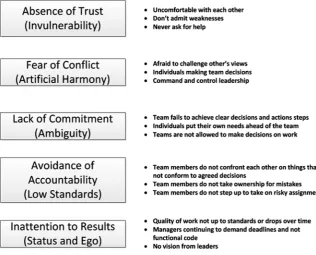
One of the holy grails of agile development is self-organizing teams. Many soft-ware developers dream of having a team with complete autonomy, able to organize however works for them, completely without management involvement or interfer-ence. However, what most developers fail to realize is that given to their own devices, without training as to how to organize and what “organizing” actually means, most would fail miserably. Often, agile development efforts fail, even with efforts to educate the team about agile principles [ 53 ]. That is because the team doesn’t fail because they don’t understand agile software development. It’s because they don’t understand human nature and the diffi culties in taking a team of highly motivated, strong personalities, and get them to automatically give up their egos, preconceived notions, and past experiences, and embrace the agile team dynamics required to put together a highly successful agile development effort. We call this “Agile Team Dysfunctionality,” and there are many common dysfunctions that plague improperly trained teams and team members. Figure 2.6 illustrates several of the most serious dysfunctions, most of which come both from basic human nature and from people’s experience with work on programs/projects in the past. Nothing drives failure of agile development like past failures. Remember Figs. 1.1 and 1.2 . Teams that have experienced Fig. 1.2 are hard pressed to throw off their suspicions and embrace agile development processes, team dynamics, and the entire agile agenda fresh. Management must be cognizant of these dysfunctions and work within the teams to dispel them.
Inability to recognize or deal with agile team dysfunctions can destabilize the team(s) and derail the agile development process faster than anything else. Keeping a stable set of Sprints teams is important, as constantly changing out team members radically changes team dynamics, and affects both personal and team Empowerment and Locus of Control [ 58 ]. Section 2.6 discusses the concept of stable team membership.
2.6 Creating a Stable Team Membership: Containing Entropy
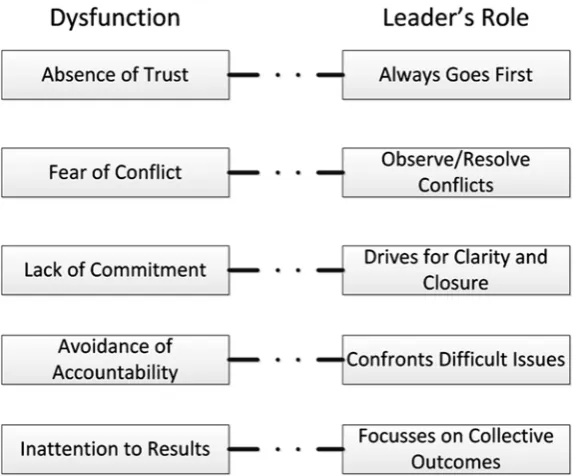
[image:29.439.55.372.62.317.2]As previously discussed, it is vital to choose the right teams for any program/project, but it is even more important for agile development. Teams with stable memberships across Sprints are vital, as team members develop trust over time, gain an under-standing of each member’s strengths and idiosyncrasies, and, with proper training, mentorship, and facilitation by the manager, settle into an agile development “rhythm” throughout the program/project. If the team has to integrate new members, effi ciency will always suffer until the new team member is properly integrated into the rhythm. New expectations are created; the new person will most likely have an entirely different notion of Empowerment and Locus of Control than the previous team member, throwing the overall team out of balance. A stable team can be a trust-ing and effi cient team [ 56 ]. There is generally an increase in commitment over time with a stable team [ 52 ]. In order to facilitate creation of stable agile sprint teams, the Agile Manager must recognize, understand, and know how to deal with the dysfunc-tionalities discussed in Sect. 2.2 . For each dysfunction, the Agile Manager must take on a role, or provide guidance that dispels the dysfunction and allows the team to move toward and independent cohesiveness between the team members [ 60 ]. Figure 2.7 illustrates the Agile Manger’s role in dealing with classical agile team
21
dysfunctions, creating a team that works together, in Empowered independence and dependence, to develop software in an effi cient agile environment.
As depicted in Fig. 2.7 , for each of the agile team dysfunctions described in Fig. 2.6 , Fig. 2.7 illustrates the Agile Manager’s response required to eliminate the dysfunction and allow the agile development teams to function effectively and effi ciently:
1. Absence of Trust : In order to build trust within the teams, the Agile Manager must always be willing to take the lead and prove to the team members that they will “roll up their sleeves” and do whatever is necessary to either get the pro-gram/project moving or to keep it moving along.
2. Fear of Confl ict : Many developers are fearful of bringing up issues, not wanting to start controversy within the team. Many people, particularly strong introverts, may internalize the confl ict, never bringing it up, but eventually the confl ict will drive controversy between the developers, create a lack of trust, and may drive the team to withdraw from each other, destroying the collaborative nature of agile development teams. In order to diffuse these situations before they begin, the Agile Manager must be observant and cue in on body language and utilize the soft people skills like paying attention to changes in personal habits, language, friendliness, and other clues apparent between team members, and facial expres-sions to understand when such nonverbal controversies exist and work to resolve the confl ict before they begin to negatively impact the development efforts.
Fig. 2.7 The Agile Manager’s response to team dysfunctions
[image:30.439.76.365.59.297.2]3. Lack of Commitment : A lack of commitment to either the agile development team or the agile process in general can destroy an agile program/project before it gets started. Observing a low quality of work, absenteeism, lack of willingness to communicate, or constantly seeming to be overwhelmed by the volume of work may be indications of a lack of commitment. The Agile Manager needs to understand the developer’s reasons for the lack of commitment, clarifying for the developer what is expected, clearing up any misconceptions the developer may have. In the end, if the Agile Manager does not feel they have dispelled the lack of commitment, the developer must be removed from the team or there is little hope for successful agile development. I know this sounds harsh, but agile only works if all parties have a buy-in to the agile development process.
4. Avoidance of Accountability : There may be issues getting developers to step up and take on rolls of responsibility within the agile teams because they are afraid that if they take responsibility for the team’s activities during a given Sprint and there are problems, they will be punished. This lack of accountability needs to be dealt with in order for the Sprint development teams to develop a good business rhythm and operate effectively. It is up to the Agile Manager to confront issues, while not assigning blame or punishment, but working through diffi cult issues, helping each developer learn from the issues in order to solidify the teams and allow the develop-ers to grow and mature as membdevelop-ers of an agile development team. This will pay off in the future as each developer becomes more embedded in the agile process and learns to be effective in and excited about agile programs/projects.
5. Inattention to Results : Some developers like the agile team process because they feel they can just write code and let other people worry about the details, results, testing, etc. But, it is vitally important that the entire team focus on the results: working, error-free code with capabilities required for each Sprint that can be demonstrated. If any of the developers/team members are not focused on the results, the team will never develop a good agile development rhythm. Also, one member being inattentive to details and results will breed mistrust between the members, reducing the effectiveness of the team(s). Therefore, the Agile Manger must keep the program/project vision in front of all developers and teams, making sure everyone is marching down the same path, ensuring that the collective outcomes of all the Sprint teams, across all of the Sprints, integrate together and are heading toward a common, customer-focused goal.
2.7
Challenging and Questioning Sprints:
Individual Responsibility
23
not force solutions on the team, for this fosters resentment and breeds an attitude of lack of commitment to the program/project. If you build and train the teams correctly, they should be able to discuss and come to agreement on how capabilities are spread across Sprints, who is the best choice for what role across each Sprint, and to work together when collaboration is needed. The ability to challenge and question leads team members to a better understanding and more commitment to the end goal, not only for each Sprint, but to the entire program/project as well [ 54 ].
2.8
Mentoring, Learning, and Creativity: Creating
an Environment of Growth
Agile development teams, at least the majority of teams, will be composed of devel-opers at a variety of experience levels. Each member comes with their own strengths and weaknesses and should be provided an atmosphere that not only allows them to succeed, but to grow and learn, both from the experience of developing code for the program/project across the Sprints, but from each other as well. If facilitated cor-rectly by the Agile Manager, the agile development program/project will allow opportunities for mentoring and learning. However, this must be designed into the Sprints, both in schedule and in capability distribution across the team members. Creating an atmosphere of mentoring, learning, and creativity increases effi cien-cies, as the team progresses through the Sprints, and helps future programs/projects as well. Given the probable diversity of team members, the Agile Manager should make sure everyone has the opportunity and personal attitude of both mentoring and learning from each other. New software techniques brought by junior developers may be necessary for certain capabilities that older more experienced software developers may not be aware of. At the same time, junior developers should also bring an attitude of mentoring and learning, as the experienced developers can aid junior developers from going down disastrous roads already traveled by senior developers. In short, the atmosphere the Agile Manager must NOT bring to the agile development teams is illustrated in Fig. 2.8 .
2.9 Keeping the Vision in Front of the Team: Ensuring
System Integration
I have heard many developers tell me that the one advantage with agile development is that they are free to do what they want, because it isn’t necessary to establish a systems and software architecture for agile programs/projects. Such notions lead to serious problems later in the development cycle. Without a systems and software architecture, integration and fi nal testing of the system is problematic at best and normally results in much rework and recoding to create a complete system [ 26 ].
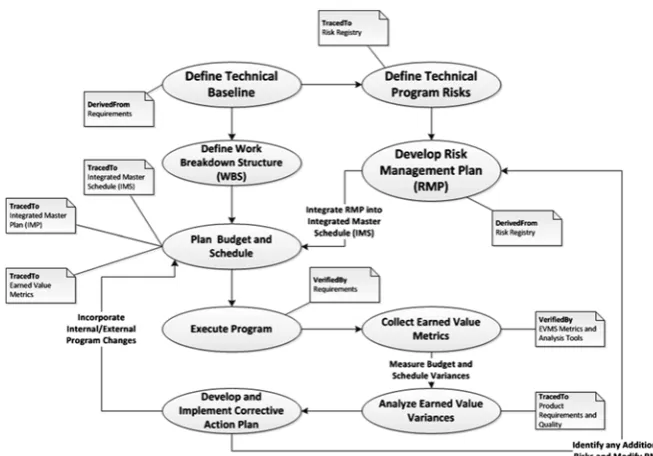
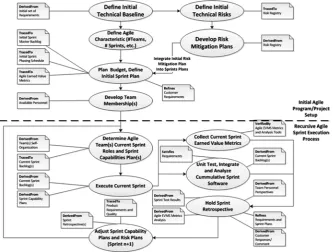
Each team member and each team must understand the end goals for the system. You must remember that agility does not mean there is no structure, but the agile development methodology provides the abilities to move about within a given archi-tecture or structure. Figure 2.9 illustrates the differences between the traditional development process and the agile development process [ 57 ].
Fig. 2.8 The “Rigid” Agile Manager
25
Every aspect of the classical development cycle has a counterpart for the agile design process, but is designed, or intended, to promote the agile mind-set: one of adaptability to changing requirements or environments. Many are uncomfortable in the agile software development paradigm. Many like the structure of classical soft-ware development. So how does one understand who is and is not comfortable with agile development. Can any developer be made to function within the “freedom” of agile? In Chap. 3 we will explore all of the dynamics of agile development teams, how to create, manage, facilitate, and empower agile development teams.
Where the traditional development process involves and is focused on detailed planning, budgeting, controlling, and program/project execution, the agile develop-ment process must be adaptive and innovative, deriving solutions to a changing requirements/capabilities baseline, the focus being on working software, not cost and schedule. This is not to say that cost and schedule are not important in agile development, because cost and schedule are always important in any program/proj-ect execution. However, the agile development process has much more fl exibility to deal with risks or issues that arise than the classical development process, giving the Agile Manager more tools and more opportunities to adjust without major rework in extensive schedules and budgets.
27 © Springer International Publishing Switzerland 2015
J.A. Crowder, S. Friess, Agile Project Management: Managing for Success, DOI 10.1007/978-3-319-09018-4_3
Understanding the Agile Team
Success in the modern, agile development era required Agile Managers and Leaders who truly understand what agile development means, how to create agile teams, and how agile teams collaborate, cooperate, and function in various situations, particu-larly in geographically and culturally diverse environments. In addition, they must understand the agile development cycle vs. the traditional development cycle [ 15 ]. Figure 3.1 illustrates the classical program/project development cycle.
This program/project development cycle has been used for many decades. Requirements are allocated and/or derived, program plans are made, budgets and schedules established, and you march forward. For this development cycle, change is bad, for it causes rework of the entire development cycle, driving up cost and schedule. And, the farther into the development cycle you are when you discover problems, or changes happen (new or changing requirements), the costlier they are to “fi x” both from a cost and schedule perspective. Figure 3.2 illustrates the increas-ing costs associated with changes, dependincreas-ing on when in the development cycle the changes or problems are encountered.
As mentioned, when problems arise, or requirement changes happen, it drives a replan of the program schedule and a re-estimation of costs to complete the pro-gram/project, either an Estimate at Completion (EAC) or an Estimate to Complete (ETC) or both. A new program plan must be put in place, new budgets and schedule, and the development cycle restarts, as illustrated in Fig. 3.3 .
28
Fig. 3.1 Traditional program development cycle
Fig. 3.2 Costs associated with changes along the development timeline
Fig. 3.3 Replanning of the classical development cycle
proper length of a Sprint. Figure 3.4 illustrates a typical agile program development cycle. In Fig. 3.4 we see the typical Sprint rhythm of initiating, planning, and execution of agile Sprints during the agile development process.
Again, the length of the Sprints is dependent on the program/project, the com-plexity of the software, total duration, and team membership. The duration of the Sprints is not relevant to this discussion. One of the big advantages to agile develop-ment is due to the adaptive nature of the Sprints. If a problem is discovered it can be rolled into the next and subsequent Sprint planning sessions and rolled into the schedules and does not require a major replan of the entire project, the way it does in classical development. Figure 3.5 demonstrates this process. Normally, because there is working software after each Sprint, problems are discovered earlier in the develop-ment process than in conventional or classical developdevelop-ment methodologies. Customer and management feedback after each Sprint provide the opportunities to re-vector the development efforts before major cost and schedule have been expended.
We will not try to argue here over the length of Sprints, except to mention that the length of Sprints is tied to the overall length and complexity of the program/ project development effort. Typically Sprints build in some sort of demo or evalua-tion to demonstrate the goals of the Sprint have been achieved. If the Sprint is too short, the work/evaluation ratios will be small; therefore the accomplishment/cost will be low. The other problem with short Sprints is that it will be diffi cult to achieve goals for complicated capabilities. Typically 30–45 days is a reasonable length for
Fig. 3.4 Typical agile program development cycle
30
a Sprint, again, depending on the complexities and overall goals for the software. The goal is to fi nd the right rhythm for the project. Sprints should be long enough to produce working software that can be properly evaluated to determine the program/ project is progressing along the correct paths [ 78 ]. But if the Sprints are too long, too many capabilities will be included in the Sprint, making end-of-Sprint demos and evaluations lengthy, and any issues discovered during the Sprint make it more diffi cult to recover. Also, if Sprints are too long, the retrospectives evaluation at the end of the Sprint is more diffi cult as it is more diffi cult to remember what happened at the beginning of the Sprint. Also, the clients/customers will be fl ooded with fea-tures to evaluate and provide feedback; in other words, if the Sprints are too long, they are not “agile” enough. Also, there should not be time between Sprints. The demonstration/evaluation, retrospective, backlog evaluations, etc., should be done and then the planning for the next Sprint should commence immediately. Again, Sprint length is tied into the quality and abilities of the teams, the technology and architecture of the systems, and the complexity of the software to be developed. Sprint length should be kept as constant as possible, since changing the Sprint length disrupts the rhythm of the project and the teams constantly have to reevaluate what can get accomplished during any given Sprint.
3.1
Agile Team Dynamics
Understanding the mix of personalities and soft people skills, coupled with how these manifest themselves across gender, ethnic backgrounds, cultural and genera-tional diversities, and other considerations, will become essential for modern devel-opment leadership and management [ 5 ]. This new Agile Team paradigm is uncomfortable to many managers, who may feel like they now have nothing to do, given that central control and authority is given to the team, not to the Agile Manager. However, the Agile Manager is as busy as or busier in this environment than in a classical development effort [ 77 ]. The role of the facilitator across the agile teams is a critical role to the overall success of the development program/project. Many of the responsibilities of the Agile Manager are not all that different from those in classical management, except that in the Agile Development world, the Agile Manager must focus on the team’s ability to deliver working software, rather than focus on traditional program/project measurement metrics [ 36 ]. The Agile Manager must lead, inspire, and provide empowerment (coaching) to the agile development team. The Agile Manager must be involved and facilitate, from a “hands-off” perspective, those supporting functions that allow the agile develop-ment team to be effective:
1. IT support and governance policies 2. Human Resource issues
3. Finance responsibilities
4. Support Teams—administrative, security, etc.
For the Agile Manager, this often involves adjusting one’s person management/ leadership style, and may require the Agile Manager to even work to affect and change the company culture to allow the agile teams to be effective and successful. It means working to acquire and utilize the abilities to understand and choose individuals who possess competencies that are agile-value based [ 37 ]. Understanding and being able to assess developers’ skills, not just in designing, coding, and testing, but in those skills that can make or break agile teams, are equally important. The Agile Manager must ensure that they, as well as the development team, understand the agile style, cultural dynamics, and team dynamics [ 38 ]. It is essential that the team understand and be comfortable with the rhythm of the agile development style, Sprint after Sprint, each with its own cycle of planning, coding, testing, lessons learned, and then immediately moving on to the next Sprint. Figure 3.6 illustrates this recurring agile Sprint development rhythm.
Figure 3.6 illustrates the recursive nature of the agile development process. Once the initial project vision and initial scope has been established (with stakeholder buy-in), the teams are selected, the initial number and length of Sprints are deter-mined, IT environments established, and the initial Sprint is initiated. From Sprint 0, the agile development program/project continues through the center two blocks shown in Fig. 3.6 until the program/project is completed and it is time for fi nal product release. Blocks 2 and 3 shown in Fig. 3.6 are the heart and soul of agile development. Block 2 represents the Sprint software development, which includes working with the stakeholders to establish the priorities and capabilities needed for the current Sprint. Brain/Model storming is used to determine the test-driven soft-ware designs required for the current Sprint capabilities, keeping in mind that the current Sprint software must integrate with the previous volume of software [48]. This is accomplished with a continuous integration process that ensures working software at the end of the Sprint. Block 3 includes the fi nal Sprint system/accep-tance testing, releasing software through Sprint N into production and demonstrat-ing the software to ensure functionalities are acceptable. Stakeholder involvement at each step ensures the fi nal software will be accepted at the end of the project. After the fi nal Sprint, the fi nal software is released and fi nal documentation is delivered, along with any training that is required.
32
This agile development process rhythm is important to the overall success of the program/project. Without understanding, facilitating, and protecting this rhythm, it will be diffi cult to achieve overall success from an agile development program/ project. Keeping the teams functioning smoothly is the best thing the Agile Manager can do to promote a successful project. Case Study #2 illustrates this.
Case Study #2: The Disruptive Scrum Master
Project Length 24 months Number of Sprints 9 Sprints Number of Teams 5 Teams Average Sprint Duration 8 weeks
Description This project was struggling early on as personnel from each of the agile development teams were hesitant to take on the role of Scrum Master for the Sprints, not wanting to be tagged as responsible if the team did not meet their capability development goals for any given Sprint. To solve this, the Agile Manager brought in a Senior Scrum Master from one of the company’s “showcase” programs/projects. The teams assumed they would be coming in to train them on how to be effective as a Scrum Master, and to teach management how to allow the Scrum Masters to handle each development team across the Sprints, and to facilitate the teams choosing the right Scrum Master for each Sprint. Instead, the Senior Scrum Master took on the role of scrum master for all fi ve teams. This was inherently a bad idea, as having one person act as Scrum Master for fi ve agile development teams violates many of the roles that the Scrum Master needs to take on during each of the development Sprints. The fi rst problem with one person acting as Scrum Master for all the teams across all of the Sprints is that the person taking on the role of Scrum Master should change at each Sprint, depending on the complexity points required for that Sprint and the expertise of the team members, based on the complexity points required for that Sprint. The role of the Scrum Master includes, but is not restricted to:
1. Assists the product owner with the backlog, both in its creation and with its maintenance.
2. Works with the agile development team to defi ne completion of the Sprint. What are the criteria for “done?”
3. Removes stumbling blocks or impediments to progress, whether they are internal to the agile development team, or outside the team (e.g., support needed from another agile development team, or the IT team, etc.).
4. Facilitates the team’s self-organization; helps the team remove roadblocks as part of the Sprint development team.
5. Helps the agile development team follow the Scrum process. As such, the Scrum Master should have an excellent understanding of the Scrum agile development management structures and must be willing to teach or mentor junior developers in the process.
6. In the end, the Scrum Master should spend the Sprint making the rest of the development team as productive as possible.
Having described the role(s) of the Scrum Master, having one person act as the Scrum Master across multiple agile development teams and across all Sprints within the development process is inherently ineffi cient, violates the precepts of a Scrum Master, and produces major problems that will ultimately hurt effi ciencies. The issues that developed with the overall project are:
1. Each individual agile development team did not have access to the Scrum Master throughout the development cycle, since the Scrum Master’s time and attention were spread