o
o
o:!
o
0 I~
o
O~
~
00 0 0
o
0 0 0 0 O ! &o
0 0 0o
0 [IJl 09aOO
0rJi
B
~crw
0~t!t o~
Computer Art Cl!ntest
First Prize
August, 1966
Banks can render this type
of bill and these types of statements
for all types of businesses!
JOHNA.JONESD.D.S. MEDICAL .. CENTER 310 MAIN STREET
PlTTSBURGH~ PA •• 15250
What started out to give doctors relief from bookkeeping chores has turned into a remedy for many another small business in Pittsburgh.
For now the Mellon National Bank & Trust Company of Pittsburgh is doing it for restaurants, auto parts stores, florists, drugstores, country
r
...,
JOHNA. JONES D~D.S. P.O~BOX 333
PITTSBURGH, PA.
clubs and others, as well as for den-tists and doctors.
Prepunched account cards are in-serted into a card reader connected to a Data-Phone* data set. And the information is transmitted over regu-lar telephone lines. At the bank, the cards are automatically duplicated
and then processed to provide the bills and forms shown here.
Businesses using the service need no longer be concerned with account-ing equipment, maintenance agree-ments, printed forms, envelopes and stamps.
. Overtime and billing-time confu-sion are eliminated. Remittances come in regularly, because state-ments are· mailed on time regardless of personnel turnover, vacations, peak loads and emergencies.
. The bank's data system provides businesses with these daily reports and forms: Transaction Journal; Trial Balance Journal; summary of all daily charges, payments, adjustments, month-to-date and year-to-date re-ceipts; deposit tickets for all money
automatically deposited in the busi-ness's account; prepunched cards for new accounts.
Monthly reports include: State-ments for all due accounts; Aged Accounts Receivable Report; Service Recapitulation Journal; New Account Report; Closed Account Report.
Now even sma II businesses get big-business billing service.
Our Communications Consultant can give you more details.
A
'r.
T@
Bell System
~
&
~ American ~elephone & T.elegraph and Associated Companies*
Trademark of the Bell SystemAnd Now, the $10,000 Computer
PDP-SIS: A full, general purpose, digital computer for real time analysis. 4K core memory (expandable). usec speeds. 66 plus instructions.
Complete, proven software, including FORTRAN. Flexible inpllt/ output bus. Teletype included.
Available now, the new PDP-8/S - a direct lineal descendant
of the PDP-8, the most flexible, versatile, approachable,
on-line, real time, high speed digital computer ever made.
Both use the same basic design concept. Both have the same size
memories. Both are expandable. Both use the same instructions,
use the same software libraries.
They do not, however, work at the same speeds. And they
do not cost the same amount of money.
The P.DP-8
IS
adds in 32 microseconds (compared with 3.0 microseconds
for its parent). If you need the speed, the PDP-8 is for you.
The PDP-8
IS
costs $10,000.
Think of it. Full computer. Proven hardware. Proven software. $10,000.
Any DIGITAL field office can give you the details. Or write.
COMPUTERS· MODULES
DIGIT AL EQUIPMENT CORPORATION, Maynard, Massachusetts 01754. Telephone: (617) 897·8821 • Cambridge, Mass •• Washington, D. C .• Parsippany. N~ J .•
Rochester, N.Y .• Philadelphia. Huntsville. Orlando. Pittsburgh. Chicago. Denver. Ann Arbor. Los Angeles. Palo Alto. Seattle. Carleton Place an'd Toronto, Ont. • Reading, England. Paris, France. Munich and Cologne, Germany. Sydney and West Perth, Australia. Modules distributed also through Allied Radio
Heads!
You don't pick precision magnetic tape this way, but we have the feeling that
some people do.
"How can you lose," we've heard
it
muttered, "one leading brand is as good
as another."
Well, like the song says, "it ain't necessarily so."
Take Computape users. They would rather be safe than sorry. And they've
found that, for long, reliable, error-free performance, Computape is about the
safest tape going.
Has to be. Not a reel of tape leaves the plant that hasn't been checked and
re-checked dozens of times for perfect quality and uniformity. And of course,
each reel has been meticulously produced to meet the individual specifications
of the equipment on which it will be used.
Nothing is completely. sure in this life, but when you can come this close
with Computape, why tempt fate with some other brand?
VISIT OUR EXHIBIT AT ACM CONFERENCE - BOOTH 39·40
A PR.DDUCT OF CDMPUTRDN INC.
122 CALVARY ST .. WALTHAM. MASS. 02154
Designate No. 3 on Readers Service Card
AUGUST, 1966 Vol. 15, No. 8
editor and publisher
EDMUND C. BERKELEY
associale publisher
PATRICK J. MCGOVERN
assiSlant editors
MOSES M. BERLIN LINDA LADD LOVETT NEIL D. MACDONALD
contributing editors
JOHN BENNETT ANDREW D. BOOTH DiCit H. BRANDON JOHN W. CARR, III NED CHAPIN ALSTON S. HOUSEHOLDER PETER KUGEL ROD E. PACKER
adf/isory committee
T. E. CHEATHAM, JR. JAMES J. CRYAN RICHARD W. HAMMING ALSTON S. HOUSEHOLDER IIERBERT F. MITCHELL, JR. VICTOR PASCHKIS
orl director
RAY W. HASS
ful/ilmrmt manager
WILLIAM J. MCMILLAN, 815 W8Ihilgtol St.
NewtolviII8, Mass. 02180, 611-0Ecatur 2·5453
advertising repretentat;lIes
New York 10018, BERNARD LANE 37 West 39 St., 212-BRYallt 9·7281
Cllicago 606", COLE, MASON AND DUliNG
737 N. Miciligu Ave., 312-SU 7-6558 Los Algeles 90005, WENTWORTH F. GREEN 300 S. Kenmore Ave., 213-DUnkirk 7·8135
Sal Francisco 94105, A. S. BABCOCK 605 Market St., 41!i-YUkoR 2-3954
Elsewhere, THE PUBLISHER 815 Was~i.gtoR St., 617·DEcatur 2-5453 Newtonville, Mass. 02160
The front cover shows Jome computer art from Stuttgart, Germany, first prize
in the 1966 competition.
For more information, Jee page 8.
In This Issue
Special Featttre:
The Computer in the Arts
8
16
20
22
COMPUTER ART CONTEST
The 1966 Computer Art Contest of "Computers and Automation"
THE COMPUTER IN MUSICAL COMPOSITION
by Professor Gerald Strang
A report on the two main aspects of computer experimentation in musical composition: aiding the composer in the production of a score; and pro-ducing actual sounds with "instruments" and an "orchestra" generated by computer.
CRITICAL EVALUATION OF SOFTWARE PACKAGES
by Carl Hammer
An investment made in critically analyzing software packages along the lines suggested here should pay handsome dividends.
INFORMATION: DILEMMA OR DELIVERANCE?
by Walter W. Finke
Reasons why the technical community (including the computer profession) should take a more active and vocal role in social affairs, so that the crossing of the information frontier will actually bring great advantages to all of society
28 ZIP, BUZZ, WHIR, CLONK: COMPUTERS BOTCH UP SOME OF THEIR JOBS
by Lee Berton
A theater fires its computer; a study calls human beings faster; who really is at fault?
In Every Issue
31
7
14
15
30
46
48
50
50
across the editor's desk
COMPUTING AND DATA PROCESSING NEWSLETTER
editorial
Computer Application Failures
market report
Good Programming is a Creative Effort: Satisfactory Completion of a Creative Effort Cannot be Accurately Predicted: Satisfactory Completion of a Good Programming Effort Cannot Be Accurately Predicted
capital report
by James Titus
throughput
by Di ck Brandon
reference information
Computer Census
New Patents, by Raymond R. Skolnick Calendar of Coming Events
index of notices
Advertising Index
:~~ COMPUTERS AND AUTOMATION IS PUBLISHED MONTHLY AT 815 WASHINGTON ST., NEWTONVILLE, MASS. 02160, BY BERKELEY ENTERPRISES, INC. PRINTED IN U.S.A. SUBSCRIPTION RATES: UNITED
~ STATES, $15.00 FOR 1 YEAR, $29.00 FOR 2 YEARS, INCLUDING THE JUNE DIRECTORY ISSUE; CANADA, ADD 50. A YEAR fOR POSTAGE; fOREIGN, ADD $3.50 A YEAR fOR POSTAGE. ADDRESS' ALL - " " / EDITORIAL AND SUBSCRIPTION MAIL TO BERKELEY ENTERPRISES, INC., 815 WASHINGTON ST., NEWTONVILLE, MASS., 02160. SECOND CLASS POSTAGE PAID AT BOSTON, MASS.
POSTMASTER: PLEASE SEND ALL FORMS 3-'79 TO 8ERKElEY ENTERPRISES, INC., 815 WASHINGTON ST., NEWTONVILLE, MASS. 02160. © COPYRIGHT, 1966, BY BERKELEY ENTERPRISES, ~NC. CHANOE OF ADDRESS: IF YOUR ADDRESS CHANGES, PLEASE SEND US BOTH YOUR NEW ADDRESS AND YOUR OLD ADDRESS (AS IT APPEARS ON THE MAGAZINE ADDRESS IMPRINT). AND AllOW THREE WEEKS FOR THE CHANGE TO BE MADE.
After we deliver a computer,
we keep delivering.
What we deliver can save you time, headaches, and hard cash. Take off·the·shelf software for instance. Your NCR representative can deliver thoroughly documented and user·proven program packages for business, scien· tific and engineering applications right now. Software packages ranging from payroll to stepwide regression. From linear programming to bivariate correlation coeffi· cient. (That's a sampling from the catalog of manage· rnent information tools in the ready·to·run NCR library.)
When we deliver an RMC, 315, or 315·100, we deliver
the programming languages that are right for you. We're ready with Cobol, Neat, Best, RPG, Fortran IV, Fortran II and Neat Assembler. We're ready to deliver the right Sort/Merge routine to match your installation needs.
We're delivering an advanced operating system with automatic run·to·run control assuring the right file name and date version, and including dating flag options for any program in the system.
Software is a big reason why NCR is serving more and more customers every day. Give us a call. We deliver.
THE NATIONAL CASH REGISTER COMPANY, DAYTON, OHIO 45409
6
®
Designate No. 4 on Readers Service CardCOMPUTERS and AUTOMATION for August, 1966
(I
c&a
EDITORIAL
Computer Application Failures
On July 6, the Wall Street Journal published an article
by staff reporter Lee Berton entitled "Zip, Buzz, Whir, Clonk: Computers Botch up Some of Their Jobs" - A Theater Fires Its Machine; Study Calls Humans Faster; But Who Really Is at Fault?"
The article (reprinted elsewhere in this issue) is well worth reading and thinking about. It lists instances where:
• A computer failed in adequately assigning seats at a theater;
• It was shown that a computer would take longer for billing and filling orders in an office supply house than human beings would;
• Changing to a computer caused 50 complaint telephone calls a day, in a subscription fulfillment operation; • A computer increased time to 7 days, compared with 4
days using clerks and billing machines, in filling orders for books.
Clonk! Clonk! Do the troubles actually come from the computer?
Of course it is true:
• That it is worse to make errors 1000 times a second than it is to make them once a second;
• That if people have not understood the process which the computer should perform, then the process pro-grammed in the computer MUST produce errors; • That it is easier to correct human clerks in the visible
performance of their work than it is to correct a com-puter in the completely invisible performance of its work.
• That computers, like matches and guns, arc tools and are completely neutral in human affairs;
• That there are many examples of successful installations of computers in assigning seats, assembling orders, per-forming billing, fulfilling subscriptions, etc.
And we could go on for a long time in pointing out similar truths about computers, and perhaps make a case for no blame to be attached to the computer.
But is this all to it? No.
COMPUTERS and AUTOMATION for August, 1966
Computers are sold by human beings in order to receive a • sale price. They arc bought by human beings in order to get . a value out of them. The sellers may be informed or ignorant, but they are most often informed. The buyers may be in-formed or ignorant, but they arc all too often ignorant. The informed seller has a duty to the ignorant buyer. The seller should refuse to sell a computer when with his knowledge it is clear that the buyer is going to waste his money.
For example, in 1950 I visited the central office of a large paper company in New York. This office had to produce weekly and monthly summary reports for some 200 products produced by 29 plants here and there all over the United States and Canada. At one time, they had had a punch card installation with some 8 machines and 6 people for the pur-pose, and they found they could not get their summaries .quickly and correctly. That installation was gone. They now used an ordinary table, some perforated forms, and an ar-rangement of pins. The forms listed all possible products in the same sequence for every plant; zero would apply if some product was not produced at a plant; and for each reporting period the completed forms giving the production figures were mailed in from all over the country. As soon as the 29th report was in, the forms were aligned by the pins on the table, and a girl would go across each row on the forms, picking up the figures for a particular product, adding them with an adding machine, and entering the total on a 30th form. Then another girl could check the adding machine tape and the entry. Thus the office avoided the entire input, out-put, sorting, and collating of punch card operations. They handled each figure only twice, once for adding and once for checking. Here is a fine example of a simple, direct, fast, efficient method avoiding both the computer' and punch card machines.
In almost every case where a figure is going to be added only once, it makes no sense to put it into some input device, add it inside a computer, and then take it out through some output device. It is better to use some other process. A guide to "When NOT to Use a Computer" would contain such a warning.
(Please turn to page 29)
Jhe first prize of our 1966 Computer Art Contest is awarded to Frieder Nake, Stuttgart, Germany. This drawing is the result of producing uniform small squares with a kind of regular irregularity specifically suitable to a computer's patience. It appears on the front cover of this issue, and in miniature above.
All the other computer art drawings published in this issue receive honorable mention. For some of these drawings, the explanation is obvious or can easily be inferred; for others, some explanation is given.
Next year we expect to run this contest again, and we again invite contribu-tions of computer art from our readers.
Another drawing entered by Frieder Nake.
SILK PATTERNS
From Maughan S. Mason, Huntsville, Alabama 35802
Both these drawings were generated by an analog computer with an X-Y plotter output. The originals were plotted in black India ink, with one dimension 30 inches long.
CUBIC FIGURES Peter Mi loj edi c McGill University
Montreal, Quebec Canada
The cubic figures on the right and below were obtained by connecting . certain points on the sides of a
cube.
to
The positions of the lines were changed by translation or rotation in order to achieve artistic effects.
The figures were drawn on a Calcomp 565 Plotter made by California Computer Products.
COMPUTERS and AUTOMATION for August, 1966
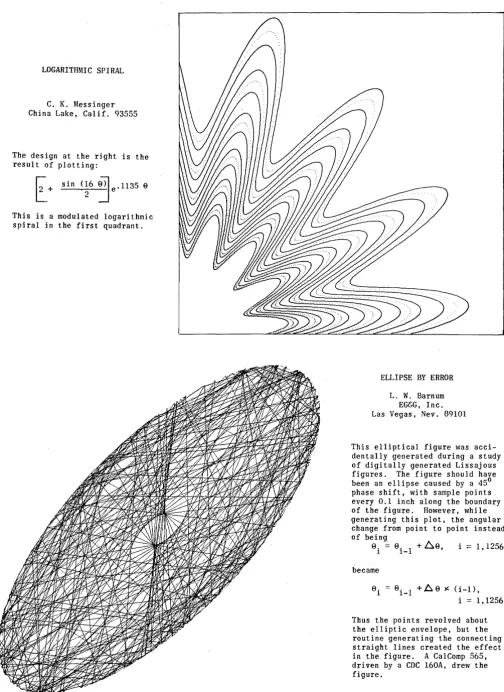
LOGARITHMIC SPIRAL C. K. Messinger China Lake, Calif. 93555
The design at the right is the result of plotting:
E+
sin(;6
~e.1135
8This is a modulated logarithmic spiral in the first quadrant.
COMPUTERS and AUTOMATION for August, 1966
ELLIPSE BY ERROR L. W. Barnum
EG&G, Inc. Las Vegas, Nev. 89101 This elliptical figure was acci-dentally generated during a study of digitally generated Lissajous figures. The figure should have been an ellipse caused by a 450 phase shift, with sample points every 0.1 inch along the boundary of the figure. However, while generating this plot, the angular change from point to point instead of being
e.~e'l+~e, i~1,1256 1
1-became
8i
e
i_l +
A
e )(
(i-I), [image:11.615.60.565.42.735.2]12
Here are two more examples of the computer art work of Frieder Nake of Stuttgart, Germany.
IIIIIIIIIIIIIIIIIIIIIIIIl1li111111111111111111
ROSETTE
D. K. Robbins Sandia Corp. Albuquerque, N. M.
The figure at the right repre-sents a modification of a solu-tion to a problem in calculus. It was drawn on a CalComp plotter made by California Computer Products.
COMPUTERS and AUTOMATION for August, 1966
ELL! PSES AND CIRCLES Peter Mil oj ed i c McGill University Montreal, Quebec,
GOOD PROGRAMMING IS A CREATIVE EFFORT. SATISFACTORY COMPLETION OF A CREATIVE EFFORT CANNOT BE ACCURATELY PREDICTED. SATISFACTORY COMPLETION OF A GOOD PRO-GRAMMING EFFORT CANNOT BE ACCURATELY PREDICTED.
The above syllogism has not, apparently, been given serious consideration by vendors in the com-puter field. All- computer builders make promises to customers and prospects on the delivery date for their system software. Some are rashly willing to include the promise in an equipment contract. One vendor is even advertising in national magazines the software delivery dates he is promising on his new computer system.
But the fact is that nearly all early users of a new computer system have had to face software de-livery delays and/or defective delivered software. This is due largely to the inability of the computer manufacturer and the software contractors he employes to predict accurately the date on which they will complete a particular programming job. And since the programming jobs in creating systems software are often interrelated, the delays can be additive .... one delay sets back the time when work can begin on other parts of the project.
MARKET
REPORT
The table below provides some appreciation for this phonomenon by listing the software delivery slippages for the leading computer manufacturer, IBM, on its new 360 line (acc'ording to a survey recently conducted by our staff). A similar table, with delivery delays in many cases as severe as those shown here, could be constructed for other computer manufacturers. No vendor has been fault-less in this regard.
Can delays in delivery of software be ~vercome?
Certainly many programming efforts on routine appli-cations require a minimum of creative effort, and often can be produced to a close timetable. However, so long as computer manufacturers produce new com-puters that require systems software more complex and more challenging that that already available (which is surely in the interest of technical prog-ress), attempts to rigidly schedule the completion time of advanced programming efforts will continue to meet with limited success.
Comments, letters, and articles from readers on this important problem are invited.
SOFTWARE DELIVERY DELAYS ON IBM'S SYSTEM 360
14
SOFTWARE Control Program
(Basic) Control Program (Time Sharing)
Assembler
Design Level 10K 44K 200K FORTRAN
Design Level 10K 200K COBOL
Design Level 10K 44K PL/I
Design Level 10K 44K 200K Report Program Generator(10K) Simulators
IBM 7090/7094 &
7070/7074 IBM 1410/7010 &
7080 Sort/Merge
2400 series tapes
& 2311 7340 2301
Utility Programs(10K)
ORIGINAL DATE REVISED DATE (Announced 4/64) (Announced 1/66)
4th Q,1965
2nd Q,1966
4th Q,1965 4th Q,1965 2nd Q,1966
4th Q,1965 4th Q,1965
4th Q,1965 2nd Q,1966
4th Q,1965 4th Q,1965 2nd Q,1966
4th Q,1965
1st Q,1966 2nd Q,1966
4th Q,1965 2nd Q,1966 2nd Q,1966 4th Q,1965
3/66
1/67(Basic) 7/67(Queued)
3/66 5/66 None Listed
3/66 6/66
3/66 11/66
None Listed 4/66 7/67
12/66
6/66 10/66
3/66 4/67 1/67 3/66
REVISED SIZE
15K
15K
15K
15K
DELAY (In Months)
3-5
7-9 13-15
3-5 5-7
3-5 6-8
3-5 5-7
4-6 13-15
12-14
3-5 4-6
3-5 10-12
7-9 3-5
"
Sometimes it pays to complain, and if you complain to the right. people; it may pay millions of dollars.
This is. exactly what· happened' in the computer industry in re'centmonths, but it goes back to June 1965 when IBM Corporation received the first of two . large equipment orders from.the National Aet,'onautics anclSpace Administration. This was an $18 million computer order for the Goddard Space Flight Center, in Greenbelt, Md.
It
was fondw~d in , October by an $80 million contract to extend the rea~e computer complex at the National Aeronautics and Space Administration1fanned Spacecraft Center, in Houston, Tex. The first contract caused little stir in the industry, but when NASA announced the second as a soIe-sourceprocure~ment, thereby sidestepping any competitive procedures, the computer '. indu~try began. to .howl.
Tv{omouths after . the~olewsource procurement; ~ASA
Headquarters called .. in· the upper echelon.' .of computer rnanagement. William Rieke, deputy. associate administrator for industry affairs, discussed a new committee set up within NASA to review its own computer procurement management with an eye to increasing competition throughout the com-puter industry. ,His announcement was met mostly with silence.
Then in ·April.1966, NASA reorganized its entire procuinentoffice,establishinga new division for policy and re-view and another for procurement surveys, in addition to the normal contract management division.
Still,as far as industry was concerned,nothing,concrete had (:omeout of . .NASA~s meetingsandannoull(:ement~, and many computer manuf~cturers. were openly . skeptical·" about NASA's "competitive" intentions. However,. much ofrhis " skepticism has finally been ,dispelled by some of t~e new contracts awarded by NASA.
In June, one of the'long.;tiIne IBM strongholds the Langley Research Center'in Hampton, Va. - . fell· to Con-trol Data. CDC picked up a $20 million contract for three large computers of the 6{00/ 6600 variety. Less than two weelts later, Univac was awarded a contract from the Mar-shall Space Flight Center, Huntsville, Ala., for five leased
1108' multi-processing systems, valued at $30 million. After the initial weeding-out process, IBM was in strong conten-tion for only the Langley contract.
What does this all mean? For one thing, it means that IBM's piece of the federal government computer pie is shrinking each year, IBM is still doing a hefty government business, and you will hear" no official complaints, but with
comp~tition increasing so rapidly in such placesas1'lASA - the second largest customer in government ~ IBM~s share
COMPUTERS and AUTOMATION for August, 1966
c&a
'CAPITAL
REPORT.
A Special Report from C&A's Washington Correspondent
of the total govelOl1ment . doUar. is dropping .. In 1963, it sup:- , plied 65 per cent ofallc()mputers in the goV'ernment'inven" ' tory;as of June 30, 1966, it was supplying only 35 per cent. ,. ,For another thing, all' this means that NASA is moving
rapidly intothird~generation equipment.
Inthe.·proc1:lreme~t of software, NASA seems to have competition inmind·also~When it annoullced the Univac contract for Huntsville, it alsoanll(>unceda$5.~ million conw tract to Computer.' Sciences. Qorpora don to provide computer support to Marshall's ComputationLaboratory.CSC .outbid General Electric, which held the contract for six'years.
In a . message to the heads of government .. agencies' last month,President L~ B. Johnson said the computer
is
having a ... greater impact 011 wh<l:t the.goveI!lll1entdoe~ a~dllOwit does. it . than any other product of modern •. technol?gy ~The ,'Vhite·House message wasreleaseci while theg()vern~ ment's use oLcomputers was being reviewed inllcaril1gs in
the House Subcommittee on Census :,and Statistics.
President Johnson said the compllteris enablin~'us~o
achieve progress and benefits which a decade ,.' ago were .be-, yond our grasp. He asked agency heads' to study new ways
in which the computer can be used to provide better service to the public, imllrove agency performance,.' a~.dred\1ce:costs: '
"At the present time," he said, "the federal government uses 2,600, computers,employs 71,000 people in this activity, spends over $2 billion annually to acquire and operate this equipment, including special military type· computers. Clearly • we' must .. devote our .' best .. efforts' to managing this large invest-ment'wisely and with the
least,cost:.~
... ' ' , . ' .',HIn my budget mes~agefor' 1967;" he. said; "It~ld .~he,
Congress of my. intent to make sure that this huge investment
is~anaged e~cienHY' 'The fe~eral~ove~Il~en~ ntust, giv~ , priority' attenti?n . to establishing better arid more' effective
, procurement methods; making fuller use' of. existing facilities through sharing and joint-use arrangements before acquiring additional equipment; re-utilizing excess equipment ;whenever ' feasible; and achieving, with industry cooperation,_ greater compatibility of equipment. '
"1 expect all agencies to cooperate fully with the Bureau of the Budget, the General SClvices Administration,. and the Department of Commerce in accomplishing these objectives: "I want the director. of the Bureau of the Budget to report to me on December 31,1966, and every'sixmonthithereafter, on the progress that is being made throughout the federal government in improving the management··' of 'this very imw portant . technology .. "
THE COMPUTER IN
MUSICAL COMPOSITION
Prof. Gerald Strang
San Fernando Valley State College
Northridge~
Calif.
lIT
he computer is extraordinarily fast and extraordinarily accurate) but it is also
exceedingly stupid and therefore it has to be told everything."
There are two main aspects to computer experimentation in musical composition. One is the use of the computer to aid the composer in the production of a score. The other is the use of the computer to generate actual sounds.
The Production of a Musical Score
For the first aspect, the center of principal investigation today is at the University of Illinois. It began with Hiller and Isaacson's work in 1955 and '56, which produced a piece called the Illiac Suite. Hiller and his colleagues have con-tinued their investigation and recently put out another com-puter work called the Comcom-puter Cantata.
E-ssentially their composing program is a system allowing the computer to make some of the choices which a composer has to make. They have experimented with random processes, probability tables, etc., and have codified the whole procedure into a program which they call (with a typical programmers' acronym) MUSICOMP. The program is essentially a way of simplifying the process by which a composer may specify what choices the computer may make on his behalf.
The Illinois investigations have dealt with producing com-puter output which could then be transcribed into musical notation and performed by musical instruments. Recently they have developed an experimental computer called the
CSXl which can convert digital output to give sound of a limited variety. But for the most part, they have not investi-gated this phase of the process.
The Production of Actual Sounds
Many people prefer to do their own composing and make their own choices. However in the generation of the actual sounds chosen, there are a great many detailed tasks for which the computer is a well qualified assistant. The com-puter can, of course, do repetitive tasks with great ease and with great speed; and the sound of music is essentially repeti-tive. We deal with cyclic repetitions of sound waves, which may range anywhere from say 20 cycles per second to say
15,000 cycles per second.
The calculation and execution of such repetitive patterns is made to order for the computer. The computer can also do many other types of manipulation with great ease. It can, for instance, elaborate a pattern of accompaniment. Given certain parameters it can then adapt such a pattern to various
16
keys, various harmonies, etc.
The sound-producing program started with the work of Max Mathews at Bell Telephone Laboratories about four years ago. The first public output of this was in the form of a record called Music from Mathematics. Here the samples
were mainly the work of engineers, and composers naturally are interested in doing rather different things than engineers. The BTL Program is now in its fourth version; there is even a programmer's manual for "Music IV."
Instruments
The composer who wants to use this program invents cer-tain types of computer operations which are called "instru-ments." For this purpose, Mathews has designed a group of unit generators which are similar to the unit generators of an electronics laboratory. There are filters, envelope genera-tors, shapers, oscillagenera-tors, etc. These units can be linked together, as in electronic circuit building. In fact, experimen-tation with simulated electronic circuits undoubtedly affected the development of this system.
An instrumental circuit of almost any degree of complexity can be drawn; it will provide almost any sort of sound manipulation desired. It corresponds to an instrument, in that its subroutine is one through which data is passed and from which it acquires certain characteristics. But this is exactly what a musical instrument does. If I write a series of notes and I say this passage is to be played mezzo forte by the oboe, with certain particular kinds of attacks and certain phrasing patterns and certain expressive devices, I am really saying that certain raw data shall be processed and modified by passing through this instrument, coming out as acoustical sound waves.
Orchestra
Under the BTL Program, once the composer has designed his instruments, he can specify that these shall form an orchestra. This then is compiled by the computer through the use of an elaborate set of instructions which form the com-piling program.
At this point a binary deck comes out which can be put into the final operation. Meanwhile the composer writes a
score expressing his choices in musical composItIOn with his computer-simulated "orchestra." The score needs to be pre-sented in numerical form. Moreover, the computer is extraor-dinarily fast and extraorextraor-dinarily accurate, but it is als~ exceed-ingly stupid and therefore it has to be told everything. You cannot assume that it is going to decide what kind of "tongu-ing" or "bow"tongu-ing" to use, or what interpretive characteristics are to be selected. So the composer specifies different kinds of data. On the other hand, his instruments can be so designed that a single instrument routine can produce a num-ber. of different kinds of tone quality and any number of different kinds of attack and decay pattern. These timbres, attack and decay patterns and the like, can also be designed by the composer. They are stored in arrays to' which the computer can make reference as demanded by the score.
The composer can write his score in any fashion he wishes. He can also put in conversion functions so that he can specify his data in any form he wishes. If he prefers to specify loudness by the usual musical means, the equivalent of mezzo
forte, mezzo piano, fortissimo, he can set up a numerical scale
and a conversion function which says, "If in this particular position on the card I punch 1, this means pianissimo; if I punch a 6, it means fortissimo." If he prefers to specify loud-ness in decibels, he uses a different conversion function.
And so on with all the other parameters. One can, for instance, very easily generate a tempered scale. Not neces-sarily a twelve tone tempered scale, but eleven or nine or thirteen or twenty-one tone tempered scales. One can also allow the computer to. make random choices of pitches or loudnesses or envelopes or anything else.
In short, the score can specify in as much detail as you choose, whatever types of parameter you choose. Other parameters can be specified as constants.
The Orchestra and the Score
When the data which form the score have been punched on IBM cards, it is fed in with the already compiled orches-tra. You can feed in data for as many instruments as you like simultaneously, and you need not insert the cards in any par-ticular order within sections.
In the execution phase of the program, the computer ac-cepts the data and stores it. It then processes that data according to your instructions and sorts it in such a way that all of the events are now ordered according to the beginnings of the events.
So you now have your score sorted and ordered. At this point, if you wish, you can put in instructions to generate new not,es (e.g., to modify, invert, reverse, or permute stored data); to create accelerandos, crescendos or diminuendos; to perform any large scale manipulation of the ordered data.
. Sampled Output
The computer now calculates values for the combined output at a fixed sampling rate. The Bell Telephone Labs Program uses a sampling' rate of 10,000 'samples per second of musical output. That is an enormous output; in fact, since each value may be the result of ·a large number of, cycles required to process several different instruments and several different units within each instrument, this represents a con-siderable task for the computer. It is a sufficient task so that on the IBM 7090 at Bell Labs in 1963, our time factor was about 10 to 1: it took us 10 seconds of computer time to generate the samples for one second of music.
Digital-to';Analog Conversion
The computer output is in <iigital form - a string of binary numbers. It has to be pro~esse~ fu:ther in order to get sound COMPUTERS and AUTOMATION for August, 1966
out of it. Essentially this is done by passing the. digital output' through a buffer into
a:
digital-to-analog conve'rter. The digital-to-analog converter takes the numerical output of the computer and converts it into voltage values which correspond in scale to the numerical values on the computer tape. This output has to be filtered. A low-pass filter is used, which usually cuts off at half the sampling rate. At Bell we were using a 5 kil~)Cycle cut-off with a 10 kilocycle sample rate. The result of .the low pass filter is to smooth the stepped aspect of the digital output. The resultant smoothly varying voltage is essentially what happens to voices in microphones. A voice is picked up by the microphone, converted into avary~ng voltage, amplified, and applied to the loud-speaker' voice coil. At that point it is re-converted from electrical to acoustical energy. It becomes a series of pressure waves in the atmosphere and is carried to the ears of the audience.
Sound
Once the computer output has been converted into a vary-ing voltage, it is simple to apply it to a tape recorder head, or directly to a speaker, thus producing sound.
Some variations of the BTL program are being worked on at Stanford, at U .C.L.A., at my college, and elsewhere. In addition, various experimentation is going on with other com-posing programs. The main centers for work with comcom-posing programs are Illinois and to some extent Yale.
From, the standpoint of the composer, learning, to program in this way is formidable, but it is still quite possible for a composer to learn rather rapidly to present his data in this form and even to anticipate what kind of sound is going to come out of the computer.
A Sample Musical Piece
Let's describe a sample of output from the program. In this sample, there are five separate voices, and a mixture of features. One voice consists of noise, filtered, in such a way that the bandwidth and center frequency can be shifted ,con-tinuously between set limits.
One instrument makes use almost exclusively' of . gliding tones of various sorts. There are two tempered scales, one of nine tones, the other of twenty-one tones. There's another instrument in which the pitches are chosen by the random number generator, whose limits can be set. For the random number generator a center frequency and a bandwidth can be set; 'then the numbers chosen will be translated into sound frequencies within the specific range .. The rate at which ran~'
dom numbers will be generated can be set. If I generate these random numbers at, say, 2,000 per second, I get a kind of brittle noise. If I generate them one or two or five ,or twenty per second, I get a set of separate pitches. ,
It is characteristic of electronic music that a tremendous amount of dubbing, patching, snipping, putting pieces of tape together and so on, goes into it. But in this sample, no editing is necessary. The whole thing is put together in the. com~
puter. All the drudgery, all the manual manipulation, all the incredibly time-consuming fussing around is avoided, and this eliminates the noise build-up completely. This sample indi-cates that with this kind of a program you can do almost anything you can. do in an ordinary music lab. But you can do it more accurately, more easily, and certainly with far more variety.
There are still limitations, and other difficulties, but they are being overcome. For. instance, at ,present the filtering produces a 5,000 cycle ceiling. The resulting sound is a little bit like a Hammond organ. But that is not a necessary result. We can vcry easily increase the sample rate and increase the complexity of the sound color to any degree that we 'wish. '
hovv
to
avoid
vvaiting for
computer time
This designer practically has a computer at his fingertips
to help him solve tough engineering problems. Actually,
he uses a Teletype Model 33 ASR (automatic
send-receive) set to communicate on-line directly to a
com-puter-even though it may be in' another building or
another city. A computer with real-time capabilities
could be working on other engineering problems, as
well as on a variety of administrative data-all at the
same time, and all because of data communications.
Teletype Models 33 and 35 equipment provide
com-munications with computers and other business
ma-chines, because they use the same permutation code
(ASCII) approved by the American Standards
Associa-tion for informaAssocia-tion interchange. And, the 4-row
key-board of this equipment makes it easy for anyone to use
since it is similar to that of an ordinary typewriter.
Solves Problems
In Minutes
A major auto
manu-facturer uses Teletype machines to put engineers in
touch with a real-time computer on a time-sharing basis.
This not only simplifies the solution of complex
engi-neering problems, but enables engineers to retrieve
infor-. mation stored in the computer's 2-million word memory
within microseconds.
Their engineering vice president reports this has helped
machines that make data move
Designate No. 5 on Readers Service Card
18
cut the time required to solve many difficult problems
from weeks to minutes. Also, since Teletype sets are
relatively inexpensive and the computer is preprogramed,
the engineers are able to use the real-time computer to
speed up solutions to all their problems.
Data Communications Capabilities
Many
com-panies are taking advantage of the data communications
capabilities of Teletype machines to put them in contact
with data processing centers.
For instance, a New England data processing center is
sharing time on its computer with 22 companies ranging
from' a clothing manufacturer to a liquor distributor. A
typical transaction· consists of a company transmitting
by Teletype set to the computer center its identification
number, stock number of an ordered material, and the
customer delivery date. The computer processes the
information, and sends back by Teletype machine the
invoice description, ,noting the current inventory, as
well as the customer credit rating.
New Brochure Available
These capabilities of
Teletype Models 33 and 35 page printers and auto- ,
matic send-receive sets are why they are made for the Bell
System and others who require reliable communications
at the lowest possible cost. Additional applications on
how Teletype equipment helps solve other business
in-for'mati~n
problems are contained in our new brochure,
"WHAT DATA COMMUNICATIONS CAN DO FOR YOU."
Write Teletype Corporation, Dept. 88H, 5555 Touhy
Avenu~,
Skokie, Illinois 60076.
'
'T,E L E TV P E
CRITICAL EVALUATION OF SOFTWARE PACKAGES
Carl
Hammer~Ph.D.
Director~
Scientific Marketing
Univac Division of Sperry Rand
Washington~
D.C. 20007
"An
operational system implies that both hardware and software are zn
work-ing condition."
The importance of evaluating and testing computer soft-ware in a way like that used for hardsoft-ware has only recently come to be fully understood. Even the less knowledgeable users appreciate that they must subject the proposed hard-ware to a very thorough scrutiny; they must determine whether it meets their specifications and possesses all the fea-tures needed for their intended applications. However, many users still hesitate to accept the fact that a critical evaluation of the software is at least of equal importance, and that this task has a rather extensive scope. Yet, it is quite apparent that testing and maintenance of software packages and ma-chine hardware have many features in common. We have learned enough during the past hardware decade so that. we should, know what to do about the software.
Possibly the most dramatic lesson learned along these lines is the importance of insisting upon accepting, delivery of a machine, with software, from a manufacturer. For strange reasons, there is still a great reluctance to 'make this a sine
qua non condition for systems acceptance. But the disastrous
consequences of systems acceptance without adequate soft-ware are too well known, although less documented. Who would ever admit publicly that his computer was not doing
its job? '
The user accustomed to hardware analysis will find that software analysis reflects every facet of the problem with which he is already familiar. He should keep in mind that any investment he makes in analyzing software packages along the lines proposed here will payoff handsome dividends both during pre-installation and ,actual operation of the tem. In faCt, it is clear that by definition an' operational sys-tem implies that both hardware and software are in working
condition.
'-Design of Software,
Only properly designed software' packages can be effective. Detailed'design specifications should be available for inspec-tion and they should have been reviewed prior to flow-chart-ing and implementation. Naturally, wemmt distflow-chart-inguish hardware-oriented systems software (e.g., executives, monitors, input/ output handlers, etc.) from problem-oriented, - opera-tional packages (e.g., compilers, sort-merge generators, linear programming, etc.). The first category offers a great variety of very challenging problems, especially for systems with multi-programming or multi-processing capability. Some of
tlws(~ queueing and allocation studies are very intricate and the determination of pertinent program parameters may
re-20
quire fairly sophisticated analytical tools. This is particularly true where, input/ output and transfers between drums, discs, and main memory are concerned. In fact, it is difficult to conceive how this type of software can be designed without extensive simulations; prospective users should inquire about the extent to which such simulations were used to determine optimum parameter values or to compare different logical,., approaches. The design of programs in the second category is less hardware-oriented; it is often governed by existing or proposed standards, conventions, or functional specifications. Many program designs, including such well-established com-pilers as FORTRAN or COBOL, also incorporate special, non-standard features (electives). These enhancements pro-vide an immediate inducement to applications programmers to try their hand at the available, greater sophistication; they also contribute to conversion problems.,due to general lack of compatibility. Needless to say that this tendency to incor-porate "goodies" is encouraged and fostered by competition among hardware manufacturers who wish to give their pro-posals "that little extra," as an inducement to simplify appli-cations programming. Therefore, the y y or wary user must examine his own long-range plans to determine whether they are properly served by making use of non-standard features of an otherwise standard language; he might also prepare some estimates of the impact that the need for conversion will have if some or all' of the special features should remain non-standard.
Quality and Efficiency of the Software
Upon completion of the software design, programs are cus-tomarily flow-charted before coding begins. The more effort spent on these preparatory efforts, the better the product will be. Most software' is now also subjected to selective field testing before it i,s released for general use. Regardless, the user has the right to expect a polished product, but unfor-tunately many customers facing software problems still show a non-realistic attitude which could imperiL their planned operations. Admittedly, no major software package is ever
absolutely free of errors but after passing field tests
pack-ages should be relatively error-free. As in the case of hard-ware, a quality measure can be attached to the software which describes its Mean-Time-Between-Failures (MTBF). The sophisticated user should inquire not only about the "bug" process. reports but also about' the frequency of such reports at the time when he makes his evaluation. It may not be easy to gain access to such records, but a request for a supporting statement along these lines is usually honored by the
facturer, especially if the sale of a large-scale system hangs in the balance.
The quality of the code of any software package under study is only one of its several aspects with which the user must .familiarize himself. It is of equal importance that he determine how efficient a particular piece of 'software is, say, under operational conditions. Thus~ he may wish to obtain figures about compile speeds, or system throughput, to men-tion only two items of interest. Either aspect can be readily determined from properly (or cleverly) chosen benchmark programs. This approach has gained recognition and wide acceptance during the past few years; it will probably be used even more frequently in the future. Customers have learned how much information this process can supply about quality a"nd efficiency of software packages, at little or no cost to them. Further, if the problem mix used for such a test in-cludes a variety of languages and problems, one can also very quickly determine whether all of the software needs are indeed met and are operational or whether one has to rely on paper tigers.
As a byproduct of such benchmark program comparisons a prospective user can also determine how efficient the com-piler-produced object code is. In many job mix environments compile speed is as important as object code efficiency~ Thus the benchmark approach provides valuable information at once about many aspects of the software: (i) Existence and efficiency of an operating system, (ii) Existence and speed of certain compilers or special purpose programs, (iii) Efficiency of the produced object code, (iv) Diagnostic capability of the packages tested. The last item should be given careful consideration where frequent assemblies or compilations are made, especially in more advanced systems where short turn-around times are the order of the day. For example, two well-known FORTRAN compilers differ in this respect mainly by producing either "on-line" diagnostics or by listing all diagnostic messages at the end of the program. While the latter approach provides an esthetically pleasing print format, professional programmers prefer the former approach. Little things like these can contribute greatly to the better use of human beings (to apply a well-known remark of Norbert Wiener to programmers).
Quality' of Documentation
In the past, availability of good documentation to accom-pany software packages has often been a' problem. More and more, users find what they really need is "legal documenta-tion" which "tells the truth, the whole truth, and nothing but the truth." For example, there is little more aggravating to the professional programmer than to have to resort to trial-and-error methods to determine program parameter limits. Also, the experienced user will certainly look carefully at existing documentation to determine whether or not it meets his needs.
Documentation of software packages can have several parts. First, there should be available detailed, flowcharted, and annotated documentation to describe the program code. An experienced user suspecting a program error in the source code can therewith often quickly track down the cause of his difficulties. Secondly, there may be programmers' reference manuals. As implied by the title, they serve as guides to the professionals, to refresh their memories, so to speak. Finally, there must be documentation intended for operational use. Here we expect a listing of the program parameters,' their permissible values, operating instructions, error messages, recovery procedures, running times, etc. However, no matter how much documentation is supplied, large quantities of printed matter are only a poor substitute for quality docu-mentation.
COMPUTERS and AUTOMATION for August, 1966
Testing of Software Packages
Testing of software packages and/or systems is, at best, a joint venture between hardware and software producers and their customers; at worst, a venomous battle between their respective legal departments. The magnitude of a thorough software test program is indeed enormous and in some cases it cannot really be completed for years. More recently, several manufacturers have developed quality assurance pro-grams to test software packages. The test methods used are very similar to the earlier mentioned benchmark programs. However, we must remember that considerable manpower is needed to develop such programs and that the machine time needed to make these tests can run into hundreds of thou-sands of dollars. This hidden cost is often overlooked or ignored, both by the manufacturers and users. However, it should most certainly be incorporated into any plan for proposed or existing computer installations. More specifically, the personnel budget for every installation should provide for sufficient manpower to carry out a well-planned software maintenance program; in the case of "large" machines at least two persons should be doing this kind of work on a full-time basis. The requisite amount of computer machine time to perform this maintenance function should also be planned for in the budget; it could easily amount to several hours per day if the installation has many special requirements.
In the process of evaluating software packages, considera-tion should also be given to compatibility (of compilers, for example) and standard items. Extensive use of non-standard items can prove to be very troublesome in case of subsequent program conversions. Naturally, of even greater importance is the need to have the required software packages available WITH the delivery of the hardware. As a matter of fact, the software should be available at least half a year prior to the installation of the hardware, but this sort of availability is still considered rather radical by many.
The critical time span for software delivery can often be shortened by calling in one of the many excellent software houses. This course of action is especially recommended where special purpose software is concerned; for it is simply not realistic to expect that each and' every manufacturer can deliver an unlimited number ,of comprehensive software packages or systems with every product-line machine. This constraint may also call for a compromise attitude on the part of the user, a willingness to employ efficiently only those packages or their parts which are tested and acceptable at the time of machine delivery. For example, if certain (small) features of a package are found to be inoperative, a user may well decide to "program around" them, while getting his emotional satisfaction from a prolonged legal battle, usually of questionable value.
In view of all our experience with software during the past decade, users are therefore well-advised to give careful thought not only to the selection of the hardware, but even more so to the problem of evaluating the software necessary to run their applications. Since many manufacturers are now offering multi-programming and multi-processing systems, this software evaluation MUST begin with the systems software (Executive Monitors, Time-Sharing System,' Communica-tions Processors, etc.); it must then extend to assembly pro-grams, compilers (both batch and conversational), and all needed special purpose packages; and it should cont~ue as part of the regularly scheduled work load, during' the entire lifetime of the installation.
The design of such a program is obviously contingent upon a combination of the three ingredients which make for s~c cessful operations: Hardware, Software, and Brainware, with emphasis' on the last so as to insure success with the first two elements.
INFORMATION: DILEMMA OR DELIVERANCE?
Walter W.
Finke~President
Electronic Data Processing Division
Honeywell~
Inc.
W
ellesley~Mass.
lIThe technologist must become a man of the world. He must bring his thoughts
and convictions into the broad pttblic domain . . . persuasively, clearly, and
broadly, to the extent that his influence can be felt by all me1J."
The evangelist and the technologist share, I think, the same ultimate goal: to improve the well-being of man.
Th~ difference between the two lies largely in the degree of importance each attaches to an ultimate goal. For the evangelist "deliverance" and "salvation" are favored items; he holds close to himself the ultimate purpose of his life's work. For the technologist, those terms are fashioned most frequently in the abstractions of some distant time and place; he holds close to himself solutions to the seeming im-mediate "dilemmas" that impede his reach for near-term
goals. ;
T~e evangelist works with traditional attitudes of the past, emotIOn, enthusiasm and group assent. The technologist re-lies on technical research, experiments, reason and individual effort.
Both are advocates: the evangelist promotes salvation through repentance and prayer; but the technologist works his accomplishments through mastery of his physical en-vironment.
Persuasion, oratory, mass meetings, and an appeal to broad audiences are the tools of the evangelist. Logic, hy-pothesis, application of the scientific method, and appeal to specific audiences are the technologist's ~eans of advancing his discipline.
And both can point to what they believe are positive re-sults. Technology has as proof of its worth a massive number of products, devices, equipment, processes, and designs that have added to the economic, strategic and physical well-being of man. Evangelism has as evidence the conviction and zeal .of its many believers.
(Based on a talk given at the Spring Joint Computer Con-ference, Boston, Mass., April 26, 1966)
22
The Information Frontier
Information is the last great frontier of man. Diligently
gathered and freed from bias, it will fill -gaping holes in man's knowledge. Carefully organized, it can serve virtually any human discipline. Readily available, it can be mar-shalled at the time decisions are to be made, rather than days, weeks o~ months later. Properly used, it can indeed become a delzverance from human ignorance and lack of knowledge. The efforts of those engaged in the new infor-mation technology have already pointed the way to the ability to gather, organize, and make information available ,-"ith efficiency unimagined a short decade ago.
On the other hand, man is the ultimate user of information and information systems. And the dilemma that persists is that while the tec?nical community works hard preparing the technology that wIll allow man to use data, it has disregarded the most critical need of all, the need to help people prepare for . th~ task of adapting. to that technology and effectively achIevmg the vast potentIal benefits which it opens to us.
The "Semantic Curtain"
In the 11 years that I have been associated with the computer industry, I have come to the conclusion that our technical profession lives behind a Semantic CurtaiI1, a shroud of· its own manufacture through which the o~tside world can seldom penetrate; but even worse, through which the ideals, convictions and values of our inner world emerge fitfully and only in part - if they emerge at all.
. Like other curtains in the world - notably the Iron and Bamboo - this Semantic Curtain provides an effective barrier . behind which exists a society apart from society. It