© 2019, IRJET | Impact Factor value: 7.211 | ISO 9001:2008 Certified Journal
| Page 1558
INTERNALLY CHARGING E-BIKE USING PEDALLING
ABHIJITH. M
1, JITHISH. K.R
2, YUVARAJ. M
3, Prof. G. PRABHAKARAN
41,2,3
B.E. Automobile Engineering Department, RVS TCC-COIMBATORE, Tamilnadu, India
4
Assistant Professor, Automobile Engineering Department, RVS TCC-COIMBATORE, Tamilnadu, India
---***---Abstract -Pollution is a critical problem that the world faces.Though Electric vehicles were brought into the market with the idea of eliminating usage of fossil fuels. Electric vehicles can’t be claimed zero pollution vehicles because they use external charging to charge the vehicle battery. Most of the power is obtained from coal power plants. Burning of coal release large amount of carbon dioxide into atmosphere. The concept of internally charging E-bike is to develop an E-bike that is affordable to common people and to harness pedaling effort of humans to charge the battery of the bike rather than charging externally. The pedal of the bike is connected to an alternator via a set of gears to charge the batteries. Gear set is used to multiply the input pedal rotation to a much higher output rpm to the alternator. This concept adds an advantage; the energy wasted to pedal a bicycle is regained into useful power. Pedaling a bicycle serves as a good exercise and helps in maintaining a good physique.
Key Words: Bicycle, Alternator, Gear set.
1. INTRODUCTION
Internal combustion engines are the most prominent propulsion methods. IC engines need fuel to burn to produce useful power. Fuel prices are hiking day by day and the availability of fuel is less. Burning of fuel pollutes the atmospheric air. IC engine powered vehicles are also costly. To overcome all these issues electric vehicles were produced which where cheaper than IC engine vehicles, and it doesn’t need any fuel to produce power. Electric vehicles charge externally to power the motor which will lead to increased power consumption. In current situation lack of charging stations is also a threat for the electric vehicles. Even though an electric vehicle was cheaper than IC engine vehicles it is not affordable to common man.
Nowadays many people will have a motorcycle, scooter or car to go for work from home and return back home. In such a condition the vehicle should be fueled on daily basis. If it is an electric vehicle it should be plugged in to a home supply to charge, this will also eventually lead to a hike in electricity bills. Other than that, in current trend people buy costly exercising machines for work out to maintain a good physique. At the end overall expense will be very high. Self-charging bike will be a combination of both a vehicle and an exercising machine. This will be less costly than the sum of a vehicle and an exercising machine.
Self-charging E-Bike is a modification of the conventional bicycle driven by an electric motor that uses pedal charging
method to charge the batteries. The pedal rotation is multiplied by a gear set which improves the charging efficiency. The charge unit is independent and is not connected with the rear wheel, and so there is no need for DC-DC Converter. Using DC-DC converter also complicates the wiring circuit. Solar panels are not used as it is not possible to produce current during a cloudy day. Solar panels are also costly. Adding solar panels or DC-DC converter to the E-Bike will increase the cost of the vehicle by which the poor people won’t be able to afford it.
People do exercise everyday which is wasted in the form of sweat. Pedaling the self-charging E-Bike will charge the batteries of the electric bike and will also serve as an exercise. This is the best way to utilize the energy wasted during a workout. After the daily workout the battery of the E-Bike will be completely charged. The completely charged vehicle can be then used for travelling to work. By this way fueling of an IC Engine vehicle and charging of an electric vehicle by external supply can be avoided and the money needed for fueling and charging can be saved.
2. LITERATURE REVIEW
[1] D. Belekar, Shweta Subramanian, Pratik Vinay Panvalkar, MedhaDesai, RonitPatole. They attempted to fabricate a regenerative system and modelled a battery electric motorcycle with a self-charging unit. They found that the batteries must be recharged by plugin and also there is a limitation in range for the electric vehicles. To overcome these limitations, they used Alternator coupled with the rear wheel to restore the energy to the battery. The alternator coupled to the wheels produce very less amount of current which is very low to charge the battery. To charge a 12V battery the alternator must produce 13-14V. As the voltage from the alternator is very less the output of the alternator is given to a DC-DC converter. The DC-DC converter steps up the input DC voltage to a much higher output DC current which is enough to charge the battery.
© 2019, IRJET | Impact Factor value: 7.211 | ISO 9001:2008 Certified Journal
| Page 1559
nine months of sunny climate, which makes the solar bicyclemore ecofriendly and ease to charge the batteries. The solar panel was placed on the carriage. When pedal is rotated, the dynamo rotates along with the rear wheel. This rotational motion of the dynamo produces electric current and charges the battery. The hybrid vehicle was driven by a hub motor mounted to the front wheel and was powered by lead acid batteries. The solar assisted hybrid vehicle was a modification of the normal bicycle to improve its speed and comfort.
[3] Rajesh Kannan Megalingam, Pranav SreedharanVeliyara, Raghavendra Murali Prabhu, Rocky Katoch. They made a detailed analysis on using pedal power to electrify villages and to charge batteries or to power small devices like mobiles phones, iPods, laptops etc. They identified that cycle is the most common mode of transportation in villages. Dynamos or Alternators were coupled to the bicycles rear wheel. Rotating the pedal rotates the rear wheel and thereby the Alternator or Dynamo coupled with the rear wheel rotates. They found that average human can generate approximately 150 watts of power while riding bicycle. They also made power generation study comparisons on Dynamo, Alternators and Super Capacitors.
3. COMPONENT DESCRIPTION
a) MOTOR
[image:2.595.323.556.56.225.2]The motor used is permanent magnet brushed DC motor. Motor is the one which drives the electric bike. It is connected to the motor controller. The motor consists of permanent magnets located in the stator and windings located in the rotor. The motor is powered by DC current. The motor is placed at the rear carrier and is bolted. The motor is connected to the rear wheel through chain and sprocket. The motor rotates in clockwise direction, which moves the bike in forward direction. Permanent magnet DC motor is chosen in order to reduce the cost without any compromise in power output.
Fig -3.1: 24V, 250 WATT, PMDC MOTOR
Fig -3.2: SIDE VIEW OF THE MOTOR
Table -1: MOTOR SPECIFICATION
Motor type DC brush motor
Motor voltage 24v
Power Output 250 watts
Rated speed (rpm) 2650 approx.
Rated torque 1.2nm
Motor dimensions 266*255*135 mm
b) MOTOR CONTROLLER
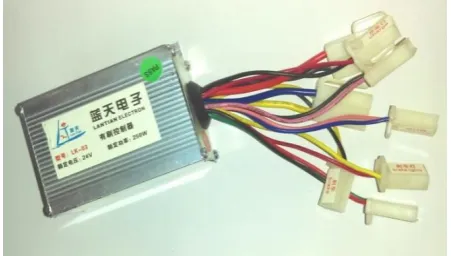
[image:2.595.321.547.501.629.2]The motor controller serves as the heart as well as the brain of the electric bike. This act similar to a car ECM (Electronic Control Module) which controls all the necessary operations of the car. The controller governs the predetermined performance of electric motor. It is used to select and regulate speed of the motor. The controller takes the throttle twist as the input to control the motor speed. The brake light is also illuminated by the controller when it senses brake is applied. It can also show the battery charge level.
Fig -3.3: MOTOR CONTROLLER
c) THROTTLE CONTROLLER
[image:2.595.54.271.567.712.2]© 2019, IRJET | Impact Factor value: 7.211 | ISO 9001:2008 Certified Journal
| Page 1560
Fig -3.4: THROTTLE TWIST CONTROLLERd) BATTERY
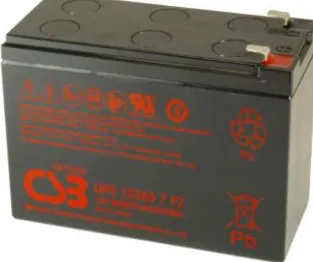
Fig -3.5: 12V, LEAD ACID BATTERY
Battery is the power house of the electric bike. It stores current and delivers it to the motor while operating. Here we have chosen lead acid inverter batteries because of their smaller dimension and slow discharging property. Inverter batteries are also known as deep cycle batteries. Inverter batteries are designed in order to discharge small amount of current consistently for longer durations of time. While the bike batteries are mainly designed to crank engine, they discharge large amount of current for a very short period of time. Considering the cost was the only reason of choosing lead acid batteries over the lithium ion batteries. As the motor is 24v we use 2,12v batteries connected in series to make up 24v to power the motor.
Table -2: BATTERY PACK SPECIFICATION
Battery type Lead Acid Battery
No of batteries 2
Overall Voltage rating 24v
Ampere rating 7.5ah
Connection type Series Connection
e) GEAR BOX
[image:3.595.84.241.299.430.2]Fig -3.6: MODEL OF GEAR BOX
Fig -3.7: SIMULATION RESULT OF GEAR BOX
A set of gears meshed together in the form of a gear train forms the gear box. The purpose of the gears in the gear box is to multiply the rpm. The alternator needs more than 2100 rpm to produce steady state of current to charge the batteries. The pedal must be coupled with the alternator so that the pedal rotation rotates the alternator. The pedal can be rotated only at 50rpm by an average human. This rpm is very less for the alternator to generate current. So a gear box is introduced between the pedal and the alternator. This gear box multiplies the input speed to a much higher output speed needed for the alternator to generate electricity. The gear box has 6 gears in it. The total gear ratio is 1:200. For each pedal rotation the alternator will spin at 200 rpm. Hence for an input pedal rotation of 50rpm the alternator will spin at 10,000rpm(approx.). After all the major loses it is possible for the alternator to obtain a final rpm of 6000(approx.).
Table -3: GEAR TEETH REPRESENTATION
© 2019, IRJET | Impact Factor value: 7.211 | ISO 9001:2008 Certified Journal
| Page 1561
f) ALTERNATORAlternators are used to charge the batteries in a vehicle. Alternators are far superior to the dynamo and generators because Alternators can produce more power with less effort and time. Dynamos are capable of producing only a small amount of charge which can be used only for low power applications. Alternators have cons too; in order to produce electricity from Alternator electricity must be supplied to the Alternator. The Alternator will start producing electricity only once the alternator is self-sustaining. Alternators have a field coil in it which draws current from the battery till the Alternator becomes self-sustaining. The current from the battery is used to magnetize the field coil inside the Alternator as it doesn’t have any permanent magnets inside as that of DC Motor. The Alternator has to overcome this field resistance to attain self-sustaining state. The voltage coming out of the Alternator depends on two main factors
The amount of current flowing through the field coil. (i.e. strength of magnetic field)
Speed at which the Alternator rotates.
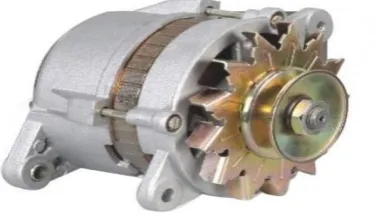
[image:4.595.75.263.459.567.2]As long as the Alternator is putting out 14.4V across the battery making the pulley to spin even faster won’t result in any more power output. Alternators generally work between 2100-8000 rpm approx. As the purpose of the Alternator is to charge the batteries, the current generated is rectified through a diode bridge to charge the attached battery.
Fig -3.8: MARUTHI 800 ALTERNATOR
Fig -3.9: ALTERNATOR WIRING
The Alternator from Maruti Suzuki 800 is chosen. The Alternator is mounted to the front frame of the E-Bike. The Alternator is wired with the battery through a switch and a bulb (resistor) in series. The Alternator shaft is connected to the output shaft of the gear box.
4. WORKING OF EXISTING SELF CHARGING E-BIKE
Existing self-charging bikes hooked up the Alternator or the Dynamo to one of the wheels and used the electricity to power the motor. The purpose of the Alternator or the Dynamo is to charge the battery. But when it is coupled with one of the wheels, the energy required to propel is vehicle is more. If you start with say 300watts it would then take twice as much power to move the vehicle. You will need another 300watts or so to turn the Alternator by way of the wheels and road. So, after all the work the end result will end up little worse than before. Alternators are designed in such a way that it need more than 2100 rpm to produce steady state of current to charge the batteries. When Alternator is coupled with the wheels, the rpm won’t remain above 2100 at all conditions throughout the ride. In such cases the Alternator won’t charge the batteries. We are aware of the fact that energy always flow from higher to lower. And so, when Alternator is not producing enough current to charge the batteries, the current from the battery will flow to the Alternator. This condition will drain the entire charge of the battery. To overcome this, existing self-charge bikes used a DC-DC converter to increase the Alternator current to a much higher current to charge the batteries. Using a DC-DC converter increased the complexity in the wiring of the electric bike. Some vehicles used solar panels along with the Alternator hooked to one of the wheels. Solar panels acted as an additional support to charge the batteries when the bike is at rest. Solar panels can charge the batteries only in a minimal amount because solar panels have only 30% efficiency after all conversion loses, and also solar panels are costly and require immense care to safeguard them as they are very brittle
5. WORKING OF THE CONCEPT
Here the bikes drive unit and charging unit are mounted separately and are not interlinked. Separately mounted charging and drive unit make the electric bike to have maximized performance. As the charging system is not mounted with the drive wheel the load on the drive motor will be less and power loss will be minimal and hence range can be increased. Charging system is also connected separately and not connected to the drive wheel hence charging of battery is more efficient and takes less time to charge the battery because of the steady voltage produced by the Alternator at a speed above 2100rpm.The electric bike working can be split up into two units
© 2019, IRJET | Impact Factor value: 7.211 | ISO 9001:2008 Certified Journal
| Page 1562
Fig -5.1: BLOCK DIAGRAMa) DRIVE UNIT
The drive unit comprises of 1. DC Motor
2. Throttle twist controller 3. Motor controller
The rear wheel drives the electric bike for better stability and control. The DC Motor is placed on the carriage at the rear of the electric bike. The motor is connected to the rear wheel sprocket through a chain drive. Here the chain link from pedal to rear wheel sprocket is removed, hence rotating the pedal won’t drive the rear wheel. The battery is also placed at the carriage of the bike for better load distribution. The motor can drive the rear wheel effectively as no other loads act on the rear wheel.
b) CHARGING UNIT:
The charging unit comprises of 1. Pedal with sprocket 2. Gear Box
3. Alternator
The pedal of the bicycle is connected to the one end of the gear train. The gear train multiplies the rpm as needed to the Alternator. Another end of the gear train is connected to the Alternator. When the pedal is rotated, the Alternator rotates. The pedal rotation will rotate only the gear train and won’t rotate the rear wheel as the chain link between the pedal and rear wheel is removed. As the rear wheel is not driven when pedaled, the pedal can be rotated freely with less effort.
Fig -5.2: CADD MODEL OF THE CONCEPT
6. CONCLUSION
The self-charging E-Bike using pedaling is a complete “Go Green” vehicle that doesn’t use any valuable fossil fuels or consume any electricity for its propulsion. It can be used widely for short distance travels and is best suited for both city and country roads. Pedaling the bike to charge the battery can be a good exercise to maintain a good health. It has very fewer components and so needs only less maintenance. It is very economical for poor class of society because it can be run throughout the year free of cost. It doesn’t need any fuelling or any external charging, so fueling costs and current charge hikes can be avoided. The bike is completely eco-friendly and pollution free
REFERENCES
1) D. Belekar, Shweta Subramanian, Pratik Vinay Panvalkar, MedhaDesai, RonitPatole “ALTERNATORCHARGING SYSTEM FOR ELECTRIC MOTORCYCLES”, International Research Journal of Engineering and Technology, Volume: 04 Issue: 04, Apr -2017
2) Kartik S Mishra, Shubham V Gadhawe, Dhiraj C Chaudhari, BhupendraVarma and S. B. Barve“DESIGN AND DEVELOPMENT OF SOLAR HYBRID BICYCLE”, International Journal of Current Engineering and Technology, 15 March 2016, Special Issue-4, March 2016
3) Piyush Kapila, Gaurav Puri, Manish Gaur, “ELECTRIC CAR CHARGING SYSTEM BY ALTERNATOR”, International Journal of Engineering Research in Electrical and Electronic Engineering, Volume: 3, Issue 11, November 2017
4) Rajesh Kannan Megalingam, Pranav SreedharanVeliyara, Raghavendra Murali Prabhu, Rocky Katoch” PEDAL POWER GENERATION”, Amrita Vishwa Vidyapeetham University, Amritapuri Campus, Kollam
© 2019, IRJET | Impact Factor value: 7.211 | ISO 9001:2008 Certified Journal
| Page 1563
BIOGRAPHIESABHIJITH. M
B.E. Automobile Engineering RVS Technical Campus-Coimbatore
JITHISH.K. R
B.E. Automobile Engineering RVS Technical Campus-Coimbatore
YUVARAJ. M
B.E. Automobile Engineering RVS Technical Campus-Coimbatore
Prof. G. PRABHAKARAN Assistant Professor
Department of Automobile Engineering
RVS Technical Campus-Coimbatore