© 2019, IRJET | Impact Factor value: 7.211 | ISO 9001:2008 Certified Journal | Page 7681
An Experimental Study on Floating Concrete
M.S. Dinesh Kumar
1, Amrutha.S
2, Gayathri.M
3, Geetha.L
41
Assistant Professor, Dept. Of Civil Engineering, Prathyusha Engineering College, Thiruvallur, Tamil Nadu, India.
234UG students, Dept. Of Civil Engineering, Prathyusha Engineering College, Thiruvallur, Tamil Nadu, India.
---***---Abstract -
The project is titled as “AN EXPERIMENTALSTUDY ON FLOATING CONCRETE”, followed by Archimedes Principle (Law of Buoyancy) to support the structure at a moderate and convenient depth. Floating concrete structure is a solid body made of lightweight materials. This project deals about the preparation of mix design and various tests namely compressive strength, tensile strength, slump test, flow properties of concrete etc., because of its low density and moderate range of compressive strength , it can be used in non-structural application .In this study, floating concrete was developed for different proportions using the ingredients with less specific gravity than the conventional concrete. Casting is done and the testing is made for 7th day and 28th day.
Key Words:Floating Concrete, Lightweight Aggregates
1. INTRODUCTION
The present world is witnessing very challenging in the field of civil engineering structures. Two-third of the world surface is covered with water. Researchers all over the world are attempting to develop low density or lightweight concrete by using different admixtures in concrete up to certain proportions. Floating concrete structures are used to construct a large array of structures, such as highways and streets, bridges, large buildings, airport runways, irrigation structures, break waters, piersand pavements, silos and farm buildings and homes. The Floating concrete structure is a solid body made of lightweight materials composed of cement, water, aggregates and admixtures. The density of concrete ranges from 600 kg/ m3 to1000 kg/m3. Since its density is less than that of water, the concrete floats on water either by usage of light weight aggregate or air entering agent. Thus, floating concrete is a special type of concrete whose density is about 1/3rd compared to the conventional concrete. This study deals with the development of floating concrete by using foaming agent (SLES), dew foam, expanded clay and pumice powder. The advantage of using lightweight materials is to reduce mass improved thermal and sound insulation properties while maintaining adequate strength. The aim of this report is to achieve mixdesign for floating concrete with density lesser than 1000 kg/m3 and performing experimental approach by making the concrete as a Floating concrete.
2. METHODOLOGY AND MATERIALS
2.1 MATERIALS USED AND ITS PROPERTIES
2.1.1 Cement:
Ordinary Portland cement
[image:1.595.302.563.402.479.2]Cement can be defined as the bonding material having cohesive & adhesive properties which makes it capable to unite the different construction materials Portland cement is one of the most widely used type of Portland Cement. It has great resistance to cracking and shrinkage but has less resistance to chemical attacks.
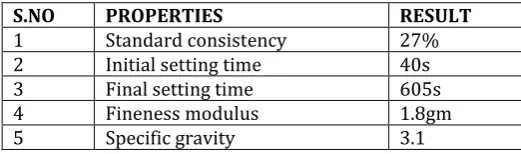
Table -1: Properties of Ordinary Portland cement
S.NO PROPERTIES RESULT
1 Standard consistency 27% 2 Initial setting time 40s 3 Final setting time 605s 4 Fineness modulus 1.8gm 5 Specific gravity 3.1
2.1.2 Water
Water is the key ingredient, when mixed with cement , forms a paste that binds the aggregate together. The water causes the hardening of concrete through a process called hydration. The role of water is important because the water to cement ratio is the most critical factor in a production of perfect concrete. The ratio refers to the ratio of water to
cement plus pozzolan ratio, w/(c+p).
2.1.3 Coarse Aggregate:
© 2019, IRJET | Impact Factor value: 7.211 | ISO 9001:2008 Certified Journal | Page 7682 clay that is fired in kiln. Light expanded clay aggregate is
strong, durable, and is an excellent solution. The dry density of lightweight expanded clay aggregate is approximately 350 kg/m3.
Fig -2: Light expanded clay aggregate
Table -2: Properties of Conventional Coarse Aggregate
S.NO PROPERTIES RESULT
[image:2.595.341.558.109.220.2]1 Water absorption 0.91 2 Specific gravity 2.77 Table -3: Properties of Light expanded clay aggregate
S.NO PROPERTIES RESULT
1 Water absorption 0.9 2 Specific gravity 0.4
2.1.4 Fine Aggregate
Fine aggregates play a very important role in concrete. It manages to fill the voids between the coarse aggregates. In Floating concrete, pumice powder has been used as fine aggregates. The size, shape and texture of aggregates control the workability cement content and drying shrinkage parameters .Pumice stone of igneous origin is disintegrated into size less than 4.75 mm and is used as fine aggregate. Here in this investigation study pumice powder has been used as fine aggregate. It varies in density according to the thickness of solid material between the bubbles. Pumice has an average porosity of 90 % .It is used to make lightweight concrete or insulative low density cinder block.
[image:2.595.55.235.163.262.2]Fig -3: Pumice Powder
Table -4: Properties of Conventional Fine Aggregate
S.NO PROPERTIES RESULT
1 Fineness modulus 2.44 2 Specific gravity 2.44 Table -5: Properties of Pumice Powder
S.NO PROPERTIES RESULT
1 Fineness Modulus 2.44 2 Specific gravity 2.46
2.1.5 Foaming Agent
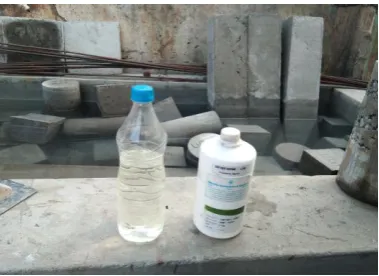
A foaming agent is a material that facilitates formation of foam such as a surfactant or a blowing agent. In this floating concrete, Sodium Lauryl Ether Sulphate (SLES) used as a foaming agent. Sodium dodecyl sulphate (SDS), synonymously sodium lauryl sulfate (SLS), or sodium laurel sulfate, is a synthetic organic compound with the formula CH3(CH2)11SO4 Na.Sodium Lauryl Ether Sulphate ( SLES )is an anionic detergent and surfactant found in many personal care products (soaps , shampoos, toothpaste etc.). SLES is an inexpensive and very effective foaming agent.
Fig -4: Foaming Agent
2.2 MIX DESIGN
[image:2.595.345.535.543.681.2]© 2019, IRJET | Impact Factor value: 7.211 | ISO 9001:2008 Certified Journal | Page 7683 from this Mix proportion by the replacement of coarse and
fine aggregates and addition foaming agent. The mix design for M30 concrete was achieved.
Grade of concrete = M30 Water Cement Ratio = 0.45 Size of Aggregates Used = 10mm Slump value = 100mm Mix Proportion achieved = 1: 1.82: 1.83 Bulk Density of Pumice Powder = 1323 kg/m3
Bulk Density of Light Expanded Clay Aggregates = 258 kg/m3 Table -6: Quantity of materials used
S.NO MATERIALS QUANTITY
1 Cement 10.21kg
2 Pumice Powder 17.08kg
3 Light Expanded
Clay Aggregate
3.35kg
2.3 COMBINATIONS USED
The specimens were designed by replacing the coarse aggregates by expanded clay aggregates, fine aggregates by pumice powder and foaming agent in different percentage of 10%, 20%, 30% to that of water content to be used respectively.
2.4 EXPERIMENT PROCEDURE
2.4.1 Material Testing
The material such as cement, conventional coarse aggregate and fine aggregate, lightweight aggregate which is used in the concrete mix is tested.
The test taken:
1. For Cement: Standard Consistency Test, Setting Time of Cement, Fineness Modulus Test and Specific Gravity 2. For Coarse Aggregate: Specific Gravity and Water
Absorption Test
3. Specific Gravity and Water Absorption Test
2.4.2 Casting of Specimen
After calculating the mix proportion, the concrete is prepared using the material cement, coarse aggregate, fine aggregate and foaming agent with the required water content (determined from water cement ratio).The mould is prepared and properly fabricated. Initially the foaming agent is added with the water and mixed to achieve the required
foam. Then the cement, sand and the foam is mixed followed by the addition of coarse aggregate. The specimens with different foaming agent proportions are achieved. The specimen is then allowed for curing of 7 days and 28 days.
2.4.3 Testing of Specimens
The test for concrete is classified as two types: 1. Fresh Concrete Test
2. Hardened Concrete Test
For Fresh Concrete: Slump Cone Test
For Hardened concrete: 1. Compressive Strength Test, Split Tensile Test and Density Test
This hardened Concrete Test this taken for 7 days and 28 days curing respectively.
3. RESULT AND DISCUSSION
3.1 COMPRESSIVE STRENGTH TEST
Compressive strength is used to determine the specimen behavior under compressive load. It provides data on helping manufactures ensure that their finished concrete are fit for purpose which follows the necessary requirements. The specimens after 7th day curing and 28th day curing are removed from water in the specified days and dried for few hours. Then the dry specimens are placed at the compressive strength testing machine so that the axis of the specimen is aligned carefully with the centre of the spherically seated plates and uniform load is applied to the specimen. The load is increased until the resistance of the specimen fails and it breaks down. The maximum load applied at which the specimen fails is note down and the compressive strength is calculated with the formula provided.
Compressive strength = Compressive load (N) Cross sectional Area (mm2) Table -7: Compressive Strength Test of conventional concrete
S.NO SPECIMEN
TRIAL 7 DAYS STRENGTH
(N/mm2)
28 DAYS STRENGTH
(N/mm2)
© 2019, IRJET | Impact Factor value: 7.211 | ISO 9001:2008 Certified Journal | Page 7684 Table -8: Compressive Strength Test of floating concrete
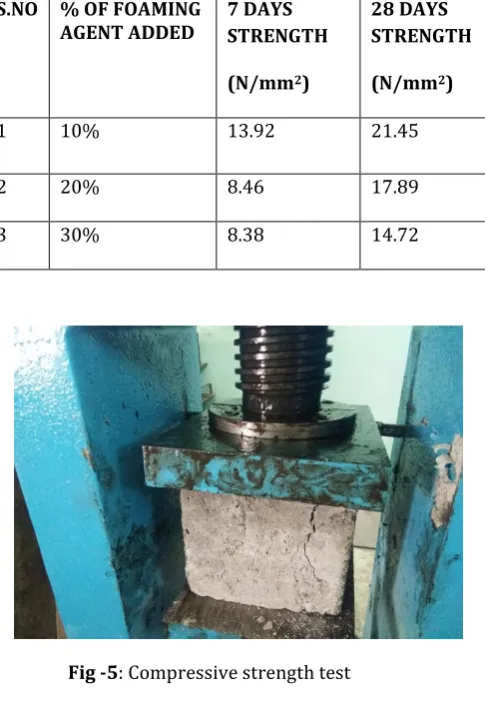
S.NO % OF FOAMING
AGENT ADDED 7 DAYS STRENGTH
(N/mm2)
28 DAYS STRENGTH
(N/mm2)
1 10% 13.92 21.45
2 20% 8.46 17.89
3 30% 8.38 14.72
Fig -5: Compressive strength test
0 5 10 15 20 25 30 35
10% 20% 30%
Conventional Concrete Floating concrete
Chart -1: Comparison of 28th day compressive strengths
3.2 SPLIT TENSILE STRENGTH TEST
Concrete does not usually resist direct tension because of its low tensile strength and brittle nature. Thus it is necessary to determine the load at which the concrete members may crack due to tension failure. The specimen is placed in the
testing machine and load is applied uniformly and increased continuously at a nominal rate until failure. The maximum load applied was recorded and any unusual type of failure is observed.
Split Tensile Strength = Tensile load (N)
Cross sectional Area (mm2)
Fig -5: Split tensile strength test
Table -9: Split Tensile Strength Test of conventional concrete
S.NO SPECIMEN
TRIAL 7 DAYS STRENGTH
(N/mm2)
28 DAYS STRENGTH
(N/mm2)
[image:4.595.308.522.227.387.2]1 Average 1.15 1.69
Table -10: Split Tensile Strength Test S.NO % OF FOAMING
AGENT ADDED 7 DAYS STRENGTH
(N/mm2)
28 DAYS STRENGTH
(N/mm2)
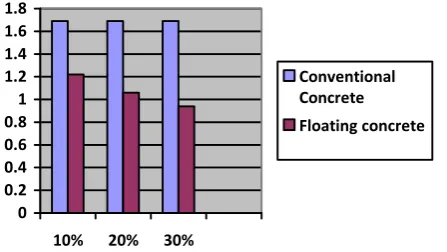
1 10% 0.93 1.22
2 20% 0.78 1.06
[image:4.595.302.565.462.555.2] [image:4.595.48.268.512.636.2]© 2019, IRJET | Impact Factor value: 7.211 | ISO 9001:2008 Certified Journal | Page 7685 0
0.2 0.4 0.6 0.8 1 1.2 1.4 1.6 1.8
10% 20% 30%
Conventional Concrete Floating concrete
Chart -2: Comparison of 28th day Split Tensile strengths
3.3 DENSITY TEST
The density of the concrete is necessary to be known in order to achieve the floating property of the concrete. It is also necessary for the concrete to possess a density less than or merely equal to the density of water which is 1000 Kg/m3. The concrete was casted into three trial specimens and the weights of the concrete specimens were noted and the densities of the concrete specimens were calculated using the following formula:
Density of the specimen = Weight of the specimen (Kg)
[image:5.595.47.271.115.241.2]Volume of the specimen (m3)
Table -9: Density Test of floating concrete
S.NO
WEIGHT
OF THE
CUBE
(Kg)
VOLUME
OF THE
CUBE
(m
3)
DENSITY
OF THE
CUBE
(Kg/m
3)
AVERAGE
DENSITY
(Kg/m
3)
1 3.65 0.003375 1081.48
2 3.40 0.003375 1007.40 1027.15 3 3.35 0.003375 992.59
900 950 1000 1050 1100
10% 20% 30%
DENSITY OF FLOATING CONCRETE
Chart -3: Results of Density Test
4. CONCLUSIONS
[1] The density of the experimental floating concrete achieved is less than 1000kg/m3 which is less than the density of water.
[2] Floating concrete can be achieved by using Light Expanded Clay Aggregates (LECA) as coarse aggregates, Pumice Powder as fine aggregates and addition of Sodium Lauryl Ether Sulphate as foaming agent. [3] The density of the floating concrete can be achieved less
than that of water.
[4] The compressive strength test results show that the maximum average compressive strength achieved is in 10% foaming agent added floating concrete of compressive strength 21.45 N/mm2.
[5] The split tensile strength test results show that the maximum average tensile strength achieved is in 10% foaming agent added floating concrete of tensile strength 1.22 N/mm2.
REFERENCES
[1] Thousif Khan, Ibrahim Killedar, Sharu Malik.H.N, Muhathasheem.R.F, Jagannatha.G.M, Dr.Shivakumara.B, “An Experimental Study on Floating Concrete Using Light Weight Materials”, International Research Journal of Engineering and Technology, May 2018.
[2] Nikhil S. Chavan , Dhiraj Yadav , Shrikant Gadhe , Dnyandeep Bachipale , Shweta Kale , Mahesh V. Tatikonda, “Mechanical Properties of Floating Concrete by Using Expanded Polystyrene Beads as Replacement of Aggregates“, International Research Journal of Engineering and Technology , May 2018.
[3] Rayees Ahmad Ganie, “Floating Concrete by Using Pumice Stone and Foaming Chemical (Thermocole) “, International Journal of Civil Engineering, 2017. [4] Mukesk.D.Ghadge, Vaibhav.D.Kamble,”Floating
Concrete by using Light weight Aggregates and Air Entering Agent”, International Journal of Engineering research and technology, August 2015.