doi:10.4236/jsea.2010.311125 Published Online November 2010 (http://www.SciRP.org/journal/jsea)
3D Human Pose Estimation from a Monocular
Image Using Model Fitting in Eigenspaces
Geli Bo, Katsunori Onishi, Tetsuya Takiguchi, Yasuo Ariki
Graduate School of Engineering, Kobe University, Kobe, Japan. Email: {takigu, ariki}@kobe-u.ac.jp
Received October 4th, 2010; revised October 26th, 2010; accepted November 3rd, 2010.
ABSTRACT
Generally, there are two approaches for solving the problem of human pose estimation from monocular images. One is the learning-based approach, and the other is the model-based approach. The former method can estimate the poses rapidly but has the disadvantage of low estimation accuracy. While the latter method is able to accurately estimate the poses, its computational cost is high. In this paper, we propose a method to integrate the learning-based and model-based approaches to improve the estimation precision. In the learning-model-based approach, we use regression analysis to model the mapping from visual observations to human poses. In the model-based approach, a particle filter is employed on the results of regression analysis. To solve the curse of the dimensionality problem, the eigenspace of each motion is learned using Principal Component Analysis (PCA). Finally, the proposed method was estimated using the CMU Graphics Lab Motion Capture Database. The RMS error of human joint angles was 6.2 degrees using our method, an improvement of up to 0.9 degrees compared to the method without eigenspaces.
Keywords: HOG, Regression Analysis, Eigenspaces, Particle Filter, Pose Estimation
1. Introduction
The 3D configuration estimation of complex articulated objects from monocular images has been widely studied. Once the technology is perfected, there will be potential applications in many fields related to human pose and kinematic information, such as computer interfaces that utilize gesture input, interaction with the robots, video surveillance, and entertainment. However, monocular human pose estimation is extremely challenging due to the complicated nature of human motion and the limited amount of information in 2D images.
The methods of human pose estimation can be sum-marized into two approaches: learning-based and model-based. In the learning-based method [1-4] features are directly extracted from the image, and the mapping func-tion for the human poses is trained using the image fea-tures. Through this mapping, the human pose of an im-age can be estimated. Once the training process is com-pleted, the pose estimation is performed rapidly. How-ever, the estimation precision decreases when the input image is not included in the training data. In the model-based method [5-8], the pose estimation method follows Bayes' theorem and models the posterior probability density using observation likelihood or cost function.
This method is computationally expensive, in general, and dependent on an initial pose.
To solve these problems, we propose a method to in-tegrate the learning-based and model-based methods to improve the estimation accuracy. An initial pose is de-termined using regression analysis in the learning-based approach, and the estimation method is switched to a particle filter in the model-based approach to improve the precision. Unfortunately, given the large dimension-ality of a 3D human model space, it is almost impractical to apply particle filtering directly as a large number of particles is required to adequately approximate the un-derlying probability distribution in the human pose space. Therefore, we first use PCA to learn the eigenspace of each motion. Then, the optimal human pose is efficiently searched in the eigenspaces selected according to the estimated type of human motion in the input images.
2. Features
2.1. Image Features
Input Image
Background subtraction & normalization
Gradient computation
Weighted vote into spatial & orientation cells
Normalization over overlapping
blocks
[image:2.595.62.283.84.190.2]HOG descriptor
Figure 1. The flow of feature extraction.
over the given region. This means that HOG can repre-sent the rough shape of an object. Moreover, since HOG can tolerate a range of varying illumination, it is suitable for pose estimation [11]. Figure 1 presents the complete processing chain of the HOG feature extraction briefly. We will now discuss the HOG encoding algorithm in this section in detail.
2.1.1. Gradient Computation
Before extraction of the HOG feature, we first separate the human region from the input image using back-ground subtraction, where thesize of the human region is normalized, and the human region is located in the center position of the image. Then the image gradient is computed as follows.
( , ) ( 1, ) ( 1, ) ,
( , ) ( , 1) ( , 1) ,
x y
f x y I x y I x y x y
f x y I x y I x y x y
(1)
where fx and fy denote x and components of the
image gradient, respectively.
y
( , )
I x y denotes the pixel intensity at the position ( , )x y . The magnitude
and orientation
( , )
m x y
( , )x y
are computed by
2
( , ) x( , ) y( , )
m x y f x y f x y2
(2)
1
( , )x y tan (fy( , )x y fx( , ))x
y
(3)
In order to make the HOG feature insensitive to cloth-ing and the facial expression, we use the unsigned orien-tation of the image gradient, which is computed as fol-lows.
( , ) , ( , ) 0
( , )
( , ),
x y if x y
x y
x y otherwise
(4)
2.1.2. Orientation Histograms
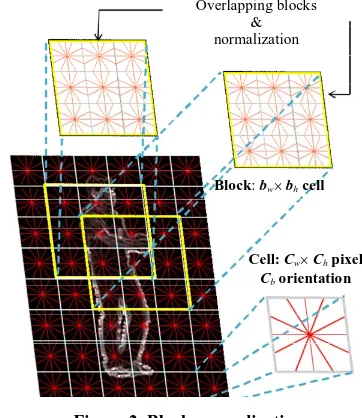
The gradient image is divided into cells cw h pixels as
shown in Figure 2. At each cell, the orientation
c
( , )x y
is quantized into cb orientation bins, weighted by its
magnitude to make a histogram. That is, a his-togram with the orientations is computed for each cell.
( ,
m x y)
b
c
[image:2.595.329.510.87.296.2]2.1.3. Block Normalization
Figure 2 shows the orientation histogram extracted at
Block: bw bh cell
Cell: Cw Ch pixel
Cb orientation
Overlapping blocks & normalization
Figure 2. Block normalization.
every cell and the larger spatial blocks with bwbh cells.
Since a cell has orientations, the feature dimension of each block is db bw h b
b
c
b c
for each block. Let v de-note a feature vector in a block, ij denote the
unnormal-ized histogram of the cell in the position ( , ,
h
)
i j
1 i bw,1 j h in a block. The feature vector of acertain block is normalized as follows.
b
2 ( 1
ij ij
h h
v
)
(5)
Since the normalization is done by overlapping the block, the histograms are repeatedly normalized by a different block.
ij
h
2.2. 3D Human Model
The human body can be regarded as a multi-joint object that transformsinto various shapes. In addition, the seg-mented part that connects twojoints can be regarded as rigid object. Therefore, it is possible to express a 3D human model with joint angles. In this research, we used the motion capture data in the CMU Graphics Lab Mo-tion Capture Database [12]. The 3D human model is represented by 56 joint angles, sothe dimension of the pose state vector is 56. Figure 3 shows an example of the 3D human model.
3. The Pose Estimation Method
Figure 3. An example of 3D human model.
Regression
Fitting
Likelihood evaluation Generate samples
Input image
z
3D human pose for initial value
x
Output (3D human pose)
x
3D human pose in eigenspace
3D human poses generated by particle filter
Select eigen space and projection
Eigen space
Back projection
3D human poses in high dimensional space
x
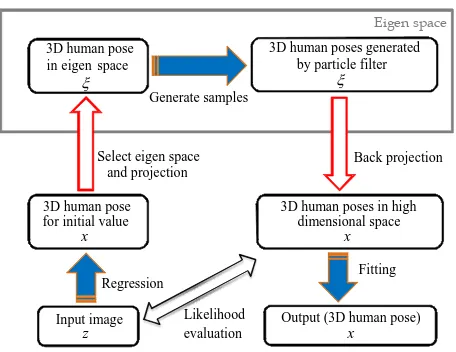
Figure 4. Pose estimation system.
integrated into the iteration procedure of the model-based method. One drawback in the model-based method is the high dimensionality of the state space, which makes the algorithm computationally ineffective. Thus we use PCA to reduce the dimension of the pose state and establish the eigenspace of each motion. Fig-ure 4 shows the proposedpose estimation system.
3.1. Learning-Based Method Using Regression Analysis
In the learning-based method, we adopt regression analysis [1,13] to estimate the pose of input image. Let
x denote the vector composed of the angles at joints in the 3D human model. The relation between the HOG feature vector z and 3D pose vector x is linearly ap-proximated using the following formula:
xRz (6)
where is residual error vector. The 3D human pose is
Estimation
R
HOG feature
z
3D human model N pairs of images and 3D
human model angles
LMS
[image:3.595.313.530.87.203.2]x
Figure 5. Regression-based estimation method.
estimated by converting the input image feature to the 3D human model vector
z x. In model training (estimate ), a set of n training pairs
R (x zi, )i i1n
is given(in our case, 3D poses and the corresponding image HOG features). The conversion matrix R is estimated by minimizing the mean square error. Packing the train-ing data into 3D pose matrix X (x x1 2 n)
)
x
and image feature matrix Z (z z1 2zn , the training is performed as follows:
2
: arg min
R
R RZX (7)
In the testing phase, the 3D human posture vector xis estimated by converting HOG features vector z using the computed conversion matrix R. Figure 5 demon-strates the regression-based estimation method.
3.2. Model-Based Method Using a Particle Filter
In the model-based method, a particle filter [14] is em-ployed. Following a notation similar to [14], we define
t
x as the state vector at time t, with zt denoting the
measurements at time t. Furthermore, let all the meas-urements untiltime t be given by Zt ( ,z1, )zt .
Par-ticle filtering basedon Bayes' theorem is used to obtain a posterior probability p x( t t) at each time-step using all the available information as shownbellow.
Z
1
( t t) ( t t) ( t t
p x Z p z x p x Z) (8)
This equation is evaluated recursively as described be-low. The fundamental idea of particle filtering is to ap-proximate the posterior probability density function (pdf) over xt by a weighted sample set . Suppose that
samples from the posterior pdf
t
S
N ( t ) are
avail-able and denote them as t
t
p x Z ( )i
x . Then the i th weighted sample at time is represented by
( ) ( )
( ,
i i
t st xt t( )i )St.
First, a cumulative histogram of all the samples' weights is computed at time t . Then, according to each particle's weight t 1
1
( )i
[image:3.595.58.286.289.465.2]Chapman-Kolmogorov equation.
1
1 1 1
( ) ( ) ( )
t
t t x t t t t t
p x Z p x x p x Z dx
1 1 (9)At the measurement step, the new state xt is weighted
according to its likelihood to the new measurement zt.
The posterior density p x Z( t t) is represented by a set of
weighted particles
, where theweights
( )
)
N
(0) (0) ( )
(st ,t )(stN , t
( )n ( ( )
t p z xt t s
1
)
i
t are normalised so that
. The new state
( )n t N
xt can be estimated by( ) ( )
1
( ) (
N
n i
t t t t
i
p x Z s
) (10)The measurement step of Equation (10) and the pre-diction step of Equation (9) together form the Bayes' formulation Equation (8).
In the ordinary model-based method, a particle filter is utilized to match the 3D model with the input image, and the initial value needs to be set manually [15,16]. In our method, the initial value can be obtained from the learn-ing-based method. Therefore, the former manual con-figuration will be replaced by an automatic estimation process.
The pose estimated by regression analysis is used as an initial value, and the particles are sampled around it. The likelihood of each particle is evaluated as its weight, and the particles are generated by a resampling process based on the weight. After repeating resampling several times, the particle with the highest likelihood is consid-ered as the final state.
1
m
m 2Eigen spaces
[image:4.595.62.279.473.685.2]High dimensional pose space
Figure 6. Original space and eigenspaces.
3.3. State Space
The 3D human model was introduced in Subsection 2.2. In this section, it is treated as the state vector of particle filter. However, in a real environment, the dimension of state space is normally very high. That would cause both low computational efficiency and poor convergence per-formance.
We propose the method of utilizing an eigenspace of each motion constructed by PCA as a motion prior, which constraints corresponding motion [17]. Simulta-neously, it is possible to search efficiently in the low-dimensional space using dimension reduction. Suppose that the number of motion types is M . When PCA is carried out using the training data of a certain motion
mM , the 3D human pose xm is projected into the
eigenspace as follows:
(
m
P x
m mx
m)
(11)where xm denotes the mean pose vector of a certain
mo-tion m, Pm is the base vector matrix, and m denotes
the pose vector in the eigenspace. Because PCA is car-ried out for M types of motions in the training data, M
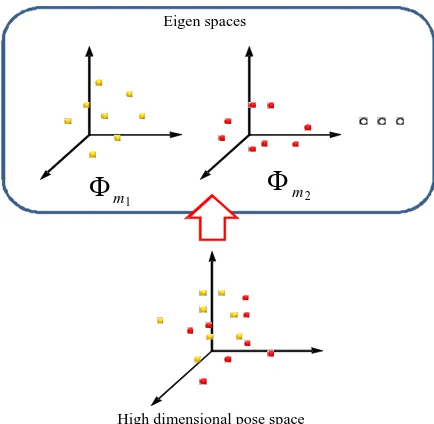
kinds of eigenspaces are constructed. The pose vector
m
x is projected to the eigenspace of each motion and is used as the state of particle as shown in Figure 6. The dimension reduction using PCA is decided according to the 95% cumulative proportion rate.
3.4. Likelihood
In the likelihood calculation stage, the state vector of everyparticle is converted to a 3D human pose in a high dimension space using PCA Inverse Transformation. Then, we use MAYA to produce the CG image that represents the pose of every particle. This CG image compared with the input image. The performance of the particle filterdepends largely on the image features that are used to calculate the likelihood. The ideal image features should remain stable in variousscenarios and be easy to extract. In our case, we adopt two features to construct weighting function: HOG for representing the humanconformation and silhouetting for evaluating the human region.
Configuration:
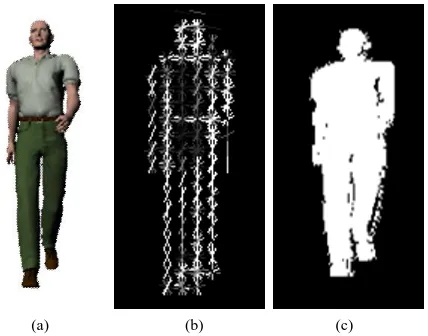
HOG represents human conformation and is robust re-garding changes in color, clothes and illumination. The CG image is generated from the particle state, and HOG is extracted (Figure 7(b)). The distance between the input image x and the state is calculated as follows:
2
1
( , ) ( , )
hog
E x z z
Dim
(a) (b) (c)
Figure 7. Feature extraction (a) CG image (b) HOG de-scriptor (c) silhouette.
' 2 2
' 1
( ( , )
c c
Dim
c c
c
z z
z z
z z
)(13)
where denotes the dimension of the HOG,
is
Dim
)
2
( ,z z
2
-distance between z and . indi-cates the -th element of the HOG feature vector.
z zc
c
Region:
The silhouette image is extracted using the background subtraction method (Figure 7(c)). The silhouette can be used for evaluation with stability because it is also ro-bust to the changes of color, clothes and illumination. After the silhouette is extracted, once again a pixel map is constructed, this time with foreground pixels set to 1 and back ground to 0, and the distance is computed as follows:
1
1
( , ) ( ( , ))
K
region i
i
E x p x
K
(14)where K is the number of pixels, and p xi( , ) the val-ues of the binary EX operation between input image and state.
OR
Next, fitness ( )C on the image is computed as fol-lows.
( ) exp ( hog( , ) region( , ) )
C E x E x (15)
In our method, the solution search is restricted to the eigenspace of the corresponding motion. Nevertheless, the pose of an image can be further constrained in a cer-tain range of the eigenspace, where we use the trajectory of motion as a prior constraint. We regard the sequence of vectors in the eigenspace as the trajectory of this mo-tion. Then the distance is calculated between state vector
and vectors of training data in eigenspaces, and it can be used for the likelihood evaluation as a penalty .
Finally, the best solution is obtained by the rule shown in Equation (16).
1
( )
L C (16)
3.5. Selecting the Eigenspace
In our method, it is necessary to select the proper eigen-space according to the estimated motion of the input image because the eigenspace is constructed for each
motion. First, many samples
i , 1, ,
m m M i Sm
are embedded into each eigenspace using the training data. The mean distance between the samples and initial pose x obtained by the regression analysis is computed, and the input motion is decided as the motion with the nearest mean distance.
The mean distances are computed in the eigenspace and the high-dimensional space respectively as follows.
2 1
1 Sm 1
i m
i m m
S D
m (17)2 1
1 Sm 1
i m
i m
m
x x S D
(18)Here m and denote the dimension of eigenspace
and an original space respectively, and
D D
denotes the low-dimensional pose vector to which x is mapped in an eigenspace. xm denotes the high-dimensional pose
vector in which m is reverted to an original space using
PCA Inverse Transformation. Sm is the number of the
samples. The motion of the input image is decided by minimizing the sum of two distances defined by Equa-tion (17) and EquaEqua-tion (18) as shown in EquaEqua-tion (19).
( )
f m is defined as a function to determine which an eigenspace m the motion m belongs to:
[1, , ]
(arg min )
m m
m M
f
m
(19)3.6. Estimation of the Human Orientation
Even if the orientation of the human is unknown, the human pose can be estimated with regression analysis because the image feature changes according the orienta-tion. However, if the orientation is not estimated in the model-based method, the image cannot be matched.
Consequently, the images in all orientations of 360 degrees are generated by CG using the results of the re-gression analysis, and human orientation is estimated using Equation (15) as follows:
1 360
ˆ arg max C x( )
(20)
where C x( ) denotes the fitness between input image and the generated image from pose x with orientation
4. Estimation of the Human Orientation
4.1. Experiment Setup
We conducted the experiment using the CMU Graphics Lab Motion Capture Database. First, we use motion cap-ture data to produce a CG animation whose resolution is
pixels. Then we rotate the figure on the hori-zontal plane in eight directions and take the CG image in each direction as experiment data. We carried out ex-periments for three kinds of motion (walking, running, and jumping). The images used for training are summa-rized in Table 1.
640 480
If the test motion is a cyclic movement, only four im-ages of the typical pose are needed to represent a certain cyclic motion. In order to represent the motion suffi-ciently, we used eight images in each direction for a con-tinuous action. Table 2 lists the details of the test data.
4.2. Experiment Results
RMS of absolute difference errors was computed be-tween the true joint angles x and estimated joint angles
x, by Equation (21). m indicates the number of joints.
1
1
( , ) ( ) mod 180
m
i i
i
D x x x x
m
(21)
Figure 8 shows the RMS error over all joints angles for all the motions. The estimation precision was im-proved by iteration procedure.
The horizontal axis indicates the number of iterations. The regression analysis results are shown in the primary iteration. After the next iteration, pose estimation is achieved by repeatedly applying the particle filter. The results show that the accuracy of estimation can be im-
Table 1. The number of training data.
The number of frames pose
1 orientation Total (8 orientations)
Walking 90 720
Running 189 1,512
Jumping 192 1,536
Total 471 3,768
Table 2. The number of test data.
The number of frames pose
1 orientation Total (8 orientations)
Walking 8 64
Running 8 64
Jumping 8 64
Total 24 192
Table 3. Confusion matrix [%].
Walking Running Jumping
Walking 84.38 3.12 12.5
Running 9.37 78.13 12.5 Jumping 15.63 4.68 79.69
6 6.2 6.4 6.6 6.8 7 7.2 7.4
1 2 3 4 5 6
Iteration
Proposed method
Without trajectory
R
M
S
e
rro
r (
d
eg
re
e)
Figure 8. Pose estimation results.
4.5 5 5.5 6 6.5 7 7.5
8
1 2 3 4 5 6
Iteration
Given Unknown
R
M
S
e
rro
r (
d
eg
re
e)
Figure 9. Estimation precision in eigenspaces.
Figure 10. Experimental result of the real image.
proved significantly because of the use of the trajectory as a constraint.
[5] M. Lee, I. Cohen, “A Model-Based Approach for Esti-mating Human 3D Poses in Static Images,” IEEE Trans-actions on Pattern Analysis and Machine Intelligence, Vol. 28, No. 6, June 2006, pp. 905-916.
good.
The selection of a proper eigenspace will greatly af-fect the final estimation results. Figure 9 compares the accuracy of two different estimation methods. The blue broken line represents the scenario in which a motion type of input image has been given, and its estimation is carried out in the corresponding eigenspace. Comparing these results with the red line for an unknown motion type, it can be concluded clearly that our method shows a better performance in terms of estimation precision.
[6] T. Jaeggli, E. Koller-Meier and L. V. Gool, “Learning Generative Models for Monocular Body Pose Estima-tion,” Proceedings ofthe 8th Asian Conference on Com-puter Vision, Vol. 1, 2007.
[7] S. Hou, A. Galata, F. Caillette, N. Thacker and P. Bromiley, “Real-time Body Tracking Using a Gaussian Process Latent Variable Model,” IEEE 11th International Conference on Computer Vision, October 2007, pp. 1-8.
The results of human pose estimation from real im-ages [18,19] are shown in Figure 10. The first row is the input real images and the second row represents the syn-thetic images generated from the estimated poses. It is confirmed that our method works effectively for the real images.
[8] G. Peng, W. Alexander, A. O. Balan and M. J. Black, “Estimating Human Shape and Pose from a Single Im-age,” IEEE 12th International Conference on Computer Vision (ICCV2009), September 2009, pp. 1381-1388.
[9] N. Dalal and B. Triggs, “Histograms of Oriented Gradi-ents for Human Detection,” IEEE Computer Society Con-ference on Computer Version and Pattern Recognition
(CVPR2005), Vol. 1, June 2005, pp. 886-893.
5. Conclusions
In this paper, we presented an approach to estimate 3D human pose from a monocular image, which integrates the learning-based and model-based estimation methods into one framework. Furthermore, through the construc-tion of an eigenspace, more efficient particle filter per-formance is obtained.
[10] G. Mori and J. Malik, “Recovering 3D Human Body Configurations using Shape Contexts,” IEEE Transac-tions on Pattern Analysis and Machine Intelligence, Vol. 28, No. 7, 2006, pp. 1052-1062.
[11] K. Onishi, T. Takiguchi and Y. Ariki, “3D Human Pos-ture Estimation Using the HOG FeaPos-tures from Monocu-lar Image,” 19th International Conference on Pattern Recognition (ICPR2008), December 2008, pp. 1-4.
Consequently, the precision of estimation is obviously improved, and experimental results demonstrated that our approach is effective. The particle filter did not need to have the initial value provided manually, and it could get the convergence solution in the situation with less iterations. In future work, in order to further improve the estimation accuracy, we are planning to use video data for the input data because the temporal coherence be-tween frames may provide useful information regarding the selection of the eigenspace of each motion.
[12] CMU Human Motion Capture Database. Available online: http://mocap.cs.cmu.edu/
[13] A. Fossati, M. Salzmann and P. Fua, “Observable sub-spaces for 3D human motion recovery,” IEEE Confer-ence on Computer Version and Pattern Recognition
(CVPR2009), June 2009, pp. 1137-1144.
[14] M. Isard and A. Blake, “Condensation-Conditional Den-sity Propagation for Visual Tracking,” International Jour-nal of Computer Vision, Vol. 29, No. 1, 1998, pp. 5-28.
REFERENCES
[15] J. Deutscher, A. Blake and I. Reid, “Articulated BodyMotion Capture by Annealed Particle Filtering,” IEEE Computer Society Conference on Computer Version and Pattern Recognition, Vol. 2, June 2000, pp. 126-133. [1] A. Agarwal and B. Triggs, “3D Human Pose from
Sil-houettes by Relevance Vector Regression,” IEEE Com-puter Society Conference on ComCom-puter Vision and
Pat-tern Recognition, Vol. 2, 2004, pp. 882-888. [16] L. Ye, Q. Zhang and L. Guan, “Use Hierarchical Genetic Particle Filter to Figure Articulated Human Tracking,”
International Conference on Multimedia and Expo
(ICME2008), 2008, pp. 1561-1564. [2] X. Zhao, H. Ning, Y. Liu and T. Huang, “Discriminative
Estimation of 3D Human Pose Using Gaussian Proc-esses,” Proceedings of 19th International Conference on
Pattern Recognition (ICPR’08), December 2008, pp. 1-4. [17] X. Zhao and Y. Liu, “Tracking 3D Human Motion in Compact Base Space,” IEEE Workshop on Applications of Computer Vision (WACV’07), February 2007, p. 39. [3] C. Sminchisescu, A. Kanaujia and D. N. Metaxas,
“BM E3 : Discriminative Density Propagation for Visual Tracking,” IEEE Transactions on Pattern Analysis and Machine Intelligence, Vol. 29, No. 11, November 2007, pp. 2030-2044.
[18] H. Sidenbladh, M. Black and D. Fleet, “Stochastic Track-ing of 3D Human Figures UsTrack-ing 2D Image Motion,” Com-puter Vision — ECCV 2000, Vol. 1843, 2000, pp. 702-718.
[19] R. Urtasun, D. Fleet and P. Fua, “Monocular 3D Track-ing of the Golf SwTrack-ing,” IEEE Computer Society Confer-ence on Computer Version and Pattern Recognition
(CVPR2005), Vol. 2, June 2005, pp. 932-938. [4] H. Ning, Y. Hu and T. Huang, “Efficient Initialization of
Mixtures of Experts for Human Pose Estimation,” 15th IEEE International Conference on Image Processing