ISSN Print: 2327-5952
DOI: 10.4236/jss.2019.77039 Jul. 31, 2019 488 Open Journal of Social Sciences
Design of Game-Based Collaborative Learning
Model
Qi Zhong
School of Educational Science, Nanjing Normal University, Nanjing, China
Abstract
Collaborative learning mode has changed the traditional teaching mode, In the process of completing tasks, learners learn new knowledge points in the form of team cooperation, rather than relying on a large amount of know-ledge inculcated by teachers, which helps to improve learners’ thinking abili-ty, communication ability and team cooperation ability. Game-based learning is a kind of instructional design which combines the design strategies of games. It enables learners to complete the learning content in a game-based way with a relaxed and pleasant environment. It helps to cultivate learners’ initiative, creativity and cooperation in learning. Based on the above two concepts, this paper proposes a game-based cooperative learning teaching model, which has a clearer design and guidance for the teaching model.
Keywords
Game-Based, Collaborative Learning, Teaching Mode, Teaching Design
1. Introduction
Cooperative Learning (CL) was proposed by the Johnson Brothers of the Coop-erative Learning Center of the University of Minnesota in the early 1960s and made substantial progress from the mid-1970s to the mid-1980s [1]. In the form of group or team, learners cooperate and help each other in order to achieve the greatest learning outcomes under the common goals and certain incentives [2]. In this process, learners’ thinking ability, communication ability, collective sense and tolerance ability between different individuals are exercised.
The learning effect of collaborative learning depends on the joint efforts of team members who have a strong positive dependence. Task-driven and appro-priate division of labor can ensure that team members actively participate and share resources [3]. Rotation of roles can promote the development of students How to cite this paper: Zhong, Q. (2019)
Design of Game-Based Collaborative Learning Model. Open Journal of Social Sciences, 7, 488-496.
https://doi.org/10.4236/jss.2019.77039
Received: June 16, 2019 Accepted: July 28, 2019 Published: July 31, 2019
Copyright © 2019 by author(s) and Scientific Research Publishing Inc. This work is licensed under the Creative Commons Attribution International License (CC BY 4.0).
DOI: 10.4236/jss.2019.77039 489 Open Journal of Social Sciences in different aspects. Sharing leadership responsibility can enable each student to participate actively. It can not only ensure students’ mutual assistance and coop-eration, but also give them the opportunity to give full play to their abilities [4]. The most effective learning effect comes from meaningful situations which can give full play to learners’ subjective initiative and improve learning efficiency [5]. For students, interest is an important factor affecting learning effectiveness. The reason why games are attractive is that games cannot be separated from real sit-uations, and their role-playing and task-driven are also important reasons for attracting games [6]. For this reason, many experts put forward the integration of education and games to achieve the goal of “teaching and entertainment”.
2. Game-Based Learning Definition
Piaget’s game-based learning theory [7] which derived from Piaget’s cognitive development theory. Piaget believes that children’s development is accomplished by the process of assimilation-adaptation. Children’s psychology (Piaget calls it intelligence) does not originate from innate maturity, nor from acquired expe-rience, but from the action of the subject. The essence of this action is the adap-tation of the subject to the object. Individual adapadap-tation achieves the balance between organism and environment through assimilation and adaptation. Assi-milation refers to a situation in which a child uses the schema or skill he has ac-quired to engage in and complete activities. Adaptation is when children try new schemas or skills to achieve certain goals. The coordination or balance between assimilation and adaptation is the adaptation of knowledge and the essence of human wisdom. In Piaget’s view, games are the way to learn new things, the way to form and expand knowledge and skills, the way to combine thinking and ac-tion, and the important means of children’s intellectual development. He also believes that the main reason why learners play games is that there is a stage for them to try without any responsibility and punishment. In this process, learners can consolidate the newly acquired cognitive structure and develop their emo-tional experience [8].
DOI: 10.4236/jss.2019.77039 490 Open Journal of Social Sciences
3. Collaborative Learning Definition
Collaborative learning is a learning strategy under the guidance of constructivist learning theory which embodies the cognitive tools, social construction and cognitive sharing advocated by constructivism [10]. Zhao Jian hua and Li Ke dong believe that collaborative learning is a strategy to organize students to learn through groups or teams, and classify it carefully. The basic modes of collabora-tive learning include competition, debate, cooperation, problem solving, partner, design and role playing [11]. In this way, learns feel that they are no longer competitors, but helpers to promote learning. Fang Yun duan analyzed the basic elements of task-driven collaborative learning model, and constructed a new education model with teachers as the leading role and students as the main body, which can cultivate students’ innovative ability, exploratory spirit and coopera-tive learning consciousness [12]. Cooperacoopera-tive learning model can mobilize learners’ enthusiasm, develop learners’ individual thinking ability and establish learners’ collective sense of honor [13]. In addition, the teaching effect of colla-borative learning mode is much higher than that of traditional teaching. It can not only improve students’ academic performance, cultivate students’ critical thinking and innovative thinking ability, but also play a positive role in cultivat-ing learners’ communication ability, respect for each other and listen to each other’s opinions modestly [14]. Han-Yu Sung a, Gwo-Jen Hwang found that in a collaborative game-based learning environment, primary school students share and organize knowledge while playing games in natural science classes, which not only promotes their learning attitude and motivation, but also improves their academic performance and self-efficacy [15]. Marina Papastergiou found that in high school computer science curriculum, compared with traditional teaching, game-based learning can promote students’ knowledge acquisition and motivation. Many scholars have confirmed through empirical research that game-based collaborative learning can really stimulate students’ motivation, and has great potential in improving students’ academic performance.
4. Instructional Design Game-Based Collaborative Learning
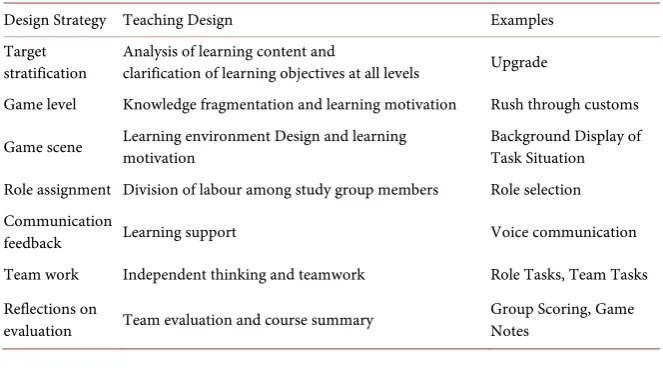
DOI: 10.4236/jss.2019.77039 491 Open Journal of Social Sciences further about knowledge and learning process, consolidate knowledge, improve thinking methods and improve learning ability. When applying the concept of game-based learning to the cooperative learning model classroom, teachers need to integrate various game-based learning design strategies into the design factors of cooperative learning teaching on the basis of mastering the concept of game-based learning design proficiently, so as to achieve the perfect integration of the two. The following will discuss how game-based learning design strategy meets the design needs of cooperative learning model classroom (see Table 1). Taking the knowledge points of “on-site arrangement” in the knowledge module of enterprise annual meeting in the textbook “Business Activity Planning and Operation” of a tourism vocational school as an example, this paper introduces in detail the current design strategy. “Site layout” comprehensive assessment of student activity execution ability a high practical value in the future work, in-cluding the layout of goods, material selection, as well as decoration site re-quirements and rules. The teaching process is mainly to create task situations by means of educational games and accomplish tasks by means of teamwork learn-ing.
4.1. Target Stratification
[image:4.595.208.540.547.735.2]Game-based learning will change the traditional idea of “teacher-centered” so that learners can actively construct their own knowledge system in teaching ac-tivities. The stratification of objectives enables students to choose appropriate content according to their level. Higher-level students deepen their knowledge and achieve more goals in a certain period of time, while lower-level students can do as they can and improve on the basis of consolidating their original knowledge. For example, at the initial level, students only need to complete the site layout of a certain item, which is the completion of a single knowledge point. As the difficulty of the level escalates, students need to design their own layout of the scene, put more items.
Table 1. The relationship between the design strategy and teaching strategies in game-based collaborative learning model.
Design Strategy Teaching Design Examples
Target
stratification Analysis of learning content and clarification of learning objectives at all levels Upgrade
Game level Knowledge fragmentation and learning motivation Rush through customs
Game scene Learning environment Design and learning motivation Background Display of Task Situation
Role assignment Division of labour among study group members Role selection Communication
feedback Learning support Voice communication
Team work Independent thinking and teamwork Role Tasks, Team Tasks
Reflections on
DOI: 10.4236/jss.2019.77039 492 Open Journal of Social Sciences
4.2. Game Level
The design of game level is based on Scaffolding Teaching mode [18]. In game-based learning, knowledge points are not suitable for students to present directly. Usually, they need to dress up as different small tasks. Each task in-cludes a small knowledge point to transform into a problem situation, that is, to create one or more scenarios which needed to be solved. The learners can com-prehend the task of constructing knowledge games according to specific scena-rios [19]. In the process of completing the task, learners will encounter prob-lems, explore probprob-lems, solve probprob-lems, encounter new problems and continue to explore solutions, so that the whole system can run and promote learners from the “first pass” to the completion of “customs clearance”. For example, when examining students’ knowledge of materials, the environment provides information about the use and location of the table to determine the size and material of the selected table.
4.3. Game Scene
The design of game situation is based on anchored teaching mode [20]. Know-ledge points are contained in game situations and are life-oriented, which makes the mastery of knowledge no longer a theoretical understanding, increases the connection with real life, and makes learners easier to understand and accept [21]. Game-based situations can create a good learning atmosphere and help to establish a harmonious relationship between learners and teachers. Student learning with interest and pleasant mood can not only improve efficiency, but also deepen the memory of knowledge [22]. For example, role-playing is per-formed by teachers. As a guest, detailed information can help students to think more thoroughly and turn knowledge into practical skills.
4.4. Role Assignment
In the process of learning, learners study knowledge and understand it through role-playing in a social situation, and use existing knowledge and life experience to solve problems in learning, so as to realize the infiltration of subject know-ledge into life [23]. Of course, they can switch roles from one another. Through role-playing, learners will have a new understanding of the problem. The success of role playing can increase learners’ sense of achievement and responsibility, and stimulate interest and enthusiasm in mastering knowledge [24]. For exam-ple, students play different roles, such as customers, designers, purchasers, im-plementers, etc. to consider different factors that need to be considered in dif-ferent positions.
4.5. Communication Feedback
DOI: 10.4236/jss.2019.77039 493 Open Journal of Social Sciences Communication can help learners to solve practical problems encountered in the process of games to improve game strategies, and make learners study from each other. Feedback of accurate information can help learners to find short-comings in the process of games, correct and make up for them to improve learning efficiency and enhance learning confidence at the same time [25]. In some game activities in the classroom, direct face-to-face communication may achieve the desired effect. However, in some games, real-time online communi-cation may be more convenient and effective. Computer, ipad and other elec-tronic devices are stationed in the classroom, which provides good support. In the whole game process, the different roles of students need to constantly com-municate and adjust the site layout to achieve the final satisfactory results.
4.6. Team Work
In order to achieve common goals, learners form a team and develop their strengths, division of labor and cooperation, learn from each other’s strengths and make up for each other’s weaknesses. The learners’ spirit of cooperation and sense of collective honor are cultivated. Because the problems to be solved are complex, participants can rely on team strength to solve them. There are com-plex cognitive communication and cognitive collaboration between them [26]. Learners can discuss and negotiate issues of common concern and get ideas from each other for problem solving. The relationship between learners is gener-ally harmonious, but it may also generate controversy for the solution of a cer-tain problem. All kinds of viewpoints can complement each other and reach consensus in the controversy so as to complete the learning task satisfactorily. Site layout is a complex process, different roles will put forward different angles of thinking about the problem. For example, the designer will think from the fi-nal layout effect, and the purchaser will think from the choice of materials.
4.7. Reflections on Evaluation
Evaluation needs to run through the whole process of the game, and process evaluation plays a very good guiding role for learners. When teachers evaluate the overall performance of learners in the whole game, they need to examine the learners’ motivation, learning effectiveness, learning ability, collaborative ability, emotional value and other factors. In addition, when deciding the learner’s per-formance, teachers should not make a “one-word” decision, but refer to the opi-nions of students themselves, teams, competitors and other directions. In deter-mining the final winner, teachers can organize award-giving activities and give certain prizes to make the learning process more attractive.
DOI: 10.4236/jss.2019.77039 494 Open Journal of Social Sciences urge students to reflect, they must put it into words to form a series of reflective process.
5. Summary
The game-based learning concept is applied in the teaching process of collabora-tive learning. The imparting and internalization of knowledge are accomplished through classroom games. This teaching method enables students to complete their learning in a relaxed and pleasant environment, and improves their self-team awareness and collaborative ability. However, in practice, there are still some shortcomings and challenges in the process of implementing game-based learning, for example, how to ensure that students can truly participate in the process instead of completing tasks by others, how to enhance the interesting degree of educational games enough to attract students to immerse in the com-pletion of tasks, how to effectively integrate educational knowledge points and game links so that students can master knowledge points rather than games.
Collaborative learning is an innovation of traditional teaching mode; the con-cept of game-based learning can well support the development of collaborative learning, which is more conducive to students’ learning. However, good applica-tion in practice still needs researchers to explore in real teaching practice. For example, improving teachers’ organizational ability is an important prerequisite for game-based collaborative learning, more diverse forms of game-based colla-borative learning are also hot topics for further research, and a more natural combination of educational games and learning content is also worth exploring.
Conflicts of Interest
The author declares no conflicts of interest regarding the publication of this pa-per.
References
[1] Li, Q., Lau, R.W.H., Shih, T.K. and Li, F.W.B. (2008) Technology Supports for Dis-tributed and Collaborative Learning over the Internet. ACM Transactions on Inter-net Technology, 8, Article No. 5.https://doi.org/10.1145/1323651.1323656
[2] Liu, G.Z., Chen, J. and Hwang, G.J. (2018) Mobile-Based Collaborative Learning in the Fitness Center: A Case Study on the Development of English Listening Com-prehension with a Context-Aware Application. British Journal of Educational Technology, 49, 305-320.https://doi.org/10.1111/bjet.12581
[3] Li, K.M. (2015) Learning Styles and Perceptions of Student Teachers of Comput-er-Supported Collaborative Learning Strategy Using Wikis. Australasian Journal of Educational Technology, 31, 32-50.
[4] Du, H., Qi, Z., Tian, X. and Pan, Y. (2010) Web-Based INC Collaborative Learning Based on LAMS. International Conference on E-Business & E-Government. 2010 International Conference on E-Business and E-Government, Guangzhou, 7-9 May 2010, 5594-5597.
Educa-DOI: 10.4236/jss.2019.77039 495 Open Journal of Social Sciences tion, 37, 313-347.
[6] Yang, H., Wang, L. and Ma, R.X. (2006) Exploration of the Integration of Online Game and Education: A Preliminary Study of Game-Based Learning Community. Research on Audiovisual Education, 4, 43-46.
[7] Piaget, J. (1974) The Future of Developmental Child Psychology. Journal of Youth & Adolescence, 3, 87-93https://doi.org/10.1007/BF02215168
[8] Piaget, J. (2010) Part I: Cognitive Development in Children: Piaget Development and Learning. Journal of Research in Science Teaching, 2, 176-186.
https://doi.org/10.1002/tea.3660020306
[9] Lee, H., Parsons, D., Kwon, G., Kim, J., Petrova, K., Jeong, E. and Ryu, H. (2016) Cooperation Begins: Encouraging Critical Thinking Skills through Cooperative Re-ciprocity Using a Mobile Learning Game. Computers & Education, 97, 97-115. https://doi.org/10.1016/j.compedu.2016.03.006
[10] Rabbany, R., Elatia, S., Takaffoli, M. and Zaïane, O.R. (2014) Collaborative Learning of Students in Online Discussion Forums: A Social Network Analysis Perspective. In: Peña-Ayala, A., Ed., Educational Data Mining. Studies in Computational Intel-ligence, Springer, Cham, 441-466. https://doi.org/10.1007/978-3-319-02738-8_16 [11] Zeng, Y. and Zhang, L.-X. (2012) Implementing a Cooperative Learning Model in
Universities. Educational Studies, 38, 165-173.
https://doi.org/10.1080/03055698.2011.598687
[12] Hui, M., Zheng, Z., Fei, Y. and Tong, S. (2010) The Applied Research of Cloud Computing in the Construction of Collaborative Learning Platform Under E-Learning Environment. 2010 International Conference on System Science, Engi-neering Design and Manufacturing Informatization, Yichang, 12-14 November 2010, 190-192.
[13] Van Ryzin, M.J. and Roseth, C.J. (2018) Cooperative Learning in Middle School: A Means to Improve Peer Relations and Reduce Victimization, Bullying, and Related Outcomes. Journal of Educational Psychology, 110, 1192-1201.
[14] Cheng, H.F., Yu, B., Park, Y.H. and Zhu, H. (2017) ProjectLens: Supporting Project-Based Collaborative Learning on MOOCs. In: Proceedings of the 2017 FourthACM Conference on Learning @ Scale, ACM, New York, 253-256.
https://doi.org/10.1145/3051457.3053998
[15] Sung, H.-Y. and Hwang, G.-J. (2013) A Collaborative Game-Based Learning Ap-proach to Improving Students’ Learning Performance in Science Courses. Comput-ers &Education, 63, 43-51.https://doi.org/10.1016/j.compedu.2012.11.019
[16] Schroeder, S. (2011) Un-Standardizing Curriculum: Multicultural Teaching in the Standards-Based Classroom. UrbanEducation, 46, 880-887.
https://doi.org/10.1177/0042085910377854
[17] Tao, S.Y., Huang, Y.H. and Tsai, M.J. (2017) Applying the Flipped Classroom with Game-Based Learning in Elementary School Students’ English Learning. 2016 In-ternational Conference on Educational Innovation through Technology, Tainan, Taiwan, 22-24 September 2016, 59-63. https://doi.org/10.1109/EITT.2016.19
[18] Bliss, J., Askew, M. and Macrae, S. (1996) Effective Teaching and Learning: Scaf-folding Revisited. Oxford Review of Education, 22, 37-61.
https://doi.org/10.1080/0305498960220103
DOI: 10.4236/jss.2019.77039 496 Open Journal of Social Sciences [20] P-Mar, V.N. (1993) Anchored Instruction and Situated Cognition Revisited.
Educa-tionalTechnology, 33, 52-70.
[21] Bottge, B.A., Rueda, E., Grant, T.S., Stephens, A.C. and Laroque, P.T. (2010) Anc-horing Problem-Solving and Computation Instruction in Context-Rich Learning Environments. ExceptionalChildren, 76, 417-437.
https://doi.org/10.1177/001440291007600403
[22] Sari, S., Anjani, R., Farida, I. and Ramdhani, M.A. (2017) Using Android-Based Educational Game for Learning Colloid Material. Journal of Physics: Conference Series, 895, Article ID: 012012.https://doi.org/10.1088/1742-6596/895/1/012012 [23] Batista, R. and Vaz de Carvalho, C. (2008) Work in Progress-Learning through Role
Play Games. 2008 38th Annual Frontiers in Education Conference, Saratoga Springs, New York, 22-25 October 2008, T3C-7-T3C-8.
[24] Dado, M. and Bodemer, D. (2017) A Review of Methodological Applications of So-cial Network Analysis in Computer-Supported Collaborative Learning. Educational ResearchReview, 22, 159-180.https://doi.org/10.1016/j.edurev.2017.08.005
[25] Shi, Y., Bi, T. and Yang, W. (2012) Development of High Quality Educational Game by Information Technology Support. 2012 2nd International Conference on Con-sumer Electronics, Communications and Networks, Yichang, 21-23 April 2012, 1779-1782..
[26] Sardone, N.B. (2018) Attitudes toward Game Adoption: Preservice Teachers Con-sider Game-Based Teaching and Learning. International Journal of Game-Based Learning, 8, 1-14.https://doi.org/10.4018/IJGBL.2018070101
[27] Vos, N., Meijden, H.V.D. and Denessen, E. (2011) Effects of Constructing versus Playing an Educational Game on Student Motivation and Deep Learning Strategy Use. Computers and Education, 56, 127-137.