Abstract. This paper addresses the question whether triple arrays can be constructed from Youden squares developed from dierence sets. We prove that if the dierence set is abelian, then having −1 as multiplier is both a
necessary and sucient condition for the construction to work. Using this, we are able to give a new innite family of triple arrays. We use an alternative version of the construction to analyse the case of non-abelian dierence sets, for which we prove a sucient condition for giving triple arrays. We do a computer search for such non-abelian dierence sets, but have not found any examples satisfying the given condition.
1. Introduction
Agrawal [1] considered a type of row-column design which now goes by the name of triple array. He observed that such an array implies the existence of a symmetric balanced incomplete block design, and asked whether triple arrays can be constructed from such designs. The statement that this can always be done, with exception for trivial and the smallest non-trivial design, is known as Agrawal's conjecture.
Denition 1.1. A triple array is anr×carray onv symbols arranged so that no
symbol occurs more than once in any row or column, and satises the following four conditions:
TA1. Each symbol occurs k times (equireplicate).
TA2. Any two distinct rows contain λrr common symbols.
TA3. Any two distinct columns contain λcc common symbols.
TA4. Any row and column contain λrc common symbols.
For a triple array we use the notationT A(v, k, λrr, λcc, λrc :r×c). An array as
above that satises conditions TA1TA3 is called a double array with notation
DA(v, k, λrr, λcc : r×c), and a double array that does not satisfy TA4 is called
a proper double array.
If we interchange the roles of columns and symbols in a triple array, we get what is called the RL form of a triple array, (short for Row-Letter form, sometimes used in statistics literature). It is an incomplete r×v array, with no repetition
in any row or column, satisfying the following four conditions, corresponding to the above conditions TA1TA4:
RTA1. Every column has k occupied cells.
RTA2. For any pair of rows, there are λrr columns in which both rows are
occu-pied.
RTA3. Every pair of symbols must occur together in λcc columns.
RTA4. The columns with occupied cells in row i must contain every symbol
exactlyλrc times, for all i,1≤i≤r.
Correspondingly, an array as above satisfying RTA1RTA3 is the RL-form of a double array.
Triple arrays satisfy the following inequality.
Theorem 1.2. [14] Any T A(v, k, λrr, λcc, λrc:r×c) satises v ≥r+c−1.
Here we consider the extremal case which is relevant for Agrawal's conjecture and the relation to symmetric designs, and for which there are many examples. In the non-extremal case there is only one example known [14].
Denition 1.3. A (v, k, λ)-balanced incomplete block design (BIBD) is a pair (V,B) where V is a v-set and B is a collection of b proper k-subsets of V called
blocks such that each element of V is contained i exactlyrblocks and any 2-subset
ofV is contained in exactlyλblocks. A BIBD wherev =bis said to be symmetric
and is abbreviated as SBIBD.
Note that, in the combinatorial literature, it is common to refer to a BIBD as a 2-design, and a SBIBD as a symmetric (or square) 2-design.
Remark 1.4. Another, but equivalent way to dene a double array is to say that rows and symbols form a BIBD, and that columns and symbols form a BIBD. Moreover, condition TA4 is often called adjusted orthogonality.
Agrawal conjectured a construction of triple arrays from SBIBDs, which we now state, together with its converse (which is true).
Conjecture 1.5. [1] If there is a (v + 1, r, λcc)-SBIBD with r−λcc > 2, then
there is a T A(v, k, λrr, λcc, λrc :r×c) with v =r+c−1.
The condition r−λcc > 2 excludes the Fano plane and its complement, for
which it is known that no triple array exists.
Theorem 1.6. [14] If there is a T A(v, k, λrr, λcc, λrc:r×c) with v =r+c−1,
then there is a (v+ 1, r, λcc)-SBIBD.
Agrawal [1] gave a construction method from which many examples have been constructed, but for which one step has not been proven and has to be performed by trial and error. Besides this, only one innite family called Paley triple arrays has been proven to exist. This has been done to dierent degrees by Seberry [20], Street [22], Bagchi [2] and Preece et al. [18], and can be summarized as follows. Theorem 1.7. Let q≥5 be an odd prime power. Then there exists a q×(q+ 1)
triple array.
Denition 1.8. Let V be a set of v symbols. A k×v Youden square is a k×v
array satisfying
YS1. every symbol of V occurs exactly once in each row, and
YS2. the symbols in each column constitute a k-subset of V, and the v such
subsets constitute the blocks of a (v, k, λ)-SBIBD.
This construction method, suggested by [19], starts from a Youden square and goes directly to the RL-form of a triple array, thereby avoiding the unproven step of Agrawal's method. However, this places strong demands on the structure of the Youden square, and it was shown in [23] that this method is not even guaran-teed to give a double array. But in [17] the usability of this method was further studied, also with some positive results. That a Youden square can always be constructed from a SBIBD was proven by [21]. But the most straightforward way to construct a Youden square is to develop it from a dierence set.
In this paper we investigate if there are dierence sets which, if developed to Youden squares, give triple arrays by the suggested construction. The rest of the paper is structured as follows: In Sect. 2 we give preliminary denitions and results about dierence sets. In Sect. 3 we present the construction and prove that having−1 as a multiplier is both a necessary and sucient condition for an
abelian dierence set to give a triple array. In Sect. 4 we present known results about existence for such dierence sets and give parameters for a new innite family of triple arrays. In Sect. 5 we present a direct version of the construction and formulate a more general condition for a dierence set to give a triple array, suitable for studies of abelian sets. Finally, in Sect. 6 we analyze the non-abelian case. We show by a computer search on small groups that having −1as
weak multiplier, or having a reversible translate, are not sucient conditions for such a set to give a triple array.
2. Preliminaries
We recall some facts from the theory of dierence sets.
Denition 2.1. Let G be a nite multiplicative group of order v, and D a k
-subset ofG. ThenDis called a(v, k, λ)-dierence set if any non-identity element
ofG can be written in exactlyλ ways asxy−1 where xandy are in D. The order
of a dierence set is the integer n = k−λ and D is called non-trivial if n > 1.
We say that D is cyclic or abelian if G is.
Unless stated otherwise, the term dierence set will here always refer to a non-trivial dierence set. Given a dierence set, we can nd many other related dierence sets.
Theorem 2.2 (cf. [16]). Let D be a (v, k, λ)-dierence set in G. Then its
Theorem 2.3 (cf. [16]). Let D⊂G be a (v, k, λ)-dierence set.
(1) For g ∈G, both gD and Dg are (v, k, λ)-dierence sets.
(2) Let α be an automorphism of G. Then α(D) is a (v, k, λ)-dierence set.
For parameters we have the following fundamental identity.
Theorem 2.4 (cf. [16]). LetDbe a (v, k, λ)-dierence set inG. Thenk(k−1) = λ(v−1).
We will need the notion of reversible dierence sets.
Denition 2.5. Let S be a subset of a group G. ThenS(−1) is the set of inverses
of the elements of S, that is S(−1) ={x−1 :x∈S}.
Denition 2.6. A dierence set D is called reversible if D=D(−1).
Dierence sets can be used to construct SBIBDs.
Denition 2.7. Let X be a subset of a nite group G. For any g ∈ G, dene Xg = {xg : x ∈ X}. We call any set Xg a right translate of X and dene the
development of X, denoted dev(X), to be the collection of all right translates of X.
Theorem 2.8 (cf. [16]). LetD⊂Gbe a(v, k, λ)-dierence set. Then(G,dev(D))
is a (v, k, λ)-SBIBD.
Studying dierence sets often means dealing with multisets, and then the fol-lowing algebraic structure can be useful.
Denition 2.9. Let G be a nite multiplicative group. The integral group ring ZG consists of formal sumsPg∈Gagg where ag ∈Z. Addition and multiplication
are dened as follows:
X
g∈G agg+
X
g∈G bgg =
X
g∈G
(ag +bg)g
X
f∈G aff
! X
g∈G bgg
!
=X
h∈G
X
f g=h∈G afbg
!
h.
Let S ⊆ G, then it is a standard convention to abuse notation and write also
the corresponding group ring element as S, that is S := P
g∈Sg. In ZG, if A=P
g∈Gagg andtany integer, then we deneA
(t) :=P
g∈Gagg
t. In particular, A(−1) =P
g∈Gagg−1. A useful notation concerning cardinality is |A|=
P
g∈Gag.
We write the identity in G as 1G to distinguish it from the integer 1. Further,
ZG is a ring with identity 1G and is commutative if and only if G is abelian.
Theorem 2.10 (cf. [16]). Let D be a non-empty proper subset of a groupG with
|D|=k and |G|=v. Then Dis a (v, k, λ)-dierence set of order n if and only if DD(−1) =n1G+λG
Denition 2.11. Let D be a dierence set in a group G. An automorphism φ
of G is called a multiplier of D if φ(D) =aDb for some a, b∈G. If a= 1, then φ is called a right multiplier. If G is abelian and φ is of the form φt:x7→xt for
some integert, then φ is called a numerical multiplier. It is common practice to
abuse terminology and call t itself a numerical multiplier.
Forφt :x7→xt we writeφt(D) =D(t)={xt:x∈D}. We will take particular
interest in the inverse mappingx7→x−1. It is an automorphism of every abelian
group but quite rare as multiplier. In non-abelian groups this mapping is not a homomorphism so it cannot be a multiplier, but is called a weak multiplier if
D(−1) is a right translate of D.
Theorem 2.12 (cf. [4]). Let D be a (v, k, λ)-dierence set in the abelian group G. Then there exists a translate of Dwhich is xed by every numerical multiplier
of D.
Hence,−1is a multiplier ofDif and only ifD has a reversible translate. Also,
note that if −1 is a multiplier of D, then it also a multiplier of every translate
ofD. To see this, suppose(Dg)(−1) =Dg. Theng−1D(−1) =Dg, soD(−1) =Dg2. Finally, we will need the following two results for calculating parameters in triple arrays.
Lemma 2.13. [15] SupposeA is aT A(v, k, λrr.λcc, λrc:r×c) withv =r+c−1.
Then λrc=r−λcc.
Corollary 2.14. [15] When v = r+c−1 every triple array is a T A(v, k, c−
k, r−k, k:r×c).
3. Triple arrays from abelian difference sets
In this section we construct triple arrays from Youden squares developed from abelian dierence sets admitting−1as a multiplier, and prove that this is both a
necessary and sucient condition for the construction to work. By Theorem 2.8 it is straightforward to construct a Youden square from a dierence set.
Construction 3.1. Let D be a (v, k, λ)-dierence set in a nite multiplicative
group G. Let Y be a k×v array where the columns are inxeded by the elements j ∈ G. Write the elements of D in an arbitrary order in column 1, and let each
row be indexed by the elementi∈D in column 1. Then, take Y(i, j) =ij, where Y(i, j) denotes the element in position (i, j) in Y.
From a Youden square we construct the RL-form of an array as suggested in [19].
As mentioned before, applying Construction 3.2 to any Youden squareY does
not even guarantee that we get the RL-form of a double array. But here Y is
developed from a dierence set.
Theorem 3.3. Let D be a (v, k, λ)-dierence set in a group G. Then there is a k×(v−k) double array.
Proof. Let Y[C] be an array from Construction 3.2 based on a Youden square Y
from Construction 3.1. Then this theorem consists of two results already known put together for constructing the RL-form of a double array. In [17], RTA1 and RTA3 was proven in Proposition 2 for any Youden squareY, and in Proposition 5
RTA2 was proven in the special case when Y is constructed from a dierence set,
without any assumtion of being abelian and to hold regardless of the choice of columnCforY[C]in Construction 3.2. Here we writeGmultiplicatively, whereas it was written additively in [17]. Hence, fromDwe can construct an RL-form of a
double array and thereby a double array with |D|=k rows and|G| − |D|=v−k
columns.
Theorem 3.4. Let D be a (v, k, λ)-dierence set in an abelian group G which
admits −1 as a multiplier. Then there is a k×(v−k) triple array.
Proof. Let Y be a Youden square obtained from Construction 3.1 when applied
to a dierence set such as above. We will prove that applying Construction 3.2 to any column C of Y gives a Y[C] which is the RL-form of a triple array. We already have RTA1, RTA2 and RTA3 by Theorem 3.3 and what remains is to prove RTA4.
That a dierence set with multiplier −1 has a reversible translate is given
by Lemma 2.12. So, suppose Y is constructed from a dierence set Dg with
reversible translate D. Take an elementx∈Dg. We will prove that the columns
inY which have elements fromG\Dg in rowxtogether contain exactlyn=k−λ
copies of each element in G\Dg.
We partition G into Lx and Rx such that Lx is the set of column indices for
columns having an element of Dg in row x, and Rx consists of the remaining
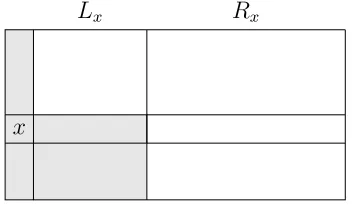
column indices. If wanted, the columns of Y could be permuted as in Figure 1.
Note that Y can be regarded as part of a multiplication table for G and that
in ZG the product DgRx represents a multiset consisting of the elements in the
columns with indices in Rx, counted with multiplicity. First we note thatx=dg
for some d∈D and that xLx =Dg, so
Lx =x−1Dg = (dg)−1Dg =g−1d−1Dg =Dd−1.
We will now determine the multiset DgRx.
Lx Rx
[image:7.612.204.381.97.200.2]x
Figure 1. A Youden square where the shaded part of row x and
the rst column both have support Dg.
We note thatDgG =|Dg|G=kGand since D is reversible we can make use of
Theorem 2.10 to write
DgG−DDgd−1 =kG−(n1G+λG)gd−1 =kG−ngd−1−λGgd−1 =
=kG−ngd−1−λG= (k−λ)G−ngd−1 =nG−ngd−1
wheregd−1 ∈Dg.
Hence, we have proved that every element in the columns indexed byRxcontain
each element of G\Dg exactlyn=k−λ times. Sincex is an arbitrary element
of Dg this holds for any x∈Dg thereby proving RTA4 for Y[C] whereDg is the support ofC. And, becauseg ∈Gwas arbitrary, the proof holds with respect to
any columnC of Y.
And now we will prove the converse, that if a Youden square constructed from an abelian dierence setDgives a triple array, then Dadmits−1as a multiplier.
For convenience we letYx[C] denote the array consisting of all columns of Y[C]
where rowx∈supp(C)has elements in G\supp(C).
Lemma 3.5. Let D be a non-reversible abelian dierence set that via
Construc-tion 3.1 gives a Youden square from which ConstrucConstruc-tion 3.2 gives the RL form of a triple array. Then |D∩D(−1)|=λ.
Proof. Suppose D gives the RL-form of a triple array when applying
Construc-tion 3.1 and ConstrucConstruc-tion 3.2, but that D is not reversible. Then there is an x∈D such thatx−1 ∈Dand we claim thatx−1 occurs |D∩D(−1)|times inYx[C].
Let y ∈ D such that y−1 ∈ D, x and y not necessarily distinct. Any column z where xz =y−1 is active in Yx[C], but then we also have yz =x−1. Hence,x−1
occurs at least |D∩D(−1)| times in Yx[C]. To see that x−1 does not occur more
times in Yx[C] we assume that y−1 ∈ D and yw = x−1. But then xw = y−1 so
Now, since RTA4 tells us that every element of D occur λrc times in Yx[C] and
Theorem 1.6 together with Lemma 2.13 give λrc=k−λ we have λrc=k−λ =|D∩D(−1)|=|D| − |D∩D(−1)|.
Hence, |D∩D(−1)|=λ.
Lemma 3.6. Let D be a dierence set in an abelian group G. Then
|Dg∩(Dg)(−1)| ∈ {|D|, λ} for all g ∈G
if and only if D admits −1 as a multiplier.
Proof. SupposeDadmits−1as a multiplier. Then−1is also a multipler of every
translate, so for eachg ∈Gwe have|Dg∩(Dg)(−1)|=λor|Dg∩(Dg)(−1)|=|D| since we know by Lemma 2.12 that there is a least one translate Dg xed by the
multiplier −1.
Now, suppose |Dg ∩(Dg)(−1)| ∈ {|D|, λ} for all g ∈ G and that −1 is not a
multiplier ofD. So there is nog ∈Gsuch that|Dg∩(Dg)(−1)|=|D|which means that |Dg ∩(Dg)(−1)| = λ for all g ∈ G. Hence, dig = g−1d−1j or equivalentely didj =g−2 has exactlyλ solutions of pairs di, dj ∈D for each g ∈G.
This would be λ|G| elementsg−2 in total when counted with multiplicity. We
compare this with all elements didj counted with multiplicity which is given by
|DD| inZG. For (v, k, λ)-dierence sets we have the identity λ(v−1) =k(k−1)
given in Theorem 2.4 and can write
|DD|=k2 >|λG|=λv =k2−(k−λ) =k2−n.
So, there is a g−2 ∈ G for which there are more than λ solutions of didj = g−2.
And since |D| is the only avialable number besides λ we know that there is a
reversible translate which means that −1is a multiplier.
Theorem 3.7. Let Dbe an abelian dierence set that via Construction 3.1 gives
a Youden square from which Construction 3.2 gives the RL form of a triple array, then D admits−1 as a multiplier.
Proof. By Lemma 3.5 we know that a non-reversible abelian dierence set D
which gives the RL-form of a triple array through Construction 3.1 and Con-struction 3.2 must satisfy |D∩D(−1)|=λ. But Lemma 3.6 tells us that it is not
possible that|(Dg)∩(Dg)(−1)|=λ for allg ∈G. Hence, there exists someg ∈G
such that Dg is reversible wich proves that−1 is a multiplier of D.
4. Existence
Here we consider abelian dierence sets having multiplier −1, or we can say
We give all small such dierence sets as examples and prove the existence of an innite family of triple arrays.
Theorem 4.1 (cf. [4]). Let Dbe a reversible (v, k, λ)-dierence set in an abelian
group, thenv andλ are even andn is a square. Moreover,v andn have the same
odd prime divisors.
We note that triple arrays constructed here never coincide with Paley triple arrays. To see this, we compare the sum of the number of rows and columns. For a Paley triple array the sum is2q+ 1, so it is odd. For triple arrays constructed
from (v, k, λ)-dierence sets with multiplier −1 the sum is k + (v − k) = v,
which is even by Theorem 4.1. The following theorem excludes many well-known dierence sets.
Theorem 4.2 (cf. [3]). Minus one is never a multiplier of a non-trivial cyclic dierence set.
Thus we turn our attention to non-cyclic groups. Kibler [9] gave a list of the small non-cyclic (v, k, λ)-dierence sets for k < 20 up to equivalence. This list
consists of 74 dierence sets in 37 groups. But the only groups here satisfying the necessary conditions of being both abelian and of even order are of order 16 or 36.
The case (v, k, λ) = (16,6,2). Here there are 12 groups having a total of 27
dierence sets. Four of these groups are abelian, having a total of eight dierence sets. But only four dierence sets admit−1as multiplier. These groups and sets
were pointed out in [7] and are given here below with numbering as in [9]. (B) Abelian. ha, b:a4 =b4 = 1i
3. {1, a, a2, b, ab2, a2b3} 5. {1, a, b, a2b, ab2, a2b2}
(C) Abelian. ha, b, c:a4 =b2 =c2 = 1i 7. {1, a, a2, ab, ac, a3bc}
(D) Abelian. ha, b, c, d:a2 =b2 =c2 =d2 = 1i 8. {1, a, b, c, d, abcd}
The case (v, k, λ) = (36,15,6). Here there are nine groups having a total of 34
dierence sets. The two abelian groups contain seven dierence sets, but only the following admits −1as multiplier.
(A II) Abelian. ha, b, c, d:a3 =b3 =c2 =d2 = 1i
17. {1, a, a2, c, a2c, bc, a2bc, b2c, a2b2c, ad, a2bd, b2d, acd, bcd, a2b2cd} Applying Constructions 3.1 and 3.2 to the dierence sets above give 6×10 and 15×21triple arrays by Theorem 3.4. We note that these dierence sets are all
members of the following well-known and important family.
To our knowledge, almost all reversible dierence sets are Hadamard. This question was systematically studied by [11] and [10], and the only exception
known is due to McFarland [12] who proved there is an abelian reversible(4000,775,150)
-dierence set and proposed the following conjecture.
Conjecture 4.4 (McFarland's Conjecture). If D is a reversible dierence set,
then either D is a (4000,775,150)-dierence set or D is a Hadamard dierence
set.
For Hadamard dierence sets there is a strong non-existence theorem.
Theorem 4.5. [13] If there exists a Hadamard dierence set with multiplier minus one in an abelian group of order 4u2, then the square-free part of u can only have the prime factors 2 and 3.
There are several constructions of reversible dierence sets, and they were put together in [8] to give the following result.
Theorem 4.6 (cf. [4]). Let Gbe a group of the form G=Zb
4×Z22c1 ×. . .×Z22cr,
and let H be a group of the form H =Z2
2×Z23a×Z4p1×. . .×Z
4
ps, where thepj are
(not necessarily distinct) odd primes and where a, b, c1, . . . , cr are non-negative
integers. Then both G and G×H contain reversible Hadamard dierence sets.
In [4] Theorems 4.5 and 4.6 are combined to give the following.
Corollary 4.7 (cf. [4]). Let u be a positive integer. There exists a reversible
Hadamard dierence set in some abelian group of order 4u2 if and only if the square-free part of u divides 6.
We conclude this section by giving an existence result for triple arrays based on the knowledge of abelian reversible dierence sets.
Theorem 4.8. Let u be a positive integer such that the square-free part of u
divides 6, then there is aT A(4u2−1, u2, u2+u, u2−u, u2 : (2u2−u)×(2u2+u)). Moreover, there is a T A(3999,625,2600,150,625 : 775×3225).
Proof. By Corollary 4.7 we know that there is an abelian reversible (4u2,2u2 −
u, u2 −u)-dierence sets when the square-free part of u divides 6, and by [12] that there is an abelian reversible (4000,775,150)-dierence set. Applying
Theo-rem 3.4 to these two cases gives the existence of the corresponding triple arrays, where the parameters are calculated using Theorem 1.6 and Corollary 2.14.
5. A direct construction
Denition 5.1. Let D be a non-empty proper subset of G. Construct an array A(G, D) with rows indexed by D and columns by G\ D, with the (x, y) entry
equal to x−1y. Note that the entries of the array are non-identity elements of G,
and that no element of G is repeated in a row or column.
Proposition 5.2. Suppose that D is a left dierence set in a group G of order v. Then A(G, D) is a double array of size k×(v −k) on v −1 symbols. It is
a triple array if and only if the size of x−1D∩D(−1)y is constant for x ∈ D,
y∈G\D.
Proof. Suppose thatD is a(v, k, λ)left dierence set, so that any two left
trans-lates of D meet in λ elements. The cancellation law for groups shows that no
element is repeated in a row or column; and clearly the identity does not occur anywhere in the array. Givenz 6= 0, there arek representations asz =x−1ywith x∈D (one for each element of D; andλ of these have y∈D. So the number of
occurrences of z in the table is k−λ. Further, we see that
• row x of A contains the elements of x−1(G\D);
• column y of A contains the elements of D(−1)y.
If D is a left dierence set, then so is G\D. Moreover, D(−1)y = (y−1D)−1,
so any two translates of D(−1) meet in a constant number of points. It follows
immediately thatA is a double array. The condition for Ato be a triple array is
clear.
Suppose that D(−1) is equal to a left translate of D, and that every right
translate of D is also a left translate. Then any row and any column contain a
constant number of common elements, so we have a triple array. Thus, if D is a
dierence set with multiplier−1 in an abelian group, thenA is a triple array.
Any triple array with v =r+c−1 arises from a SBIBD, as Agrawal pointed
out. The points of the design are the rows and columns of the array (in the rst form we described); the blocks are indexed by the letters and one additional symbol ∗, where ∗ is incident with all rows and no columns, while a letter is incident with the rows not containing it and the columns containing it.
For triple arrays from dierence sets with multiplier−1, one can ask whether
this design coincides with the one obtained by developing the dierence set. It is immediate from our direct construction in this section that the answer is yes. For the dierence set D is a block of the design, and we have given bijections
between the rows and D, and between the columns and G\D; the two bullet
points in the proof of Proposition 5.2 show that the designs coincide. 6. Non-abelian difference sets
Question 6.1. Suppose that D is a left dierence set in a non-abelian group G.
We next discuss some computations related to this question. (We have not found any examples.)
Proposition 6.2. Let D be a left dierence set in a group G. Then
(a) D generates G, so D cannot be contained in a proper subgroup of G.
(b) The set S ={x∈G:xD=Dy for some y∈G} is a subgroup of G.
(c) If D⊆S, then S =G.
Proof. (a) holds because every element ofGhas the formx−1yfor somex, y ∈D.
To see that (b) holds, note that G×G acts on the power set of G by the
diagonal action (x, y) : D7→x−1Dy; the stabiliser of a set D is thus a subgroup
ofG×G, and the setS of the Proposition is the projection of this subgroup onto
the rst factor.
Before we discuss the non-abelian dierence sets in Kibler's list [9], we recall some preliminary observations.
(a) D is a left dierence set if and only if it is a right dierence set (that is,
the non-identity elements of G occur equally often in the form yx−1, for x, y ∈D [5].
(b) We say that−1is a weak multiplier ofD if the setD(−1) ={d−1 :d∈D} (which is also a dierence set) is a translate Dx of D, for somex∈G.
(c) We say that D is reversible if D(−1) = D. Note that, if D(−1) = Dx2
where xis central in G, then
(Dx)(−1) = (xD)(−1) =D(−1)x−1 =Dx,
soDx is a reversible dierence set.
The case (v, k, λ) = (16,6,2). For this case Kibler found, up to equivalence,
that eight of the twelve groups having dierence sets are non-abelian, containing
19 dierence sets.
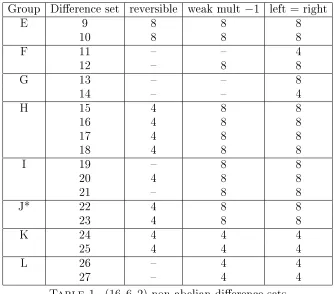
Note that Kibler's group (J) is incorrect. The presentation of the group should be ha, b : a8 = b2 = 1, ba = a5bi, and the two dierence sets are {1, a, a2, a5, a4b, a2b} and {1, a, a3, a4, a3b, a5b}. This is noted by an asterisk in the table below. The other notation is as in Kibler's paper.
Using GAP [6], we examined all cases. Data on the number of reversible trans-lates of D, the number of translates with a weak multiplier −1 (this is weaker
than having a reversible translate), and on the numbers ofxfor whichxD=Dy
for some y, is given in Table 1. Each of these numbers is independent of the
particular choice of dierence set among the collection of all translates.
Note that s =v would be equivalent to the assertion that every left translate
is a right translate (giving a triple array); but this never occurs.
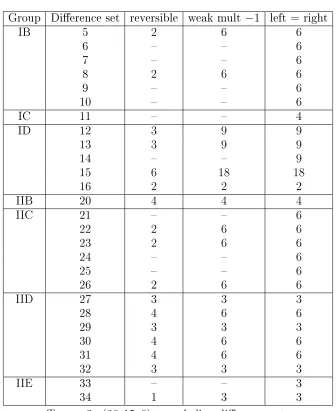
Table 2 has the same information for the non-abelian(36,15,6)dierence sets.
Group Dierence set reversible weak mult −1 left = right
E 9 8 8 8
10 8 8 8
F 11 4
12 8 8
G 13 8
14 4
H 15 4 8 8
16 4 8 8
17 4 8 8
18 4 8 8
I 19 8 8
20 4 8 8
21 8 8
J* 22 4 8 8
23 4 8 8
K 24 4 4 4
25 4 4 4
L 26 4 4
[image:13.612.124.458.94.388.2]27 4 4
Table 1. (16,6,2)non-abelian dierence sets
References
[1] Hiralal Agrawal, Some methods of construction of designs for two-way elimination of het-erogeneity, J. Amer. Statist. Assoc. 61 (1966), 11531171.
[2] S. Bagchi, On two-way designs, Graphs Combin. 14 no. 4 (1998), 313319.
[3] M. K. Baumert, Cyclic dierence sets, SpringerVerlag, New York, Lecture Notes in Math-ematics, 1971.
[4] T. Beth, D. Jungnickel and H. Lenz, Design Theory (Second Edition) Cambridge University Press, Cambridge, England, 1999.
[5] R. H. Bruck, Dierence sets in a nite group, Trans. Amer. Math. Soc. 78 (1955), 464481. [6] The GAP Group, GAP Groups, Algorithms, and Programming, Version 4.7.2; 2013:
http://www.gap-system.org.
[7] E. C. Johnsen, The inverse multiplier for abelian group dierence sets, Canad. J. Math. 16 (1964), 787796.
[8] D. Jungnickel and B. Schmidt, Dierence sets: An update, In: Geometry, combinatorial designs and related structures, J. W. P. Hirschfeld, S. S. Magliveras and M. J. de Resmini (Editors), Cambridge University Press, Cambridge, 1999, pp 89-112.
[9] R. E. Kibler, A Summary of Noncyclic Dierence Sets,k <20, J. of Combinatorial Theory
(A) 25 (1978), 6267.
[10] S. L. Ma, McFarland's conjecture on abelian dierence sets with multiplier−1, Designs,
Codes and Cryptography 1 (1991), 321332.
[11] R. L. McFarland and S. L. Ma, Abelian dierence sets with multiplier−1, Arch. Math. 54
Group Dierence set reversible weak mult −1 left =right
IB 5 2 6 6
6 6
7 6
8 2 6 6
9 6
10 6
IC 11 4
ID 12 3 9 9
13 3 9 9
14 9
15 6 18 18
16 2 2 2
IIB 20 4 4 4
IIC 21 6
22 2 6 6
23 2 6 6
24 6
25 6
26 2 6 6
IID 27 3 3 3
28 4 6 6
29 3 3 3
30 4 6 6
31 4 6 6
32 3 3 3
IIE 33 3
[image:14.612.138.474.85.496.2]34 1 3 3
Table 2. (36,15,6)non-abelian dierence sets
[12] R. L. McFarland, A family of dierence sets in non-cyclic groups, J. Comb. Th. (A) 15 (1973), 110.
[13] R. L. McFarland, Subdierence sets of Hadamard dierence sets, J. Comb. Th. (A) 54 (1990), 112122.
[14] J. P. McSorley, N. C. K. Phillips, W. D. Wallis and J. L. Yucas, Double Arrays, Triple Arrays and Balanced Grids, Designs, Codes and Cryptography 35 (2005), 2145.
[15] J. P. McSorley, Double Arrays, Triple Arrays, and Balanced Grids with v = r+c−1,
Designs, Codes and Cryptography 37 (2005), 313318.
[16] E. H. Moore and H. S. Pollatsek, Dierence Sets: Connecting Algebra, Combinatorics, and Geometry, American Mathematical Society, 2013.
[18] D. A. Preece, W. D. Wallis and J. L. Yucas, Paley triple arrays, Australas. J. Combin. 33 (2005), 237246.
[19] D. Raghavarao and G. Nageswararao, A note on a method of construction of designs for two-way elimination of heterogeneity, Communications in statistics 3 no. 2 (1974), 197199. [20] J. R. Seberry, A note on orthogonal Graeco-Latin designs, Ars Combin. 8 (1979), 8594. [21] C. A. B. Smith and H. O. Hartley, The Construction of Youden Squares, Journal of the
Statistical Society, Series B, Methodological 10 no. 2 (1948), 262263.
[22] D. J. Street, Graeco-Latin and nested row and column designs, Combinatorial Math., Lecture Notes in Math. 884, Springer 8 (1981), 304313.