
The influence of the different elements of an organic
molecule structure on the main kinetic parameters of its
unimolecular reaction in the high-pressure region
David Krinkin
Yozmot HaEmek Technological Incubator, Migdal HaEmek, Israel; [email protected]
Received 29 June 2011; revised 17 July 2011; accepted 22 July 2011.
ABSTRACT
The most general dynamic tendencies of the energy redistribution in the high-pressure re-gion are considered. Their influence on the possible deviations from the kinetic concep-tions, which is now generally accepted, is ex-amined. In this way, the structural elements of an organic molecule that promote internal en-ergy mobilization in the high-pressure region and, conversely, hamper it, are defined. The first of these elements reduces both the Arrhenius parameters of the unimolecular reactions while the second leads to the opposite results. Some well-known exceptions to existing kinetic theo-ries, which find an explanation in the framework of these proposed concepts, is considered. The proposed concept is very general as distinct from the existing dynamic studies, which inves-tigate more particular details of the separate bond behaviors. The proposed general concept can broaden the study of chemical kinetics.
Keywords:Arrhenius Parameters; A-Factor; High-Pressure Region
1. INTRODUCTION
The present paper is devoted to the dynamics of en-ergy mobilization inside an energized molecule in order that a reaction will proceed in the high-pressure region. Presently, the dynamics picture of the energy flow in chemical kinetics is studied practically exclusively by the method of collision-induced relaxation of a vibra-tionally excited molecule, which has been the subject of continuing interest for the past several decades [1-6]. The problem of the internal energy mobilization of a molecule is studied mainly in the fall-off region, where it plays a decisive role and determines in particular the
transition in the high-pressure region. The existing dy-namical method is concerned with the detailed treatment of molecular vibrations and the behavior of particular molecular coordinates as a function of time. Generally, this relaxation is studied during and after one collision.
In the present paper, in contrast to the existing dy-namics method, an attempt was made to formulate those elements of the organic molecule structure that promote the concentration of the energy surplus of an energized molecule on the bond that is being broken or, conversely, that detain part of the energy on some structural group of bonds, disperse it between these bonds, and in this way impede energy concentration on the bond that is being broken. The first structural elements reduce the general energy quantity necessary for molecular activation (E), and also reduce the energy and the entropy of the transi-tion state (A-factor) and the energy that remains on the reaction fragments. Note that in this case the negative transition state entropy, i.e., negative entropy of activa-tion, will be even in the simple bond fission reacactiva-tion, which is absolutely impossible in the framework of the modern statistical Rice-Ramsperger-Kassel-Marcus (RR KM) theory. In so doing, energy activation also may be lower than the strength of the bond that is being broken. This is also impossible in the high-pressure region ac-cording to statistical theories, whereas in the fall-off region the usual well-known situation exists. Conversely, the second type of structural element leads to an increase in energy activation (E) and the pre-exponent (A-factor). In this case, the high A-factor and “loose” transition state may be even at its ringed form, when it has lost a few degrees of freedom. This is also impossible in the framework of the modern statistical theories.
statisti-cal RRKM theory (see below).
In the Introduction, both types of the above-mentioned molecular structures and some semi-empirical rules that result from them are outlined. In the subsequent parts of the article are discussed: the agreement between existing kinetic data and these semi-empirical rules; their limita-tions and the extent of their applicability; the connection between them and the existing dynamic method; and their ability to explain some known exceptions to mod-ern statistical theories.
The main source of the existing kinetic data is, of course, the articles in the current kinetic literature. Other than this, a very comprehensive collection of rate data on thermally induced unimolecular, homogeneous gas phase reactions by Sydney Benson and O’Neal [7] should be noted, which unfortunately includes kinetic data only up to February 1968, and a fundamental book on uni-molecular reaction by P. Robinson and K. Holbrook [8], which, in addition to kinetic theory, contains a signifi-cant collection of the experimental data.
The proposed method is not an alternative approach to the existing dynamical one, but rather a qualitative sup-plement, and a very general approximation. Nevertheless, it introduces a few new concepts that are very important for any branch of science, in that it aids our understand-ing and interpretation of experimental data, and confirms the direction that further research should take, particu-larly that using existing conventional methods. It is also important in that it explains the exceptions to existing kinetic theories. Probably existing dynamic methods and some others (particularly quantum scattering theory) will in the future incorporate this approach to study similar generalizations, and correct some of them.
We tried to cite the kinetic data of the usual static and flow method, which are intentionally obtained for the high pressure region only, and the data of the VLPP (shock tube technique) method only if they were ob-tained under strongly comparative conditions, since, in this case, the values of both the Arrhenius parameters are slightly dependent on the experimental condition.
The early kinetic data [7,8] were utilized only if their interpretation was not disproved in later works. We do not refer to the works in the field of quantum scattering theory, in particular the numerous works of the Miller Group (mostly published in the J. Chem. Phys.) in spite of many common ideas. These works, even for quantum mechanical transition state theory by the semi-classical method, represent a statistical but not a dynamical ap-proach.
The general preconditions. When at its stretching a bond that is being broken falls into the region where the attraction between the atoms that it is forming is weak-ened (the anharmonic part of the potential curve), the
neighbouring bonds are generally shortened as a result of a decrease in their resistance to this shortening. This liberates a part of their energy for the bond breaking. The shortening of the neighbouring bonds and the stret-ching of the broken bond mutually accelerate one an-other. A shift of the neighbouring bond atoms as a result of their shortening is further transferred along the mo-lecular chains, which may participate in this manner in the internal energy mobilization of a molecule for the bond breaking.
A weak bond in the vicinity of stronger neighbouring bonds falls into its anharmonic region more often than they fall into theirs. It therefore uses part of their energy for stretching and breaking more often than conversely. This weak bond in such a surrounding is an acceptor of their common vibrational energy. Therefore, the break-ing of a weak bond in such a surroundbreak-ing increases the internal energy mobilization of a molecule. If the reac-tion takes place in the part of a molecule with stronger bonds, this reduces the rate of energy mobilization and promotes the energy dispersion, because the weak bond absorbs a part of their common energy.
The increase in the internal energy mobilization rate reduces the energy necessary for a molecule's activation and also the energy, and consequently the entropy, of the transition state, i.e., it reduces both Arrhenius parameters: energy activation (E) and pre-exponent (A factor). The dispersion energy in a molecule leads to the opposite result: an increase in both Arrhenius parameters. The pre-exponent (A) is a more reliable indicator of these two processes than energy activation, because the latter is exposed to fewer influences of other factors. A surplus or lack of energy in the molecule produced as a result of these two contrary processes is taken away by reaction fragments with further relaxation.
energy of the back reaction is available. This condition is, probably, not so critical for a ringed transition state. Here, the energy redistribution (inner relaxation) takes place inside a ring and the fragments moving off are, as a rule, neutral molecules but not radicals.
A less incisive example of internal energy mobiliza-tion is the case of a triatomic molecule whose bonds are both identical, but whose peripheral atoms have different masses. When the common vibration energy of two bonds approaches the detachment energy of one atom (E), the quicker light atom on average more often falls into the anharmonic region than does the heavy one, and therefore more often uses the energy of its bond than conversely. As a result, in opposition to statistical theo-ries, the light atom has an additional advantage over the heavy one in the detachment energy, i.e., it has less en-ergy activation in spite of the identical potential enen-ergy threshold (E). The energy advantage can lead to a sig-nificantly greater difference between the reaction rates of the two isotopes (isotope effect) than only the differ-ence in mass and velocity. Naturally, this advantage may be completely realized only at infrequent collisions of the triatomic molecule with surrounding particles (in the extreme case when there are no collisions at all), because these collisions destroy the dynamic interaction between two bonds and shift the bond breaking reaction in the region of the usual isotope effects.
The simplest example of the interaction of the two identical bonds, which is convenient for computer cal-culation, is represented by a hypothetical triatomic “mo-lecule,” restricted to a linear configuration and only two modes of linear vibration (no bending modes). The sta-tistics of the light and heavy atoms’ detachments from such a triatomic “molecule” has been studied at different surplus energies over a potential energy threshold [9]. For each energy surplus (E), many vibrations are per-formed at the random initial conditions, in order to cal-culate the average parameters of the detachment sepa-rately for light and for heavy atoms. The interaction model and numerical procedure is usually accepted now for computer calculation of collision-induced vibration [1,4]. The “molecule” vibrates until one of two atoms, the heavy or the light one, detaches from the diatomic molecule remaining. The smaller the energy surplus (E) is, the greater the prolongation of the vibration. Under such conditions, the ratio of the frequencies of light and heavy atom detachments significantly exceeds the known values of isotope effects. The light atom takes away on average a greater part of their surplus energy than the heavy one, i.e., it makes better use of their common vibrational energy for its detachment. It can be said that light and heavy atoms compete with one an-other for a common energy excess and the possibility of
their detachment. The light atom, since its speed is greater (on average) than that of a heavy atom, benefits more frequently from this competition. These calcula-tions have been performed in connection with the ex-perimental discovery [9] of an anomalously large kinetic isotope effect for oxygen isotopes separation, which is also a motive for the present paper.
It is also necessary to consider the structural elements that impede the energy concentration on the bond that is being broken. As mentioned above, the significant dif-ference in the parameters of the neighbouring bonds promotes the energy concentration on one of them and impedes the free passing of energy fluctuation along a carbon chain. The proximity of these parameters (in the extreme case, their full identicalness) must, conversely, promote the free circulation of the energy fluctuation in the system of these identical bonds, retarding its exit from this system to the bonds with other parameters. This proximity includes also the identicalness of the mutual locations of these bonds, i.e., the symmetry of this bonds system. Such a system of similar or fully identical bonds is, to some extent, the energy fluctuation trap, detaining the energy fluctuation on its bonds and dispersing it between them.
As the branching of the carbon chain increases the number of identical bonds linked to one central atom, so also a ring having similar or fully identical bonds is rep-resentative of such a similar bonds fluctuation trap. In the first case of the branched chain the effectiveness of the energy dispersion (demobilization) has to increase in the row: primary, secondary, tertiary, quaternary (neope- ntane type) carbon atom. In addition, a carbon atom, in particular the other elements of the IV group of the pe-riodic table, Si, Sn, Pb, may be in the center of the branching. In the second case of a ring that can include not only a carbon but also a heteroatom, the effective-ness of the demobilization process will be increased with more light movement of energy fluctuation inside the ring. This lightness depends on the proximity not only of the bonds’ strengths but also of other parameters, first of all frequencies, masses of atoms, etc.
The case when the bond that is being broken is a part of the fluctuation trap corresponds to the most effective demobilization. When the bond that is being broken is not found in the fluctuation trap, the effectiveness of the demobilization depends on the structure and dimension of those parts of a molecule that are found between them. The more free energy circulating between these two parts of a molecule, the more the effectiveness of the demobilization increases.
activation (E) and pre-exponent (A) uniformly, i.e., ei-ther increase or reduce both of them. In the framework of the effect considered in the present paper, both Ar-rhenius parameters are closely bound one to another quantitatively. Indeed, the mobilization of energy quan-tity E from the internal energy of a molecule reduces simultaneously, for the same value (E), both the energy activation (E) and the energy of the transition state. A decrease in the transition state energy for this value (E) means also a decrease in its entropy for the value of
E/T, pre-exponent (A) by a factor eE/T and logA for value E/2.3 RT. In the case of demobilization, all these values will be increased for the same quantities. In such a manner, the considered effect is bound to positive lin-ear correlation between the logarithm of pre-exponent (A) and energy activation (E) with a correlation coeffi-cient (b) equal to 1/2.3.RT. It is, of course, the approxi-mate evaluation of this coefficient, based on the statisti-cal regularities, which are not completely applicable for the dynamic picture that is being considered here. It can be shown that this is the top evaluation. At the real lower values of this coefficient (b), the low values of both the Arrhenius parameters correspond to the high values of the reaction rate (mobilization) and, conversely, the high values of both of them correspond to the low rates (de-mobilization).
It is interesting in this connection to consider the in-fluence of different substituents in a molecule on both the Arrhenius parameters of the same reaction, that is, the correlation between both Arrhenius parameters of the one group of derivatives. The absolute majority of de-rivatives really shows a positive correlation between the energy activation (E) and the pre-exponent (A), which in the coordinates logA ~ E can be expressed as logA = a + bE. Such graphs are quite informative. The derivatives with structural elements, which promote internal energy mobilization, in many cases are actually located in the region of the low Arrhenius parameters at the left low end of the correlation line, where the reaction rate is higher, and those which promote demobilization are lo-cated in the right high end. Unfortunately, the signifi-cance of this information is limited by the influence of other effects, as much on the energy activation (± I ef-fect, conjugation) as on the pre-exponent (change in the transition state degree of freedom). In spite of these complications, the consideration of such graphs is useful, because the significant deviation from the correlation line is practically always very informative, as for in-stance, at the change of the reaction mechanism.
In spite of the generally qualitative character of the proposed method, as applied to derivatives it also allows some quantitative evaluations. This is particularly true of a qualitative evaluation of the energy quantity remaining
in the case of demobilization on the one degree of free-dom for different types of structural elements (see be-low). These structural elements preserve a more or less similar value of internal energy surplus in the different chemical substantives, a fact that indicates the objective character of these evaluations.
The new concepts introduced by the proposed method are internal energy mobilization and demobilization and the regularity of the fluctuation energy passing in a molecule through different bond types; its reflection, dis- persion and concentration on a certain type of bond seem somewhat unusual, although they represent the funda-mental properties of the chemical kinetics. The appear-ance of a new relevant concept is always very important for any branch of the science. This paper is devoted to the elucidation of relevance of the new concepts.
The main items of the proposed concepts may be formulated briefly in the following way.
1) An organic molecule has structural elements that promote the internal energy mobilization for its uni-molecular decay in the high-pressure region, reduce both Arrhenius parameters, and increase the reaction rate, and elements that, conversely, detain part of internal energy, disperse it, and impede its concentrations on the bond that is being broken. This second type of structural ele-ments increases both the Arrhenius parameters and re-duces reaction rate.
2) The mutual arrangement of these two types of structural element in the particular organic molecule produces the row regularities that are discussed in this paper.
3) A weak bond in the vicinity of stronger neighbour-ing bonds is an acceptor of their common vibrational energy in order to break. This bond represents the first type of structural elements that promote an internal en-ergy mobilization.
4) The number of the linked identical bonds: the branching of the carbon chain or the bonds’ ring repre-sent the second type of structural element, which dis-perses internal energy between identical bonds and im-pede its concentration on the bond that is being broken. In the row: the primary, secondary, and tertiary carbon atom increases the number of linked identical bonds and increases also the energy dispersion.
regu-larities discussed in the present paper.
The discussion begins with examples of the mobiliza-tion of the internal energy of a molecule and continues with demobilization examples. Between the presenta-tions of these two groups of examples, the kinetic data, which represent both tendencies, are presented. The in-clusion of examples that are representative of both ten-dencies somewhat complicates the construction of the text.
2. DISCUSSION
2.1. The Thermal Decomposition of the Hydrazines and the Amines)
These are simple bond fission reactions. The compre-hensive collection of kinetic data on the decomposition of the hydrazines and amines and their analysis is con-tained in the volume by Benson and O’Neal [7] men-tioned above. First, they called attention to the fact that both Arrhenius parameters of these reactions are ex-tremely low, being very far beyond the framework of the modern statistical theories. The authors do not find an explanation for this. They write: “The A-factors of the hydrazine and the amine decompositions are all less than the normal ekT/h values; some are significantly lower. Such a situation implies negative entropies of activation, which, in the case of simple bond fission reactions is just not reasonable.” (page 34) The negative entropy of acti-vation for bond fission reaction is typical of the in-creased energy mobilization in the high-pressure region, according to the effect being considered (see Introduc-tion). High A-factors are presently more consistent with the modern theory of simple bond fission reactions, than are low A-factors. Such reactions as a rule have logA- factors higher than “normal” values (13.5 - 14), being about 15 - 16. At the same time the experimental values logA-factors of the hydrazines and the amines are as a rule lower than this “normal value, being 11.7 - 13.2 for hydrazines and a little bit higher for amines – 12.8 - 13.4, which means about 3 orders of magnitude lower than the majority of other reactions with a single bond rupture.
The simple bond fission does not demand a particular transition state conformation, reducing its degrees of freedom and accordingly reducing its entropy and A-factor. Therefore the low values of A-factor mean also a significant reduction in the rotational and vibrational energy remaining on the molecule and on the transition state, i.e., in the significant internal energy mobilization for bond breaking in the high-pressure region.
Presently, the activation energy (E) of the bond fission reactions is universally accepted as the reaction enthalpy,
i.e., the kinetic factor is accepted as a thermodynamic
one, which leads to many complications. This also means that the most common assumption has been that the activation energy for radical-radial recombination reactions is accepted as zero. This is more or less true with some precision for many bond fission reactions. At the same time, experimental values of the energy activa-tion for the hydrazines decomposiactiva-tions are less than the reaction enthalpy by 10 - 14 kcal/mol and for the amines by 7.5 - 11. These values would probably represent the highest discrepancy of their kind known. This means that the activation energy of a molecule of a hydrazine or an amine is significantly lower than the strength of the bond that is being broken, i.e., a part of the energy for bond breaking arrives from the internal energy of a molecule. This also confirms that the internal energy mobilization in the high-pressure region is in agreement with the considered effect.
Both the conditions for bond fission reaction that are accepted now, i.e., the high value of the A-factor and the energy activation values exceeding bond strength in the high-pressure region, are the consequence of the statisti-cal character of the modern kinetic theories. This char-acter excludes any tendency for energy redistribution inside a molecule. This means that the transfer of an energized molecule to a transition state is governed by purely statistical consideration and its bond interaction, which is studied by dynamic methods, is practically ig-nored. Such indeed is the main concept of the modern statistical RRKM theory that defines the general ap-proach of the collection’s authors. Since the reported experimental data for hydrazines and the amines contra-dict significantly the statistical transition state theory, the collection’s [7] authors presented also the preferred val-ues of both the Arrhenius parameters (E and A-factor) adapted to this modern theory in such a way as to pre-serve the rate constant. They write: “Preferred values will generally be those judged to be most consistent with the experimental reaction rate and transition state the-ory” (page 5). The usual procedure has been to equate the activation energy to the reaction enthalpy and to in-crease also the A-factor to preserve the reaction rate. In this case, of course, the agreement between experimental and adapted reaction rates was preserved only at the mean reaction temperature, with a discrepancy for higher and lower temperatures.
The rates were based on the production of ammonia. The reaction of 1,1-dimethylhydrazine. The experimen-tal data: energy activation (E) is 49.6 kcal/mol; loga-rithm of pre-exponent logA = 13.2; logaloga-rithm of con-stant rate kT (sec–1) logkT = –0.88 (770˚K). The heat of
the formation of the produced radicals (heat of formation or broken bond strength) is calculated by the authors as
H˚ = 63.0 kcal/mol. The authors notice: “Rate con-stants are probably reliable. Arrhenius parameters are low” (page 442). In such a manner, in this case, energy activation (E) is lower than bond breaking energy by 13.4 kcal/mol (a quarter of its value). The authors in-creased the preferred value of energy activation (E) up to about the heat of formation (H˚), i.e., up to 62.7 kcal/mol. They were forced to increase logA-factor up to 16.9, i.e., by 3.7 units, in order to preserve the rate con-stant at the mean temperature (805˚K). This means the A-factor increases by five thousand times. For these preferred Arrhenius parameters, the value of the rate constant at 805˚K is preserved quite precisely.
Similar situations with other hydrazine derivatives. The experimental data of the methyl hydrazine decom-position are: energy activation is 51.9 kcal/mol; logA is 13.19 units; the calculated heat of formation H˚ is 65.6 kcal/mol. The authors increased the preferred value of energy activation up to about the heat of formation, 64.8,
i.e., by 12.9 kcal/mol, and logA by 3.51 units up to 16.7 to preserve the reaction rate at the mean of temperature region.
Phenylhydrasine decomposition. The experimental data: E = 40.0 kcal/mol; logA = 11.8. The calculated heat of formation H˚ = 50.7 kcal/mol is 10.7 kcal/mol more than experimental values of energy activations. The authors increased again the preferred energy activa-tion up to about the heat of formaactiva-tion –51.1 kcal/mol and logA up to 15.5 unit, in order to preserve the reac-tion rate.
The main conclusion drawn from the kinetic data for hydrazine decomposition is that energy activations are significantly less than the strength of the bond that is being broken and A-factors are significantly less than “normal” values for bond fission reactions. The thermal decomposition of amines takes place with C-N bond breaking.
Here also, the experimental values of energies activa-tion are lower than the breaking bond strengths and the A-factor is lower than “normal” values for the bond fis-sion reaction, with a slightly smaller difference than for hydrazines. The experimental data for n-methylbenzi- lamine are: energy activation E = 57.7 kcal/mol; loga-rithm A-factor 12.86 units; calculated heat of formation
H˚ = 65.2 kcal/mol. The authors increased the preferred value of the energy activation a bit more than heat of formation up to 69.0 kcal/mol, i.e., by 11.3 kcal/mol and logA up to 15.7 i.e., by 2.84 units, to save the reaction rate.
The experimental Arrhenius parameters of n-methy- laniline: E = 60 kcal/mol and logA = 13.4 units. The authors increased the preferred values to E = 67.7 and logA = 15.3. The preferred E value is close to heat of formation H˚ = 68.3 kcal/mol. In both cases, the au-thors note that: “The rate constants are probably reliable. Arrhenius parameters are suspect”.
The strength of the N-N bond in the hydrazine deriva-tives is about half of the surrounding C-C bonds. Ac-cording to the considered effect, such a difference must lead to significant internal energy mobilization of a mo-lecule for the weak bond that is being broken. In the case of hydrazines, the weak bond (N-N) is an energy accep-tor and the strong bonds (C-N, C-C) are the energy do-nors. In the case of amines, the weak bond is C-N and the strong bonds are C-C. The internal energy mobiliza-tion must, in its turn, lead to a significant reducmobiliza-tion in the energy that is necessary for molecular activation (E) and the entropy of activation.
The experimental data of the hydrazines and the amine decomposition give a few independent reasons for such a mobilization in the high-pressure region:
1) The energy activation of a molecule is lower than the strength of the bond that is being broken.
2) The A-factors for the hydrazines and amines de-composition are actually lower than A-factors for most bond fission reactions by about three orders of magni-tude.
3) As mentioned in the Introduction, in the framework of the considered effect there must be a certain depend-ency between the lowering of the energy activation (E) and that of the A-factor. The average energy activation of hydrazines decomposition is lower than the breaking bond strength by about 13 kcal/mol. According to coef-ficient 1/2.3RT, the lowering of logA by 3 - 3.5 units can be expected. The average experimental value of logA for hydrazines is about 12.5, which is actually less than “normal” values (15 - 16) for bond fission reactions by this value (3 - 3.5).
gives a correction for logA of 2 - 2.5 units. The experi-mental values of logA are 13 - 13.5, which is approxi-mately less than the “normal” values (15 - 16) by this amount (2 - 2.5).
It is pertinent to note that the authors of the cited vol-ume [7] adapted the experimental values of the logA-factors for the hydrazines and amines, practically up to these “normal” values for bond fission reactions (15 - 16).
4) So sharp an internal energy mobilization (~13 kcal/ mol or about a quarter of the total activation energy) probably demands a remarkable energy activation for the back reaction of radicals’ recombination, as is discussed in the Introduction. Benson and O’Neal in their volume [7] collect also recombination rate constants for nitrogen radicals. All nitrogen radicals whose recombination produces hydrazines and amines have values of loga-rithm rate constant (l/mol.sec) ranging from 5.8 to a maximum of 7.5 (lower values for hydrazines); the structurally similar hydrocarbon radicals have values ranging from 8.7 up to 9.8. Other nitrogen radicals also have these values ranging from 8.6 to 9.8. The recombi-nation rate of radicals, which produce hydrazines by a 3.0 - 3.5 and amines by a 2.0 - 2.5 order of magnitude, is less than the absolute majority of other radicals, whose recombination energy activation are now accepted as being zero. This means that the radicals that produce the hydrazines and amines have a remarkable obstacle to their recombination in the form of significant energy activation. These data are not fully independent evidence of internal energy mobilization because some of them are calculated from the results of the hydrazines and amines’ decomposition.
5) The recombination rates data of the radicals that produce the hydrazines and amines make it possible to estimate the energy activation (E) of these reactions. The factor e–E/RT reduces the values of recombination rate by
a 3 - 3.5 order of magnitude for hydrazines and by 2 - 2.5 for amines. The energy activations (E) of the radical recombination from this equation are very close to the internal energy mobilizations of the decomposition, i.e., about 13 kcal/mol for hydrazines and about 9 - 10 for amines. Such a relationship between the kinetics of the direct and back reactions must be available in the framework of the considered effect. This means that direct and back reactions are accelerated similarly (a purely kinetic effect).
The true cause of the remarkable energy activation for nitrogen radicals’ recombination lies far beyond the scope of the present article. Only one of a few possibili-ties can be mentioned. A hydrazine molecule is consti-tuted of two dipoles. Their positively charged ends (ni-trogen atoms) are bound one to the other by the N-N
bond. The repulsion of these dipoles after N-N bond breaking forms a back slope on the potential energy curve of the N-N bond. It is also the reason for the acti-vation energy arising in the back recombination reaction. The dipole is formed by a positively charged nitrogen atomthat is found in the vertex of a trigonal pyramidal structure and a negatively charged single non-bonding pair of electrons in its base (sp3 hybridization). The two
orbitals of the nitrogen covalent bonds and one orbital of nitrogen’s lone electron pair form the three arms of this trigonal pyramidal structure.
The existence of a few independent pieces of evidence of internal energy mobilization for the bond that is being broken in the high-pressure region for the hydrazine and amine makes this mobilization mechanism quite reason-able. It contradicts statistical theories and reflects the general dynamic picture of the bonds interaction ac-cording to the proposed concept.
To the best of our knowledge, the very serious dis-crepancy mentioned above between theory and experi-ment for hydrazine and amine [7] has not been satisfac-torily explained until now.
It is quite possible that the consideration of the dis-cussed effect applied to other substances and reactions will bring about a revision of the same assumptions, which are accepted now a priori:
1) The high values of both Arrhenius parameters for bond fission reactions;
2) The equality of the reaction enthalpy and the en-ergy activation for the bond fission reaction and the consequent absence of activation energy for the back reaction of radicals recombination;
3) Other conclusions in the kinetics and thermodynam-ics, that are bound to the above mentioned assumption.
2.2. Decomposition of Nitroalkanes
The thermal decompositions of the nitroalkane pro-ceed through a five-center transition state, producing olefines and nitrous acid:
is a natural result of the restriction in the internal rotation of a transition state. At the same time, this reduction was significantly greater than can be theoretically estimated on the basis of the statistical transition state theory, (RRKM). Benson and O’Neal write in their collection [7]: “By the transition state methods used to estimate A-factor for the four- and six-center reactions, the A-factor estimates of the five-center reactions are be-tween one and two orders of magnitude higher than those reported” (page 12).
The reported value of logarithm A-factors for the thermal decompositions of nitroethane are 11.35; 11.53; 10. 83; 13.0; 12.4. Benson and O'Neal write: “The ex-perimental A-factors require an extremely tight activated complex (i.e., almost total loss of both internal rotations). By analogy with six-center transitions state reactions, one would expect an A-factor in excess of 1013 sec–1”
(page 130), i.e., logA is more than 13. The experimental A-factors for 2-nitropropane decomposition are 11.34; 11.05; 11.05; 11.30. Benson and O’Neal write: “Ar-rhenius parameters appear unreasonably low” (page 132). In the reaction of nitroalkane decomposition, the weak C-N bond (73 kcal/mol) is broken in the surrounding of stronger bonds: the double N=O bonds (about 140 kcal/ mol) from one side and one or two C-C bonds (83 kcal/mol each) from the other. The non significantly stronger C-C bond, however, in the process of this reac-tion is significantly reinforced at the sacrifice of the weakening C-N (scheme above) and is converted into a double C=C bond (145 kcal/mol), in just the most criti-cal position, defining the internal energy mobilization of a molecule. So that, in this position, when the configura-tion of a nitroalkane molecule approaches the transiconfigura-tion state conformation, the weakened C-N bond that is being broken is surrounded by very strong bonds.
In addition, the limitation about the obligatory pres-ence of the energy activation for a back reaction as for a simple bond fission is absent here. The energy redistri-bution here takes place inside a transition state ring, and the forming molecules, as distinct from radicals, always have remarkable energy activation for a back reaction. This leads one to expect significant internal energy mo-bilization and consequently a reduction in the A-factor, as has been shown experimentally for nitroalkanes.
This is an example of the weak bond breaking in the neighborhood of stronger ones in the ringed transition state, which leads to additional internal energy mobiliza-tion and A-factor reducmobiliza-tion.
2.3. The Thermal Decomposition of Tetra-Alkyl Orthosilicates (Silicon Alkoides)
The tetraalkyl orthosilicates Si(OR)4 and other
ele-ments of the IV group (C, Ge, Sn, Pb) are also important for kinetic investigation, because they make it possible to vary widely both the nature of the central atom and also the radical (R) structure.
The replacement in the Si(OR)4 of methyl radical (R)
instead of ethyl leads to very significant kinetic conse-quences. For this reason Chu, Breslin, Wang, Lin, and co. investigated [10,11] the relative stabilities of tetramethyl (TMOS) and tetraethyl orthosilicate (TEOS). The pyro-losis was carried out between 858 and 968 K for TMOS and between 721 and 820 K for TEOS, with a very low concentration of the reagents, using argon as diluent and near atmospheric pressure to minimize the reactor wall effect and to obtain a reliable first order rate constant in the high-pressure region.
The rate constants for TMOS can be effectively rep-resented by k = 1.4.1016 exp(–81200/RT) sec–1,
conse-quently logA = 16.15 and E = 81.2 kcal/mol. The rate constant for TEOS is k = 7.4.1010 exp(–49500/RT) sec–1
steps in these two systems are very different. The A-factor of the TMOS reflects a very loose transition state, typical for a bond-breaking process producing radical products: Si(OCH3)4 CH3 + OSi(OCH3)3.
The low A-factor and activation energy measured for TEOS suggest that the initial decomposition may occur by a six-centered complex:
The possibility of such a mechanism is connected to the presence of -hydrogen in the TEOS molecule. This mechanism is similar to the known 6-centered molecular decomposition process for diethyl carbonate:
whose unimolecular decomposition constant has been measured to be K = 7 × 10¹³ exp(–4600/RT) sec–1. The
s–1 but not 7 × 10¹⁰. They suspect the secondary
reac-tion’s influence is an explanation for this discrepancy. Benson and O’Neal write in section 4.1, which is de-voted to six-centered elimination reactions: “Observed entropies activation are about half this expected amount; therefore cyclic transition states must be reasonably loose” (pages 12-13).
The strength of the C-O bond that is being broken is 80 - 85 kcal/mol. The strength of the neighbouring Si-O bond is not less than 100 kcal/mol [10] and it is signifi-cantly reinforced in the process of this reaction, transfer-ring into double bond Si=O. Therefore, the weak C-O bond being broken is neighbouring on a very strong bond, exactly at the critical moment when the former is found in its anharmonic region. In such a manner, the mobilization of the internal energy of a molecule in the high-pressure region may quite easily be the cause of the unusually low values of the A-factors for these reactions. Both the Arrhenius parameters of the TEOS pyrolysis are significantly lower than the TMOS one, and the con-stant rate is significantly higher. The transition to a ki-netically more advantageous mechanism leads to a re-duction in both the Arrhenius parameters in the same fashion as the influence of the considered effect. How-ever, this transition is accompanied by a much more sig-nificant reduction in energy activation in relation to the reduction in the A-factor. This leads naturally to a very remarkable rate constant increase. Therefore, this transi-tion in the coordinates logA~E for some derivative sys-tems will be characterized by a deviation from the cor-relation line to the side of the higher A-factor at the same energy activation, i.e., up and leftward. Such a deviation is a clear indication of the transition to another reaction mechanism.
Actually, in the transition from the TMOS pyrolysis to the TEOS one, the energy activation is reduced by 31.7 kcal/mol. The correlation coefficient between E and logA (1/2.3RT) equals 0.24 mol/kcal for an average experimental temperature of 900 K. The reduction in the logA may be expected, in the framework of the consid-ered effect, to be by a value of 31.7 × 0.24 = 7.7 units,
i.e., from 16.15 down to 8.45 units. The real value of the logA-factor is actually remarkably higher –10.87 units. For derivatives decomposing as a TMOS according to the simple bond fission mechanism, the represented TEOS point must be significantly deflected from the correlation line to the upper left side, which will be the indication of reaction mechanism change.
This is also an example of the weak bond breaking in the ring in the vicinity of the stronger one, which leads to a significant reduction in the Arrhenius parameters.
It is also an example of the change in the reaction mechanism drawing the derivate out of the correlation
line.
2.4. The Influence of the Continuous Chain Length on the Internal Energy Mobilization
It is of interest to consider the substances whose molecules contain both structural elements, which, just as they promote internal energy mobilization, also sup-press it. Among these are, in particular, alkanes contain-ing the t-butyl group, which is bound with a continuous chain. The strongly branched t-butyl group
detains energy fluctuations on its bonds (demobilization) while the continuous chain promotes the internal energy concentration on its bonds (mobilization).
The availability of the back slope on the potential en-ergy curve in this case of the two contrary influences is probably less critical than for other cases of mobiliza-tion.
The influence of the length of the continuous chain radicals (R) on the main kinetic parameters of the bond breaking between this radicals and the t-butyl in the mo- lecules with a common formula, R-t.butyl, is studied by W. Tsang and J. Kiefer [12] and [13]. The main parame-ters of this reaction for different alkanes with this com-mon formula were studied under strongly comparative conditions. This increases the precision of the compari-son and may reveal a tendency that is of interest to us, even though the difference between the results is not big.
The comparative data for these alkanes’ decomposi-tion were determined from a single pulse shock tube study at a temperature of 1000 - 1200˚K. This very low-pressure pyrolysis (VLPP) method is a very good one for obtaining reliable first-order parameters in the high-pressure region for simple bond fission reactions. The bond fission, an initial reaction in decomposition, is, as a rule, complicated by the numerous secondary reac-tions of the radicals that are produced. The good solution is a very short reaction time and accordingly a very low rate of conversion and concentration of the radical that is produced. The single pulse shock tube was designed and constructed to achieve extremely short reaction times and conversions.
the moderate difference between A-factors, the common tendency is clear. The continuous chain lengthening in-creases the internal energy mobilization.
The chain increase for one carbon atom from methyl to ethyl radicals reduces the logA by 0.22 units. The subsequent chain length increase reduces more moder-ately. This influence fades along the chain’s length.
In this case, the chain’s increase for one carbon atom close to the breaking bond is equivalent to an internal energy mobilization equal to 2.3logART = 2.30.22 RT 0.5 RT. This is, of course, a very rough estimation.
This is an example of the carbon continuous chain lengthening promoting the internal energy mobilization.
2.5. The Thermal Decomposition of the Cyclobutane and Its Derivatives
This is a homogeneous unimolecular reaction yielding two molecules of olefins. The reaction is expressed by the following scheme:
Presently, the biradical mechanisms are commonly ac-cepted, in particular because simultaneous breaking of two opposite ring bonds does not agree with the high A-factor. The logarithm of A-factors as a function of energy activation (E) for cyclobutane derivatives with this common formula R-C4H7 is shown in Figure 1. The
reaction is studied in the temperature region 695 - 740˚K. The connection between these two parameters is very well expressed by the correlation line:
logA = 2.12 + 0.216E,
with a moderate deviation from it. The correlation coef-ficient equal to 0.305 corresponds to the preservation of the constant reaction rate along the whole correlation line. The real, lower correlation coefficient, 0.216, cor-responds to the reaction rate increase in the left lower part of the correlation line, where the simultaneous de-crease of both the Arrhenius parameters reflects the mo-bilization of the internal molecule energy for bond breaking. Indeed, at a temperature of 720K the rate con-stant for methylcyclobutate (point 1) in the lowest part of the correlation line is 5.5 × 10⁻⁴ sec–1. At the same
time, t-butylcyclobutate (6) in the highest part of the correlation line has a lower rate value: 2.58 × 10⁻⁴ sec–1.
[image:10.595.311.539.86.220.2]All the derivatives that appear in Figure 1 can be di-vided into two groups, those lying below and those lying above cyclobutane (4), i.e., more to the left and more to
Figure 1. The logarithm of A-factor as a function of energy activation (E) for cyclobutane derivates: 1-methylcyclobutane; 2-propylcyclobutane; 3-ethyl cyclobutate; 4-cyclobutate; 5- isopropylcyclobutane; 6-t-butylcyclobutate; 7-cyclobutane d8.
the right of the line AB. The derivatives with continu-ous-chain substitutes methyl, ethyl and proplycyclobu-tanes lie to the left of and below cyclobutate (4), in the region corresponding to the internal energy mobilization of a molecule for the ring bonds breaking. Both the Ar-rhenius parameters in this region are lower and the reac-tion rate is higher than for derivatives on the right side of the correlation line. A substitute branching shifts a de-rivative right and upward along the correlation line. The most branched t-butylcyclobutate is found in the almost highest position (6); the less branched isopropylcy-clobutane is found lower (5).
Cyclobutane has a high rate of symmetry and com-pletely identical C-C bonds, which, according to the effect being considered, promotes the dispersion of en-ergy fluctuation into the ring and hampers the enen-ergy concentration on its bond. The cyclobutane ring is a fac-tor of the demobilization. Any substitute reduces its symmetry rate and must therefore reduce the A-factor. In spite of this, t-butyl significantly increases them (6), that reflects the very high-energy dispersion ability of the strongly branched chain. These two opposing influences on the less branched isopropylcyclobutane (5) only re-ciprocally counterbalance one another, so that it is found practically on the same part of the correlation line as cyclobutane (4).
influ-ence (mobilization or demobilization) in comparison with an initial hydrocarbon. The deuterated cyclobutate (7) has a remarkably higher rate of demobilization, and it is found significantly higher on the correlation line.
The broadening of a derivative group included in the correlation picture increases, as a rule, the results’ devia-tion from the correladevia-tion line. The inclusion of the de-rivatives with two substitutes, for example 1.2 dymethy- lcyclobutanes, in the above correlation as well increases the deviation from the correlation line, to a large extent for trans-compound and to a lesser extent for cis.
The 1,1,3,3-tetramethylcyclobutane, with its high rates of symmetry and a branching, is found practically on the continuation of the correlation line in the demobilization region (dotted line). This cyclobutane derivative, accord- ing to the effect being considered, actually must show a high rate of demobilization.
The influence of the continuous-chain substitutes (1,2,3) in this case, except of a mobilization, is probably above all expressed in the reduction in the demobiliza-tion influence of the cyclobutate (4). So that the deriva-tive for which both the influences mobilization and de-mobilization are counterbalanced lies near to these three derivatives (1,2,3) or even lower on the correlation line. This frontier derivative can have both its Arrhenius pa-rameters maximum close to their estimation based on statistical theories (for example, RRKM), without the dynamical influence.
Generally, the analysis of such a correlation picture for a derivatives system may give some kinetic informa-tion that is useful, and even more specific for a narrower group of derivatives.
There are here the derivatives that, according to the proposed concept, promote the internal energy mobiliza-tion and those that impede it. The first group lies in the lower part of the correlation line (with low E and A val-ues) and the second one in the higher part.
2.6. The Pyrolyses of Esters to Give Olefins plus Carboxylic Acids
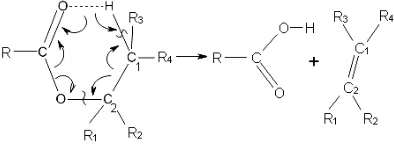
The esters decompose as a rule by purely molecular mechanisms with some exceptions for primary esters, which demand that a concurrent chain reaction be sup-pressed by inhibitors for this. For the unimolecular process, the six-centered transition state is commonly accepted:
Inside the transition state ring, a very significant vi-brational energy redistribution takes place. The strength-ening bonds C-O and C1-C2 and the forming O-H bond
transfer their released energy to the C1-H and C2-O
bonds that are being broken (the energy flow is indicated in the scheme by arrows). In the acid part of the ring, the simple C-O and the double C=O bonds exchange places. This is related to the energy exchange between them. This affects the other bonds of the transition state ring to only a moderate extent. The breaking of the bonds (C1-H
and C2-O) takes place in the alcohol part of the ring. For
this reason alone it is possible to assume that the mo-lecular structure of the alcohol part of an ester influences the ester’s decomposition more significantly than the structure of the acid part (see below).
All the energy released at the conversion of the simple C1-C2 bond into the double C1=C2 bond (~60 kcal/mol)
and the O-H bond formation (~100 kcal/mol) passes through the carbon atoms C1 and C2 on the bonds that
are being broken, C1-H and C2-O. In the framework of
the effect considered here, the branching at these carbon atoms C1 and C2 must have a significant influence on
this passage, hampering it. For example, the split of the sole energy flow through the C1 carbon atoms in the
di-rection of the side chains, R3 and R4 (see scheme)
re-duces the energy entering on the bonds that are being broken in the ring, C1-H. A similar situation exists with
regard to the C2 carbon atom and the branching into the
R1 and R2 side chains. In other words, the reduction in
the alkyl substituent’s numbers around the double C1=C2
bond in the reaction product accelerates the production of this product from the viewpoint of the effect being considered here. In such a manner, the effect explains the well-known Hofmann rule of which this is a special case. Robinson and Holbrook [8] formulate this rule: “For esters which are capable of decomposing in differ-ent ways, the predominant direction of elimination is given by the Hofmann rule, i.e., the favored olefinic product is that bearing the fewest alkyl substituents around the double bond.” The influence of the usual steric effect is also possible in this case.
[image:11.595.73.270.650.725.2]The correlation picture of the esters’ decomposition in the coordinates logA ~ E is split into three almost paral-lel separate lines depending on the molecular structure of the alcohol part of the molecule where the bond breaking is taking place. The deviation from the correlation lines is moderate, whereas the difference between them is very significant, and it shows the very significant influ-ence of the structure of the alcohol part of a molecule,
Figure 2. The correlation between high-pressure Arrhenius parameters for the pyrolyses of the esters, to give olefins and carboxylic acids. Designation: - - continuous-chain alcohols; - - isopropyl alcohols ; - - branched-chain alcohols (at the tertiary carbon atom); - - cycloalkane alcohols; -- aromatic alcohols; - - t-butyl chloroacetates. 1-propyl formate (9.4; 39.7). 2. ethyltrimethylacetate (11.2; 44.0). 3. ethyl formate (11.3; 44.1). 4. ethyl acetate (11.6; 44.0). 4. ethyl acetate (12.5; 47.8). 5. ethyl propionate (12.7; 48.5). 6. ethyl-d5 acetate (12.7; 49.5). 7. isopropul acetate (12.1; 42.9). 8. isopropyl formate (12.4; 44.2). 8. isopropyl formate (12.6; 44.0). 9. isopropyl trimethylacetate (12.9; 44.8). 7. isopropyl acetate (12.9; 46.1). 7. isopropyl acetate (13.0; 45.0). 10. sec-butylacetate (13.3; 46.6). 7. isopropylacetate (13.4; 46.3). 11. t-butyl formate (11.1; 34.6). 12. t-butyl propionate (12.8; 39.2). 12. t-butyl acetate (13.3; 40.5). 14. t-amyl acetate (13.4; 40.3). 13. t-butyl acetate (13.5; 42.1). 15. cyclopentyl acetate (12.9; 44.1). 16. cyclopen- tyl acetate (12.6; 45.2). 17. 1.2 diphenylethyl acetate (13.0; 42.3). 18. t-butyl chloroacetate (13.1; 38.1). 19. t-butyl di-chloroacetate (12.8; 36.1). The first figure in the brackets is logA, the second one is E kcal/mol.
A-factors from all three groups. The alcohols with minimum branching of the carbon chain (at the secon-dary carbon atom) are found on a somewhat higher level of A-factors, line CD.
The maximally branched alcohols (tertiary carbon atom) are found in the highest position along the logA axis, with average logA values for 3.2 units higher than the continuous-chain alcohols - line EF (Figure 2).
So clear a split of the common correlation line into a few separated, clearly distinguished groups, depending on some parameters, appears quite seldom and testifies to the distinct influence of these parameters. These data are in the very good agreement with the effect being considered here. As indicated in the Introduction, the branching disperses the energy fluctuation into different ways and hampers its concentration on the bond that is being broken. This increases the energy remaining on a molecule at the moment of breaking, i.e., increases the A-factor and the energy, which is necessary for the
mo-lecule’s energization (E).
It is possible, very roughly, to estimate the energy amount remaining on the branched groups, based on these data. The tertiary branching increases logA for 3.2 units, i.e., 3.2 × 2.3RT = 7.36RT kcal/mol energy, which remains on this branched group. If we assume the main model of tertiary branching the t-butyl group (four carbon atoms, 12 degrees of freedom), then each degree of freedom of such very strong branching detains 7.36/12 = ~0.6RT additional energy. No account has been taken in this calculation of the contribution of the C-H bonds, which have very different parameters (fre-quencies and strengths) from the C-C and C-O bonds. The average energy amount remaining on the secondary carbon atom branching can also be evaluated in a similar way. The propyl group may be taken as a main model of this branching (3 carbon atoms, 9 degrees of freedom). This branching increases the average logA value for 1 units (Figure 2), i.e., the remaining energy for 2.3RT or ~0.25 RT for each degree of freedom. This is signifi-cantly less than the stronger tertiary branching.
It is quite clear that the hydrogen atom and C-H bonds contribute somewhat to additional energy retention on a molecule at the moment of breaking. For this reason, the deutering, which to some extent brings together C-H and C-C bonds’ properties, according to the considered ef-fect, has to make some contribution to the A-factor’s increase. The deutered ethyl-d5 acetate (6) really has
some more A-factor than the initial one (4) and lies therefore on the highest part of the correlation line (AB) for continuous chain alcohols. A similar situation per-tains to deutered cyclobutane (see above).
A few additional esters are presented in the graph for comparison with their three main types (esters of pri-mary, secondary and tertiary alcohols). The esters of cyclo alkanes, cyclopentyl and cyclohexyl acetates (15,16) are found practically on the correlation line CD of the sec-ondary alcohol esters. The ester of the aromatic alcohol- 1,2-diphenyl ethylacetate (17) - is found a bit nearer to the more branched tertiary alcohol esters. This can serve as a hint that the rings of cycloalkanes and aromatic compounds, containing bonds that are similar or almost similar to branched alkanes, refer also to some type of fluctuation trap and detain on these bonds part of the energy necessary for bond breaking. This of course mer-its more detailed consideration here (see below).
same point. A similar situation exists for isopropyl for-mate (8) and isopropropyl trimethylacetate (9), where alcohol residua are the same (isopropyl), but acid ones are very different by the branching rate. They also have close A-factor values and lie on the same correlation line CD.
Even the very significant change of the acid residuum is connected to only a moderate deviation from the cor-relation line, corresponding to the same alcohol part of esters. The Arrhenius parameters of t-butyl chloroace-tates (18, 19) lie not far from correlation line EF of the t-butyl esters that are not chlorinated. These deviations from the EF line are significantly less than the difference between the lines depending on the structure of the al-cohol parts (AB, CD and EF).
In such a manner, the presence of the carboxyl group between two alkane chains hampers the fluctuation en-ergy passing from the one carbon chain to the other, i.e., from the fluctuation trap (isopropyl, t-butyl groups) in the acid part to the bond that is being broken in the al-cohol part of a molecule. This reduces the efficiency of the fluctuation trap, i.e., its ability to increase both Ar-rhenius parameters. It is indicated in the Introduction that the presence between two carbon chains of the bonds and atoms whose properties (frequencies, strengths, atomic masses) are significantly different from carbon- carbon bonds must lead to such results.
The proportionality coefficient “b” between logA and E, i.e., the slope of the correlation lines AB, CD and EF in Figure 2 equal 0.37. This generally corresponds to the temperature diapason for esters pyrolyses (500 - 800˚K) according to estimation b = 1/2.3 RT.
The reported data dispersion of energy activation (E) and A-factor (A) by different authors is, as a rule, much bigger than their rate constant data. Therefore, between the results of different authors for A and E values of the same reaction, there exists, as a rule, a more or less lin-ear correlation, approximately preserving a similar rate constant value. This correlation is quite near to those that are stipulated by the effect being considered. For exam-ple, all the four points of indicated data of the different authors for pyrolyses isopropyl acetate (7) are near to the correlation line CD for other derivatives with the iso-propyl group (Figure 2).
The experimental data presented on Graph 2 are quite consistent with the body of conclusions about the effect being considered mentioned in the Introduction:
1) The influence of the carbon chain branching on the increase of both Arrhenius parameters for unimolecular reaction in the high-pressure region;
2) The increase in this influence with the increase in the branching rate;
3) The known Hofmann rule finds its substantiation in
the considered effect;
4) The influence of a heteroatom in a carbon chain between a branching and a bond that is being broken;
5) The linear character of the correlation line for a de-rivatives system in the coordinates logA ~ E.
2.7. The Benzene Ring as a Fluctuation Trap
The dynamics of intramolecular energy flow in the benzene ring is being studied very widely by the method of collision-induced relaxation of vibrationally excited molecules (at least many tens of articles). Therefore, there are enough data to look at this problem from the viewpoint that is interesting to us. The toluene molecule is a particularly attractive one to study because of the presence of both a benzene ring and a side chain. Most authors study the collision-induced dynamics of highly vibrationally excited toluene interacting with argon, us-ing quasiclassical trajectory calculation [1,5] with the reproduced model Figure 1. Either CHmethyl or CHring has
been set at its high-energy state (as a rule, a little bit be-low its dissociation threshold), while all other vibrational modes are in their ground state.
It is found [5] that the interaction near θ = 77˚ (Figure 3(b)) plays a dominant role in promoting energy loss through intramolecular energy redistribution, because it is connected with energy transfer by bend mode through the most flexible C-C-Hmethyl region. The smaller and
greater angles lead to significantly less energy loss, be-cause the attack of the incident atom in these cases is directed to the much more rigid corners of the benzene ring and not to the side chain. The reverse situation, i.e., the excitation of the bend mode of the side chain region from the vibrational energy of the rigid benzene ring, seems significantly less probable. This is consistent with the well-known experimental fact that the highly excited benzene derivatives, which have side chains, show a much greater tendency to transfer their vibrational en-ergy to translation than the highly excited benzene does (up to ten times as much).
The main conclusion to be drawn from these studies [1,5] is that the relaxation process is dominated by the energy flow from the side chain (methyl group) to the benzene ring, but not in the opposite direction. The au-thors [5] write: “We do not find any evidence of energy flowing out of C-Hring and returning to C-Hmethyl. That is,
energy flows irreversibly out of the initially excited C-Hmethyl vibration and deposits in the C-Hring after
pass-ing through two stretchpass-ing and three bendpass-ing modes” (page 4864). These two notions: “irreversibility” and “vibrational energy deposit” are exactly the key concepts of the considered effect.
(a)
(b)
bonds, and the angles between them and their surround- ing; the flat hexedron right form; and the identical mass distribution (six identical carbon atoms). All these prop-erties are conditions for practically free fluctuation en-ergy movement inside the ring, whereas their exit from the ring is very hampered, because of the demands of the side-chain bend mode excitation. At the same time, a side chain of aromatic compounds has the bond (β), which is very much weakened in comparison with the neighbouring one () as result of the I-effects of the benzene ring (about 63 against 90 kcal/mol).
This bond (β) is broken in most bond fission reactions. The nearness of a weak bond, which mobilizes sur-rounding energy, must reduce the role of the benzene ring as a contrary factor.
These investigations [1,5] also give valuable
informa-tion about the C-H bond influence on the processes of concentration and dispersion of vibrational energy in the system of C-C bonds. The highly excited C-Hmethyl bond
of toluene makes at least 15 vibrations before the colli-sion with the Ar atom and ~30 after it, without any vis-ual indications of this high energy transfer to neighbour-ing C-C bonds, which have significantly less vibrational energy, because they vibrate in their ground state [1,
Figure 2(a), page 1225]. This is so even in spite of the fact that the excited C-H bond in this case is in its an-harmonic region and therefore vibrates at a lower fre-quency (484 cm–1) than the neighbouring C-C bonds
(1208 and 1494 cm–1), which are in their ground state. A
similar situation is described in [5]. 5, page 4863, Figure 5. The main role here is played, of course, by the mass difference between carbon and hydrogen atom. It should be noted that the highly excited C-C bond transfers its energy to surrounding C-C bonds practically during a few vibrations.
The vibrational energy from the excited stretch mode of the C-Hmethyl bond transfers to the C-Hring through two
stretch modes of C-C bonds and deposits on this C-Hring
bond to a greater extent than on these two intermediate C-C bonds [1, Figure 2(b), (c), page 1225].
These data, which are interesting for our consideration, have been taken directly from the corresponding graphs because the authors of these papers [1-5] discuss in the text other aspects of these calculations in which they were interested. All these data mean that the interaction between C-H and C-C bonds is significantly lower than between C-C themselves and C-H themselves. It can be loosely said that the vibrational energy movement inside a molecule takes place through the system of C-H bonds and the system of C-C bonds to some extent independ-ently. This statement is significantly more right for the system of C-C bonds. The energy movement along C-H bonds fades much more quickly, because it must pass through C-C bonds with very different properties.
The main conclusion is that the identical bonds of the benzene ring constitute a very effective fluctuation trap, which disperses energy fluctuation and impedes its con-centration on the individual bond of the ring or the side chain.
The second conclusion is that the interaction between C-C and C-H bonds systems is much weaker than the interaction inside the system of the C-C bonds and be-tween the C-C bonds themselves.
It is of interest to compare the kinetic parameters of α
[image:14.595.60.280.73.452.2]contrary influences: the mobilization of the internal en-ergy of a molecule by this weak β-bond for its breaking, and, in contrast, the detention of a part of this energy by the benzene ring. Unfortunately, the α-bond fission in the hydrocarbon benzene derivatives with the availabil-ity of the β-bond is almost impossible. In this case, the weak β-bond is practically always broken. There are, however, quite reliable data for an α-bond fission in the benzene derivatives containing a heteroatom. It is also of interest because the benzene ring properties as a fluctua-tion trap have to be quite manifest in this case also.
2.8. The β-Bond Fission
The β-bond fission can be considered in the example of the thermal unimolecular decomposition of ethylben-zene, isopropylbenethylben-zene, and tert-butylbenzene [14]:
logA = 15.3; E = 72.7 kcal/mol; T = 1053 - 1234˚K
logA = 15.8; E = 71.3 kcal/mol; T = 971 - 1151˚K
logA = 15.9; E = 69.1 kal/mol; T = 929 - 1157˚K
These reactions have been studied using the very low-pressure pyrolysis (VLPP) technique under com-parative conditions. Each reactant is decomposed by
β-bond homolysis, producing methyl radicals and benzyl or benzylic type radicals.
The tendency of the A-factor to increase in passing from the ethyl to the t-butyl group is undoubtedly con-nected with the growth of the branching rate in this row. This regularity was already mentioned in particular for the esters pyrolyses and will be discussed further. Here the transfer from strongly branched t-butyl to the con-tinuous chain of the ethyl group reduces the logarithm of A-factor to 0.6 units only, whereas a similar transfer for esters pyrolyses lowers this value to 3.2 units. This might quite easily be a consequence of the fluctuation trap influence produced by the benzene ring, which does not allow the reduction of A-factor. That is, the influ-ences of the strongly branched t-butyl group and the benzene ring are quite commensurable and opposed.
The conclusion: The growth of the demobilization factor (dispersion rate of the fluctuation) occurs together
with the increased number of identical bonds in the branching (branching rate).
2.9. The α-Bond Fission
The α-bond fission can be considered in the example of the unimolecular decomposition of nitrosobenzene with phyenyl radical production [15].
The rate constant was measured at temperatures be-tween 553 and 648˚K at atmospheric pressure and a strong dilution with argon. This leads to minor secon-dary processes and a reliable measurement of the h ig h- pressure first-order rate constant for the primary nitro-sobenzene decay. The result of the experiments may be presented as energy activation 55.06 ± 1.08 kcal/mol, which is higher by as much as 6 kcal/mol than those reported earlier, and a logarithm A-factor of 17.15 units. Such a high A-factor value indicates essential vibrational energy dispersion inside the molecule, i.e., the presence of an effective fluctuation trap, a role which, in this case, may be played only by the benzene ring.
The C-N bond that is being broken lies in the same plain as the benzene ring, and forms identical angles (~120˚) with both ring bonds. All this must promote the energy exchange between the C-N bond and the benzene ring and increase the efficiency of the benzene ring as a fluctuation trap in relation to this bond. The absolutely symmetrical phenyl radical is produced in the process of the nitrosobenzene decay, which may be a main factor in the vibrational energy dispersion inside its identical bonds (see below). This may probably justify the high A-factor value, in spite of the weak bond breaking, and confirm the high level of efficiency of the benzene ring as a fluctuation trap. This is consistent with the previous example. At the same time, all these preliminary results need more experimental confirmation.
2.10. The Fluorescence Spectra of Benzine Derivatives


![Figure 2(a), page 1225]. This is so even in spite of the](https://thumb-us.123doks.com/thumbv2/123dok_us/9085329.405336/14.595.60.280.73.452/figure-page-spite.webp)
