ABSTRACTIONS IN
DATA BASE SYSTEM ARCHITECTURE
A thesis
presented for the Degree of
Doctor of Philosophy in Computer Science in the
University of Canterbury by
M.M. Ridwan
PHYSICAL SCIENCES LIBRARY
For Ceri Bryant who has endured. Untuk Ibuku yang telah lama menunggu.
ACKNOWLEDGEMENTS
Sincere thanks are due to Dr Zen Loy, for his advice, guidance
and encouragement through the greater part of this research project. ii
I wish to express thanks also to Dr R.E.M. Cooper, who assumed
the role of supervisor during the earlier stages, and to M. Naguleswaran
for her part in the programming.
Finally, I am indebted to Ceri Bryant, who has kept me in touch
with the real world.
The financial assistance received from the University Grants
ABSTRACT
Levels of abstraction in data base system architecture are investigated. A diagrammatic representation of abstract machines in a data base system is presented.
i i i
Two major levels in a coexistence architecture: the data base modelling and data base model support levels, are considered in detail. A comprehensive treatment of abstractions in data base modelling is made and a new model, DATAM, is presented. Also presented is PRIMDAS, a primitive data structure interface for generalized model support.
INDEX OF TERMS AND ABBREVIATIONS
The section given is that at which the term or abbreviation is
introduced.
abstract model
access • • . • •
advanced system
alternative model
alternative view
architecture
associationa1 access
associations of containment
attribute association
basic system
coexistence
common link association community model
community view
composite attribute
concat
conceptual dynamics
conceptual spectrum
conceptual view
consolidation .
currency indicators
cursor
data base model
data base setting
.
..
Section
2.4.1.1 5.2.3.1 3.5.6 2.3.3.1 2.3.3.1 2.1 5.2.3.4 3.3.8 3.3.4 3.5.3 2.1 5.2.3.4 2.3.3.1 2.2.2 3.3.9 6.3.3.3.6 3.2.2 3.5.1 2.2.1.1 4.6.3 6.4.2.2.1 5.2.3.3 2.3.1 5.3.3.3.4
data model data pools
data sublanguage db- (data base) . dependency event
dependency relationship dependent entity
direct association EA-table
enterprise view eov (cursor) event . . . .
evolutionary operator evolutionary system Ev-table
excess entities fact
factored attribute factorization . . . fact representation generalized constructs global deletion
global entry identifier
.
. .
.
.
.
... .
implementation base implied access
indirect association instance set
intermediate system . . .
interval (cardinality) of mapping inverted table structure
IS-ONE-OF association level of abstraction link entries
link structure local deletion local entry marking mark set modification navigation
navigational interface n-way event . . . . . object representation PART-OF association predicate representation primitive system
procedural semantics progression .
range set regression role
role factored objects R-table
schema
schema handling
schema structure
semantic reference
stored schema
sub-attribute
sub-entity
sub-range set
sub-schema
subview
super-range set
temporal system
token
unnamed cursor
value set
v/m set
*
'
.
. .
.
.
vii
Section
TABLE OF CONTENTS
Acknowledgements Abstract
Index
CHAPTER 1: INTRODUCTION 1.1 Data base modelling 1.2 Data base model support
CHAPTER 2: DATA BASE ARCHITECTURE 2.1 Introduction
2.2 Hierarchies of abstract machines 2.2.1 Levels of data representation
2.2.1.1 Four levels of abstraction 2.2.1.2 Other approaches
2.2.1.3 The nature of the independence 2.2.1.4 General criteria
2.2.2 Levels of data perception 2.2.3 Levels of data base languages
viii
Page
ii i i i iv 1 2 4 6 6 8 8 8 9 10 11 12 14
2.2.3.1 Language components 14
2.2.3.2 Relationship to levels of data representation 15
2.2.3.3 Diagrammatic convention 16
2.3 The support of multiple models
2.3.1 Introduction
2.3.2 Multiple model support 2.3.3 Coexistence
2.3.3.1 Community model 2.3.3.2 Schema
2.3.3.3 Construction of alternative perceptions 2.3.3.4 Alternative model support
2.3.3.5 Transformations in alternative view construction
2.3.3.6 View dependencies 2.4 Two major levels of abstraction
2.4.1 Community models
2.4.1.1 Data models and abstract models 2.4.1.2 Criteria for abstract models
2.4.2 Implementation bases
2.5 Description of data base system architectures 2.5.1
2.5.2 2.5.3 Figures
Diagrammatic representations An illustration
Examples
CHAPTER 3: ABSTRACT MODELLING OF AN ENTERPRISE 3.1 Introduction
3.2 Representation of the real world 3.2.1 Representation of facts
3.2.2
3.2.1.1 Predicate and object representations 3.2.1.2 Binary relational object representation Representation of conceptual dynamics
3.3 Concept abstractions of reality 3.3.1 Introduction
3.4 3.3.2 3.3.3 3.3.4 3.3.5 3.3.6 3.3.7 3.3.8 3.3.9 3.3.10 Entity Attribute Relationship Event
Dependent object
Cardinality of association IS-A association
Composite attribute Procedural semantics
3.3.10.1 Membership assertions
3.3.10.2 Construction of derived objects 3.3.10.3 Associational semantics
3.3.10.4 Time dependence 3.3.10.5 Discussion Value abstraction
3.4.1
3.4.2
The instances of abstractions 3.4.1.1 Instance set
3.4.1.2 Range set 3 . 4. 1. 3 Token
3.4.1.4 Identifiers
The representation of dependent objects
3.4.3 Instance dependencies
3.4.3.1 Attribute-object dependencies 3.4.3.2 Composite attribute instances 3.4.3.3 IS-A instances
3.4.3.3.1 Sub~object dependencies 3.4.3.3.2 Sub-attribute dependencies 3.5 Conceptual spectrum of data base models
3.5.1 Introduction 3.5.2 Primitive systems 3.5.3 Basic systems
3.5.4 Intermediate systems 3.5.5 Evolutionary systems 3.5.6 Further systems
3.5.7 Existing data base approaches Figures
CHAPTER 4: DATAM - A DATA ABSTRACTION MODEL 4.1 Introduction
4.2 Specifications of DATAM
4.2.1 DATAM IS-A representation 4.2.2 DATAM attributes
4.2.3 DATAM events 4.3 Illustrative examples
4.3.1 Example 1 4.3.2 Example 2
4.4 Transformation examples
4.5
4.6
4.4.1 Binary relational model
4.4.2 Entity-relationship (ER) model 4.4.3 Aggregation/generalisation diagram Subviews of the abstract model
4.5.1 Subviews of DATAM models 4.5.2 Subviews with entities 4.5.3 Subviews with attributes 4.5.4 Subviews with relationships 4.5.5 Subviews with events
Evolution of the abstract model 4.6.1 Evolution of DATAM models 4.6.2 Entry and exit·of objects
4.6.3 Factorization and consolidation of object types
4.6.3.1 Independent objects
4.6.3.2 Role factored sub-objects
4.6.3.3 General sub-objects
4.6.3.4 Composition o~ instances
4.6.3.5 n-way events
4. 6. 4 Transformation of abstraction ·types
4.6.4.1 Attribute+ entity
4.6.4.2 Entity+ event
4.6.4.3 Relationship+ event
4.6.4.4 Dependent entity+ regular entity
4.6.5 Modification operations
xi Page 116 116 116 117 117 118 118 119 120 120 121 121 4.6.5.1 Change of range attributes 122
4.6.5.2 Change of object names 122
4.6.5.3 Change of mapping cardinalities 122 4.6.5.4 Change of ordering in instance composition 122 4.7 Evolution and subviewing
4.8 Analysis of data models
4.8.1 DATAM as a .semantic reference
4.8.2 A representation of DATAM instances
4.8.3
4.8.4
4.8.2.1 EA-table type
4.8.2.2 R-table type
4.8.2.3 Ev-table type
Analysis of the relational model
4.8.3.1 Descriptor types
4.8.3.2 Entity type
4.8.3.3 Event type
4.8.3.4 Multi valued dependency Analysis of the network model
4.8.4.1 Entity-attribute associations
4.8.4.2 Relationship type
4.8.4.3 Event type
4.8.5 Correspondence of data models
Figures
4.8.5.1 Relational to network transformation
4.8.5.2 Network to relational transformation
CHAPTER 5: PRIMDAS - A PRIMITIVE DATA STRUCTURE INTERFACE FOR GENERALIZED MODEL SUPPORT 5.1 Introduction
5.2 Considerations of a primitive data structure interface 5.2.1 Introduction
5.2.2 Influence of conceptual data associations 5.2.2.1 Data associations
5.2.2.2 Associational structures 5.2.2.3 Inverted table structure 5.2.3 Form of the data sublanguage
5.2.3.1 Procedural approach 5.2.3.2 Marking
5.2.3.3 Navigation
5.2.3.4 Associational access 5.2.4 Representation of consistency
5.3 PRIMDAS - a primitive data structure interface 5.3.1 Introduction
5.3.2 PRIMDAS structural objects 5.3.2.1 Value sets
5.3.2.2 Link structures 5.3.2.3 Mark sets
5.3:3 PRIMDAS operators 5.3.3.1 I~troduction
5.3.3.2 Navigational facilities 5.3.3.3 Associational access
5.3.3.3.1 ASSOC operator 5.3.3.3.2 AT operator
5.3 .. 3.3.3 Multiple associations 5.3.3.3.4 Data base setting
xii Page 146 146 147 147 147 147 148 149 150 150 151 153 154 155 156 156 157 157 159 160 161 161 162 163 164 165 166 166 5.3.3.4 Specification of indirect association 166 5.3.3.5 Specification of direct association 168 5.3.3.6 Specification of common link association 169
5.3.3.7 Data manipulation 170
5.3.3.8 Subsetting operators 172
5.3.3.9 Inter-value set navigation 173
5.3.3.10 Structural operators 5.3.4 PRIMDAS consistency considerations
5.3.4.1 Consistency of mark sets
xiii
Page
5.3.4.2 Consistency of links Figures
178 180
CHAPTER 6: REPRESENTATION OF DATA BASE MODELS WITH PRIMDAS 184
184 184 184 186 187 188 188 188 189 190 190 190 191 192 6.1 6.2 6.3 Introduction
Model development tool
6.2.1 Primitive data base system 6.2.2 The role of PRIMDAS
6.2.3 Multi-level schema handling Representation of data base models
6.3.1 Introduction
6.3.2 Representation of data objects and associations 6.3.2.1 Entity-attribute associations
6.3.2.2 Relationships 6.3.2.3 Events
6.3.2.4 Other DATAM concepts
6.3.3 Representation of data manipulation operations 6.3.3.1 Access of related items
6.3.3.1.1 Entity to attribute access 192
6.3.3.2
6.3.3.1.2 Attribute to entity access 193
6.3.3.1.3 Access through a relationship 193
6.3.3.1.4 Implied access through
a relationship 194
6.3.3.1.5 Access through many relationships 194 6.3.3.1.6 Access through involvement
in an event
6.3.3.1.7 Access of event from member objects
Entry and exit of DATAM objects
6.3.3.2.1 Entry and exit of attribute 6.3.3.2.2 Entry and exit of entity
6.3.3.2.3 Entry and exit of relationship 6.3.3.2.4 Entry and exit of event
More complex operations
6.3.3.3.1 Retrieval of instances with values in a given range 6.3.3.3.2 Retrieval of all instances
of an attribute-type
6.3.3.3.3 Deletion of all relationships of an entity
195
201
201
6.3.3.3.4 Retrieval of multiple associations through event 6.3.3.3.5 Entry of new tokens
6.3.3.3.6 Retrieval of composite 6.3.3.3.7 Access of a dependent 6.3.4 Representation of subvtews and evolution
6.3.4.1 Attribute+ entity 6.3.4.2 Entity+ event
6.3.4.3 Relationship + event
6.3.4.4 Dependent entity+ regular entity 6.4 The role of PRIMDAS in coexistence
6.4.1 PRIMDAS as an implementation base 6.4.2 A network view of a DATAM data base
6.4.2.1 Structural correspondence 6.4.2.2 Network access
attribute entity xiv Page 202 203 204 205 206 207 209 210 211 212 212 213 213 214
6.4.2.2.1 Currency indicators 215
6.4.2.2.2 FIND record-type USING key 217
6.4.2.2.3 FIND NEXT record-type OF set-type 217
6.4.2.2.4 FIND OWNER RECORD of set-type 218
6.4.2.2.5 FIND OWNER IN set-type 1 OF CURRENT OF set-type 2 6.4.3 Relational view of a DATAM data base
6.4.3.1 Structural correspondence 6.4.3.2 Relational access
219 219 219 220
6.4.3.2.1 Tuple access 220
6.4.3.2.2 Alternative representations 222
6.4.3.2.3 Direct representation example 223
Figures 224
CHAPTER 7: AN EXAMPLE -DATA BASE MODEL AND DATA BASE CONSTRUCTION
7.1 Introduction
7.2 Schema structures on PRIMDAS 7.2.1 PRIMDAS schema structure 7.2.2 DATAM schema structure 7.3 DATAM construction
7.3.1 Range procedures 7.3.2 Create procedures
7.3.2.1 Entity construction
7.3.2.2 Sub-entity construction 7.3.2.3 Attribute construction 7.3.3 Enter procedures
7.3.4 Exit procedures 7.3.5 Retrieval procedures
7.4 Enterprise model construction on DATAM 7.4.1 Enterprise model construction 7.4.2 Data entry
7.4.3 Data base manipulation 7.5 Evolution procedures
7.5.1 Attribute+ entity 7.5.2 Relationship+ event 7.6 Alternative view
7.6.1 Support of subviews 7.6.2 Network view
Figures
CHAPTER 8: CONCLUSION AND SUGGESTIONS FOR FURTHER RESEARCH 8.1 Conclusion
8.2 Suggestions for further research
APPENDICES
A. A PRIMDAS interface B. DATAM schema structure C. DATAM operators
REFERENCES
XV
Page
237 237 239 241 243 244 244 245 246 247 248 249 251 251 252 254
265 265 267
269 280 283
CHAPTER 1
INTRODUCTION
The importance of data base systems is reflected in the intensive research currently being carried out in data base theory and data base support. This thesis represents a further contribution to the study and construction of data base systems.
Of major concern in the data base field is the structure
or framework with respect to which data base systems are constructed. As early as the 1960's (File 68 [1969], see Fry and Sibley [1976] for an historical perspective) considerations of optimization, data independence and software engineering in general have highlighted the need for multi-level data base systems. Study in data base system structuring has gathered momentum, gaining widespread recognition with the publishing of the ANSI/SPARC report in 1975 (ANSI/X3/SPARC [1975]). This , which presents an architecture for data base systems, has since been used as the frame of reference for various refinements to the state-of-the-art (e.g. Bracchi et al. [1976], Klug and Tsichritzis
[1977], Senko [l976b]). These studies have described how particular data base system functions can benefit from a multi-level approach.
1
2
systems can be described.
The main impetus in the drive to more formalized data base system structuring arises from the need for individual systems to be able to support different data base models. This multiple model support is termed coexistence (Nijssen [1976a]). Such coexistence is seen as a compromise, where, in the final analysis, the choice of a data base model may be a matter of individual preference. In coexistence, two levels of abstraction in the architecture become significant. One is the level at which the real world is described to the data base and the other the level at which different data base models are to be supported.
1.1 DATA BASE MODELLING
At the data base modelling level, the primary consideration
concerns the choice of a community model. The community model of a data base is the data base model with respect to which the meaning of the data base and any of its subviews are determined.
Recently (e.g. Nijssen [1976b, l977c]), a number of data base models have been proposed as community models. Their differences lie in the concepts and the manner in which concepts of the real world are modelled. For some of these models, attempts have been made to expose and classify their similarities and differences (Kerschberg et al.
[1976], Biller and Neuhold [1977]). No definitive conclusions have been arrived at and the question of the best model remains open.
As such, new points of view and new data base models can still be seen as contributions to this area.
Any further proposals, however, need to be based on the consolidation of existing approaches. A new approach is required, since classifications evident in the literature (Kerschberg et al.
3
introduction of further models and by the isolation of further data constructs (for example, those surveyed by Wong and Mylopoulos [1977]). Also, conceptual frameworks proposed in the literature (e.g. Smith and Smith [1977a, l977b], Biller and Neuhold [1978]) have taken the approach of reducing abstract concepts to a few primitives which are to form the associational base of any real world modelling. This approach, although important, neglects the development of higher level abstractions of real world perception.
These more specific abstractions reflect the level of interest of the objects modelled, and of the particular form of associations perceived between them. Since such abstractions determine the
behaviour of the data base, i t is important that they are formalized, with their interaction and consequences completely specified.
Toward providing this consolidation and formalism, Chapter 3 presents a comprehensive treatment of abstractions of real world data modelling. Abstractions are introduced and defined within a single framework, thus providing a unifying treatment of concepts hitherto presented under varying conventions.
It is noted that in practical terms, i t may not be desirable that all data base systems should support all possible abstractions. Instead, i t would be more expedient to provide a range of systems supporting data base models of varying degrees of conceptual
complexity and power. The capability of a system in modelling the real world is determined by the constructs that i t provides. This is the basis of the data base spectrum presented in Chapter 3.
Currently lacking in the literature is a data base model which falls into the evolutionary category of this conceptual
changes to be effected on the data base. Chapter 4 presents an evolutionary model based on the discussion of Chapter 3. The relationships of this model, called DATAM - Data Abstraction Model, to more traditional models are described. Also, the evolutionary operators which complem~nt the model are given.
1.2 DATA BASE MODEL SUPPORT
4
Another level of abstraction that is significant in a coexistence architecture is that at which the data base models are to be supported.
Traditionally, a data base system is constructed around the data base model the system is meant to support. That is, the system is dedicated to a single model, so that support of any further models has to be done on that model's interface. Such high level support is
typically cumbersome and prone to inefficiency. To avoid this, a lower level interface is required which is designed not for a specific model but allows ease in the support of different models.
With the current emphasis on data base modelling, this area of data base model support has so far received relatively little attention. Three systems which do consider the actual support of multiple models are System-R (Astrahan et al. [1976]), DIAM (Senko [1976b]) and LSL
(Klug and Tsichritzis [1977]). The DIAM system provides a STRING model which interfaces the storage structuring facilities. This approach, however, involves access path specification and is oriented towards optimization rather than the representation of logical associations.
traditional models: hierarchical, network and relational. Also, the interfaces are provided as high level facilities, therefore biasing the form of the interfaces that can be constructed easily on i t .
To cater for a wider range of models and interfaces to these models, a more flexible support facility is required. This can be provided by a lower level interface containing generalized data structure constructs. PRIMDAS (Primitive Data Structure), described in Chapter 5, is such a facility.
PRIMDAS acts as a primitive data base system, and is used as the base machine in developing data base model interfaces. PRIMDAS is offered as a procedural constructional facility, on which
specificational systems such as LSL or formal mappings (Pelagatti
et al. [1977]) can be built. The roles of PRIMDAS in the support of
a data base model, specifically DATAM, and in coexistence, are described in Chapter 6.
A PRIMDAS system has been implemented on a Burroughs B6700. It takes the form of a data sublanguage consisting of procedure calls, embedded in Burrough's Extended Algol (Burroughs Corporation [1977]). Procedures constructed on this implementation to provide a primitive DATAM system are described in Chapter 7. This chapter also describes the construction of a small data base using the DATAM system.
Appendices describing particular features of the PRIMDAS interface in the current implementation, are included.
Chapter 8 presents conctusions and outlines possible directions for further work.
The architectural approach in Chapter 2 and the conceptual framework in Chapter 3 represent original work as do the DATAM and PRIMDAS models presented in Chapters 4 and 5. Chapters 6 and 7 present applications of these new concepts, and details of an actual
implementation are given in the Appendices.
CHAPTER 2
DATA BASE ARCHITECTURE
2.1 INTRODUCTION
As in other large systems, data base can be constructed
from independent but cooperating parts. For any system, its chosen
decomposition depends on the particular goals and objectives demanded
of the system (Ferrari [1971]).
In data base systems, the major objective is typically that of
"data independence" (Date and Hopewell [197la, 197lb], Bachman [1975],
Senko et al. [1973]), a term which encompasses a wide range of system
concerns (Engles [1970], Jardine [1973]). Regardless of the exact
nature of the independence required, it is obtained by appropriate
subdivision of the overall function and corresponding interfacing.
6
This buffering technique allows particular parts of the system to be
changed without impacting the rest of the system. It is these
inter-faces and their relationships which constitute the system's architecture.
An architecture is often presented as a of abstract
machines (Infotech [1977], Goos [1975]) existing at various levels.
The level of an abstract machine corresponds to its relative distance
from the base machine. Each such level of abstraction provides a
different perception of the data base (Palmer [1974]).
It is necessary to specify the role of these levels with
to the overall system function and in terms of the independence they
achieve. Subgoals at each level also need to be specified since they
The widespread adoption of the ANSI/SPARC guidelines (Nijssen [l976b, l977c]) suggests that there is agreement on the general specification and function of the levels in data base architectures. Therefore, i t is the subgoals or refinements which require further attention.
In the gross architecture of data base systems (Nijssen (l976a, l977a]), i t is possible to distinguish between three separate
hierarchies of abstract machines, each representing distinct functions. These are: the hierarchy of data representation levels, the hierarchy of levels of data perception and the hierarchy of data base languages. Their distinction allows subgoals to become more clearly defined. Sec. 2.2 examines architectural considerations of each hierarchy and the manner in which they interrelate.
In a coexistence architecture (Falkenberg [1977]) the dependence of a data base system to any particular data base model is avoided.
7
A distinction (not treated in the literature) is made in Sec. 2.3
between two forms of multiple model support. Their separate treatments provide insights into the criteria that they impose on the architecture.
In coexistence, two levels of abstraction emerge as significant: one is the level at which the semantic equivalence of data representations are determined and the other the level at which different data base
models are to be supported. General criteria for these levels are outlined in Sec. 2.4.
8
2.2 HIERARCHIES OF .ABSTRACT MACHINES
Levels in the representation of data arose from the original aim of data independence that of gaining independence from physical
storage considerations by the insertion of further layers of software between the application program and the physical data (Olle [1974b]). Application programs then no longer operate on storage representations, but rather on logical views of data. 'rhese logical views are data representations based on data structures independent of the storage structures on which they are implemented.
Further levels have been distinguished and proposed (e.g. Palmer [1974], Senko [1975], Chen [1976]) as distinct from the data as seen by the end-user to the data as represented on storage media. An end-user is a user that perceives data in the form available at the level furthest from the machine. Fig. 2.1 illustrates a hierarchy of levels of data representation. The data representation at each level, except for that at the lowest, is implemented on the one at the level below i t . Levels 2 and 3 are the storage and logical structuring levels described previously.
A recent development is to make the data with which the bulk of users are to interact appear more meaningful {Chen [1976]; Biller and Neuhold [1978], Cadiou [1976), Sundgren [1974]). This is done by representing the data in terms of objects which closely reflect data concepts of the real world. This level of abstraction is indicated as level 4 in Fig. 2.1. With the inclusion of a level to represent this conceptual view of data, the opportunity arises for alternative data structures to be provided for any such view (Sibley and Kerschberg
Closer to the machine - on the bottom of the hierarchy - a further refinement is made by providing independence from the
considerations of the various levels of physical storage (Senko et al.
[1973], Olle [l974b]). Here strategies for the representation of data on a single level store - i.e. main memory - is separated from those for the representation of data in secondary storage which typically would consist of many levels (Senko and Altman [1976] , Scarrott [1971], Rose and Gotterer [1973]). The two levels of abstraction required to represent this independence are shown in Fig. 2.1 as levels 2 and 1.
Functionally, this hierarchy of abstract machines represents the discrete steps in which a model of data of the real world is represented on the computer. There is no theoretical limit to the number of levels that could be inserted between the end-user and the machine, but in practical terms each further level represents a further degradation in performance.
2.2.1.2 Other approaches
Although terminologies differ, the perception of levels as found in the literature is essentially similar. Various approaches are
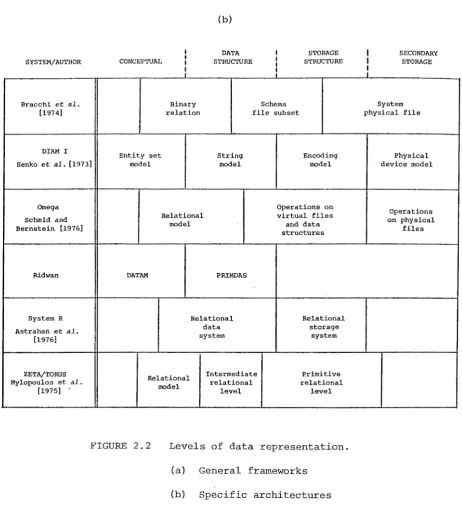
tabulated in Figs 2.2(a) and 2.2(b).
Each row of the figures represents the levels of data represent-ation proposed by a particular author or used in a particular system. Each row represents a progression from high level to low. The four levels described in this section are shown at the top of each table. The approximate correspondence of levels of a particular approach to those four levels is indicated by their positioning. Fig. 2.2(a) shows levels of data representation proposed as general frameworks, while Fig. 2.2(b) gives the levels of specific systems as described in the literature.
The figures show that there are fewer proposals in the lower data representation levels. This is not a reflection of the relative
10
importance of the levels, but of the current emphasis on conceptual
data modelling aspects. It is also seen that the four levels described
here correspond to the points of independence currently perceived as
warranted.
2.2.1.3 nature of the
This section considers the general form of the independence
inherent in hierarchies of data representation levels.
Each abstract machine is implemented on the one at the level
below it, so that a change in the abstract machine at a level may have
repercussions on that above it. Except for the top level, the interface
at each level typically cannot be independently modified. The only
independent change possible is that in extending an interface by the
addition of further structures or operators, perhaps as alternatives.
The major form of independence that is achieved is the freedom
in the implementation of an interface at a level on the one below it
(Senko et al. [1973], Frasson [1975], Hainaut [1977]). That is, an
abstract machine can be reimplemented without impacting the levels above
it. This is true only if no change is introduced in the abstract machine
in the process ..
The motivation for changing the implementation of an interface
is efficiency, while the limits to which it can be done are determined
by the flexibility of the interface on which it is implemented.
The discussion above concerns the dependencies of abstract
machines. It describes how objects and operators provided on one level
are dependent functionally on that of another. This is distinct from
the dependencies of the actual data which is perceived to exist at each
level.
The physical data exists only at the storage level, but each
level of abstraction imposes structures representing the interpretation
11 lower level represents a rephrasing of the data in a form closer to the machine. That is, the data perceived to exist at each level are
equivalent, since one can be derived from the other. This means that changes to the data at a level, e.g. deletions and additions, would have to be propagated to the data seen in other levels. Such changes are typically invoked at the top level representing a revision of the perception of the enterprise. A reimplementation of data, on the other hand, involves only a downward propagation. A reimplementation at a high level requires restructuring at lower levels (Navathe and Fry
[1976], Swartout et al. [1977]), but the form of restructuring on lower levels should insulate higher levels. For example, if the implementation of record-occurrences of the network model is changed from sequential to linked list storage structures, changes to the physical data may be required, but the record-occurrences the~selves are not altered.
That is, restructuring at a lower level occurs in two contexts: as a result of restructuring at another level or of reimplementation of a higher level.
2.2.1.4 General criteria
The distinctions above are made to clarify the nature of the independence that is achieved in the construction of levels in the
representation of data. Consequently, the goals and limitations of such a construction become more well-defined. The manner in which particular systems satisfy these goals can then be used as the basis for comparison.
The following are general criteria based on the exposition given in the previous subsections.
(1) Degree of independence of a level - This is determined by the
(2) Semantic accuracy of the topmost level in modelling real world concepts - Although measures of this are difficult to formulate, a general rule is that architectures whose topmost level is based on some form of data structure are less accurate than those whose topmost level consists of direct representations of real world data concepts.
12
(3) Flexibility of corresponding levels - This represents the degree
to which alternative abstract machines can be supported by a level.
(4) Efficiency of corresponding levels can also be considered - This
can only be done in specific situations, involving comparable approaches and information environment.
2.2.2 Levels of Data Perception
A large data base is typically shared by many users. In such a situation i t is often desirable to be able to define subsets of the data base for specific applications (Date and Hopewell [l97la] , CODASYL
[1971]). Reasons for this include simplicity and security (Swartout and Fry [1978]). The perception of the total data base, representing the model of the enterprise, is called the community view (Codd [1974]).
A subview is a subset of a given view.
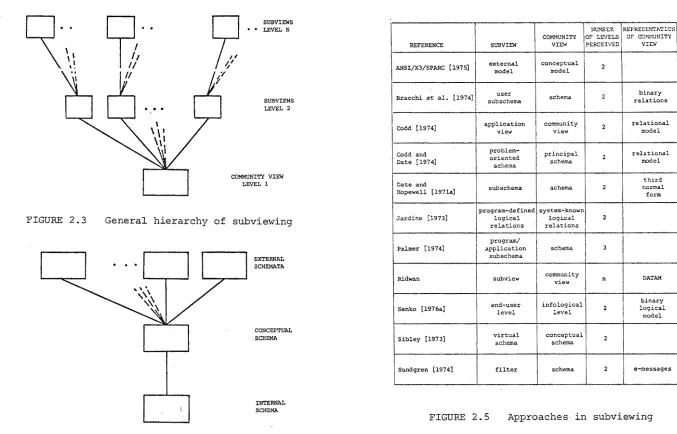
Although in practice subviewing is typically of only a single level, in concept there should be no restriction on the number of possible levels of subviewing. Therefore, in the general case, the hierarchy of levels in subviewing is as indicated in Fig. 2.3. Each view at a level (except the community view), represents a subview of a view on the level below. Therefore, along a branch in the hierarchy, there is a progressive loss of perception of the community view at each higher level.
One of the major objectives in subviewing is to insulate
instead. Two forms of independence are required of this interfacing. The first is the independence of subviews tobe able to remain static
13
in the face of any unrelated changes on the view on which i t is defined. The other subview independence is the freedom in the presentation of each view from that of any other. That is, i t should be possible for subviews to be available in a form not necessarily the same as that of the view on which i t is defined, so long as no extra information is introduced in the process.
This hierarchy of subview levels or levels of data perception is distinct from and independent of the hierarchy of levels in the representation of data (Sec. 2.2.1). As described in Sec. 2.2.1, the data contained in each data representation level are equivalent. Therefore, in principle, a view can be presented in terms of any data representation level, since functionally only the data content matters. In practice, however, the topmost data representation levels reflect the preferred ways in which to view data, so that all views and
especially community views are typically presented in the forms of these levels. Also, being closer to real world concepts, subviewing at these levels is easier to formulate.
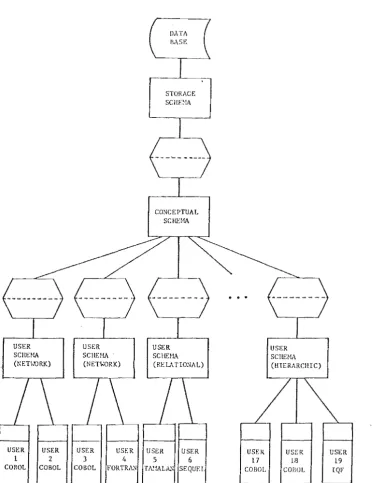
Nevertheless, architectural diagrams such as that in Fig. 2.4 are misleading, since they do not establish the independence of the concepts of representation and subviewing. It is not obvious that the lines joining external schemata to the conceptual schema and that joining the conceptual schema to the internal schema pertain to separate concepts. The alternative is to describe each hierarchy separately. A diagrammatic representation based on this scheme is given in Sec. 2.5.
than the author, only one other approach (Palmer [1974]) perceives more than two levels of views.
Comparisons on the provision of subviews can be made on the basis of:
(1) The ease and scope in forming valid subviews.
(2) The degree of change in the community view that can be tolerated. (3) The range of alternative structures/models with which to
view the data.
(4) The level of subviewing provided for.
2.2.3 Levels of Data Base Languages
It is necessary to provide a range of data base languages to cater for the needs of different users (Olle [1974b] , Sibley [1973] , Nijssen [1976a]). Numerous data base languages are described in the literature including discussions on providing measures to determine the level of procedurality of data base languages (Olle [1974a], Michaels et al. [1976], Chamberlin [1976]).
A single data base system is to provide a set of languages of varying procedurality, giving rise to an architectural consideration involving the specifications of the interrelationships of languages or user interfaces in the system. These relationships are of a hierarchical form (Goos [1975], Kraegeloh and Lockemann [1975]). It is the levels in these hierarchies of data base languages which are considered in this section.
2.2.3.1 Language components
14
Data base languages consist of two components. One, a component concerned with the storage and retrieval of information in the data base, is called a data sublanguage (Codd [197la]). The data sublanguage is embedded in the other component, called the host language, if i t exists.
15
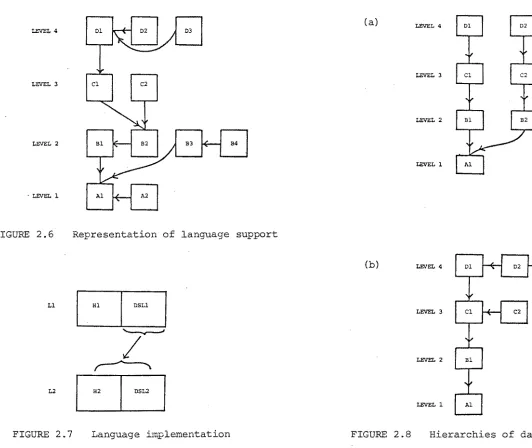
Fig. 2.6 is a diagrammatic representation of the structural relationships of languages in a data base system. The association between two related languages is that one is defined or constructed on the other. This association, however, needs further explanation in terms of the two components, host and data sublanguage.
Consider Fig. 2.7 in which a language Ll is defined on a language L2. The host language of Ll, denoted as Hl, need not necessarily have been derived from L2. The data sublanguage of Ll, DSLl, on the other hand, is completely determined by L2. It is essentially defined on data sublanguage DSL2 of L2, since any data base operations in Ll can only be implemented by those in L2. However, in the process of
construction, host facilities of L2 are typically required. The
association, as abstract machines, is therefore as depicted in Fig. 2.7 where the data sublanguage of one language is defined on the totality of another language.
2.2.3.2 Relationship to levels of data representation
In a hierarchy of data representation levels (e.g. Fig. 2.1), the specification of access at one level has to be mapped to access at a lower level. This mapping may be constructed just once, but the concept of independence implies that reimplementation is possible. A language is therefore required at each level, at the very least to implement the level above it.
Besides implementation, each level of data representation forms a potential interface for user interaction. In Fig. 2.6, the set of languages depicted as being in a particular level represent those languages whose data objects are that of the corresponding data representation level. For example, assuming that the languages of Fig. 2.6 are those of the data representation levels of Fig. 2.1, then the languages{Dl, D2, D3} are those based on the conceptual data
16
structure level.
In Fig. 2.6, at each level, the association is defined on, is indicated by an arrow. A language at one level can either be defined on another language at the same level or on a language at the level below. However, a language at level 3, say, cannot be defined on a language at level l, since this would violate the relationship of the levels of data representation which has its manifestations in the relationship of their interfaces.
2.2.3.3 Diagrammatic convention
At each level, the diagrammatic ordering of the languages, as in Fig. 2.6, can be made to correspond to their relative procedurality, so that there is an increasing degree of procedurality from right to left. This would indicate which languages are more procedural than others, and whether a language is defined on a procedural or a non-procedural language. This latter observation provides an estimate of the relative efficiency of an interface, since in general an interface defined on a ,more procedural language is more efficient than one defined on a less
procedural one.
17
2.3 THE SUPPORT OF MULTIPLE MODELS
2.3.1 Introduction
The term data base model refers to a representation of data with which the real world is modelled. In a hierarchy of abstract machines in the representation of data (Fig. 2.1), the data base model is
typically that at the highest level , since the objects at this level most closely reflect the data associations of the real world.
Traditionally, a data base system provides only one model.
More recently, the concepts of coexistence (Nijssen [l976a]) or multiple
view support (Klug and Tsichritzis [1977]) has become the accepted
approach. These are typically based on the three-level framework of ANSI/SPARC (ANSI/X3/SPARC [1975]), in which a single data base is to support more than one model. This section discusses considerations in the support of multiple models, with emphasis on architectural terms.
Multiple model support can be taken to mean one of two distinct system concepts. One of these is where the system provides interfaces for different models, but any single data base can be of only one model. That is, the system provides alternative models with which a data base can be constructed but not with which to view it.
The other form of multiple model support is that of the typical interpretation, where the system allows a single data base to be viewed in terms of different models.
The considerations of each of these forms of multiple model support are discussed in Sees 2.3.2 and 2.3.3.
2.3.2 Multiple Model Support
This section considers the support of alternative models in the construction of a data base, but not necessarily in viewing it.
one model. Only three models are indicated in the example, but the considerations apply as well to the general case.
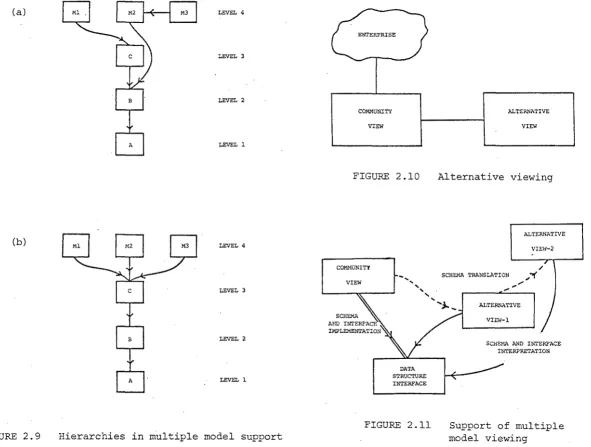
Each of the three models {Ml, M2, M3} must eventually be implemented on the lowest data representation level. That is, there must be a sequence of abstract,machines from each model to the secondary storage level. In Fig. 2.9(a), the sequences are seen to be <Ml, C, B, A>, <M2, B, A> and <M3, M2, B, A>.
18
The prime considerations in multiple model support are the ease with which an interface of a data base model can be constructed and the efficiency of its operators. The significant factor which determines these two features is the form of the abstract machine on which the interface is directly defined.
The three models in Fig. 2.9(a) are implemented at different levels. Ml is defined on a data structure interface, M2 on a storage structure interface, while M3 is constructed on an interface to another model, M2.
Implementation at a lower level can be expected to result in a more efficient interface for two reasons. One is the decrease in the number of software levels through which the operators are mechanized, and the other is the increased control available in the use of the machine's resources. This concern over details, however, is dis-advantageous, since greater effort is necessary in the construction. Specifically, the effort required in the implementation of many models on a storage structure interface is prohibitive.
On the other hand, implementation at a higher level has available objects more suited to the problem, therefore requiring less
The consequence is that transformations required in the construction of one model on another may be unduly awkward, e.g. as for the
implementation of a network model on a strictly hierarchical one. The remaining level, the data structure level, represents a compromise at which an interface with a suitable efficiency/ease of construction tradeoff can be provided. Fig. 2.9(b) illustrates the three models implemented on a data structure interface. The provision of such an interface, however, requires a departure from traditional data base construction, where the specifications of lower level data representations of a system are determined by the model supported. In such a system, the lower level abstract machines are only suitable for the support of that one data base model. That is, the implementation of further models cannot be easily done at these lower levels.
A data structure interface to be used as the implementation base for data base models must take into account a wide range of data models and interfaces. Sec. 2.4.2 discusses further features of such a model implementation base.
2.3.3 Coexistence
2.3.3.1 Community model
!n the multiple model support of 2.3.2, where the modelling alternatives provided are in the construction of a data base, the
19
data itself is of no consequence. Only the support of abstract machines need be considered. In coexistence systems, where users may perceive
the s~me data with alternative representations, the major considerations
involve the data.
Each data base model represents a framework with which
20
situation, a particular model (the community model) has to be chosen as the agreed upon representation from which all other perceptions are to be derived. That is, i t is the model with which the conceptual
schema (ANSI/X3/SPARC [1975], Bachman [1975], Biller and Neuhold [1977])
or Common Universe of Discourse (Nijssen [l976b, l977c]) is constructed. This need for a special model in a coexistence environment is widely recognised (e.g. Sundgren [1974], Biller and Neuhold [1977, 1978], Nijssen [1976b]), although no widespread consensus has been reached on the specific form i t should take.
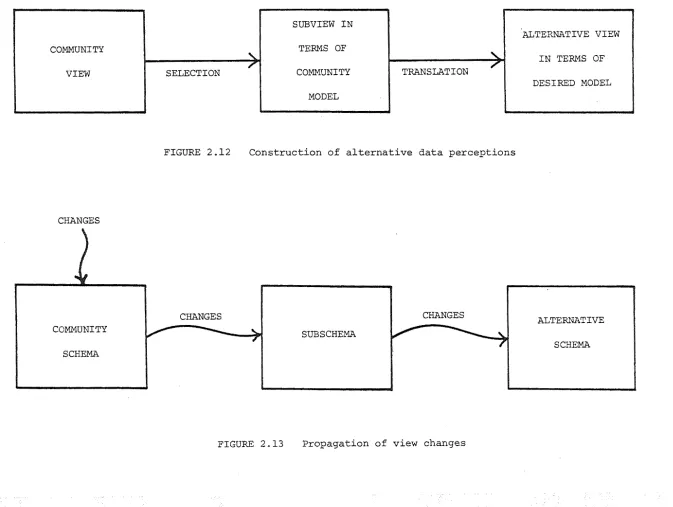
The data base as seen through this special interpretation forms the community view. Fig. 2.10 illustrates that any alternative view relates to the enterprise only through the community view. Its perception of the associations of the enterprise and the effects of its operators are determined by transformations from the community view. Therefore, operations on the data base in terms of the other models would have to be transformed to corresponding operations based on the community model.
This leads to the two main architectural considerations in coexistence: the transformation of the data perceived in terms of the community model to that in an alternative model and the support of alternative models as abstract machines.
2.3.3.2 Schema
In the representation of an enterprise, instances of the object types available on the data base model are specified and created to represent the real world concepts. The totality of the declarations describes the universe of the objects used to represent the enterprise. This description is called the schema of the enterprise in terms of the model used.
c:r-eated at each level represent the same enterprise. That is, a
different schema for the enterprise exists at each level. In a
coexistence system, the description of each alternative view of the
data represents further schemata of the enterprise in terms of the
alternative models.
21
For clarity, the term community schema refers to the schema of
the total data base in terms of the community model. An alternative schema is the schema of an alternative view, while the schema at any
data representation level is appropriately prefixed, e.g. data structure
schema, storage structure schema.
2.3.3.3 Construction of alternative perceptions
The formation of an alternative perception of the data base can
now be described as the formation of an alternative schema. Consider
the construction of a level 2 subview (Fig. 2.3) defined on the
community view. Consider also Fig. 2.11 which illustrates architectural
features of coexistence.
The schema at each data representation level can potentially be
used as the basis for deriving an alternative schema. However, since
correspondence to the real world is determined through the community
model, derivation of an alternative schema is done most meaningfully
in ~erms of the community schema. The formation of an alternative
perception consists of a transformation from the community schema to
one in the required model. In Fig. 2.11 this is indicated by the dotted
line from the community view to alternative view-1.
Similarly, the construction of views at other levels consists of
the derivation of a schema from that of the view on which they are
defined. In Fig. 2.11 this is indicated by. the dotted line from
alternative view-1 to alternative view-2.
2.3.3.4 Alternative model support
22
also noted by Klug and Tsichritzis [1977] , need not be implemented on a
community model interface, but may be supported directly on a lower data
representation level interface. Considerations in the ease of
construction/efficiency tradeoff here is the same as that in the
multiple model support of 2.3.2, so that a suitable implementation base
would similarly be some data structure interface.
The form of the support of a community model on such a base
differs from that of an alternative model. This is described below.
The meaning and growth of the physical data base is determined
by the community model. This means that the hierarchy of data
representation levels in the system, in fact facilitates the
implementation of the community model. The schema at the implementation
base represents a direct implementation of the community schema, and
operations in terms of the community schema are implemented as
operations on the corresponding objects at the implementation base.
These two transformations need not involve any consideration of
alternative views. This independent and direct support is indicated
in • 2.11 by the double-lined arrow.
Support of alternative models on the other hand is determined
by the implementation of the community model. Here the implementation
base schema of the community view is transformed to appear and behave
as the alternative view. Also, the meaning of operations on the
alternative view is determined by its correspondence to the community
view. This means that the transformation from an alternative view to
the implementation base is defined on three schemata: the alternative
schema, the community schema, and its corresponding schema at the
implementation base. This interpretive support is indicated in
Fig. 2.11 by the single-lined arrows.
There are therefore two transformations in the support of an
support on the implementation base. Only a single set of these
transformations is required for each alternative model. This
corresponds to the Structural Mapping Definition of Pelagatti et al.
[ 1977] .
The support of an alternative model interface requires the
following information:
(1) the correspondence of the community model to the alternative
model,
(2) the representation of the community model on the implementation
base, and
(3) the form that the interface to the alternative model is to take.
2.3.3.5 Transformations in alternative view construction
It is to be noted that alternative views are differentiated
from alternative models. In particular, different alternative views
may be of the same model. This is made clear by considering the
general construction of alternative data perceptions as illustrated
in Fig. 2.12.
The construction involves two separate processes (Nijssen
[1976a]):
(1) a subviewing in terms of the community model itself.
(2) the transformation of the resultant subview into a corresponding
view in terms of the desired data base model.
Operators to perform the subviewing of {1) is considered a
community model related facility and is discussed in Chapter 4.
The results of a subviewing is a set of community model data objects
representing the required semantic subset of the community view.
The description/specification of the objects in any particular subview
is called a sub-schema. The transformation of (2) is based on some sub-schema and results in an alternative schema.
24
The schema translation and interface of alternative views other than those defined directly on the community view involves further considerations. Consider alternative view-2 of • 2.11 and where the models of the views in the figure are all different. There are two possible approaches in the construction of view-2.
The first is where the objects at view-2 are derived from the objects at view-1 in terms of the model at view-1. This means that the support of view-2 on the data structure level involves two levels of interpretation, one with respect to the view-2 model and the other the community model. Besides requiring numerous and complex support procedures, this approach may introduce inconsistencies through the multi-level translation of objects from one model to another.
The alternative and that adopted here is where all views are derived from schemata in terms of the community model. Here view-2 is constructed from the sub-schema at that view. With this scheme, there can be at most one level of inter-model translation, so that consistency and simplic can be better
be interpreted in terms of this approach. 2.3.3.6 View dependencies
Fig. 2.11 is to
Alternative views are not totally independent from the community view. In particular, a subview and therefore also its corresponding alternative view, must at all times be a subset of the community view. This means that changes of the community schema have to be propagated through to any alternative schema which may be affected (Fig. 2.13).
The reverse, where changes to an alternative schema are to be reflected in the community schema, involves considerations of the
25
to.be transformed to community model terms.
2.4 TWO MAJOR LEVELS OF ABSTRACTION
2.4.1 Community Models
Studies on data base models (Kerschberg et al. [1976], Biller and Neuhold [1977]) have concentrated on classifying the models on their approaches in the representation of real world concepts. Few direct evaluations (Bracchi et al. [1976]) have been made; while, because of the fast growing nature of the field, any such comparisons become quickly superseded. Consequently, no general consensus has been reached on which model would serve best as a community model. This is evidenced by the continuing contributions and proposals in data base modelling (e.g. Falkenberg [1977], Pirotte [1977]).
Nevertheless, preliminary analyses can still be carried out usefully by considering a model's potential in specific functions of community models. This subsection briefly discusses features considered essential for a community model and introduces a new data base model to be described in Chapter 4.
2.4.1.1 Data models and abstract
The community model forms the semantic reference with respect to which a common interpretation of the meaning of the data base is made. As such the perception provided should closely correspond to the real world.
With this criterion, certain types of data base models become less suitable as community models compared to others. Data base models can be differentiated on their level of data representation. A data
model is one which provides structural representations for the instances
26
representations of distinct real world concepts (Schmid [1977]
presents a similar distinction). Data models are at the data structure
level while abstract models are at the conceptual level in the hierarchy
of data representation levels (Fig. 2.1). The meaning attached to data
described in terms of data models (e.g. network model) are open to
interpretation, so that in the formation of subviews or translations
to other models, intuition may be involved (Biller and Neuhold [1978]).
Therefore, abstract models, in which the objects represent formal
concepts, are better candidates for community models.
2.4.1.2 Criteria for abstract model
A minimum set of requirements for abstract models in a
coexistence architecture, representing the consensus of the September
1976 meeting of IFIP Working Group 2.6 (Biller and Neuhold [1977],
Nijssen [1977b]), are:
l . complete
2. formal
3. easy to formulate and understand
4. easy to change
Nijssen [1977b] has added three more:
~s. easy to transform (to other views)
6. unique
7. orthogonal ,
while Biller and Neuhold [1977] include:
8. stable
9. form the basis for different views.
To gauge the relative importance of these criteria in the choice
of a community model, consider the two main processes involved in the
construction of alternative views described in Sec. 2.3.3 and
The deciding criteria in the choice of a community model are
the ease in the formulation and understanding of community views and
ease in the formulation of subviews. Difficulty in the formulation
or understanding of a community view would result in ambiguity in the
construction of transformations to other models. Since the
specification of an alternative view involves a subsetting of the
community view, it is important that rules in subviewing be simple
and easy to understand.
The other requirements, including the additional one of
conceptual accuracy/expressiveness, are desired features of data base
models in general and do contribute to their suitability as community
models. However, most models are claimed to satisfy these criteria,
so that amongst those that are "good" abstract models, it is those
that satisfy the two criteria above that determine the choice.
27
The concept of simplicity is difficult to quantify (Kent [1977)).
However, the form of the constructs provided by models generally
determine the ease with which they can be applied. Models such as DIAM
(Senko et al . [ 197 3] ) , Info logical Model (Langefors [ 197 41 ) , and
Information Management Concepts (Durchholz and Richter [1974]) are based
on the specification of detailed units of data associations and are
correspondingly difficult to follow and utilize. It seems more natural
and therefore simpler to model the real world in terms of characteristic
rather than individual data associations. This, as well as other
considerations of simplicity, are incorporated in the Data Abstraction
Model (DATAM) presented in Chapter 4.
The final choice may be determined by individual preference.
Nevertheless, the choice would be made from models having comparable
semantic power based on the abstractions each provides. Towards
providing a measure for this, Chapter 3 presents a comprehensive
28
as well as a conceptual spectrum for data base models.
2.4.2 Bases
Approaches in implementation are typically specific to data base
models and among these the major thrust has been in the implementation
o.f the. relational model (Senko [1977a]). Examples of these are
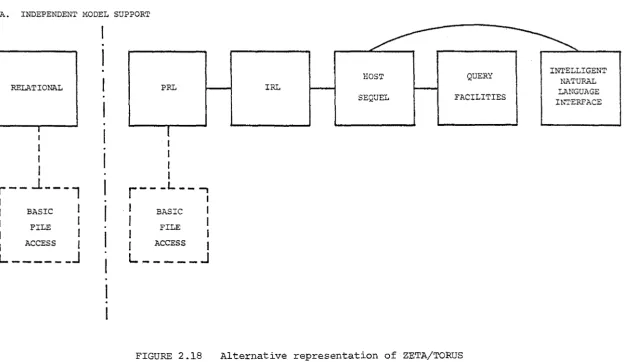
ZETA (Mylopoulos et al. [1975]), INGRES (Held et al. [1975], R
(Astrahan et al. [1976]), Gamma-0 (Bjorner et al. [1973]).
More general approaches (Sibley and Taylor [1973], CODASYL [1977],
Stocker [1977]) are oriented to the formalization of storage structuring.
These approaches can be described as involved in the specification of
the mapping or encoding of logical structures to storage, rather than
the provision of the structures themselves. This is
also the function of the string model of DIAM, which has been shown to
facilitate the mapping of the access paths of the Entity-Set Model
(Senko et al. [1973]) and the relational model (Schneider [1976]) to
the encoding level. The string model also forms the basis for
access path optimization (Ghosh and Astrahan [1974]).
These approaches differ from the implementation base to be
considered in the support of multiple models. The interface required
here is one which provides data structure building blocks with which
the instances of the data associations of the conceptual level can be
perceived and operated on. Such an abstract machine would form the
base on which the underlying structures and operations of data models
can be constructed.
Two approaches providing for such support are System-R and the
Link and Selector (Tsichritzis [1976]). However, as indicated
in 1, they are mainly oriented for the support of the
hier-archical, relational and network models (e.g. Klug and Tsichritzis
29
support of procedural interfaceswould therefore encounter the
awkwardness commented on by Tsichritzis (Discussion on "Views on Data",
Tsichritzis and Lochovsky [1976]):
"If you take one data model and impose another data model on it, you will find a very weird situation whereby you do
something underneath, then yo1,1 cover it up with something else, and then you unearth it higher up."
Also, their record-oriented approaches predetermine access so that
for example, the column-oriented access of SQUARE (Boyce et al. [1974])
cannot be directly represented.
To provide a corresponding facility for a wider range of data
base models and interfaces to them, two approaches can be taken:
(1) provide a wider range of options at a high level to cope
with perceived conditions, or
(2) provide a lower level facility maximizing flexibility while
retaining storage independence; in other words, avoiding
initial structural or access bias.
The first approach involves providing specific facilities for
each known variation. The second, more general approach is adopted
here, where in Chapters 5 and 6, an interface to a primitive data
structure (PRIMDAS} is presented.
2.5 DESCRIPTION OF DATA BASE SYSTEM ARCHITECTURES
2.5.1 Diagrammatic Representations
The difficulty of vigorous comparisons in data base systems has
been noted (Hardgrave and Sibley [1975]). The problem is attributed to
"the lack of an accepted formalism for describing and comparing data
base requirements and data base systems". Data base complexity is
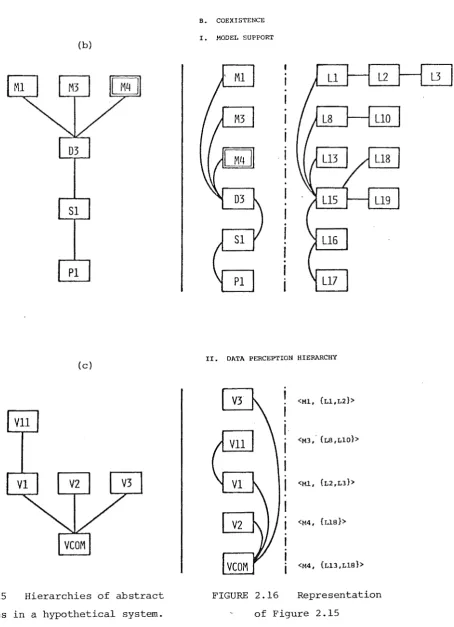
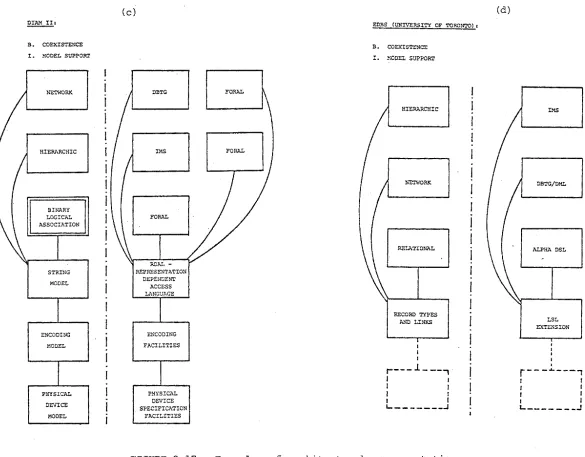
further compounded by the advent of multi-level systems. Attempts at