A GENERALIZED RISK-BASED
MAINTENANCE MODEL TO PLAN
ROAD MAINTENANCE
Master thesis Industrial Engineering and Management
Colofon
Document Master thesis
Title A Generalized risk-based maintenance model to plan road
maintenance
Keywords Risk-based maintenance, asset management, maintenance planning,
Linear programming
Author Inge van der Weg
S1353950
Educational institution University of Twente
Faculty of Behavioural Management and Social Sciences Department of Industrial Engineering and Business Information Systems
Educational program Industrial Engineering and Management
Specialization: Production and Logistics Management
Orientation: Service Logistics and Maintenance Management
Company Sweco Nederland B.V.
Department: Asset Management Team: Asset Management Consulting
Graduation committee University of Twente Dr. E. Topan
Dr. A. Hartmann Sweco Nederland Ir. P. Vermey
Management summary
The goal of this research is to support Sweco by designing a generalized Risk-based maintenance (RBM) model that provides a maintenance planning (MP) for any asset while considering the aspects of risk, cost, and performance. Because of the increasing demand to improve the efficiency of road MP, mainly caused by a limited budget, the generalized RBM is applied towards roads. The corresponding research question is formulated as:
How can a generalized RBM model be used to plan corrective maintenance actions for roads by taking aspects such as total risk, performance, and cost into account?
Currently, the municipality plans road maintenance by a multi-year period planning, based on the condition of the top layers. By identifying the damage of the road, the plan year and maintenance activities are determined. A budget released for road maintenance is often limited, which results in the incapability of executing all desired maintenance activities. Besides, the current MP provides a disliked cost peak in the first year.
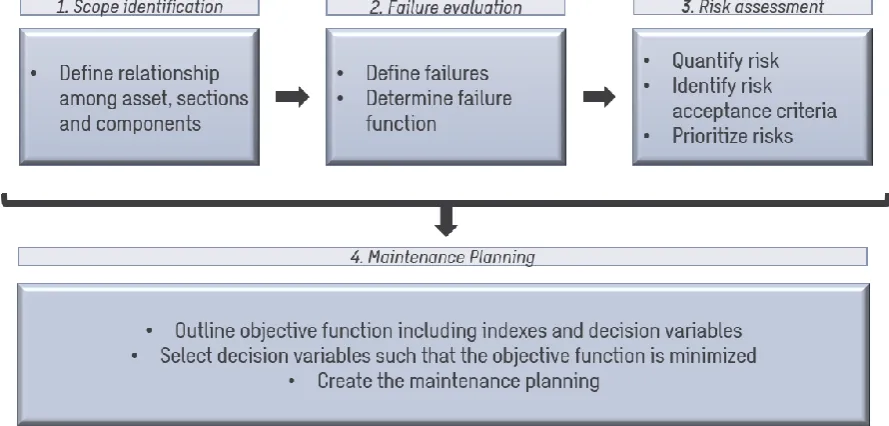
The generalized RBM model is generated by the RBM model, according to Krishnasamy et al. (2005) and considers the cost, performance, and risk of the asset. This research proposes four phases to develop an MP, formulated as:
I. Scope identification II. Failure evaluation III. Risk assessment IV. Maintenance planning
The objective function optimizes the total risk, cost, and performance for each decision variable and is formulated by using a Lagrange relaxation. Constraints ensure the budget is not exceeded, and the cost is equally spread during the planning horizon. The generalized RBM model is applied for roads that are managed by a municipality in the Netherlands. The roads are divided into lane sector that is inspected based on the level of damage.
Four failure distributions are considered as reasonable failure functions. The analysis of the failure distributions shows no significant differences, and the increasing distribution is selected to analyze the generalized RBM model. The current MP is exceeding the budget that restricts the total cost of the generalized RBM model. By using the same budget, the current MP shows lower risk and higher performance concerning the generalized RBM planning. This is due to the budget constraint that ensures that the cost per year is equally distributed. If both budget constraints are removed, the generalized RBM model provides an MP with the lowest possible risk and the highest possible performance. The results show that the generalized RBM is optimizing road maintenance related to the cost, performance, and risk concerning the current MP. However, removing the budget constraints provides an MP that is not representative for road maintenance, since too many maintenance activities are planned in the first year. It shows that the effect of both budget constraints in the generalized RBM model are significant. By analyzing the case study, we can conclude that the correlation between, performance and risk is approximately -70%. The cost has no significant correlation with the performance and risk of the lane sectors. The study to the Lagrange multipliers shows that variating the Lagrange multipliers between zero and one has no impact on the MP and the risk, cost, and performance.
Preface
With this research, I finish my master Industrial Engineering and Management, and my student time in Enschede. I look back to an amazing time where I met many interesting people and learned a lot about the field of industrial engineering and research. The University of Twente provides me a great environment and interesting topics to study.
It was a pleasure to write my thesis at Sweco in the main office in De Bilt. I felt really home and had nice colleagues that support me. The internship gives me the opportunity to have a look into the world as an engineer. It was a challenge to define the thesis proposal, but my colleagues of Sweco supports me by creating valuable research.
I would like to thank my supervisors from the University of Twente and Sweco for all the support, collaboration, feedback, and time. It was always interesting to receive your feedback and to learn so many details about asset management, risk-based maintenance, and road maintenance. I enjoyed working with you! Besides, I want to thank my friends, family, colleagues at Sweco, and fellow students that support me during my study and master thesis. You help me to finish this final report, which I am really proud of.
Table of Content
Colofon ... 2
Management summary ... 4
Preface ... 6
Table of Content ... 8
List of Figures ... 10
List of Tables ... 11
1. Introduction... 12
Company description... 12
Research motivation ... 13
Research objectives ... 14
Research scope and limitations ... 14
Research questions... 15
Reading guide ... 16
2. Literature review ... 18
Asset management ... 18
Maintenance planning ... 21
Risk-based maintenance... 23
Conclusion literature review ... 27
3. Current maintenance planning ... 28
Road maintenance ... 28
Characteristics of roads ... 31
Creating maintenance planning ... 35
Conclusion current maintenance planning ... 41
4. Generalized risk-based maintenance model ... 42
Theoretical framework ... 42
Generalized risk-based maintenance model ... 44
Applying the RBM model for road maintenance ... 48
Conclusion generalized risk-based maintenance model ... 54
5. Case study ... 56
Case description ... 56
Case study: generalized RBM model ... 57
Results ... 62
6. Discussion ... 76
7. Conclusion and recommendations ... 78
Suggestions for further research ... 79
8. References ... 80
9. Appendix ... 82
Organogram Sweco Nederland B.V. ... 82
Inspection guideline from CROW ... 83
VBA code ... 85
Results current maintenance planning vs generalized risk-based maintenance planning ... 86
List of Figures
Figure 1: Research framework ... 16
Figure 2: The three main aspects of AM ... 18
Figure 3: Nine benefits of AM (Davis (2012)) ... 20
Figure 4: Classification of maintenance policies (Tinga, 2013) ... 21
Figure 5: Timeline maintenance philosophies (Arunraj & Maiti, 2007) ... 22
Figure 6: RBM-model (Krishnasamy et. al. 2005) ... 24
Figure 7: FTA example (Tinga, 2013) ... 25
Figure 8: RBM model framework ... 27
Figure 9: Layer of a road (Sirvio, 2017) ... 28
Figure 10: Division per pavement at municipalities in 2007 ... 29
Figure 11: Breakdown of a road ... 31
Figure 12: Roadway breakdown in the urban area ... 31
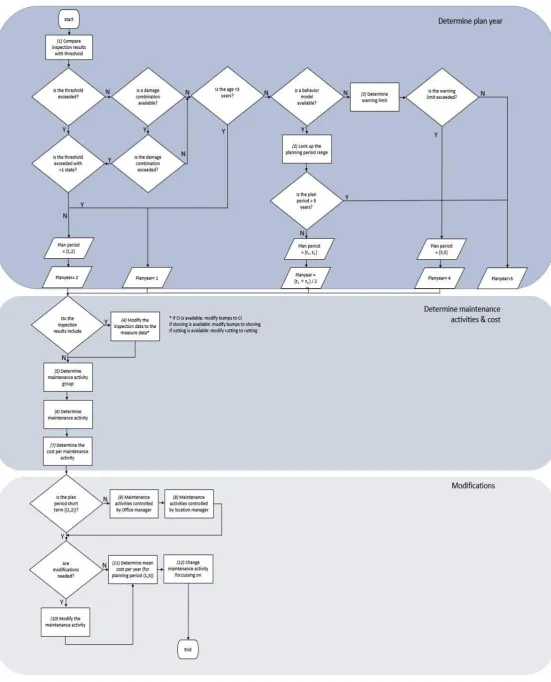
Figure 13: Flowchart current maintenance planning ... 36
Figure 14: Maintenance cost per year... 40
Figure 15: Phases of the generalized RBM model ... 42
Figure 16: The generalized RBM framework ... 44
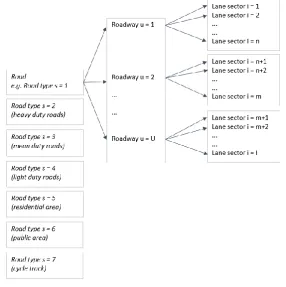
Figure 17: SBS for roads ... 48
Figure 18: Failure horizon ... 49
Figure 19: Failure distributions roads ... 50
Figure 20: Distribution cost per year ... 66
Figure 21: Amount of maintenance activities scheduled each year ... 67
Figure 22: Performance comparison ... 68
Figure 23: Amount of maintenance activities scheduled per year ... 69
Figure 24: Distribution lane sectors for each performance level ... 70
Figure 25: Amount of maintenance activities scheduled per year ... 70
List of Tables
Table 1: Characteristics (required and optional) ... 32
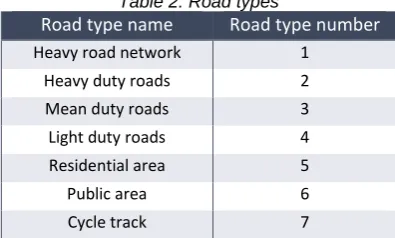
Table 2: Road types ... 32
Table 3: Quality levels ... 33
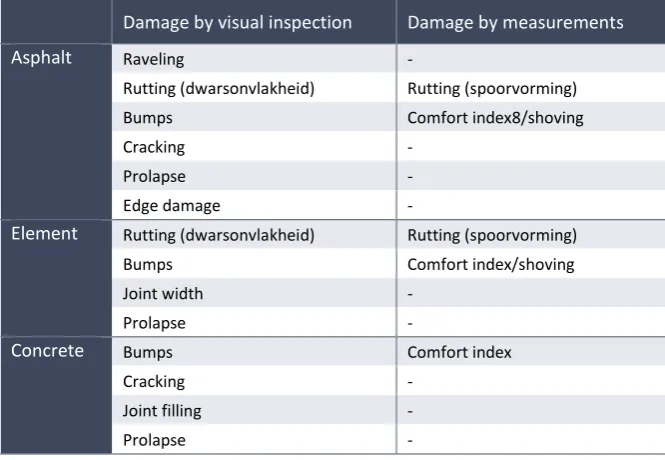
Table 4: Damages that are inspected per pavement type ... 33
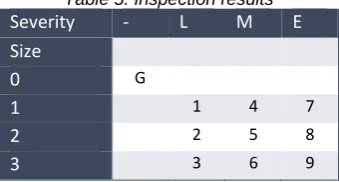
Table 5: Inspection results... 34
Table 6: Behavior table (for damage type raveling, threshold M2, Road type 1 and 2) ... 37
Table 7: The four policy themes ... 40
Table 8: Example prioritization based on road type ... 40
Table 9: Example of weights of consequences for safety ... 51
Table 10: Explanation worksheets Excel File ... 57
Table 11: Characteristics case study ... 58
Table 12: Risk intervals ... 60
Table 13: Performance values ... 60
Table 14: Presentation of the results ... 62
Table 15: Results for considered failure distributions ... 63
Table 16: Results risk for each failure distribution ... 63
Table 17: Results performance for each failure distribution ... 64
Table 18: Total cost and cost per year for each failure distribution ... 64
Table 19: Number of maintenance activities scheduled in year t ... 65
Table 20: Results current maintenance planning vs RBM planning ... 65
Table 21: Results of current maintenance planning vs. RBM planning with the same cost ... 66
Table 22: Average cost per scheduled maintenance activity per year ... 67
Table 23: Results on cost, risk, and performance without budget constraint (2) and (3) ... 68
Table 24: Results generalized RBM planning without budget constraint (2) ... 69
Table 25: Correlation between Risk, Cost, and Performance ... 71
1.
Introduction
In this first chapter, the company Sweco is introduced in section 1.1. The research motivation and the research objectives are addressed in section 1.2 and section 1.3, respectively. In section 1.4, the research scope and limitations are given, which leads to the research questions in section 1.5. Finally, an overview of this master thesis is given in section 1.6 by providing the chapter content.
Company description
This master thesis is executed for the company Sweco, an architecture and engineering consultancy. With circa 15 000 engineers and architects, Sweco is located in Northern Europe, with its roots in Sweden. Sweco’s vision is ‘to become Europe’s most respected knowledge company in the fields of consulting engineering, environmental technology, and architecture’ (Sweco, 2018). As an architecture and engineering consultancy, Sweco is involved in many different projects. An example is the ice rink in Leeuwarden, were Sweco advises about the installation concept, the construction, and the energy design. Another case is the project for Northwest Europe, related to gas pipelines. Sweco was responsible for the engineering and equipment of several installations and supplies the design. As a broad specialism in roads, the business line Transportation & Mobility of Sweco investigated in the integration of the highway A27, the environmental impact and the quality of life measurements. We end with an industrial project that is performed for the company AkzoNobel. The request was to advise dismantling the factory. It is a complex process, because of safety and environmental requirements related to the materials. Sweco delivers an action plan and procures the buyers for parts of the factory. Sweco is a country-based organization. Sweco Nederland B.V. started in 1913 as Grontmij (ConsultancyNederland, 2018). In 2015, Grontmij was taken over by Sweco. In the Netherlands, Sweco consists of circa 1.800 employees. The three divisions of Sweco Nederland B.V. are Transportation & Mobility, Water & Energy and Urban & Regional Development. Each division consists of multiple departments, all with their own specialty. In total, circa 18 departments are divided over offices in nine cities in the Netherlands. In appendix 9.1, the organogram of Sweco Nederland B.V is shown.
Research motivation
The department Asset Management (AM) focusses on assets in the infrastructure. The infrastructure supports the economic development of a country (Schraven & Hartmann, 2010). Performing the optimal condition of the asset is important for among other things, the safety and public environment. An asset manager is engaged in building and planning, as well as maintain and innovate the asset. To guarantee a structured and efficient maintenance planning (MP), a maintenance concept can be selected.
The maintenance concept provides a strategy for the MP for the total life cycle of the asset. In the past, maintenance was only seen as costs without any value adding activity (Tinga, 2013). Nowadays, many strategies are developed to perform optimal maintenance. These strategies have different focus. Some well-known strategies are time driven maintenance, usage-based maintenance, and risk-based maintenance (Tinga, 2013). The maintenance concept risk-based maintenance (RBM) is considered to be one of the concepts that support performing AM. The demand towards RBM by municipalities is increasing, especially towards the AM consultants. According to Arunraj and Maiti (2007), the purpose of RBM is to minimize the occurrence of high-risk failure modes. Municipalities argue they want an RBM methodology because the budget that is available to perform maintenance is limited. Therefore, not all the mandatory maintenance activities can be performed, and prioritization is needed to select the maintenance activities that are scheduled. A risk-based method is defined as a cost-effective maintenance policy (Krishnasamy, Khan, & Haddara, 2005), because the technical features like reliability characteristics are analyzed by considering economic and safety consequences. Scenarios can be used to provide a holistic overview by comparing the cost of every maintenance decision (Krishnasamy, Khan, & Haddara, 2005). Therefore, municipalities and Sweco suggest RBM as an efficient methodology to deal with fixed budgets.
According to Krishnasamy et al. (2005), the RBM model consists of the identification of the scope, a risk assessment and the risk evaluation to provide an MP as output. The RBM model is used for an industrial case study. Even if the methodology is the same for all types of systems/assets, performing the scope, risk assessment and risk evaluation depends on the type of asset, and so modifications are needed. Secondly, one of the principles of AM is to take, next to risk, also cost and performance into account by making decisions. The request is to design a generalized1 RBM model that can be used for
any asset while considering the three key performance indicators (KPI’s) risk, cost, and performance. Besides, the model should be applicable for roads, to analyze if RBM supports the asset manager to deliver the required performance on a reliable and optimal way. The generalized RBM model is applied for roads are because of:
• High demand to implement RBM for roads, mainly caused by the limited budget.
• A lot of standardized data related to inspection/condition is available.
• Clear risk definitions by CROW2.
• Municipalities are liable for damage if the roads do not fulfill the requirements.
• Easy to compare RBM with the current maintenance concept.
Besides the scientific arguments for this master thesis is the research valuable for Sweco since it connects the RBM methodology with AM to provide knowledge for the team. Secondly, the comparison between the current MP and the RBM model can be used to advise municipalities about road MP.
1 The RBM model is generalized since it will be developed in general by inferring from the specific case of road maintenance, discussed in more detail in chapter 4.
Research objectives
The research objective is to propose a model to plan corrective maintenance actions that takes the aspects of risk, performance, and cost of a system into account. The RBM3 methodology is developed
based on literature. By performing a case study for road maintenance, the generalized RBM model will be analyzed. The case study supports the asset manager with developing a multi-year maintenance planning by using the generalized RBM model that makes decisions objective rather than subjective. A remark towards the generalized RBM model is that the model should be generalized by using a systemic approach. To facilitate a systemic approach, RBM described in literature will be considered. To implement the generalized model for roads, the RBM model is combined with the AM aspects risk, cost, and performance. Therefore, the risk aspect will be combined with cost and performance. The model should give maintenance activities by a priority list for planned maintenance activities.
Research scope and limitations
The study focuses on roads that are managed by municipalities in the Netherlands only. In 2008, this was about 85% of the total road network in the Netherlands (Molenaar & Houben, 2010). Notice that highways in the Netherlands are excluded since it is the responsibility of Rijkswaterstaat. Secondly, only the tactical road MP is considered. While the strategic road planning focuses on cyclical maintenance activities and the operational on the small maintenance activities, this study concentrates on the maintenance activities that are based on the quality/inspection results. The maintenance activities that are scheduled are given, and so the determination of the maintenance activities is out of the scope. During the model development, many assumptions are made. If the impact on the results can be significant, the assumption is considered in the discussion.
Research questions
To achieve the research objective, the following main research question is defined:
To answer the main research question, four sub-questions are developed, each consisting of several additional questions. A literature review provides insights into RBM, as well as the relation between AM, MP, and RBM. To develop the generalized RBM model that improves the MP of an asset, literature is used to approach a model. The first sub-question is:
1. What is written in the literature about RBM? 1a. What is the relation between AM and MP?
1b. What is written in literature about developing an RBM model?
Road maintenance that is performed by municipalities is analyzed in the current situation. The CROW guide describes the MP for roads from beginning to end. The conclusion is that the MP is deterministic, and decisions are based on experience and subjective. The available data of roads in the current situation is analyzed to investigate whether the data is useful as input for the generalized RBM model. The second sub-question is formulated as:
2. How is maintenance currently planned for roads? 2a. What does road maintenance imply?
2b. What data is gathered and used for the current MP? 2c. What decisions are made to develop the MP for roads?
The generalized RBM model is developed based on the four phases of RBM, according to Krishnasamy et. al. (2005). The phases are outlined as ‘Identifying the scope,’ ‘Risk assessment,’ ‘Risk evaluation’ and ‘Maintenance planning.’ In the last phase, the MP is developed by relating the decisions with optimizing risk, performance, and cost. Because we implement the generalized RBM model for road maintenance, the failure and remaining useful lifetime of a road should be determined. The risk determination should be specified for roads. The third research question addresses the development of the generalized RBM model and the implementation for road maintenance and is formulated as: 3. What actions should be taken to use the generalized RBM model to plan maintenance for
roads?
3a. How can we use the literature to develop a generalized model for RBM?
3b. How can the generalized model be related to the aspects of risk, cost, and performance? 3c. What is a failure in relation to road maintenance and how can it be modeled?
3d. How to calculate the remaining useful lifetime distributions? 3e. How to determine risks?
After the generalized RBM model is developed, we will implement the model for a case study, related to road maintenance. Depending on the completeness of the case, the RBM model will be implemented for one road type or a road network to compare the RBM model output with the current MP. The results also provide suggestions for improving the generalized RBM model. The final sub-question is formulated as:
4. How does the generalized RBM model perform compared to the current model in relation to the aspects cost, risk, and performance?
4a. What are the results of the case study?
4b. How can we compare the generalized RBM planning concerning the current MP?
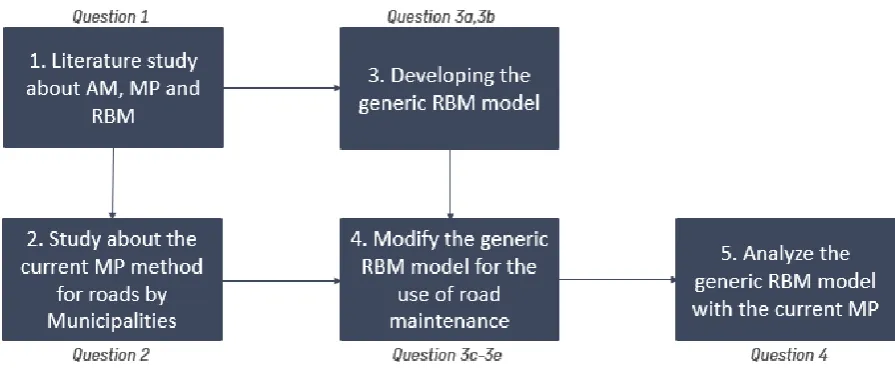
Figure 1 shows the research framework and relations between the chapters and research questions. The next section provides a reading guide by providing the content of each chapter.
[image:17.595.74.522.117.303.2]
Figure 1: Research framework
Reading guide
2.
Literature review
To develop the generalized RBM model, relevant literature is studied in the literature review. In this chapter, we will address an answer to the research question:
‘What is written in the literature about RBM?’
In section 2.1, we discuss AM by focusing on the three aspects of risk, performance, and cost. The history of MP and strategies that are used in practice will be addressed in section 2.2 to answer research question 1a. Literature is used to address how the maintenance concept RBM can be modeled, presented in section 2.3, to answer question 1b. Finally, section 2.4 covers the conclusion of the literature review.
Asset management
In the seventies, maintenance activities were planned by a corrective policy, meaning that components are fixed/repaired only after failure is indicated (Tinga, 2013). In the eighties, the demand for other maintenance concepts grown because of the building peak between 1930 and 1940 and the increase of big cities (iAmPro, 2018). Also, corporate social responsibility was introduced in the 80s, which results in the growing importance of environmental aspects instead of only taking profit into account (CROW, Kennisplatform CROW, 2018). The issues related to infrastructural problems about social responsibility is the origin of AM in England by the PAS 55. The PAS 55 became a standard for AM and is replaced in 2015 by the ISO 55.000. ISO is an international organization for standardization and is used worldwide to provide international standards (NEN, 2014). Nowadays, the ISO 55 000 series provides an overview of AM and AM systems and is developed for all types of assets and organizations (NEN, 2014).
As mentioned in section 1.4, the research will focus on the infrastructure and includes public assets. The financial value of public assets in the Netherlands has estimated around 400 billion euros (Ruitenburg, Braaksma, & Dongen, 2017). The high financial value of public assets supports, together with the social value, the importance of public assets in the Netherlands. Finding the right balance between performance, risks, and costs of an asset should be managed to provide availability for the users, which is the leading focus of AM. Figure 2 shows the relationship between the main AM aspects cost, risk, and performance.
According to Robert Davis (2012), investigating AM is needed to deal with three challenges:
• To receive the maximum possible benefit for the asset by combining the lowest costs and the highest return on investment.
• To provide an understanding of the life cycle cost of the asset.
• To create the maximum life cycle while taking global challenges like climate changes into account. The challenges can be related to the goals of AM and express by risk, performance, and cost that were mentioned earlier (Davis, 2012).
To define AM, the definition of an asset should be mentioned firstly. According to ISO 55.000 (p. 2), an asset is defined as ‘an item, thing or entity that has potential or actual value to an organization.’ In the dictionary, an asset is defined as ‘any item of economic value owned by an individual or corporation.’ Both definitions mention that the asset should add value. The value can be on the corporation’s balance sheet or by delivering a process or service (Davis, 2012) and should be defined by the organization.
The main key aspects risk, cost, and performance are the bases of AM and used in many definitions in the literature. The definition of AM applies to many disciplines (Pudney, 2010). According to Pudney (2010), AM is “an organization’s coordinated multidisciplinary practice that applies human, equipment and financial resources to physical assets over their whole life cycle to achieve defined asset performance and cost objectives at acceptable levels of risk whilst taking account of the relevant governance, geo-political, economic, social, demographic and technological regimes” (Ruitenburg, Braaksma, & Dongen, 2017, p. 261). The standardized definition of AM in the Netherlands is ‘coordinated activity of an organization to realize value from assets’ (NEN, 2014).
According to Davis, there are seven main key activities for an asset manager (2012). The AM strategy specifies the approach and objectives by the organizational principles defined in the policy. By the principles in the policy and the concepts and strategies, the asset manager can compose the AM planning. The planning should be executed by delivering the plans. To be able to deliver, or to improve the delivering of the activities, skills, and competencies of the people should be developed, and the risks should be managed. Finally, gathering and analyzing the data supports improvements by managing asset information.
Davis (2012) identifies nine benefits of AM and claims that AM can be optimized by optimizing the nine benefits. The nine benefits are (Davis, 2012):
1. Reduce the total costs of operating the asset.
2. Reduce the capital costs of investing in the asset base.
3. Improving the operating performance of the asset (reduce the failure rate, increase availability). 4. Reduce the potential health impacts of operation the assets.
5. Reduce the safety risks of operating the asset.
The benefits are shown in Figure 3 in a simplified overview to provide an overall picture of the aspects that should be improved or reduced to optimize AM. The benefits are grouped by cost, risk, impact, asset, and organization. Minimizing costs, risks, and impacts in combination with maximizing the asset and organization performance support optimizing AM.
We can relate the benefits with the aspects of AM. The asset and organization that should be maximized can be related to performance. We can combine the benefit impact with the benefit risk if we look closer to the definition of risk. Risk is defined by Khan & Haddara (2003) as:
𝑅𝑖𝑠𝑘 = 𝑝𝑟𝑜𝑏𝑎𝑏𝑖𝑙𝑖𝑡𝑦 𝑜𝑓 𝑓𝑎𝑖𝑙𝑢𝑟𝑒 ∗ 𝑐𝑜𝑛𝑠𝑒𝑞𝑢𝑒𝑛𝑐𝑒 𝑜𝑓 𝑓𝑎𝑖𝑙𝑢𝑟𝑒
The consequence of failure can be the impact of the failure, for example, the health impact or environmental impact. The benefits impact and risk are both related to risk.
This section can be concluded by assuming AM can be optimized by minimizing costs and risk while maximizing the performance. This will always be a trade-off since higher performance will often lead to higher cost, see Figure 2. Simultaneously, lowering the risk leads to higher cost. The variables risk, cost, and performance are important for the rest of the study since they are presented in the objective function and important by optimizing the MP of roads. We will now take a closer look at one of the aspects of AM, namely MP.
Maintenance planning
The European standard EN13306 defines maintenance as ‘the combination of all technical, administrative and marginal actions during the life cycle of an item intended to retain it in, or restore it to, a state in which it can perform the required function’ (Tinga, 2013, p. 162). Another expression of maintenance is ‘fixing and/or replacing components either when they have failed or when they are found to be failed’ (Tinga, 2013, p. 167).
The available budget for maintenance is often minimal, whereby not all the technical, administrative, and marginal actions can be performed during the life cycle. The decisions should be made about the performances and risks of the system to stay within the budget, where the trade-off between availability and cost is often the case (Tinga, 2013). We define an MP as ‘a set of related activities directed to restoring or keeping a system or object in the desired condition, so that it will function within specified quality norms’ (Worm & Van Harten, 1996, p. 307).
According to the ‘Nederlandse Vereniging voor Doelmatig Onderhoud’ (NVDO), the maintenance costs in the Netherlands are around 30 to 35 billion euros per year (NVDO, 2018) and expected to increase. The increasing in maintenance field is caused by the growth of size, complexity, and variety of assets (Khan & Haddara, 2003) and results in a leading control priority (Arunraj & Maiti, 2007). Maintenance consists of a strategic, tactical, and operational level (Tinga, 2013). The strategical level covers the business goals by formulating the priorities and setting up the targets. The requirements, planning, and scheduling according to the resources are represented at the tactical level. Finally, the operational level plans and executes the tasks in the scheduled time according to maintenance.
At the strategical level, typically a maintenance concept4 is developed. A reduction of around 40% to
60% can be achieved by selecting an effective maintenance concept (Krishnasamy, Khan, & Haddara, 2005). Selecting a maintenance concept that maximizes the availability and efficiency of the asset, controls the deteriorations, safety, environment, and performance, and minimizes the total cost of the operation is the major challenge of selecting and implementing a maintenance concept (Krishnasamy, Khan, & Haddara, 2005).
A maintenance concept aims to determine how the maintenance process is organized by selecting one or more maintenance policies5 and the general structure of combining policies (Wayenbergh &
Pintelon, 2002). Figure 4 provides an overview of the policies by the classifications reactive, proactive, and aggressive.
Figure 4: Classification of maintenance policies (Tinga, 2013)
The first classification is related to the budget of the total maintenance. Reactively executing maintenance means that it takes place when a component fails or when it is detected to be failing. Proactive means that replacing/repairing of components take place before a failure occurs. One way is called opportunistic, where maintenance activities are clustered to take advantages of, for example, downtime cost. Well-known examples of proactive are predictive, preventive, condition based, and time-based. The aggressive policy is more design-oriented and is based on improving the components so that failures can avoid/reduced. The maintenance policies can be combined while defining a maintenance concept, and are therefore also used as a guide in the tactical and operational level of maintenance. (Tinga, 2013)
Besides the maintenance policies, a maintenance concept includes the decisions about identification and allocation of resources, upgrading and back up of the assets and determining actions about repair, inspection, and replacement (Tinga, 2013). In the past decades, maintenance concepts pass through many changes because of the development of maintenance philosophies.
Figure 5 provides the timeline for the last decades and shows an overview of the modifications in maintenance strategies (Arunraj & Maiti, 2007).
Figure 5: Timeline maintenance philosophies (Arunraj & Maiti, 2007)
Risk-based maintenance
RBM is developed to identify the high-risk components of the system to be able to maintain those components with a higher priority to achieve a better overall risk profile (Arunraj & Maiti, 2007). According to Arunraj and Maiti (2007), inspection and maintenance that is based on risk analysis minimize the probability of failure and the related consequences. Secondly, it supports decision making according to the investments in maintenance. A risk is defined as ‘the considered expected loss or damage associated with the occurrence of a possible undesired event’ (Arunraj & Maiti, 2007, p. 656). The organization is free to define risks for the system and the related consequences. A risk can be classified as quantitative or qualitative. A quantitative risk is numerically expressed and easy to prioritize. A well-known tool to quantify risk is Fault Tree Analysis (FTA), discussed in the next sections. A qualitative risk is determined by the probabilities and consequences and provides a subjective value (Khan & Haddara, 2003). Besides the risk definition, it is important to emphases why to take the risk into account by developing the MP in the first place, in other words, why to use an RBM policy. Many maintenance concepts are focusing on the reliability of the system and/or the components. The reliability is the probability of survival. However, it is also important to take the risk into account, because a low probability of failure (so high reliability) does not give information about the consequences of that failure (Arunraj & Maiti, 2007). In some situations, the reliability can be around 95%, but the risk of failure that people get injured is also 95%. In that case, reliability of >99% is preferred, and so maintenance on that part has a high priority.
In the subparagraphs below, the four phases will be explained in more detail. 2.3.1Identification of the scope
First, for a certain system, all the subsystems and components are identified. A structured way to show the relationships among system, subsystems, and components is a system breakdown structure (SBS), also called a tree diagram. For each component, the failure model is determined by using (historical) failure data, an experience-based approach. A failure mode is a way or mode an asset can fail concerning the undesired top event (Schüller, 1997). The data can be provided by the suppliers of the component or is available by historical data. A method to select the best fitting failure model is the least square method that selects the distribution with the smallest sum of squared distances.
[image:25.595.173.419.60.445.2]Well-known probability distributions to model the lifetime of a nonrepairable item are exponential, Gamma, Weibull, Normal, Lognormal, Birnbaum-Saunders, and the inverse Gaussian distribution (Rausand & Høyland, 2004). The two most used failure distributions are Weibull and exponential distribution (Tinga, 2013). The Weibull distribution is the most popular method to analyze failures (Jardine & Tsang, 2013) and is flexible to model life distributions with a decreasing, increasing or constant failure rate function (Rausand & Høyland, 2004).
The corresponding distribution function for a component with time to failure (T), scale parameter (λ), and shape parameter (α) is given by:
𝐹(𝑡) = 𝑃𝑅 (𝑇 ≤ 𝑡) = { 1 − 𝑒−(𝜆𝑡) 𝛼
𝑓𝑜𝑟 𝑡 > 0 0 𝑜𝑡ℎ𝑒𝑟𝑤𝑖𝑠𝑒
(Rausand & Høyland, 2004)
If the shape parameter α = 1, the distribution equals the exponential distribution. 2.3.2Risk assessment
To assess the risk for each component, the asset manager should identify the relevant hazard by failure scenarios, analyze the probabilistic failure, assess the consequences, and finally quantify the risk. To identify the hazard, failure scenarios describes which series of events lead to system failure (Khan & Haddara, 2003). Generally, various failure scenarios are possible, while not all are relevant or likely to happen. Therefore, we should select the relevant failure scenarios. Methods are available in the literature to select the most important failure scenarios. Well-known methods are maximum credible accident scenarios MCAS) and worst-case scenario. After selecting the relevant failure scenarios, the probabilistic failure needs to be quantified.
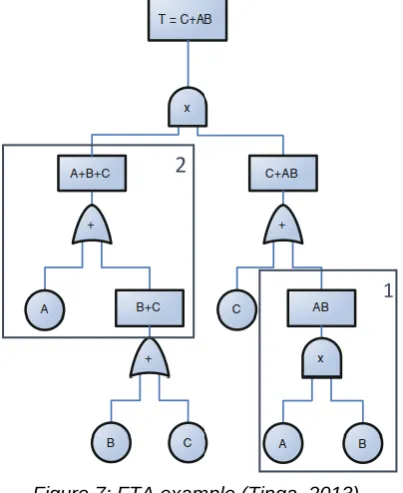
The probabilistic failure analysis can be applied by developing a probabilistic fault tree, an analytical simulation. Fault tree or decision trees determines the probability that events (in a certain sequence) result in consequences (Khan & Haddara, 2003). A fault tree analysis (FTA) provides a diagram with the basic failures and the relations between the failures that causes system failure (Tinga, 2013). The system failure is the top event in the tree. Figure 7 shows a fictive fault tree.
The circles (A, B, and C) are the basic events that may result in the occurrence of the top event (T). The gates (x and +) indicates if one or more events are leading to the failure (OR-gate) or that all the events should happen (AND-gate). Boolean algebra is used to express the higher events. An AND-gate as shown in box one is expressed by AB so that only if A and B are true, the event is also true. The OR relation as in box two is determined by the sum of the events. In the example, the top event is equal to (A+B+C) (C+AB).
1
[image:26.595.196.398.406.653.2]2
To determine the minimal cut sets (MCS) of the system, the equivalent fault tree (EFT) determines the top event, expressed as:
𝑇 = ∑𝑛𝑖=1𝑀𝐶𝑆𝑖 = ∑𝑛𝑖=1(∏𝑚𝑗=1𝑖 𝐶𝑖𝑗) (Tinga, 2013)
By using the rules of Boolean algebra and the corresponding laws, the top event of the example can be reduced to T= C + AB. Software tools determine the minimal cuts and the top event for a fault tree, e.g., PROFAT. The probability of failure for the system equals the probability of the top event. The probability failures of the events can be estimated by, e.g., Monte Carlo Simulation and by failure parameters.
For the top events, the consequences for the system are identified and analyzed. Examples of the consequences are system performance losses, financial losses, human health losses, and environmental losses (Khan & Haddara, 2003). The consequences are calculated by mathematical models, to make it quantifiable, and based commonly on maintenance. By the consequences, the effect of the occurrence of the top events is provided.
Finally, the risks are quantified by multiplying the probability with the consequences, so that: 𝑅𝑖𝑠𝑘 = 𝑝𝑟𝑜𝑏𝑎𝑏𝑖𝑙𝑖𝑡𝑦 𝑜𝑓 𝑓𝑎𝑖𝑙𝑢𝑟𝑒 ∗ 𝑐𝑜𝑛𝑠𝑒𝑞𝑢𝑒𝑛𝑐𝑒 𝑜𝑓 𝑓𝑎𝑖𝑙𝑢𝑟𝑒
The quantification is made by ranking the risks from high to low. 2.3.3Risk evaluation
To evaluate the risks, a risk acceptance criterion decides whether a risk is acceptable. The risk acceptance criteria can be selected by using as low as reasonably possible (ALARP) or Dutch acceptance criteria (Khan & Haddara, 2003). The components for which the risk exceeds the risk acceptance criteria are selected to improve by modifications in the maintenance plan. To quantify the effect of the improvements on the MP, we will use the risk index (Krishnasamy, Khan, & Haddara, 2005). The risk index equals the actual risk divided by the risk acceptance criteria. The risk index should be lower than one to be acceptable. All the risks indexes that are higher than one are considered in the next phase. 2.3.4Maintenance planning
Conclusion literature review
According to Pudney, AM is “an organization’s coordinated multidisciplinary practice that applies human, equipment and financial resources to physical assets over their whole life cycle to achieve defined asset performance and cost objectives at acceptable levels of risk whilst taking account of the relevant governance, geo-political, economic, social, demographic and technological regimes” (Ruitenburg, Braaksma, & Dongen, 2017, p. 261). The standardized definition of AM used in the Netherlands is ‘coordinated activity of an organization to realize value from assets’ (NEN, 2014). Finding the right balance between the risk, performance, and cost of asset supports performing AM optimal. Coordinating the whole life cycle of an asset includes performing maintenance which is defined by ‘fixing and/or replacing components either when they have failed or when they are found to be failed’ (Tinga, 2013, p. 167). Maintenance supports the nine benefits of AM, according to (Davis, 2012).
At the strategical level, a maintenance concept is selected that maximizes the availability and efficiency of the asset, controls the deteriorations, safety, environment, and performance. Minimizing the total cost of the operation is the major challenge of selecting and implementing a maintenance concept (Krishnasamy, Khan, & Haddara, 2005). In the last decades, many maintenance concepts were developed and used to schedule maintenance activities. In the last 20 years, maintenance concepts focus on RBM and inspections, to combine safety with maintenance.
This study focusses on RBM, which is developed to identify the high-risk components of a system to be able to maintain those components with a higher priority to achieve a better overall risk profile (Arunraj & Maiti, 2007). Risk is quantified by multiplying the probability of failure with the consequence of failure.
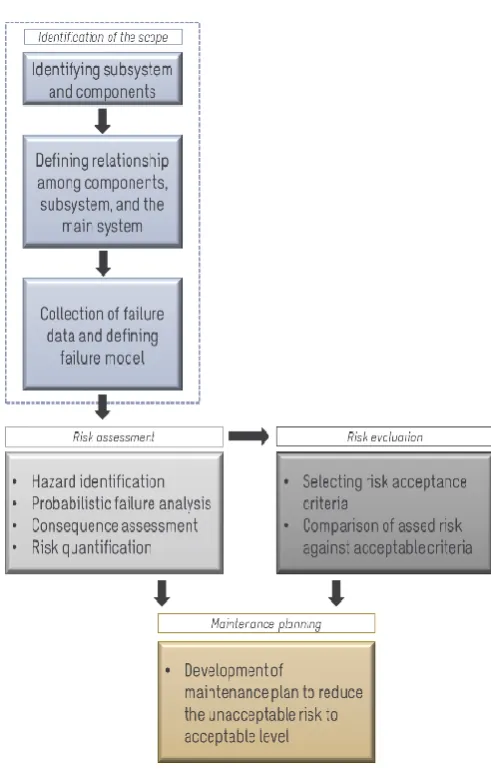
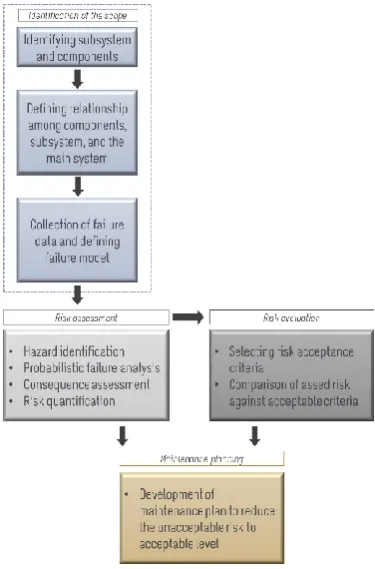
To develop the generalized RBM, the model from Krishnasamy et al. is selected (2005). Figure 8 shows the four steps that create the MP of a certain phase. The phases are defined as:
1. Identification of the scope 2. Risk assessment
3. Risk evaluation 4. Maintenance planning
[image:28.595.376.564.432.717.2]The identification of the scope defines the relationship among the components and determines the failure models. In the second phase, the risks are quantified. A risk acceptance criteria prioritize the selection of components that are considered while improving the MP. In the last phase, the MP is improved so that the unacceptable risks are reduced to an acceptable level.
3.
Current maintenance planning
This chapter aims to describe the current method that is used to plan maintenance activities for roads that are included in the portfolio of a municipality. The conclusion answers the second sub-question:
‘How is maintenance currently planned for roads?’
To be able to explain the current method, we first discuss the main characteristics of roads and the variables that influence the deterioration, resulting in a need for maintenance. The first section 3.1 discusses roads and road maintenance in general, to answer question 2a.The current method to plan road maintenance for a municipality in The Netherlands is based on the CROW road maintenance publications (CROW, Wegbeheer, 2011). Standardized variables are used as input for the MP. In section 3.2, the characteristics are discussed to provide an answer on question 2b.The decisions that are made for the current road MP are presented in a flowchart and explained in section 3.3, answering question 2c.This chapter is concluded in section 3.4.
Road maintenance
In general, a road consists of several layers, as shown in Figure 9 (Sirvio, 2017).
SurfaceCourse
Binder Course
Base Course
Subbase Course
Compacted Subgrade
Natural subgrade
Figure 9: Layer of a road (Sirvio, 2017)
Figure 10: Division per pavement at municipalities in 2007
Multiple characteristics and measurements are used in literature to express the condition of the road and to be able to analyze the deterioration and quality. The main effect of deterioration is decreasing driving comfort and a shorter service life. The main factors that influence the deterioration process for roads are traffic density, type of pavement, and climate conditions (Worm & Van Harten, 1996). Sirvio (2017) takes the variables serviceability (comfort), safety, and structural capacity into account by analyzing the effects of the deterioration. Currently, the influences by climate condition are not considered in the road MP designed by the municipality, although they have big effects on the deterioration of the road. In this study the climate conditions are not considered because of the unpredictability compared with the other factors.
The asset owner of roads in the Netherlands is the municipality, ‘Rijkswaterstaat,’ ‘Provincies’ or ‘Waterschappen.’ As mentioned, we focus only on municipalities, who manage most of the roads of the total road network in the Netherlands, namely 85,3% in 2008 (Molenaar & Houben, 2010). The municipality is responsible for the state of the road (Sirvio, 2017). In the thesis, we define a road as ‘A line of travel communication using a stabilized base other than rails or airstrips, primarily for the use of road motor vehicles running on their own wheels’ (Sirvio, 2017, p. 14). The service life of a road without renovation varies between 10 and 50 years, depending on the road class and the design standards (Sirvio, 2017). With a size of 10 000 kilometers of highways and main regional roads, the importance to perform maintenance for Dutch road network as optimal as possible is increased (Worm & Van Harten, 1996).
In general, the purpose of road maintenance is to keep the capacity and the value of the road optimal (Sirvio, 2017). At the municipalities, the MP for roads is the responsibility of the local road authority (Dutch: wegbeheerder) (Rijksoverheid, 2019). The expenditures for road maintenance are maximized by a budget. The size of the budget for road maintenance is regulated by the city council (gemeenteraad). The road authority should demonstrate how much money is needed to keep the asset performance on a predetermined level, based on the CROW guideline. In a technical sense, there is a minimum limit to prevent capital loss. The study considers the tactical MP.
43,7%
1,4% 54,9%
Distribution per pavement
Characteristics of roads
The characteristics of roads that are used to develop the MP are categorized by roadway, roadway sector, and lane sector6 (Worm & Van Harten, 1996). Figure 11 visualizes the difference between a
lane and a roadway. It shows that the road in Figure 11 consists of two roadways and four lanes.
In practice, many roads managed by the municipality are in the urban area and consists of different components like a curb or a junction with different pavements, and are not that clear as the road in Figure 11. Because of the different pavement and usage, the road cannot be divided into equal size lane sectors. The common breakdown is on roadway sectors, based on the same pavement and usage. If the roadway sector is too big, the roadway sectors are divided into lane sectors as well. Figure 12 visualizes an example of the breakdown of roadway sectors and lane sectors.
As shown in the figure, not every roadway sector has (multiple) lane sectors. That is why the inspection is explored for roadway sectors in the first place, and, if accessible, for lane sectors as well. Regulations are available to break down the road correctly. The breakdown is often based on logical points, e.g., at a crossing street point or a streetlight. The roadway/lane sectors are around 100 meters in the urban area, and 200-500 meter outside the urban area.
6 In the report ‘Wegbeheer 2011’, other words (in Dutch) are used for roadway, roadway sector and lane sector. However, because of the clearity, we will use the words used in the paper of Worm & Van Harten (1996).
Figure 11: Breakdown of a road
The MP is based on characteristics of the road, and data that is gathered by inspection. The characteristics are available for the categories roadway, roadway sector, and lane sector are presented in Table 1. This categorization is made since some characteristics can only be gathered correctly for one of the categories, e.g., the traffic intensity. A roadway can have multiple traffic intensities. Therefore, the traffic intensity is determined for each roadway sector. The characteristics are divided into required and optional. The required characteristics should always be available and used as input for the current MP. The optional characteristics are not always available, depending on the municipality.
Table 1: Characteristics (required and optional)
Roadway Roadway sector Lane sector
required characteristics
Road number Roadway sector number Type lane sector
Name Soil Road type
Total length Length Surface
Number of road sections Start point Length
Start point Endpoint Pavement
Endpoint Geographical location Age
Traffic intensity Length joints
Freight traffic intensity Maintenance type & date
Bus route Width component
Construction type Thickness construction Thickness and type foundation Type joint filling
optional characteristics
Traffic sign Sprinkle route
Lighting Marks
Street name sign Cables and pipes Exit driveway Gully tops Traffic regulations
Since the road types are important in the rest of the report, the seven road types that are considered are mentioned in Table 2. In the rest of the report, the numbers are often used to refer to the road type.
Table 2: Road types
Road type name Road type number
Heavy road network 1
Heavy duty roads 2
Mean duty roads 3
Light duty roads 4
Residential area 5
Public area 6
Cycle track 7
Besides the characteristics, data is gathered to provide information about the quality of the road. The quality of a road is quantified by visual quality (Dutch: beeld kwaliteit) and technical quality (Dutch: technische kwaliteit). The visual quality is quantified by a picture of the state of a road. The quality is assessed by A+, A, B, C, and D, indicating the quality by respectively very high to very low7. CROW
[image:33.595.198.396.556.675.2]publication 232 (‘Kwaliteitscatalogus openbare Ruimte 2018’) and 147 (‘Technische kwaliteit’) provides an identification of the costs for each ambition level for a certain road type, as an indication for the feasibility for the municipality. Table 3 indicates the meaning of each letter.
Table 3: Quality levels
Quality Explanation
A+ No damages
A Small damages
B Warning limit is exceeded sufficient
C The threshold is exceeded with 1 moderate D The threshold is exceeded with more than 1 insufficient
[image:34.595.131.464.336.566.2]As Table 3 shows, the letters B, C, and D are categorized by sufficient, moderate, or insufficient. The municipality decides how much of the total should be quantified as sufficient, moderate, or insufficient. The technical quality is determined by inspectors. The inspection process is described in detail in the ‘Handleiding globale visuele inspection 2011’. The results of the inspections are value based on the severity and size of the damage and gathered in a structured way. The damages that are assessed during an inspection are shown in Table 4.
Table 4: Damages that are inspected per pavement type
Damage by visual inspection Damage by measurements
Asphalt Raveling -
Rutting (dwarsonvlakheid) Rutting (spoorvorming)
Bumps Comfort index8/shoving
Cracking -
Prolapse -
Edge damage -
Element Rutting (dwarsonvlakheid) Rutting (spoorvorming)
Bumps Comfort index/shoving
Joint width -
Prolapse -
Concrete Bumps Comfort index
Cracking -
Joint filling -
Prolapse -
Table 4 shows that the damage types depends on the pavement of the lane sector. Three damages can be measured and provided reliable, as shown in Table 4 as well. However, in practice, those three measurements are not used much by municipalities, because of the costs. If the damages are measured, they will replace the visual inspection data. This will be explained in more detail in the MP description. The other damages can only be measured visually since it is not possible to provide reliable values by measuring with equipment.
The damages based on the inspection are assessed by size and severity. The size is expressed by 0,1,2, or 3 and is based on the size of the damage in % or meters. The severity is expressed by L (light), M (medium), and E (serious) and is also based on a % of the total lane sector or the length in mm. The guideline is provided in Appendix 9.2. In practice, the results are written by 1 to 9, as shown in Table 5.
Table 5: Inspection results
Severity - L M E
Size
0 G
1 1 4 7
2 2 5 8
3 3 6 9
Creating maintenance planning
Creating the MP consist of roughly three main steps: determine the plan year, determine the maintenance activities with corresponding costs, and finally assess changes in the MP. In the flowchart in Figure 13, all the process steps and decisions are shown. The three main process steps are explained in the subsections below. The processes (rectangles) in the flowchart are numbered and used in the clarification of the MP model. For the MP, we use the required characteristics shown in Table 1 and the damages summarized in Table 4. The output is an MP for five years and is reconsidered every time new inspection results are provided (often every two years). We assume that the MP is reconsidered every two years, which means that the planning is fixed for the upcoming two years, while the last three years are just as indication/orientation (e.g., to analyze the distribution of the cost per year). Sweco developed the software tool OBSURV that supports the MP roads. OBSURV is an integrated management system for public assets like roads, bridges, tunnels, and parks that are used by customers like municipalities, the province, and Rijkswaterstaat. Sweco uses OBSURV to calculate the cost and determine, e.g. maintenance activities and plan years, which we will discuss in more detail in the next subsections.
3.3.1Determine plan year
The plan year notifies the year that the municipality should take a maintenance activity to avoid exceeding the threshold. The threshold is the maximum acceptable value for the damage, defined by the municipality. The threshold is expressed as a number, which is a function of the size and severity; the same expression as for damages mentioned in section 3.2, see Table 5. If for a certain lane sector, the threshold equals M2 (so 5), the threshold is exceeded if the inspection result is M3 (so 6). If the damage result equals L1 (so 1), the threshold is not exceeded. The CROW guideline provides for each damage and road type a minimum threshold. The municipality is only allowed to set the threshold higher.
To determine the plan year, first the plan period is determined. The plan period provides a period in which the maintenance activity should be planned and is present as ‘{minimum plan year, maximum plan year}.’ To determine the plan period, the inspection results are compared with the threshold (1)9. If the threshold Development, the plan period is at most {1,2}. The plan year is one if the threshold is exceeded with more than one state or if the age of the lane sector is less than three years old10.
Otherwise, the plan year is the mean of the plan period {1,2}, which is 1,5 year. If the plan year is not an integer, the plan year is round up.
A damage combination exists if, on a certain roadway sector/lane sector, both two damages are initialized. A threshold is determined for each damage combination as well. If the threshold for the damage combination is exceeded, the plan period is set on {1,2} as well, and if the threshold is exceeded with more than one state, the plan year is 1. Exceeding the threshold means that maintenance is not accomplished during the technical optimal moment. Executing the maintenance activity too late can result in unsafe traffic situations resulting in increasing chance on liability. In the case of asphalt, it can also relate to capital destruction.
If both the threshold is not exceeded for the damages or the damage combinations (if possible) and the age is not smaller than three years, the behavior model11 is used to determine the plan period (2), if accessible. See Table 6 for an example of one of the behavior models.
Table 6: Behavior table (for damage type raveling, threshold M2, Road type 1 and 2) Plan period
AGE
3 4 5 6 7 8 9 10 11 12 13 14 15 16 17 18 19 ≥ 20
inspecton results
G > 5 > 5 > 5 > 5 > 5 > 5 > 5 > 5 > 5 > 5 > 5 > 5 > 5 > 5 > 5 > 5 > 5 > 5
L1 2-6 > 5 > 5 > 5 > 5 > 5 > 5 > 5 > 5 > 5 > 5 > 5 > 5 > 5 > 5 > 5 > 5 > 5
L2 2-5 2-6 2-6 3-6 3-6 > 5 > 5 > 5 > 5 > 5 > 5 > 5 > 5 > 5 > 5 > 5 > 5 > 5
L3 1-4 1-4 1-4 1-4 1-4 1-4 1-4 1-4 2-5 2-6 2-6 3-6 3-6 3-6 3-6 > 5 > 5 > 5
M1 1-2 1-2 1-2 1-3 1-3 1-3 1-3 1-4 1-4 2-4 2-4 2-4 2-4 2-4 2-4 2-4 2-4 2-4 M2 1-2 1-2 1-2 1-2 1-2 1-2 1-2 1-2 1-2 1-2 1-2 1-2 1-2 1-2 1-2 1-2 1-2 1-2
9 As mentioned in the introduction of section 3.3, we refer to the processes by the numbers provided in the flowchart.
10 The age equals the year of inspection minus the year maintenance is executed or, in case no maintenance is executed before, the building year.
For a certain inspection result and age of the road type, the table provides the expected time maintenance activities are needed, also called the remaining useful lifetime. It depends on the type of damage, the threshold, and the road type. The behavior model is only accessible for the pavement asphalt. To make the use of the behavior model clearer, we illustrate the following example:
• Pavement: Asphalt
• Damage type: Raveling
• Threshold: M2
• Road type: 2
• Age: 10
• Inspection result: M1
The characteristics are circled in Table 6 and show that the corresponding planning period for those characteristics and inspection results is equal to {1,4}.
The behavior model also provides a plan period of >5. This planning period is not specific since a proper indication of the remaining useful lifetime is unknown. Therefore, the planning horizon of the MP is made for the upcoming five years. As shown in the example in Table 6, the behavior model provides the plan period, and the plan year again is determined by the mean of the plan period.
Since the behavior models are only accessible for asphalt, the pavement element and concrete remaining useful lifetime should be determined by a warning limit (3) which is provided by the CROW guideline as well. A warning limit is used if the damage does not exceed the threshold but is expected to exceed the threshold within the upcoming five years. The warning limit is a state for each damage and road type. If that state is exceeded, the plan period is set to {1,5}. If the warning limit is not exceeded, no maintenance activities are needed within the five coming years and the plan period is set to >5.
Now that we determine the plan year for each roadway sector/lane sector, the next process is to determine the maintenance activities and the corresponding costs. Notice that we do not go in more detail about which month/day the maintenance activity is executed since this depends on many factors like weather, lead time materials, communication with environment and accessibility for companies. These factors are outside the scope of the research.
3.3.2Determining maintenance activities and the corresponding cost
The maintenance activities and the costs depend on the plan period that is determined in the previous step. Determining maintenance activities depends on whether the plan period is greater than five years or not. If the inspection results include measurements (presented in the third column in Table 4), the visual inspection results are replaced by the measurement results (4)12. For each roadway sector/lane sector, the maintenance activity group can be determined by the CROW guideline (5). The maintenance activity group is a collection of similar maintenance activities and indicates the type of maintenance. Selecting the maintenance activity group is done by unique relations between the damage inspection results and is often implemented in a tool. Sweco uses its application tool OBSURV. An example of a maintenance activity group for asphalt is ‘conserving’ (In Dutch: conserveren). For each road type, the maintenance activity group provides if the surface course should be replaced or a surface treatment is needed. Based on the maintenance activity group and the road type, the maintenance activity is selected (6), often again by using a tool/application like OBSURV. We assume that the state of the lane sector is as good as new after a maintenance activity is executed. Since the
MP planning is developed for a planning horizon of five years, we assume that the lane sector does not require another maintenance activity for the remaining time within the planning horizon.
The cost for each maintenance activity is established by the manager, by using standard cost for each type of maintenance activity that is provided by engineering consultancies, e.g., by Sweco (7). The total costs for each roadway sector/lane sector are calculated by multiplying the area with the maintenance activity cost since the cost is provided per unit. The maintenance cost includes all the cost for executing the maintenance activity, so materials cost, machine cost, labor cost, preparing cost and the cost for setting of the road. The maintenance cost is excluding the inspection cost, the cost for developing the MP, and the possible extern cost because the road cannot be used while executing the maintenance activity.
The damages that require maintenance after the plan period of five years are only considered to indicate the expected cost in the future and to determine the small maintenance activities budget. The small maintenance activities are the damages that are too small to assess by an inspection result but need maintenance. Those damages are not considered by the MP but need maintenance activities. The maintenance activities are scheduled on an operational base. In a time window of five years, the situation can change, especially the policies of the municipality. Therefore, the lane sectors that are set on a plan year greater than five years are not considered for the current MP.
3.3.3Modifications
Finally, the modification phase considers integration planning to determine the final plan year. For the short-term period (plan period {1,2}), the office manager, and the location manager, officials of the municipality, check the maintenance activity concerning cost and damage. The office manager (8) controls the size and plan year for each maintenance activity concerning the budget after each time he receives the inspection results. Secondly, the office manager controls the total portfolio and analyzes if the maintenance activities can be combined with, e.g. sewer renovation or if multiple roadway/lane sectors can be combined. The location manager (9) supervises if the damages are close to each other and if it is possible to combine maintenance activities, which often leads to postponing or more maintenance activities. If necessary, both managers can decide to choose another maintenance activity (not necessary within the same maintenance activity group) (10). These decisions are manually and based on experiences. By all maintenance activities and costs within the plan period of five years, the mean costs per year are calculated (11). Often, the costs are not equally spread per year. Based on real data from a municipality, Figure 14 shows that the maintenance costs are often high at the beginning of the plan period of five years, and relatively low in the middle. Therefore, maintenance activities are shifted within their plan period to create a more equally spread cost per year (12).
€ 0 € 1.000.000 € 2.000.000 € 3.000.000 € 4.000.000 € 5.000.000 € 6.000.000
2017 2018 2019 2020 2021
Cos
t
Figure 14: Maintenance cost per year
Municipalities can use policy themes, road types, the geographical location, or a combination between them to priorities which maintenance activities are shifted first. The policy themes are provided in Table 7 and are representing the core values of a municipality. Each damage should get a score on the four themes. A higher score means a higher prioritization and is therefore shifted at least.
Table 7: The four policy themes
Secondly, a municipality can decide to use the road type to prioritize roads. An example of a common prioritization is shown Table 8.
Table 8: Example prioritization based on road type
Road type (number) Prioritization
Heavy duty roads (2) Highest Cycle track (7)
Public area (6) Residential area (5) Head road network (1)
Mean duty roads (3)
Light duty roads (4) lowest
Finally, prioritization based on the geographical location is possible. The order of the prioritization is divided by districts, residential area, neighborhoods, or streets. If the costs per year are equally spread, a basis MP is drawn up with the corresponding costs per year. The maintenance cost should fit with the available budget per year. Often, the available budget per year is smaller than the maintenance cost per year. This means that not all maintenance activities can be executed. To decide which maintenance activities are postponed again, the municipality can use three priority methods; based on policy themes, road types, or geographical location, as explained in the paragraph above. CROW provides the correlations between the policy themes and damages, and those correlations are used to prioritize the maintenance activities. The maintenance activities with the lowest priority are selected first.
By shifting a maintenance activity, it is possible that the activity is planned outside the planning period. If it is scheduled earlier, there are no problematical consequences, but it is not desirable. If the maintenance activity is shifted to a plan year later than the planning period, the budget for small maintenance activities increases by two, since the probability that small maintenance activities are needed in the future increases. Secondly, the total budget increases by 10% for each extra year, since the maintenance activity is expected to be more difficult to execute. For the pavement asphalt, capital loss should be considered.
In chapter 4, the generalized RBM is developed. By using the data of a municipality, the generalized RBM model is implemented in chapter 5, and the results are shown. In both chapters, we excluded the modification phase that is discussed above. Shifting a maintenance activity to another plan period or changing the maintenance activity should be done by an expert, and there are plenty of
English Dutch Explanation
Sustainability Duurzaamheid Indicates the technical condition of the pavement concerning the usage. Safety Veiligheid Indicates the effect of the quality on road safety.