Abstract—Recently, Three Dimensional (3D) Network on Chip (NoC) is proposed to overcome the bottleneck of on-chip interconnection. Multicast communication helps to reduce unnecessary duplication and improve data transmission efficiency in 3D NoC. However, most current multicast algorithm may not effectively meet the communication energy consumption constraint. In this paper, a Path Optimized Multicast Routing Algorithm (3D-POM) is proposed for 3D mesh NoC. 3D-POM aims at fully utilizing the common transmission path, reducing the propagation distance and the number of replications, and thus reducing the energy consumption. Simulation results shown that the proposed 3D-POM outperforms the tree-based MXYZ multicast routing algorithm by 2.8% to 11.69% reduction in average communication energy consumption. And the results also show that the proposed approach is scalable for larger networks.
Index Terms—3DNoC, Multicast Routing, Communication Energy, Minimal Path Routing
I. I
NTRODUCTIONITH the increasing of function block incorporated in system on chip (SoC), traditional bus based interconnection scheme is becoming the bottleneck of system performance improvement [1]. The scalability, communication efficiency, communication bandwidth, synchronization, and power consumption, etc. are all greatly affected. Network on Chip (NoC) is proposed as a promising solution to the above communication related problem. NoC draws on the communication mode of the macro computer network system, and utilize the routing technology to build the communication network [2].
Compared with the traditional bus architecture, NoC effectively improves communication concurrency and greatly decreases global wires. However, with further increase of on-chip network scale, the hop-by-hop communication results in larger zero-load communication
Manuscript received June 10, 2015. This work was supported in part by the National Natural Science Foundation of China under Grants 61376025 and 61106018, and the Industry-academic Joint Technological Innovations Fund Project of Jiangsu under Grant BY2013003-11.Z. LIU is with the College of Electronic and Information Engineering, Nanjing University of Aeronautics and Astronautics, Nanjing , 210016, China.(email: [email protected])
N. WU is with the College of Electronic and Information Engineering, Nanjing University of Aeronautics and Astronautics, Nanjing, 210016, China (e-mail: [email protected]).
L. ZHOU is with the College of Information Engineering, Yangzhou University, Yangzhou, 225009, China. (e-mail: [email protected])
G. YAN is with the College of Electronic and Information Engineering, Nanjing University of Aeronautics and Astronautics, Nanjing , 210016, China, and with the College of Mathematics, Physics and Information Engineering, Anhui Science and Technology University, Fengyang, 233100,China.(email: [email protected])
latency and communication power consumption. The network scale is also restricted by the limited two-dimensional plane layout. With the development of the 3D Integrated Circuits (IC) technology, extending NoC to the vertical dimension, 3D NoC is becoming a new research area. 3D NoC utilizes the vertical stacking and TSV (Through Silicon Vias) [3] technology to reduce the length of the interconnected wire, which greatly reduces the communication delay and power consumption of the system.
Multicast communication is becoming more and more common in many NoC-based applications, such as the cache coherency maintenance, parallel searching algorithm [4], network status information sharing, etc. It is defined as the delivering of the same message from one source node to an arbitrary number of destination nodes. With this technology, unnecessary packets duplication can be reduced and thus data transmission efficiency is improved. But multicast communication also couples with many problems needed to be optimized, such as communication energy, communication delay and deadlock [5]. These issues are closely related to the multicast routing algorithm applied.
Hence, multicast routing algorithm optimization is of great importance.
A recent proposed multicast routing algorithm is MXYZ [6]. MXYZ executes XY multicast routing algorithm in each layer. When packets reach the intermediate nodes which has the same XY coordinates with the destination node, packets will be replicated and forwarded along Z coordinates.
Although MXYZ has been proved to be better than the traditional path-based and tree-based methods, its basic algorithm is XY multicast routing algorithm, within which the communication path and the number of replications are non-minimal. Hence, extra communication energy will be consumed.
In this paper, a Path Optimized Multicast Routing Algorithm for 3D NoC is proposed (3D-POM) to reduce the communication energy consumption. At each current intermediate node, 3D-POM divides all nodes into several regions, and then through using the basic tree which is built by current intermediate node and the destination nodes which have the same X and Y coordinates with the current intermediate node to forward packets. Hence, 3D-POM establish the multicast routing path by a distributed strategy and make full use of the common transmission path, which will reduce the complexity of path computing, the communication distance and the number of replications, so as to achieve the purpose of reducing the energy consumption. Compared to tree-based MXYZ, the average communication energy consumption can be reduced by 2.8%
to 11.69%.
The rest of the paper is organized as follows: Section II
A Path Optimized Multicast Routing Algorithm for 3D Network-on-Chip
Zhaorui LIU, Ning WU, Lei ZHOU and Gaizhen YAN
W
will introduce some related work of the 3D NOC multicast routing algorithm. The principle of 3D-POM will be illustrated in detail in section III. Section IV presents experimental setup, and simulation details along with the results and analysis. Finally, Section V concludes the paper.
II. R
ELATEDW
ORKIn NoC communication, multicast communication can be classified into two categories: tree-based and path-based algorithms [7]. In the path-based algorithm, the destinations addresses are ordered in specific sequence and stored in the packet header [8]. When the packet reaches one of the destinations, the packet will be copied to the local memory.
The corresponding destination address is removed from the stored list and then delivered to the next destination. This process will repeat until all destinations receive the packet.
And then the packet can be removed from the network.
In tree-based routing, the destination set is partitioned into different group at the source node to construct a tree and separate copy of one packet is sent to multiple outgoing channels towards different destination subsets. Compared to the path-based method, tree-basedrouting can guarantee the communication path between the source and the destinations is the shortest. This helps to minimize the multicast network traffic distance, improve the system of communication efficiency and reduce the communication energy consumption of the system.
There are several multicast routing algorithms have been proposed. In [5], path-based Two-Block Partitioning (TBP), Multi-Block Partitioning (MBP), Vertical-Block Partitioning (VBP) and Hybrid Partitioning (HP) methods were proposed.
Tree-based MXYZ multicast routing algorithm was proposed in [6]. In [9], Recursive Partitioning Multicast Routing Algorithm (RPM) is proposed as multicast approach for data migration in 2D-mesh NoC. RPM allows routers to select intermediate replication nodes based on the global distribution nodes distribution. Tree-based 3D-RPM and 3D-ORPM [4] are proposed as extensions to RPM. In another work [10], an efficient routing algorithm, named Look Ahead-XYZ (LA-XYZ) algorithm has been proposed.
This algorithm reduces communication latency and dynamic power consumption significantly.
III. E
NERGYM
ODELSANDP
ROPOSED3D-POM In this section, the architecture of 3D NoC and relative power consumption model will be firstly illustrated. And then routing algorithm and deadlock avoiding strategy of the proposed 3D-POM will be described in detail.
A. Architecture and Communication Energy Models
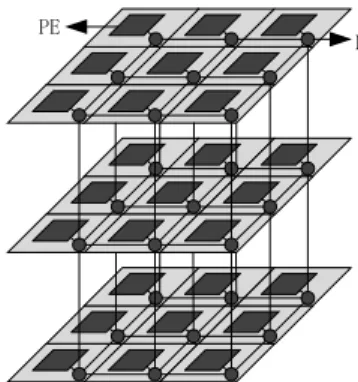
Generic 3D-NoC architecture is shown in Fig.1, which has three layers and each layer consists of nine titles. Each tile has a Processor Element (PE) and a Router. Each router has seven ports, including East, West, North, South, Local, Up and Down. Every router is connected to its neighboring routers on the same layer and it is also connected to the router on the layers above and below the current layer. The average power consumption
of multicast communication which sends 1 bit from source tile s to the set of destination tiles D can be represented as (1) [6],
(1) Where is the total number of routers traversed from tile s to tiles in D, and and are the count of horizontal and vertical links traversing on the multicast path, respectively.
is the bit energy consumed by the router,
is the bit energy consumed on each horizontal link, and
is the bit energy consumed on each vertical link.
B. Multicast Routing Algorithm
Due to
,
and
are all constant in (1), we should try to reduce and to reduce the communication energy consumption in multicast communication. That is, energy consumption reduction can be achieved by reducing the total length of communication path. Fully utilizing common transmission path applied in this paper is one of effective methods. Before the introduction of the 3D-POM, several concepts should be firstly introduced:
Basic Tree: The multicast transmission path which is composed of the source node and the destination nodes with the same X coordinateor Y coordinate in the same horizontal layer.
Real Destination: Node that itself is a destination.
Virtual Destination: Node that locates upward or downward direction of the real destination.
Mix Destination: Node locates upward or downward direction of a real destination and it is also a real destination.
In path establishment of 3D-POM, path will be calculated by every intermediate router passing through, rather than only by the source router. Therefore, each intermediate router must calculate the transmission path of the packet based on both the direction of destination nodes and the current location, so as to complete replication and forwarding operation. Thus, in such a distributed multicast routing strategy, each intermediate route only completed part of the multicast tree establishment, reducing the routing computation. And an optimal multicast tree can be achieved according to the different traffic distribution. A step-wise description of 3D-POM is as follows:
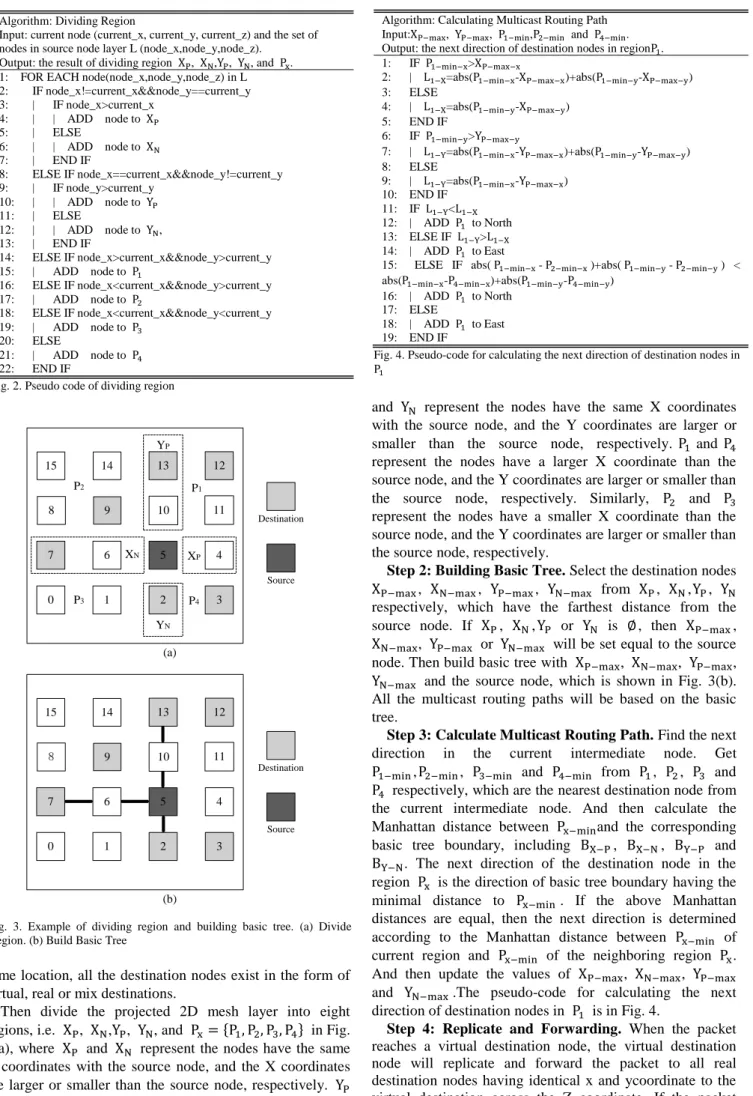
Step 1: Dividing Region. Divide the network into several regions based on the relative position of the source node and the destination node. The pseudo-code for the operation of the region dividing is in Fig. 2.
Firstly, all nodes of the 3D mesh network are projected on to a 2D mesh layer in which the source node is located. So, all nodes that have same x and y coordinate are now in the
PE Router
Fig. 1. 3D NoC architecture
same location, all the destination nodes exist in the form of virtual, real or mix destinations.
Then divide the projected 2D mesh layer into eight regions, i.e. , , , , and { } in Fig.
3(a), where and represent the nodes have the same Y coordinates with the source node, and the X coordinates are larger or smaller than the source node, respectively.
and represent the nodes have the same X coordinates with the source node, and the Y coordinates are larger or smaller than the source node, respectively. and represent the nodes have a larger X coordinate than the source node, and the Y coordinates are larger or smaller than the source node, respectively. Similarly, and represent the nodes have a smaller X coordinate than the source node, and the Y coordinates are larger or smaller than the source node, respectively.
Step 2: Building Basic Tree. Select the destination nodes
,
,
,
from , , , respectively, which have the farthest distance from the source node. If , , or is , then
,
,
or
will be set equal to the source node. Then build basic tree with
,
,
,
and the source node, which is shown in Fig. 3(b).
All the multicast routing paths will be based on the basic tree.
Step 3: Calculate Multicast Routing Path. Find the next direction in the current intermediate node. Get
,
,
and
from , , and respectively, which are the nearest destination node from the current intermediate node. And then calculate the Manhattan distance between
and the corresponding basic tree boundary, including
,
,
and
. The next direction of the destination node in the region is the direction of basic tree boundary having the minimal distance to
. If the above Manhattan distances are equal, then the next direction is determined according to the Manhattan distance between
of current region and
of the neighboring region . And then update the values of
,
,
and
.The pseudo-code for calculating the next direction of destination nodes in is in Fig. 4.
Step 4: Replicate and Forwarding. When the packet reaches a virtual destination node, the virtual destination node will replicate and forward the packet to all real destination nodes having identical x and ycoordinate to the virtual destination across the Z coordinate. If the packet
0 1 2
5
7 6 4
8 9 10 11
15 14 12
3 13
P2
P4 P1
P3
YN
YP
XN XP
Destination
Source
(a)
0 1 2
5
7 6 4
8 9 10 11
15 14 12
3 13
Destination
Source
(b)
Fig. 3. Example of dividing region and building basic tree. (a) Divide Region. (b) Build Basic Tree
Algorithm: Dividing Region
Input: current node (current_x, current_y, current_z) and the set of nodes in source node layer L (node_x,node_y,node_z).
Output: the result of dividing region , , , , and . 1: FOR EACH node(node_x,node_y,node_z) in L 2: IF node_x!=current_x&&node_y==current_y 3: | IF node_x>current_x
4: | | ADD node to 5: | ELSE
6: | | ADD node to 7: | END IF
8: ELSE IF node_x==current_x&&node_y!=current_y 9: | IF node_y>current_y
10: | | ADD node to 11: | ELSE
12: | | ADD node to , 13: | END IF
14: ELSE IF node_x>current_x&&node_y>current_y 15: | ADD node to
16: ELSE IF node_x<current_x&&node_y>current_y 17: | ADD node to
18: ELSE IF node_x<current_x&&node_y<current_y 19: | ADD node to
20: ELSE
21: | ADD node to 22: END IF
Fig. 2. Pseudo code of dividing region
Algorithm: Calculating Multicast Routing Path Input: , , , and . Output: the next direction of destination nodes in region . 1: IF >
2: | =abs( - )+abs( - ) 3: ELSE
4: | =abs( - ) 5: END IF
6: IF >
7: | =abs( - )+abs( - ) 8: ELSE
9: | =abs( - ) 10: END IF
11: IF <
12: | ADD to North 13: ELSE IF >
14: | ADD to East
15: ELSE IF abs( - )+abs( - ) <
abs( - )+abs( - ) 16: | ADD to North
17: ELSE
18: | ADD to East 19: END IF
Fig. 4. Pseudo-code for calculating the next direction of destination nodes in
reaches a mix destination node, the mix destination node will deal with the packet like a virtual destination and it will also eject the packet to its local port. And if the packet reaches to a real destination node then the packet will be replicated and ejected to the local port. Repeat the above step until the packet reaches all destination node.
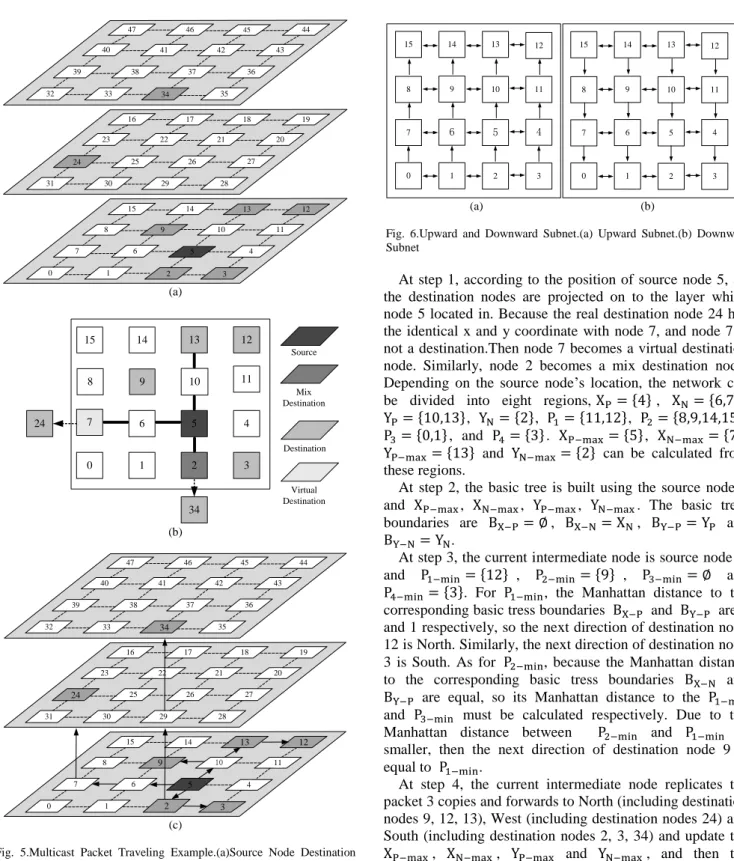
To make it more clear, we use the example in Fig.5 to simulate the process of sending a multicast packet to all destinations. When the network interface in node 5 initiatesone multicast packet, the routing computation component encodes the destination list in the packet header (currentdestination nodes are 2, 3, 9, 12, 13, 24 and 34).
At step 1, according to the position of source node 5, all the destination nodes are projected on to the layer which node 5 located in. Because the real destination node 24 has the identical x and y coordinate with node 7, and node 7 is not a destination.Then node 7 becomes a virtual destination node. Similarly, node 2 becomes a mix destination node.
Depending on the source node’s location, the network can be divided into eight regions, { } , { } , { }, { }, { }, { }, { }, and { }.
{ },
{ },
{ } and
{ } can be calculated from these regions.
At step 2, the basic tree is built using the source node 5 and
,
,
,
. The basic tress boundaries are
,
,
and
.
At step 3, the current intermediate node is source node 5, and
{ } ,
{ } ,
and
{ }. For
, the Manhattan distance to the corresponding basic tress boundaries
and
are 3 and 1 respectively, so the next direction of destination node 12 is North. Similarly, the next direction of destination node 3 is South. As for
, because the Manhattan distance to the corresponding basic tress boundaries
and
are equal, so its Manhattan distance to the
and
must be calculated respectively. Due to the Manhattan distance between
and
is smaller, then the next direction of destination node 9 is equal to
.
At step 4, the current intermediate node replicates the packet 3 copies and forwards to North (including destination nodes 9, 12, 13), West (including destination nodes 24) and South (including destination nodes 2, 3, 34) and update the
,
,
and
, and then the current nodes will become node 10, node 6 and node 2.
Then repeat the step 2 to 4 at the current nodes until the packet reaches all destination node.
Deadlock freedom is an important feature for every routing algorithm. Flows in the same network may cause a cyclic dependency, which freezes movement of all packets in a cycle [11] [12]. A turn restriction must be given to guarantee deadlock freedom. We use two subnets (upward and downward subnet) to avoid deadlock. Fig. 6 shows these two subnets. If a destination lies upside of current node, the packet is transmitted through upward subnet; otherwise we use downward subnet to transmit. There is no cycle dependency in each subnet, so no deadlock will occur.
47 46 45 44
32 33 35
39 38 37 36
40 41 42 43
16 17 18 19
31 30 29 28
27 26
25
23 22 21 20
15 14
0 1
7 6 4
8 10 11
5 3
12 13
24
34
2 9
(a)
0 1
34 5
6 4
8 9 10
15 14 12
3 13
11
24 7
2
Destination Source
Mix Destination
Virtual Destination
(b)
47 46 45 44
32 33 35
39 38 37 36
40 41 42 43
16 17 18 19
31 30 29 28
27 26
25
23 22 21 20
15 14
0 1
7 6 4
8 10 11
5 3
12 13
24
34
2 9
(c)
Fig. 5.Multicast Packet Traveling Example.(a)Source Node Destination Nodes. (b)Basic Tree. (c) Result of the Proposed Multicast Routing Algorithm.
0 1
6 4
8 10 11
15 14 13 12
9
5
7
2 3 0 1
6 4
8 10 11
15 14 13 12
9
5 7
2 3
(a) (b)
Fig. 6.Upward and Downward Subnet.(a) Upward Subnet.(b) Downward Subnet
IV. P
ERFORMANCEE
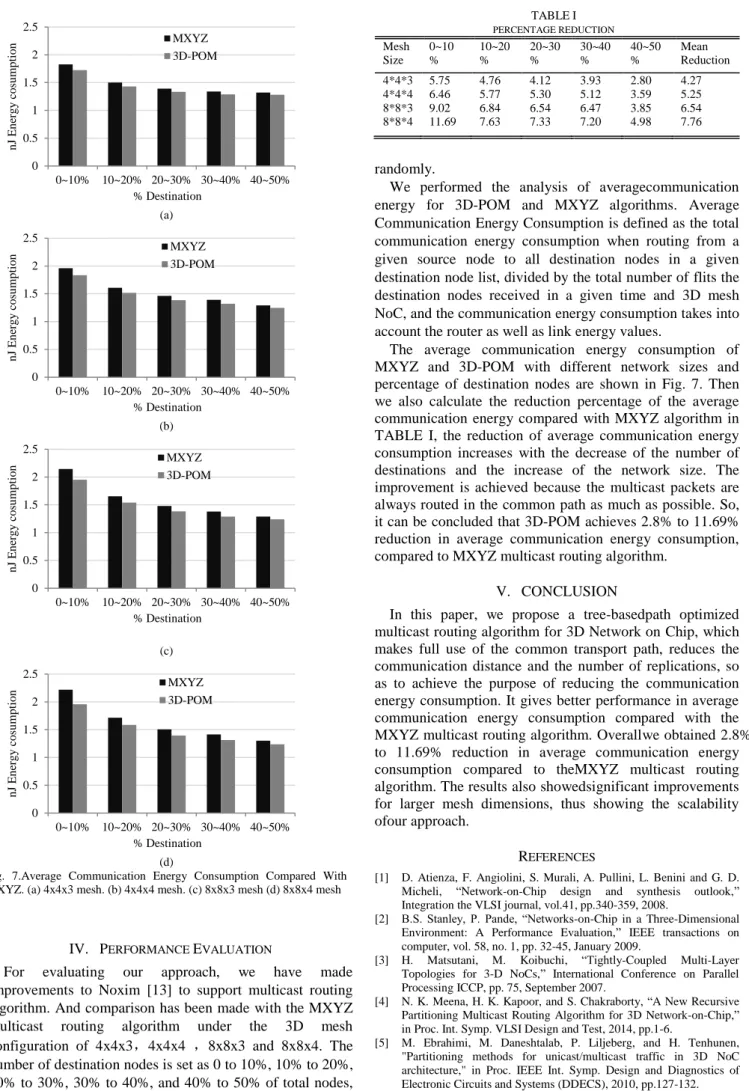
VALUATIONFor evaluating our approach, we have made improvements to Noxim [13] to support multicast routing algorithm. And comparison has been made with the MXYZ multicast routing algorithm under the 3D mesh configuration of 4x4x3,4x4x4 ,8x8x3 and 8x8x4. The number of destination nodes is set as 0 to 10%, 10% to 20%, 20% to 30%, 30% to 40%, and 40% to 50% of total nodes, respectively, and the destination nodes are distributed
randomly.
We performed the analysis of averagecommunication energy for 3D-POM and MXYZ algorithms. Average Communication Energy Consumption is defined as the total communication energy consumption when routing from a given source node to all destination nodes in a given destination node list, divided by the total number of flits the destination nodes received in a given time and 3D mesh NoC, and the communication energy consumption takes into account the router as well as link energy values.
The average communication energy consumption of MXYZ and 3D-POM with different network sizes and percentage of destination nodes are shown in Fig. 7. Then we also calculate the reduction percentage of the average communication energy compared with MXYZ algorithm in TABLE I, the reduction of average communication energy consumption increases with the decrease of the number of destinations and the increase of the network size. The improvement is achieved because the multicast packets are always routed in the common path as much as possible. So, it can be concluded that 3D-POM achieves 2.8% to 11.69%
reduction in average communication energy consumption, compared to MXYZ multicast routing algorithm.
V. CONCLUSION
In this paper, we propose a tree-basedpath optimized multicast routing algorithm for 3D Network on Chip, which makes full use of the common transport path, reduces the communication distance and the number of replications, so as to achieve the purpose of reducing the communication energy consumption. It gives better performance in average communication energy consumption compared with the MXYZ multicast routing algorithm. Overallwe obtained 2.8%
to 11.69% reduction in average communication energy consumption compared to theMXYZ multicast routing algorithm. The results also showedsignificant improvements for larger mesh dimensions, thus showing the scalability ofour approach.
R
EFERENCES[1] D. Atienza, F. Angiolini, S. Murali, A. Pullini, L. Benini and G. D.
Micheli, “Network-on-Chip design and synthesis outlook,”
Integration the VLSI journal, vol.41, pp.340-359, 2008.
[2] B.S. Stanley, P. Pande, “Networks-on-Chip in a Three-Dimensional Environment: A Performance Evaluation,” IEEE transactions on computer, vol. 58, no. 1, pp. 32-45, January 2009.
[3] H. Matsutani, M. Koibuchi, “Tightly-Coupled Multi-Layer Topologies for 3-D NoCs,” International Conference on Parallel Processing ICCP, pp. 75, September 2007.
[4] N. K. Meena, H. K. Kapoor, and S. Chakraborty, “A New Recursive Partitioning Multicast Routing Algorithm for 3D Network-on-Chip,”
in Proc. Int. Symp. VLSI Design and Test, 2014, pp.1-6.
[5] M. Ebrahimi, M. Daneshtalab, P. Liljeberg, and H. Tenhunen,
"Partitioning methods for unicast/multicast traffic in 3D NoC architecture," in Proc. IEEE Int. Symp. Design and Diagnostics of Electronic Circuits and Systems (DDECS), 2010, pp.127-132.
(a)
(b)
(c)
(d)
Fig. 7.Average Communication Energy Consumption Compared With MXYZ. (a) 4x4x3 mesh. (b) 4x4x4 mesh. (c) 8x8x3 mesh (d) 8x8x4 mesh
0 0.5 1 1.5 2 2.5
0~10% 10~20% 20~30% 30~40% 40~50%
nJ Energy cosumption
% Destination MXYZ 3D-POM
0 0.5 1 1.5 2 2.5
0~10% 10~20% 20~30% 30~40% 40~50%
nJ Energy cosumption
% Destination MXYZ 3D-POM
0 0.5 1 1.5 2 2.5
0~10% 10~20% 20~30% 30~40% 40~50%
nJ Energy cosumption
% Destination MXYZ 3D-POM
0 0.5 1 1.5 2 2.5
0~10% 10~20% 20~30% 30~40% 40~50%
nJ Energy cosumption
% Destination MXYZ 3D-POM
TABLEI
PERCENTAGE REDUCTION
Mesh Size
0~10
%
10~20
%
20~30
%
30~40
%
40~50
%
Mean Reduction
4*4*3 5.75 4.76 4.12 3.93 2.80 4.27
4*4*4 6.46 5.77 5.30 5.12 3.59 5.25
8*8*3 9.02 6.84 6.54 6.47 3.85 6.54
8*8*4 11.69 7.63 7.33 7.20 4.98 7.76
[6] Wang Xiaohang, M. Palesi, Jiang Yingtao, M. C. Huang and Liu Peng,
“Low latency and energy efficient multicasting schemes for 3D NoC-based SoCs,” in Proc. IEEE/IFIP Int. Conf. VLSI and System-on-Chip (VLSI-SoC), 2011, pp. 337-342.
[7] F. A. Samman, T. Hollstein, and M. Glesner, “Adaptive and Deadlock-Free Tree-Based Multicast Routing for Networks-on-Chip,”
IEEE Trans. Very Large Scale Integration System., vol. 18, no. 7, pp.
1067–1080, Jul. 2010.
[8] S. R. Moosavi, A. M. Rahmani, P. Liljeberg, and H. Tenhunen, “An efficient implementation of Hamiltonian path based multicast routing for 3d interconnection networks.” in Proc. 21st IranianConf. Electrical Engineering (ICEE), 2013, pp. 1-6.
[9] L. Wang, Y. Jin, H. Kim, and E. Kim, “Recursive partitioning multicast: A bandwidth-efficient routing for Networks-on-Chip,” in Proc. ACM/IEEE Int. Symp. Networks-on-Chip, 2009, pp. 64-73.
[10] A. B. Ahmed and A. B. Abderazek, “LA-XYZ: low latency, high throughput look-ahead routingalgorithm for 3D network-on-chip (3D-NoC) architecture,” in Proc. IEEE Int. Symp. Embedded Multicore Socs (MCSoC), 2012, pp. 167-174.
[11] Z. Lu, B. Yin, and A. Jantsch, “Connection-oriented Multicasting in Wormhole-switched Networks on Chip,” in Proc. IEEE Computer Society Annual Symposium, Emerging VLSI Technologies and Architectures, 2006, pp. 6.
[12] K. Lee, C. Chang, and H. Yang. “An efficient deadlock-free multicast routing algorithm for mesh-based networks-on-chip,” in Proc. IEEE Int. Symp. VLSI Design, Automation, and Test (VLSI-DAT), 2013, pp. 1-4.
[13] Noxim. Network-on-Chip Simulator. [Online]. Available:
https://github.com/davidepatti/noxim.