University of Warwick institutional repository: http://go.warwick.ac.uk/wrap This paper is made available online in accordance with
publisher policies. Please scroll down to view the document itself. Please refer to the repository record for this item and our policy information available from the repository home page for further information.
To see the final version of this paper please visit the publisher’s website. Access to the published version may require a subscription.
Author(s): Tall D.; Thomas M.; Davis G; Gray E.; Simpson A. Article Title: What Is the Object of the Encapsulation of a Process? Year of publication: 1999
Link to published version: http://dx.doi.org/10.1016/S0732-3123(99)00029-2
What is the object of the encapsulation of a process?
David Tall#, Michael Thomas+, Gary Davis*, Eddie Gray#, Adrian Simpson# #
University of Warwick, UK, +University of Auckland, New Zealand, *University of Southampton, UK
Dedicated to the memory of Robert B. Davis†
Several theories have been proposed to describe the transition from process to object in mathematical thinking. Yet, what is the nature of this “object” produced by the “encapsulation” of a process? Here we outline the development of some of the theories (including Piaget, Dienes, Davis, Greeno, Dubinsky, Sfard, Gray & Tall) and consider the nature of the mental objects (apparently) produced through encapsulation, and their role in the wider development of mathematical thinking. Does the same developmental route occur in geometry as in arithmetic and algebra? Is the same development used in axiomatic mathematics? What is the role played by imagery?
Theories of encapsulation/reification
In this article we address the question: what are mathematical objects and how are they constructed by the individual? This does not have a universal answer. Rather we must ask: what is a mathematical object for a given person in a given mathematical context? We contend that as mathematical maturity develops so does the number of available mathematical objects, each intimately linked with (and related to) other mathematical objects. It is the purpose of this article to consider how these objects are constructed.
In recent years there has been great interest in the encapsulation (or reification) of a process into a mental object as a fundamental method of constructing mathematical objects. Piaget (1985, p. 49) focused on the idea of how “actions and operations become thematized objects of thought or assimilation”. Dienes (1960), following Piaget, used a grammatical metaphor to formulate how a predicate (or action) becomes the subject of a further predicate, which may in turn become the subject of another. Davis (1984) formulated the same basic idea a quarter of a century later:
When a procedure is first being learned, one experiences it almost one step at time; the overall patterns and continuity and flow of the entire activity are not perceived. But as the procedure is practiced, the procedure itself becomes an entity – it becomes a thing. It, itself, is an input or object of scrutiny. All of the full range of perception, analysis, pattern recognition and other information
† The reader will notice that the work of Bob Davis features prominently in this article,
processing capabilities that can be used on any input data can be brought to bear on this particular procedure. Its similarities to some other procedure can be noted, and also its key points of difference. The procedure, formerly only a thing to be done – a verb – has now become an object of scrutiny and analysis; it is now, in this sense, a noun.
(pp. 29–30.) He formulated the notion of visually moderated sequence where each step is written down and prompts the next until the problem is solved. This becomes an integrated sequence when it is conceived as a whole and may be organized into sub-procedures. He also used the term “procedure” as a specific algorithm for implementing a “process” in an information-processing sense (Davis, 1983, p. 257).
At this time information processing was focusing on the way in which a procedure that can be used as an input to another procedure could be conceived as a “conceptual entity” (Greeno, 1983).
The notion of the transformation of a process into an object took new impetus in the work of Dubinsky (1986, 1991) and Sfard (1988, 1989, 1991). Sfard hypothesized two approaches to concept development, one
operational focusing on processes, the other structural, focusing on
objects.
A constant three-step pattern can be identified in the successive transitions from operational to structural conceptions: first there must be a process performed on the already familiar objects, then the idea of turning this process into a more compact, self-contained whole should emerge, and finally an ability to view this new entity as a permanent object in its own right must be acquired. These three components of concept development will be called interiorization, condensation, and reification, respectively.
Condensation means a rather technical change of approach, which expresses itself in an ability to deal with a given process in terms of input/output without necessarily considering its component steps.
Reification is the next step: in the mind of the learner, it converts the already condensed process into an object-like entity. … The fact that a process has been interiorized and condensed into a compact, self-sustained entity, does not mean, by itself, that a person has acquired the ability to think about it in a structural way. Without reification, her or his approach will remain purely operational.
(Sfard, 1992, pp. 64–65) Dubinsky (1986, 1991) and his colleagues (Cottrill et al, 1996) formulate the encapsulation of process into object as three stages of a four-part theory with the acronym APOS. A (step-by-step) action becomes conceptualized as a total process, is encapsulated as a mental object, to later become part of a mental schema.
The notions of action and process are characterized in a manner reminiscent of the notions of visually moderated sequence and integrated sequence of Davis:
of recalling some fact from memory. It may also be a multi-step response, by then it has the characteristic that at each step, the next step is triggered by what has come before, rather than by the individual’s conscious control of the transformation. … When the individual reflects upon an action, he or she may begin to establish conscious control over it. We would then say that the action is interiorized, and it becomes a process.(Cottrill, et al, 1996, p. 171 (our italics)) The action becomes a process when the individual can “describe or reflect upon all of the steps in the transformation without necessarily performing them.” A process becomes an object when “the individual becomes aware of the totality of the process, realizes that transformations can act on it, and is able to construct such transformations.”
The final part of the APOS structure occurs when “actions, processes and objects ... are organized into structures, which we refer to as schemas.” When this has been achieved, it is also proposed that:
“… an individual can reflect on a schema and act upon it. This results in the schema becoming a new object. Thus we now see that there are at least two ways of constructing objects — from processes and from schemas.”
(Cottrill, et al, 1996, p. 172 (our italics)) By considering the developments of concepts in simple arithmetic of whole numbers, Gray & Tall (1994) reviewed how a lengthy procedure such as “count-all” (count one set, count another, put the sets together and count all) becomes compressed into a shorter procedure “count-on”—with variants such as “count-both”, “count-on-from-larger”). Other techniques are also developed, such as remembering “known facts” and “deriving facts” from a combination of number facts and counting. Following Davis (1983) they used the term “procedure” as a specific algorithm for implementing a process and highlighted how a number of different procedures were being used to carry out essentially the same process in increasingly sophisticated ways. They noted that a symbol such as 4+2 occupies a pivotal role, as the process of addition (by a variety of procedures) and also as the concept of sum. Soon the cognitive structure grows to encompass the fact that 4+2, 2+4, 3+3, 2 times 3, are all essentially the same mental object. They therefore proposed the following definitions:
An elementary procept is the amalgam of three components: a process which produces a mathematical object, and a symbol which is used to represent either process or object.
A procept consists of a collection of elementary procepts which have the same
object. (Gray & Tall, 1994)
authors. This “lack of closure” is none other than the focus on the procedure of evaluation rather than on an algebraic expression as a manipulable procept. Gray and Tall (1994) also noted the peculiar case of the limit concept where the (potentially infinite) process of computing a limit may not have a finite algorithm at all. Thus a procept may exist which has both a process (tending to a limit) and a concept (of limit), yet there is no procedure to compute the desired result.
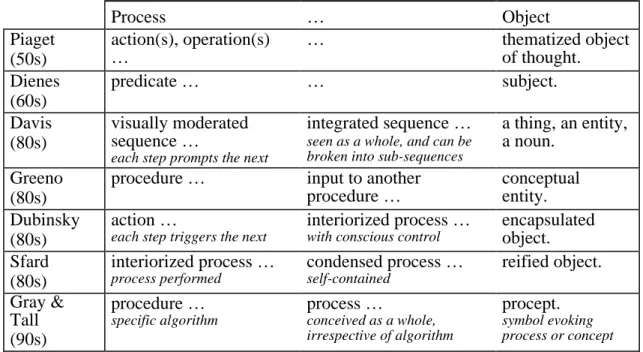
Table 1 shows a summary of the discussion so far. It does not intend any direct correspondence between the stages of the theories, simply that each passes through a development of growing sophistication from some kind of procedure/process usually performed step-by-step and ending with an object/concept that can be manipulated as an entity in its own right. The intermediate stages specified in each line are not intended to correspond directly. For instance, Greeno’s “input to another procedure” is essentially the same as conceiving a programming procedure as an entity, whereas Dubinsky characterizes the individual’s ability to take control of a repeatable action, and Sfard’s focus is on the ability to think of the process in terms of input/output without needing to consider the intermediate steps.
The wider literature of the various authors suggests further similarities and differences between their ideas. For instance, there seems to be broad agreement that a function as a process is determined as a whole by input-output, regardless of the internal procedure of computation. Thus the functions f(x) = 2x+6 and g(x) = 2(x +3) are one and the same as
Process … Object
Piaget (50s)
action(s), operation(s) …
… thematized object
of thought. Dienes
(60s)
predicate … … subject.
Davis (80s)
visually moderated sequence …
each step prompts the next
integrated sequence … seen as a whole, and can be broken into sub-sequences
a thing, an entity, a noun.
Greeno (80s)
procedure … input to another procedure … conceptual entity. Dubinsky (80s) action …
each step triggers the next
interiorized process … with conscious control
encapsulated object. Sfard
(80s)
interiorized process … process performed
condensed process … self-contained reified object. Gray & Tall (90s) procedure … specific algorithm process …
conceived as a whole, irrespective of algorithm
procept. symbol evoking process or concept
processes—even though the arithmetic procedures to compute them have a different sequence of operations. The intermediate stage(s) intimate how (one or more) specific procedures become seen as a single process without needing to carry out the intermediate steps.
What seems more problematic is to explain precisely what is meant by the“object”hypothesized as being constructed by encapsulation.
What is the “object” of encapsulation?
Dörfler questioned the nature of the object formed by encapsulation: … my subjective introspection never permitted me to find or trace something like a mental object for, say, the number 5. What invariably comes to my mind are certain patterns of dots or other units, a pentagon, the symbol 5 or V, relations like 5+5=10, 5*5=25, sentences like five is prime, five is odd, 5/30, etc., etc. But nowhere in my thinking I ever could find something object-like that behaved like the number 5 as a mathematical object does. But nevertheless I deem myself able to talk about the number “five” without having distinctly available for my thinking a mental object which I could designate as the mental object “5”. (Dörfler, 1993, pp. 146–147.) Support for this view comes from interviews on a video produced by Gray & Tall (1993) in which individuals were asked the following two questions:
What does the word “triangle” mean to you? What does the word “five” mean to you?
The first was invariably met with a description or definition of a three-sided figure as if the individual had a clear mental picture of what was being described, sometimes adding other properties, such as “the angles add up to 180”. The second invariably caused the difficulties described by Dörfler, with some individuals describing “five objects”, or a property such as “it’s one bigger than four”, yet not being able to describe what the term “five” meant of itself. However, all were secure when asked to
operate with the number “five”, for instance, that “five plus five” evoked
the response “ten”.
We hypothesize that the distinction between the notion “triangle” (which most would consider as an “object”) and “five”, which Dörfler suggests is not, is the difference between what we would term a “perceived object” and a “conceived object”. The first occurs based on perceptual information—seeing a triangle, physically cutting out a triangle, touching it, feeling the corners, counting the edges. The focus is therefore on specific physical manifestations of the notion of a triangle. The second occurs when there is reflection on perceptions and actions, with the focus shifted from the specific physical manifestations to the actions/processes performed upon them.
Piaget, as usual, made pertinent comments in this direction, long before any of the rest of us. He distinguished between empirical
objects and pseudo-empirical abstraction deriving knowledge from the processes which the individual performs on the objects. Empirical abstraction constructs a perceived object, or percept.
Pseudo-empirical abstraction constructs a conceived object which in many settings takes the form of a procept. For instance, a focus on the process of counting may progress to the idea that different ways of counting the same set give the same result, leading to the concept of number. Even though there may be no ‘mental object’ corresponding precisely to the number “5” as there is with a perceived object, there is a huge cognitive structure built up allowing the individual to use the symbol 5 as if it refers to an object. The number “5” has a concept image, in the sense of Tall & Vinner (1981), consisting of “all the mental pictures and associated properties and processes” related to the concept in the mind of the individual. The symbol “5” or the word “five” can be written, spoken, heard, seen and read. It can be manipulated mentally as if it were an object. This is a common mode of mental activity not just in mathematics, but throughout our whole experience. Lakoff and Johnson (1980) express this succinctly as follows:
Our experiences with physical objects (especially our own bodies) provide the basis for an extraordinarily wide variety of ontological metaphors, that is, ways of viewing events, activities, emotions, ideas, etc., as entities and
substances. (p.25)
It is essential in empirical abstraction to be aware of the genuine distinction between objects existing in the physical world and objects constructed in our minds. A stone in the real world can be thrown and a person can be hit with it. We cannot hit someone with a stone in our mind. Of course, the word “stone” is a result of a categorization and so, in some sense, a mature observer can take the “object” to be an instance of the constructed category of stones in our head. However, the reference, for the knower, is to a concrete object in the world: one that is heavy and hurts if one is hit with it. In considering the cognitive development of the individual it is not how we see things as mature reflective adults, but how a child senses them during the construction process.
For a child, pseudo-empirical abstraction involves an intimate connection between the objects operated upon and the concepts abstracted through operating upon them:
Empirical evidence collected by Gray and Pitta (1997) suggests that those who move to focus on the conceptual relationships rather than the perceptual arrangements are more likely to develop a flexible and powerful view of symbols and hence to have longer-term success. We therefore suggest that the total cognitive structure of the concept image of number, with its power to manipulate the symbols and to think of their properties, gives number its most powerful status as an object. What matters more is not what it is, but what we can do with it.
Mental conceptions of objects
The apparent “non-existence” of an “object” corresponding to a number is not as strange as at first seems. Consider, for example, the notion of “animal”, which includes cats, dogs and gorillas. When we mentally picture an “animal”, what do we “see”? The name “animal” is a signifier that can be used to signify any of a wide number of particular instances but we appear to fail to have a single mental object which is “an animal.” Nevertheless, to paraphrase Dörfler, although we may fail to have a unique mental object for “an animal” we deem ourselves able to talk about it.
This is a well-observed phenomenon in the verbal categorization of objects. Rosch (1978) notes that certain “basic” categories are more easily recognized and are often the first level comprehended by children. A basic category such as “dog” usually has a generic mental image that individuals can imagine in a representative way. Higher-order categorizations such as “animal” become so general as to fail to have a single mental image, although the basic categorizations within the category such as “dog”, “kangaroo”, “chimpanzee” are each capable of having a prototypical mental image. Such higher order categories may be supported not only by a variety of images, none of which is broadly characteristic of the whole category, but also by properties such as “being alive”, “having four legs”, “having fur” which may be typical of many members of the category, but not necessarily of all of them.
parallelograms, within the category of quadrilaterals, within polygons. This development is supported by a variety of experiences. For instance, a square may be categorized as a rectangle using the definition of having all angles right angles and each pair of opposite sides equal, or it may simply be added to the category of rectangles because it has been deemed to be so.
In this way we see that mental objects occurring in mathematics have aspects which are found in other areas of experience.
Language markers for objects
The discourse used to describe everyday objects, or mental images of such objects, is description. Whereas narrative discourse is used to describe a procedure or a succession of events, descriptive discourse usually features the simultaneity of various aspects of a to-be-described object. The possibility is, therefore, that we might ascertain whether an individual has constructed a mental object in relation to a concept by the way that individual talks or writes about the concept. In other words, seeing the
concept as an object is likely to lead to descriptive rather than narrative discourse. As Denis (1996) says:
“ ... descriptions are not disorganized lists of elements. Descriptions are constrained by the structural organization of described objects.” (p. 169) If someone conceived of “5” as a mental object what sort of language might they use to describe it? How might this language itself give us pointers to their seeing “5” as an object? Typically objects are described by their properties, their relationships with other objects, and the ways in which they can be used. For example, someone might describe a kitchen pot as generally round, made of metal, with a handle, and used for holding water in which to boil food. Similarly, if we say that 5 is a prime number, the third prime, and the second odd prime; it is the first number n for which there is a non-solvable polynomial of degree n, then we are describing properties of 5, and its relation to other things. Whether these other things—polynomials or other numbers—are themselves conceived as objects at the time is not the point at issue. It is the use of language in a way that intimates properties, relationships, usage of a concept which indicates that the individual is, in fact, conceiving “5” as an object.
The role of awareness in the construction of objects
procedure. This development utilizes imagery of fingers or other collections of objects in an important way as figurative material acted upon mentally and then re-interpreted (or re-presented) to see it also in terms of the results of the operations. This is essentially a change of focus of attention in the same way that Sfard speaks of focusing on structural or operational facets and Gray and Tall speak of the ambiguous use of symbolism to dually represent process or concept. The dual use of figurative imagery as operations or results is embodied in the following comment by Steffe about number units. The discussion can also be interpreted for many, if not all, mathematical procedures:
“I was thinking of, for example, the way in which a child might use the records of past experience that are recorded in the unit items of a sequence to regenerate something of that past experience in a current context. The figurative material that is regenerated may act as symbols of the operations of uniting or of the results of the operations in that the operations may not need to be carried out to assemble an experiential unit item. The figurative material stands in for the operations or their results. In this I assume that the records are interiorized records – that is, records of operating with re-presented figurative material.
My hypothesis is that these operations will continue to be outside the awareness of the operating child until a stand-in is established in which the operations are embedded. ... awareness to me is a function of the operations of which one is capable. But those operations must become objects of awareness just as the results of operating. To become aware of the operations involves the operations becoming embedded in figurative material on which the operations operate. To the extent that this figurative material can be re-generated the operations become embedded in it.
The figurative material is also operated on again. In this way the operations are enlarged and modified.” (Steffe, private communication) This point of view—that operations are outside conscious awareness until a mental “stand-in”, or symbol, is developed upon which the operations can act mentally—is of critical importance in our perception of the development of mathematical objects. For it is these symbols (in the sense of Steffe) that lead to objects: not only is the scope of the operations extended, as Steffe says, but what it is that the operations operate on becomes conceived as a mental object. One might argue that symbols, in Steffe’s sense, do not lead to objects: if they did, so the argument might go, our job of teaching would be very much easier for we could just give students appropriate symbols when we wanted them to form an object. However, this argument does not take into account that—by the very nature of symbols—we cannot simply “give” a student symbols. Their symbols have to be constructed through a subtle process of reflective abstraction.
than √2 because (3/2) 2 is greater than 2. The average of 1 and 3/2 is 5/4 which, again is smaller than √2. This procedure, repeated often enough gives a decent, but slow, approximation to √2. What is uppermost in a student’s mind after carrying out such a procedure? We hypothesize it relates to the answer to the question “What is the value of √2?” which may be calculated to some degree of accuracy using the procedure. The number √2 has the property that its square is (exactly) 2 and the procedure gives successively better approximations. What the student may not generally be aware of in the early stages—in the sense of being able to articulate it—is the nature of the overall procedure by which this approximation was found, despite the fact that the student can work step-by-step through the procedure to get an answer.
A student’s reflection on their actions—in the absence of actual calculations—may bring back to mind the episode of operating to calculate a good approximation to the square root of two. What might prompt such reflection? One thing could be a student’s wondering whether they could calculate an approximation to √3 in a similar way, or being asked to formulate such an approximation. Without actually going through the procedure, this recalling of the operations in a similar context allows the possibility—but not the necessity—of the student operating on mental imagery in the form of figurative material associated with the original calculations. The scope of the operations has become enlarged because, although students could, in principle, carry out the actual calculations to approximate √3, they may not, preferring instead to reflect on the figurative material in their mind. The original operations now become objects of awareness, and the sign “√n” has the possibility,
through repeated re-presentation, to become a symbol: the symbol of the operations embedded in the figurative material. This, we hypothesize, is what transforms √n into a mathematical object. Prior to the re-presented
figurative material and the act of operating on this material, √n may be a
procedure for which the only articulable awareness the student had was the result of concrete operations.
The scope of the process-object construction
Once the possibility is conceded that the process-product construction can be conceived as an “object”, the floodgates open. By “acting upon” such an object, the action-process-object construction can be used again and again.
The various proponents of process-object construction do not all claim the same scope for the application of their theories. For Dubinsky—utilizing Piaget’s notion of “permanent object”—a process is any cognitive process. The notion of “permanent object” arises through “encapsulating the process of performing transformations in space which do not destroy the physical object” (Dubinsky et al, 1988, p. 45). A “perceived object” in our sense is, for Dubinsky, formed by process-object encapsulation. He also sees the theory of encapsulation applying equally well to the logical construction of formal concepts in advanced mathematics. He also acknowledged that there may be many cognitive processes involved in the construction of a mental object, used in an increasingly coherent manner, leading naturally to his later assertion that objects can also be formed by encapsulating schemas. Dubinsky therefore offers a single, unified theory of encapsulating cognitive processes as cognitive objects after the manner of Piaget.
The scope of procept theory is narrower. This does not mean that it is weaker, since it is designed to give greater insight into the profoundly powerful use of symbols in mathematics to switch effortlessly between concepts to think about and mathematical processes to solve problems. The definition is formulated so that it can refer not only to the
construction of procepts, but also to the use of procepts which enables a
biological brain with a limited focus of attention to switch between thinking of the problem symbolically and then to perform a mathematical solution process.
The notion of procept was never intended to have the same broad scope as the theories of Sfard or Dubinsky. Neither the child’s notion of permanent object nor the students’ notion of axiomatic system are procepts because neither has a symbol capable of evoking either process or concept. Nor is the notion of procept defined to be explicitly tied to the situation in which the mental object represented by the symbol is necessarily construction by “encapsulation” from the corresponding
mathematical process, even though this is the way in which many procepts
are constructed.
As has often been emphasized by Dubinsky, there may be many processes involved in encapsulating a mental object not all of which are usually classified as being mathematical. For instance, the Solution
Sketcher software (Tall, 1991) allows the user to enter a first order
end-to-end can give a visual and kinesthetic meaning to a solution of a differential equation, including the insight that there is a unique solution through each point where the equation defines a slope. This suggests that it could be inappropriate to always insist that a mathematical process must be presented first so that it may then be encapsulated as a mathematical concept. Other cognitive processes can be used to build up useful parts of the concept image as foundations for later formal or symbolic development.
Sfard’s (1991) theory formulates two ways of constructing mathematical conceptions through the complementary notions of operational and structural activities as “two sides of the same coin”. It is the first of these which involves process-object construction. She makes the important observation that in any given mathematical context it is usually possible to see both operational and structural elements. For instance, in the transition from arithmetic to algebra, Sfard (1995, p.21) considers that, given “the boys outnumber the girls by four”, the number of boys can be formulated in an operational manner as “add four to the number of girls” or structurally as “x=y+4”.
Kieran (1992) also makes a distinction between the (numerical)
evaluation of an expression such as 2x+3 for a numerical value of x as
“operational” and the manipulation of such expressions as “structural”. However, this does not attend to the full subtlety of Sfard’s distinction between structural and operational. For Sfard, the algebraic expression itself has a structure but, once the student conceives the algebraic expressions as manipulable objects, then their manipulation is categorized as “operational”. The latter interpretation is consonant with the original ideas of Piaget where “operations” at one level (in this case algebraic formulae as generalized arithmetic operations) become “objects of thought” at a higher level (algebraic expressions) which can themselves be manipulated.
Structural aspects of mathematics
The term “structural” has more than one meaning in the literature. The French texts published under the corporate name of Bourbaki are often referred to as having a structural approach in the sense that they describe the formal “structures” of mathematical axiomatic systems. The set-theoretic “new math” of the sixties was often referred to as a “structural approach”. Sfard uses this interpretation when she describes two distinct aspects of proof by induction:
• Structural: given a set S ⊆ N, prove 1 ∈ S, and k ∈ S ⇒ k+1 ∈ S
to establish S = N. Sfard (1989, p. 151)
Her description of a function as a “set of ordered pairs” as structural (Sfard, 1991, p. 5), also agrees with the formal Bourbaki approach. However, in referring to structural conceptions as being “supported by visual imagery” while an operational conception is “supported by verbal representations” (ibid., p. 33), she is using a meaning different from that of Bourbaki. In this meaning she refers to the visual structure of a mental object by analogy with the structure of a building. For instance, she considers the visual imagery of a graph of a function to be structural (ibid., pp. 5, 6). She also provides perceptive empirical evidence in which mathematicians use visual and spatial metaphors to provide them with “intimate familiarity” with structure that gives “direct insight into the properties of mathematical objects,” (Sfard, 1994). Such insight may be fallible and is certainly not structural in the Bourbaki sense.
This suggests a clear distinction between the building of conceptions from visual and kinesthetic senses described verbally on the one hand and the more sophisticated construction of a formal theory of the properties of a concept which is specified by set-theoretic axioms. This in turn suggests that Sfard’s notion of “structural” can usefully be subdivided into two. On the one hand there is the focus on properties of observed or conceived objects (which usually involve visual and enactive elements). On the other, some of these properties are specified as set-theoretic axioms and definitions to give a formal theory that is “structural” in the sense of Bourbaki. In our perception, we would prefer to use the term “structural” to relate to the Bourbaki sense of the term, because we believe that this involves a more sophisticated form of mental construction than the visual and enactive construction of meaning from mental images.
Categorizing mathematical objects and their construction
Faced with several different versions of “object construction” in mathematics, we now come to the question of categorizing objects and their constructions in a manner that sharpens the relationships and differences between the theories. Dubinsky offers a broad vision which encompasses all the various methods of construction as process-object encapsulation. Sfard divides her theory into two (operational and structural) where the first is concerned with operations which may be reified into objects and the second focuses more on the properties of the objects themselves. Gray and Tall offer a theory more focused on the relationship between mathematical processes, objects and symbols that dually evoke both.
Different classifications can operate at different levels and have different uses. Our quest here is to seek a classification that is useful for distinguishing cases that involve differing cognitive constructions and necessitate different strategies in learning. Sfard makes a step in this direction by hypothesizing that operational constructions are more primitive than structural so that that an operational approach should usually precede a structural. Other levels of categorizations are also possible, for instance, subdividing the notion of structural into distinct categories as proposed earlier.
To seek a cognitively based categorization at an appropriate level of generality, we return to Piaget’s distinction between empirical and
pseudo-empirical abstraction which we see operating in different cognitive
described by Van Hiele (1986) and another in arithmetic and algebra based on symbols dually representing process and concept. After the initial use of empirical and pseudo-empirical abstraction, constructions proceed also by reflective abstraction that occurs through reflections on the manipulation of mental objects already constructed. However, we see differing kinds of reflective abstraction depending on the focus of attention of the construction process.
In geometry, although there are many processes involved, including the formal processes of geometric construction, we hypothesize that the main focus is initially on objects. This leads to a sequence of development from teasing out the properties of the objects, making verbal descriptions, thinking about relationships, verbalizing inferences, formulating verbal proofs, leading to a broad development after the fashion described by Van Hiele (1986). As the development becomes more sophisticated, the form of object construction becomes more subtle. In the initial stages the child is building a conceptual meaning for real-world objects and their properties by perceiving and acting upon them to construct percepts (through empirical abstraction). The next Van Hiele stage involves classifying these percepts into separate classes that are not yet hierarchical, for instance, squares (four sided figures with right angles and all four sides equal) are not special cases of rectangles (which only have
opposite sides equal). The next stage builds up hierarchies by using verbal
descriptions. The focus switches from the objects described to the nature of the descriptions themselves that are then used to define objects. At this stage mental objects are constructed as imaginary manifestations of the perfection of the definition, for instance, lines with no thickness that can be extended arbitrarily in either direction. Thus the construction of
perceived geometric objects leads later to conceived geometric objects
which, though imagined in the mind’s eye, and discussed verbally between individuals, are perfect entities that have no real-world equivalent. Tall (1995) referred to these conceived objects as platonic
objects, and quoted the observations of G. H. Hardy explaining his
conceptions as a professional mathematician:
… I draw figures on the blackboard to stimulate the imagination of my audience, rough drawings of straight lines or circles or ellipses. It is plain, first, that the truth of the theorems which I prove is in no way affected by the quality of my drawings. Their function is merely to bring home my meaning to my hearers, and, if I can do that, there would be no gain in having them redrawn by the most skilful draughtsman. They are pedagogical illustrations, not part of the real subject-matter of the lecture. (Hardy, 1940, p. 125.) The mental objects of higher geometrical thinking are therefore no longer the physical drawings of the individuals, but shared platonic mental conceptions with perfect properties that underlie them.
addition, subtraction, and on the symbols used to represent them. The encapsulation of processes into arithmetic procepts (using symbols as a pivot between the two) also change in their cognitive sophistication as the conceptions are built in later developments. In arithmetic all the symbols have built-in computational processes to “give an answer”. In algebra the symbols are now algebraic expressions which only have a potential process of inner computation— the evaluation of the expression when the variables are given numerical values. Despite this, the symbols themselves can be manipulated algebraically and a finite number of such manipulations can be used to solve linear and quadratic equations. In the calculus the situation changes again, with limit processes that are now
potentially infinite and so we may have a limit concept which has an
infinite process attached with no finite procedure of computation. Thus, although the symbols all have a process-concept framework, which enables them all to be classified as procepts, the changes in the nature of the procept cause major cognitive difficulties in the transition from arithmetic to algebra and algebra to calculus. This also explains why students are so much more able to compute with the finite procedural rules for differentiation in the calculus than conceptualize the infinite process of limit.
In elementary mathematics a versatile approach links proceptual symbolism of arithmetic and algebra to visual representations using a number line and coordinate plane. As visual and symbolic aspects grow in sophistication, they may be linked together in different ways, with a curriculum designed to build from those aspects more easily grasped by the individual to building up more sophisticated aspects. This occurs in the “locally straight” approach to the calculus where the visual and enactive notion of local straightness (with its dynamic computer pictures) can be explored before, or in tandem with, the numerical or algebraic facets which have a more sophisticated notion of “locally linear” (with its ensuing symbolism). Likewise the inverse process of solving differential equations can be performed visually and enactively supported by computer software to give a perceived solution before the numeric or symbolic processes are studied in detail.
A further case of “process-object” construction is the notion of a
defined object. For Dubinsky this is again a case of encapsulation of
process into object. In the sense of Sfard, it has structural overtones because the definition specifies certain structural criteria. However, just as Sfard’s notion of “structural” has two different senses, there are two corresponding meanings to an object specified by a definition. Our earlier discussion of Euclidean geometry noted that the individual has in mind certain mental objects that are then defined linguistically, such as a line, a point, a triangle, and a circle. This notion of “definition” is consonant with the notion of definition in a dictionary. It specifies an object by referring to other familiar ideas encountered earlier by the individual. There may be well-known examples of such a defined object that all seem to have a common property, and yet this property may not follow from the specified criteria. For instance, the notion of triangle carries with it the properties inherent in two-dimensional space. Its angles add up to 180°. Yet if a triangle is defined formally in some other type of geometry, for instance the geometry on the surface of a sphere (on which we happen to live—“geometry” means “earth measurement”)—then the sum of its angles may be different. Just try cutting the skin of an orange and see. Two cuts through the “north pole” at right angles to one another meeting a cut round the equator will give a spherical triangle with three right angles, adding up to 270°.
until it is greater than half the surface area of the sphere, what may be termed the “inside” becomes the “outside” and vice-versa.)
The shift from Euclidean geometry, with its platonic objects based on the refined perceptions of the senses, to axiomatic geometries where everything is defined purely in terms of explicit axioms and logical deductions was noted as a further stage in cognitive development by Van Hiele. This confirms the need to distinguish between two different constructions of defined objects—platonic objects found, for example, in Euclidean geometry, and axiomatic objects constructed within a theory founded on axioms.
In the first case a platonic object begins with a mental image refined from experience of physical forms and then given a verbal definition to focus on the perfection of the ideas within it. In the second case, an axiomatic object may arise from experiences of explicit situations that have certain properties in common. Historically, the definitions used in axiomatic theories have only arisen after long periods of study of the phenomena to be axiomatized. But once these properties have been enshrined in axioms and set-theoretic definitions the only properties possessed by the axiomatic object are those that can be deduced by formal proof. The formal part of an axiomatic theory (e.g. group theory, vector space theory, topology) begins with an explicit set of axioms (for group, vector space, topological space) and further objects may be defined by formal definitions in each theory (e.g. sub-group, normal sub-group, coset, quotient group; spanning set, linearly independent set, basis, subspace; continuous function, uniformly continuous function, compact set, etc.).
The essential difference between platonic and axiomatic objects is that in the first the object is the initial focus of attention and the definition is constructed from the object. In the axiomatic theory of the second, the
definition is the initial focus of attention and the object is constructed from
the definition, determining its properties by proving theorems. Gray et al. (in press) distinguish these by referring to “object→definition” construction of platonic objects and “definition→object” construction of axiomatic objects.
one, unique, identity element in a group”. Theorems deduced in this way give properties shared by all structures that satisfy the criteria. We use the same linguistic conventions in speaking of “a group” as we do in speaking of “an animal”. For instance, we can say treat it as a “thing” and say “a group has a unique identity element.”
Summary
In this paper we have discussed the ways in which mental objects can be constructed in mathematics and have distinguished three types of object construction, each of which operates in an increasingly sophisticated manner:
• perceived objects, arising through empirical abstraction from
objects in the environment (and later may be given successively subtler meaning through focusing also on verbal descriptions and definitions to construct platonic objects),
• procepts, which first involve processes on real-world objects,
using symbols which can then be manipulated as objects, upon which operations may be performed and symbolized in the same way,
and
• axiomatic objects, conceived by specifying criteria (axioms or
definitions) from which properties are deduced by formal proof.
These are related to Piaget’s notions of abstraction as follows. Perceived objects arise through empirical abstraction, and more sophisticated platonic objects may be later constructed through reflective abstraction. Procepts arise first through pseudo-empirical abstraction from actions on real-world objects and then by higher level reflective abstraction on the resulting conceived objects that represented by symbols enabling us to pivot between process and concept. Defined objects occur by reflective abstraction from the properties of perceived or conceived objects (including both platonic and proceptual). Selected properties are formulated as axioms and definitions and other properties are constructed as theorems through logical processes of deduction. Platonic objects, procepts and defined objects are all categories of conceived objects.
The “object” of the encapsulation of a process is a way of thinking which uses a rich concept image to allow it to be a manipulable entity, in part by using mental processes and relationships to do mathematics and in part to use a name or symbol to mentally manipulate, and to think about mathematics.
References
Trigonometry Using Computer Software, In Fulvia Furinghetti, (Ed.), Proceedings of PME XIII, (pp. 144–151), Assisi, Italy.
Brown, Anne, DeVries, David J., Dubinsky, Ed & Thomas, Karen (1997). Learning Binary Operations, Groups and Subgroups, Journal of Mathematical Behavior, 16, 187–240.
Asiala, Mark, Dubinsky, Ed, Mathews, David M, Morics, Steven & Okta, Asuman (1997). Development of Students' Understanding of Cosets, Normality, and Quotient Groups, Journal of Mathematical Behavior, 16, 241–309.
Cottrill, Jim, Dubinsky, Ed, Nichols, Devilyna, Schwingendorf, Keith, Thomas, Karen & Vidakovic, Draga (1996). Understanding the limit concept: Beginning with a co-ordinated process schema. Journal of Mathematical Behavior, 15, 167–192.
Davis, Robert B. (1983). Complex Mathematical Cognition. In Herbert P. Ginsburg (Ed.) The Development of Mathematical Thinking, (pp. 254–290). Academic Press, New York.
Davis, Robert B. (1984). Learning mathematics: the cognitive science approach to mathematics education. Norwood, NJ: Ablex.
Denis, Michel (1996) Imagery and the description of spatial configurations. In Manuel de Vega, Margaret Jean Intons-Peterson, Phillip Johnson-Laird, Michel Denis & Marc Marschark, (Eds), Visuospatial Cognition, (pp. 128–197). Oxford: Oxford University Press.
Dienes, Zoltan P. (1960). Building up Mathematics, Hutchinson Educational: London. Dörfler, Willibald. (1993). Fluency in a discourse or manipulation of mental objects,
In Ichiei Hirabayashi, Nobuhiko Nohda, Keiichi Shigematsu and Fou-Lai Lin, (Eds.), Proceedings of PME 17, (vol. 2, pp.145–152), Tsukuba, Japan.
Dubinsky, Ed (1986), Reflective Abstraction and Computer Experiences: A new approach to teaching theoretical mathematics, In Lappan, Glenda, Even, Ruhama, (Eds), Proceedings of the Eighth Annual Meeting of PME-NA, E. Lansing, Michigan: Michigan State University.
Dubinsky, Ed (1991). Reflective Abstraction in Advanced Mathematical Thinking. In David O. Tall (Ed.) Advanced Mathematical Thinking (pp. 95–123). Kluwer: Dordrecht.
Dubinsky, Ed, Elterman, Flor & Gong, Cathy (1988). The Student’s Construction of Quantification. For the Learning of Mathematics 8, 44–51.
Gray, Eddie, M, Pitta, Demetra (1997). In the Mind … What can imagery tell us about success and failure in arithmetic? In G. A. Makrides (Ed.), Proceedings of the First Mediterranean Conference on Mathematics, (pp. 29–41). Nicosia: Cyprus.
Gray, Eddie M. & Tall, David O. (1991). Duality, Ambiguity and Flexibility in Successful Mathematical Thinking, In Fulvia Furinghetti, (Ed.), Proceedings of PME XIII, (vol. 2, pp. 72–79). Assisi, Italy.
Gray, Eddie M. & Tall, David O. (1993). Can You Count On It? Video available from Mathematics Education Research Centre, Warwick University, UK.
Gray, Eddie M. & Tall, David O. (1994). Duality, Ambiguity and Flexibility: A
Proceptual View of Simple Arithmetic, The Journal for Research in Mathematics Education, 26, 115–141.
Greeno, James (1983). Conceptual Entities. In Dedre Gentner, Albert L. Stevens (Eds.), Mental Models, (pp. 227–252). Hillsdale, NJ: Lawrence Erlbaum Associates.
Hardy, G. H. (1940). A Mathematician’s Apology (2nd edition, 1967). Cambridge: CUP.
Hong, Ye Yoon & Thomas, Michael O. J. (1997). Using the Computer to Improve Conceptual Thinking in Integration, Proceedings of the 21st
Conference of the International Group for the Psychology of Mathematics Education, (vol. 3, pp. 81–88). Lahti, Finland.
Kieran, Carolyn (1992). The Learning and Teaching of School Algebra. In Douglas A. Grouws (Ed.) The Handbook of Research on Mathematics Teaching and
Learning, (pp. 390–419), New York: Macmillan.
Lakoff, George & Johnson, Mark (1980). Metaphors We Live By. Chicago: University of Chicago Press.
Piaget, Jean (1972). The Principles of Genetic Epistemology. London: Routledge & Kegan Paul.
Piaget, Jean (1985). The Equilibrium of Cognitive Structures. Cambridge MA: Harvard University Press.
Rosch, Eleanor (1978). Principles of Categorization. In Rosch, Eleanor, Lloyd, Barbara B. (Eds) (pp. 27–48), Cognition and Categorization. Hillsdale, NJ: Lawrence Erlbaum Associates
Sfard, Anna (1988). Two conceptions of mathematical notions: operational and structural. In Proceedings of PME XII, (pp.162–169), Montréal, Canada.
Sfard, Anna (1989). Transition from Operational to Structural Conception: The notion of function revisited. In Proceedings of PME XIII, (pp.151–158), Paris, France. Sfard, Anna (1991). On the Dual Nature of Mathematical Conceptions: Reflections on
processes and objects as different sides of the same coin, Educational Studies in Mathematics, 22, 1–36.
Sfard, Anna (1992). Operational origins of mathematical objects and the quandary of reification—the case of function. In Guershon Harel & Ed Dubinsky (Eds.), The Concept of Function: Aspects of Epistemology and Pedagogy, MAA Notes 25, (pp. 59-84). Washington DC: MAA.
Sfard, Anna (1995). The Development of Algebra: Confronting Historical and psychological Perspectives, Journal of Mathematical Behavior, 14, 15–39. Skemp, Richard R. (1979). Intelligence, Learning and Action, London: Wiley. Tall, David O. (1985). Understanding the calculus, Mathematics Teaching 110,
49–53.
Tall, David O. (1991). Intuition and rigour: the role of visualization in the calculus. In Stephen Cunningham & Walter S. Zimmermann (Eds), Visualization in Teaching and Learning Mathematics, MAA Notes No. 19, (pp.105-119). Washington DC: MAA.
Tall, David O. (1995). Mathematical Growth in Elementary and Advanced
Mathematical Thinking, (plenary address). In Luciano Meira & David Carraher, (Eds.), Proceedings of PME 19, (vol.1, pp. 61–75). Recife, Brazil.
Tall, David. O. & Thomas, Michael O. J. (1989). Versatile Learning and the Computer, Focus, 11, 117–125.
Tall, David O. & Thomas, Michael O. J. (1991). Encouraging Versatile Thinking in Algebra using the Computer, Educational Studies in Mathematics, 22, 125–147. Tall, David O. & Vinner, Shlomo (1981). Concept image and concept definition in
mathematics, with special reference to limits and continuity, Educational Studies in Mathematics, 12, 151–169.
Thomas, Michael O. J. (1988). A Conceptual Approach to the Early Learning of Algebra Using a Computer, Ph.D. Thesis, University of Warwick, UK. Van Hiele, Pierre (1986). Structure and Insight. Orlando: Academic Press. Von Glasersfeld, Ernst (1987). Preliminaries in any Theory of Representation. In