
M&A failure factors
153
0
0
Full text
(2) Abstract Purpose: The aim of this master thesis is to analyse the relationship between M&A failure factors found in the literature and M&A failure factors identified at the CORPORATE BANK case studies. Methodology: This research employs a combination of quantitative research and qualitative research. Literature is searched on the base of secondary research on M&A failure factors, published by experts. Key search terms, various synonyms and related terms are applied in the literature search in order to identify generalizable M&A failure factors. The qualitative research concerns ## case studies at CORPORATE BANK. Semi-structured interviews are conducted in order to refine and extend on the caserelated information retrieved from CORPORATE BANK’s applications. Theoretical Implications: In the literature, there is little consensus regarding the reasons for acquisition failure. The results of the literature review supports this matter of contention as the literature review results in an extensive list of M&A failure factors. This research contributes to theory by creating clarity in the available M&A failure factors in the literature. Literature is inventoried, and by doing so, clarity is created through an overview displaying M&A failure factors found in the literature. This is of added value since even though there is no single recipe for M&A failure, the most remarkable finding of the literature review is that failure factors associated to management have been indicated most often. Yet, the substantial challenge is to extend the overview displaying the M&A failure factors, e.g. by adjusting the failure factors related to unforeseen events such as the Economic Crisis. Yet, one should be cautious with theorizing that the number of times a failure factor is mentioned is a criterion regarding the determinativeness of that failure factor. Practical Implications: The findings of the CORPORATE BANK case studies indicate that 95% of the defaulted acquisition credit loans can be explained by only two failure factor categories (i.e. managerial problems and economic crisis). Therefore, the results of the CORPORATE BANK cases are controversial regarding the little consensus of the M&A failure factors identified in the literature. The intended contribution to practice is a report for CORPORATE BANK which not only contains an overview of the defaulted acquisition credit loans issued by CORPORATE BANK, but also contains an overview with the factors that contributed to the defaulted acquisition credit loans. This report is advantageous for CORPORATE BANK as it allows CORPORATE BANK to anticipate on the failure factors and to mitigate the M&A transaction risk for the future. The substantial challenge for CORPORATE BANK is to decide whether or not additional procedures should be launched e.g. regarding cyclical businesses or businesses involving multiple shareholders. Keywords: Mergers & Acquisitions, Takeovers, Failure Factors, CORPORATE BANK.
(3) Preface This Master Thesis is written as a completion of the Financial Management master at the University of Twente. The subject M&A failure factors has been chosen as a continuation of my interest in Corporate Finance. Even though the master Financial Management is already interrelated with Corporate Finance, I saw this research as an opportunity to gain further knowledge and experience in the world of Corporate Finance. In order to gain practical experience, I applied for an internship at CORPORATE BANK. Condition of the internship was that I showed my commitment through assisting with organizing a client event. As it concerned an event regarding the valuation of businesses, I was very happy to be of assistance as I could not only develop my organizational skills, but at the same time I could also learn more about the valuation (issues) of businesses. Moreover, during the internship, I gained experience in several applications and in conducted interviews. Furthermore, I developed myself through realizing that it is not always efficient do all the work yourself. Sometimes, it is more efficient to ask colleagues for help, or just for their insights. Even though it was sometimes difficult to find a balance between “what does CORPORATE BANK wants” and “what does the University of Twente wants”, my experience of the internship at CORPORATE BANK is positive. Several persons have contributed academically, practically and with support to this master thesis. Therefore, I would firstly like to thank my supervisor of the University of Twente, ir. H. Kroon, for his time and guidance throughout the entire master period. Furthermore, I would like to thank my supervisor of CORPORATE BANK, Elroy Witzand, for his time, constructive comments and valuable input regarding the research. Accordingly, I would like to thank CORPORATE BANK as organization for providing me with the opportunity for doing research, introducing me to numerous people and for making it possible to develop myself on several areas. Finally, I would like to thank my family and friends for their moral support during my time studying at the University of Twente. I hope you will enjoy reading this thesis. Enschede, August 25th 2016 Renée Houwers.
(4) Table of Contents 1.. 2.. 3.. Introduction .......................................................................................................................................... 1 1.1. Background Information ............................................................................................................... 1. 1.2. Research Goal ............................................................................................................................... 2. 1.3. Research Question ........................................................................................................................ 2. 1.4. Scope ............................................................................................................................................. 3. 1.5. Intended contribution of the Research......................................................................................... 3. Methodology......................................................................................................................................... 5 2.1. Data Collection Literature Review ................................................................................................ 5. 2.2. Data Collection Case Studies......................................................................................................... 7. Theoretical Framework ....................................................................................................................... 13 3.1. The term “M&A” ......................................................................................................................... 13. 3.2. Background on Mergers & Acquisitions...................................................................................... 14. 3.3. Current Mergers & Acquisitions Market ..................................................................................... 14. 3.4. Different Types of M&A’s............................................................................................................ 15. 3.5. Motives for M&A’s. ..................................................................................................................... 16. 3.6. M&A Challenges .......................................................................................................................... 16. 3.6.1. Integration Challenges ........................................................................................................ 16. 3.6.2. Managerial Challenges ........................................................................................................ 18. 3.6.3. Target Valuation Challenges ............................................................................................... 19. 3.6.4. Synergy Realization Challenges ........................................................................................... 20. 3.7. 3.7.1. Failure due to Human Aspects ............................................................................................ 24. 3.7.2. Failure due to Valuation Problems ..................................................................................... 25. 3.7.3. Failure due to Managerial Problems................................................................................... 26. 3.7.4. Failure due to Integration Problems ................................................................................... 26. 3.8 4.. M&A Failure Factors. .................................................................................................................. 22. Conclusion Literature Review ..................................................................................................... 27. CORPORATE BANK .............................................................................................................................. 29 4.1. General Information about CORPORATE BANK .......................................................................... 29. 4.2. History of CORPORATE BANK ..................................................................................................... 30.
(5) 5.. 4.3. Sector Advisory & Sustainability ................................................................................................. 30. 4.4. CORPORATE BANK’s M&A Policy ................................................................................................ 32. 4.5. Financial Restructuring & Recovery ............................................................................................ 32. 4.6. UCR.............................................................................................................................................. 32. CORPORATE BANK Case Studies ......................................................................................................... 34 5.1. 5.1.1. Categories of Failure Factors .............................................................................................. 35. 5.1.2. Individual Failure Factors .................................................................................................... 36. 5.1.3. Conclusion Failure Factors of the Defaulted Acquisition Credit Loans ............................... 45. 5.2. 6.. Failure Factors of the Defaulted Acquisition Credit Loans ......................................................... 35. Descriptive Factors of the Case Studies ...................................................................................... 46. 5.2.1. Year of Issuing Acquisition Credit Loan ............................................................................... 49. 5.2.2. Year of Transfer to FR&R..................................................................................................... 50. 5.2.3. Months between Issuing Acquisition Credit Loan and Transfer to FR&R ........................... 51. 5.2.4. UCR ...................................................................................................................................... 53. 5.2.5. Number of Shareholders after the Acquisition ................................................................... 55. 5.2.6. Age of the Entrepreneur(s) ................................................................................................. 57. 5.2.7. Sector the Business is operating in ..................................................................................... 59. 5.2.8. Form of Acquisition ............................................................................................................. 61. 5.2.9. Family Business ................................................................................................................... 62. 5.2.10. Conclusion of the Descriptive Factors of the Case Studies ................................................. 64. 5.3. Future Perspective of the Cases.................................................................................................. 67. 5.4. Overall Conclusion of the Case Studies....................................................................................... 70. General Conclusions and Discussion................................................................................................... 73 6.1. Conclusion – Central Research Question .................................................................................... 73. 6.2. Interpretation of the Results ...................................................................................................... 77. 6.3. A Critical Look towards the Results............................................................................................. 77. 6.4 Conclusion – Research Questions ..................................................................................................... 79 6.5. Unexpected Findings ................................................................................................................... 82. 6.6. Theoretical and Practical Implications ........................................................................................ 83. 6.6.1 Theoretical Implications ............................................................................................................. 83 6.3.2. Practical Implications ................................................................................................................ 84.
(6) 6.7. Recommendations for CORPORATE BANK.................................................................................. 84. 6.7.1. Recommendations based on the M&A Failure Factor results. ........................................... 85. 6.7.2. Recommendations based on the Descriptive Factors. ....................................................... 86. 6.7.3. General Recommendations for CORPORATE BANK ............................................................ 87. 6.8. Research Limitations ................................................................................................................... 88. 6.8.1. Quantitative Research Limitations ...................................................................................... 88. 6.8.2. Qualitative Research Limitations ........................................................................................ 89. 6.8.3. Limitations of the Researcher ............................................................................................. 91. 6.9. Suggestions for Further Research ............................................................................................... 91. 7.. References .......................................................................................................................................... 93. A.. Appendices ........................................................................................................................................ 103 A.1 Appendix I – Search Terms, Databases, Results ............................................................................ 103. The role of corporate culture in mergers and acquisitions ...................................................................... 103 A.2 Appendix II – M&A ......................................................................................................................... 109 A.3 Appendix III – History of CORPORATE BANK .................................................................................. 110 A.4 Appendix IV – M&A History ............................................................................................................ 112 A.5 Appendix V – Types of M&A’s ........................................................................................................ 114 A.5.1 Horizontal acquisition .............................................................................................................. 114 A.5.2 Vertical acquisition .................................................................................................................. 114 A.5.3 Conglomerate Acquisition ....................................................................................................... 115 A.6 Appendix VI – Motives for M&A’s .................................................................................................. 116 A.6.1 Rational Motives for M&As ..................................................................................................... 116 A.6.2 Non-rational motives for M&A’s ............................................................................................. 121 A.7 Appendix VII – Numbered Articles.................................................................................................. 123 A.8 Appendix VIII – Individual Failure Factors of the Literature Review .............................................. 126 A.9 Appendix IX – Categories of Individual Failure Factors .................................................................. 134 A.9.1 Human Aspects ........................................................................................................................ 134 A.9.2 Valuation Problems ................................................................................................................. 135 A.9.3 Managerial Problems ............................................................................................................... 136 A.9.4 Integration Problems ............................................................................................................... 138 A.18 Appendix XVIII – Management Risk Evaluation ............................................................................ 139.
(7) A.19 Appendix XIX - Template Semi-Structured Interview ................................................................. 140 A.20 Appendix XX - E-mail to introduce the Research ........................................................................ 146.
(8) 1. Introduction This first chapter focusses on M&A background information, the research goal and research questions. In addition, the scope and intended contribution of the research will be covered.. 1.1 Background Information Mergers and acquisitions represent a complex phenomenon exemplifying an interesting paradox. On one side, growing M&A activity and volume can be observed while on the other side, a high failure rate of M&A is recognized. Fortunately, many academics from several disciplines are interested in the world of M&A (Birkinshaw et al., 2000), including the financial, strategic, behavioural, operational and crosscultural aspects of this challenging activity (Cartwright & Schoenberg, 2006). Therefore, voluminous research data, both quantitative and qualitative, is available. Research indicates that approximately 40%-60% of all acquisitions fail to achieve their desired outcomes (Uzelac et al., 2015). Yet, some research even present a higher M&A failure rate of 60%-80% (Angwin, 2007, Groen & McCarthy, 2011; Johnson, 2006). Nevertheless, if more than half of M&A transactions are doomed to fail, the transaction risk is significant. Despite the enormous availability of M&A research, there seems to be little consensus as to the reasons for acquisition failure (Hitt et al., 2009). Having an understanding of factors contributing to acquisition failure can be beneficial, not only for the companies engaged in a M&A transaction, but also for the external financer(s) of the transaction. After all, if an acquisition fails, it does not only influence the business owner(s) or employees, but also the external financer(s). When management or bankers have a decent understanding of the factors causing M&A’s to fail, one can anticipate on these failure factors and mitigate the risk of a negative acquisition outcome. As a debt provider for the acquiring company, CORPORATE BANK Bank (hereafter referred to as CORPORATE BANK, unless specified) engages in the M&A transaction risk. If the acquisition fails, CORPORATE BANK has the risk of not gathering back the invested amount of money nor the interest payments. The financial loss of a defaulted acquisition credit loan is high as there barely is a cover for the credit loan as opposed to a regular credit loan to a company. Thus, ideally, it would be the best if CORPORATE BANK only grants credit loans to these M&A’s which are not doomed to fail. In order to mitigate the risk of an unfavourable acquisition outcome, a list containing acquisition failure factors can be valuable.. 1.
(9) 1.2 Research Goal The goal of this research is to investigate which factors caused acquisitions, financed by CORPORATE BANK, to fail and how this is related to M&A failure factors found in the literature. This research helps to gain deeper understanding about why acquisition credit loans, issued by CORPORATE BANK, become in default. Literature is researched and analysed in order to find M&A failure factors. In addition, case studies are conducted at CORPORATE BANK in order to find specific failure factors concerned to the CORPORATE BANK cases. By reviewing literature, a comparison can be made with failure factors found in the literature and failure factors found by the acquisitions financed by CORPORATE BANK. This is interesting because these results give new insights for both practice and literature. The results of this research are beneficial for CORPORATE BANK as these will help prevent an undesirable action, issuing an acquisition loan to a company with high risk of becoming in default, from occurring.. 1.3 Research Question The goal of this research is to uncover which factors causes acquisitions to fail. Therefore, the central research question of this thesis is: "How do the M&A failure factors found in literature relate to the failure factors identified in the M&A practice of the CORPORATE BANK Bank?” The aim of this research is to present failure factors discovered at unsuccessful acquisitions financed by CORPORATE BANK and to compare these failure factors with failure factors discovered in the literature. The results of this research are valuable for CORPORATE BANK as these allow CORPORATE BANK to anticipate on particular failure factors and, by doing so, mitigate the M&A transaction risk. Down the road this will lead to less issued acquisition credit loans becoming in default and a better financial position for CORPORATE BANK. The central research question implies two parts, a literature part and a multiple case studies part. Therefore, the research questions that will help answer the central question are: 1. What are the M&A failure factors found in the literature? 2. What are the M&A failure factors of acquisitions financed by the CORPORATE BANK Bank? These research questions are answered through reviewing literature and through conducting case studies. The answers to these research questions will be used to answer the central research question.. 2.
(10) 1.4 Scope The foundation of this research is a literature study in combination with case studies at CORPORATE BANK, which means that this research consists of two main parts. The scope of the first part, the literature review, is the overall M&A market. Relevant literature is analysed and selected based on the article title and abstract. Condition during this literature search is that the articles should be generalizable to the overall M&A market. Even though the scope of the case studies at CORPORATE BANK is on the Dutch market, literature on acquisition failure factors on the Dutch market is too restricted. Consequently, we decided to broaden the literature part to the overall M&A market. In addition, this literature review starts broad and ultimately ends specifically focusing on the M&A failure factors. The case studies at CORPORATE BANK refer to acquisitions financed by CORPORATE BANK which needed assistance from Financial Restructuring & Recovery (FR&R). FR&R is a department being of assistance to companies with financial difficulties, thus when acquisition credit loans are in default or when there is an increased credit risk. The geographical scope of the case studies is the North East Region of The Netherlands. The North East region of the Netherlands refers to the provinces Groningen, Friesland, Drenthe, Overijssel, and Flevoland. Furthermore, the case studies are limited to small medium sized enterprises (SME). SME’s refer to companies with a revenue turnover between 1 and 30 million. In addition, the time scope of the case studies is six years, namely; 2010 – 2015. Note that this time scope is out of the ordinary as it covers (part of) the economic crisis (i.e. the economic crisis approximately started December 2007). A scope of six years is chosen because an acquisition credit loan issued by CORPORATE BANK should be repaid in six years. Thus, the first six years after the acquisition credit loan is issued are most critical from an CORPORATE BANK perspective.. 1.5 Intended contribution of the Research The intended contribution to practice is a report for CORPORATE BANK in which not only an overview can be found containing the defaulted acquisition credit loans issued by CORPORATE BANK (i.e. region North East between 2010-2015), but also an overview with the factors which contributed to the defaulted acquisition credit loans. This report is advantageous for CORPORATE BANK as it allows CORPORATE BANK to anticipate on the failure factors and to mitigate the M&A transaction risk for the future. With the result that in the future, no or less acquisition credit loans are issued with a high risk of becoming in default. Accordingly, CORPORATE BANK will lose less money as the result of defaulted. 3.
(11) acquisition credit loans. Thus, the results of this research will help improve CORPORATE BANK’s M&A portfolio and financial position. This research contributes to theory by creating clarity in the available M&A failure factors in the literature. Literature is inventoried and by doing so, clarity is created through an overview displaying M&A failure factors found in the literature. The discovered M&A failure factors are combined in a table, displaying the individual failure factors observed in the literature and, additionally, which article mentioned which failure factor. A table that integrates and combines the different individual failure factors observed in the literature presents a comprehensive picture of M&A failure factors. An overview containing all the individual M&A failure factors found in the literature is of use as, apparently, M&A failure factors are of a broad range. Most research only focusses on a part of this range, e.g. cultural differences within companies, while this research covers a broader range of M&A failure factors.. 4.
(12) 2. Methodology This chapter covers the design of the research, including an abstract description of my empirical approach to data collection and analysis. As this master thesis is conducted to assess the failure factors of acquisitions financed by CORPORATE BANK and to compare these failure factors to the generalizable failure factors of M&A found in the literature, the foundation of this thesis will be a literature review in combination with case studies. This research design fits in the category “academic problem solving”, since there is a problem within CORPORATE BANK related to the performance of CORPORATE BANK for which a solution is sought. As there are two parts in this master thesis, this chapter is divided into two sections, namely; “Data Collection Literature Review” and “Data Collection Case Studies”.. 2.1 Data Collection Literature Review This section describes the search strategy and the selection criteria adopted for the literature review. The literature review is conducted based on secondary research. Desk research has been performed on papers published by experts on the field of M&A failure. The literature on mergers and acquisitions is extensive, thus it is of essence to specify search terms in order to find literature that is of added value for answering the research question. The search terms employed in this research include various synonyms or related terms in order to find enough and appropriate information on the concept. Given my problem statement, I decided to use the following main sources of information for the literature part of this research: •. Google Scholar, a simple way to search for scholarly literature.. •. Scopus, the largest abstract and citation database of peer-reviewed literature. This database includes collections of scientific journals, books and conference proceedings.. •. Web of Science, a comprehensive and versatile research platform providing access to data, journals, proceedings and patents.. •. EBSCOHost, which offers a broad range of full text and bibliographic databases designed for research.. •. Books. An example of a book used is “Corporate Finance, European Edition“ by Hillier et al., (2010).. These sources of information are of high academic quality.Throughout the literature search keywords as “Mergers & Acquisitions”, “M&A”, “failure, unsuccessful”, “pitfalls”, “takeovers” and “challenges” are, 5.
(13) among others, employed. This resulted in an extensive list covering 50 articles which indicate factors regarding M&A failure. A table containing the titles and the authors of articles found can be looked at in Appendix I. Appendix I also displays the search terms used in which database and the total number of results. Note that not all identified articles are displayed in Appendix I as also other methods are used to obtain data. Further, the literature search methods characterizes no constraint in date published, since M&A failure factors is not a novel concept. Results are judged based on the article title and abstract and based on their level of generalizability. Results which are only focusing on a specific industry and/or a particular country are not touched upon because these results are less generalizable. Though, there can be a rare number of exceptions if the result did appear to be generalizable. Furthermore, in some cases, subject areas are selected in order to refine the results. Scopus, for example, offers the possibility to refine the results to specific search areas. The areas this paper will employ while using Scopus are Business, Management and Accounting (BUSI). This provided me with more relevant results for this thesis, since only the suitable articles are exemplified. Another technique that helped me assessing the great availability of the literature is the snowball method. This method helped me to continue to search through the reference list of main sources. After literature and knowledge is collected, the goal is to have a clear overview presenting the failure factors of mergers and acquisitions identified in the literature (i.e. see also Figure 1 and Appendix VIII). This overview is needed in order to assess the relationship with the failure factors discovered at “failed” acquisitions financed by CORPORATE BANK. In short, the methodology of the literature review can be summarized as follows: •. Unit of Analysis: Failed Acquisitions.. •. Selection Procedure: Selection based on title and abstract. The unit of analysis should be generalizable to the overall M&A market.. •. Constructing measurement instruments: Interpreting 50 articles regarding M&A failure factors and combine the identified M&A failure factors in a table.. •. Method of collecting data: Using key terms and synonyms in multiple, and of high academic quality, databases.. •. Analysing the data: M&A failure factors are analysed based on the number of times an article mentions a specific M&A failure factor. 6.
(14) 2.2 Data Collection Case Studies This section describes the data collection and analysis of the CORPORATE BANK case studies. The case studies at CORPORATE BANK is considered qualitative research. The purpose of qualitative research is not to generalize findings, but to form an interpretation of a phenomena (Myers, 2000). The case studies at CORPORATE BANK refer to the acquisitions financed by CORPORATE BANK which needed assistance from Financial Restructuring & Recovery (FR&R) within six years. Therefore, the unit of analysis are businesses to whom CORPORATE BANK granted an acquisition credit loan during the time frame of 2010 - 2015 and which became in default (i.e. transfer to the FR&R department) within 6 years (i.e. until mid – 2016). The data regarding a case study analysis is obtained in 7 steps. These 7 steps are presented below. Step 1: The first step concerns the selection procedure. An overview of all issued acquisition credit loans by CORPORATE BANK during the time frame of 2010 -2015 is composed. This data was stored on Excel files, separated by the name of Specialist of Acquisition. Step 2: The second step is to evaluate which of the issued acquisition credit loans during the time frame 2010 – 2015 “failed”. During the case studies, “fails” implies issued acquisition credit loans which became in default within six years (i.e. see also Appendix XIV). The application that is used to evaluate whether the issued acquisition credit loan became in default, thus whether or not assistance from FR&R was necessary, is “Klantbeeld”. This is an application in which data of clients (businesses) can be accessed through the business’s name or account number. When there is an FR&R code displayed at “approval authority”, it means that the credit loan of that particular company is in default. In total,#acquisition credit loans issued between 2010 – 2015 became in default before mid-2016. Step 3: The third step concerns the collection of data procedure. Data needed to be collected to determine why the selected companies became in default. This data is collected through a combination of interpreting application data and semi-structured interviews. The applications used to discover why a company became in default are KEM and EKD. KEM is an intranet-application that approves credit loans on the basis of several other client data systems. In addition, commentary is added in KEM about whether or not a fiat is approved, or if a credit loan should be transferred to FR&R. This commentary comes from different sources, under which from Risk Management and the credit approver, which improves the internal validity. EKD (i.e. Electronic Customer Dossier) is a system in which all relevant documents of a “customer” are stored. Therefore, 7.
(15) EKD provides access to, among other documents, the “acquisition plan” written by the specialist Acquisitions and the “transfer to FR&R” document, written by the FR&R advisor. The “acquisition plan” describes the story behind the acquisition, the impression of the entrepreneur(s), the outlook of the corresponding sector as well as comments on ratios and the valuation of the shares. The “transfer to FR&R” document gives insights into the reasons why transfer to the FR&R department is necessary. As the information provided by KEM and EKD are of use for this research, these two applications are essential. The information retrieved from the documents (i.e. KEM and EKD) will be compared with the information retrieved from the interview. Step 4: The fourth step concerns the identification of the respondents. The FR&R advisor has been chosen as a respondent of the interview as the FR&R advisor is considered to be an unbiased person regarding the businesses of the case studies. The FR&R advisor does not have a relationship with the corresponding business prior to the transfer to FR&R. Therefore, the FR&R advisor is not influenced by a goodwill factor regarding the entrepreneur. Additionally, the FR&R advisor is not being judged on the business being transferred to FR&R whereas an account manager (i.e. who also possesses information regarding a particular business of the case) does not only have a relationship with the business and entrepreneur(s), but might also be judged on the business being transferred to FR&R and therefore can be biased. The FR&R advisor of the business of the case is considered to be the most appropriate respondent as the FR&R advisor does possess the information regarding transfer to FR&R and is also considered to be the least biased person, which improves the validity of the information. The respondents (i.e. FR&R advisors) could be identified through the FR&R code displayed by “Approval Authority” in Klantbeeld. The code signifies a name and through the application “Zoek Collega” the name of the corresponding FR&R could be retrieved. Step 5. The fifth step concerns conducting the interview (i.e. data collection method). The information retrieved from the interview with the FR&R advisor concerns semi-structured interviews. Interviews have been conducted as the information retrieved from the documents usually was insufficient in order to draw conclusions and interviews imply a value on personal language as opposed to data retrieved from documents. Interviews are appropriate as a data collection method in this research as the research is primarily focused on gaining more insights. Semi-structured interviews are chosen as a data collection method as similar questions can be asked to the FR&R advisors, although supplementary questions can be asked as well, if appropriate.. 8.
(16) The semi-structured interview is designed with open-ending key questions which are grouped thematically. These key questions are based on non-biased information and designed in such a way that all possible factors behind the “failure” of the acquisition would be retrieved. The key questions are grouped in themes in order to more easily switch from theme during the interview. In general, the key questions were non-leading questions as the answers should be the least biased as possible. The approach and structure of the interviews and a template of key questions grouped into themes can be discovered in Appendix XIX. In short, the interviews were prepared with an analysis of the available data in the documents. By analysing the data regarding a specific case as a preparation before the interview, the researcher not only prevented to ask redundant questions, but could also ask additional appropriate questions concerning a particular case. This approach improved the quality of the information retrieved from the interview. In general, although the themes of the key questions of the semi-structured interviews are similar to the M&A failure categories of the literature review, I attempted to not be blind-sided (i.e. biased) by the M&A failure factor categories of the literature review as it would also be possible to discover M&A failure factors which are not identified in the literature (yet). In order to be sure that I had covered all the possible factors contributing to the defaulted acquisition credit loan, I always asked the question whether or not a possible other factor could have contributed to the defaulted acquisition credit loan, and in what degree. Step 6: The sixth step concerns the interpretation of the data. While the data retrieved from the documents can be easily interpreted in the context, the information retrieved from the interview with the FR&R advisor can less easily be interpreted as it concerns self-reported data (i.e. probability of being biased by the FR&R advisor). It is remarkable that in general, the documents provided relative little information while the information retrieved from the interviews provided a significant part of the total information. First, the information retrieved from the documents is interpreted. A distinction is made regarding M&A failure factors which directly contributed to the transfer to FR&R and M&A failure factors that indirectly contributed to the transfer to FR&R. Subsequently, through the interview with the FR&R advisor, the information retrieved from the documents is either agreed upon, extended or (partly) replaced. In general, I considered the information retrieved from the interview as more determinative than the information retrieved from the documents since the documents either provided really little information, or the FR&R advisor provided me with strong arguments. 9.
(17) The case studies are analysed the same matter (i.e. see Appendix XVII). First some general information regarding the business of the case is presented. General information of the business is of use in order to understand what business is being analysed, which sector the business is operating in, the story behind the acquisition (i.e. intention of the acquisition) and so on. Thereafter, the information retrieved from the documents regarding transfer to the FR&R department is discussed. Subsequently, the information retrieved from the interview with the FR&R advisor is presented. Concluding, the information retrieved from the documents and the information retrieved from the interview is compared. Thereupon the contributing factors regarding transfer to FR&R are determined, while a distinction is made between direct factors having contributed to the defaulted acquisition credit loan and indirect factors having contributed to the defaulted acquisition credit loan. This distinction is made as, in general, a defaulted acquisition credit loan is due to a combination of factors. Though, these factors usually do not weigh the same regarding the defaulted acquisition credit loan. In order to analyse the determinative factor regarding the defaulted acquisition credit loan, it is appropriate to distinguish between direct (i.e. determinative) factors and indirect factors. The interviews with the FR&R advisors have been recorded. Having a recording of the interview increases the quality of the analysis of the information retrieved from the documents. By recording the interview, I not only had full attention regarding processing the answers of the FR&R advisor and correspondingly, full attention regarding the most suitable question to ask next (i.e. as I did not have to write everything down), but I was also able to verify the analysis of the interview by listening to the recording and ensuring that I encompassed all the relevant information. Unfortunately, due to anonymity and sensitivity of the information, the recorded interviews are not included in this research. In the context of anonymity, the case studies are described in such a way that anonymity of the entrepreneurs and the businesses is guaranteed. Therefore, the names of the entrepreneur and shareholder are replaced with “entrepreneur”, and “shareholder” respectively. While some information regarding the business is presented (i.e. sector the business is operating in), I made sure that none of the information could be traced back to a business or entrepreneur in order to guarantee the anonymity.. 10.
(18) Step 7: After elaborating the ## case studies, a further analysis regarding the identified failure factors had to be made. In the context of interpreting the information regarding the defaulted acquisition credit loans, I developed a table presenting the failure factors of the defaulted acquisition credit loans (i.e. Appendix XVI). Since the conclusion of each individual case analysis discusses the direct and indirect factors regarding the transfer to the FR&R advisor, the information employed in the table (i.e. Appendix XVI) could be retrieved from the conclusion section of the case studies. Appendix XVI also displays the distinction between direct and indirect factors. In general, the rule of a direct factor is that that factor was the determinative factor regarding the transfer to FR&R, while an indirect factor also had a finger in the pie regarding the transfer to FR&R. Appendix XVI displays the distinction between a direct and an indirect factor through different colours (i.e. red for direct factors and yellow for indirect factors). Through the use of different colours, it is more easy to interpret the data since by just looking at the table, a pattern can be discovered by graphical representation. However, Appendix XVI is still extensive and displays numerous individual failure factors. In order to have a more convenient overview, the individual failure factors have been categorized. Categorization of the individual failure factors was possible since multiple failure factors are similar and can be grouped into one overarching category. Thereupon, five failure factor categories derived (i.e. see also table 4). Yet, one should note that a bias limitation is present regarding the data interpretation of the case studies. The researcher has to assume that the information retrieved from the FR&R advisor is valid. Additionally, the researcher combined the individual failure factors into categories, which can be considered self-reported data. Self-reported data can rarely be independently verified, which might be a threat to the internal validity of the data. Though, I do not consider this limitation as a constraint, as the categories were solely employed to draw broader conclusions. The individual failure factors within the categories are also discussed, which diminishes the threat of internal validity. In short, the methodology of the case studies can be summarized as follows: •. Unit of Analysis: Businesses to whom CORPORATE BANK granted an acquisition credit loan in the time frame 2010 - 2015 and which became in default (i.e. transfer to the FR&R department) within 6 years (i.e. until mid – 2016). •. Selection Procedure: Analysing an overview of all issued acquisition credit loans by CORPORATE BANK during the time frame 2010 – 2015. When employing the Klantbeeld application, select. 11.
(19) these acquisition credit loans with an FR&R code displayed at “approval authority”. As a result, ## cases are selected. •. Method of collecting data: A combination of interpreting application data and through conducting semi-structured interviews.. •. Analysing the data: A distinction is made between direct factors and indirect factors regarding the contribution of the defaulted acquisition credit loan. Subsequently, the direct and indirect failure factors are combined in a table in order to draw conclusions.. 12.
(20) 3. Theoretical Framework In order to answer the central question, it is necessary to study all relevant literature in advance and to integrate it into a theoretical framework. The theoretical framework first gives an introduction in the world of M&A. In this part, not only the term “M&A” is touched upon, but also the background of M&A activity. By providing some general information about the term “M&A” and the background of M&A activity, more insights can be given to the several concepts and the current M&A market. Further, different types of M&A are described as well as motives for M&A. Having an understanding of the different types of M&A provides one with a broader picture of the world of M&A. Given that more than half of M&A transactions are doomed to fail, an impression on why companies engage in M&A in the first place can be valuable. Therefore, rather than only focusing on the M&A failure factors, a section dedicated on describing motives for M&A is included as well. In addition, in line with the high failure rate, M&A imposes several challenges. These challenges are also discussed. On top of the challenges, M&A failure factors are presented. The section portraying the M&A failure factors will be the central concept of this research. The objective of that section is to provide categories of failure factors found in the literature. In addition, this section will provide insights in which failure factors are mentioned more often, or less, than other failure factors. However, if a failure factor is mentioned more often than another failure factor, it does not necessarily indicate that that specific failure factor is more determinative.. 3.1 The term “M&A” In order to understand the answers to the research question, one should have a basic understanding of the concept of M&A. The purpose of this section is to exemplify several definitions to the concepts of mergers and acquisitions. Even though mergers and acquisitions are not the same, I consider these concepts, mergers and acquisitions, as synonyms. Mergers and acquisitions can be considered synonyms during this research since the aspects being examined are equivalent for both a merger and an acquisition. Mergers and Acquisitions are commonly referred to as “M&A” in the literature since the two terms are grouped in the same area of interest (Ionescu, 2015). Despite the broad interest on the topic of M&A, it is hard to find one clear definition of ”M&A” in the scientific literature. While looking at non-scientific literature, definitions of M&A appear to be similar. Further information regarding the term M&A and several definitions can be discovered in appendix II.. 13.
(21) In short, even though mergers and acquisition have slightly different definitions. These variances will be inessential in this research since the focus in this research is on the failure factors. The failure factors of acquisitions will be close to equal to the failure factors of mergers as both comprise a change of shareholders (i.e. control). This combination is the overall aspect which embraces challenges and thus yield failure factors. Therefore, unless otherwise stated, the terms “M&A”, “merger”, “takeover” and “acquisition” shall be referred to synonymously.. 3.2 Background on Mergers & Acquisitions The aim of this section is to provide some historical information on M&A activity. This historical information purposes as a guide towards the current M&A market and its activities. The case studies at CORPORATE BANK (i.e. chapter 5) investigate the causal factors of relatively recent failed acquisitions. Since the examined failed acquisitions financed by CORPORATE BANK eventuated during 2010 – 2015, I thought it is interesting to read some basic background information on M&A activity in order to better understand the current M&A market. It has been observed that the M&A market exhibits a cyclical wave pattern. These so called “takeover waves” are characterized by the number and total value of takeover deals over time (Martynova & Renneboog, 2008; Mueller, 1989; Fauli-Oller, 2000). In the scientific literature, six takeover waves can be identified. These takeover waves are illuminated in Appendix II as a base to understand the current M&A market. The current M&A market is discussed in section 3.3. In short, this section touches upon six takeover waves. The interesting take-away of this section is that each takeover wave possesses its own characteristics and despite this diversity, all waves do have similarities. Each takeover wave preceded by technological or industrial shocks and occurred in a positive economic environment. While, at the end of a takeover wave, non-rational, self-interested managerial decision-making can be observed (Martynova & Renneboog, 2008). This is relevant as this might express something about the current M&A market and the time scope in which the case studies at CORPORATE BANK are researched.. 3.3 Current Mergers & Acquisitions Market With this brief history on the takeover waves as a background, more attention will be given to the current M&A market. This section answers the following two questions: How is the current M&A market as well as its outlook? Which trends in the M&A market are expected for the near future? Even though these questions are not necessarily of essence in order to answer the main research question of this. 14.
(22) study, the answers are still relevant as ultimately a recommendation report will be written for CORPORATE BANK for the future and thus insights on the current and future M&A market is applicable. Information regarding the current M&A market as well as its outlook and the expected trends regarding the M&A market can be discovered in Appendix IV. In short, the outlook for the M&A market is positive (Primack, 2015; Reuters, 2015; Hammond, 2015; Deloitte, 2014; Flynn & Noto, 2015). Moreover, specialization. across. industries,. an. active. healthcare. industry. as. well. as. an. active. Technology/Media/Telecom industry and cross-border M&A activity are trends we can expect in the M&A market (Caiazza & Volpe, 2015).. 3.4 Different Types of M&A’s After having touched upon the current M&A market, including its future outlook and major recognizable trends, more focus will be given to different types of M&A. I will present a numeration of several types of M&A due to two reasons. First, mergers and acquisitions are complex, involve multiple steps and several parties (Bruner, 2009; Caiazza & Volpe, 2015; Achim, 2015). This results in confusion when it comes to the term “M&A”. Therefore, it might be easier to understand M&A better in general, and the motives behind M&A, when M&A are categorized in several types. Second, I consider the several types of M&A as fascinated and I would like to share this and by doing so providing a broader picture of the world of M&A. However, the several types of M&A are not of essence for the outcome of this research. So, after this section, the several types of M&A’s will not be treated any further. In the literature, several types of M&A’s can be observed (Häkkinen et al., 2004; Cole & Vu, 2006; Lubatkin, 1983). However, since the goal of this research is not to provide an extensive list of different types of M&A, the simple classification scheme of Hillier et al., (2010) is chosen. The classification scheme of Hillier et al., (2010), including clarifications on the types of M&A can be discovered in Appendix V. In short, three categories of acquisitions are discussed, namely; horizontal acquisitions, vertical acquisitions and conglomerate acquisitions. However, in the literature other categories can be discovered. An example of another category found in the literature is “concentric mergers” (Lubatkin, 1983). Though, for the sake of simplicity, this research withstands with a straightforward classification into three categories.. 15.
(23) 3.5 Motives for M&A’s. The purpose of this section is to examine why companies engage in M&A transactions. Even though the main question of this research is about the failure factors of M&A, I thought it would be interesting to also touch upon the motives behind M&A. This way, there will not only be focus on “what goes wrong in M&A” but also on “why engage in M&A in the first place” and thus the overall picture of M&A will be broadened. In addition, the motive behind an acquisition can be used as an indicator of transaction risk (Groen & McCarthy, 2011). When non-rational motives are behind an acquisition, the acquisition has a higher chance of failing. Appendix VI treats four rational motives for M&A and subsequently two nonrational motives for M&A. In short, the rational motive for M&A is to create synergy. Rational motives for M&A consists of revenue enhancement, cost reduction, tax gains and reduced capital requirements. While the non-rational motives for M&A consists of earnings growth and diversification. The take-away of this section is that there is no sole motive behind M&A and a motive is not necessarily always a rational motive. In addition, the merger motive can be used as an indicator of the M&A transaction risk. If the motive behind the acquisition is focused on product expansion, geographic expansion or earnings growth, the transaction is more risky and more likely to fail (Groen & McCarthy, 2011). This is relevant to understand for the case studies at CORPORATE BANK.. 3.6 M&A Challenges Previous section discussed several motives for mergers and acquisitions. Unfortunately, extracting the maximum potential benefits from an acquisition is not easy (Caiazza & Volpe, 2015; Bruner, 2009). Even if the motive behind an acquisition is rational (i.e. with the intention to create synergy), synergies are rarely realized (Groen & McCarthy, 2011). Mergers and acquisitions imposes several challenges (Uzelac et al., 2015). The aim of this section is to discuss challenges of M&A found in the literature. Discussing M&A challenges is of use for the sake of this research since M&A challenges serve as a bridge towards M&A failure factors. M&A challenges are roughly divided into “Integration Challenges”, “Managerial Challenges”, “Target Valuation Challenges”, and “Synergy Realization Challenges” and will be discussed below. 3.6.1 Integration Challenges The integration process refers to the process after the merger deal is closed, when the combined company should co-operate and work as one company. Though, the integration process should already start before the deal is closed. As integration is a complex process (Caiazza & Volpe, 2015), integration 16.
(24) difficulties which are often encountered by a combined company can be of multiple forms. Roughly, integration can collapse into two dimensions namely; task integration and human integration (Risberg, 2013; Epstein, 2004; Caiazza & Volpe, 2015; Birkinshaw et al., 2000). Task integration focusses on linking different financial and control systems, while human integration focusses on building effective work relationships, managerial integration, employee satisfaction and company culture integration (Risberg, 2013; Birkinshaw et al., 2000). Task integration and human integration are conceptually distinct processes, but not independent of one another (Birkinshaw et al., 2000; Uzelac et al., 2015). Task integration after a merger imposes difficulties as two separate companies’ systems need to fit together. This process is sophisticated and requires a demanding approach (Epstein, 2004). The two companies might use different systems which not easily work together. Maybe one system has to be replaced to make integration work. In addition, duplicate functions might have to be removed, while technology, capabilities and intellectual capital might have to be increased (Caiazza & Volpe, 2015). These are just a few challenges a company might face regarding task integration after merging with another company. Even a bigger integration challenge might be human integration (Caiazza & Volpe, 2015). Human integration emphasizes human satisfaction in both companies and the creation of an atmosphere of mutual respect and trust (Birkinshaw et al., 2000). When two companies are combined, the combined company might consist of two different company cultures, different management views and unsatisfied employees. This can deliver tension in the combined company and ultimately it will hurt the value of the company (Meglio et al., 2015; Uzelac et al., 2015). In addition, Bouwman (2013) suggests that cultural differences are a significant causal factor regarding merger failures. This is in line with the article of Schraeder & Self (2003), which analyses how organizational culture differences can contribute to the failure of mergers or acquisitions. Moreover, Galpin & Herndon. (2000). claim that 47% of key. employees leave within the first year following an M&A transaction and 75% of key employees leave within the first three years following a transaction (2000). These high percentages indicate that cultural differences do enforce a challenge. Even though task integration and human integration processes are distinct, task integration and human integration are interrelated and both necessary for M&A success (Birkinshaw et al., 2000; Uzelac et al., 2015; Meglio et al., 2015). Emphasis should be on both task integration and human integration simultaneously. When employees are satisfied, a transfer of capabilities and resource sharing will be easier than when employees are unsatisfied. At the same time, task integration is likely to foster 17.
(25) employee satisfaction (Birkinshaw et al., 2000; Uzelac et al., 2015). If task integration and human integration diverges, it can have a negative impact on the value of the acquisition. An example would be if task integration is achieved at the expense of human integration. This will result in unmotivated employees who are not committed to the organization. Unmotivated employees, even if they not resign, hurt the value of the company (Birkinshaw et al., 2000; Patterson & west, 2004). Therefore, an emphasis on both task integration and human integration is desirable for the overall outcome of the acquisition. 3.6.2 Managerial Challenges Managerial challenges refer to the challenges managers face when they are coping with a merger. These difficulties include the managerial motives for the merger, time demanded by the merger and company culture differences (Marks & Howard, 2015). As stated earlier, if the sole intention of the acquisition is to create an appearance of growth, shareholders will not benefit from the acquisition as this intention has more to do with glory-seeking than with business strategy (Hillier et al., 2000). On the other hand, acquisitions can also be driven by the idea that only big players will survive in the competitive world of nowadays. These acquisitions can be driven by generalized fear. New technological development, increasing competition, globalization or the fast changing economy are possible factors driving acquisitions from fear (Investopedia, n.d.). A challenge for the managers is to make sure that the right intention for an acquisition is pursued. A right intention is essential in order to make an acquisition successful. Acquisitions driven by the ego of managers who want to seek glory are doomed to fail (Sudarsanam, 2003). Managers coping with a merger face the challenge of spreading their time between their core business and the merger. Managers need to be intimately involved during the negotiation phase of the acquisition (Nguyen & Kleiner, 2003), while managers also have to run the core business of the acquirer. Even when the deal is closed, managers should stay focused on the transaction (Simpson, 2000). This imposes a time management challenge. Yet, during the integration phase, management has to focus on the identification and capture of value which demands time as well. Management is responsible that human integration takes place as smoothly as possible (Nguyen & Kleiner, 2003). Further, there is a time pressure regarding “a fast start”. Roughly, the first three months after a major change are essential in order to make a change successful. Managers should be aware of this and time should be set aside to focus on a good start of the combined company (DiGeorgio, 2002). Time demanded for human. 18.
(26) integration and a good start should not be underestimated and imposes a challenge for management (Nguyen & Kleiner, 2003; DiGeorgio, 2002). When company cultures differ significantly, it imposes a challenge for management (Birkinshaw et al., 2000). Not only might management have to deal with other management views of the target company, they also have to attempt to make or keep employees satisfied. Employees of the target company might feel invaded by the acquisition. Management has the responsibility to create a respectful working environment in which the employees won’t feel invaded anymore and are committed to the company. In addition, if, for example, the employees of the target company are used to a very open company culture in which access to top management and flexible working hours are normal, management should be careful in changing this suddenly (Investopedia, n.d.). Dealing with another company culture is complex and should be handled carefully, which can be a challenge for management. 3.6.3 Target Valuation Challenges Setting the right price for the target is another challenge of an acquisition (Pablo & Javidan, 2009; Recardo & Toterhi, 2015). Usually, the price paid for an acquisition is higher than the intrinsic value of the target. A premium is paid for e.g. the expected synergy (Shusta, 1999; Hitt et al., 2009). The price of the target should be in accordance with both the acquirer and the target. Challenges for target valuation comprises the choice of the valuation method, information asymmetry between the buyer and seller, and the valuation of assets. In order to come to an estimation of the price of the target, a valuation method can be used. There are several valuation techniques available nowadays. However, there is not just one method that is best suited for every situation. Which technique to use depends not only on the company’s industry sector, but also on its characteristics and the preference of the analyst (Hillier et al., 2010; Petit & Ferris, 2013). The Dividend Discount Model (DDM), the Discounted Cash Flow Model (DCF) and the Comparables Method are three examples of widely used valuation methods (Hillier et al., 2010; Fernandez, 2002). Though, some argue that there is not just one single correct price for an acquisition (Shusta, 1999; Eccles & Cfa, 1999). Price (2013) suggests that there are fundamental problems which lie at the heart of the valuation methods themselves. Price further argues that a significant proportion of acquisitions fail due to these problems in valuation methods. Which valuation method to use imposes the first challenge regarding target valuation. Information asymmetry between buyers and sellers can increase the level of difficulty of the target valuation (Pablo & Javidan, 2009; Chemmanur et al., 2009; Capron & Shen, 2007). Information 19.
(27) asymmetry occurs when one party in a transaction has access to more, or superior information than another party (Badbeh et al., 2013). When the acquirer suspects that the target company did not share all the available information, the acquirer might feel that the value of the target company should be lower than the price proposed by the target. This indicates how information asymmetry can have an influence on the valuation of a target. Information asymmetry has been observed more by relatively young firms rather than by established firms (Pablo & Javidan, 2009; Drobetz et al., 2010). This is partly due to resource and institutional constraints. In addition, young firms might lack reliability and accountability in their organizational routines and performance (Hannan & Freeman, 1989). The lack of reliability and accountability in organizational routines and performance in combination with institutional constraints suggests greater uncertainties and credibility problems for a young target company when convincing potential acquirers of the value of the company (Pablo & Javidan, 2009). Nevertheless, information asymmetry can also occur at mature companies (Chen, 2008). However, a study by Badbeh et al., (2013) argues that information asymmetry actually has no effect on firm value. Therefore, it is not only difficult to estimate whether or not there is information asymmetry and in what degree, but it is also difficult to decide how the information asymmetry should or should not influence the target’s price, information asymmetry imposes a challenge regarding target valuation. Further, there is the challenge of pricing particular intangible assets (Pablo & Javidan, 2009). Since intangible assets are of essence in the current business world, there is a difficulty when it comes to quantify the economic and monetary value (Penny & Torgby, 2003; Matolcsy et al., 2002). There are several approaches for the valuation of intangible assets. These approaches include thoughts about the useful life of the asset, the portion of the operation income generated by the asset, and the buyer’s willingness to pay for the asset (Trugman, 2012). In addition, it should be noted that intangible assets are associated with more uncertainty than tangible assets. This uncertainty is related to the amount and the timing of the future economic benefits of the intangible assets (Choi et al., 2000). The lack of physical substance, multiple approaches to value an intangible asset and the associated uncertainty makes it difficult to determine a value for the intangible assets and therefore imposes a challenge regarding target valuation. 3.6.4 Synergy Realization Challenges The challenge of achieving the expected synergies is another challenge faced when coping with a merger. Achieving the expected synergies after a merger is essential as synergies are the key rational reason behind a merger. Synergy is the ingredient that adds value to the combined company that makes 20.
(28) the combined company worth more than the two individual companies. Anticipated synergies are often not realized (Stahl & Voigt, 2008; Recardo & Toterhi, 2015). Therefore, it is important to have the challenges in mind regarding realizing the expected synergies. Challenges regarding the realization of the anticipated synergies overlap with previously discussed challenges (Larsson & Finkelstein, 1999). Though, it is still useful to roughly approach the challenges associated with the realization of synergies. These challenges range from the estimation of the total available synergies, to integration difficulties, to expected costs and time needed. In order to realize the anticipated synergies, first an estimation of the anticipated synergies has to be made. When the estimation of the anticipated synergies is incorrect, it will be harder to achieve the expected synergies. The challenge of pricing the target right, discussed in previous section, overlaps with the challenge of estimating the synergies. When a right price for the target has to be set, the value of anticipated challenges will be incorporated in the price of the target. Therefore, the challenges regarding pricing the target are comparable with the challenge of estimating the synergies. Recall that revenues from synergies are subdivided into, among others, revenue enhancement and cost reduction. Especially synergies from revenue enhancement are hard to accurately estimate (McLetchie & West, 2010). In order to estimate revenue synergies, a detailed assessment and an adequate team is required. Due diligence conducted before a merger is often incapable of providing an accurate estimate of the anticipated challenges (Connerty & Lavoie, 2013). This signifies that estimating expected synergies does already provide a challenge. A more straightforward challenge regarding the realization of anticipated synergies comes with the challenges of task and human integration. Birkinshaw et al., (2000) even used the term “task integration” as a synonym for synergy realization. This is in line with the ideas of Larsson and Finkelstein (1999), who argue that task and human integration is basically a prerequisite for the realization of synergies. If the combined organization lacks a positive attitude and satisfied employees, synergies are less likely to be realized (Meglio et al., 2015; Uzelac et al., 2015). When human integration has not been successful, there still might be a negative atmosphere and a cultural difference within the organization. Cultural differences can affect the extent to which synergies can be realized, as argued by Larsson and Finkelstein (1999). This indicates the link between integration challenges and challenges regarding the realization of anticipated synergies. Challenges discussed in the integration challenges are also of essence in this section.. 21.
(29) Furthermore, the costs and time needed to achieve the synergies are often underestimated. When the costs and times needed are underestimated, it will be more difficult to realize the anticipated synergies (Connerty & Lavoie, 2013; Straub et al., 2012). In addition, an advanced preparation is critical in order to realize the synergies as soon as possible. When, for example, the acquirer is able to absorb the new products fast and get it into the market before a competitor can do something similar, an advanced preparation can be essential for the competitive position. The Human Resources can contribute in this phase as well by retaining key talent in the company, maintaining productivity, and by minimizing disruption (Sacek, 2012; Price, 2013). Key talent in the company is needed for estimating the time and costs neededto realize the synergies. When costs are underestimated, the total added value through s ynergies will be lower than expected. When time is underestimated, synergies will be realized later than expected and thus lowers the total value of the synergies. In short, just task integration and human integration will not be sufficient in order to realize the potential synergies (Pablo & Javidan, 2009). Rather, it is a combination of challenges which has to be overcome in favour of achieving potential synergies. Note that aforementioned challenges are not independent of each other. For example, realizing synergies, depends partly on the degree of integration achieved (Larsson & Finkelstein, 1999). Another example would be if management is incapable of managing a company culture difference (managerial challenge), it will also have a negative effect on the human integration (integration challenge). This indicates that above mentioned challenges are interrelated and overlap with each other.. 3.7 M&A Failure Factors. Previous section provided some insights in the most noticeable challenges imposed by mergers and acquisitions. Considering the range of challenges, it is already more understandable why the bigger halve of the M&A transactions are doomed to fail. Yet, the discussed challenges do not sufficiently explain why a significant number of M&A fail. Therefore, I decided to search further in the literature and consider which specific failure factors can be found. The objective of this section is to provide categories of failure factors found in the literature. In addition, this section provides insights in which failure factors are mentioned more often, or less, than other failure factors. However, one should note that the number of times a failure factor is mentioned should not be the criterion regarding the determinativeness of that M&A failure factor. Literature is researched and analysed, which resulted in an extensive list of factors negatively influencing M&A performance outcomes. The articles naming M&A failure factors can be discovered in 22.
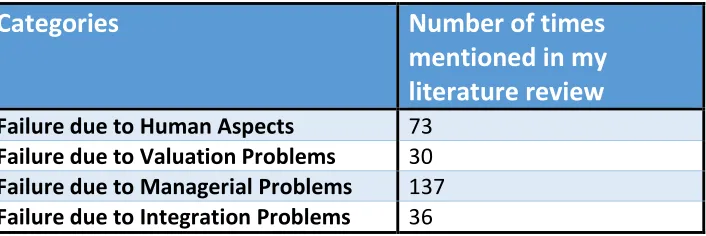
(30) appendix VII. Appendix VII consists of a list with a total of 50 articles with the according author(s). These articles are numbered and can correspondingly be found in appendix VIII. Appendix VIII horizontally displays the numbers corresponding to the articles while the failure factors are displayed vertically. An “X” can be discovered when a certain article names a particular failure factor. Since Appendix VIII is an extensive list including over forty failure factors, it is not easy to quickly draw conclusions from Appendix VIII. Thereupon, I decided to group similar failure factors into four categories. Once the discovered failure factors are grouped, it is more manageable to identify which categories are named in the literature. After grouping together the comprehensive list of failure factors found in the literature, four categories derived (i.e. “Human Aspects”, “Valuation Problems”, “Managerial Problems” and “Integration Problems”). These categories are established based on the main focus of each failure factor. A complete writing of which failure factors are included in which category can be found in appendix IX. The four categories are presented in table 1, including the number of times an article mentioned an individual failure factor fitting that category. The failure factor categories and the corresponding percentages of being mentioned in the literature is displayed in figure 1. Under the table, a short description can be found of what is intended by each category.. Categories. Number of times mentioned in my literature review. Failure due to Human Aspects Failure due to Valuation Problems Failure due to Managerial Problems Failure due to Integration Problems. 73 30 137 36. Table 1. Failure Factor Categories indicated by the Literature Review.. 23.
Figure

+7



Outline
CORPORATE BANK
Individual Failure Factors
Months between Issuing Acquisition Credit Loan and Transfer to FR&R
Conclusion of the Descriptive Factors of the Case Studies
Future Perspective of the Cases
Conclusion – Central Research Question
Appendix I – Search Terms, Databases, Results
Appendix VII – Numbered Articles
Appendix IX – Categories of Individual Failure Factors
Appendix XVIII – Management Risk Evaluation
Related documents
Therefore, we developed a strategy to (i) monitor cell behavior noninvasively via site-specific integration of firefly luciferase (Fluc) and the human positron emission
The purpose of this pilot project was to evaluate the impact of a leadership development program on participants’ perceptions of structural empowerment, leadership self-efficacy, and
the mean differences shown in Table 3 universally favoured students who reported high levels of inquiry-oriented learning activities in their science classes. In summary, the
Tools and systems described include (a) technologies to deliver courses in a blended mode; (b) application of a learning management system to act as a content management system;
Multiple human papillomavirus infection and high grade cervical intraepithelial neoplasia among women with cytological diagnosis of atypical squamous cells of
The undersigned animal welfare and consumer protection organizations commend the National Organic Program (NOP) for proposing requirements for the welfare of animals raised under
The smaller growth in the segment of smaller dairy farms is in concordance with farm growth results from Census and farm business surveys data, since, the latter are generally based
