Master thesis – Business Administration
The process of partnership initiation
between Dutch businesses and NGOs
F.L.F. Tedjo
University of Twente
Behavioral, Management and Social Sciences
Examination committee
Dr. ir. J. Kraaijenbrink M. Ramos-Mejia MScDocument number
BMS – 1
2
Management summary
This study focuses on the partnership initiation processes between Dutch businesses and non-governmental organizations (NGOs). Nowadays, there exists many partnerships between businesses and NGOs, however, still little is known how these partnerships can occur. These processes seem fuzzy of nature and the main research question in this study is therefore: “How can Dutch businesses and NGOs initiate a workable partnership together?”. In order to provide a comprehensive answer to this, the reasons, benefits, resources, partnership processes and recommendations are provided in this study. For this study, a literature review is conducted in order to gain a deeper insight involving the subject. This literature review involves the foundation theories on which organizations want to partner and forms alliances together. After this, semi-structured interviews have been conducted with eleven organizations which consist of businesses and NGOs in The Netherlands.
This study has found that there are many benefits, reasons and resources involved in a business-NGO partnership. First, the main benefits and reasons for companies involve complementary resource exchange, community involvement and synergy. For NGOs, this involves primarily the financial support and in order to achieve the NGO’s goals. Second, the main resources that are exchanged between companies and NGOs are financial resources, human resources and completion for the company’s CSR policies. Hereby is the ideal situation that the partners have a fit together, and that the resource exchange is bilateral in order to deliver valuable complementary resources to each other. Third, it has been found that the extent of formality in partnerships has an immense influence on the course of the business-NGO partnerships. The partnership processes may therefore be different for a formal or an informal partnership. These partnership processes consist of the following stages: acquaintance, assessing the partnership potential, developing partnership criteria and proposal, experimentation, evaluation, adaptation, operationalization, continuance or end of the partnership. These stages are incorporated in the developed model for this study. With this model, it is expected that businesses and NGOs can initiate workable partnership together. Another important finding within this study is that the process of partnership has many things in common with the aspects of human relationships. Therefore, up to a certain extent, business-NGO partnerships may be compared to the stages of human relationships.
3
Table of contents
Management summary ... 2
List of figures ... 5
List of tables ... 6
List of abbreviations ... 7
1. Introduction ... 8
1.1 Research background ... 8
1.2 Research goal and questions ... 9
1.3 Outline of the thesis ... 9
2. Theoretical framework ... 9
2.2 Social exchange theory ... 10
2.3 Value networks ... 11
2.4 Strategic alliances ... 12
2.5 Corporate social responsibility ... 14
2.6 Business-NGO partnerships ... 16
2.7 Research model ... 26
3. Methodology ... 26
3.1 Introduction ... 26
3.3 Data collection and analysis ... 27
3.4 Case description ... 29
4. Findings ... 32
4.1 Introduction ... 32
4.2 Benefits and reasons for NGOs and businesses from partnering together ... 32
4.2.1 Reasons for companies ... 32
4.2.2 Benefits for companies ... 34
4.2.3 Reasons for NGOs to partner ... 38
4.2.4 Benefits for the NGOs ... 39
4.3 Complementary exchanges between companies and NGOs ... 42
4.3.1 Resources that companies offer ... 42
4.3.2 Resources that NGOs offer ... 45
4.4 Process of partnerships between companies and NGOs ... 48
4.4.1 Informal and formal company – NGO partnerships ... 49
4.5 Recommendations for business-NGO partnership ... 58
4
5.1 Conclusion ... 62
5.2 Discussion ... 64
5.2.1 Theoretical implication ... 64
5.2.2 Practical implication ... 65
5.3 Limitations ... 68
5.4 Future research ... 69
References ... 70
Appendix A ... 82
Interview questions for companies ... 82
Appendix B ... 83
5
List of figures
Figure 1: Stages of partnership……….14
Figure 2: Initial partnership design………...24
Figure 3: Research model for this study………...26
6
List of tables
Table 1: Dimensions of CSR………15
Table 2: Benefits for businesses and NGOs……….19
Table 3: Challenges for business-NGO partnership………...21
Table 4: Recommendations for business-NGO partnership………...22
Table 5: Overview of the NGOs………...30
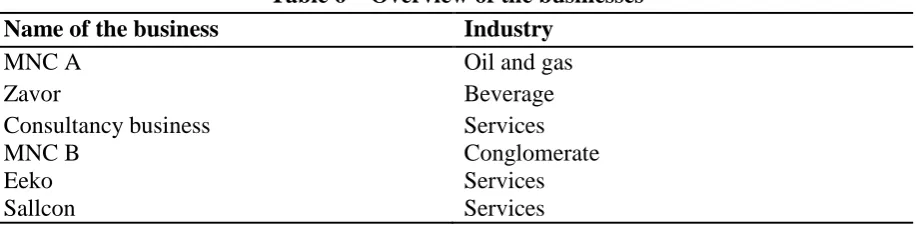
Table 6: Overview of the businesses……….31
Table 7: Companies and NGOs in terms of size …...………...31
Table 8: Companies benefits and reasons to partner………..………...37
Table 9: NGO’s benefits and reasons to partner...………41
Table 10: Companies’ resources for companies………...45
Table 11: NGOs’ resources for companies …….……….48
Table 12: Partnership stages………...56
Table 13: Recommendations from practitioners………...61
7
List of abbreviations
CC Consultancy company
CSR Corporate social responsibility
EU European union
MNC Multinational company
NGO Non-governmental organization
RdD Regalo de Dios
SME Small-medium enterprises
8
1.
Introduction
1.1Research background
For decades, many non-governmental organizations (NGOs) have tried to survive in conducting and broaden their activities in many different ways. As NGO being, it might be more difficult to guarantee their existence because most of the NGOs are-not-for profit organizations. One of the ways to survive is to become more similar to for-profit organizations. However, among the scholars there exist different attitudes towards this phenomenon: one main stream opinion is that management and organization studies should play an important role in supporting the adoption of becoming for-profit organizations, while the other opinion argues that by doing these threats like mission drift and loss of idealism can take place (Maier, Meyer & Steinbereithner, 2014). Within this study, a combination of both aspects is aimed to be made. Namely that NGOs can become professional in terms of organizational aspects, but still are active in their field of operations. In order to achieve this, NGOs can develop partnerships with companies so that mutual exchange of valuable resources can takes place.
The context in which this study takes place is the Dutch NGOs and companies that are based in the Netherlands. The research problem within this study involves the issue in how NGOs and companies can develop workable partnerships together. This is because the processes in order to achieve a partnership between a business and NGO are still vague in practice. Currently, most of the prescribed pathways for companies and NGOs exist of one single mapped out blueprint in how they can achieve a partnership together (Dantuma, 2014; GEMI & EDF, 2008; ING, 2014; Jóźwiak, 2014; Tennyson, Harrison & Wisheart, 2008). However, in reality there exist many different kinds of NGOs and companies which makes that this one sized blueprint cannot fits all sorts of organizations. An important additional phenomenon is that the pathways to initiate a partnership are fuzzy, and it has many things in common with the stages of human relationships. This thesis aims to give more attention to the hidden variables that are involved within the partnership initiation process. The end result of this thesis is to provide a workable model for various sorts of NGOs and companies to initiate a partnership together.
9 1.2Research goal and questions
The research goal within this study is to know how Dutch NGOs and companies can initiate a partnership together in such a way that these organizations can deliver values to each other for a beneficial partnership. The theoretical gap hereby is that other studies propose for one rigid pathway of engaging companies and NGOs in partnerships, while not acknowledging the other underlying relevant variables involved.
The central research question within this thesis is therefore as follows: “How can Dutch businesses and NGOs initiate a workable partnership together?” This central research question will be split into smaller research questions as the following below:
a. What are the benefits and reasons for Dutch companies and NGOs for partnering together?
b. What are the complementary resources that are exchanged between companies and NGOs?
c. How is the process arranged in the partnership initiation between businesses and NGOs?
d. What are the recommendations for a good partnership between the Dutch NGOs and businesses?
By answering these sub-questions, a comprehensive answer can be provided towards the central research question of this study.
1.3Outline of the thesis
From here, the thesis will proceed as follows. First, a literature review will be provided in order to obtain a better insight to the most important concepts and theories within this study. After having developed a solid theoretical foundation, primary and the public available secondary data will be collected and processed for the purpose of this study. In the end, a comprehensive conclusion and discussion will be provided in order to answer the main research question within this study, including its limitations and suggestions for future research.
2.
Theoretical framework
2.1Introduction
10 2.2Social exchange theory
The SET is relevant to discuss because it attempts to explain why businesses and NGOs want to exchange resources with each other. The SET belongs to one of the most important frames of reference within the organizational behaviour studies (Cropanzano & Mitchell, 2005; Emerson, 1976). This theory will be elaborated as first because it forms the foundation for the upcoming concepts as building blocks for this study. The SET is relevant to discuss because this theory explains the origin of logic why organizations cooperate or partner together. The three main contributions came primarily from Homans (1961), Blau (1964) and Emerson (1972a; 1972b; 1976). First, the concept will be elaborated and explained in more detail, followed by the criticisms and shortcomings posed by scholars during the last few decades.
SET according to the classical authors
Although Emerson (1976) has argued that the SET is not a theory at all but rather a frame of reference in which many different micro and macro theories come together, in this thesis it will be considered as a theory that is still subjected to many propositions and improvements. The term ‘social exchange’ can be defined as “the exchange of activity, tangible or intangible, and more or less rewarding or costly, between at least two parties” (Homans, 1961, p. 13). Furthermore, Homans (1961) argued that social behaviour between organizations exists by how organization A’s behaviour reinforces the organization B’s behaviour and in the same way how organization B’s behaviour reinforces organization A’s behaviour in return. This is called the social interaction at the “sub-institutional” level (Cook, 2013; Homans, 1961). Relationships between organizations can fail due to lack of reinforcement or if there is too large asymmetry regarding the rewards and costs. Compared to Homans’ focus on the dyadic exchange, Blau (1964) focused on the structure of social organizations. Therefore he identified several generic processes that are active at various layers within organizations including collective action, legitimacy, opposition, conflict, and cooperation (Cook, 2013; Blau; 1964).
Regulations and norms around SET
11 accentuates the interpersonal transactions in which the action by one party leads to a reaction from the other party. Lastly, the resources used in SET are not only limited in terms of economic value, but it encompasses a wider field as Foa and Foa (1980) suggest; status, love, money, information, goods and services. In addition, Porter and Kramer (2011) advocate that organizations should think in wider value terms rather than in economic value alone, as the following quote suggests: “As governments and NGOs begin to think more in value terms, their interest in collaborating with business will inevitably grow.”
Relationships in SET
In general, when scholars discuss the term relationships, they refer to an association among two partners, whether as individuals or organizations. There exist different kinds of relationships with different kinds of corresponding behaviors. In general, because individuals and organizations return the advantages received, it is expected that they will correspond goodwill and cooperativeness to the party whom they have a social exchange relationship with (Masterson, Lewis, Goldman, & Taylor, 2000). Moreover, within the SET literature there is a lack of clarity regarding the term of relationships. Cropanzano and Mitchell (2005) argue that two possible interpretations exist for this term. The first interpretation refers to series of interdependent exchanges while the second interpretation is that relationships are the result from the series of interdependent exchanges. These authors also suggest that the main core of SET can be summarized as “Social exchange comprises actions contingent on the rewarding reactions of others, which over time provide for mutually and rewarding transactions and relationships” (Cropanzano & Mitchell, 2005, p. 890).
2.3Value networks
The topic of value networks is relevant to the business-NGO partnerships because it discusses the importance for businesses and NGOs to form a network in order to achieve a synergy together rather than to operate separately from each other. Because businesses and NGOs can exchange valuable resources within the context of business-NGO partnership in order to complement each other in their needs. The concept of value networks can therefore be defined as “Entities of several connected individuals or organizational actors that transform and transfer various complimentary resources and capabilities” (Morgan, Feller & Finnegan, 2013, p.572). This concept is also known as strategic networks (Zaheer, Gulati & Nohria, 2000), business networks, value web (Tapscott, Lowy & Ticoll, 2000) and business ecosystem (Iansiti & Levien, 2004; Katsamakas & Economides, 2006). Value networks have become more and more important subject for many companies. This is because the locus of competition has shifted from the individual firm level towards the network wide level (Patnayakuni, Rai & Seth, 2006).
12 Austin (2010) argues that creating value is the main justification for cross-sector partnerships. Through the facilitation of joint learning, problem-solving processes and the integration of complementary resources, knowledge exchange can lead to value creation (Parise & Henderson, 2001). Morgan et al. (2013) suggest that there are four important factors that prosper the value creation and capture within a value network, these are commitment, knowledge exchange, alignment of objectives and effective governance. The first factor, commitment, is about the extent in which the network members are willing and desire to establish a collaborative effort and build on a valued partnership. The second factor, knowledge exchange, argues about the extent in which network members exchange insights and knowledge in mutual way. The third factor, alignment of objectives, is about the extent to which the value network identifies and implements the different objectives and aims, so that shared understanding of requirements can be achieved. The last factor, effective governance, is about the extent to which the resources and competences of various stakeholders within the value network are combined and being managed. Having said this, it is important to mention that once the value is created within the value network, the second important thing is to capture the value created. Besides to capture the value created in the monetary terms such as by developing revenue model and a cost structure (Amit & Zott, 2001), there also exists other value capture strategies in non-monetary terms. These strategies include the entry to tacit knowledge and excellent reputation that is useful for marketing purposes (Morgan et al., 2013).
2.4Strategic alliances
The topic of strategic alliances, especially regarding the business – NGO alliances, is relevant to discuss because it is important to choose the right alliance as partner and to decide into which depth the partnership is meant to be. Austin and Seitanidi (2012a) conducted a review about nonprofit-business collaboration, with the focus on business-nonprofit dyads, and they saw much potential within this cross-sector collaboration. These scholars were not the only ones, because Porter and Kramer (2006; 2011) also elaborated much on the cross-sector partnering subject. They argue that collaboration between NGOs and companies is an inescapable and important vehicle for performing CSR and in order to achieve their organizational socio-economic goals. Furthermore, the C&E report (2014) shows that 90% of NGOs and businesses state that engaging partnerships with each other will become more important for the coming three years.
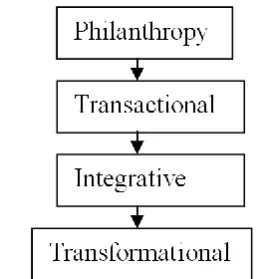
13 about a business providing gifts in terms of time or resources such as properties, securities and money for public purposes (Salamon & Anheier, 1992). Moreover, the direction of the resource flow is mainly unilateral, that is, only one way resource flow from the business towards the NGO. This is a form of resource complementarity with money as the main resource for NGOs and it can serve as CSR activities “buy” option for businesses (Austin & Seitanidi, 2012a; Margolis & Walsh, 2003).
The next stage is the transactional one. This involves the reciprocal exchange of resources through cause-related marketing, sponsorships, name and logo licensing agreements and other goal specific projects. Here the resource flow is bilateral rather than unilateral, like the previous stage. In this stage, the organizational fit plays an important role since both partners must have a certain level of linked interests for value creation in their partnerships. Corporate volunteering is one of the possible activities that can be undertaken within this stage. When business volunteers bring their specialized competencies along with them, besides their time and effort, the potential value delivered to NGOs will be greater than without (Vian, Feeley, Macleod, Richards, & McCoy, 2007). Moreover, this nonmonetary donation improves the depth of relationships between NGOs and businesses which makes donor stickiness more likely. Due to partnerships, both partners can have access to shared resources; bundling these with their non-shared resources can enhance the organizational competitive advantage (Liu & Ko, 2011).
The third stage is the integrative collaboration. Within this stage, organizational fit becomes more important. Partners’ values, mission and strategies are expected to be integrated as consequence of having worked together successfully (Austin & Seitanidi, 2012a). The incentive to continue the partnership lies within the linked interests and synergistic value creation of the business and NGO. Furthermore, the partnership within this stage is seen as essential to strategic success of both partners. However, this stage requires also more attention towards the difference in value creation logics from both partners (Le Ber & Branzei, 2010a) and requires a deeper commitment. Therefore, it has become clear that collaboration at this stage is more complex and organic compared to the previous two stages.
14 change, managerial complexity, strategic value, co-creation of value, innovation and synergistic value (Austin & Seitanidi, 2012; Austin, 2000b).
Figure 1 Stages of partnership
2.5Corporate social responsibility
15 Table 1 Dimensions of CSR1
Dimension Refers to
Environmental The natural environment
Social Relationship between business and society
Economic Financial aspects or business operation
Stakeholder Stakeholders (groups)
Voluntary Actions not prescribed by law
Most empirical studies conducted around the concept of CSR focus on the relationship between CSR and corporate financial performance (Linnenluecke & Griffiths, 2013). However, the outcomes regarding this issue remain mixed and no consensus has been found yet (Van Beurden & Gössling, 2008). The inclination for companies to perform CSR activities varies across countries and the reason why is still not fully answered (Maignan & Ralston, 2002). However, Matten and Moon (2008) attempted to provide an answer towards CSR differences between the United States and Europe corporations. These authors found that in Europe, concerning the explicit CSR that forms an explicit element of the corporate policies is mainly a subject for large companies such as multinationals (MNCs) rather than small-medium enterprises (SME).
The reasons for companies to conduct CSR activities are as follows. First, the most argued reason among scholars is that by conducting CSR activities, the company can gain legitimacy among stakeholders or stakeholder groups that are positioned in the region (Rondinelli & London, 2003). The second reason for companies to conduct CSR activities is somewhat interrelated with the first reason, namely to manage the possible complaints from the society (Bhattacharya, Korschun & Sen, 2009). The third reason for many companies to conduct corporate community involvement activities is because they want to support the society and to maintain good citizenship in the area where the companies are active at (Brammer & Millington, 2003). The fourth reason is the possible relationship between the corporate social performance (CSP) and the corporate financial performance (CFP). Here the term is altered towards CSP because the term CSR is not a variable and is thus impossible to measure (Van Beurden & Gössling, 2008). These authors have performed a review towards the possible relationship between these two variables and they found that the majority of the identified studies found a positive relationship for this. In addition, Campbell (2007) argues that the companies that are likely to perform CSR activities are those that experience a relatively strong financial performance. Therefore it might be the case that there exists a two-way relationship between these two interconnected variables. The fifth reason is somewhat interrelated with the second reason, which is that CSR can be a source of opportunity, innovation and competitive advantage (Porter & Kramer, 2006).
16 2.6Business-NGO partnerships
In this section, the core subject of this study will be discussed, namely the concepts that are related with the business-NGO partnership. The benefits, challenges, conditions, maximization and implementation of the partnership will be discussed in this chapter.
In this thesis, non-governmental organizations (NGOs) are defined as ‘‘private, not-for-profit organizations that aim to serve societal interests by focusing on social, political, and economic goals, including, inter alia, equity, education, health, environmental protection, and human rights’’ (Teegen, Doh & Vachani, 2004, p.466). Next to this, the term partnership in this study is defined as “a sort of collaboration to pursue common goals, while leveraging joint resources and capitalizing on the respective competences and strengths of both partners” (Jamali & Keshishian, 2009).
The idea that cooperation between businesses and NGOs can have much potential is not new. Khanna & Palepu (1997) argued in that time period for the potential of complementary benefits in the relationships between businesses and NGOs. The reasoning behind this is that businesses are beneficial with their relatively large size, scale, experience and resources while NGOs are seen beneficial for their access to local stakeholders, of which some of them are difficult to reach without partnering with these NGOs. The role of businesses in the field of development is being termed as the concept of resource complementarity by Oetzel & Doh (2009). It might also require businesses to become actively involved in building local capacity through partnering with local NGOs in order to provide sustainable capabilities and skills.
NGOs receive their incomes from different sources, such as from interested third parties in form of grants and donations, companies, community clubs and associations, individual donors and governments (Viravaidya & Hayssen, 2001). The well known charitable giving or philanthropy is not the only income channel for NGOs. However, many NGOs still have this income generation or fundraising mindset as their main purpose of operation (Salamon & Anheier, 1992).
Benefits for businesses
As the SET attempts to provide explanations for organizations why they exchange resources with each other, this section elaborates on the benefits as drivers for businesses and NGOs to cooperate together. Because the reason to partner is often related to the benefits that each party receives from the other. Therefore, in order to know what the drivers are from the company’s and NGO’s side to engage themselves into a partnership, the benefits for both parties will be elaborated in this and the following sections.
17 process for license to operate (Ishikawa & Morel, 2008). So despite the fact that the businesses relatively possess more financial resources, businesses can benefit from NGO’s greater social power due to their reputation and high esteemed social legitimacy (Oetzel & Doh, 2009). This can be seen as a prerequisite for businesses to operate successfully abroad.
Second, by partnering with an NGO a business may gain visibility (Gourville & Rangan, 2004) and this in turn may contribute to the social license to operate, access to local communities and credibility (Austin, 2000a; Greenall & Rovere, 1999).
The third benefit for businesses has to do with one of the stakeholders involved, which are employees. The collaboration with NGOs can have positive effects of 2.3 times bigger rate of employee retention, 2.2 times larger access to new markets and 3 times better in improving their risk management (Boston College Center for Corporate Citizenship, 2014). Also another survey indicated that nearly 75% of the respondents would opt to work for a business with a good philanthropic reputation with other variables being equal (Deloitte, 2004). Moreover, the business-NGO partnership has also positive psychological fulfillment for employees and creates new cross-sectoral friendships (Seitanidi, 2010). In addition, it also creates new leadership opportunities, managerial skills, new sector knowledge and broadened perspectives, with thereby the condition that employees should be involved in the relevant programs (Austin & Seitanidi, 2012b; Bhattacharya et al., 2008). Therefore, the most important benefit hereby is to attract and retain employees, which is seen as the most important resources for many businesses. However, this does not restrict to employees alone, the benefits also reach further to a greater extent of other stakeholder loyalty and improving the stakeholder communication and accountability (Ishikawa & Morel, 2008; Pearce & Doh, 2005). Especially within the stage of transactional partnerships, employee volunteering can enhance the work motivation and in consequence, the job performance, but also the customer orientation and increasing productivity (Jones, 2007; Vock, Dolen & Kolk, 2013).
The fourth benefit is associational value of the business with reputational enhancement as consequence of the business involved (Austin & Seitanidi, 2012a). Associational value is the value derived from the collaborative partnership with other organization. One example is that people have higher esteem from a business that partners with an NGO in order to solve social problems (GlobeScan, 2003). Furthermore, Farquason (2000) found that consumers within the UK switched brands, tried new products and increased their purchases because of the associational value with a charity motive. Nevertheless, a positive image is subjected to the type of the organizational fit of both partners (Kim, Sung & Lee, 2011). By doing this, the business’ reputation and image is improved (Yaziji & Doh, 2009) while also influencing the increasing amount of sales and broader use of products (Gourville & Rangan, 2004).
18 access to networks (Millar, Choi & Chen, 2004) and enhanced political power within the society, community and government relations (Seitanidi, 2010).
The sixth group of benefits involves the investor and consumer related benefits. For investors these include investor recruitment fit and increasing investors’ loyalty (Gourville & Rangan, 2004). For example investors who want to invest in sustainable projects or in impact investments. Benefits for customers involve the customers’ preference of choosing a company’s product above the competitor’s products (Brown & Dacin, 1997) and decreasing asymmetry of knowledge between consumer and business (Googins & Rochlin, 2000). Because of the employees’ enthusiasm, there might be some positive spillover outcome that induces favorable consumer responses (Kolk, Van Dolen & Vock, 2010).
The seventh benefit for companies to engage in partnerships with NGOs is because of the quality management. This involves especially those companies that utilize their NGO partners as the main supplier of their products (Linton, 2005). This kind of business-NGO collaboration is also called as the value chain partnerships (Bitzer & Glasbergen, 2015). These NGOs do not only supply for tangible products and resources such as coffee and cocoa (Bitzer, Glasbergen & Arts, 2013; Bitzer, Glasbergen & Leroy, 2012), but it includes also services and facilities that NGOs can offer to companies (BSREF, 2001).
Benefits for NGOs
For NGOs, the benefits accompanied by cooperating with businesses are as follows. First, a business seems to be a more reliable partner to cooperate with rather than with the local governments of the host countries. This is because legal guarantees and commitments made by host governments are often not being met, for example in infrastructure sectors (Doh & Ramamurti, 2003). Therefore, by partnering with businesses there is higher probability that the investments made are sustainable over longer term period. The withdrawal of government support due to economic crisis (Feiock & Jang, 2009) and limited funds constraints (Schwartz, 2004) induces businesses to gain a more significant role in supporting the NGOs.
19 Third, by partnering with businesses, NGOs can obtain access to networks within the profit sector and improve their relationships with for profit organizations (Millar et al., 2004; Vock et al., 2013). By having access to these networks, NGOs can obtain market intelligence that can result into process-based improvements, innovation and positive organizational change for improvements (Holmes & Moir, 2007; Glasbergen, 2007; Yaziji & Doh, 2009).
[image:19.595.64.530.340.433.2]Fourth, NGOs can obtain their credibility and improve their organizational reputation for the reason that they are chosen as funding beneficial by influential businesses (Galaskiewicz & Wasserman, 1989; Yaziji & Doh, 2009). Another related benefit is that NGOs can obtain visibility that may improve the public image, public relations and potential for funding (Alsop 2004; Gourville & Rangan, 2004; Milne, Iyer & Gooding-Williams, 1996; Seitanidi, 2010). Moreover, Sanzo et al. (2014) found that the visibility and the scale of its operations are positively related to NGOs’ funding. Besides obtaining more publicity for them, public awareness of the social issue might also increase so that NGOs may receive more support for their missions to solve social issues (Gourville & Rangan, 2004; Pierce & Doh, 2005).
Table 2 Benefits for businesses and NGOs
Business NGO
Legitimacy Reliable partner
Visibility Financial support
Positive effect on employees Learn business-related competences
Associational value Access to business networks
Complementary resources Credibility
Investor and consumer related benefits
Challenges for the business-NGO partnerships
20 Second, by conducting cross sector partnerships between for-profit and not-for-profit organizations, organizational learning among these alliance partners can only happen with the requirement of a certain level of common experience, which is often absent or weak in this kind of partnership (Rondinelli & London, 2003).
Third, by building these partnerships with NGOs, escalating and unrealistic demands can arise towards businesses to enhance their engagement towards social development (Yajizi, 2004). Therefore, due to the absent of common experience, trust and clear communication, conflict can arise among these newly partners despite the fact that the business has many shared values like the NGO.
Fourth, since NGOs belong to a not-for-profit sector, the drawbacks hereby are that they often have less focus on organizational performance or on obtaining financial competences. Furthermore, NGOs are likely to have a higher cost structure due to their inability to capitalize on economies of scale (Oetzel & Doh, 2009). Moreover, many NGOs find it hard to fulfill the financial accounting needs from businesses in order to implement credit programs. This results in complex relationship models between the NGO and the business (Sanzo et al., 2014).
Fifth, another potential drawback for the NGO is that because of the salient partnership with a wealthy business, decrease in donations can occur (Austin & Seitanidi, 2012b; Gourville & Rangan, 2004). Next to this, the need for resource allocation, a decrease of volunteers’ trust, unexpected exit of the partner and the potential ‘green washing’ mechanism need to be taken into account (Utting, 2005). The public perception can also be negatively changed due to this partnership with a for-profit organization, for example with thoughts of ‘mission drift’ or loss of independence from the NGO (Sanzo et al., 2014).
Sixth, another potential risk for both NGO and business is the chance of reputation damage caused by the action of the partner (Sanzo et al., 2014; Wymer & Samu, 2003). These actions can be the scandals, frauds, and improper behavior of its partner. For the NGO, the consequences have more impact compared to the business, because a damaged reputation means a decrease in NGO’s capacity to attract volunteers, donors and in consequence to that also to an end of their existence as NGO (Seitanidi, Koufopoulos & Palmer, 2010). However, these aforementioned issues can also apply for the business’ reputation as well, in case when the NGO does something inappropriate in its behavior. Next to this, Sanzo et al. (2014) found that the level of perceived reputation damage risk has a negative influence on the perception of mission and strategy alignment within the partners. Therefore, managing the potential reputational risk is very important for both organizations because the partner’s improper actions can result in bad publicity and damaged reputation for both (Galaskiewicz & Colman, 2006).
21 Berger, Cunningham & Drumwright (2004) suggest that many partnerships problems can be predicted upfront and can therefore be dealt with.
Table 3 Challenges for business-NGO partnership
Distrust
Absence of common level experience Escalating demands can occur Asymmetry of financial competences Decrease in donations due to public perception
Chance of reputation damage Misalignment and unfamiliarity
Recommendations for business-NGO partnerships
In order to minimize the challenges mentioned above, businesses and NGOs should take the following issues into account. First, both parties should aim for strategies that mitigate the costs of partnerships and committing to one another with much credibility. An example from Pearce & Doh (2005) shows that business-NGO partnership is likely to be the most effective when the activities performed together are situated close to each others’ core capabilities. This makes that the adjustments low and also lower costs of adaptation for partnering together.
The second recommendation is that partners should have goal alignment in their partnership (Jamali & Keshishian, 2009). This goal alignment can be achieved when partners agree to pursue common goals together. Besides goal alignment, Austin & Seitanidi (2012a, 2012b) argue that mission and strategy alignment are very important factors to reduce negative conditioning factors of trust. In addition to this, they also argue that linked interests to the social issue, complementary resources, two-way of resource flow and organizational fit are the fundamental factors in order to have a successful partner selection process. One of the benefits of an appropriate organizational fit is that it allows both organizations to gain value beyond “first order” benefits (Gourville & Rangan, 2004), such as increasing amount of revenues for the business and fees for the NGO towards “second order” associational benefits as mentioned earlier, like reinforcing relationships with stakeholders and widening the donor base of the NGO. To conclude, a proper organizational fit enables the creation of synergic value and the greater the fit between the business and the NGO, the greater the potential for joint value creation will be.
Third, factors such as nation, sector, firm, NGO and managerial level can have an influence on the potential success of this partnership. For example, the industry and orientation in which NGOs are active in will influence the potential compatibility with the chosen company. The strategic fit in this will affect the likelihood, shape and satisfaction of the partnership. Overall, Oetzel & Doh (2009) believe that the most important variable that has an influence on success is the degree of complementarity in the resources and capabilities of the business and NGO.
22 very important process because the cooperation that comes after this determines the joint value creation and is vital to mitigate the conflict potential of both partners (Sanzo et al., 2014). Within this stage, accurate assessment of the value and partnership potential is one of the predictor of the partnership viability (Austin & Seitanidi, 2012b; Pangarkar, 2003). Within this stage, the partnership criteria and proposal is developed (Austin & Seitanidi, 2012b; Holmberg & Cummings, 2009; Seitanidi, 2010). These include the conditions under which the partnership can take place. Both parties should agree with the criteria proposed in order to cooperate together.
Fifth, past experiences of NGOs and businesses in developing valuable relationships can be a significant determinant for the organizational fit (Hardy, Lawrence & Phillips, 2006; Barnett, 2007). This is because the history of experience in partnership can be an indicator of the organization’s ability to uncover new competences and outlook for social value creation (Brickson, 2007).
[image:22.595.57.532.476.571.2]Sixth, with the challenges of power imbalance, such as the question of effectiveness of the mechanisms and the difference in decision-making and control processes (Brown, 1991; Reed & Reed, 2009), a possible solution may be provided for these issues. A call for shared consensus in the way of decision making and joint regulation is proposed to equal the power differences between partners (Ashman, 2000; Elbers, 2004; Seitanidi & Ryan, 2007; Utting, 2005). Thereby a decentralized control is needed in which various stakeholders can express their concerns and suggestions, establishing feedback loops and setting up decentralized social accountability posts to facilitate answers and enforcement to the stakeholders (Clarke & Fuller, 2010; Newell, 2002; Utting, 2005).
Table 4 Recommendations for business-NGO partnership
Aim for strategies that mitigate the costs of partnerships Degree of complementarity in the resources and capabilities
Goal, mission and strategy alignment Organizational fit between business and NGO
Proper partner selection process Past experiences in partnerships
Shared consensus in decision making and joint regulation
Maximization of the partnership potential Partnership selection stage
23 fact that two-way or reciprocal resource flow appears to be more effective compared to the unilateral exchange.
In the following sections, this study follows the partnership fit potential model from Austin & Seitanidi (2012b). Partnership formation can be initiated by first articulating the social issue that potential partners want to solve together. Then, linked interests and complementary resources in order to solve the social issue must be identified. After this, both partners’ motive and missions must be identified and aligned. Hereafter, the history of partnerships and the visibility fit must be identified. As last, pre-partnership champion must be appointed, that is, a person who will be the main responsible in sustaining the cross-functional teams during the partnership (Rondinelli & London, 2003).
Partnership implementation
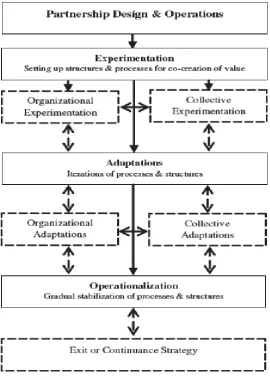
24 Figure 2 Initial partnership design2
For the aforementioned stages of partnerships, which are philanthropy, transactional, integrative and transformational, the process of partnership design and operations are the same. Irrespective of the partnership stage in which the business and NGO begin, they all have to go through the same processes. After a time of period, they can grow in their partnership to move to the next deeper stage.
The model developed by these authors serves as a starting ground to build upon the cases from business and NGO in practice. The partnership design includes the establishment of objectives and structural specifications (Glasbergen, 2007), framing rules and regulations (Gray, 1989), formulating a declaration of intent (Seitanidi & Crane, 2009), setting up leadership positions (Austin, 2000), choosing organizational structures (Berger et al., 2004) and corresponding with how to manage the partnership (Seitanidi & Crane, 2009). These processes contribute to goal congruency (Andreasen, 1996) and this again leads to organizational compatibility. The decisions made move towards the operationalization, with
25 thereby the intermediating phase of adaptations due to the presence of internal and external factors (Austin, 2000). Within the operationalization phase, processes and structures of the partnership are expected to be stabilized till the following cycle of iteration (Seitanidi & Crane, 2009).
The processes above consist primarily of formal control mechanisms within cooperation (Das & Teng, 1998) while according to Ben (2007) informal mechanisms are likely to be more effective. Other scholars also argue that informal mechanisms of control can play important function within NGO-business partnerships in order to determine the partnership viability and the co-creation of value (Arya & Salk, 2006; Rivera-Santos & Rufin, 2010). These mechanisms include management of partnership culture to mix and harmonize organization cultures, ways of communication that contributes to the level of trust, charismatic style of leadership to inspire employee contribution, mutual respect and openness to each other, learning processes, management of conflict issues and stimulating open dialogue (Austin, 2000; Bhattacharya, Sen & Korschun, 2008; Elkington & Fennell, 2000; Seitanidi, 2010; Wilkof, Brown & Selsky, 1995). These processes will be applied once potential partners identify each of their resources, purposes and competences to be exchanged. Thereby the potential for partnership can be eliminated at the very beginning of the first stage if the partners realize that the distance between values is too large.
From here and further
26 2012b; Cornelius & Wallace, 2010). By involving the concerned communities as stakeholders, it creates an extension of partnership institutionalization that goes beyond the business-NGO dyad (Austin & Seitanidi, 2012b). Lastly, it is important to have regular evaluations in between the various stages above (Arino & De La Torre, 1998; Cohen, 2003; Ring & Van De Ven, 1994). Valuable feedback and lessons can be obtained from these evaluations and these can positively improve the partnership processes.
2.7Research model
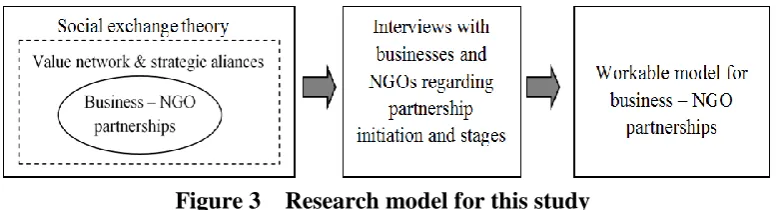
[image:26.595.106.495.417.522.2]Below is a figure with the research model for this study. First, the literature review is done starting from the most generic subject to the more specific subject. The SET is discussed to know more about the reasons for organizations to partner together. Next, the topic of value network is discussed to stress the importance to form a network together, followed by the topic of strategic alliances where it is important to choose the right alliance as partner. After this, finally the aspects of business-NGO partnership are discussed, including the topic of CSR. After the literature study, interviews are conducted with businesses and NGOs regarding partnership initiation and its corresponding stages. After the analysis process, a workable model for business-NGO partnership is developed including the most important aspects found within this study.
Figure 3 Research model for this study
3.
Methodology
3.1Introduction
In this chapter, the methodology of how the thesis is made will be discussed. This includes the research design, data collection, data analysis methodology and the case description of the interviewed businesses and NGOs.
3.2Research design
27 some complexity involved (Miles & Huberman, 1994) in Dutch business-NGO partnerships. It is chosen for a qualitative approach because the outcome of the research is to find answers to understand the meanings, beliefs, values, intangibles and experience, and these can be best understood by qualitative data (Lowhorn, 2007; Wisker, 2008). Also because qualitative studies shed light on the contingent nature of the current social reality and it provides the opportunity to ask questions that cannot be put into numbers (Hopper, 2011). For these reasons, qualitative study seems the best suitable approach rather than a quantitative study.
The research design applied for this study has the characteristics of a descriptive design. Describing situations and events is a major purpose of many social science studies and many qualitative studies aim especially at the description of it (Babbie, 2010). This research design can provide the answers towards the who, what, where, when and how questions related to a specific research problem (Anastas, 1999). Moreover, descriptive studies can deliver data which can lead towards significant recommendations in practice.
The main method to collect data is by conducting interviews. Kvale (1996) identified a number of advantages that come along with interview as data collection method and a couple of these are as follows. The reason to opt for this method is first because it provides the opportunity to go more into depth of the subject with all the details around a particular topic. Second, with this method the interviewer can obtain direct feedback from the interviewee and thereby probing for complete and correct interpretations of the answers given. Third, by conducting interviews, rich data with new insights can be obtained because the interviewees can express the responses in their own words with many examples to illustrate it. The interviewer can also utilize the interviewee’s knowledge, experiences and skills to identify unexplored ideas related to the subject raised by interviewees’ responses.
From here, there exist a number of variants for interview methods, which are the focus group, structured, semi-structured, unstructured and informal interviews. For this study it is chosen for the semi-structured interviews for the following reasons. According to Bernard (2006), semi-structured interviews suit the best when the interviewer only has one chance to interview the interviewee and in order to obtain richness of data due to the interviewee’s freedom to utter their responses in their own wording. The outcome of the semi-structured interviews can produce reliable, comparable qualitative data and the questions are prepared in advance (Cohen & Crabtree, 2006). Furthermore, Bernard (2006) argues that semi-structured interviews suit well in projects when the interviewer has to deal with high-level bureaucrats, which are people who are used to make efficient use of their time.
3.3Data collection and analysis
28 The interviews are mostly taken in the location where the organization is located. The interviews are held with the person who is responsible for the partnership with the NGO or company. After the introduction and explaining for what purpose the interview is held, the interview can finally start. The semi-structured interview questions are composed as follows. The interview starts with a general, broad open-ended question as recommended by Laforest (2009). After this the interviewee is asked for open-ended questions derived from the literature review of this study. These questions cover the themes of value networks, strategic alliances, benefits and reasons to partner, complementary resources, recommendations and the practicality of the theoretical model from Austin & Seitanidi (2012b). The interview ends with an open question to ask whether the interviewee has another remark or things that were not discussed during the interview, such as Zorn (2008) has recommended to ask as the last question.
The purpose of qualitative data analysis is to examine all meaningful and symbolic content of the collected data. Miles and Huberman (1994) define qualitative analysis as a process that consists of three synchronic flows of activities: data reduction, data display and conclusion drawing. Data reduction involves “the process of selecting, focusing, simplifying, abstracting, and transforming the data that appears in written-up field notes or transcriptions” (Miles & Huberman, 2004, p. 10). This means that the data collected can be selected, transformed into written summaries, categorized within coding schemes, categorized into themes, making clusters and partitions. This process of data reduction or transforming will continue until the final thesis is completed. Furthermore, this process is important because here the researcher has to decide which data chunks should be coded and which data should be left out. In this phase, the collected data is sharpened, sorted, focused and organized in order to draw final conclusions from the findings (Miles & Huberman, 1994).
The second process, data displaying, involves the process of organizing and compressing the influx of data that leads to conclusion drawing and action. Utilizing the display of information means that people can easily understand what currently is happening and based on that to analyze it further or to take action. This is useful since by showing a data display much information can be summarized in a short period of time. The process of designing a data display is a part of the analysis, because in case of a qualitative data matrix, the rows and columns have to be decided which things should to be inserted there, along with in which form the data should be displayed. And these processes belong to the analytic activities (Miles & Huberman, 1994).
29 The procedures in which the data are gathered and processed are as follows. First, Dutch businesses and NGOs are contacted by e-mail to ask the person in charge for an interview. For businesses, it is aimed towards businesses that currently have cooperation with one or more NGOs. The same applies for NGOs; it is aimed towards NGOs that currently have cooperation or partnership with one or more businesses. Second, the semi-structured interviews are taken and with the permission of the interviewees, the interview conversation is saved so that the focus can be fully set on the conversation itself and no data will be lost. Third, the saved data are listened again to transcribe, code, interpret and analyze the findings for the purpose of this study. By using Atlas.ti, the written interview can be coded and categorized. This is useful because the relevant data can be filtered out from the remaining not-relevant data. This is the stage of data reduction according to Miles and Huberman (1994) above. Fourth, the relevant coded data are synthesized in order to write the findings section. This is the phase of data displaying, in which the data are organized and compressed into written text and transformed into tables for the comprehensiveness. Lastly, with the findings and new gained insights, the main research question can be answered and a conclusion will be drawn in the last section. This is then the phase of the conclusion drawing according to Miles and Huberman (1994) above.
3.4Case description
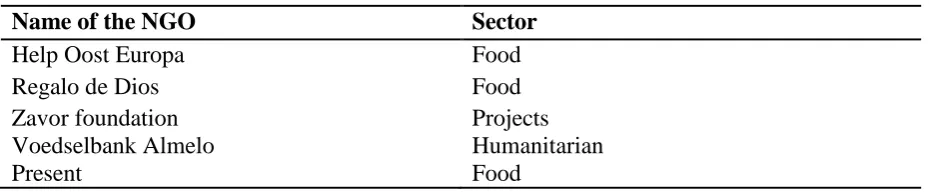
30 Help Oost Europa – This NGO is established in 1998, and its main activities are providing food supplies to East Europe countries including Hungary and Romania. Besides being active abroad, this NGO is also actively involved within the local community. It has its own thrift shop and it has developed several partner agreements with the local supermarkets and companies.
Regalo de Dios – This is a relatively young NGO, established in 2009. Its main activities are providing daily meals to children within the slum area of Peru. This NGO has informally developed partner agreement with a company to support them financially. Besides this, they also regularly organize fundraising events in The Netherlands by selling taco’s to raise money for the foundation.
Zavor foundation – This foundation is established in 2010 by Zavor as company. Zavor foundation is primarily active in Kenya. It is the aim from the company to share prosperity and knowledge with the underprivileged people in Kenya, the country where the products are produced. Moreover, Zavor foundation has set up many local projects with the aim to develop ability to do things independently. This NGO receives their income from sponsors, gifts, Zavor company and by giving lectures.
Voedselbank Almelo – This NGO is a branch from Voedselbank Nederland in the city Almelo. The parent organization is founded in 2002, and the branch in Almelo is founded in 2008. Each week, Voedselbank Almelo provides food parcels to the people in need in Almelo. This NGO receives their income from sponsors, gifts and collaborations with the local supermarkets.
[image:30.595.65.530.547.643.2]Present – This NGO is a branch from Present Nederland, which is established in 2003. Present makes use of the human resources from the companies’ employees to perform their activities. This NGO acts as middle men between people that want to do volunteers work and people who need their help. Present receives their income from sponsors, gifts and financial help from local companies.
Table 5 Overview of the NGOs
Name of the NGO Sector
Help Oost Europa Food
Regalo de Dios Food
Zavor foundation Projects
Voedselbank Almelo Humanitarian
Present Food
31 Zavor – This company is a coffee and tea company founded in 1980. It has its roots in Kenya, where the tea and coffee come from. Therefore this company has set up its own foundation, which is Zavor foundation, which helps to improve the coffee chain for the benefit of local population and quality of coffee. A fixed percentage of the gross operating profit is donated to the foundation each year.
Consultancy business – This is a small-medium enterprise, and it provides services in the area of human resources for the companies in The Netherlands. This company has close partnership with Present, and provides human resources and financial support to its partner NGO.
MNC B – This business is a multinational with its headquarters located in Germany. Moreover, this company is involved in various industries including health care and communication. It has a broad palette of CSR policies and also partnerships with several NGOs.
Sallcon – This is a company that is involved in providing human resources for companies, organizations and NGOs. These human resources are primarily people with a distance to the labor market, and Sallcon acts as middlemen to find places where their employees can work for.
[image:31.595.69.529.464.577.2]Eeko – This is a small-medium enterprise that is involved in the recycling business. To have partnerships with NGOs is very important for this company because of the two-sided benefits that the partners can have together. NGOs collect recycle materials as resource for Eeko and these NGOs receive their rewards for the delivered goods in form of financial compensation.
Table 6 Overview of the businesses
Name of the business Industry
MNC A Oil and gas
Zavor Beverage
Consultancy business Services
MNC B Conglomerate
Eeko Services
Sallcon Services
According to the European Union (EU) recommendation, organizations that are called small and medium-sized enterprises (SME) are mainly determined by the number of employees and by the turnover or balance sheet total3. As the second factor is not fully accessible for all organizations, rough division by using the first criteria will be made. Next to this, the organizations are also categorized in terms of their formality. These organizations can either be formal or informal in their way of conducting activities. This topic will be discussed in more detail in the findings section.
Table 7 Companies and NGOs in terms of size
32
Organization Size Formality
MNC 1 Large Formal
MNC 2 Large Formal
CC Small Informal
Eeko Small Formal
Sallcon Medium Formal
Zavor Small Informal
Zavor foundation Medium Informal
Voedselbank Large Informal
Present Large Formal
SHOE Small Informal
Regalo de Dios Small Informal
4.
Findings
4.1Introduction
In this section the main findings and its analysis will be provided in order to answer the sub-research questions and subsequently the main sub-research question. First the reasons and benefits from the NGO’s and company’s side will be discussed. Then the complementary resources between NGOs and companies will be explored in more detail. Third, the stages of partnership initiation till the end of the partnership will be described with a model that serves as a continuum between the formal and informal partnerships.
4.2Benefits and reasons for NGOs and businesses from partnering together
In this section, benefits and reasons why NGOs and businesses partner with each other will be elaborated. The theoretical possible benefits and reasons are elaborated within the literature review and within this section the benefits and reasons from practice are gathered and listed. As the benefits to partner together is somewhat interrelated with the reasons to partner, these two concepts will be discussed interchangeably within the same section below. First, the benefits and reasons from the companies’ point of view will be provided followed by the NGOs’ point of view.
4.2.1 Reasons for companies
33 in a high risk sector such as within the petroleum industry, which is the industry where MNC 1 operates. This is because these companies need approval from the local community in order to perform their activities.
“If you cooperate with NGOs it gives more, better image, although you cannot mention it directly, but it does give credibility to the company.” (MNC 1)
“And we really need contacts with the government in order to utilize the land. Therefore the legitimacy goal is aimed towards the government while the credibility purposes are aimed towards the NGOs. It gives us a better reputation.” (MNC 1)
The second reason for companies to cooperate or partner with NGOs has to do with the withdrawal of the government support towards NGOs (Feiock & Jang, 2009). Some companies feel therefore the responsibility to support those NGOs in need. In this study, only one company gave this as one of the reasons. This reason might be related to the next reason, which is the CSR policy, because the company might feel responsible to support the NGOs and this is translated within their CSR policies statement.
“Many NGOs have to survive on their own and we think that companies should contribute to play a role in this issue.” (MNC 2)
The third reason for companies to partner with an NGO is because of their CSR policies (Campbell, 2007; Porter & Kramer, 2006). Although from the sample of this study it became apparent that only half of the six companies gave this as reason, it is possible that more companies share this reason though not explicitly mentioned. Because once a company has decided to become involved in CSR, these companies have to make a policy of their CSR and then find a way to transform those policies in practice. One of the common used CSR activities from companies is to donate money to charities such as NGOs or establishing their own foundation. In addition, some companies prefer to have a local focus to perform their CSR activities, while some prefer to focus on the location where their products are produced as the quote of the company below suggests.
“Our community involvement is located very deeply in East Africa.” (Zavor)
Another benefit or reason for companies to partner with an NGO has to do with the management of complaints. As the corporate governance theories suggest that companies have to build a good relationship with its most primary stakeholders, the fourth reason to partner is to enhance the management of complaints and to mitigate the amount of complaints submitted from the near neighborhood. This reason is mentioned only once from the six cases. This reason is somewhat interrelated with the aforementioned reason of legitimacy and credibility, because again, this is especially likely for companies that are prone to receive complaints and protests from the local community. For example, service companies in HRM are less likely to receive complaints about their daily company activities.
34 The fifth reason for companies to partner with an NGO is because of doing well for the society. Because the company forms a part of the society, the company cannot operate in isolation. Therefore, one of the most common responses received from the companies is that they want to support the society and to become part of a good citizenship. Four out of the six companies gave this as one of the main reasons. This reason fits well within the philanthropy stage from Austin & Seitanidi (2012a) because of the unilateral character of the resource flow towards the society. Furthermore, this reason might be interrelated to the reason of CSR policies.
“We try to cooperate and we see the benefit in the social involvement so that our employees can contribute to the society.” (MNC 1)
“We are part of the society. We cannot see ourselves apart from the society, therefore we want to make a contribution to the society.” (MNC 2)
The sixth reason that half of the six companies have mentioned is because of the goal alignment. This reason is somewhat interrelated to other reasons such as network and synergy. Because when companies and NGOs share the same goal, it is likely that they also share the same networks and form a synergy together. As goal alignment between company and NGO is an important condition to have a workable partnership together, it is expected that these companies from the sample can have long-lasting partnerships with their partner NGOs.
“…especially a part of network and often NGOs operate closely to the things that we are also doing. Therefore also a piece of synergy is included.” (Sallcon)
“The alignment is of course the product coffee, tea and chocolate.” (Zavor)
4.2.2 Benefits for companies
In this section the benefits that were included in the literature review will be discussed first, followed by new data found from the conducted interviews. The first benefit for companies to partner with NGOs is that it can have a positive impact on the employees’ teambuilding (Seitanidi, 2010; Vock et al., 2013). Two from the six companies indicated this as reason. When employees have to volunteer together as a team, they obtain experiences outside the company buildings that they otherwise cannot obtain. This teambuilding can result in the next reason, positive name awareness and reputation, for the company because it is then seen as a pleasant place to work for. Therefore, this reason has not merely impact on the existing employees, but also to attract people from outside the company to work there.
“So if they are volunteering somewhere, they receive an entirely different experiences than if they were staying the entire day in office. It may sound very prestigious but also to broaden their world view, showing people what is available out there.” (MNC 2)
35 “Surplus value can be for a company a piece of teambuilding.” (Present)
The second benefit for companies to cooperate with NGOs is that the company can receive a positive reputation and name awareness from the public point of view (Austin & Seitanidi, 2012a; Yaziji & Doh, 2009). Half of the companies indicated this as one of the benefits. This includes publication of partnership with the NGO on the company’s website or on the NGO’s website. People can have a positive association of the company when they see that the company is involved in doing good initiatives with the NGO. This can also lead to acceleration of license to operate from the local community. This benefit might be related with these aforementioned reasons; legitimacy, credibility and management of complaints. This is because the aim of these reasons is to give the company a better reputation and promote the company’s name in a positive way. Although not every company mentioned this explicitly, when one visits their website it becomes obvious that some companies are eager to show their partnership to public.
“Our goal, the reason why we do that is to contribute to the company’s reputation in the Netherlands and to promote the license to operate.” (MNC 1)
“Our logo will be shown and so on... ” (CC)
The third benefit for companies to partner is network (Millar et al., 2004). Two from the six companies saw this as one of the benefits. Not only for NGOs, but for companies access to networks is important via the NGO. This is especially the case where the network interests lie closely next to each other, so that the company’s network can be broadened and new opportunities can be utilized. Because often it is the same kind of companies that partner with the NGO that fits best with them, so the NGO meetings can serve as a junction between the same types of companies among them.
“It fits with us in terms of quality and it is an NGO who’s chairman is acquainted with people, and those people again is acquainted with other people, and often you see the same kind of network and we can support each other when needed.” (CC)