Multigrid One-Shot Method for PDE-Constrained
Optimization Problems
Subhendu Bikash Hazra
Group of Water Supply and Groundwater Protection, Institute IWAR, Department of Civil Engineering and Geodesy, Technical University of Darmstadt, Darmstadt, Germany
Email: [email protected]
Received July 18, 2012; revised August 18, 2012; accepted August 25, 2012
ABSTRACT
This paper presents a numerical method for PDE-constrained optimization problems. These problems arise in many fields of science and engineering including those dealing with real applications. The physical problem is modeled by partial differential equations (PDEs) and involve optimization of some quantity. The PDEs are in most cases nonlinear and solved using numerical methods. Since such numerical solutions are being used routinely, the recent trend has been to develop numerical methods and algorithms so that the optimization problems can be solved numerically as well using the same PDE-solver. We present here one such numerical method which is based on simultaneous pseudo-time step-ping. The efficiency of the method is increased with the help of a multigrid strategy. Application example is included for an aerodynamic shape optimization problem.
Keywords: Shape Optimization; Simultaneous Pseudo-Time Stepping; Multigrid Methods; Preconditioner; Reduced SQP Methods; Reduced Hessian; One-Shot Method; Airfoil
1. Introduction
Numerical methods for PDEs (also known as simulation techniques) are being used routinely for analysis of pro- blems in scientific research and industrial applications as they are cost effective alternative to experiments. Since optimization of some quantity in such problems are quite common, recent trend in scientific research has been to develop numerical methods and algorithms so that the simulation techniques can be extended from analysis to simulation based optimization.The complexity and the nature of the optimization problem is completely differ-ent than those of the underlying PDEs. Therefore, it is not straight forward to extend the algorithms and solvers for PDE-solution to the PDE-constrained optimization problems. However, due to increasing interest in research in this field, continuous improvement is being reported by the researchers in this community.
The methods used for solving such optimization prob-lems are mainly of two different types, namely, gradient based (such as steepest descent, quasi-Newton methods etc.) and gradient less (such as simulated annealing, ge-netic algorithm etc.). In general, gradient based methods are having advantage that they are much more efficient than the gradient-less methods. However, they only result in a local optimum. In comparison to that, gradient-less methods result in global optimum. Since in many appli-cations a local minimum suffices for the purpose of
solving the optimization problems, if it is achieved in considerable time, the gradient based methods are being considered there. The goal is to bring efficiency in the numerical methods for non-linear optimization so that the problems in real applications can be solved in “real time”.
When using a gradient based method, one has to com-pute the gradient by some means (such as using sensitivi-ties or using adjoint equations etc.) [1]. Adjoint based gradient methods are advantageous as long as the number of design variables are large in comparison to the number of state constraints present in the problem. Solution of the adjoint equations can be obtained using almost the same computational effort as that of the forward or state equation. In “traditional” gradient methods (e.g., steepest descent or quasi-Newton methods), one has to solve the flow equations as well as the adjoint equations quite ac-curately in each optimization iteration. Despite using efficient CFD techniques, the over all cost of computa-tion is quite high in these methods.
applications has been between 2 - 8 times as that of the forward simulation runs, whereas in traditional gradient methods the cost of computation is between 30 - 60 for-ward simulation runs. This is a drastic reduction in com-putational cost. However, the number of optimization iterations is comparatively large since we update the de-sign parameters after each time-step of the state and co-state runs.
To overcome this problem, we use a multigrid strategy to accelerate the optimization convergence. The idea of the method is to solve optimization subproblems of simi-lar structure at different grid levels. The solution of the coarse grid subproblem, which is cheap to compute, is used to find the optimal direction of the fine grid optimi-zation problem efficiently. This method has been applied to aerodynamic shape optimization problems without additional state constraint in [10] and to problems with additional state constraint in [11]. The number of opti-mization iterations are reduced by more than 65% of that of single grid computations and the overall cost of com-putation of the optimization problem on fine grid is about 3 - 5 forward simulation runs. In this paper we present the whole idea in compact form, which otherwise can be found in detail in the references mentioned above and in [12].
The paper is organized as follows. In the next section we discuss the abstract formulation of the shape optimi-zation problem and its reduction to the preconditioned pseudo-stationary system of PDEs. Section 3 presents the multigrid algorithm which we have used for the applica-tion example. Numerical result is presented in Secapplica-tion 4. We draw our conclusions in Section 5.
2. The Optimization Problem and
Pseudo-Unsteady Formulation of the KKT
Conditions
The optimization problems can be formulated mathe-matically in abstract form as (see, among others, in [1, 13-16], also in [2,3])
min , s. . , = 0,
I w q
t c w q (1)
where (X, P are appropriate Hilbert spaces), I: X × P → R and c: X × P → Y are twice Fre-chet-differentiable (with Y an appropriate Banach space).
w q,
X PThe Jacobian, J c w
, is assumed to be invertible. Here, the equation c(w, q) = 0 represents the differential model equations, in our case the steady-state flow equations (Euler equations) together with boundary conditions, w is the vector of dependent variables and q is the vector of design variables. The objective I(w, q) for our application example is the drag of an airfoil.
The necessary optimality conditions can be formulated
using the Lagrangian functional
, ,
=
,
, ,L w q I w q c w q
(2) where λ is the Lagrange multiplier or the adjoint variable from the dual Hilbert space. If is a minimum, then there exists a
ˆ ˆ ˆ = ,
z w q
ˆ
such that
ˆ,ˆ =
ˆ ˆ
ˆ = 0zL z zI z zc z
. (3) Hence, the necessary optimality conditions (known as KKT conditions) are
,
= 0, (State equation)c w q (4a)
, ,
= 0, (Costate equation)wL w q
(4b)
, ,
= 0. (Design equation)qL w q
(4c)
In adjoint based gradient methods the above system of equations are solved using some iterative techniques, for example, reduced SQP or rSQP methods. Instead of that, we use simultaneous pseudo-time stepping for solving above problem (4). In this method, to determine the solu-tion of (4), we look for the steady state solusolu-tions of the following pseudo-time embedded evolution equations
d
, = 0 d
w
c w q
t ,
d , , = 0,
dt wL w q
(5)
d
, , = 0.
d q
q
L w q
t
This formulation is advantageous, particularly for the problem class in which the steady-state forward (as well as adjoint) solution is obtained by integrating the pseudo-un-steady state equations (e.g. in our application example). However, pseudo-time embedded system (5) usually results, after semi-discretization, a stiff system of ODEs. Therefore explicit time-stepping schemes may converge very slowly or might even diverge. In order to accelerate convergence, this system needs some preconditioning. We use the inverse of the rSQP matrix (see, for example, [2] for details) as a preconditioner for the time-stepping process. Hence, the pseudo-time embedded system that we consider is
1
0 0
= 0 ,
0 w q A w L c q B q c c A q L (6)
on most recent reduced gradient and parameter update informations is good enough for the problem class con-sidered in the application example. We use the same up-date strategy here.
In many applications, the optimization problem con-tains additional state constraints. Treatment of additional state constraint in simultaneous pseudo-time stepping method is presented in detail in [7,9]. Adding a scalar state constraint to problem formulation (1) results in
minI w q,
s. .t c w q, = 0, (7)
,
= 0h w q .
Typically, the additional constraint is of the form h(w, q) ≥ 0 however, for simplicity in the presentation we discuss only the equality constraint, which is also the case of our application example.
The preconditioned pseudo-time embedded non-sta- tionary system to be solved in this case reads as
0 0 0 = , 0 0 0 0 w q h A w w L h c
B q L
q q h h h c w q c A q (8)
where μ is the Lagrange multiplier corresponding to the additional state constraint h(w, q).
Following the reduction strategy presented in [7,9], the solution of this problem is obtained in two steps. First, system (6) is solved for the design velocity . This de-sign velocity is then projected onto the tangent space of the state constraint through the solution of the following QP
q
1 min
2q Bq g q
1. . h = , ,
h
s t g q h w q A c
w
(9)
where g= qL c A w q
L
is the reduced gradient of the objective function and
1 =
h
h h c
g A
q w q
is the reduced gradient of the constraint h(w, q). For the
construction of the reduced gradients g and gh, one has to solve one adjoint problem (approximately) for g and one for gh. Due to the nonlinearity of the problem, there is some deviation from the additional state constraint. Therefore we use a correction strategy in each optimiza-tion step to avoid this deviaoptimiza-tion. The correcoptimiza-tion strategy as well as the algorithm presented below can be found in [7,9].
The one-shot algorithm for solving this problem reads as follows:
Algorithm 1: The simultaneous pseudo-time stepping for the preconditioned system
0) Set ; start at some initial guessw0, λ0, μ0and q0.
:= 0 k
1) Compute λk + 1, μk + 1 marching one step in time for the adjoint equations.
2) Compute sensitivities using state and adjoint solu-tions.
3) Determine some approximation Bk of the projected
Hessian of the Lagrangian.
4) Solve the quadratic subproblem (9) to get q. 5) March in time one step for the design equation. 6) Use the correction step for the new qk + 1.
7) Compute wk + 1 marching one step in time for the state equations.
8) Set k:=k1; go to 1) until convergence.
3. The Multigrid Algorithm
As it is well-known, multigrid methods are iterative methods for solving system of algebraic equations, which results, for example, after discretization of PDEs. In these methods, iterative methods (such as Jacobi, Gauss- Seidel etc.) for linear system of equations having inher-ent smoothing properties are applied at differinher-ent grid resolutions to remove the errors of all frequencies present in the system of equations leading to faster convergence of the method. Pioneering works, theories and applica-tions of multigrid methods can be found, among others, in [17-21]. Similar ideas for the full optimization prob-lems, also termed as “optimization-based” multigrid me- thods, are discussed in [22-25]. In our applications, we use similar strategy. The basic difference in our imple-mentations is that we use multigrid in the context of si-multaneous pseudo-time stepping. In the multigrid algo-rithm we solve different optimization subproblems on different grid levels. The coarse grid solution, which is achieved in much less computational effort, is used to accelerate the convergence of the optimization problem in fine grid. The solution methodology is based on si-multaneous pseudo-time stepping as mentioned in the previous section. The ideas are demonstrated through practical aerodynamic shape optimization applications with Euler equations in 2D.
resolution and N the next coarser mesh resolution; ˆn N I
denotes the prolongation operator and ˆn N
I denotes the restriction operator. The multigrid algorithm reads as [11]
Algorithm 2:
1) If on the finest level, solve partially the optimization problem (7) and get qn 1.
N 2) Compute 1 = ˆ
n
g I g and 1 = ˆN h n h
g I g .
3) Compute 1 ˆ 1 = N N n n
q I q .
4) Solve in each coarse grid iteration the modified subproblem
1min , T
N N N
I w q g q
s. .t c w qN, N = 0, (10)
,
1T =N N h N
h w q g q 0.
to get the update vector
1 =
N k N h N N
e tB g g qN
N
n
e
(as in steps 5) and 6) of Algorithm 1). 5) Compute = ˆn
n N
e I e
6) Update new = 1 .
n n
q q
7) Goto step 3) in case of more than one coarse grid iterations.
Otherwise,
8) Solve partially the problem (7) with initial solution .
new n
q
The algorithm defines the V-cycle template of the mul-tigrid algorithm. The coarse grid subproblem contains objective function and the state constraints which are corrected using the in-exact reduced gradients. The steps based on coarse-grid subproblem leads to (faster) im-provement of the optimal solution of the fine-grid prob-lem maintaining the feasibility.
Multigrid computations start on the finest level. “Par-tially” solving means few iterations of the one-shot me- thod. For prolongation we use linear interpolation and for restriction we use simple injection. Since problems (7) and (10) are of similar structure, all steps of Algorithm 1 can be carried out at respective discretization levels. Only for problem (10), step 6) of Algorithm 1 is carried out after the prolongation of the update vector to finest level. This has advantage that all the modules of the codes, developed in our earlier works, can be used in different discretization levels with minor modifications.
In the present paper, we have implemented this me- thod for the shape design example using Euler equations. The details of governing equations, discretization, geome- try parameterization, gradient computation and grid per-turbation strategy can be found in [3,7].
4. Numerical Results and Discussions
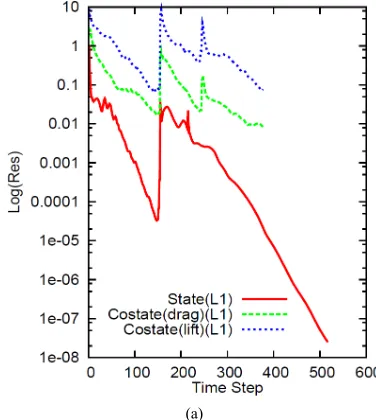
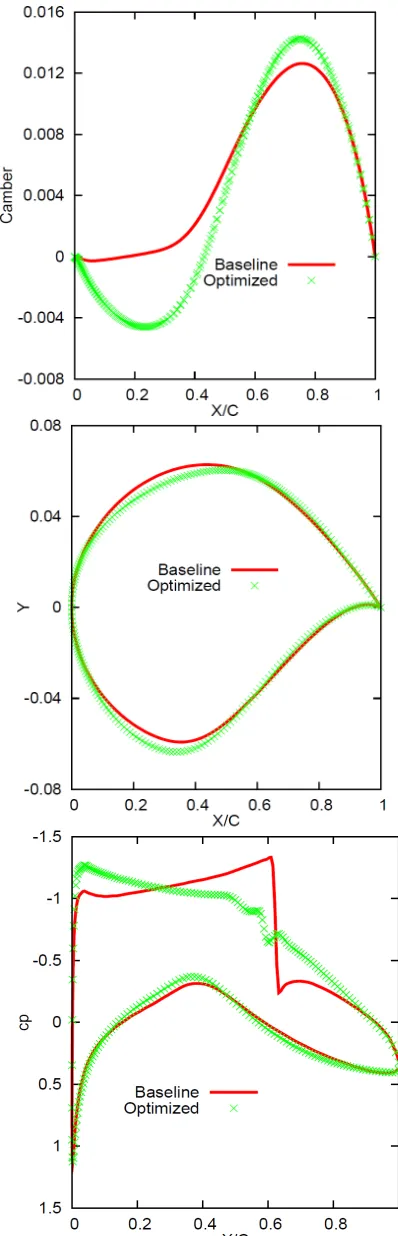
We present here the results of a test case of RAE 2822 air-foil for drag reduction with constant lift together with geo-metric constraint of constant thickness. The flow conditions are given at transonic Mach number 0.73 and angle of inci-dence 2 degrees. Further results obtained using this method can be found in [11]. The computational domain consists of C-grids in three levels with size: (321 × 57) (denoted by L1), (161 × 29) (denoted by L2) and (81 × 15) (denoted by L3). On these grid levels the preconditioned pseudo-stationary equations, resulting from the necessary optimality condi-tions corresponding to the optimization subproblems of Section 3, are solved using Algorithm 1. The initial values of the iterations (i.e., w0, λ0 and μ0) are obtained after 150 time steps on L1 level (and 100 time steps on L2 and L3 levels) of the state and costate equations. During a switch from “n” to “N” or from “N” to “n” the “restart” facility is used to read the solution of last iteration on the same level and this solution is corrected (as there is change in the ge-ometry) using 85 time steps on L1 (and 55 time steps on L2 & L3) of the state and costate solvers (refer to figures of convergence histories). After the convergence of the opti-mization problem, another 200 time-steps are carried out (in L1) for the state equation to get more accurate values of the surface pressure and force coefficients.
Figure 1. Convergence history of the optimization itera-tions.
(a)
(b)
[image:5.595.75.263.525.735.2](c)
Figure 2. Convergence history of state and costate residuals on level-1 (a), level-2 (b) and level-3 (c).
be attained in 85 optimization iterations [11]. However, it is to note that the final converged solution remains the same. This is another proof of numerical stability of the method. Also in any case, the total effort is about 5 times that of the forward simulation runs, since one sufficiently converged forward solution needs about 450 time-steps and total effort in the finest level is less than four forward simulation runs. Adding up the time-steps required in coarser and coarsest level, we come up with this number.
5. Conclusion
Figure 3. Comparison of Camberlines, airfoils and surface pressure distributions.
tion levels. Coarse grid solution, which is less expensive to compute, is used to accelerate the convergence of the optimization problem in fine grid. Multigrid strategy is quite effective when far away from the solution. The overall convergence is achieved by about 25% - 35% effort of that required by single grid computations using the same method.
6. Acknowledgements
I would like to thank DLR, Braunschweig, for giving access to the FLOWer code.
REFERENCES
[1] M. D. Gunzburger, “Perspectives in Flow Control and Optimization,” SIAM, Philadelphia, 2003.
[2] S. B. Hazra and V. Schulz, “Simultaneous Pseudo-Time- stepping for PDE-Model Based Optimization Problems,” Bit Numerical Mathematics, Vol. 44, No. 3, 2004, pp. 457- 472. doi:10.1023/B:BITN.0000046815.96929.b8
[3] S. B. Hazra, V. Schulz, J. Brezillon and N. R. Gauger, “Aero- dynamic Shape Optimization Using Simultaneous Pseudo- Timestepping,” Journal of Computational Physics, Vol. 204, No. 1, 2005, pp. 46-64.
doi:10.1016/j.jcp.2004.10.007
[4] S. B. Hazra, “An Efficient Method for Aerodynamic Shape Optimization,” AIAA Paper 2004-4628, 10th AIAA/ISS- MO Multidisciplinary Analysis and Optimization Confer-ence, Albany, 2004.
[5] S. B. Hazra, “Reduced Hessian Updates in Simultaneous Pseudo-Timestepping for Aerodynamic Shape Optimiza-tion,” 2006.
[6] S. B. Hazra and N. Gauger, “Simultaneous Pseudo- Time- stepping for Aerodynamic Shape Optimization,” Percent Allocation Management Module, Vol. 5, No. 1, 2005, pp. 743-744.
[7] S. B. Hazra and V. Schulz, “Simultaneous Pseudo- Time- stepping for Aerodynamic Shape Optimization Problems with State Constraints,” SIAM Journal on Scientific Com- puting, Vol. 28, No. 3, 2006, pp. 1078-1099.
doi:10.1137/05062442X
[8] S. B. Hazra, V. Schulz and J. Brezillon, “Simultaneous Pseudo-Timestepping for 3D Aerodynamic Shape Opti-mization,” Journal of Numerical Mathematics, Vol. 16, No. 2, 2008, pp. 139-161. doi:10.1515/JNUM.2008.007 [9] S. B. Hazra and V. Schulz, “Simultaneous Pseudo- Time-
stepping for State Constrained Optimization Problems in Aerodynamics,” In: L. Biegler, O. Ghattas, M. Heinken-schloss, D. Keyes and B. van Bloemen Waanders, Eds., Real-Time PDE-Constrained Optimization, SIAM, Phila- delphia, 2007.
[10] S. B. Hazra, “Multigrid One-Shot Method for Aerodyna- mic Shape Optimization,” SIAM Journal on Scientific Com- puting, Vol. 30, No. 3, 2008, pp. 1527-1547.
doi:10.1137/060656498
Con-strained Aerodynamic Shape Optimization,” SIAM Jour-nal on Scientific Computing, Vol. 30, No. 6, 2008, pp. 3220- 3248. doi:10.1137/070691942
[12] S. B. Hazra, “Large-Scale PDE-Constrained Optimization in Applications,” Springer-Verlag, Heidelberg, 2010. doi:10.1007/978-3-642-01502-1
[13] J. L. Lions, “Optimal Control of Systems Governed by Partial Differential Equations,” Springer-Verlag, New York, 1971. doi:10.1007/978-3-642-65024-6
[14] O. Pironneau, “Optimal Shape Design for Elliptic Sys-tems,” Springer-Verlag, New York, 1982.
[15] P. Neittaanmiaki, J. Sprekels and D. Tiba, “Optimization of Elliptic Systems,” Springer, Berlin, 2006.
[16] F. Troltzsch, “Optimal Control of Partial Differential Equa- tions: Theory, Methods and Applications,” Graduate Stu- dies in Mathematics, AMS, 2010.
[17] A. Brandt, “Multigrid Techniques: 1984 Guide with Ap-plications to Fluid Dynamics,” SIAM, Philadelphia, 1984. [18] W. Hackbusch, “Multigrid Methods and Applications,”
Springer-Verlag, Berlin, 1985.
[19] P. Wesseling, “An Introduction to Multigrid Methods,” R.
T. Edwards, Inc., Philadelphia, 2004.
[20] S. F. McCormick, “Multilevel Adaptive Methods for Partial Differential Equations,” SIAM, Philadelphia, 1989. doi:10.1137/1.9781611971026
[21] A. Jameson, “Solution of the Euler Equations for Two Dimensional Transonic Flow by a Multigrid Method,” Applied Mathematics and Computation, Vol. 13, No. 3-4, 1983, pp. 327-356. doi:10.1016/0096-3003(83)90019-X [22] S. Ta’asan, “Multigrid One-Shot Methods and Design Stra-
tegy,”Lecture Notes on Optimization, 1997.
[23] S. G. Nash, “A Multigrid Approach to Discretized Opti-mization Problems,” Optimization Methods and Software, Vol. 14, 2000, pp. 99-116.
doi:10.1080/10556780008805795
[24] R. M. Lewis and S. G. Nash, “A Multigrid Approach to the Optimization of Systems Governed by Differential Equations,” 2000.
[25] R. M. Lewis and S. G. Nash, “Model Problems for the Multigrid Optimization of Systems Governed by Differ-ential Equations,” SIAM Journal on Scientific Computing, Vol. 26, No. 6, 2005, pp. 1811-1837.