A Note on the Proof of the Perron-Frobenius Theorem
Yun Cheng1, Timothy Carson2*, Mohamed B. M. Elgindi3* 1University of Chicago, Chicago, USA
2University of Texas, Austin, USA 3Texas A&M University—Qatar, Doha, Qatar
Email: [email protected], [email protected], [email protected] Received September 13, 2012; revised October 14, 2012; accepted October 21, 2012
ABSTRACT
This paper provides a simple proof for the Perron-Frobenius theorem concerned with positive matrices using a homo- topy technique. By analyzing the behaviour of the eigenvalues of a family of positive matrices, we observe that the conclusions of Perron-Frobenius theorem will hold if it holds for the starting matrix of this family. Based on our observations, we develop a simple numerical technique for approximating the Perron’s eigenpair of a given positive matrix. We apply the techniques introduced in the paper to approximate the Perron’s interval eigenvalue of a given positive interval matrix.
Keywords: Perron Eigenpair; Homotopy; Eigencurves; Positive Matrices; Interval Matrices
1. Introduction
A simple form of Perron-Frobenius theorem states (see [1,2]):
If A
aij ij ais a real matrix with strictly posi- tive entries , then:
n n 0
1) A has a positive eigenvalue r which is equal to the spectral radius of A,
2) r is a simple,
3) r has a unique positive eigenvector v, 4) An estimate of r is given by the inequalities:
max min ij ij
i
ja r i
jaThe general form of Perron-Frobenius theorem in- volves non-negative irreducible matrices. For simplicity, we confine ourselves in this paper with the case of posi- tive matrices. The proof, for the more general form of the theorem can be obtained by modifying the proof for positive matrices given here.
Perron-Frobenius theorem has many applications in numerous fields, including probability, economics, and demography. Its wide use stems from the fact that eigen- value problems on these types of matrices frequently arise in many different fields of science and engineering [3]. Reference [3] discusses the applications of the theorem in diverse areas such as steady state behaviour of Markov chains, power control in wireless networks, commodity pricing models in economics, population growth models, and Web search engines.
We became interested in the theorem for its important
role in interval matrices. The elements of an interval matrix are intervals of . In [4], the theorem is used to establish conditions for regularity of an interval matrix. (An interval matrix is regular if every point in the interval matrix is invertible). In Section 4 we develop a method for approximation of the Perron’s interval eigen- value of a given positive interval matrix. See [5] for a broad exposure to interval matrices.
Since after Perron-Frobenius theorem evolved from the work of Perron [1] and Frobenius [2], different proofs have been developed. A popular line starts with the Brouwer fixed point theorem, which is also how our proof begins. Another popular proof is that of Wielandt. He used the Collatz-Wielandt formula to extend and clarify Frobenius’s work. See [6] for some interesting discussion of the different proofs of the theorem.
It is interesting how this theorem can be proved and applied with very different flavours. Most proofs are based on algebraic and analytic techniques. For example, [7] uses Markov’s chain and probability transition matrix. In addition, some interesting geometric proofs are given by several authors: see [8,9]. Some techniques and results, such as Perron projection and bounds for spectral radius, are developed within these proofs. More detailed history of the geometry based proofs of the theorem can be found in [8].
In our proof, a homotopy method is used to construct the eigenpairs of the positive matrix A. Starting with some matrix H0 with known eigenpairs, we find the eigenpairs of the matrix H t
H0t H
0D
for tstarting at 0 and going to 1. If for each t all eigenvalues
of H t
are simple, then the eigencurves r t
do not intersect as t varies from 0 to 1.Our proof requires that the curve formed by the greatest eigenvalues and its reflection about the real axis (i.e.,
r t
r t
) will not intersect with any other eigencurve. Together they form a “restricting area” for all other eigenvalue curves. As a result, the absolute value of any other eigenvalue will be strictly less than r t
for. By choosing an initial matrix 0
0 < < 1t H that has the desired properties stated in the Perron-Frobenius theorem, we will show that the “restricting area” preserves these properties along the eigencurves for all H t
, and forin particular.
1A H
Our proof is elementary, and therefore is easier to understand than other proofs. While most of the other proofs focus on the matrix A itself, we approach the problem by analysing a family of matrices. In our proof we study some intuitive structures of the eigenvalues of positive matrices and show how those structures are pre- served for matrices in a homotopy. Thus, our proof pro- vides an alternative perspective of studying the behaviour of eigenvalues in a homotopy.
Furthermore, our proof is constructive. The idea is to start with the known eigenpair corresponding to the maximal eigenvalue of H0, then use the homotopy method and follow the eigencurve corresponding to the maximal eigenvalues of positive matrices H t
, apply- ing techniques such as Newton’s method. Recently, many articles are devoted to using homotopy methods to find eigenvalues, for example see [10-12] and the re- ferences therein. In most cases, the diagonal of A is used as starting matrix H0. Still, people are interested in finding a more efficient H0, one which has a smaller difference from A. The H0 constructed in our proof provides an alternative to the query. It is promising be- cause by proper scaling, it can behave as some “average” matrix.2. The Proof
In the following sections, A
aij will denote a realmatrix with strictly positive entries, i.e. . If is an eigenvalue for A, and v is its corresponding eigenvector, then forms an eigenpair for A. A vector is positive if all of its components are positive. An eigenpair is positive if both of its eigenvalue and eigen- vector components are positive.
n n aij > 0
r
r v,
Lemma 2.1. A has a positive eigenpair
r v, .Proof. Define the function f V: V to be:
Avf v Av
where
: 1 , 0 for 1 ,and 1
n
i j
j
V v v v i n v ,
and v denotes the maximum norm of vn
Then f is continuous (since V does not contain the zero vector and Av is positive for any v in V), V is convex and compact (since V is closed and bounded, it is compact, while convexity follows trivially), f V
V (since the maximum norm of v in V is dominated byj jv
). According to Brouwer fixed point theorem, a continuous function f which maps a convex compact subset K of a Euclidean space into itself must have a fixed point in K. Thus, there exists v in V such that
f v v. No component of v can be 0, since any positive matrix operating on a non-negative vector with at least one positive element will result in a strictly positive vector. So v is a positive eigenvector of A, and the associated eigenvalue r is also positive.
Lemma 2.2. If r is the positive eigenvalue associated
with the eigenvector v in the previous lemma, then r has
no other (independent) eigenvector.
Proof. Suppose on the contrary, there is another posi-
tive eigenvector x for r. Assume that x and v are indepen- dent.
Let
min i 0
i i
v
t x
x
Let m be an index such that v xm mt. Let y v tx ,
then y is an eigenvector for A associated with eigenvalue
r. It’s clear that ym0 and for all i. Since x
and v are linearly independent, . Therefore,
0
i
y
y0
Ay m 0. On the other hand, m , a contradiction. Therefore v is the only eigenvector for
r.Ay rym 0
Lemma 2.3. v is the only positive eigenvector for A.
Proof. Suppose on the contrary, there is another
positive eigenvector x (independent of v) associated with an eigenvalue . It’s clear that 0. According to Lemma 2.2, r. Without loss of generality, assume
r
. Suppose
min i m
i i m
v v
t
x x
Let y v tx
0
, then just as in the previous lemma,
m
y , yi0 for all i, and y0. It follows that Ay rv tx is a positive vector.
But rvmrtxmtxm
0
tx
, which contradicts
m m
rv .
Remark. The previous lemmas imply that there exists
a unique positive eigenpair
r v,
for A.Lemma 2.4. There is no negative eigenvalue for A
Proof. Suppose the statement of the lemma is false. It follows that there exists an eigenpair
r x,
such thatAx rx. Then
r x2,
is an eigenpair for A2. On theother hand,
r v2,
is also an eigenpair for A2. Thereare two different eigenvectors associated with r2. Since
2
A is a positive matrix, this contradicts Lemma 2.2 and this completes the proof of this lemma.
Lemma 2.5. Suppose a b, . Then 0 ,
such that
1, 1, ,2 2
n m n m
1 1
0n a m b (1)
2 2 0
n a m b
(2)
Proof. Inequalities (1) and (2) are equivalent to
1 1
0 n a m
b b
(3)
2 2 0
a
n m
b b
(4)
According to Dirichlet’s approximation theorem, for any x,N, there is M such that
1
Mx Mx Mx Mx
N
Let x a b N , b 1.
Then n1 M m, 1 M a b satisfy (3).
Now let Mx Mx . If 0 , then
2 , 2
n M m M a b satisfy (4). If 0, then
1 1
1 1 Mx Mx
1
so n2 1M m, 2 1 M a b1 satisfy (4).
Lemma 2.6. There does not exist complex eigenvalue
of A such that
z z r.
Proof. Suppose, on the contrary, that there exists an
eigenpair
z x,
such that Axzx, where z \ and z r . Let z re i, 2π. It’s impossible that
xj 0 for all j, for this would make
Ax j
0 for all j. However, it’s clear that when.
0
l
zx
xl 0
Therefore, there exists some xj such that
xj 0.(if not, then consider x). Suppose
min i 0
i i
v
t x
x
and t is obtained at . Let , then for all i. Either
i m y v tx
0
yi 0
y or there existssome n such that n . Since if for all
i, then let m be the index of the element with non-zero imaginary part. For any
y 0
k
yi 0
,
k k k k
eikm m
m m m
A y A v A tx r v tx
If
y 0 ,s k
, then according to lemma 2.5, there exists such that
0 2 sπkarg xm
It follows that
eik
m m
v tx 0
, a contradiction. The case for
y 0 is similar.If
ym 0, then there exists some p such that
yp 0 . Let t t , y v tx. Require t t to be sufficiently small so that Ay
1
k is still a positive vector. It follows that for any ,
ei
k k k
m m m
r v tx A y 0. But according to lemma 2.5, for any > 0, there exists s k, such that
2π
k s . Then eik 0
m
v txm . This again results
in a contradiction, and hence the eigenpair
z x, does not exist.Remark. The previous lemmas imply that if
r v, isthe unique positive eigenpair of A, then is equal to
the spectral radius of A (since if
r
s w,
is any eigenpair corresponding to an eigenvalue of the maximum absolutevalue, then it can be shown that
s w ,
npairwith positive eigenvector, and the above lemmas will
then imply that r s
is an eige
.) Lemma 2.7. The matrix
1 1 , 1 1
D
has a simple eigenvalue n and eigenvalue 0 with alge- braic multiplicity n1. In addition, the eigenvector associated with n is positive.
Proof. Since , n is an
eigenvalue of D. Likewise,
1,1, ,1T 1,1, ,1T
D n
1,0, 1, ,0 , , 1,0,0, ,
T T
T
1, 1,0, ,0 ,
11
n
are independent eigenvectors of D associated with the eigenvalue 0. So 0 is an eigenvalue for D with multip- licity n1. Since an n n matrix have only n eigen- values, these are all the eigenvalues of D. Therefore, the eigenvalue of the greatest absolute value of D is positive and simple, and its corresponding eivenvector has posi- tive entries.
Theorem 2.1. Let A be any positive matrix. Then A
has a positive simple maximal eigenvalue r such that any other eigenvalue λsatisfies r and a unique positive eigenvector v corresponding to r. In addition, this unique positive eigenpair,
r v, , can be found by following the maximal eigenpair curve
r t v t
,
of the family of matrices
,0 1,H t D t A D t
Proof. The first part of the statement of the theorem follows from the previous lemmas. We will denote the eigenpair of the matrix D by r1
0 n and.
1 0 1,1, ,1
T
v
H t , 0 t 1, are all positive matrices. We will now examine the eigencurves C ti
r t v ti
, i
, where
i
r t is a particular eigenvalue for H t
, and v ti
is an eigenvector associated with it. The eigencurve Ci
t starting at is not going to intersect any other eigencurve at any time and remains to be the largest eigenvalue. Therefore, the unique positive eigenpair, of the matrix A, can be found by following the maximal eigenpair curve .
1 0 , 1 0
r v
r v,
1
r t
1
C
t Theorem 2.2. An estimate of r is given by:max min ij ij
i
ja r i
ja Proof. Supposemin max
m i
M i
v v
v v
then
min
max
m m m mi m
i
i j
ij
M M M Mi M
i
i j
rv Av v a v a
rv Av v a v a
ijTherefore
max min ij ij
i
ja r i
jaRemark. This completes the proof of Perron-Fro-
benius theorem for positive matrices. The proof can be
modified to prove the more general case for irreducible
non-negative matrices. For example, this can be done by
letting H0maxa Dij , where D is the matrix defined in Lemma 2.7. As we noted in the introduction, we will next demonstrate how to use homotopy method to find the
largest eigenvalue of a positive matrix A numerically.
3. Numerical Example
In this section we use the homotopy method to appro- ximate the positive eigenpair of the matrix:
0.56201 1.0361 1.3522 0.50958 1.5610 0.88017 1.8872 0.57813 0.44808 1.3507
, 1.0543 1.2754 1.3436 1.3357 0.013431 0.91485 1.9154 1.3903 1.6888 1.2043
1.7507 0.48141 0.13599 0.68892 0.77354
A
starting with the 5 × 5 matrix D of all entries ones. In [12] it is shown that the homotopy curves that connect the eigenpairs of the starting matrix D and those of A can be
followed using Newton’s method. We use these tech- niques to follow the eigencurve associated with the largest eigenvalue of D. While [12] finds all the eigenvalues of tridiagonal symmetric matrices, the method works well in approximating the largest eigenvalue when it is applied to any positive matrix due to the separation of its eigencurves (see [12] for details).
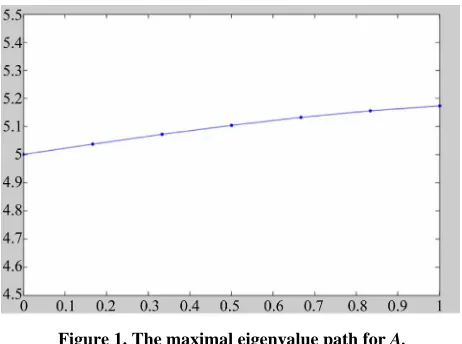
The eigenpath of D t A D
, shown in Figure 1, is constructed using the numerical results presented in the following table:t 0 1/6 2/6 3/6 4/6 5/6 1
Largest
Eigenvalue 5.0000 5.0369 5.0718 5.1038 5.1321 5.1556 5.1730 Corresponding
Eigenvector 0.4472 0.4431 0.4372 0.4295 0.4202 0.4094 0.3972 0.4472 0.4450 0.4408 0.4343 0.4253 0.4136 0.3988 0.4472 0.4449 0.4442 0.4450 0.4475 0.4515 0.4573
0.4472 0.4753 0.5034 0.5314 0.5592 0.5868 0.6138
0.4472 0.4262 0.4048 0.3827 0.3600 0.3364 0.3119
4. An Application to Positive Interval
Matrices
To differentiate ordinary matrices in the previous sec- tions from interval matrices, we will call them point ma- trices in this section. As stated in Section 1.2, an interval matrix is of the form A A A, , where A and A are point matrices.
Definition 4.1. We call A a positive interval matrix if
A and A are positive. The set E is Perron’s interval
eigenvalue of A if E consists of all positive real maximal eienvalues of all the positive point matrices B with
A B A.
We are interested in determing Perron’s interval eigen- value E of A. We’ll show that if s = the Perron’s eigenvalue of A, t = the Perron’s eigenvalue of A, then E
s t, . Therefore, we can approximate E using the Homotopy method introduced in this paper.Lemma 4.1. Let B be an positive point matrix
with Perron’s eigenpair
n n
,v , and C be an n npositive point matrix with Perron’s eigenpair
,x
. Suppose bij cij for all 1i j n, , then .Proof. Let M maxi
x vi i
, and suppose the maxi-mum is obtained when i k . Then
1 1
1 1 1
n n
kj j kj j j j
j j
k k k k
n n n
kj j kj j kj j
j j j
k k k
c x c v x v
x v x v
c v M c v b v
v M v v
Figure 1. The maximal eigenvalue path for A.
Theorem 4.1. Let A A A, be a positive interval
matrix, and E is its Perron’s interval eigenvalue.
Suppose s= the Perron’s eigenvalue of A , tthe
Perron’s eigenvalue of A, then E
s t, 1i j, .Proof. For any B A and n , we have
ij ij
ij
a b a . Suppose is the Perron’s eigenvalue of
B, then s t from the previous lemma. Therefore
,E s t
.
Let H u A
1u
A, 0u1. Define the func- tion f : 0,1
s t, to be:
Perron's eigenvalue of
f u H u
Then f
0 s and f
1 t. Since f is continuous, then from the Intermediate Value Theorem, for all
s t, there’s some u
0,1 such that f u
. Therefore
s t, E.It follows that E
s t,Remark. Theorem 4.1 shows that in order to find the
Perron’s interval eigenvalue E of A, we only need to find
the Perron’s eigenvalues of A and A, which can be
approximated using the technique introduced in the previous section.
5. Acknowledgements
This research was partially carried out by two students: Yun Cheng and Timothy Carson, under the supervision of Professor M. B. M. Elgindi, and was partially spon- sored by the NSF Research Experience for Under-
graduates in Mathematics Grant Number: 0552350 and the Office of Research and Sponsored Programs at the University of Wisconsin-Eau Claire, Eau Claire, Wis- consin 54702-4004, USA.
REFERENCES
[1] O. Perron, “The Theory of Matrices,” Mathematical An- nalem, Vol. 64, No. 2, 1907, pp. 248-263.
[2] G. Frobenius, “About Arrays of Non-negative Elements,” Reimer, Berlin, 1912.
[3] S. U. Pillai, T. Suel and S. Cha, “The Perron-Frobenius Theorem: Some of Its Applications,” IEEE in Signal Processing Magazine, Vol. 22, No. 2, 2005, pp. 62-75. [4] J. Rohn, “Explicit Inverse of an Interval Matrix with Unit
Midpoint,” Electronic Journal of Linear Algebra, Vol. 22, 2011, pp. 138-150.
[5] J. Rohn, “A Handbook of Results on Interval Linear Problems,” 2005.
http://uivtx.cs.cas.cz/ rohn/publist/!handbook.pdf [6] F. R. Gantmache, “The Theory of Matrices, Volume 2,”
AMS Chelsea Publishing, Providence, 2000.
[7] University of Nebraska-Lincoln, “Proof of Perron-Fro- benius Theorem,” 2008.
http://www.math.unl.edu/~bdeng1/Teaching/math428/Le cture%20Notes/PFTheorem.pdf
[8] A. Borobia and U. R. Trfas, “A Geometric Proof of the Perron-Frobenius Theorem,” Revista Matematica de la, Vol. 5, No. 1, 1992, pp. 57-63.
[9] H. Samelson, “On the Perron-Frobenius Theorem,” The Michigan Mathematical Journal, Vol. 4, No. 1, 1957, pp. 57-59.
[10] T. Zahng, K. H. Law and G. H. Golub, “On the Homo- topy Method for Symmetric Modified Generalized Ei- genvalue Problems,” 1996.
http://citeseerx.ist.psu.edu/viewdoc/summary?doi=10.1.1. 49.7261
[11] M. T. Chu, “A Note on the Homotopy Method for Linear Algebraic Eigenvalue Problems,” North Carolina State University, Raleigh, 1987.
[12] P. Brockman, T. Carson, Y. Cheng, T. M. Elgindi, K. Jensen, X. Zhoun and M. B. M. Elgindi, “Homotopy Method for the Eigenvalues of Symmetric Tridiagonal Matrices,” Journal of Computational and Applied Mathe- matics, Vol. 237, No. 1, 2012, pp. 644-653.