ISSN Online: 2151-4771 ISSN Print: 2151-4755
DOI: 10.4236/ce.2017.815163 Dec. 7, 2017 2393 Creative Education
Arts and Scholastic Performance
Arnaud Cabanac
De Rochebelle, C.S.D.D, Québec, Canada
Abstract
Pleasant environmental music during an academic test helped students to overcome stress. As a result the grades they obtained were higher. It was also demonstrated that students selecting music as optional course performed bet-ter, than music-less control students over three consecutive years. Yet, there remained ambiguities as for the causes of the higher test performance of these students. Our study confirmed a Mozart effect, and further showed a latency of two to three years for such a positive influence to take place, suggesting that it is the practice of music itself that helps cognition. We showed also that oth-er art courses, when freely chosen, have similar positive influences on stu-dents’ performances, illustrating that the principles of learning are linked to hedonism and to will effort in a more general manner.
Keywords
Music “Mozart Effect”, Arts Academic Achievement, Education Pleasure Will Effort
1. Introduction
Ambient music in the examination room has been demonstrated to have a posi-tive influence on students while performing academic tests as it helped them to overcome stress, to devote more time to stressful and more complicated tasks and their eventual grades were higher as demonstrated (Perlovsky, Cabanac,
Bonniot-Cabanac, & Cabanac, 2013). It has also been shown that students
se-lecting musical courses during their academics performed better than control music-less students (Gouzouasis, Guhn, & Kishor, 2007; Cabanac, Perlovsky,
Bonniot-Cabanac, & Cabanac, 2013). Yet, there remained ambiguities as for the
causes of the higher test performance of these students. Music has been shown to develop IQ but personality and individual differences were recently suggested to play an important part in the efforts children would put to reach success (Corri-How to cite this paper: Cabanac, A.
(2017). Arts and Scholastic Performance. Creative Education, 8, 2393-2399.
https://doi.org/10.4236/ce.2017.815163
Received: October 17, 2017 Accepted: December 4, 2017 Published: December 7, 2017
Copyright © 2017 by author and Scientific Research Publishing Inc. This work is licensed under the Creative Commons Attribution International License (CC BY 4.0).
DOI: 10.4236/ce.2017.815163 2394 Creative Education
gall, Schellenberg, & Misura, 2013). In this present study, we asked whether
freely chosen, would other kinds of art courses also have such positive influence as music had on academic performance? And also, how long would the delay be before any music positive influence to take place in teenagers?
2. Methods
The population studied consisted of students from a secondary school of the province of Quebec in Canada. De Rochebelle secondary school is a large school consisting of many buildings connected together with about 1700 students. The students of the present study belonged to the International Baccalaureate pro-gram for which they were selected on their high grades in previous years. They formed a homogenous group in terms of their grades. At registration, all stu-dents were requested to choose the kind of art they were going to follow on their next year. The options were Plastic art, Theater, and Music. A forth option which was sport (basket-ball) has been removed from the samples even though they were linked with music, because those students were definitely putting too much of their efforts into sports and as such were not normally distributed as the three others groups.
The mean grade differences between groups after 2, 5, and 10 months over the three years of the study were computed. Winter and summer holidays were dis-carded as school stopped, even though it is likely that the student were practicing their art at will during that time.
We compared the marks obtained by the three different groups of students: 60 Plastic arts students, 60 Theater students, and 30 - 40 Music students, for a grand total of 160 students included into the survey. Students, were 12 - 13 years old, of both genders at the beginning of the study, and were therefore 14 - 15 at the end of the study.
In the three different courses of arts (Plastic art, Theater, and Music), students were asked similar tasks, including creation, interpretation, and appreciation of the art.
DOI: 10.4236/ce.2017.815163 2395 Creative Education and an interpretation of a short melody. Again a concert was given at the end of the school year. On the second and third year these knowledge were rein-forced during the school year with a Christmas’s concert and an ending of the year’s concert.
In the Theater course, the students were evaluated on their ability to create and to play some dramatic works, and on their appreciation of dramatics works. Over the first semester, the students had to learn first who they were themselves in order to use it in their art. In workshops, the students were to create some short sequence dramas, and to build different characters based from different parts of their body and their voices. They also learned some history of the art of marionettes. Over the second and third semester, the students had to create some short scene with marionettes, thus learning manipulation, use of their voices, and the reading of different texts; finally, the students had to play various characters in improvised and programmed plays. On their second year they learned setting and make-up and they had to create and to play dramas and clowns. On their third year the students learned different moves and they had to write some short plays. Again on several occasions of each year the student had to perform on a stage in front of a public of schoolmates, teachers, and parents.
The Plastic arts students were evaluated on their ability to create some images with particular characteristics (personal and media), and on their abilities to ap-preciate some pictures. Over the three years, the students had to use different media and technics (drawing, painting, and sculpture) to create some images that were personal and some that were medias. Their teachers presented differ-ent artistic works from the patrimony in link to the currdiffer-ent work made by the students. The students learned how to analyze and appreciate various drawings, paintings, and sculptures (their own production and well-known public ones). Most of the works were individual, but on occasions some works could be done in collaboration with a class mate. With drawings, paintings, recycling of mate-rials, pastings, and sculptures, students became familiar with lines, dots, forms, textures, colors, melting, shades, volumes, dyeing, space organization, 3-D pers-pective. Here again, at the end of each year there is a big event in which the art-ists presented their works to the entire school and parents.
All the students were among the top grade level of their school. To judge their level on their general education, we used only results from courses with quanti-fiable performance including: sport, science, mathematics, ethics, geogra-phy/history, French, English, and Spanish.
3. Results and Discussion
DOI: 10.4236/ce.2017.815163 2396 Creative Education
2007; Cabanac, Perlovsky, Bonniot-Cabanac, & Cabanac, 2013). The results from
our present study confirmed previous studies. At the beginning our population was homogeneous and after only two months of practicing either Plastics arts, Theater, or Music, there were still no trend of one art having a positive influence on the academic performance in the other topics (general education). Figure 1 illustrates the homogenate results after two months of study. All groups re-mained homogeneous over that first year.
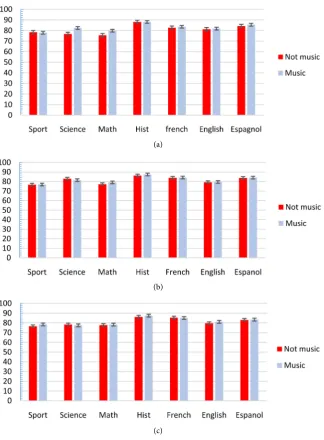
However, the group’s grades of students following music as their artistic course began to become better than the other groups on the third year of prac-ticing music (month-2 of that third year: Student’s t-test, p = 0.04; month-5 of the third year: Student’s t-test, p = 0.19; month-10 of the third year : Student’s
t-test, p = 0.07), as illustrated on Figure 2. Eerola & Eerola (2013) reported that
extended music education has a positive influence on the social aspects of schooling, Kokkidou, Tsakiridou, & Geka (2008) showed that learning a music instrument, had positive effects on school competence, academic performance, development of self-esteem and self-consciousness emotional maturity, and on the promotion of social skills. Recent theoretical hypothesis suggested that music helps resolving knowledge contradictions and, then, is fundamental for the sur-vival of the entire human evolution (Perlovsky, 2011, 2013) study. All groups remained homogeneous over that first year.
In previous studies lay an uncertainty of whether it was due to the practice of music rather than the personal ability of the teenager that would explain the Mozart effect (Corrigall, Schellenberg, & Misura, 2013) or the opposite pheno-menon. Interestingly, the fact that it took two to three years to become signifi-cant in the present study, suggests that it is the practice of music that made the student better at school rather than a personal ability of the student. Otherwise a difference should have be present from the beginning and not been built over the years as our results showed.
[image:4.595.216.538.571.690.2]Another interesting fact of the study is the analysis of Plastic art students’ as they became stronger than the other students as early as the end of the first year (Student t-test, p = 0.078), but confirmed thereafter on the second year (Student t-test : p = 0.043, p = 0.008, p = 0.009, months-2, -5, -10) and third year (Student
DOI: 10.4236/ce.2017.815163 2397 Creative Education
(a)
(b)
[image:5.595.214.539.67.508.2](c)
Figure 2. Mean marks of 14 - 15 teenagers after 2 ((a) t-test, p = 0.043); after 5 ((b) t-test: p = 0.193); and after 10 months ((c) t-test, p = 0.071) on the third year of study.
t-test: p = 0.307, p = 0.059, p = 0.028, months-2, -5, -10). Theater students were never better than the other art students over the three years of the study. They may have been better in some particular courses, but not as a general trend in all topics.
DOI: 10.4236/ce.2017.815163 2398 Creative Education
Hammel, 2011).
The influence of music and plastic art confirmed in the present results is likely to be due to the pleasure experienced by the participants. Indeed, hedonism, the experience of pleasure, is the door to cognition (Cabanac, 2010).
In the modern society lot of efforts are invested into technology. Chen,
Cha-vez, Ong, & Gunderson (2017) pointed out that if many educational policies
provide learners with more resources (e.g., new learning activities, study mate-rials, or technologies), less often do educators explore whether students are us-ing these resources actually, and that makus-ing students more self-reflective about how they should approach their learning with the resources available to them the more they improve their performance.
Furthermore, will effort by itself might enhance the given motivation or/and by weakening competition with other motivations. Thus, will effort would direct the subject’s attention toward those elements of choice and raise their desirabili-ty. Therefore, the choice between possible decisions becomes easier. Indeed, will effort activating emotional/hedonic memory leads a subject toward beneficial decisions (Ovsich, 2017).
We underline, in agreement with Aristote (LaCourse Munteau, 2012), the old knowledge that simple pleasure in learning should be present in a teacher’s per-formance and satisfaction of efficiency in the student state, in order to reach a state when learning becomes a pleasure (Theron, 2009; European Commission, 2017).
4. Conclusion
The current paper shows relations between arts education and academic per-formance. Students selecting musical and plastic art courses perform better than those declining such courses, despite equally high initial achievements. This suggests that the practice of art with efficiency helps students in their academic achievements. In addition to addressing this fundamental scientific question about learning these results suggest that efforts should been made on a playful approach in education.
Acknowledgements
The author thanks De Rochebelle School (C.S.D.D., Quebec, Canada) and Di-rector Daniel Lemelin for making available academic performance records. This research did not receive any specific grant from funding agencies in the public, commercial, or not-for-profit sectors.
References
Cabanac, A., Perlovsky, L., Bonniot-Cabanac, M. C., & Cabanac, M. (2013). Music and Academic Performance. Behavioural Brain Research, 256, 257-260.
https://doi.org/10.1016/j.bbr.2013.08.023
DOI: 10.4236/ce.2017.815163 2399 Creative Education 155, 173-200.https://doi.org/10.1016/S0022-5193(05)80594-6
Cabanac, M. (2002). What Is Emotion? Behavioural Processes, 60, 69-83. https://doi.org/10.1016/S0376-6357(02)00078-5
Cabanac, M. (2010). The Fifth Inluence. The Dialectics of Pleasure. Bloomington, IN: iUniverse, ISBN 978-1-4401-8836-7, 284 p. https://doi.org/10.13140/2.1.3610.5282 Cabanac, M., Cabanac, R., & Hammel, H. (2011). Consciousness: The Fifth Influence.
Journal of Cosmology, 14. http://journalofcosmology.com/Consciousness127.html Cabanac, M., Guillaume, J., Balaskó, M., & Fleury, A. (2002). Pleasure in Decision
Mak-ing Situations. BMC Psychiatry, 29, 2-7.https://doi.org/10.1186/1471-244X-2-7 Chen, P., Chavez, O., Ong, D. C., & Gunderson, B. (2017). Strategic Resource Use for
Learning: A Self-Administered Intervention That Guides Self-Reflection on Effective Resource Use Enhances Academic Performance. Psychological Science, 6, 74-785. https://doi.org/10.1177/0956797617696456
Corrigall, K. A., Schellenberg, E. G., & Misura, N. M. (2013). Music Training, Cognition, and Personality. Frontiers in Psychology, Auditory Cognitive Neuroscience, 222, 1-10. https://doi.org/10.3389/fpsyg.2013.00222
Eerola, P. S., & Eerola, T. (2013). Extended Music Education Enhances the Quality of School Life. Journal Music Education Research, 16, 88-104.
https://doi.org/10.1080/14613808.2013.829428
European Commission (2017). Culture and Education, Press Release Data Base, Update 20 Feb. 2017. http://europa.eu/rapid/press-release_PRES-94-130_fr.htm
Gouzouasis, P., Guhn, M., & Kishor, N. (2007). The Predictive Relationship between Achievement and Participation in Music and Achievement in Core Grade 12 Academic Subjects. Music Education Research, 9, 81-92.
https://doi.org/10.1080/14613800601127569
Kokkidou, M., Tsakiridou, E., & Geka, M. (2008). Correlation between Music Studies and School Competence: Field Research. In M. Argyriou (Eds), Current Trends and Dy-namics of School Psychology in Education and Music Pedagogy (pp.172-179). Athens: Diaplasi.
Lacourse Munteau, D. (2012). Aristote on Pleasure and Learning. In N. Seel (Eds), En-cyclopedia of the Sciences of Learning (pp 312-313). Berlin : Springer.
Ovsich, A. (2017). Mathematical Models of Desire, Need, Attention, and Will Effort. In: J. Vallverdú, M. Mazzara, M. Talanov, S. Distefano, & R. Lowe (Eds), Advanced Research on Biologically Inspired Cognitive Architerctures (Chapt-9, pp. 177-213). ISBN 9781522519478.IGI Global, USA.
Perlovsky, L. I. (2011). Music, Cognitive Function Origin and Evolution of Musical Emo-tions. WebmedCentral Psychology, 2, WMC001494.
Perlovsky, L. I. (2013). A Challenge to Human Evolution—Cognitive Dissonance. Fron-tiers in Psychology, 4, 179.https://doi.org/10.3389/fpsyg.2013.00179
Perlovsky, L., Cabanac, A., Bonniot-Cabanac, M. C., & Cabanac, M. (2013). Mozart Ef-fect, Cognitive Dissonance, and the Pleasure of Music. Behavioural Brain Research, 244, 9-14.https://doi.org/10.1016/j.bbr.2013.01.036