ISSN Online: 2162-2086 ISSN Print: 2162-2078
DOI: 10.4236/tel.2018.82011 Feb. 7, 2018 159 Theoretical Economics Letters
A Comparison between Corruption and
Smuggling: Which One Is Worse?
Khandokar Istiak
Department of Economics and Finance, University of South Alabama, Mobile, AL, USA
Abstract
Corruption is a universal issue for almost all developing and underdeveloped countries. It is considered as one of the most important reasons that hamper economic growth. I follow a simple graphical approach to show the dreadful economic impact of corruption on the economy. I compare two evils, corrup-tion with smuggling, and find that the welfare cost of corrupcorrup-tion is higher than that of smuggling. I suggest merit-based recruitment of government of-ficers and an independent judicial system to eradicate corruption from the economy.
Keywords
Corruption, Smuggling, Tariff, Welfare Cost
1. Introduction
Corruption is defined as the bribe-taking behavior in public offices (Dhillon et al. [1]). Generally, corruption reduces tax revenue as it compromises govern-ment ability and power to collect taxes (Kaufmann and Wei [2]). Mauro [3] and Bardhan [4] show how corruption creates a negative impact on growth and overall economic development of a country. Low wages of the government of-ficers are often considered as a cause of corruption and the use of “efficiency” wages is proposed as a solution to corruption (see, for example, Amir and Burr
[5]). There exists some recent literature that supports non-monetary incentives to minimize corruption. For example, Dhillon et al.[1] argue that maintaining a high status in the public sector as opposed to private sector will reduce corrup-tion in the economy.
Whereas the existing studies follow a theoretical or empirical approach to ex-plore the nature of corruption and the ways to eradicate it, I use a graphical
ap-How to cite this paper: Istiak, K. (2018) A Comparison between Corruption and Smug-gling: Which One Is Worse? Theoretical Economics Letters, 8, 159-165.
https://doi.org/10.4236/tel.2018.82011
Received: January 10, 2018 Accepted: February 4, 2018 Published: February 7, 2018
Copyright © 2018 by authors and Scientific Research Publishing Inc. This work is licensed under the Creative Commons Attribution International License (CC BY 4.0).
http://creativecommons.org/licenses/by/4.0/
DOI: 10.4236/tel.2018.82011 160 Theoretical Economics Letters
proach to show how bad the impact of corruption is on the economy. This ap-proach has some advantages over the other apap-proaches in two ways. First, the process is based on a simple supply-demand model and does not involve hefty econometric techniques. So, it is straightforward and easy to understand even to non-economists. Second, and most importantly, the corruption rate can be ad-justed easily by this graphical approach. This provides a room to check the ro-bustness of the baseline findings, as demonstrated in the last paragraph of Sec-tion 3.
In this paper, I only consider the corruption prevailing in the international trade sector. I define the amount of corruption equals to the bribe paid to the corrupted government officials to obtain the license of importing goods. I com-pare the adverse effects of corruption with those of smuggling, which is another curse for the economy. I examine whether there is a net welfare gain if a cor-rupted economy is turned into one that incurs smuggling. I find that there is a net gain if corruption is eradicated, but smuggling is introduced in the economy. So, I argue that the overall negative impact of corruption is larger than that of smuggling. I suggest that a strong, impartial, and independent judicial system can eliminate corruption from the economy.
The main contribution of this study is to demonstrate the alarming effects of import-based corruption by using a simple graphical approach. This is a theo-retical paper and I do not use any empirical analysis in support of the findings. The theoretical findings of this paper can be confirmed by collecting data from an experimental lab setting. This can be treated as a scope of future research in this context.
The paper is organized in the following way. Section 2 provides a review of the past literature. Section 3 represents the graphical model to discuss the impact of smuggling and import based corruption in a hypothetical economy. The section also shows the net gain of switching from a corrupt economy to a smuggling prevailing economy. The final section provides the concluding remarks with the policy suggestions.
2. The Literature Review
Corruption is a widespread phenomenon in many developing countries. There are some excellent articles that discuss the nature of corruption in the economy. For example, Amir and Burr [5] explain the introduction of corruption in a Cournot industry with linear demand and costs. They argue that a firm may pay a bribe-maximizing official a fixed percentage of anticipated profit to have access to the industry. In this case, a monopoly may emerge that can create huge ineffi-ciency in the economy. The importance of corruption from an economic view-point has also been noted in multiple research papers; for example, see Tullock
[6], Rose-Ackerman [7], Jain [8], Aidt [9], Burguet and Chwe [10], among oth-ers.
ex-DOI: 10.4236/tel.2018.82011 161 Theoretical Economics Letters
isting studies find that corruption slows down economic growth, total invest-ment, and foreign direct investment (see, Mauro [3] and Wei [11]). Corruption increases the cost of production and drives the firms out of the official economy (Kaufmann [12]). The impact of corruption is also prevalent in the macroe-conomy. For example, Tanzi and Davoodi [13] find that corruption reduces public sector budgets and hampers the productivity of a country's infrastructure. As corruption introduces huge social loss, it has attracted an increasing attention from the legislators, politicians and academic scholars. Many authors identify low wages of the government officials as the main reason for corruption (see, Amir and Burr [5], Becker and Stigler [14], Chand and Moene [15], among oth-ers). So, “efficiency wage” has been identified as a solution to prevent corrup-tion, see Mahmood [16]. However, a large body of field experiments has found that monetary incentive may not be useful to eradicate corruption (see, Akerlof and Dickens [17] and Deci et al.[18]). So, the effectiveness of higher wages to remove corruption from the economy is still debated.
My research adds a new dimension to the literature because to show the nega-tive effects of corruption I compare it with smuggling. I find that between the two evils, the corruption is the worse. I also show that the welfare cost of corrup-tion is higher than that of smuggling. So, to the best of my knowledge, the tech-nique of my research is utech-nique in the literature.
3. The Model
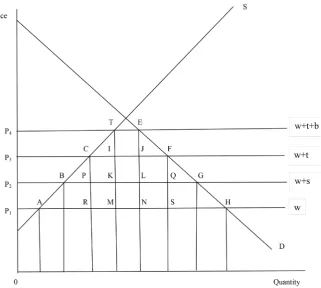
In Figure 1, D and S indicate the domestic demand and supply curve of a prod-uct, respectively. The horizontal world price line 0P1 is below the domestic
equi-librium. In this case, the country will import that product from the rest of the world. When per unit tariff P1P3 is imposed, the price of the imported product
would be 0P3 in the domestic market. At this price, the import will be CF and
government revenue will be tariff times import or equal to the area of CRSF. The social loss from the tariff equals to the area of CAR plus the area of FSH. They represent the production and consumption distortion cost of the domestic country, respectively.
If per-unit smuggling cost is less than the tariff, there is a possibility of smug-gling. Smuggling cost can be any amount less than P1P3. I assume that the
im-porters pay per unit smuggling cost of P1P2 to the border officials. The price of
the imported product would be 0P2 in the domestic market. At this price, the
import will be BG, but the government does not earn any revenue.
Now I assume that the importers require a license to import goods and they need to pay per unit bribe of P3P4 to the corrupt administrative officers for
ob-taining the license. In Figure 1, I keep bribe = smuggling cost or P3P4= P1P2 so
that it is easy to compare their overall effects. If the bribe equals P3P4, the price of
the imported product in the domestic market would be 0P4. At this price import
will be TE and government revenue will be tariff times import or equal to area
DOI: 10.4236/tel.2018.82011 162 Theoretical Economics Letters
Figure 1. The economic impact and comparison of corruption vs. smuggling.
Both smuggling and corruption are harmful to the economy. To compare them I find the net gain of switching from corruption (when the price is 0P4) to
smuggling (when the price is 0P2). If the net gain is positive, corruption is worse
than smuggling. If the price declines from 0P4 to 0P2, the gain in consumer
sur-plus equals area P4P2GE, the loss in producer surplus equals area P4P2BT, and the
loss in government revenue equals area IMNJ.
(
)
(
)
(
)
(
)
(
)
(
)
4 2 4 2
Net gain area
area
area area
area area
P P GE P P BT IMNJ
TBGE IMNJ
TBK ELG TIJE IKLJ IKLJ KMNL
TBK ELG TIJE KMNL
= − −
= −
= + + + − +
= + + −
(1) As smuggling cost = bribe, area TIJE = area KMNL. So, Equation (1) becomes
Net gain = area (TBK + ELG)
As the overall net gain of switching from corruption to smuggling is positive, the overall impact of corruption on the economy is worse than that of smug-gling.
What is the intuition behind the result? According to the theory of interna-tional trade, if world price is 0P1 and tariff amount is P1P3, the social cost equals
DOI: 10.4236/tel.2018.82011 163 Theoretical Economics Letters
to obtain an import license, the importers pass the burden of bribe to the do-mestic consumers. As a result, the price of the imported product goes up and the total amount of import declines compared to a no corruption situation. Thus, the social cost of area CAR and area FSH increase to area ATM and area ENH, respectively. Moreover, the government revenue now shrinks to area IMNJ only. So, both the government and the society suffer if corruption is introduced. On the other hand, under smuggling government does not get any revenue, but the price of the good is very low in the domestic market. The consumer surplus is so high in this case that the overall social cost of smuggling is lower than that of corruption.
I consider three cases to check the robustness of the finding. First, consider the case that the bribe rate is higher than the smuggling cost. In this case, the 0P4
line shifts upward and the area of (TBK + ELG) increases. The length of TI and
EJ increase but the length of TE and IJ decrease. So, the area of TIJE remains roughly constant. Again, if the 0P4 line shifts upward, the length of KL and MN
decrease, but the length of KM and LN remain constant. So, the area of KMNL
declines. Thus, if 0P4 line shifts upward, the area of (TIJE − KMNL)is still
posi-tive. So, overall the net gain of switching from corruption to smuggling in equa-tion (1) is still positive. Second, consider the case that the bribe rate is lower than the smuggling cost. In this case, the 0P4 line shifts downward and the area of
(TBK + ELG) decreases. The length of TI and EJ decrease, but the length of TE
and IJ increase. So, the area of TIJE remains roughly constant. Again, if the 0P4
line shifts downward, the length of KL and MN increase, but the length of KM
and LN remain constant. So, the area of KMNL increases. If the 0P4 line does not
shift downward by a large amount, the area of (TIJE − KMNL) is still positive. So, overall the net gain of switching from corruption to smuggling in Equation (1) is still positive. Third, consider the case that the country is reducing the tariff rate in the wake of globalization. In this case, the 0P3 line shifts downward. Now
the area of TIJE increases, but the area of KMNL is unaffected. So, the area of (TIJE − KMNL) goes up. In Equation (1), the area of (TBK + ELG) will be un-changed, if the 0P3 line shifts downward. So, overall the net gain from switching
from corruption to smuggling is still positive.
4. Conclusions
DOI: 10.4236/tel.2018.82011 164 Theoretical Economics Letters
I suggest a free market economy with less government regulation. This will reduce the scope to pay bribes to the corrupt officials. Moreover, the recruitment of government officers must be strictly merit-based. Proper punishment must be specified if any case of nepotism and rent-seeking activities are found in case of recruitment. Also, to combat corruption, a well-motivated salary compensated with domestic inflation must be proposed to the civil servants. Above all, a strong, impartial and independent judicial system, the freedom of the press, and democracy are important to prevent corruption from the country.
Acknowledgements
I am indebted to an anonymous reviewer whose valuable insights and comments have greatly improved this paper.
References
[1] Dhillon, A., Nicolo, A. and Xu, F. (2017) Corruption, Intrinsic Motivation and the Love of Praise. Journal of Public Economic Theory, 19, 1077-1098.
https://doi.org/10.1111/jpet.12278
[2] Kaufmann, D. and Wei, S. (1999) Does “Grease Money” Speed Up the Wheels of Commerce? NBER Working Paper No. w7093. https://ssrn.com/abstract=162974 [3] Mauro, P. (1995) Corruption and Growth. Quarterly Journal of Economics, 110,
681-712. https://doi.org/10.2307/2946696
[4] Bardhan, P. (1997) Corruption and Development: A Review of Issues. Journal of Economic Literature, 35, 1320-1346.
[5] Amir, R. and Burr, C. (2015) Corruption and Socially Optimal Entry. Journal of Public Economics, 123, 30-41.https://doi.org/10.1016/j.jpubeco.2014.12.012 [6] Tullock, G. (1967) The Welfare Cost of Tariffs, Monopoly and Theft. Economic
In-quiry, 5, 224-232.https://doi.org/10.1111/j.1465-7295.1967.tb01923.x
[7] Rose-Ackerman, S. (1978) Corruption: A Study in Political Economy. Academic Press, New York.
[8] Jain, A.K. (2001) Corruption: A Review. Journal of Economic Surveys, 15, 71-121.
https://doi.org/10.1111/1467-6419.00133
[9] Aidt, T. (2003) Economic Analysis of Corruption: A Survey. The Economic Journal, 115, 632-652.https://doi.org/10.1046/j.0013-0133.2003.00171.x
[10] Burguet, R. and Chwe, Y.K. (2004) Competitive Procurement with Corruption. The RAND Journal of Economics, 35, 50-68.https://doi.org/10.2307/1593729
[11] Wei, S.J. (2000) How Taxing Is Corruption on International Investors? The Review of Economics and Statistics, 82, 1-11.https://doi.org/10.1162/003465300558533 [12] Kaufmann, D. (1997) Corruption: The Facts. Foreign Policy, 107, 114-131.
https://doi.org/10.2307/1149337
[13] Tanzi, V. and Davoodi, H. (1997) Corruption, Public Investment, and Growth. IMF Working Paper No. 97/139. https://www.imf.org/external/pubs/ft/wp/wp97139.pdf [14] Becker, G. and Stigler, G. (1974) Law Enforcement, Malfeasance, and
Compensa-tion of Enforcers. Journal of Legal Studies, 3, 1-18.https://doi.org/10.1086/467507 [15] Chand, S. and Moene, K. (1999) Controlling Fiscal Corruption. World
DOI: 10.4236/tel.2018.82011 165 Theoretical Economics Letters [16] Mahmood, M. (2005) Corruption in Civil Administration: Causes and Cures.
Hu-manomics, 21, 62-84.https://doi.org/10.1108/eb018905
[17] Akerlof, G. and Dickens, W. (1982) The Economic Consequences of Cognitive Dis-sonance. American Economic Review, 72, 307-319.