ORIGINAL RESEARCH
Normal Sagittal and Coronal Suture Widths by
Using CT Imaging
L.A. Mitchell C.A. Kitley T.L. Armitage M.V. Krasnokutsky V.J. Rooks
BACKGROUND AND PURPOSE: Pediatric cranial sutures are often evaluated for abnormal diastasis upon presentation to the emergency department after trauma or during a neurologic consultation; however, few normative data for CT measurements exist. This study establishes normal means for the sagittal and coronal suture widths during the first year of life by using CT.
MATERIALS AND METHODS: The sagittal suture and bilateral coronal sutures were evaluated for 483 patients, ages 1 day to 395 days collected retrospectively from electronic medical records. Histograms as well as normality and boxplots were used to view the distribution of the data. An analysis of variance was performed for each suture measured by using month of age as the independent class variable.
RESULTS: The average proximal suture widths for the sagittal and coronal sutures at zero months of age were 5.0⫾0.2 and 2.5⫾0.1 mm, respectively. From zero to 1 month of age, these sutures narrowed significantly to 2.4⫾0.1 and 1.3⫾0.1 mm, respectively. From 1 to 12 months of age, sutures narrowed gradually. The proximal coronal suture widths showed a significant reduction from 1 month to 12 months (1.3⫾0.1– 0.8⫾0.1 mm).
CONCLUSIONS:The normative values for suture widths established by CT scan among this large population may be used to assess the infant calvaria for suture diastasis.
ABBREVIATION:ICC⫽intraclass correlation coefficient
T
he United States has seen a recent rise in the number of emergency department visits from 352.8 to 390.5 per 1000 persons over the time span of 1997–2007.1This trend also isreflected in the pediatric population,2which, along with
diffi-culty obtaining a good history, lowers the threshold for the emergency department physician to image pediatric patients. In 2008, the American College of Radiology produced an up-dated version of its Appropriateness Criteria for head trauma, which provides both the clinician and the radiologist with guidelines for imaging in the setting of acute head injury.3,4CT
is considered appropriate in the evaluation of pediatric pa-tients presenting with seizures, trauma, or the concern for nonaccidental trauma.
Pediatric head trauma is a common presentation for emer-gency department and acute care clinic visits.5More than 1.5
million head injuries occur annually in the United States, re-sulting in approximately 300,000 pediatric hospitalizations.6 A key component of the work-up for infants who have in-creased somnolence, a large hematoma, loss of consciousness, or change in behavior is an imaging evaluation of the head. As
imaging technology has advanced, so has the evaluation of the acutely injured head. Henderson and Sherman7were among
the first to assess neonate sutures. They evaluated 100 neonate infants by radiography, demonstrating a large variation in the coronal and sagittal suture widths.7 Erasmie and Ringertz8
provided numerical data from imaging to assess sutural dias-tasis; however, conventional radiology does not provide an assessment of the intracranial anatomy nor is it indicated for most patients who are at moderate to high risk for intracranial pathology.6As sonography technology advanced, sutural ap-pearance and intracranial distances were assessed to deter-mine normality.9In the acute setting, however, sonography is
not the preferred method of assessing the pediatric head due to variability between ultrasonographers,9 ultrasonographer
availability, and limited overall assessment of intracranial contents.
CT scanning affords uncontested superior evaluation of intracranial contents and morphology in comparison with conventional radiography10and sonography in the acute
set-ting.6Furthermore, the American College of Radiology has
recommended that if a patient has neurologic symptoms and there is suspicion of nonaccidental trauma, a noncontrast CT of the head should be performed.4,11As part of the
morpho-logic evaluation in the acute setting, a close evaluation of the sutures is performed to assess for fracture,12diastasis,11or
early closure.
There is scant literature describing normal suture widths among the infant population. Although case reports of cepha-lomegaly predominate in the literature, few studies have un-dertaken a systematic analysis to quantify normal suture widths based on CT.13,14To date, radiologists have largely
re-lied on gestalt and experience to assess sutures for pathology based on knowledge that there may be a large variation in suture width during the first month of life with sutures even-tually closing at 22–24 years of age.15
Received January 19, 2011; accepted after revision March 18.
From the Department of Radiology (L.A.M., V.J.R.), Tripler Army Medical Center, Honolulu, Hawaii; Department of Radiology (C.A.K., M.V.K.), Madigan Army Medical Center, Tacoma, Washington; Statistical Consultant (T.L.A.), Clovis, New Mexico; and Department of Radiology and Radiological Sciences (M.V.K., V.J.R.), Uniformed Services University of the Health Sciences, Bethesda, Maryland.
This work was previously presented in part at: 95th Scientific Assembly and Annual Meeting of the Radiological Society of North America, November 29 –December 4, 2009, Chicago, Illinois (LL-PD4254-D08) and 48th Annual Meeting of the American Society of Neuroradiology, May 15–20, 2010, Boston, Massachusetts..
Disclaimer: The views expressed in this abstract/manuscript are those of the author(s) and do not reflect the official policy or position of the Department of the Army, Department of Defense, or the U.S. Government.
Please address correspondence to Lex A. Mitchell, Department of Radiology, MCHK-DR, Tripler Army Medical Center, 1 Jarrett White Rd, Honolulu, HI 96589; e-mail: [email protected]
http://dx.doi.org/10.3174/ajnr.A2673
PEDIATRICS
ORIGINAL
Given the lack of standard normal values on CT, this study was proposed to assist the interpreting radiologist in diagnos-ing cranial suture abnormalities. The mean values for suture widths based upon the CT scans in this large data base of normal CT studies may be helpful in assessing the infant cal-varia for suture diastasis.
Materials and Methods
Patients
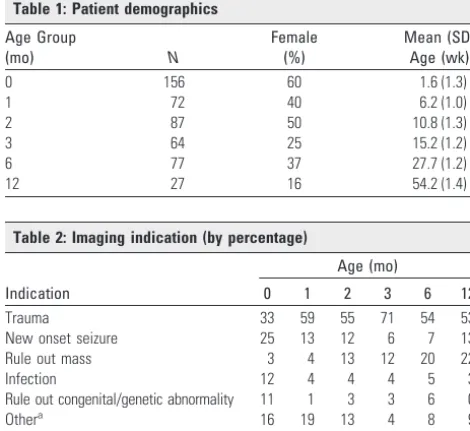
The study protocol was approved by the Human Use Committee at 2 different institutions. Investigators adhered to the policies for protec-tion of human subjects as prescribed in 45 CFR 46 and provision 32CFR219.110. A review of CT imaging reports on the PACS identi-fied patients with no acute intracranial pathology or a normal CT of the head; the study included head CTs conducted among patients 1 year of age or younger during the period January 1, 1994, through December 31, 2008. All known premature infants were excluded from the dataset. The study sample included 483 patients between 1 and 395 days of age (mean, 96 days). The CT data available included 966 sagittal suture evaluations and 1932 coronal suture evaluations. Among the selected patients, 251 were male and 232 female, with a disproportionate representation of the neonate cohorts as reflected by the low mean months of age (Table 1) but with similar histories across the age groups (Table 2). Age, in days, was abstracted from the radio-logic information system. The age in weeks was calculated by dividing the provided days of life by 7, and the month of life was determined based on a 30-day average month, with the assigned month represent-ing the last complete month of life. Patients were subsequently as-signed into the following 6 age groups for analysis: 0, 1, 2, 3, 6, and 12 months.
CT Imaging Techniques
The sagittal suture and bilateral coronal sutures were evaluated on axial imaging with a 5-mm section interval by using an average kilo-volt peak of 120 and product of the tube current and the exposure time of 120, standard algorithm, and average window/level values of 3077 and 570, respectively.10Imaging was performed on a 16-detector
row, 8-detector row, or 4-detector row CT scanner (GE Medical Sys-tems, Milwaukee, Wisconsin).
CT Imaging Analysis
The sagittal suture and bilateral coronal sutures were evaluated on axial imaging by using a measurement selection point similar to Eras-mie and Ringertz8and electronic calipers measuring distances along the inner margin of the suture. All suture width measurements were made in relation to the anterior fontanelle, confirmed on cross-refer-enced lateral scout images, and reviewed by 2 senior board-certified radiologists with certificates of added qualification. Values of sutural width were obtained in the proximal one-third of the sagittal (Figs 1A and 2A) and bilateral coronal sutures (Figs 1Band 2B) as well as the distal two-thirds of each suture (Fig 1A-,B). Evaluation of interdigi-tated sutures was performed by obtaining 3 different measurements, and the mean was used as the suture width. Suture width measure-ments were checked for consistency by blinded peer-review analysis.
Statistics
Descriptive statistics included histograms, scatterplots, and boxplots to view the distribution of the suture width data across the population by age of the patient. Data were analyzed by analysis of variance to compare means to evaluate differences by age group. A Bonferroni post hoc evaluation was used to compare adjusted means, by using SEs, to determine significant difference between age groups. Signifi-cant variation between right and left coronal sutures was analyzed by using a pairedttest. The significance level for all comparisons was .05. Interrater reliability was assessed by calculating ICCs. Ten examina-tions were selected at random, and the coronal and sagittal sutures reviewed by the 2 senior radiologists. ICCs were calculated to assess agreement of measurements obtained at the proximal sagittal and coronal sutures as well as the distal sagittal and coronal sutures.
Results
Assessment of Sagittal Suture Width
The mean proximal sagittal suture width at 0 months of age was 5.0⫾0.2 mm (Fig 3A). In comparison to neonates, the mean proximal suture width of 1-month-olds was approxi-mately half (2.4⫾0.1 mm;P⬍.001). In comparison with 1-month-olds, infants 6 months of age had significantly nar-rower mean suture widths (P⬍.001) and likewise for infants 12 months of age compared with 1-month-olds (P⬍.001; Fig 3Aand Table 3). Other month-by-month comparisons between 2, 3, 6, and 12 months did not reach significance.
The mean distal sagittal suture width at 0 months of age was 4.6⫾0.2 mm (Fig 3B). In comparison to neonates, the mean distal sagittal suture width of 1-month-olds was approx-imately 45% narrower (2.6⫾0.1 mm;P⬍.001). Compared with 1-month-olds, the mean suture width of the 3-month-olds was significantly narrower as was that of 6-month-3-month-olds and 12-month-olds (P⬍.0001). The decrease in suture width did not continue to reach statistical significance for other month-by-month comparisons with the exception of 2 months and 12 months (P⬍.028; Fig 3Band Table 3).
Assessment of Coronal Suture Width
[image:2.594.51.286.48.263.2]The right and left coronal sutures closed at the same rate as reflected by mean widths that were statistically indistinguish-able from each other at all time points measured (Tindistinguish-able 3 and
Table 1: Patient demographics
Age Group
(mo) N
Female (%)
Mean (SD) Age (wk)
0 156 60 1.6 (1.3)
1 72 40 6.2 (1.0)
2 87 50 10.8 (1.3)
3 64 25 15.2 (1.2)
6 77 37 27.7 (1.2)
12 27 16 54.2 (1.4)
Table 2: Imaging indication (by percentage)
Indication
Age (mo)
0 1 2 3 6 12
Trauma 33 59 55 71 54 53
New onset seizure 25 13 12 6 7 13
Rule out mass 3 4 13 12 20 22
Infection 12 4 4 4 5 3
Rule out congenital/genetic abnormality 11 1 3 3 6 0
Othera 16 19 13 4 8 9
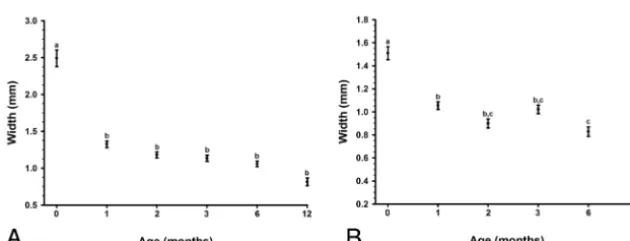
Fig 4A, -B). In contrast, there was significant difference be-tween mean proximal coronal suture width at 0 months of age and 1 month of age, 2.5⫾0.1 and 1.3⫾0.1 mm, respectively (P⬍0.001; Fig 5A). Unlike the sagittal suture, there was no significant reduction in the mean proximal coronal suture width between 1 and 12 months of age (1.3⫾0.1 versus 0.8⫾ 0.1 mm; Fig 5A).
The mean distal coronal suture widths at zero months of age was 1.5⫾0.1 mm (Fig 5B). By the first month of age, the mean distal suture width had decreased significantly to 1.1⫾ 0.1 mm (P⬍.001). There was no statistically significant re-duction in the suture width between 1 and 3 month of age. The large number of coronal CT evaluations supported findings
of statistical significance by 12 months of age versus 1, 2, 3, and 6 months (P ⫽.001, 0.002, 0.001, and 0.031, respectively; Fig 5B).
Comparison with Sonography
Proximal sagittal and coronal suture widths were compared with previously published sonography results evaluating the sagittal and coronal sutures.9 The proximal sagittal suture
measured 5.0⫾0.2 mm by CT at 0 months of age, whereas the measured range by sonography was approximately 0.9 –1.4 mm. At 1 month, the proximal sagittal suture measured 2.5⫾ 0.1 mm by CT, whereas the range by sonography was approx-imately 0.6 –1.2 mm; at 2 months the proximal sagittal suture Fig 1.Scout suture evaluation.A, Lateral scout image from CT scan of a young child demonstrating the location of proximal (s1, solid bar) and distal (s2, solid bar) sagittal suture measurements. Measurements were obtained at a minimum distance of 5 mm from the associated fontanelle.B, Lateral scout image from CT scan of a young child demonstrating the location of proximal and distal measurements (solid bars). Measurements were obtained at a minimum distance of 5 mm from the anterior fontanelle and the sphenosquamous suture.
Fig 2.Axial suture evaluation. Bone algorithm axial CT images of a 6-month-old head (A) at 5-mm intervals, demonstrating sample measurements of the sagittal suture and of a 0-month-old head (B) at 5-mm intervals, demonstrating sample measurements of the coronal suture.
[image:3.594.135.452.44.169.2] [image:3.594.133.453.214.381.2] [image:3.594.130.450.418.543.2]measured on CT was 2.0⫾0.1 mm, whereas the range by sonography was approximately 0.5–1.7 mm. At 3 months, measured CT width of the proximal sagittal suture was 1.7⫾ 0.1 mm, and sonography was approximately 0.5–1.7 mm.
The proximal coronal suture measured 2.5⫾0.1 mm by CT at 0 months of age, whereas the range by sonography was approximately 0.9 –1.5 mm. At 1 month, the proximal coronal suture width measurement by CT was 1.3⫾0.1 mm, whereas sonography was approximately 0.5–2.1 mm. At 2 months, proximal coronal suture widths measured 1.2⫾0.1 mm on CT, whereas sonography was approximately 0.4 –1.5 mm. At 3 months, the proximal coronal suture measured 1.1⫾0.1 mm on CT, whereas the range by sonography was approxi-mately 0.4 –2.9 mm. No previously reported data were found to measure ultrasound suture widths for infants ages 6 –12 months.
Assessment of Interrater Reliability
ICCs ranged from 0.88 to 0.99, indicating agreement between the 2 senior radiologists.
Discussion
The United States has seen a rise in the use of emergency de-partments for pediatric evaluation.2With this rise in visits has
come a concomitant rise in the number of cross-sectional im-aging studies performed. There are a varied number of reasons for neonates and infants to undergo CT imaging of the head; however, the overwhelming reason is trauma both nation-ally1,2and in our population (Table 2). The CT evaluation of
the pediatric head for hemorrhage from either accidental or nonaccidental trauma can be performed quickly, and read-ily answers the question. However, where there is concern for sutural fracture or diastasis, the assessment has historically relied on the experience of the reviewing radiologist.
This study expands on the evaluation of sutures initially discussed by Erasmie and Ringertz.8Our data delineate a CT
table for sagittal and coronal suture widths throughout the first year of life. These data correlated with previously reported sonography measurements of suture width at 2 and 3 months.9Although our CT sutural width measurements were
larger at 0 months of age and 1 month of age than the sonog-Fig 4.Comparison of the right and left proximal (A) and distal (B) coronal suture widths over a 1-year-period. At each time point, there was no difference between the right and left coronal suture. Data are represented as means⫾SE (n⫽27–156).
[image:4.594.52.537.59.148.2]Fig 5.Age variation of the proximal (A) and distal (B) coronal suture width over a 1-year period. Data are represented as means⫾SE (n⫽27–156). Means with different superscripts (a, b, c, d) are statistically different (P⬍.05).
Table 3: Suture width measurements
Age (mo)
Sagittal Suture (mm) Right Coronal Suture (mm) Left Coronal Suture (mm)
Proximal Distal Proximal Distal Proximal Distal
[image:4.594.137.450.178.290.2] [image:4.594.135.450.332.452.2]raphy data, this variation in suture width may be secondary to our larger sample size and or including a fibrous portion of the suture. No additional studies have been found to date to com-pare older infant (ages 6 –12 months) suture widths, probably due to rapidly closing suture width.
We recognize that the current study has limitations that should be noted. First, premature infants may have been in-cluded in the sample population. The data base query yielded results based upon patient age but did not take into consider-ation the gestconsider-ational age of the infant at the time of birth. Although we excluded all known premature infants, the pre-maturity may not have been indicated in the charts of infants adopted or those new to our health care system. It is possible that the inclusion of premature infants may skew the measure-ments at 0 and 1 month of age but probably did not affect results of the older age groups. Also, the amount of skew was probably offset by the larger sample sizes in the younger age groups, which presumably included mostly full-term infants. Second, the patients’ medical charts were not reviewed to determine whether a patient who was given the results of nor-mal or no acute intracranial pathology might have later devel-oped complications. We feel this potential limitation is mini-mized in the closed community from which the sample was drawn. These patients would have had follow-up imaging that also would have appeared in our data base query, or the pri-mary care provider would have notified the radiologists if fur-ther imaging were needed. None of the patients in this study had such follow-up imaging or notification.
Also, there was a slight male predominance in the study population, and we did not separate patients by sex. Previous anthropologic studies have suggested a slight increase in su-ture width among the adult male population versus the adult female population16; however, an equivalent number of
stud-ies did not reach the same conclusion.17Results also were not
stratified by ethnicity because previous studies have not found this effect to be statistically significant.16,18-20
Finally, the authors recognize the inherent limitation of assessing sutures that may be smaller than the section thick-ness of the acquired images. Reviewing both the transverse images and the cross-referenced scout images mitigated the section thickness limitation by allowing the authors to con-firm that the location of measurement was representative.
In summary, CT measurements of mean suture widths de-crease rapidly in the first year of life. The most dramatic clo-sure occurs during the first month of life for all meaclo-surement points followed by gradual decrease in width during the re-mainder of the first year of life was reached. Statistical signif-icance for closure of all suture measurement points, during the first month of life. Based on these data, we developed norma-tive values for the coronal and sagittal sutures on CT during the first 12 months of life. The data allow extrapolation of normal values for the intervening months. These results
cor-related well with prior reports of sonography measurements verifying this method of analysis.8
This study is the first to derive suture widths on CT across a broad population of infants reflecting the most common technology used today. The suture widths listed by month here afford radiologists a quick and reliable means of assessing a patient’s suture width against normative values for CT.
Conclusions
The normative values for suture widths established by CT scan among this large population may be used to assess the infant calvaria for suture diastasis.
Acknowledgments
We thank Allison Krug, MPH, for the thoughtful editing of this document.
References
1. Tang N, Stein J, Hsia RY, et al.Trends and characteristics of US emergency department visits, 1997–2007.JAMA;304:664 –70
2. Krauss BS, Harakal T, Fleisher GR.The spectrum and frequency of illness presenting to a pediatric emergency department.Pediatr Emerg Care1991; 7:67–71
3. American College of Radiology.ACR Appropriateness Criteria. Head Truma. 2008.Availableathttp://www.acr.org/SecondaryMainMenuCategories/quality_ safety/app_criteria/pdf/ExpertPanelonNeurologicImaging/HeadTraumaDoc5. aspx. Accessed January 5, 2011.
4. American College of Radiology.ACR Appropriateness Criteria. Head Trauma-Pediatric. 2008.Available at http://www.acr.org/SecondaryMainMenuCategories/ quality_safety/app_criteria/pdf/ExpertPanelonPediatricImaging/SuspectedPhysi calAbuseChildDoc9.aspx. Accessed January 5, 2011.
5. Frush DP, O’Hara SM, Kliewer MA.Pediatric imaging perspective: acute head trauma—is skull radiography useful?J Pediatr1998;132:553–54
6. Atabaki SM.Pediatric head injury.Pediatr Rev2007;28:215–24
7. Henderson S, Sherman L.The Roentgen anatomy of the skull in the newborn infant.Radiology1946;46:107–18
8. Erasmie U, Ringertz H.Normal width of cranial sutures in the neonate and infant. An objective method of assessment. Acta Radiol Diagn (Stockh)
1976;17:565–72
9. Soboleski D, McCloskey D, Mussari B, et al.Sonography of normal cranial sutures.AJR Am J Roentgenol1997;168:819 –21
10. Furuya Y, Edwards MS, Alpers CE, et al.Computerized tomography of cranial sutures. Part 1: comparison of suture anatomy in children and adults.J Neu-rosurg1984;61:53–58
11. Fernando S, Obaldo RE, Walsh IR, et al.Neuroimaging of nonaccidental head trauma: pitfalls and controversies.Pediatr Radiol2008;38:827–38
12. Meservy CJ, Towbin R, McLaurin RL, et al.Radiographic characteristics of skull fractures resulting from child abuse.AJR Am J Roentgenol1987;149: 173–75
13. Stokes NJ, Cremin BJ.The skull vault in neonates and infants.Australas Radiol
1974;18:275– 82
14. Swischuk LE.The normal newborn skull.Semin Roentgenol1974;9:101–13 15. Cohen MM, Jr.Sutural biology and the correlates of craniosynostosis.Am J
Med Genet1993;47:581– 616
16. Lynnerup N, Jacobsen JC.Brief communication: age and fractal dimensions of human sagittal and coronal sutures.Am J Phys Anthropol2003;121:332–36 17. Key C, Aiello L, Molleson T.Cranial suture closure and its implications for age
estimation.Int J Osteoarchaeol1994;4:193–208
18. Hershkovitz I, Latimer B, Dutour O, et al.Why do we fail in aging the skull from the sagittal suture?Am J Phys Anthropol1997;103:393–99
19. Herring SW.Sutures–a tool in functional cranial analysis.Acta Anat (Basel)
1972;83:222– 47
20. Meindl RS, Lovejoy CO.Ectocranial suture closure: a revised method for the determination of skeletal age at death based on the lateral-anterior sutures.