warwick.ac.uk/lib-publications
A Thesis Submitted for the Degree of PhD at the University of Warwick
Permanent WRAP URL:
http://wrap.warwick.ac.uk/95238
Copyright and reuse:
This thesis is made available online and is protected by original copyright. Please scroll down to view the document itself.
Please refer to the repository record for this item for information to help you to cite it. Our policy information is available from the repository home page.
'.~ .. --"<00
DIFFEOMORPHISMS ON SURFACES
WITH A FINITE NUMBER OF MODULI
SEBASTIAN VAN STRIEN
(joint vlork with 1\'. de Melo)
Submitted for the degree
of Ph.D. in Mathematics
at the University of
Warwick.
CONTENTS
o. Introduction 1
1. Statement of Results 3
2. Existence of-Moduli 5
2a. Some technical lemmas 5
2b. Construction of Moduli 10
3. A few techniques for constructing conjugacies 21
3a. Construction of Foliations 24
3b. Construction of Conjugacies 32 4. Construction of conjugacues when all invariant
manifolds except WU(p) and WS(q) intersect
each other transversally 37
5. Construction of conjugacies: general case 48
Sa. w u (p),W s (q) and W (q),W u s ' (r) have
non-trans-versal intersections. All other invariant manifolds
intersect transversally .48
5b. Construction of conjugacies: remaining cases 66
6. A bound for the number of tangencies 67
7. Appendix: Smoothness of Invariant Foliations 75
7.1 A fiber-contraction on a jet-bundle 16
1.2 .Differentiability on invariant foliations.
A differentiable version of the Lambda-Lemma 81
7.3 C1-linearisabilty near saddle-points in the
7.4 Differentiability 9f invariant'foliations
with polynomial tangencies
8. References
88
ACKNONLEDGEMENTS
I would like to thank the Maihematics Department of
Warwick and in particular my supervisor David Rand. and
Elaine Shields for their hospitality during my stay in
Warwick between 1978-79. I made some very good friends
in Warwick. in particular my wife Hilary.
This thesis is a result of joint work with W. de Melo
which started in 1981.
Declaration
This thesis is based on truly joint work.with W. de Melo.
It is impossible to distinguish \ .. hich section was written by
·
.
SUMMARY
une of the purposes of the theory of Dynamical Systems is to
understand the orbit structure of diffeomorphisms. Here we say
that two diffeomorphisms f and g have the same orbit struc~
ture if they are conjugate, that is, if there is a homeomorphism
h of the arnbi~nt manifold such that hf = gh. Basically the
only kind of diffeomorphisms whose dynamics are well studied, are
the class of structurally stable diffeomorphisms. These are
diffeo-morphisms f such that all nearby diffeomorphisms are conjugate
to f. The well known Structural stability Theorem says that a diffeomorphism is structurally stable if i t is Axiom A and if all
invariant manifolds are transversal to each other.
If these transversality conditions are not satisfied then the
diffeomorphism not only fails to be stable, but also this gives
rise to the appearence of moduli. That is, one needs several
real parameters to parameterise all conjugacy classes of nearby
diffeomorphisms.(The minimum number of parameters needed is called
the number of moduli).
Here we deal with diffeomorphisms on two dimensional manifolds.
whose asymptotic dynamics are well understood, (the class of Axiom A
diffeomorphisms). The Main Result characterises those Axiom A
diffeomorphisms which have a finite number of moduli. This result
can be regarded as a generalisation of the Structural Stability
Theorem~.From the proofs i t follows that the dynamics of these
diffeomorphisms can also be well understood.
In the proof of our Main Theorem we need certain invariant
foliations to be quite smooth. In an Appendix we piove a
,
.
-1-DIFFEOMORPHISMS ON SURFACES WITH A FINITE NUMBER OF MODULI
"
.. .,,_ ... ,'.
by'
w.
de Helo & S.J. van StrienOne of the purposes of the theory of Dynamical Systems is
to understand the orbit structure of diffeomorphisms. Here we
say that two diffeomorphisms f and g have the same orbit
structure if they are conjugate that is, if there is a
homeomorphism h of the ambient manifold such that hf = gh.
Clearly this defines an equivalence relation - on the space of
diffeomorphisms. Since the dynamics of many diffeomorphisms is
very complicated and sensitive to perturbations (of the
diffeomorphisms) we cannot hope to understand the space of
conjugacy classes in general. However this space is very neat
in neighbourhoods of many conjugacy classes. This paper is.,.in
the direction of characterising all diffeomorphisms representing
these conjugacy classes. One may measure the degree of
complexity of this local structure by looking at the local
dimensions of this space. This dimension we call the number of
moduli. This number is defined as follows. If a diffeomorphism
f is structurally stable or if there are at most a countable
-number of different conjugacy classes in a neighbourhood U of
f then we say that the number of moduli is zero. i f U contains
a countable'number of k-parameter Cl families of
-2-to at least one diffeomorphism from these families, then f has
a finite number of moduli. The minimum number k of parameters
needed is the number of moduli (or the 'modality of f).
Here we deal with diffeomoruhisms on two dimensional ....
manifolds whose asymptotic dynamics is well understood. In fact
we consider the set
a
of diffeomorphisms satisfying the AxiomA aRd the no cycle condition. Such diffeomorphisms are
O-stable, namely, the dynamics of the non-wandering set does not
change with small p~rturbations (SmIJ, (Sm2J. However the
intersection pattern of invariant manifolds is the same for
conjugate diffeomorphisms. Transversality conditions of stable
aRd unstable manifolds are needed to have structural stability
tRJ. If these transversality conditions are not satisfied then
the diffeomorphism not only fails to be stable but this also
gives rise to the appearence of moduli CP),tNPTJ,CMPS],CSl],CS2).
However even in this case the diffeomorphism may still have
finite modality CMe2), eMFJ, tS2J. The purpose of this paper is
to characterise the class ~ of diffeomorphisms in
a
havingfinite modality.
-Our results provide a much more precise description of
the conjugacy classes in a sufficiently small neighbourhood h
of a diffeomorphism
union of submanifolds
f in ~. One has that h is a countable
:1i · Each :1. ~ has finite codimensio nand
contains a finite dimensional submanifold Si. Moreover there
exists a differentiable fibration "..: ;1. -+ S. ·so that all
~ ~ ~
diffeomorphisms in the same fiber are conjugate. ~rthermore
each Si contains a dense subset Ti . such that no two distinct
. diffeomorphis~s in are conjugate to each other . The
-3-the dimensions of S1 is the modal~ty of f.
§1 statement of Results
•
Let M be a compact, two-~mensional manifold
without boundary and Diff=(M) be the set of
em
diffeomorphismson 1-1 wi th the
e
CD topology •. We denote by
a
C Diff=(M) the set of diffeomorphismssatisfying Axiom A and the no-cycle condition. Recall that
:f E Diff= (M) satisfies Axiom A if the non-''landering set nCf)
is hyperbolic and the periodic orbits are dense in nCf), LS~lJ
If f satisfies Axiom A then n(f) is a union of finitely
many closed invariant sets
ai's,
called basic sets, such that:£ has an orbit dense in each 0i. Fi~Ally we say that f
satisfies the no-cycle condition if there are no basic sets
nl,···,nn' 0n+l = 01 with WU(Oi) n ",S(Oi+l)# ¢. Here .'''~Oi)
(resp. WS(Oi») in the set of points whose a.-limit set (resp.
w-lj.mi t set) is contained in
°
1. ''Ie recall that if f "~a
then.f is O-stable
CSm2J.
The main result of this paper isthe characterisation of the set ~ c
a
of diffeomorphisms havingfinite moduli. Remark that if
t
has k moduli then f has aneighbourhood U such that each g in U has modality at nost
k. In particular the set of diffeomorphisms in
a
with finitemodality is open.
. Let
mEa
be the set of diffeomorphisms satisfying the1) if x,y E O(f) are such that
WU(x)
1s not transversal to~(y) then the basic sets containing x and yare trivial
(i.e. consist of periodic orb:i,:ts)J -... ~~
2) there are only a finite number of orbits of non-transversal
intersections between stable and unstable manifolds and the
contact between these manifolds along these orbits are of
finite order;
3) if 'p,q E Per(f) are such that ~(p) has an orbit of
non-transversal intersection with ~r(q) then the number of
orbits in WS(p) (resp. in
WU(q)
belonging to someunstable (resp. stable) manifolds of periodic saddle points
of f is finite;
4)
if x is a point of non-transversal intersection of WU(p)and "f (q) then there exist an arc 1: transversal to WU(p)
at x such that no con."'lected component of E - (x)
contains points of both stable and unstable manifolds of
saddles;
5) i f lfl(p) has a point of non-transversal intersection -l'li th
WS(q)
andWU(q)
has a point of non-transversal intersectionwi th
,of
(r ~ then there is no saddle point of f whoseunstable manifold (resp. stable ma~ifold) intersects WS(p)
(resp. WU(r» •
Remark. It is well kno~m that every diffeocorphism in
a
whichsatisfies the transversality conditions- on invariant
ma'nifolds is structurally stable (RbJ. The clas~ frI. relaxes
these conditions: The fbllowing theorem generalizes this
-5-structural st~bility result.
Main Theorem. If f E Diffm(Mf) is .in
a.
then f ·has finitemodality if and only if f E
m.
§2. Existence of Hoduli
Let M be a compact em manifold of dimension t,.,o and
f: M-+: M be a em diffeomorphism having a pair of periodic
points p and q such that the unstable manifold of p has an
orbit of non-transversal intersection with the stable manifold
of q. In this section we will construct all conjugacy
invariants generated by the existence of these tangencies. We
will use these conjugacy invariants to prove the follO\-:ing.
Theorem. If f E
a
has finite modality then f E ~.Later in sections 3, 4 and 5 ''Ie will prove that two
diffeomorphisms in ~, having an equivalent intersection
pattern of stable and unstable manifolds, are conjugate if they
have the same conjugacy invariants.
§2(a) Some technical lemmas
I~ order to show the existence of moduli we will have to
compare metrics induced on M by
~o
C1 coordinate systems.So we start by describing some properties of Cr metrics. By
this 'VIe mean metrics which are induced by er Riemannian
structures. We say that d: HxH -+ R is a Cr metric, 0 ~
-6-on M such that d(x,y) is given by the infimum of the lengths
of all paths that connect x and y. In formulas: d(x,y)
=
~ inft~g(Y);
y: (O,lJ-+ M is apie~ew~se
C1 curve withyeO)
=
x'and
y(l) = y). Here~g(Y)
=f:
.!g(y.(t).y.(t» ·dt.
The distance from a point x to a set S will be denoted by
d(x,S)
=
inffd(x,y); y Esl.
It will be convenient to use thefQ110wing notation~ For sequences C
i ,
e
i of real numbers wewi11 write
if is bounded and bounded a\'ray :from
zero,
if converges to
1.-Lemma 2.1. Let" d: Rn x :Rn --+ R be a CO metric induced by
the Riemannian structure g. Let do be the metric
induced by the constant Riemannian structure go which coincides
with g at O. -If S C Rn contains
°
and x. E Rn--S~
Proof: Since g is continuous, for every p >
°
there arepositive constants such that
(2.1)
for every v e]ln and every x ERn with
Uxll
< p. Clearly wecan take cp and c; arbitrarily near 1 by taking p
suf.ficiently small. From (2.1) \-le have that if y is a
piecewise C1 curve contained in the ball with
c~nter
0 and'.
-7-the constant Riemannian structure, i. e • ',. go ( (x, v), (x, w) )
=
= g({o,v), (o,w)) for all x,v,w ERn. Hence. if
p
> 0 ·is-" -
..
sufficiently small then c p do(x,y) ~ d{x,y) ~ c~ do(x,y) for
all x,Y·E Rn with UxU,Uyll ~
p.
Therefore for p > 0 suf-ficiently small we have that cp do(x,S) ~ ~(x,S) ~ c; do(x,S) .for all x -: nn wi th UxU ~P .
This proves the le!!lIIla. IILemma 2.2. Let S C::Rn be a codimension one C1 submanifold
containing 0 and d
j , j =1,2 be CO metrics on
Rn. Then there exists a positive real number )., such that
d1(xi,S) ~ ~d2(xi'S)
to 0 E JRn ..
for any sequence Xi E R ·n -S converging
Proof. By taking Cl coordinates on :Rn we may assu.me that S
is a hyperplane. By let1l:la 2.1 "Ie can assume that d
1
and d
2 are induced by Riemannian structures "Ihich are constant
with respect to this ccordinate system. From these observations
the lemma follO\'ls easily. 11
-
is another ·Cl codimension one submanifold Remark: If Sn
-tangent to S at 0 and Xi E R -S converges to 0
then d1(xi,S) 2= ). d
2(xi
,s),
"/here ~ is the same constant as, . for S. This follows from the proof of the lemma and the factthat we can find a pair of Cl diffeomorphisms
·Ql,q2:(:R~O)~
such that ~l(S)
=
~2(S) is a h)~erplane and the derivative of -1_ Qlo~2 at 0 is the i~entity.
Using CO metrics we can introduce the notion of contact
-8-Defini tion. Let. x be a point of -.tangency of two Cl
submanifolds 81,82 C M. vie say that 8
1 has a
contact of order n with 82 at x if for some metric d on
M the limit below exists and is posi ti ve:
lim ·w"'X wESl
d (",~, S2)
(d(w,x) jn
If this limit is infinite we say that the contact is less than
If ~he limit is zero for all n we say that the contact is
infini te.
Remark. From lemmas 2.1 and 2.2 it follows that the above
definition is independent of the metric. Notice also
that the contact may not exist. Ho\"ever if there is a Cl
coordinate system ~ on a neighbourhood of x such that ~(Sl)
and
~(S2)
are bothC~
submanifo1ds ofm
2 then the contactis either defined or it is infinite.
Definition. Let p be a hyperbolic fixed point of a C~
dif-feomorphism f: M-+ M. By a 1inearising metric at
p we mean a CO metric d on a neighbourhood U of wB(p) U
n
U WU(p) such that in a Cl coordinate system in U 1inearising
f, d coincides with the Euclidean metric.
Remark. If wS(p)
n
WU(p)=
¢, such a linearising metric alwaysexists. In fact by a theorem of Hartman (Ha] (see also
the Appendix) there is a C1 coordinate system in a neighbourhxri
of p linearising f. If vf(p)
n
WU(p)=
¢, this coordinatesystem can be. extended to a full neighbourhood of ~t!)(p)
u
WU(p).Thus we obtain a linearising metric at p. These metrics are
not unique. However, since any Cl diffeomorphism cO:n!nuting with
9
-it 1s easy to see that if d 1s another linearising metric
then the restriction of d and
d
to each connected component~f
WS(p)
UWU(p) - (pl
differ only by a multiplicative constant.The follQwing two lemmas will" be used repeatedly.
Lemoa
2.3.
Let p be a hyperbolic fixed point of saddle typeof a C2 diffeomorphism f: M ~ M. Let x E WU(p)
- (pl, d be a CO metric on
M
and ~ be the contractingeigenvalue of dfp • For any sequence x ... x we have:
~
i) if there exists a sequence n(i) -t" CI) such that f-n(i)(x.)
~
converges to a point
z
E ~~(p), thene:
Cd(~,P)
Ic:ln(i) for some constant cd ( xi' WU (p
»
~which depends on
x,z
and d but not on the sequence; if d isa
linearising.metric then c is independent of x and z;
ii) if d(Xi,,"U(P» 2::
~Ic:.ln(i)
for some constant c > 0 andsome sequence
n(i)~"
(I) then the sequence f-n(i)(xi ) has
at least one and at most two limit points which are contained
in yf(p).
Proof: It is clear that both statements hold for a linearising
metric. Therefore the lemma follo'(/s from Lemma 2.2.
Definition. Let x be a one sided tangency (for example a
quadratic tangency or a tangency of even order)
. between WU(p) and
,·r(q),
where p andq
are hyperbolic.
fixed points of f. He say that a sequence
Xi -+ x is nice with resp::!ct"to the pcHr (x,y) if (1) fi
Cx
1 )converges to y; (ii) d(xi , ~'lu(p»" 2: d(X
-10-We will now prove that the property OI being a nice
..
sequence is preserved tLDder a topological conjugacy .
.
Lemma 2.4. Let h be a conjuga~y benveen I and f. Then
x. -.' x is a nice sequence ",ith respect to (x,y) if
l
and only if h(xi ) is a nice sequence with respect to (h(x),h(y)).
Proof: We have two cases to consider:
a) y is accumulated by the.iterates of any small
interval in WU(p) which contains X; (b) (a) does not occur.
In both cases it is easy to see that we have the following
characterisation of nice sequences. The sequence x. -+ X is
l
nice with respect to (x,y) if (i)
fi(xi)~'
y; (ii) givensequences of integers n(j)-+ ~ and i(j)~ ~ such that
I-n(j)(xi(j)) converges to z E
WS(p)
then for~ny
othersequence
x!~
x such that fi(x!)-+ y we have:l l
d( f-n(j) ( ' xi (j) , ) p) ~ d(z,p)
In fact let x.
l be nice with respect to
in case (a)
in case (b)
(x,y).
~ d(xi,Ws(q)) and
Lemma 2.3 one has
fi(X i )-+ y. If also fi(xi)
~
y, then byd(xi,WS(q)) ~ d(xi,WS(q)). Moreover since
wU(p) and vIs (q) have a one-sided tangences
.
d(xl, \'lu(p)) ~ d(x~, WS (q) ) in case (a)
,
d(xl, WU(p)) ~ d(xi, \ltS (q) ) in case (b)
Hence the limit points of rd(x~, \oJu(p) )/d(x
i , W
ll
-11-1 in case (a), and at least 1 in case (b). From this and Lemma
one deduces
(*).
Similarly(*)
implies that x. 1 is a niceseq~ence. Since WS(p) has dimension one, it follows easily that
these conditions are preserved under conjugacy.
§2(b) Construction of Moduli
Now we will construct all conjugacy invariants arising
from non transversal intersection of invariant manifolds of
periodic points. TQ simplify the exposition we will assume that
all periodic points involved are in fact fixed points. The
. general case is treated in the same way by looking at appr~iate
iterates of the diffeomorphism. The next lemma introduces the
first conjugacy invariant found in (pJ and· shows the rigidity of
the conjugacy if this invariant is irrational as in CMe2J.
Lemma 2.5. Let x (resp. x) be a tangency of even order
between
WU(p)
andWS(q)
(resp.WU(p)
andWS(q))
where p and q (resp. p and q) are hyperbolic fixed p'Jints of
the C2 diffeomorphism f (resp.
~).
Let~ (resp~)
be thecontracting eigenvalue of dfp
the expanding eigenvalue of dfq
(resp.
dip)
and(resp. dfg:). Let
(resp. S) be
h be a
-conjugacy between f and f with h(p) = p, h(q) = q and
hex) =
x.
Then we have the following ~roperties:1)
2)
loglal
logl~1 =
logla.1
logl~ I
Let ~ be a linearising
.
.lincarising metric at q.
metric at p
loglul
If loglSI
and d . be a
q
dp(h(Z),P)
loglcl logla.1
t~(z,p)j .
-12-is constant in each conn~cted component of
vf3
(p) - {p)and
dq(h(w),q)
is constant in each connected
component of ,.,u(q) - {ql. loglEI
loglal
[d
q (w, q)
J
Proof: 1) Let xi - t ' ~ be e nice sequence with respect to (x,y)
where
yE WU(q).
Hence by ~emma 2.~Xi
= h(xi ) is a
nice sequence with respect to
(h(x),h(y».
Choose subsequencei(j) and n(j) such that f-n(j)(Xi(j» converges to a point
2 E
WS(p).
From Lemma 2.3 i t follows thatc~(z,p)Ia.ln(j) ~
~
d(xi(j)'WU(p»~
d(Xi(j),WS(q»~
Ctdq(y,q)ISli(j). Hencei(j) loglttl
--~---n(j) loglS
I
i(j)
n(j)
logl£1
e: _ _ _
log
Is I
•Since h is a conjugacy i f follows also that
Thus loglal loglal
=
logltil
loglS
I
2) l..et x.;; ~ be nice \vi th r~sY\e' c ~ ct +0 v (..,.. ~,. y) From th e lrs par f" t t
of the :proof follows that -for anyi(j), n{j)
¥lhel"e Ax = c'/c. It follows that for any z in one component
of If(p) - {p) there exists
i{j),
n{j) such thatx-n(j)(Xi(j»
~
z, since 10glttl/loglSI is irrational. Because
-13-,
log
1;:1
loglsi
where B =
-loglCtI =--~ loglSI Since the right ha~d side of this
equation is independent of z, the result follows.
Remarks. 1) From the second part of Lemma 2.5 it follows that
the restriction of h to WS(p) - (pJ and to
fqJ
is a Cl diffeomorphism.2) The restriction of h to each component of
WS(p) {p) .and WU(q). - {q} is determined by the image of one
point. This is the rigidity of the conjugacy we have mentionec
before.
Corollary 1. Each orbit of tangency between stable and unstable
manifolds of periodic orbits gives rise to at least
one modulus condition.
Proof: Let - wU(p) and vls(q) have tangencies of even order
along r orbits o(xl), ... ,O(x
r ). Then from the proof
of Lemma 2.5 (using the same notation) one obtains the
following r conditions:
(A )b (A ) 0
logla.1 loglCtI x. 1 x· J
=
and =loglSI loglSI A_ (A_ )
xi x.
J
If f has };: orbi ts of 'tangency, then arbi trarily near f th8re
~S a diffeomorphism f with at least k orbits of tangency of
-14-Corollary 2. If f E
a
has finite moduli then f satisfyconditions
(1), (2),
(3) and (5) of §l.Proof: If f E
a
does not satisfy(1),(2),(3)
or(5)
thenfor any k E l'J there exists a diffeomorphisn: f
arbitrarily near .f satisfying one of the follovling properties:
(a) ~
-
has at least k orbits of tangency between stable andunstable manifolds of periodic orbits;
(b) there exist saddles p, q so that
,.p(p)
andWS(q)
aretangent and so that there exist an infinite number of
orbits of intersections of invariant manifolds of saddles with
lf3{p)
or ~(q). In the latter case f-
has modality at leastk because of the remark 2 above. In the former case f has
modality
=
because of corollary 1. Since this holds for any kthe modality of f is ~.
Lemma 2. 6. Let f and f be as in lemma 2.5 with loglcl
10giSI
irrational. Let r Crespo
r)
be a hyperbolic.fixed point- of f (resp. f) of saddle type , ... hose stable
. .
manifold intersects transversally the unstable manifold of q
-(resp.
q). .
If h is a conjugacy between f. and f then theexpanding eigenvalue of df(r) is equal to the expanding
eigenvalue of df(r).
..
Proof: Let Yi E
WU(q)
be a sequencen
WS(r) and such that f1(Yi)W E "f ( r ) . S inc
e .
hI
WU ( q ) - {q) is.converging to Y E ''lu(q)
n
converges to ~ point
Cl , there exist a constant
c l > 0 such that d(h(Yi),h(y)) ~ cl d(Yi'Y). If y is the
-15-d(Yi' wB(r)) 2: c2~(w,r)
Iv
,-i for some constant c2 > O. Similarly
d(h(Yi)' w~(r»)~ c2 d(w,r)lvl-i . From these equations we have
Ivl
=
Ivl.
Clearly this impliesY
=
v.
•
Remark: Similarly to the above situation ,.,e have that the
contracting eigenvalue at each saddle point v!hose
unstable manifold intersect ~(p) transversally is a conjugacy
invariant.
Now we will introduce some other conjugacy invariants
which arise in the following situation: there are three fixed
"points p, q, r such that WU(p) has a point x of tangency ,.,i th
wB(q)
of order 2n and WU(q) has a point Y of tangency with~(r) of order 2m. Take curves ~x, ~y at x, y,
transversal to
wB(q)
andWU(q)
respectively.Take a neighbourhood R of q which contains x and y, and
-on which f has a linearising coordinate system. Let L:
n,x be the component of fn(tx)
n
R containing fn(x), and similarly~n,y the component of f-n(~ y )
n
R containing f-n(y). "There arefour cases to consider: (see Figure 2.1).
Case A:
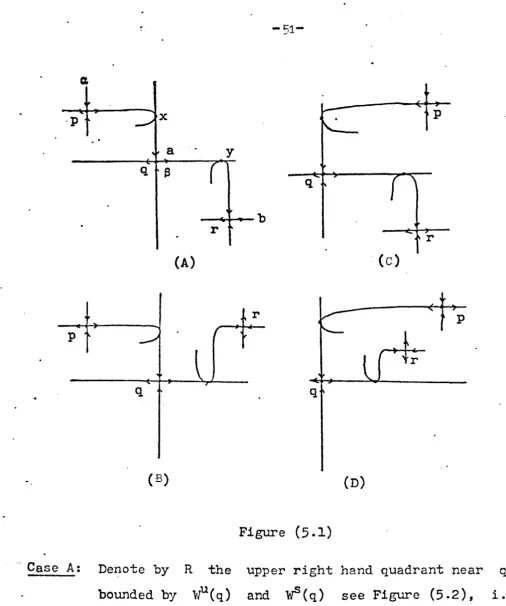
'""
L.,n,?,n
vr
(r) and do not accumulate to y respectively x as n--+ CD;Case B: does accumulate to y, but
does not accumulate to x;
Case C: tn,x
n
~(r) does not accumulate to y, but tn,yn
n
\VU(p) does accumulate to x;Case D: L n,x
n
\,/s(r) and t n,yn
\'[u(p) do accumulate to y
-16-~1X
+rj
Xp~
x J Pt
t ...
~ri
iT
~;Mx-P-
~.~
7f
.
tr
qt
yJ. B C
D
Fi[,ure' (2.1)
Lemma 2.7. Let f: M~ M pe a diffeomorphism having the same
intersection pattern of stable and unstable manifolds
as f. Consider the following equations:
(Ml) a. = a.
(M2) S = S
(M3) a =
a"
-(M4) b = b
(M5)
QX
td
(X,q)J
2n
d(y,q) =
(M6)
':v
td
(y,q)]2m=
d(x,q)
C-(- -),2n
Q
x
d x,q Jd(y,q)
OyCd(y,q)J
2mCl(x,q)
where a., a are contracting eigenvalues of dfp and df . -" q' S b ,
are expanding eigenvalues of dfq, dfr ; d is a linearising
metric at q; lim d(w,\vu(p»)
WE\.f(q) Ld(w,x)J2n w-'x
If loglCtI
loglt3\
loglal and
loglbl
are irrational and h is a conjugacy between
f and
f
such that h(p) =p,
h(q) = q, her) = r, hex)=
xand hey) = y then the following conditions are satisfied:
Case A:
Case B:
Case C:
conditions (Ml) to
condition (Ml) to
conditions (Ml) to
(f.16 )
(M4) plus condition (M5)
(M4) plus conditions (M6)
-17-Proof: From Lemm~ 2.5 we have that"
and
loglal
loglSI
loglal
loglbl
logla.1 :::
loglel
loglal
:::
-loglbl
(1)
(2 )
Furthermore if these numbers are irrational we have that
hlvr(q)-{q) are maps. We will show now
that in all cases equalities (Ml) to (H4) are satisfied.
~ake a sequence
x and such that
converging to the point o£ tangency
converges to some point z E WS(p).
~ Lemma 2.3 we have that
where c is a positive constant independent of the sequence ..
Now ~u(p) andWS(q) have a tangency of order 2n at x. !rhere-Iore i f 'we consider a co:> metric d 1 induced by a cO)
~t)o.rdinat-e system' in which W,U(p) is a s-traight line and ,.,s(q) is
-the graph of a. homogeneous polynomial of degree 2n then
, d l (xi' WU (p ) )
td
I (Xi' x)J2nis a positive number~
Lemma ~.2 tells us that
But since
(4)
d is a CO metric,
-to ~ :posi ti ve constant which does not depend on the metric.
Clc'ar1y the sequence d(xi"x)/d'(xi,x) also converges to a
and Q > O.
x
-18-d(x
i , V,u(p»
Cd(x
i ,x»)2n
is
(5)
so that
(6)
Equat·ions (3), (5) and (6) imply that
IIlI
= I~I. Hence c:t = E.Similarly we prove that b
=
band Irom (1) and (2) itIollows that S
=
S .and a=
a. II we are in case D then weare finished. So let us show that there are additional moduli
·in cases
A,B,C.
Let us prove thatM5
is satisfied in casesA
and B. For that, take a sequence xi ~ x nice with respect
such that
to
(x,y).
Choose subsequences i(j)£-n(j)(xi(j» converges to a point
and. n(j)
Z E WS(p). Since we are in
case A
that
or in case B
f-n ( j) (z .) -+ Z •
J
we can take a sequence Zj E WS(q) such
Since {x. )
J. is nice with respect to
(x,y)
and d is a linearizing metric we haved ( Xi ( j) , WS ( q»
~
d (y , q )I
SI -
i ( j) ,d ( xi ( j) , WU (p
»
~ d ( xi ( j ) ,v,s (
q» .
So vie have( u(
» "'"
(
)
I I-
i (j)d xi(j)' W p ~ d Y,q S •
Since f-n(j)(Xi(j» and f-n(j)(Zj) both converges to z we
have from Lemma 2.3 that d(Xi(j)'V'U(p» ~ d(Zj'WU(p». Finally
we have equation (5): d(Zj'WU(p»
~
Qxfd(Zj,x)}2n. This and(7) implies:
d(y,q)'
ISI-~(j) ~
Qxtd(Zj,x»)2n
i.e.(8)
Q
x {d (x, q )} 2 n
-19-Since hlvr(q):"'{qJ is linear and d is·~ linearising metric we
have
d (h ( Z j ) , h ( x))
... -.
-
......
d(h(x) ,h(q))
From this, ~ =~, and (9) it follows that
Qx· {d(x, q) r2n
d(y,q)
is a topological invariant.
•
Similarly, we prove that is cases A and C conditions M6 is
satisfied.
Remark. It is not obvious that the numbers which appear in the
modulus conditions (M5) and (M6) -are independent of
the choices made for the metric d. That these numbers are
independent of the metrics is proved in §3(b). (In case A this
also follows from the conclusion of Lemma (2.6).
In section 5 we shall show that the equations from Le~~a
(2.6) are the only obstructions for constructing conjugacies
between two diffeomorphisms as above.
•
Proof of the theorem. It remains to prove that if f E
a
hasfini te modality then condition 4 and 5 of §l are
satisfied. Notice that if f has finite modality then the
modality of any g sufficiently near f is at most equal to the
.
modali ty of f. So we will prove that if f E
a
does not satisfycondition 4 of §l then f can be approximated by diffeomorphisms
diffeomorphism'baving an orbit of non t~ansversal intersection
between
WS(q)
and· WU(p). We may assume that all periodicpoin~s are in fact fixed point by considering a sufficiently high
1 terate of· f. By taking a small perturbation of f we may
assume that
WU(p)
has a point x of quasi-transversal (i.e.quadratic contact) intersection with W (q). Now assume that con-s
dition 4 of §1 does not hold. Then any arbitrarily small arc
r at x transversal to WU(p) contains unstable (stable) manifolds of saddles. Then, by taking a small perturbation of f
one can find a saddle P (Q) such that WU(P) (Ws(Q)) has an
intersection with WS(p) (Wu(q). We also may assume that WU(P)
(respectively WS(Q») contains a small interval I (resp. J)
which intersects transversally WS (p) (resp. ''iu( q)) in a unique
point (see figure 2.2). Now assume that condition 4 of §l does
not hold. Then ;e(l) has an intersection with J for any k
suffiCiently big.
---~,~.~---~~
p I
•
J
Figure (2.2)
From the Appendix i t follows that we can construct a
C
lunstable (resp. stable) foliation 3~ (resp. 3~), with a C1
-21-.
Claim: If is irrational then the p~ints of tangency of
f-k(J) with ~~ accumulate at I
n
wB(p).· The theorem thenfollows easily from this claim. In fact, if the claim is correct
then by a small perturbation of f witp support in a small
neighbourhood of I
n
WS(q)
we can create an arbitrary number oforbits of tangen'cy between ,yu(P) and WS(a). Since by
co~ollary 1 each orbit of tangency gives rise to a conjugacy
invariant we have that f has infinite modality. So it remains
to prove the claim. Since x is a point of quasi-transversal
intersection of WU(p) with
WS{q)
and the tangent line fieldsCl i t follovlS, from the
to the foliations
~implicit function theorem, that in a neighbourhood of x, ~~.
is transversal to ~s q except along a C1 curve t which is
transversal to WU(p) at x (see CNe2.j). Let a = fn(I)
n
tn
and b n
=
f-n(J)n
t. If d is a CO metric on M then wehave
where cl !. c
2 are -positive constants. This follows from ler:u:1a
2.2, the transversality of t with WU(p) and the fact that (~
are obviously true for appropriate linearising metrics. Now
logla.1 since
loglSI
... <Xl such that
and therefore:
is irrational we can Iind sequences n(k),m(k)
-n(k)
IBI
~ c1 . From (*) therefore followslal
mCk ) c2d(am(k)'
bn.~k»
---t 0 ,. lallH(k)
d(f-m(l<)(b ) r-rn(k)(' . ) ) 0
-22-Hence converges to
WS(p)
n
I as k -+=. This.,.
proves the claim.
§3. A few techniques for constructing conjugacies
In this section we will develop a few techniques for
constructing conjugacies. In sections 4 and 5 we will employ
these techniques in order to construct conjugacies beu~een two
nearby maps in
a
which satisfy the relevant moduli conditions.Let us start with making a general comment. It is well
known that every diffeomorphism in
a
which satisfies certaintransversallity conditions on invariant manifolds is structurally
stable, see (RbIJ. In order to prove these results one has to
construct conjugacies between U'lO nearby diffeomorphisms.
Basically there are two "lays of doing this. One method is
functional analytic. Here one defines an operator on an
appropriate space of homeomorphisms and sho,'!s this operator has
a hyperbolic fixed point, see (RJ. The other method is a
geometric proof using invariant foliations, see
CPS],
(Mel],tMe2J. (For Axiom A diffeomorphisms this geometric method has
only been developed in dimensions two see r: Nel j). In any case
it is probably difficult to use the functional analytic methods
since all the operator~ will be non-hyperbolic see CRb2J. Therefore we
~ill give geometric const~uctions using invariant foliations.
These methods also enable us to keep tra~~ of all the freedom
one has in constructing the conjugacies. Let us now define these
-
23-Take a nyperbolic periodic point p '(of saddle type) of
a diffeomorphism f. An unstable foliation ~~ (tubular family)
for p is a continuous retraction TT~:.
vll
--+"\of
(~ (p» , where&(p) is·the orbit of p and VU is a neighbourhood of
.
WU(~{p»
with: (i) (nu)-l(p) = WU(p);(ii)
the foliationwhose leaves are fibers of nu is f-invariant. Similarly we
define the stable foliation ~~ for p. Using the A-Le~a it
is easy to construct invariant unstable foliations, see CPlJ. The
'leaves in fact can be chosen d1fferentiably (Ck if f is Ck )
but the field of tangent lines to the leaves 1s only continuous
" in general (however see the Appendix where we prove this
foliation is sometices more smooth). The use of this foliation
is explained by the following lemma ,.,hose proof is straightforvrard.
Lemma. Let p, p be hyperbolic fixed points of f and f
with ~~stable foliations _u ~p' ~~. p Let h be a map "
from a neighbourhood h of ",u(p) to a neighbourhood of "lu(P)
p
with the following properties: (i ) hi' =
in;
i i ) (hI
,of
(p ) ) :WS
(p) - t . Yls(p) is continuous; iii) hi (hp
-,.,s
(p» is' continuous;.
iv) h preserves the unstable foliations. Then h 1s
continuous.
In order to construct global conjugacies it is necessary
that all unstable foliations fit together nicely. So let p, q
. be hyperbo"lic periodic points of f
We say that the unstable foliations
if each leaf of ~~ contains a leaf
",i
th ... U cJ"P
of
"p(p)
n
Yls(q) ~ 0.and .... u cJ"q are compatible
:tu •
q In order to
. construct a conjugacy h between t"/O nearby Horse-Smale
diffeomorphism. one first constructs conjugacies on the stable
,.
unstable foliations. Here one pr.oceeds inductively using the
natural dynamical ordering of periodic orbits starting at sources
and ending up at sinks Then we extend h to £undamental
domains of the sinks again preserving these foliations. The
conjugacy equation (hi
=
fh) gives a uniqUe ext.ensions of hto the whole manifold. From the lemma above it follows that h
is continuous. In this approach the compatibility of the
foliations is essential.
In our case we have tangencies of invariant manifolds.
Therefore some leaves of unstable foliations do not have a unique
_intersection with stable 'manifolds. Hence it is ~mpossible to
construct a coopatible system of unstable foliations. So we ,..,ill
have to use both the unstable and the stable foliations. In the
Morse-S=ale case these foliations are transversal but here they
can be tangent. The geometry of their intersection is extremely
complicated (espe,cially when higher order tangencies are
involved) . So \'1e are forced to make carefull adjustments of
these foliatiops in order to get a good control of their
intersect~on. These modifications near the tangencies must be
globalised in order to keep the foliations invariant. For that
we need some carefull estimates which we will make in section 3(a.)
using a generalised A-Lemma proved in the Appendix.
There is another difference with the Morse-Smale case.
Here we will have to define the conjuga~J in a whole
neighbourhood of the tangency points first. Then we have the
.
problem of exte~ding h continuously to the closure of the
orbit of this neighbourhood. This is done in section 3(b).
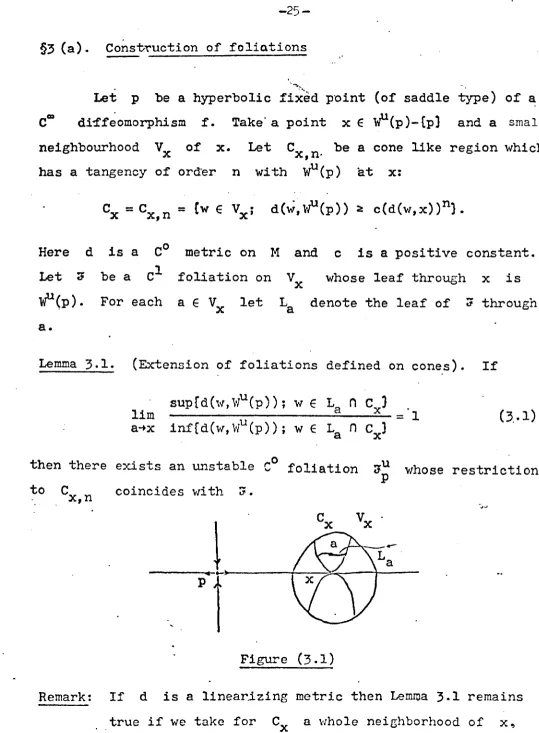
-25-§3 (a). Const-1"uction 01 foliations
.... ~ ..
Let P be a hyperbolic fixed point (of saddle type) of ... a
Cm di~feomorphism f. Take· a point x E WU(p)-{p) and a small
neighbourhood Vx of x.
has a tangency of order
Let C x,n· be a cone like region which
n with WU(p) at x:
Here d is a CO
Let :;: be a C1
l'f(p) .
For eacha.
metric on M
foliation on
a E Vx let
and c 1s a positive constant.
Vx whose leaf through x is
La denote the leaf of ~ through
Lemma
3.1.
(Extension of foliations defined on cones). Ifsup [ d ( ,., , 1'lu ( P ) ) ; wE La
n
Cx)lim
=
1a ... x 1nf(d(w, '_lu(p)) ; w E La n Cx)
(3 .. 1)
then there ey~sts an unstable CO foliation
aU
whose restrictionp
to Cx,n coincides "lith
-
,y..-.~
Cx V .
~
xLa
..
--P1
Figure (3.1)
Remark: If d is a linearizing metric then Lemma 3.1 remains
true if we take for Cx a whole neighborhood of x.,
[image:31.606.47.586.50.783.2]
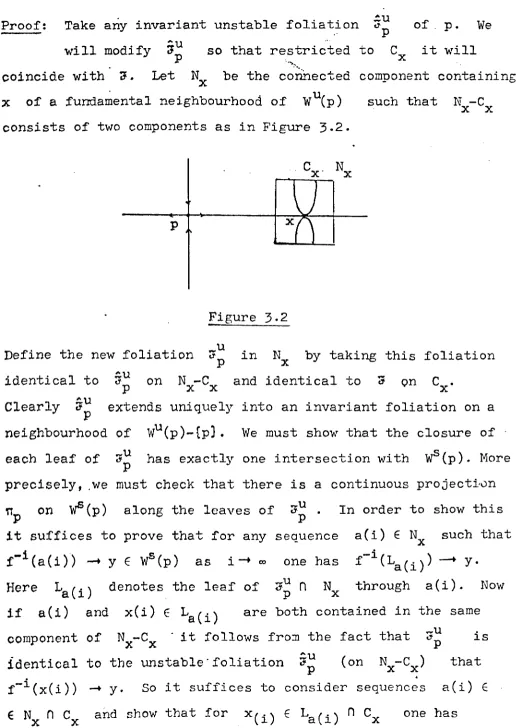
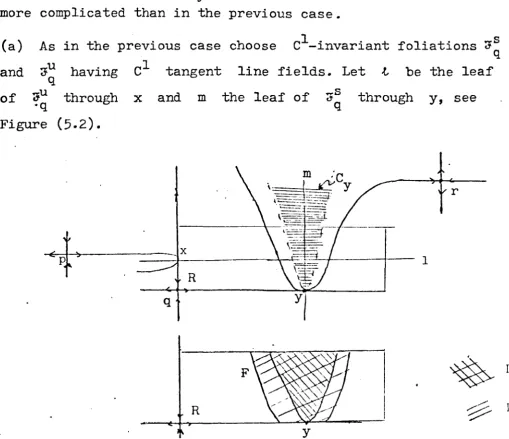
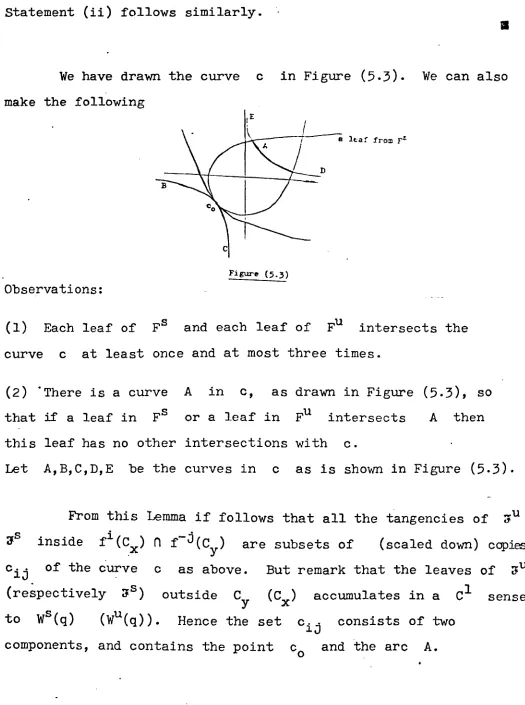
-26-Proof: Take any invariant unstable foliation .!.U cJ
p of _ p. We
.... u
will modify 3p so that restricted to Cx it will
"'-"':-...
coincide with ~. Let N
x be the co~~ected component containing
x of a fundamental neighbourhood of WU(p) such that N-C
x x
consists of two components as in Figure 3.2.
[image:32.606.48.577.73.801.2]p
Figure 3.2
Define the new foliation in by taking this foliation
identical to on
N -C
and identical tox x
Clearly C1 "'u
P extends uniquely into an invariant foliation on a
neighbourhood of
WU(p)_{p).
We must show that the closure ofeach leaf of ;t~ has exactly one intersection with wB(p). More
precisely, . we must check that there is a continuous projecti'un
'lip on
v;S(p)
along the leaves of a~. In order to show thisit suffices to prove that for any sequence a(i) E Nx such that
f-1(a(i))-+ y E WS(p) as i-+ co one has f-i(La(i») --+ y.
Here La(i) denotes the leaf of ~~
n
Nx through a(i). Nowif a(i) and xCi) E La(i) are both contained in the same
component of Nx-Cx - it follows fro:n the fact that .... u "'p is
identical to the unstable-foliation ~ .... u (on N -C ) that
p x x
f-i(x(i)) --t y. So it suffices to consider sequences a(i) E
E Nx
n
Cx and show that for xCi) E La(i)
n
C x one hasf-i(x(i)) --t' y. But from
,J.. •
-27-From equation (3.2) and Lemma 2.3 it follows that f-i(a(i)) -+ y
if and only if f-i(x(i))-+: y. This finishes the proof of the
lemma.
It "Ii
11
be conveni ent to give a general way ofconstructing foliations ~ which satisfy equation
(3.1),
interms of some Cl-coordinate systems near x. In fact take a
Cl-coordinate system (u,v) near x so that
{v = oj = WU(p) , {(u,v) = (0,0)1 = {xl.
In these coordinates the leaves of ~ are in the form
La
=
{v = g(u,a))with g(O,a) = a. Write ga(U) = g(u,a).
Lemma (3.2). (Construction of foliations in cases which can be
'extended to tubular families).
Let n be' the order of tangency of the cone C x,n with
Wu(p) and let g: R2-+ JR be so that:
(1·) the n":'jet J .n ga(u) varies Cl or a:
a-+ jn ga(u) is Cl •
-28-Then the conclusion of Lemma (3.1) holds i.e. the foliation ~
can be extended to an unstable foliation.
Proof: According to the theorem of Taylor one has
with" R(u,a) -+ 0 as (u,a) -+: (0,0), and with ~i C1 so
that ~i(O) =
o.
Now for (u,v) E Cx,n one has for soneconstant c1 '
No-w let (u,v) = (u,g(u,.a)).
one has from O
(3.3) and (3.4)
Since ~o
J.
that:
is C 1 and ~O(O) = 0
J.
'v,
=
I
g (u, a)I
:s: c2 •I
aI
+ cl •I
vI ·
'R (u, a)I
for some constant c2. From this it fo110'\'ls that
for some constants c
3 and c4. Therefore
g(u,a)
I
:y: -a11
=I
a-
11
~~2(a) ~n(a)
n
n
s I
a
1·lul +··.+1
a l·lul
+ I~'·IR(u,a)1
s c5·lul +
c4·IR(u,a)~
From this it follows that
g(u,a)
I:Y:"-
11
=
I
" -
ll~ 0a a
as (x,a) ---+ (0,0). Obviously equati.on (3.6) implies equation
-29-We will UP~ Lemma
3.2
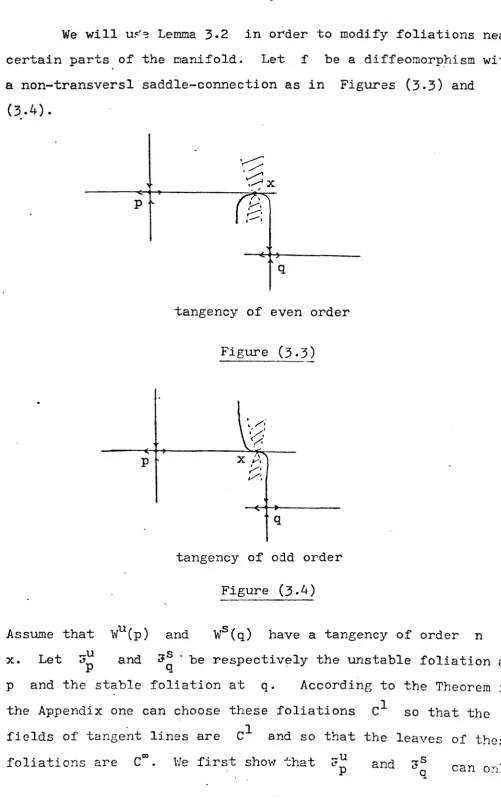
in order to modify foliations nearcertain parts of the manifold. Let f be a diffeomorphism with
a non-transversI saddle-connection as in Figures
(3.3)
and(3.4) •
p
p
,.--:
, /
~x
, ;q
tangency of even order
Figure (3.3)
q
[image:35.607.49.550.69.868.2]tangency of odd order
Figure
(3.4)
Assume that WU(p) and ~(q) have a tangency of order n at
x. Let .... u "p and ;y:~. be respectively the unstable foliation at
p and the stable foliation at q. According to the Theorem in
the Appendix one can choose these foliations Cl so that the
. fields of tangent lines are Cl and so
t~at
the leaves of thesefoliations are
cco.
We first show .lchat ~U cJbe tangent in a certain cone
-30-C
x,
n.
,."Lemma (3.3). Let ~,~' be C 1
'-.
foliations on a neighbourhood
f th . " f JR2
o e or~g~n 0 such that the leaves are
c
r +l , r ~:;' (0) of
T
be thecontact of
precisely,
1, the fields of tcngent lines are Cl
-,
through 0 has contact r+l" with.:r
set of points where ..., .:r is. tangent to ;J' •
T will ~(O)
either
T-tol
lim
zET-
Lo)
z-,O
=
at 0 is less than r+l,
¢ or
d(z, ~(o))
: : Q)
where d is some CO metric.
and the leaf
~(o). Let
Then the
that is more
Proof: Choose a Cr+l coordinate system (u,v) in a
neighbourhood of 0 such that 3'(0,0) = {tu,v)
I
v = 0)and 3"(0,0) = {(u,v)1 v
=
ur+lJ. Denote by ~(u,v) thetangent of the angle of ;]1 (u,v) with the horizontal line
through (u,v) and by *(u,v) the tangent of the angle between
"~
3'(u,v) and ~I(U,V). Hence ~ and ~ are C1
,
V(u,O)=
= Q(-t'·.:I), Q(u,ur +l ) = (r+l) ·ur and T
=
{(u, v)I
V(u, v) =0).
By tl,ie m~an value theorem we have
~t'J
V(u,v) = ¢(u,O) + ~ (u,v)'v ,
and
-for some v between 0 and v and some v between 0 and
and
-31-)..~... r..1..1 )..t
=
(r+l).ur -b;
(u,v).u· +bV
(u,V).v ,~ (u, v)
=
ur
+lr+l
- -
u b~ b ,. \Tbv
(u,v)
+ bv(u,v).
r+l·u
I I (u,v) E T we have ~(u,v) = 0 and since b~ bv is boundec, we have
Iv I
lim
=
+00(u,v)ET lul r
+l u-+OThis clearly proves the Lemma.
Now we "'ill put Lemma 3.2 and Lemma 3.3 together and
show how to modify the foliations
tangent only along a curve.
;,ru and ;;s
p q so that they are
Consider any CO metric d. Since WU(p) and wB(q) have
a tangency of order· n
for some positive number
one has (as in Lemma (2.6)) that
d ( w,
v,u
(p ) )---+Q x
Now let T be the set ",here
and :;5
q are tangent, and let as before
.... u
c1 p
Acoording to Lemma 3.3, for any c > 0 there is a neighbourhood
V of x so that
x·
·So take c > ~, and
Vx
so small thate
x,nn
WS(q)
= {xl ===
e
n
WU(p).foliations _u cJ'
P add ;Js q
-32-have no tap~encies
t •
(in
will modify th€se foliations in Cx,n. We can modify either
... s according to whichever is more convenient. Let us
or c:t
q
change ... s c:t
.
In order to do this .take Cl-coordinates (u,v)q
that tv = 0) =. vlu (p ) , and so that the leaves of .... u
near x so .:t
p
of the form [v = c), i.e. parallel to the tv = oj line.
are
From the Appendix it follows that this is possible. Clearly we can
wri te
vf
(q) in the formvf
(q) = tv = g( u)) where 'g is someCl function and .g(O) =
o.
From the remark abov:e Lemma(2.3)
i t follows that
g(~)
converges to a number 0~
0 asu~:
O.U
vie will treat the case that n is even and the case that n
is odd separately.
Case 1: n is even
Consider the foliation tv
=
g(u,a)), aE R,
whereg(u,a) = Oun + a. According to Lemma
3.2
we can change thefoliation as q so that inside C x,n the
foliation are of the form tv
=
g(u,a)).(3.3)
it follows that then aU p and ;Jsq
the line [u = ol~
Case 2: n is odd.
,
In this case change the foliation
leaves of this
From this and Lemma
are tangent exactly in
... s
cJ'
q so that inside C x,n
the leaves of this foliation are of the form {v = g(u,a)J,
where g(u,a)
=
Qun + a 2 .u + a. From this it follows that then.are tangent only at the point x.
Remark: The set Cx,n \{xl consists of two components.
Sometimes it will be necessary to modify
component and :;s
q in the. other component.
-33-§
3(b). Constru~tion of conjugacies.Now we give a Lemma which will show us how to use these
foliations in the construction of conjugacies. As before let Vx
b~ a neighbourhood of a point x E WU(p) - tpJ and let,
(Here d is a CO metric as before).
We consider the following situation. Let p,p be
hyperbolic fixed points of C2 diffeomorphisms i , f . Let the
, contracting eigenvalue of f (resp.
i)
be ~ (resp.a),
andlet
Let J'u p (resp.
~ :;::
~~) p
logl~1
logl~1
,
i.e.be the unstable foliation for f (resp.
f). Let d, d be two CO metrics. We have the following.
Lemma (3.4). Let h: V - .
V-x
x
be a homeomorphism satisfying(i)
.
the properties:
'lim
WECx,n
, w-+ x
d(h(w) WU(p))
( d (
'\>',
WU (p ) ) [)exists and is positive.
(ii) The restriction of h to each connected component of
v -c
x x maps leaves of the restriction of the foliation to this connected component into leaves ofThen h extends to a homeomorphism of a neighbour:-,ood of p,
-34-Proof: Let d' and be metrics induced by Cl l' - l.near~s~ng "
coordinates for £ (resp. f). From Lemma (2.2) in
section 2 i t follows that
lim
d'
(h ( w) , ''Iu (p) )
r
d ' (w, Wu (p ) J C(3.6)
w -+xwEC x, n
Furthermore since d' and dt are induced
coordinates one has for sequences
by linearising
that f-n(i) (x. )
.1
converges to some point z E
WS(p)
if and onlyd f (xi' W
U
(p» 2:! d' (p, z) •
I
~ Ine
i),
. and a similar statement holds for f. From this, equation
(3.6)
and the fact that
I
c:I
0 =I
c:I,
it .follows that h extends to aCI)
homeomorphism of the closure of
and
f.
U .f- kec )
k=O x,n conjugating :f
Now assume
n
Vx = ¢> • We canis su.f.ficiently small so that .f(v )
n
x
extend h to Vx by taking any extension of hlc n which maps leaves of ;:1 to leaves of ;:1_
It .follows
x, p p
CI)
that h extends to the closure o.f U .f-kev
x ).
k=O
Let us now extend h to a neighbourhood o.f
WU(p).
Takea leaf F of
chosen so that if
For simplicity we can assume that Vx is
F intersects Vx ' then F\ evx U .f-Iev x
»
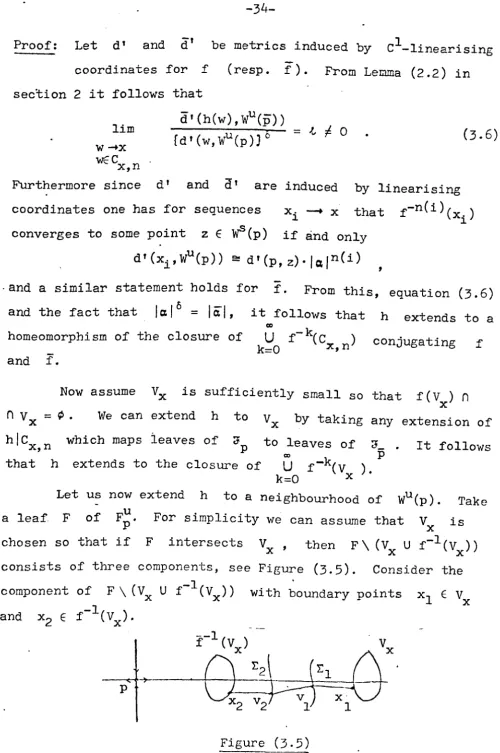
consists of three components, see Figure(3.5).
Consider thecomponent of F \ evx U f-1e vx
»
with boundary points xl E Vxand x
[image:40.603.63.564.45.799.2]2 E f-levx).
-35-not lie on one lea! of ... U ~-
.
~erefore we will modifyIn fact t~ke two curves
h~Vx) ·am £-l(h(V
x
»
p " '
1:1, .1:2 transversal to WU(p)
as in Figure (3-5). The leaf
need .... U
~-
-p
between'
of
u
3p through h(x
i ) has an intersection ,Vi with t i • Take a
leaf
Lv.
in the strep b~tween tl ~nd t2 which is piece-wise1
linear with respect to the linearising coordinates for f such
that LVl
n
13
1 = VI' ~ 1n
E2
= v2 - Do this for every v1 E t 1-Now define a new foliation
"::r
u " which is identical to _U~-P P
outside the.strip between
~
and 1:2 and identical to thepiecewise linear one inside this strip. It is easy to see that
If~U II
P i's an honest unstable foliation for p, using Lemma 3.1.
Now define a conjugacy h on a neighbourhood of WU(p)
by taking any extension of
h!V
x "/hich maps leaves of
.... U
"'p
onto leaves of ,,~u II
-
-
From the construction above if followsP
that this is possible.
Now "Ie consider the situation that a homeomorphism h is
only defined on a cone-like set
ex.
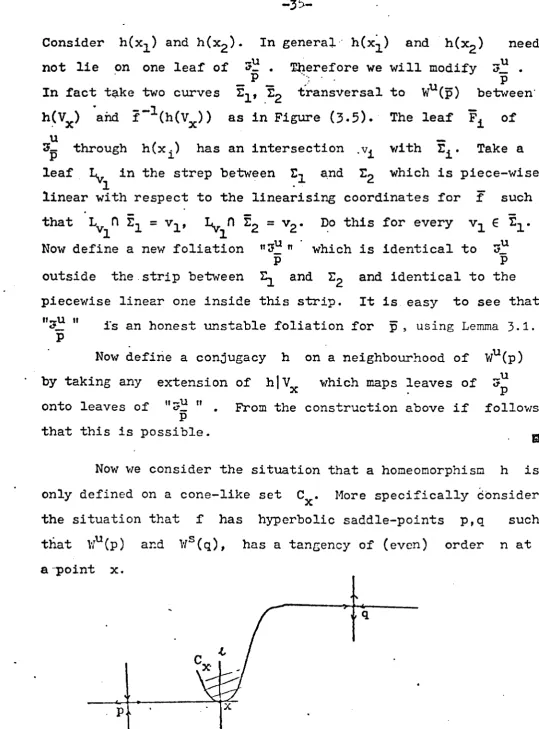
Hore specifically donsiderthe situation that f has hyperbolic saddle-points p,q such
that l'lu(p) ar..d "ls (q), has a tangency of (even) order n at
a -point x.
q
[image:41.600.37.577.48.778.2].p
-36-Let C
x be t.ae cone-like set as in FigUre (3.6), and let f be
a diffeomorphism so that
WU(p)
and WS(q) also have a"tangency of order' n a1 x. Assume h: Cx '" ex is a
homeomorphism. When can we extend h to a conjugacy on a
neighbourhood of p? In order to investigate this question take
a ..
CO-metric d: near x and defineAs we have sho\ffl before,
~
is well defined andOx
-!
o.
Define <L similarly. Let .(, be a Ct%> curve through
x
x
. transversal to
\f{p)
and take a similar curve:r
for f • v;eassume that h(.(,)
=
Z
and that the fOllowing.limits exist and arepositive:
C1
=
lim. w-+x
wEC - t
x
d(h(w), Z)
d(w,t)
d
{h ( w) ,,.f3 (
q ) )and lim
w"'x d ( w,
,.f3 (
q) )"IEC
x-
,vB
(q )Also assume the contracting eigenvalue of f at p is equal
to the contracting eigenvalue of f at p. The numbers ~,
'ax,
Cl , C2 do depend on the choice made for the metrics d,d.However
",e
have the follm'ling result.Lemma 3.5. ·Let h be a homeomorphism as above. Then:
(1) the equality
metric d,d;
(2) if
C
n°
x=...1
O_C2 x does not depend on the
then the homeomorphism h can be
-37-Proof: (1) Let d l be another metric instead of d.From
Lemma 2.2 and the remark below this lemma we have that
there exist A > 0 so that
. lim
w-+x
wEv,s
(q)dew, ,.,u(p))
d' (w, vtu(p)) = ). = w .... lim x
WECx
d(w,wB(q))
d ' (w, \\'s ( q) )
Furthermore if w E
WS(q)
converges to x then from Lemma 2.1i t follows that d(w,x)/d'(w,x) converges to a positive constant
J.l. On the other hand one has d(w,t) ~ d(,\,1,x) , d' (,."t) ~d' (w,x)
for w E
WS(q)
converging to x sincewB(q)
and WU(p) aretangent to each other and transversal to lv. Hence
d(w,x)
lim - - - - = I.L =
wE
wB, ( q)
d' (w, x)W-+X
It follows immediately that Q =
x
lim wEWs(q)
w-+x
Cn 1
C2
~
does not depend on thechoice of d. Similarly it does not depend on the choice of d.
(2) Take C~ coordinates (u,v) at x so that WU(p) =
- tv
=
0),
and t=
{u=
0). From(1)
wecan taJ{e for d the usual Euclidean metric in this coordinate
.system. Take ,\,1 E C
x and let w have coordinates (u, v). Then
Furthermore
as w-+ x (see the arguments used in" the remark below leP."_ma 2 .2).
Now we use the follo\.,ing elementary fact.
of positive numbers such that
Take sequences
a. ~ b. + c.
l. l. l.
a· , l.
-38-converges to 1. Then a. ~ b. + d .•
1. 1. 1. It follows that
and similarly
Using a similar elementary computation as above one concludes
that
converges for w ECx
d
(h ( w ) , Wu (p) )dew,
wU(p))converging to x i f and only i f
(In this case the limit is C2). Using Lemma
3.4
i t followsthat we can extend h to a conjugacy near p.
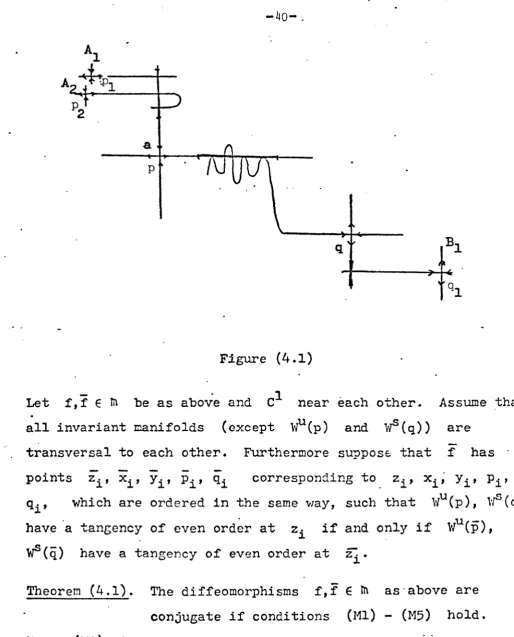
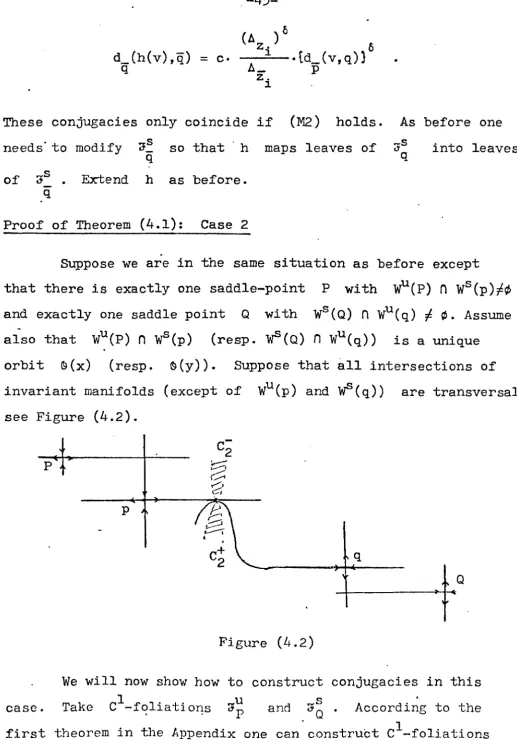
-§4 9onstruction of conjugacies "'hen all invariant manifolds
except WU(p) and WS(q) intersect each other transversally
Suppose that p and q are hJ~erbolic saddle-points and
that WU(p) and
WS(q)
have k-orbits of non-transversalintersection.
In order to state the next theorem we need some notation.
Let Ct (resp. S) 'be the contracting {resp. expanding)
domain D~ in wll(p) and let zl' .•• ~·zk be the points in D~
where
WU(p)
andWS(q)
are tang~Pt. - Order these points sothat
d(zi~P)
< d(z1+l'P). Then take a' C1 curve~i
at zitransversal to ,~(p) and
WS(q)
and take linearising metricsd -at P
q and q respectively. Define
~(W,Zi)
dq(\,I,zi)
be the saddles ,.,hose
unstable Crespo stable) manifolds intersect ,.,s(p) (resp.
"?(q».
Denote the contracting (resp. expanding) eigenvalue of f at
Pi (resp qi) by Ai (resp. Bi ), and the linearising metrics
by respectively d
q.
1
Choose fundacental do~ins Dp S in WS(p) and DU q in '~(q).
Let x1, .•• ,xt(p) (resp. Yl' ••• 'Y~(q» be the intersectio~s
of the unstable (resp. stable) manifolds of the saddles Pi'S
(resp. qi's) with D~ (resp. D~) ordered as above.
Let I = ti
I
",U(p) and vr(q) have a tangency of even order=
lim'r ... y j
\,rE\p( q)
Define
d
pi (w,Xj )
~(w,Xj) if