Received: 27 Oct 2017 ISSN 2056-757X
Measuring Knowledge Management
Capability Condition on the Support
of Marine and Fishery Resources
Utilisation
Roberto M. K. Teniwut, Cawalinya L. Hasyim, Wellem A.
Teniwut
Fishereis Agribusiness Study Program, Tual State Fisheries
Polytechnic, Indonesia
Abstract
Economically and ecologically, marine environment plays an important role in all aspects of our life. Throughout human existence, we have relied on the marine environment for food, recreational activities, economic opportunities, and so on. For that reason, it is vital to protect, sustain, and improve the coastal zone as an aquatic resources and a habitat for wildlife. Managing coastal zones require involvements from many different stakeholders; however, the integration of all knowledge types -- including local expertise and scientific knowledge -- with the policymaking is not without challenges. This paper looks at the resource based capability and knowledge-based capability perspectives in measuring the effectiveness of knowledge management in a rural coastal region, Southeast Maluku district. This research uses stepwise regression analysis method with 253 respondents. The results of this study indicate that resources based and knowledge based capabilities in this region are effective in supporting the application of knowledge capability management. However, the ability to obtain information and utilise information has not significantly impacted the development of knowledge capability management of fishery resources and marine in this region at the time of writing.
Paper type: Research paper
1. Introduction
Knowledge management practice has received growing attention in the costal communities; for example, in the Northern Cape (Mabudafhasi, 2002), Timor and the Arafura Sea (Stacey et al., 2015), Solomon Islands (Folke et al. 2005), and Pacific regions (Harvey and Hilton, 2006). Studies have shown that knowledge management practices are often affected by the cultural and institutional contexts (Hussinki et al., 2017). However, limited work has been done in analysing the knowledge management initiatives in rural Indonesian coastal regions. Hence, this study aims to fill the research gap by examining the knowledge management practices in a rural Indonesian coastal region: the Southeast Maluku district.
The Maluku Islands are an archipelago within the Banda Sea, Indonesia. Unlike the northern and central parts of Maluku Islands which are covered by the rainforests, the Southeast Maluku province is sparsely vegetated and it has extensive coastal areas and inland swap (O’Connor et al., 2002). Given the remoteness and ecological environment of the Southeast Maluku province, the livelihoods on the Maluku province are largely depend on the surrounding marine environment, and marine-based activities constitute a significant proportion of economic activities and nutritional intakes in the province (O’Connor et al., 2002; Pannell, 1997; Steenbergen, 2016). However, the marine resources and ecosystems in Indonesia are not only threatened by the climate change but also over-exploitation, growing population, and pollution (Pannell, 1997). Given the significance of the marine environment to the rural coastal communities like the Southeast Maluku province, it is necessary to better utilise the scarce resources in a sustainable and efficient manner. This calls for a more thorough review of the current use of the marine environment, improve the current understanding of the coastal zone, and co-create a more sustainable way of undertaking marine-based activities.
The Southeast Maluku province is a rural coastal region and the interactions between economic and ecologic interests has resulted tensions in managing this coastal zone. These tensions have often emerged from sharing and integrating knowledge from different sources of information (e.g. researchers, local residents, policy makers, non-governmental organisations). The objective of this paper is to analyse the knowledge management capability in Southeast Maluku Regency, with particular attention to the role of resource structuring and capability building in coastal communities.
2. Literature Review
2.1. Knowledge Management in coastal regions
economic interests. Furthermore, the local residents can contribute to the knowledge building and sharing in regard to local ecological knowledge (Berkes et al., 2007; Green and Raygorodetsky, 2010; Puente-Rodríguez et al., 2015).
However, the process of producing and sharing knowledge in the coastal regions is more complex than in contemporary corporations. The complexity of governance system is one of the reasons coastal knowledge could not be easily integrated into environmental and development policy (Acheson, 2006; Nursey-Bray et al. 2014; Shanley and Lopez, 2009). Researchers refer the barriers to implementing changes due to cultural and political interests as “knowledge-governance gap” (Cash et al. 2006). Compiling relevant traditional knowledge is proven to be a complicated task (Berkes et al., 2007) and transferring scientific knowledge to the local coastal communities is equally challenging (Cash et al. 2006). Additionally, the ongoing pervasive environmental changes (Harvey and Hilton, 2006) and globalisation constitute to challenge to managing knowledge in the coastal communities. The next section discusses the practice of knowledge management, with a focus on disseminating knowledge in the coastal communities.
2.2. The practice of knowledge management
To a great extent, these five steps mirror the four fundamental questions as identified by Puente-Rodríguez et al. (2015): why, who, what, and how. First, the why-question focuses on the reasons, issues, or problems that initiate the knowledge exchange at first place. Second, the who-question identifies the key actors and decision makers in the knowledge management initiative. Third, the what-question is concerned with what knowledge to be shared and assimilated. And lastly, the how-question is about creating and developing strategies to exchange and manage knowledge efficiently.
A closer examination on the work of Puente-Rodríguez et al. (2015) and Kumar and Leonard (2012) suggests that their views of knowledge management practices focus on the following issues: people, process, purpose, and content. This paper further develops the theoretical groundings by expanding KM practices into a six categorisations, which is based on the central premise of resource-based view: capability building and resource structuring (Barney et al., 2001). These six factors are: Culture Knowledge (CK), Technology (T), Organizational Structure (OS), Expertise Capability (EC), Learning Capability (LC), and Information Capability (IC). While the first three variables are based on resource-based perspective, the latter three are concerned with the knowledge-based perspective (Aujirapongpan et al., 2010). The next sections explain the six variables proposed to cover the most important aspects of KM in coastal regions.
2.2.1. Culture Knowledge (CK)
Knowledge represents a cumulative body of beliefs (Berkes et al., 2007), intellectual development (Hussinki et al., 2017), and cultural evolution (Green and Raygorodetsky, 2010). Knowledge can exists in various forms, including formal, informal, tacit, explicit, local, scientific, etc. Puente-Rodríguez et al. (2015) concluded that scientific knowledge alone is insufficient to create and maintain sustainable coastal communities, and the involvement of different stakeholders is required in order to co-create knowledge in coastal regions. In particular, the involvement of local populations and local know-how are valued by the scientific communities in order to understand the local environmental conditions and habitats (Berkes et al., 2007; Green and Raygorodetsky, 2010; Puente-Rodríguez et al., 2015). Scholars refer the cultural and historical continuity of region-specific knowledge as “indigenous knowledge” (Green and Raygorodetsky, 2010), “community knowledge” (Nursey-Bray et al. 2014), “local knowledge” (Naess, 2012), and “traditional knowledge” (Berkes et al., 2007). In this study, we refer this type of knowledge as culture knowledge.
2.2.2. Technology (T)
(2015) reported that technological supports such as communication platforms and decision support tools are needed in the coastal management context. In short, technology can help to build a capacity for knowledge management.
2.2.3. Organisational Structure (OS)
Knowledge sharing and management is often affected by the organisational design issues, especially in terms of power distance and communication relationship (Aujirapongpan et al., 2010; Hussinki et al., 2017; Puente-Rodríguez et al., 2015). Organisational structure determines how information flows between and among levels of management; it also affects the extent to which functional roles and responsibilities are delegated and coordinated in disseminating information. For instance, a hierarchical organisational structure may be less efficient in disseminating information compared to cross-functional teams (Hussinki et al., 2017). Empirical studies have shown that supports from senior management, employee empowerment, and power decentralisation are positively correlated to the successful implementation of knowledge management systems (Hussinki et al., 2017; Yang and chen, 2007). Organisational structure is also relevant to knowledge management in coastal communities. While top-down regulatory framework appears necessary to enforce holistic coastal management and knowledge governance strategies, a bottom-up approach tends to emerge spontaneously in sharing knowledge related to coastal zone management (Puente-Rodríguez et al., 2015). In other words, organisational structure, or power distance and communication flow more specifically, is likely to affect the mechanism of knowledge sharing and management in the communities.
2.2.4. Expertise Capability (EC)
2.2.5. Learning Capability (LC)
Learning Capability refers to the capability to learn and the knowledge gained while working under various circumstances (Aujirapongpan et al., 2010; Freeze and Kulkarni, 2007). Such learning may take place at many different forms and levels. The capacity to embrace multiple forms of knowledge, in addition to the provision of a diversity of governance regimes, will create a good ‘fit’ over the geographies and scales of coastal regions (Nursey-Bray et al., 2014). Ability to Potential indicators of Learning Capability includes the capability to articulate (Oliver et al., 2012), ability to capture and transfer lessons learned (Freeze and Kulkarni, 2007), and motivated to study and co-create knowledge (Aujirapongpan et al., 2010).
2.2.6. Information Capability (IC)
The last variable from the knowledge-based capability perspective is the Information Capability, which refers to the “the capability to have valuable and beneficial information, both quantitatively and qualitatively” (Aujirapongpan et al., 2010: 188). In the context of coastal management, information includes specific location data and expert data, which often accumulated from many different sources. Potential indicators regarding information capability include the accessibility and the retrieval of data (Aujirapongpan et al., 2010), storage capacity (Nursey-Bray et al., 2014), and efficiency (Oliver et al., 2012).
3. Methodology
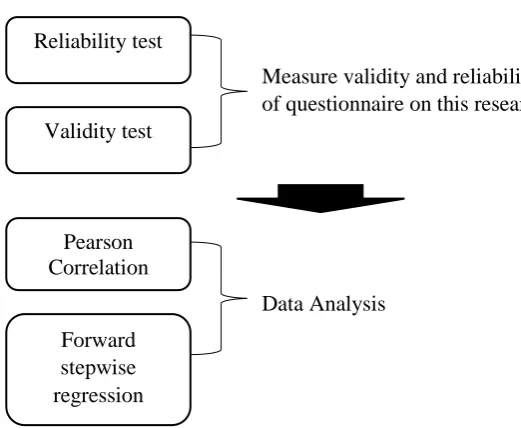
Figure 1: Steps of analysis method
3.1. Data Collection
This study is based on both interviews and questionnaires, and the data were collected using the probability sampling method with a simple random sampling approach. The respondents of this research is a coastal community which is engaged in the management and utilisation of marine and fishery resources as the main source of economy in Southeast Maluku Regency, which include culture farmer, fishermen, fishery product seller and capital owner. The sample selection was conducted by conducting an initial survey to determine the location (Village) that became the target. The location of the research was conducted in 12 locations spread in Pulai Kei Kecil and Kei Besar, among others, Ohoidertutu Village, Ngilngof Village, Matwaer Village, River Village, Ngafan Village, Evu Village, Letvuan Village, Selayar Village, Dudunwahan Village, Sathean Village, and Ohoiren Village.
3.2. Data Analysis
The best model can be obtained from the variables studied using Forward Stepwise Regression Procedure. The forward elimination procedure is one of the best model selection procedures in regression with the elimination of independent variables that build the model gradually.
The steps are as follows:
1. Create a simple regression model for each independent variable. Then, each model is tested by a slope test with F. We compare the highest F values, e.g., FL, with
certain fixed F values from the table, for example, F0. If FL< F0, means there's no
independent variable that being choose
2. If FL> F0, enter independent variable L to model.
Validity test Reliability test
Measure validity and reliability of questionnaire on this research
Forward stepwise regression
Pearson Correlation
3. If at stage 1 there is an independent variable that is inserted (e.g., L), then we create a regression model with two independent variables in which one of them is variable L, suppose free variable L and K. Then we do partial F test: FK
=
) , (
) (
L K MSE
L K MSR
then we make comparison model for higher F value, where FK with
certain F value, then F0.
a) If FK< F0, means that only 1 independent variable in the model.
b) If FK> F0, means that we can enter variable K in the model.
4. If on second step there is independent variable available (K), then stepwise will check whether the independent variable in model been dropped out or not.
Partial F test: FL=
) , (
) (
K L MSE
K L MSR
.
a) If FL< F0, means that independent variable L expelled from the model.
b) If FK> F0, means that independent variable L and K include in the model.
Suppose we keep the independent variable L. Thus, the independent variables L and K are used in the model. Furthermore, the stages repeated until no more variables are added or removed. Using SPSS 24, the regression model used as follows:
Where:
KCM = Knowledge Capability Management
T = Technology
OS = Organizational Structure OC = Organizational Culture LC = Learning Capability IC = Information Capability EC = Expertise Capability
= Error
This study initially set a target respondents were 280, then after the distribution of questionnaires, only 278 pieces of questionnaires were returned and only as many as 253 questionnaires that meet the statistical requirement to be included in the calculation of this research. Before proceeding to the stage of data processing, it is necessary to test the instrument, in this case, is a test of reliability and validity.
3.3. Validity test
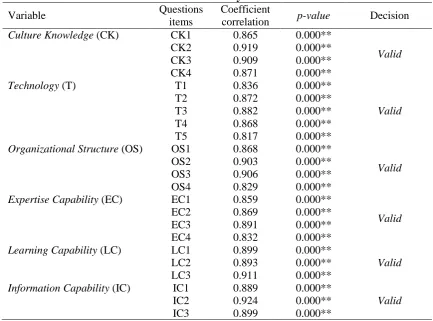
of testing question instruments in the questionnaire used in this study can be seen in table 1 below:
Table 1: Validity result
Variable Questions
items
Coefficient
correlation p-value Decision
Culture Knowledge (CK) CK1
CK2 CK3 CK4 0.865 0.919 0.909 0.871 0.000** 0.000** 0.000** 0.000** Valid
Technology (T) T1
T2 T3 T4 T5 0.836 0.872 0.882 0.868 0.817 0.000** 0.000** 0.000** 0.000** 0.000** Valid
Organizational Structure (OS) OS1
OS2 OS3 OS4 0.868 0.903 0.906 0.829 0.000** 0.000** 0.000** 0.000** Valid
Expertise Capability (EC) EC1
EC2 EC3 EC4 0.859 0.869 0.891 0.832 0.000** 0.000** 0.000** 0.000** Valid
Learning Capability (LC) LC1
LC2 LC3 0.899 0.893 0.911 0.000** 0.000** 0.000** Valid
Information Capability (IC) IC1
IC2 IC3 0.889 0.924 0.899 0.000** 0.000** 0.000** Valid
**significant N = 253
The results of testing the validity of the items of the questions used in this study indicate that all items signify valid questions in the sense that the items of questions represent variables adequately measured in the study, further followed by reliability testing to analyze the consistency of the variables in this study.
3.4. Reliability test
Table 2: Reliability result
No Variable Coefficient reliability Decision
1 Culture Knowledge (CK) 0.914 Reliable
2 Technology (T) 0.908 Reliable
3 Organizational Structure (OS) 0.899 Reliable
4 Expertise Capability (EC) 0.884 Reliable
5 Learning Capability (LC) 0.884 Reliable
6 Information Capability (IC) 0.888 Reliable
In Table 2 above can be seen that, the results of reliability tests on the variables used in the study showed that all variables in this study meet the criteria of reliability, which means that the variables in this study consistent.
4. Results
This study uses two analytical tools in accordance with the objectives to be achieved, where the first was the Pearson correlation test to test the interrelations between independent variables and dependent variable with the aim to test the relationship between variables and the second was stepwise regression for analyzing the effect of resources based capability (RBC) that is culture knowledge, technology, organizational structure and knowledge-based capability (KBC) that is expertise capability, learning capability, information capability on knowledge capability.
4.1. Pearson Correlation Test
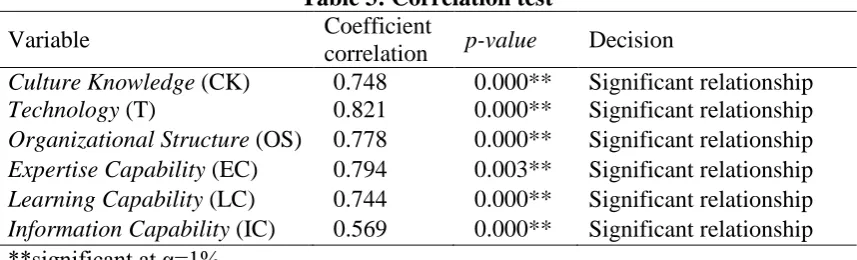
The results of correlation test between independent variables with a dependent variable can be seen in table 3 below:
Table 3: Correlation test
Variable Coefficient
correlation p-value Decision
Culture Knowledge (CK) 0.748 0.000** Significant relationship Technology (T) 0.821 0.000** Significant relationship Organizational Structure (OS) 0.778 0.000** Significant relationship Expertise Capability (EC) 0.794 0.003** Significant relationship Learning Capability (LC) 0.744 0.000** Significant relationship Information Capability (IC) 0.569 0.000** Significant relationship **significant at α=1%
[image:10.595.84.513.457.587.2]4.2. Stepwise Regression Analysis
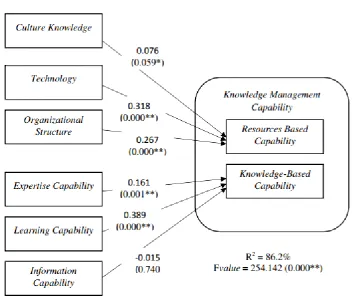
[image:11.595.84.514.199.393.2]This analytical tool is used to determine the influence of each group of variables separately and simultaneously to the dependent variable. It aims to obtain a detailed and gradual description of the effect of each resource based capability and knowledge-based capability on the equitable distribution and knowledge management of fishery resources by sustainable coastal communities in a single regression test. The results of the analysis of stepwise regression analysis in this study can be seen in Table 4 below:
Table 4: Stepwise Regression Analysis
First step Second step Coefficient
regression
p-value
Culture Knowledge (CK) Technology (T)
Organizational Structure (OS)
0.086 0.398 0.487
0.058* 0.000** 0.000** Culture Knowledge (CK)
Technology (T)
Organizational Structure (OS) Expertise Capability (EC) Learning Capability (LC) Information Capability (IC)
0.076 0.318 0.267 0.161 0.389 -0.015
0.059* 0.000** 0.000** 0.001** 0.000** 0.740
R2 = 81.3% R2 = 86.2%
F value = 358.434 (0.000**) F value = 254.142 (0.000**) Durbin Watson = 1.833
VIF < 4
**significant in α = 0.05 (95%); *significant in α = 0.1 (90%)
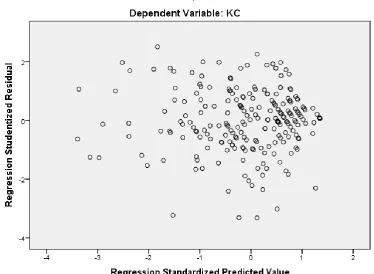
Figure 2: Scatter Plot regression for heteroscedasticity
The final result of stepwise regression analysis in this study passed the test of classic assumption; hence, it’s worth continuing to significance testing. In the above results, it can be seen that the value of R2 in the first stage where the variable resources-based
Figure 3: Regression Results
5. Discussion
The six factors representing a knowledge-based capability and resource-based capability have a strong relationship with knowledge management capability in the region. However, based on the results of research, the Information Capability -- which is one of the variables of the knowledge-based capabilities -- has no significant influence in this region. This condition becomes a huge concern for local government because the party that acts as management in Southeast Maluku district, organises information flow, form and accuracy of information, information delivery and evaluation of coastal resource management information is not well-managed.
organizational structure in the area had a positive effect on KM capability in the region. This indicates that formal and informal government and community structure in the region do fit with the KM effectiveness criteria, where the coastal community can easily contact the government office and researcher in the area directly. Additionally, the technology factor also supports KM capability in the Southeast Maluku district as accessibility to the technology is quite high. This finding supports the study of Yang and Chen (2007) which concluded that structural, technical, and human knowledge capability are significant to the KM capability.
Furthermore, the results of this study also showed that knowledge based capability (expertise capability and learning capability) of the coastal community in the Southeast Maluku district supports the KM capability. Expertise capability in this context is related to tacit knowledge, which is based on the accumulated expertise from the elders, experience, and practice,(Naess, 2012). On top of that, learning knowledge also has a positive impact on KM capability in the region. Capability of coastal community to learn is also supported by their willingness to improve their capability, although we have found that coastal community in the region tends to be more sceptical about new knowledge their provided with, but we also found that person who provides the knowledge also has impact on the capacity of coastal community to receive and assimilate knowledge. For information capability, the results show that it has no significant impact on KM capability in the region. Information capability related to the capability to utilize the information they get, in which based on our findings some of the information provided to the coastal community does not fit with the real conditions. The rate of education background also contributes to this situation.
6. Research Implications
In general, the results indicate that the resources-based and knowledge-based perspectives have a positive impact on KM capability in the region, although information capability is deficient. Therefore it is necessary to conduct training and periodic assistance to increase coastal community capability to use the obtained information sufficiently. Training, material and assistance can be provided by the research institution in collaboration with local and central government. This region has the better core for KM capability; though, there is need for the further study on the real impact of knowledge sharing between coastal community and government along with NGOs on the utilisation of the marine and coastal resources in the region.
7. Acknowledgements
8. References
1. Acheson, J. M. (2006), “Institutional failure in resource management”, Annual Review of Anthropology, Vol. 35, No. 1, pp. 117-134.
https://doi.org/10.1146/annurev.anthro.35.081705.123238
2. Aujirapongpan, S.; Vadhanasindhu, P.; Chandrachai, A. and Cooparat, P. (2010) "Indicators of knowledge management capability for KM effectiveness", VINE, Vol. 40, No. 2, pp.183-203, https://doi.org/10.1108/03055721011050677
3. Barney, J.; Wright, M. and Ketchen, D. (2001), “The resource-based view of the firm: Ten years after 1991”, Journal of Management, Vol. 27, No. 6, pp. 625 – 641. https://doi.org/10.1177/014920630102700601
4. Berkes, F.; Berkes, M. K. and Fast, H. (2007), “Collaborative Integrated
Management in Canada's North: The Role of Local and Traditional Knowledge and Community-Based Monitoring”, Coastal Management, Vol. 35, No. 1, pp. 143-162. https://doi.org/10.1080/08920750600970487
5. Chuang, S.H. (2004), “A resource-based perspective on knowledge management capability and competitive advantage: an empirical investigation”, Expert Systems
with Applications, Vol. 27, No. 3, pp. 459-65.
https://doi.org/10.1016/j.eswa.2004.05.008
6. Freeze, R. D. and Kulkarni, U. (2007), “Knowledge management capability: defining knowledge assets”, Journal of Knowledge Management, Vol. 11, No. 6, pp.94-109, https://doi.org/10.1108/13673270710832190
7. Folke, C., Hahn, T., Olsson, P., and Norberg, J., (2005), “Adaptive Governance of social–ecological systems”, Annual Review of Environmental Resources, Vol. 30, No. 1, pp. 441–473.https://doi.org/10.1146/annurev.energy.30.050504.144511
8. Green, D. and Raygorodetsky, G. (2010), “Indigenous knowledge of a changing climate”, Climatic Change, Vol. 100, No. 2, pp. 239–242.
https://doi.org/10.1007/s10584-010-9804-y
9. Harvey, N. and Hilton, M., (2006), “Coastal management in the Asia-Pacific region”, In: Harvey, N. (Ed.), Global Change and Integrated Coastal Management: The Asia-Pacific Region. Coastal Systems and Continental Margins, Volume 10, The Netherlands: Springer, pp. 39–66. https://doi.org/10.1007/1-4020-3628-0_3
11.Kumar, S., Leonard, A. (2012), The Art of Knowledge Exchange: a Results-focused Planning Guide for Development Practitioners. Washington DC: World Bank. Available from: https://openknowledge.worldbank.org/handle/10986/11983 (accessed on 17 Nov 2017).
12.Mabudafhasi, R. (2002), “The role of knowledge management and information sharing in capacity building for sustainable development—an example from South Africa”, Ocean & Coastal Management, Vol. 45, No. 9-10, pp. 695–707.
https://doi.org/10.1016/S0964-5691(02)00094-7
13.Naess, O. (2012), “The role of local knowledge in adaptation to climate change”, WIREs Climate Change, Vol. 4, No. 2, pp. 99–106.
https://doi.org/10.1002/wcc.204
14.Nursey-Bray, M. J., Vince, J., Scott, M., Haward, M., O’Toole, K., Smith, T., Harvey, N. and Clarke, B. (2014), “Science into policy? Discourse, coastal management and knowledge”, Environmental Science & Policy, Vol. 38, pp. 107-119. https://doi.org/10.1016/j.envsci.2013.10.010
15.O’Connor, S.; Aplin, K.P.; Spriggs, M.; Veth, P. and Ayliffe, L.K. (2002), “From savannah to rainforest: changing environments and human occupation at Liang Lemdubu, Aru Islands, Maluku (Indonesia)”, in: P. Kershaw, B. David, N. Tapper, D. Penny, J. Brown (Eds), Bridging Wallace’s Line: The Environmental and Cultural History and Dynamics of the SE-Asian-Australian Region, Volume 34 of Advances in Geoecology, Reiskirchen: Catena Verlag, pp. 279–306.
16.Oliver, D.M. Fish, R.D. Winter, M. Hodgson, C.J. Heathwaite, A.L. Chadwick, D.R. (2012), “Valuing local knowledge as a source of expert data: farmer engagement and the design of decision support systems”, Environmental Modelling and Software, Vol. 36, pp. 76-85. https://doi.org/10.1016/j.envsoft.2011.09.013
17.Pannell, S. (1997), “Managing the Discourse of Resource Management: The Case of Sasi from Southeast Maluku, Indonesia”, Oceania, Vol. 67, No. 4, pp. 289-307.
18.Puente-Rodríguez, D., Giebels, D. and de Jonge, V. N. (2015), “Strengthening coastal zone management in the Wadden Sea by applying knowledge-practice interfaces”, Ocean & Coastal Management, Vol. 108, pp. 27-38.
https://doi.org/10.1016/j.ocecoaman.2014.05.017
19.Shanley, P. and Lopez, C. (2009), “Out of the loop: why research rarely reaches policy makers and the public and what can be done”, Biotropica, Vol. 41, No. 5, pp. 535-544. https://doi.org/10.1111/j.1744-7429.2009.00561.x
20.Stacey, N., Karam, J., Jackson, M., Kennett, R., and Wagey, T. (2015), “Knowledge exchange as a tool for transboundary and coastal management of the Arafura and Timor Seas”, Ocean & Coastal Management, Vol. 114, pp. 151-163.
21.Steenbergen, D. (2016), “Strategic Customary Village Leadership in the Context of Marine Conservation and Development in Southeast Maluku, Indonesia”, Human Ecology, Vol. 44, No. 3, pp.-327. https://doi.org/10.1007/s10745-016-9829-6.
22.Sumbal, M. S.; Eric Tsui, E. and See-To, E. W.K. (2017), “Interrelationship between big data and knowledge management: an exploratory study in the oil and gas sector”, Journal of Knowledge Management, Vol. 21, No. 1, pp.180-196. https://doi.org/10.1108/JKM-07-2016-0262