Denotation in Nominalizations
in Spanish
Aina Peris
∗University of Barcelona
Mariona Taul´e
∗ University of BarcelonaHoracio Rodr´ıguez
∗∗Technical University of Catalonia
This article deals with deverbal nominalizations in Spanish; concretely, we focus on the deno-tative distinction between event and result nominalizations. The goals of this work is twofold: first, to detect the most relevant features for this denotative distinction; and, second, to build an automatic classification system of deverbal nominalizations according to their denotation. We have based our study on theoretical hypotheses dealing with this semantic distinction and we have analyzed them empirically by means of Machine Learning techniques which are the basis of the ADN-Classifier. This is the first tool that aims to automatically classify deverbal nominalizations in event, result, or underspecified denotation types in Spanish. The ADN-Classifier has helped us to quantitatively evaluate the validity of our claims regarding deverbal nominalizations. We set up a series of experiments in order to test the ADN-Classifier with differ-ent models and in differdiffer-ent realistic scenarios depending on the knowledge resources and natural language processors available. The ADN-Classifier achieved good results (87.20% accuracy).
1. Introduction
The last few years have seen an increasing amount of workin the semantic treatment of unrestricted text, such as Minimal Recursive Semantics in Lingo/LKB (Copestake 2007), Frame Semantics in Shalmaneser (Erkand Pad ´o 2006), Discourse Representation Structures in Boxer (Bos 2008), and the automatic learning of Semantic Grammars (Mooney 2007), but we are still a long way from representing the full meaning of texts when not restricted to narrow domains. Many Natural Language Processing (NLP) applications such as Question Answering, Information Extraction, Machine Reading and high-quality Machine Translation or Summarization systems, and many NLP intermediate level tasks such as Textual Entailment, Paraphrase Detection, or Word
∗ CLiC, Centre de Llenguatge i Computaci ´o/University of Barcelona, Gran Via de les Corts Catalanes 585, 08007 Barcelona. E-mail:[email protected]; [email protected].
∗∗ TALP Research Center - Technical University of Catalonia, Jordi Girona Salgado 1-3, 08034 Barcelona. E-mail:[email protected].
Sense Disambiguation (WSD), have almost reached their practical upper bounds and it is difficult to move forward without using a serious semantic representation of the text under consideration. Given the limitations and the difficulties in obtaining an in-depth semantic representation of texts as a whole, most efforts have been focused on partial semantic representation using less expressive semantic formalisms, such as those that come under the umbrella of Description Logic variants, or on discarding the whole semantic interpretation taskin order to focus on smaller (and easier) subtasks. This is the case, for instance, in Semantic Role Labeling (SRL) systems, which indicate the semantic relations that hold between a predicate and its associated participants and properties, the relations of which are drawn from a pre-specified list of possible semantic roles for that predicate or class of predicates. See M ´arquez et al. (2008) and Palmer, Gildea, and Xue (2010) for recent surveys. Closely related to SRL is the task of learning Selectional Restrictions for a predicate, for example, the kind of semantic class each argument of the predicate must belong to (Mechura 2008). In this case a predefined set of semantic classes must also be used to perform the classification task. WordNet (Fellbaum 1998), VerbNet (Kipper et al. 2006), PropBank (Palmer, Kingsbury, and Gildea 2005), FrameNet (Ruppenhofer et al. 2006), and OntoNotes (Hovy et al. 2006) are resources frequently used for this purpose. Most of these efforts are verb-centered and reduce role labeling to the roles played by entities around a predicate instantiated as a verb. At a finer level, there is the taskof WSD, for example, assigning the most appropriate sense to each lexical unit of the text from a predefined lexical-semantic resource. Once again a catalogue of classes has to be used as a range for the assignment.1In this case as well, despite its excessive finer granularity, WordNet is the most widely used reference. See Navigli (2009) for a recent survey.
In this line of research, there has recently been a growing interest in going beyond verb-centered hypotheses to tackle the computational treatment ofdeverbal nominal-izations (nouns derived from verbs), in order to move forward to the full compre-hension of texts. Deverbal nominalizations are lexical units that contain rich semantic information equivalent to a clausal structure. Many recent studies have focused on the detection of semantic relations between pairs of nominals that belong to different Nominal Phrases (NPs), such as Task4 of SemEval 2007 (Girju et al. 2009) and Task8 of SemEval 2010 (Hendrickx et al. 2010), or between nominals taking part in noun compound constructions. In the latter case, they take into account a predefined set of semantic relations (Girju et al. 2005) or use verb paraphrases with prepositions (Task9 of SemEval 2010 [Butnariu et al. 2010a, 2010b]). Although these works include nominalizations, they are not strictly focused on them but cover all type of nouns. Actually, most of the workstudying only deverbal nominalizations is focused on their argument structure: Some authors focus on the detection of arguments within the NP headed by the nominalization (Hull and Gomez 2000; Lapata 2002; Gurevich et al. 2006; Pad ´o, Pennacchiotti, and Sporleder 2008; Surdeanu et al. 2008; Gurevich and Waterman 2009), whereas others center their attention on detecting the implicit arguments of the nominalizations which are outside the NP (Gerber and Chai 2010; Ruppenhofer et al. 2010). Among the former group, there are different approaches to the problem: Lapata (2002) and Gurevich and Waterman (2009) use probabilistic models, Hull and Gomez (2000) and Gurevich et al. (2006) develop heuristic rules, Pad ´o, Pennacchiotti, and
Sporleder (2008) workwith an unsupervised SRL system, and in Surdeanu et al. (2008) the workpresented uses supervised SRL systems. The kind of argument annotated is also different in these works: Although only two, more syntactic labels (subj [subject] and obj [object]), are used to annotate the arguments in Lapata (2002), Gurevich et al. (2006), and Gurevich and Waterman (2009), Pad ´o, Pennacchiotti, and Sporleder (2008) use FrameNet labels and Surdeanu et al. (2008) use NomBank(Meyers, Reeves, and Macleod 2004)2labels. The interpretation of nominalizations is crucial because they are common in texts and an important amount of information is represented within them. In the AnCora-ES corpus (Taul´e, Mart´ı, and Recasens 2008), for instance, the semantic in-formation is mostly coded in verbs (56,590 verbal occurrences) but a significant number of deverbal nominalizations (23,431 occurrences) also encode rich semantic information. Most of the workon this topic sets out from the denotative distinction between nominalizations referring to anevent, those that express an action or a process, and nominalizations referring to a result, those expressing the outcome of an action or process. From a theoretical point of view, it is stated that this denotative distinction may have repercussions on the argument-taking capability of deverbal nominaliza-tions. Despite being aware of this distinction, computational approaches focus onevent nominalizations, not taking into account theresult ones or, more frequently, without characterizing the difference. For instance, SRL systems are mostly applied to event nominalizations (Pradhan et al. 2004; Erkand Pad ´o 2006; Liu and Ng 2007). Result nominalizations are more frequent than theevent types, however, at least in Spanish (1,845event occurrences in contrast to 20,037resultoccurrences in AnCora-ES). In the present work, we hypothesize thatresultnominalizations, likeevent nominalizations, can take arguments; therefore, discardingresultnominalizations would imply a loss of semantic information, equally relevant to text representation. In this article, we focus our interest on this denotative distinction. Concretely, we aim to determine the relevant linguistic information required to classify deverbal nominalizations asevent or result types in Spanish. In order to achieve this goal, we have built an automatic classifier of deverbal nominalizations—the ADN-Classifier—for Spanish, aimed at identifying the semantic denotation of these nominal predicates (Peris et al. 2010). The ADN-Classifier is a tool that takes into account different levels of linguistic information depending on its availability, such as senses, lemmas, or syntactic and semantic information coded in the verbal and nominal lexicons (AnCora-Verb [Aparicio, Taul´e, and Mart´ı 2008] and AnCora-Nom [Peris and Taul´e 2011]) or in the AnCora-ES corpus.
Therefore, this article contributes to the semantic analysis of texts focusing on Spanish deverbal nominalizations, although the proposal presented could be extended to other Romance languages. We base our study on theoretical hypotheses that we analyze empirically, and as a result we have developed three new resources: 1) the ADN-Classifier, the first tool that allows for the automatic classification of deverbal nouns as event or result nominalizations; 2) the AnCora-ES corpus enriched with the annotation of deverbal nominalizations according to their semantic denotation, the only Spanish corpus that incorporates this information; and 3) AnCora-Nom, a lexicon of deverbal nominalizations containing information about denotation types and argument structure.
The ADN-Classifier can be used independently in NLP tasks, such as Corefer-ence Resolution and Paraphrase Detection (Recasens and Vila 2010). For CoreferCorefer-ence
Resolution tasks it would be useful to have the nominalizations classified into denota-tions in order to detect coreference types. For instance, if a nominalization has a verbal antecedent (anchor) and its denotation is of theeventtype, an identity coreference rela-tion could be established between them (Example (1)). If the nominalizarela-tion is of the resulttype, however, the relation established between verb and noun would be a bridg-ing coreference relation (Example (2)) (Clark1975; Recasens, Mart´ı, and Taul´e 2007).
(1) En Francia los precioscayeronun 0,1% en septiembre.La ca´ıda<event>ha provocado que la inflaci ´on quedara en el 2,2%.
‘In France pricesfellby 0.1 % in September.The fall<event>caused
inflation to remain at 2.2 %.’
(2) La imprentase invent ´oen 1440.El invento<result>permiti ´o difundir las
ideas y conocimientos con eficacia.
‘The printing presswas inventedin 1440.This invention<result>allowed
for ideas and knowledge to be spread efficiently.’
As for Paraphrase Detection (Androutsopoulos and Malakasiotis 2010; Madnani and Dorr 2010), event nouns (but notresult nouns) are paraphrases for full sentences, so this type of information can also be useful for this task. For instance, the sentence in Example (3) and the NP headed by aneventnominalization in Example (4) are typically considered to be paraphrases.
(3) Se ha ampliadoel capital de la empresa en un 20%. ‘The company’s capitalhas been increasedby 20%.’
(4) La ampliaci ´on<event>del capital de la empresa en un 20%.
‘The increase<event>of company’s capital by 20%.’
(5) Se han vendidomuchas traducciones<result>de su ´ultimo libro.
‘Many translations<result>of his latest bookhave been sold.’
(6) Se han vendidomuchos libros traducidosde su ´ultimo t´ıtulo. ‘Many translated editionsof his latest bookhave been sold.’
If the nominalization, however, has a result interpretation as in Example (5)— traducciones, ‘translations’ refers to the concrete object, that is, the booktranslated— it is impossible to have a paraphrase with a clausal structure. This is due to the fact thatresultnominalizations can denote an object whereas verbs cannot denote objects. In fact,resultnominalizations can only be paraphrases of other NPs denoting objects (Example (6)).
The AnCora-ES corpus enriched with denotative information could be used as training and test data for WSD systems. The workpresented in this article also provides an additional insight into the linguistic question underlying it: the characterization of deverbal nominalizations according to their denotation and the identification of the most useful criteria for distinguishing between these denotation types.
experiments conducted are described and their results are reported. Section 8 reviews related workand, finally, our conclusions are drawn in Section 9.
2. Theoretical Background
In the linguistics literature related to nominalizations, one of the most studied and controversial topics is the denotative distinction betweenevent andresult nominaliza-tions. Byevent nominalization we mean those nouns that denote an action or process in the same way that a verb does. In other words, as their verbal counterparts,event nominalizations have the aspectual property of dynamicity (Example (7)). In contrast, a resultnominalization refers to the state (Example (9)) or the concrete or abstract object resulting from the event (Example (8)). Both types ofresultnominalizations (states and objects) lackthe aspectual property of dynamicity.
(7) El proyecto americano consiste en laadaptaci ´on<event>de la novela
Paper Boy.
‘The American project is theadaptation<event>of the Paper Boy novel.’
(8) Estaadaptaci ´on<result>cinematogr ´afica ha recibido buenas cr´ıticas.
‘This filmadaptation<result>has received good reviews.’
(9) Reforz ´o latendencia<result>al alza del Euro de los ´ultimos d´ıas.
‘The upwardtrend<result>of the euro has been reinforced in recent days.’
In Example (7), the nounadaptaci´on(‘adaptation’) denotes aneventbecause it expresses an action in the same way that a verb does (it is equivalent toEl proyecto americano con-siste en adaptar la novela Paper Boy, ‘The American project consists of adapting the Paper Boy novel’). Theevent interpretation is characterized as dynamic because it implies a change from ‘not being adapted’ to ‘being adapted.’ In contrast, in Example (8) the same nominalization is understood as aresultbecause it denotes a specific object that is the outcome of the action of adapting a creative workinto a film. In Example (9), theresult interpretation is due to the fact that the verb base oftendencia, ‘trend,’ denotes a state, so the noun inherits the property of stativity (non-dynamicity) and does not imply any change.
In this sense, our notions of event and result are equivalent to the complex-event andresultnominalizations, respectively, in the terminology of Grimshaw (1990)3or the terms process and resultused in Pustejovsky (1995)4 and Alexiadou (2001). Although theevent vs. result distinction we make is widespread, it is true that event and result nominalizations can also be represented in a more fine-grained way. For instance, Eberle, Faasz, and Heid (2009) distinguish between events (messung, ‘measurement’), states (teilung, ‘division’), and objects (lieferung, ‘furnished material’) in German nominalizations, and Balvet, Barque, and Mar´ın (2010) propose a typology of French nominalizations that contemplates four aspectual types:states(admiration, ‘admiration’), durative events(op´eration, ‘operation’),punctual events(explosion, ‘explosion’), andobjects (bˆatiment, ‘building’). For English, Levi (1978) identifies four types of nominalizations: actions (parental refusal), which are equivalent to the event notion; agents (financial
3 She distinguishes a third denotative type,simple eventnouns liketripinThat trip took two weeks, but we discard them because, although expressing anevent, they are not derived from verbs; in this research we focus on deverbal nominalizations.
analyst), which denote the agent of an action and are characterized by using a different set of suffixes;products(human error), which denote the result of an action; andpatients (student’s inventions), which denote the patient object of the action. Also for English, Nunes (1993) defines five types of nominalizations:processnouns, that name the action or process denoted by the base verb (The documents’ destruction by the North); result nouns, that denote a new creation resulting from the base verb (The invention was put on display);accumulated-actionnouns, that name the sum total of a verb activity (The attack was unexpected);experiential-statenouns, nominalized stative verbs or nominalizations of a state brought about by a particular verb (Sam’s interest in maths); andexperiential-state results, the result counterpart of the previous class (Sam has many interests).
The authors working on this topic mainly differ on two issues. On the one hand, they do not agree on how to consider (and therefore, how to represent) these two denotations: as two senses of the same lexical unit (Pustejovsky 1995; Badia 2002; Alonso 2004) or as two different lexical units (Grimshaw 1990; Picallo 1999; Alexiadou 2001). Regarding this denotative distinction, several linguistic criteria have been proposed in order to identify each of these denotations, mostly for English, although there are some proposals for Spanish (Picallo 1999), French, Greek, Russian, and Polish (Alexiadou 2001) (see Table 2 in Section 4.1). On the other hand, authors differ on the argument-taking capacity of deverbal nominalizations: Some linguists maintain that only event deverbal nominalizations can take arguments (Zubizarreta 1987; Grimshaw 1990), whereas others consider that both eventandresult nominaliza-tions can take arguments (Pustejovsky 1995; Picallo 1999; Alexiadou 2001).
Authors who conceptualize event and result nominalizations as different lexical units justify this in different ways. Grimshaw (1990) considers that only complex-event nominals legitimate an argument structure, and that constitutes the main difference with respect toresultnominalizations which, according to her, lackargument structure. In Alexiadou (2001) and Picallo (1999), the idea that event and resultnominalizations are different lexical units is justified by the different functional projection of these two types of nominalization and by word-formation at different levels of the language,5 respectively. In contrast to Grimshaw, however, they state that both types of nominal-izations can select arguments. In the words of Alexiadou (2001, page 69): “Given that there is no lexical difference between verbs and process nouns, and between result and process nouns, apart from the functional domain, all can take arguments.” Picallo also believes that complements of resultnominalizations are arguments when argumental relationships can be established between them and the nominal head.
In contrast, those who consider both denotations as senses of the same lexical unit maintain that nominalizations areunderspecifiedlexical units (Pustejovsky 1995), units in which a disjunction of meaning is present (Alonso 2004), or simply lexical units with different senses (Badia 2002). Specifically, Pustejovsky accounts for theevent-result ambi-guity in nominalizations by means of an underspecified lexical representation called dot-object, arguing thatevent-resultnominalizations are cases of complementary polysemy: “both senses of a logically polysemous noun seem relevant for the interpretation of the noun in the context, but one sense seems ‘focused’ for purposes of a particular context” (Pustejovsky 1995, page 31). In relation to argument-taking capacity, both types of nominalizations are argumental because thedot-objectrepresentation has an argument structure in which the nominal arguments are specified.
Alonso (2004) argues that these nominalizations present a disjunction of meaning because they can update aneventand aresultreading in the same sentence without the understanding of the sentence being affected. For instance,declaraci´on(‘declaration’) in Example (10)6can be interpreted as aneventand as aresultat the same time: Onlyevent nominalizations can be said to have an initial moment and onlyresultnominalizations can be said to have five pages. These two senses both originate in the same lexical unit, which includes both, and the context provides both meanings.
(10) Ladeclaraci ´on<event/result>que el juez tom ´o al testigo, que comenz ´o a
las once, ocupa cinco folios.
‘Thestatement<event/result>that the judge tookfrom the witness, which
began at eleven, takes up five pages.’
Regarding argument-taking capacity, Alonso maintains that all nominalizations taking part in a support-verb construction can select arguments. So, if aresultnominalization is part of a support-verb construction, it will also have argument structure. Following these authors, we also consider thatresultnominalizations can take arguments.
Within a computational framework, there are different models that represent nom-inalizations; not all of them take into account theeventandresultdistinction, however. For instance, in NomBank(Meyers, Reeves, and Macleod 2004) this distinction is com-pletely ignored and the authors focus on argument structure. In contrast, Spencer and Zaretskaya (1999) label each nominal sense with one of the Grimshaw semantic cate-gories (i.e.,complex event,simple event, andresult). Their database contains information about 7,000 Russian verbs and their 5,000 corresponding nominalizations, distinguish-ing between the verbal entries that nominalize the whole event while preserving the verbal argument structure, and those that denote a concrete or abstractresult of the verb. The Nomage project (Balvet, Barque, and Mar´ın 2010) annotates French deverbal nominalizations in the French TreeBank(Abeill´e, Cl´ement, and Kinyon 2000) with one of the four classes proposed in their work (i.e.,states,durative events,punctual events, and objects). In the middle ground between these two positions, we find the representation models proposed in WordNet (Fellbaum 1998), FrameNet (Baker, Fillmore, and Lowe 1998; Ruppenhofer et al. 2006), and Ontonotes (Hovy et al. 2006). WordNet, possibly due to its extremely fine granularity, usually includes among the senses corresponding to deverbal nouns one paraphrased as “the acting of verb x” (oureventnominalization) and another paraphrased to something similar to “the thing X-verb+ed” (our result nominalization). FrameNet distinguishes between deverbal nominalizations defined as theaction orprocess of X verb and nominalizations defined asentities. Concerning nouns, Ontonotes is interested in the disambiguation of noun senses in order to create an ontology. Within deverbal nouns the authors distinguish between nominalization senses that truly inherit the verb meaning and deverbal noun senses whose denotation is not directly related to the verb meaning.7 That is, they distinguish between two different types of deverbal nouns but this distinction is not akin to theevent-resultone. The distinctions established in WordNet and FrameNet are more similar to the one proposed in OntoNotes.
To sum up, theevent vs. resultdistinction in deverbal nominalizations has received much attention in linguistics literature. It seems to be less relevant in the computational
6 This example is taken from Alonso (2004).
framework, in contrast, although some computational models do represent a semantic distinction that is similar to the one we are analyzing (see Section 8).
3. Methodology
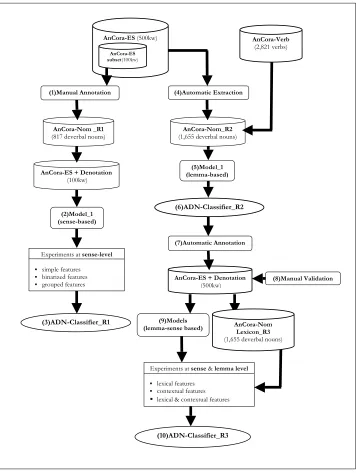
[image:8.486.52.410.163.636.2]The aim of the current workis twofold: first, to detect the most relevant features for the denotative distinction betweeneventandresultnominalizations; and, second, to build
Figure 1
an automatic classification system for deverbal nominalizations according to their de-notation. In Figure 1 the overall methodology for carrying out this workis schematized. In order to determine the most relevant features, the first step was to carry out a linguistic study of deverbal nominalizations (see Section 4). This study consisted of the application of the linguistic criteria stated in the literature to a reduced set of nominal-izations corresponding to the occurrences extracted from a 100,000 word (henceforth 100kw) subset of the AnCora-ES corpus. As an outcome, we manually obtained (see step 1 in Figure 1) a lexicon for this deverbal nominalization set, AnCora-Nom-R1 (Peris, Taul´e, and Rodr´ıguez 2009), which allowed us to annotate the corresponding deverbal occurrences in the corpus subset. The nominalization classifying model (see step 2 in Figure 1) underlying these two initial resources was tested by empirical methods. This first model of classification is based on sense distinctions—that is, the extraction of features was performed at sense level and the examples for learning (both positive and negative) corresponded to different senses in the lexicon; thus, we will refer to it as the sense-based model. We set up a series of experiments based on Machine Learning (ML) techniques in order to evaluate the consistency of the data annotated in AnCora-Nom-R1, to analyze the relevance of the attributes used in the lexical-semantic representation and to infer new useful features to distinguish betweeneventandresultnominalizations. As well as experimenting with AnCora-Nom-R1 simple features, we experimented with the binarization8 and grouping9 of several of them to address sparseness problems. Furthermore, with these experiments the foundations of the automatic classification system, the ADN-Classifier-R1, were laid (see step 3 in Figure 1). See Section 6 for a description of the ADN-Classifier.
Once the consistency of the annotated data was corroborated and the most relevant features were established, we focused on the building of the ADN-Classifier, the second goal of the research presented in this article. In order to develop the final version of the ADN-Classifier (R3) we increased the corpus data used for learning. Therefore, we needed to annotate the denotation types in the whole AnCora-ES. Because this involves an increase in the number of nominalization occurrences to annotate (23,431 occurrences in contrast to 3,077), we carried out this annotation automatically. To do so, we modified the (sense-based) model of classification underlying the ADN-Classifier-R1 (see step 2 in Figure 1) creating a new model able to carry out the more realistic taskof classifying the occurrences in the whole AnCora-ES corpus.
This new model (see step 5 in Figure 1) uses the following as knowledge resources: 1) the AnCora-Verb lexicon to obtain the features from the verbs related to nominaliza-tions; 2) the complete AnCora-ES corpus (500kw); and 3) AnCora-Nom-R2, an extended lexicon of nominalizations without denotation types obtained automatically (see step 4 in Figure 1). This lexicon contains a total of 1,655 lexical entries, corresponding to the 1,655 nominalization types in the whole AnCora-ES. Because we annotate the occur-rences in the AnCora-ES corpus, however, we reduce our dependence on the lexical source AnCora-Nom-R2 (see Section 5.3), removing the sense-specific information from it and taking into account only the information shared by all the senses of one lemma, while maintaining the features extracted from the corpus. In this sense, we adapted the sense-based model developed in ADN-Classifier-R1 (see step 2 in Figure 1) to obtain a new classification model that is based on lemmas (and not senses) (see step 5 in
8 Binarizing ak-value categorial feature means transforming it intokbinary features. 9 Combining several simple features into a complex feature using a combination (for instance,
Figure 1). This new model was used for the automatic annotation of the AnCora-ES corpus with denotation information (see step 7 in Figure 1). Afterwards, in order to evaluate the performance of the developed model, the corpus annotation was manually validated (Peris, Taul´e, and Rodr´ıguez 2010) (see step 8 in Figure 1). This manual process also guarantees the quality of the corpus annotation, leading to the final version of the AnCora-Nom lexicon (R3) containing denotation type information.
At that moment, we were able to build the final version of the ADN-Classifier (R3) (see step 10 in Figure 1). In order to do so, we set up a series of experiments leading to the development of new sense- and lemma-based models using the resources already built (AnCora-ES with denotation information and AnCora-Nom-R3), that is, models learned with more instances. We also replicated the experiments at sense and lemma level with the subset of 100kw from the already enriched AnCora-ES and the subset of 817 lexical entries from the AnCora-Nom-R3. Specifically, we carried out a set of new ML experiments using the simple and binarized features from the nominal and verbal lexicons as well as additional features obtained from the AnCora-ES corpus (the so-called contextual features). For the evaluation of the different sense- and lemma-based models derived from this set of experiments (see step 9 in Figure 1), tenfold cross-validation was used with the pre-created resources. These models give rise to the final version of the ADN-Classifier (R3) (see step 10 in Figure 1). See Section 6 for a description of the ADN-Classifier.
4. Previous Linguistic Study
The aim of the corpus-based linguistic study conducted was twofold. First, we wanted to determine which of the criteria stated in the literature were the most relevant linguis-tic features to establish the distinction betweeneventandresultdenotations in Spanish. Secondly, we wanted to find other features that could be used to reinforce the semantic distinction we are dealing with.
In order to do this, we selected a sample of 817 Spanish deverbal nominalizations corresponding to 3,077 occurrences. These nominalizations were obtained semiauto-matically from a 100kw subset of the AnCora-ES corpus. In this selection we took into account a predefined list of ten suffixes (-a, -aje, -i´on/-ci´on/-si´on/-´on, -da/-do, -dura/-ura, -e, -ido, -miento/-mento, -ncia/-nza, -o/-eo–[Santiago and Bustos 1999]) that contribute to an eventorresultmeaning and which take verbs as a basis for the derivation process.
This sample corresponds to the original 3LB corpus (Civit and Mart´ı 2004), that can be considered to be a preliminary version of AnCora-ES. The set of 817 nominalizations consists of those occurrences in this sub-corpus. Despite coming from different sources, the 100kw corpus and the full 500kw corpus are comparable as is shown in Table 1.
[image:10.486.48.433.610.665.2]In Table 1 we present some metrics for describing the whole AnCora-ES corpus and its 100kw subset. We present the metrics we have used in three rows: degree
Table 1
Descriptive content of AnCora-ES and its 100Kw subset. In each cell the values corresponding to the subset and the whole corpus are present.
Min Max Mean Standard Deviation
sense/lemma 1/1 13/13 2.19/1.86 1.54/1.31
examples/lemma 1/1 239/255 19.99/14.15 30.76/26.44
of polysemy (number of senses per lemma), the number of examples (sentences) per lemma in the corpus, and the average length of sentences per lemma. We depict the minimum and maximum values, the mean and the standard deviation for each metric. The values in the figure seem reasonable. The only anomalous figures correspond to the extremely high values of the standard deviation of the number of examples metric. It is due to the highly biased shape of the curve towards small values. In fact, most of the lemmas have only one example (121 for the 100kw sample) and the number of lemmas having values over the mean are very few. As can be seen in Table 1, there are no notable differences in the values corresponding to the whole set and the subset. Additionally we computed the ratio of lemmas containing only one example.
4.1 Analyzing Features from the Literature
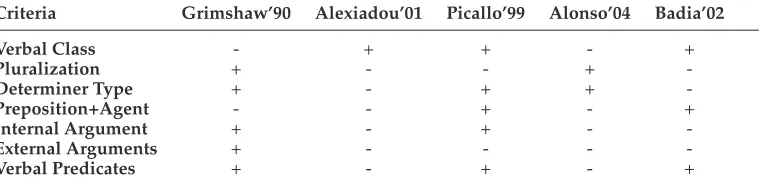
In order to determine which criteria stated in the literature were the most relevant, we selected seven criteria that satisfy two conditions: first, they are some of the most widely used by other authors, and second, it is possible to search for them in the AnCora-ES corpus without suffering data sparseness. These criteria and the authors who propose them are shown schematically in Table 2.
The seven criteria were analyzed by contrasting them with the behavior of the 817 Spanish deverbal nominalizations in the AnCora-ES corpus. Concretely, two graduate students in linguistics classified the 3,077 occurrences independently intoeventorresult class. After this first annotation, we discussed the results with them and reached an agreement in those cases in which the denotation type assigned was not the same. It should be noted that the aim of this analysis was to encourage reflection on the suit-ability of these seven criteria and on finding new clues to interpret the nominalizations semantically.
[image:11.486.57.439.570.663.2]During the classification procedure, we observed that these two denotations did not allow us to account for all the data in the corpus. On the one hand, it is not always possible to distinguish betweeneventandresult, because the linguistic context (the sentence) is not always informative enough. We label such cases underspecified types, resulting finally in three possible denotation values. On the other hand, we noticed that some nominalizations can take part in a lexicalized construction, thus, we added the attribute<lexicalized>. In such cases, we distinguish between six types of lexicalization according to their similarity to different word classes: nominal (e.g., s´ındrome de abstinencia, ‘withdrawal symptoms’), verbal (e.g.,estar de acuerdo, ‘to be in agreement’), adjectival (e.g.,al alza, ‘rising’), adverbial (e.g., con cuidado, ‘with care’), prepositional (e.g.,en busca de, ‘in search of’), and conjunctive (e.g., en la medida que,
Table 2
Linguistic criteria for distinguishing betweenresultandeventnominalizations from different
authors.
Criteria Grimshaw’90 Alexiadou’01 Picallo’99 Alonso’04 Badia’02
Verbal Class - + + - +
Pluralization + - - +
-Determiner Type + - + +
-Preposition+Agent - - + - +
Internal Argument + - + -
-External Arguments + - - -
‘as far as’). One of the three denotation values—event, result, underspecified—is assigned to the whole lexicalized construction only in the case of nominal lexicalizations. It is important to recognize such lexicalized cases because if the nominalization takes part in a lexicalized construction other than the nominal, it does not receive a denotation (a semantic distinction that is only associated with nouns).
The 3,077 occurrences were classified into 1,121 senses considering that different denotations associated with a lemma are different senses. Henceforth, we refer to them as nominalization senses. Among these 1,121 senses, 807 were annotated asresult(72%), 113 as event(10%), 131 asunderspecified(12%), and 70 as non-nominallexicalizednoun (6%). It is not surprising thatresultnominalizations are the most frequent becauseevents tend to be realized mostly by verbal clauses and nominalizations are more frequently used for theresult(non-dynamic) meaning, more typical of nouns.
The fact that AnCora-ES is annotated with different linguistic information levels allowed for the evaluation of the seven morphosyntactic and semantic criteria se-lected. Next, we briefly present each criterion, how they were applied, and the results obtained.10
4.1.1 Verbal Class.One of the most commonly used criterion to determine the denotation is the verbal class from which the nominalization is derived (Picallo 1999; Alexiadou 2001; Badia 2002). It is claimed that unergative and stative verbs give rise to result nominalizations, and unaccusative verbs usually result in ambiguous, or what we call underspecified, nominalizations. Regarding transitive verbs, they give rise to eitherevent, result, orunderspecifiednominalizations. To analyze this criterion, we set out from the semantic verbal classification proposed in AnCora-Verb. In this verbal lexicon, each predicate is associated with one or more semantic classes depending on the four basic types of events (Vendler 1967) (accomplishments which correspond to transitive verbs; achievements corresponding to unaccusative verbs; states corresponding to stative verbs; and activities corresponding to unergative verbs) and on the diathesis alterna-tions in which the verb can occur. We therefore looked up the verbal classes from which the 817 nominalizations are derived in AnCora-Verb. This allowed us to determine whether the claims about the relation between the nominalization denotation type and the corresponding verbal classes are valid.
In the sample analyzed, most of the nominal senses were classified as results (72%), thus, it should not surprise us that all the verbal classes have a wide per-centage ofresultnominalizations. The most significant result, however, is that stative and unergative verbs lead nearly exclusively to result nominalizations in Spanish, 97% and 100%, respectively. Regarding transitive and unaccusative verbs, they lead to event,result, orunderspecifiednominalizations. It is also interesting to remarkthatevent nominalizations derive mostly from transitive verbs (15%, in contrast to the 1% derived from achievement verbs) andunderspecifiednominalizations derive from unaccusative verbs (28%, in contrast to the 11% and 3% derived from transitive and state verbs, respectively), confirming the hypothesis stated by Picallo (1999), Alexiadou (2001), and Badia (2002).
4.1.2 Pluralization.According to Grimshaw (1990) and Alonso (2004), one of the features that clearly identifiesresultnominalizations is their pluralization capacity because it is
more usual to quantify objects thanevents. It is important to point out, however, that it is also possible to make aneventreading of a plural nominalization. For instance, in Example (11)bombardeos(‘shelling’) refers to multiple actions of bombing, therefore, it is open to aneventreading.
(11) Losbombardeos<event>de Sarajevo por parte del ej´ercito Bosnio.
‘Theshelling<event>of Sarajevo by the Bosnian army.’
This criterion was measured taking into account whether the 817 nominalizations appeared in the plural in some of their occurrences in the sample analyzed. The results obtained (98% of the nominalizations in the plural were classified as result and the remaining 2% asunderspecified) confirmed plurality as one of the features able to detect resultnominalizations. In contrast, the singular feature is not informative enough to discard any of the nominal denotations (69% of the nominalizations were classified as results, 15% asevents, and 16% asunderspecifiedtype). Therefore, in the sample analyzed alleventnominalizations and most of theunderspecifiednominalizations appeared only in the singular.
4.1.3 Determiner Types. Authors such as Grimshaw (1990), Picallo (1999), and Alonso (2004) claim thatevent nominalizations usually appear with definite articles whereas result nominalizations may be specified by all types of determiners. For instance, demonstrative determiners can only specifyresult nominalizations because this type of determiner is used to refer to an entity in a frame of reference. In order to evaluate this criterion we tookinto account the types of determiners combining with the nomi-nalization and also whether the noun appeared without a determiner.
Because most of the nominal senses were classified asresults (72%), it should not surprise us that all types of determiners have a wide percentage ofresult nominaliza-tions. A striking result observed in Table 3, however, is that indefinite articles (99%), demonstratives (100%), and quantifiers (100%) nearly always appear withresultsenses. In contrast, the definite article, the possessive, and the empty position can occur in all nominalization classes. Seventy-two percent of definite articles appear withresult, 13% withevent, and 15% withunderspecifiednominalizations; 82% of possessive determiners appear withresult, 10% withevents, and 8% withunderspecified nominalizations; and 88% of nominalizations without determiner are classified asresult, 5% asevents, and 7% asunderspecifiednominalizations. The data therefore partially confirm the hypotheses from the literature:Resultnominalizations appear with a wider range of determiners. Althougheventnominalizations are not always specified by a definite article, they can also appear with possessive determiners or without any determiner.
4.1.4 Preposition Introducing the Agent. In Spanish nominalizations derived from tran-sitive verbs are considered to beresults if the agentcomplement is introduced by the prepositionde(‘of’) andeventsif the preposition used ispor(‘by’) (Picallo 1999).11 We tookinto considerationagent complements introduced by prepositions appearing in the sample analyzed. As shown in Table 3, Prepositional Phrases (PPs) interpreted as agentsin the NPs analyzed are introduced by the following prepositions:de(‘of’),entre (‘between’),por(‘by’), andpor parte de(‘by’). We observed that the distribution of the four PPs is complementary between event and resultdenotations: The agent nominal
Table 3
Distribution of the denotation types according to the criteria evaluated.
Criteria Values Result (%) Event (%) Underspecified (%)
Verbal Class
Accomplishments 74 15 11
Achievements 71 1 28
States 97 – 3
Activities 100 – –
Pluralization Plural 98 – 2
Singular 69 15 16
Determiners
Definite 72 13 15
Indefinite 99 – 1
Demonstrative 100 – –
Possessive 82 10 8
Quantifier 100 – –
No Determiner 88 5 7
Preposition-Agent
de‘of’ 98 – 2
entre‘between’ 100 – –
por‘by’ – 100 –
por parte de‘by’ – 100 –
Internal argument
Possessive 41 38 21
PPs 53 25 22
Relative Pronoun 71 29 –
Relational Adjectives 97 – 3
External argument
por‘by’PPs – 100 –
Relational Adjectives 100 – –
Possessive 95 – 5
Predicates Attributive 75 6 18
Eventive 44 41 15
complement introduced by de or entre occurs with result nominalizations (98% and 100%, respectively) and the agentnominal complement introduced bypororpor parte de occurs with event nominalizations (100% both), corroborating the hypothesis put forward by Picallo (1999).
first two constituents appear in the three nominal denotation types: 41% of possessive determiners appear withresultnominalizations, 38% witheventsnominalizations, and 21% withunderspecifiednominalizations; and 53% of PPs complementresult, 25%events, and 22%underspecifiednominalizations. Relative pronouns only occur withevent(29%) andresult(71%) denotation types, and, finally relational adjectives occur nearly exclu-sively inresultnominalizations (97%). This last fact constitutes an identification feature forresultnominalizations, as Picallo states (see next criterion).
Table 3 shows the results obtained for each criterion.
4.1.6 External Arguments vs. Possessors. Grimshaw (1990) states that PPs introduced by the preposition ‘by’ (by-PPs), relational adjectives, and possessive determiners in English would be interpreted as external arguments (subjects) in the case of event nominalized NPs. These constituents, however, would be interpreted as possessors (that is, as non-argumental) in result nominalized NPs. Other authors, like Picallo (1999), nevertheless, claim that possessive determiners may be argumental inresultandevent nominalizations in Spanish. Regarding relational adjectives, Picallo argues that these constituents can only be arguments of result nominalizations. As seen, there is no consensus among authors; therefore, it seemed to us to be an interesting criterion to contrast. We observed whether these constituents (by-PPs, relational adjectives, and possessive determiners) were interpreted as external arguments in the nominalized NP sample. If this was so, we also analyzed whether the fact of being external arguments conditioned the denotation of the nominalization.12
The results obtained are very clear: PPs introduced by por (‘by’) with an agent interpretation only occur in NPs headed byeventnominalizations. Relational adjectives are interpreted as external arguments only in NPs headed byresultnominalizations. Possessive determiners with an agent interpretation are mostly (95%) constituents of NPs headed by resultnominalizations though they can also be constituents (5%) of NPs headed byunderspecifiednominalizations. Therefore, for Spanish, Grimshaw’s hy-pothesis is only partially corroborated because only by-PPs guarantee theevent read-ing. Regarding relational adjectives, Picallo’s thesis is confirmed, because this type of constituent mostly appears as an argument of result nominalizations. Moreover, we observed a preference for possessive determiners to be external arguments of result nominalizations, which is not stated in any of the theoretical proposals.
4.1.7 Verbal Predicates.The type of verbal predicate that can be combined with nominal-izations may be an indicator for determining the denotation (Grimshaw 1990; Picallo 1999; Badia 2002).Resultnominalizations tend to combine with attributive predicates, whereaseventnominalizations tend to be subjects of predicates such astener lugar(‘to take place’) orocurrir(‘to happen’) because these predicates tend to selectevent type subjects. In order to examine this criterion, we analyzed the types of predicates com-bined with the 817 nominalization types. We observed whether the predicates belong to theevent-denoting class (tener lugar, ‘to take place’;ocurrir, ‘to happen’; comenzar, ‘to begin’;acabar, ‘to finish’;durar, ‘to last’;llevar a cabo, ‘to carry out’) or if they were attributive predicates (ser, ‘to be’;estar, ‘to be’;parecer, ‘to seem’ ). Table 3 illustrates that
attributive predicates tend to chooseresultnominalizations (75%) as subjects whereas eventive predicates do not show a clear preference for any type of nominal: Forty-four percent of them combine withresult, 41% withevents, and 15% withunderspecified nominalizations. These results partially confirmed what is stated by these three authors: resultnominals combine preferentially with attributive predicates.
From the corpus-based study, we conclude that the semantic distinction between eventandresultnominalizations is not always as clear as is stated in the literature. The criteria proposed in the literature are well suited to constructed examples but when they are applied to naturally occurring data they do not workso well: Some of them cannot be applied and sometimes we found contradictory criteria in the same example. That said, it is important to point out that these criteria are not irrefutable proofs for making aneventor aresultreading, but rather indicators that can help us to strengthen our semantic intuition. In fact, we propose the third denotation typeunderspecifiedfor those cases in which semantic intuition is insufficient and the criteria for reinforcing one of the two main denotation types are not clear.
Regarding the criteria established in the literature, the main conclusion drawn is that not all the criteria analyzed seem to hold for Spanish. Among the evaluated criteria, those that appear to be most helpful for distinguishing betweeneventandresult nominalizations are: 1) the semantic class of the verb from which the noun is derived; 2) the pluralization capacity; 3) the determiner types; 4) the preposition introducing an agentive complement; and 5) the obligatory presence of an internal argument. These features are represented as attributes in the nominal lexical entries of the AnCora-Nom lexicon (see Section 5.3).
It is interesting to note that the number of criteria found that reinforceresult read-ings is significantly higher than the number of criteria found that strengthen event readings. In every criterion we find features that support the identification of result nominalizations but not event nominalizations. To supportresultnominalizations the following features were found: nominalizations deriving from unergative and stative verbs; nominalizations appearing in the plural; nominalizations specified by an indeter-minate article, a demonstrative, or quantifier determiner; nominalizations with anagent complement introduced byde(‘of’) orentre(‘between’); the nonrealization of the inter-nal argument; and nomiinter-nalizations having relatiointer-nal adjectives as arguments and the attributive predicate combined with them. In order to underpineventnominalizations, however, the only unambiguous criterion found was when the preposition introducing a PPagentcomplement ispor(‘by’) orpor parte de(‘by’).13 If we take into account that theagentcomplement is mostly optional in an NP configuration, it is very difficult to find a criterion within the NP context to supporteventnominalizations.
We believe that there are more features to supportresultnominalizations because they are closer to non-derived nouns and, like them, admit a wide variety of config-urations: plural inflection, different types of determiners, the possibility of appearing without complements, and so forth. In contrast,event nominalizations (since they are not typical nouns because they denote an action), like verbs, do not admit this variety of configurations: They rarely appear without complements, admit fewer types of deter-miners, and appear in the plural less frequently. Most of the configurations they admit are also admitted by resultnominalizations; this explains why there are more criteria to supportresultthaneventnominalizations.
In fact, the remaining criteria—the fact of deriving from transitive or unaccusative verbs; the nominalization being in the singular; the co-occurrence with a definite ar-ticle, a possessive determiner, or without any determiner; the presence of the internal argument; and the combination with typically eventive predicates—do not support any specific denotation. As a result, there are several cases where it is very difficult to assign a denotation, especially when the context is not clear enough, and therefore, we need to apply theunderspecifiedtag.
In the next section, we present other indicators found in the empirical study that provide us with clues for the differentiation betweeneventandresultnominalizations. These indicators are data-driven and we can only guarantee that they workfor Spanish.
4.2 Finding New Clues to SupportEventandResultDenotations
The analysis of 3,077 nominalization occurrences, focusing on the semantic distinction between those denoting anevent,result, or underspecifiedtype, has allowed us to find new clues that strengthen these readings, especially theeventreading.
One of the clearest clues for detecting theeventnominalizations is the possibility of paraphrasing the NP with a clausal structure, as we saw in Section 1, Examples (3)– (6). Another valuable clue is to checkwhether the nominalization admits an agent complement introduced bypor(‘by’) orpor parte de(‘by’). We use this criterion because it is the most informative one to supportevent nominalizations but it is also a very optional complement and is scarcely represented in the corpus. The annotators could use these two tests to decide the denotation type. Therefore, they had two extra criteria that the data did not provide.
Furthermore, we found other indicators that can help to select one denotation type, the so-calledselectors. We identified two types of selectors:
1. External selectors: Prepositions likedurante(‘during’), nouns likeproceso (‘process’), adjectives likeresultante(‘resulting’), verbs likeempezar (‘begin’), and adverbsen v´ıa de(‘on the way to’), which are elements that point to a specific denotation from outside the nominalized NP. For instance, in Example (12) the prepositiondurante(‘during’) gives a clue to interpretpresentaci´on(‘presentation’) as anevent.
2. Internal selectors: Prefixes within the nominalization that indicate a specific denotation type; for instance, a noun with the prefixre-with a reiterative meaning such asreubicaci´on(‘relocation’) in Example (13). This is due to the fact that the reiterative meaning only applies to bases that denote actions.
(12) Durante [lapresentaci ´on<event>del libro], ´el abog ´o por la formaci ´on de los investigadores en innovaci ´on tecnol ´ogica.
‘During [thepresentation<event>of the book], he advocated the training of researchers in technological innovation.’
(13) Hoy [lareubicaci ´on<event>del ex ministro] no resulta f ´acil.
‘Today, [therelocation<event>of the ex minister] does not seem easy.’
5. Knowledge Resources
This section presents the linguistic resources used in building the final version of the ADN-Classifier (R3). We briefly describe the AnCora-ES corpus and the AnCora-Verb lexicon, and we focus in more detail on the description of the AnCora-Nom lexicon from which we obtain most of the features for the building of the ADN-Classifier.
5.1 AnCora-ES Corpus
AnCora-ES is a 500,000 word (henceforth, 500kw) Spanish corpus14consisting of news-paper texts annotated at different linguistic levels: morphology (part of speech and lemmas), syntax (constituents and functions), semantics (verbal argument structure, thematic roles, semantic verb classes, named entities, and WordNet nominal senses), and pragmatics (coreference).15 The corpus contains 10,678 fully parsed sentences. As we explained in Section 3, nominalization occurrences (23,431) were automatically an-notated with denotation types using an intermediate model of classification (see step 5 in Figure 1). This automatic annotation was then manually validated by three graduate students in linguistics. These annotators were selected from a group of five, because they achieved an observed agreement of over 80%, corresponding to a kappa of 65% in an inter-annotator agreement test, whereas the average observed agreement was 75% corresponding to a 60% kappa. For the purpose of annotation, the three annotators took into account the semantic definition we provided, the criteria presented in Section 4.1, and the semantic tests described in Section 4.2. The inter-annotator agreement was carried out to ensure the consistency and quality of the AnCora-ES manual annotation.16 Therefore, the AnCora-ES corpus enriched with denotation type annotation is used for learning the different models of the ADN-Classifier-R3. From this resource we obtained two kinds of features:
(a) The corpus versions of the features from the lexicon (see Section 5.3): the type of determiner used in Section 4; the number (plural or singular) in which the nominalization occurrences appear; and the constituent type of the complements.
(b) The contextual features such as the tense and the semantic class of the verb that dominates the nominalization in the sentence; the syntactic function of the NP headed by a nominalization; and whether the noun appears in a named entity.
We use the Tgrep217tool for the feature extraction from the corpus; this allows us to efficiently inspect the syntactic trees in a Treebankformat.18
14 A similar version exists for Catalan, AnCora-CA.
15 AnCora-ES is the largest multilayer annotated corpus of Spanish freely available at:
http://clic.ub.edu/corpus/ancora.
16 For more details on the manual validation and the inter-annotator agreement test, see Peris, Taul´e, and Rodr´ıguez (2010).
17http://tedlab.mit.edu/ dr/TGrep2/. Tgrep2 is an improvement of Tgrep. Both tools are tree-based counterparts of the widely used string searching Unix Grep tool.
18 In the following linkthe set of tgrep rules as well as some implemented examples are available:
5.2 AnCora-Verb
AnCora-Verb-ES is a verbal lexicon that contains 2,830 Spanish verbs.19 In this lex-icon, each predicate is related to one or more semantic classes, depending on its senses, basically differentiated according to the four event classes—accomplishments, achievements, states, and activities (Vendler 1967; Dowty 1979)—and on the diathe-ses alternations in which a verb can occur (V ´azquez, Fern ´andez, and Mart´ı 2000). The semantic class of the verb base of the nominalization is used as a feature in the ADN-Classifier.
5.3 AnCora-Nom
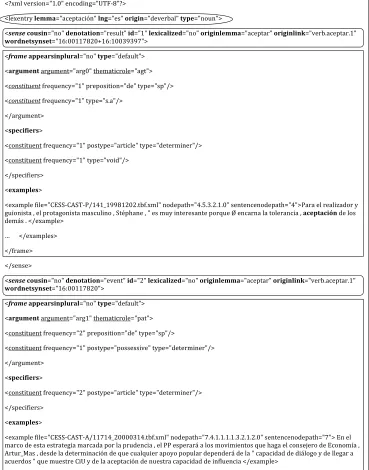
This section presents AnCora-Nom,20 a Spanish lexicon of deverbal nominalizations that has been iteratively used and improved as a result of the experiments reported here. At present, it contains 1,655 lexical entries corresponding to 3,094 senses and 3,204 frames. These lexical entries represent the lemmas corresponding to the 23,431 deverbal nominalization occurrences appearing in the annotated AnCora-ES corpus. For each of these lemmas we created a lexical entry using the information annotated in the corpus.21The features of each lexical entry are organized in three levels: lexical entry, sense, and frame level. The lexical entry attributes are not extracted from the corpus but added in order to document the lexical entry. Sense and frame attributes, in contrast, were extracted from the AnCora-ES corpus. Each lexical entry is organized in different senses, which were established taking into account the denotation type, the sense of the base verb, and whether or not the nominalization is part of a lexicalized construction. In turn, each sense can also contain one or more nominal frames, depending on the verbal frame from which the nominalization is derived. Next, we detail the attributes specified in the three levels described above. Figure 2 shows the full information associated with the lexical entryaceptaci´on(‘acceptance’).
5.3.1 Lexical Entry Level Attributes.These are as follows:
(a) Lemma. In Figure 2, the value for this attribute is the noun aceptaci´on (lemma=“aceptaci ´on”).
(b) The attributelanguage(“lng”) codifies the language represented in the lexical entry. AnCora resources workwith Spanish and Catalan, so the values of this attribute are “es” for Spanish (lng=“es”) and “ca” for Catalan (lng=“ca”). At present, AnCora-Nom only deals with Spanish nominalizations.
(c) The attributeoriginindicates the type of word from which the nouns are de-rived. In Figure 2, the value for this attribute is “deverbal”, meaning that this lexical entry concerns a noun derived from a verb. At present, AnCora-Nom only contains deverbal nouns but in the future it will include other types of nominalizations such as deadjectivals.
(d) The attributetyperefers to the word class, “noun” in Figure 2.
19 A similar version exists for Catalan, AnCora-Verb-CA.
20 We describe here AnCora-Nom-R3, the final version of the lexicon.
Figure 2
5.3.2 Sense Level Attributes.These include:
(e) The attributecousinmarks whether the nominalization is morphologically de-rived from a verb (cousin=“no”, in Figure 2) or is a cousin noun (cousin=“yes”). Cousin nouns (Meyers, Reeves, and Macleod 2004) are nouns that give rise to verbs (e.g.,relaci´on [‘relation’]>relacionar[‘to relate’]), or nouns semantically related to verbs (e.g.,escarnio [‘mockery’] is related tomofarse[‘to make fun’]).
(f) The denotationattribute indicates the semantic interpretation of the deverbal noun. The possible values are: “event,” “result,” and “underspecified.” In Figure 2, there are two senses, the first one beingresult(denotation=“result”) and the second oneevent (denotation=“event”).
(g) Each sense contains anidentifier(“id”) to indicate the sense number.
(h) Thelexicalized attribute indicates whether or not the nominalization is part of a lexicalized construction (idiomatic expression) (Figure 2: lexicalized=“no”). In the first case, two additional attributes are added: (i) the alternative-lemma, specifying the whole lexicalized construction of which the nominalization is part (for instance, alternative-lemma=“golpe de estado,” [‘coup d’etat’]), and (ii)lexicalization-type, to distinguish between the six types of lexicalizations: “nominal,” “verbal,” “adjectival,” “adverbial,” “prepositional,” or “conjunctive” (see Section 4). We should bear in mind that one of the three above-mentioned denotation values is assigned to the whole lexicalized construction only in the case of nominal lexicalizations. For instance, the lexicalized constructiongolpe de estadois a nominal lexicalization (lexicalization-type= “nominal”), and therefore, it has a denotation value (denotation=“result”).
(i) The attribute originlemma specifies the verb lemma from which the noun is derived. In Figure 2, the value for this attribute is “aceptar” in both senses (origin-lemma=“aceptar”).
(j) Because verbs can have different senses, the attributeoriginlinkindicates the concrete verbal sense of the base verb. In Figure 2, theoriginlinkattribute takes the same value in both senses: “verb.aceptar.1” (oringinlink=“verb.aceptar.1”).
(k) Because nouns in the AnCora corpus are annotated with WordNet synsets,22we incorporate this information in the attributewordnetsynset. In Figure 2, the first sense ofaceptaci´oncorresponds to two synsets (wordnetsynset=“16:00117820+16:10039397”), whereas the second only corresponds to one (wordnetsynset=“16:00117820”). It should be noted that senses in AnCora-Nom are coarser grained than in WordNet: a sense can group together more than one WordNet synset.
5.3.3 Frame Level Attributes.These are detailed as follows:
(l) The attributetypeindicates the verbal frame from which the nominalization is derived. In AnCora-Verb, each verbal sense can be realized in more than one frame: default, passive, anticausative, locative, and so forth. In the nominal entries, we mark the corresponding verbal frames, which are the possible values for this attribute. In most cases, its value is “default” as in Figure 2 (type=“default”). This feature is needed to lookfor the corresponding verbal semantic class in AnCora-Verb.
(m) Argument (Structure). In this complex attribute, the different arguments (argument) and the corresponding thematic roles (thematicrole) are specified. To represent the arguments we follow the same annotation scheme used in AnCora-Verb. For instance, in Figure 2, the event sense has one argument (“arg1”) with a patient thematic role (“pat”). This argument is realized twice (frequency=“2”) by a prepositional phrase (constituent type =“sp”) introduced by the preposition de (‘of’) (preposition=“de”) and once by a possessive determiner (type=“determiner,” postype=“possessive”).
(n) The attributereferencemodifier represents the nominal complements that are not arguments but which modify the reference of the nominalization. Frequency is also taken into account. Strictly speaking, this attribute does not fit perfectly at the frame level. We were interested in representing this information, however, and the most suitable level was the frame level because it allows for a seamless comparison of argumental and nonargumental nominal complements.
(o) The type of determiner has proved to be a useful criterion for distinguishing between result and event readings, so we include this information in the attribute specifier.23 The possible values are: “article,” “indefinite,” “demonstrative,” “exclama-tive,” “numeral,” “interroga“exclama-tive,” “possessive,” “ordinal,” and “void” when there is no determiner. In this attribute, we also take into account the frequency with which the determiners are realized. In Figure 2, theeventsense is specified twice (constituent frequency=“2”) by an article determiner (type=“determiner,” postype=“article”).
(p) The attribute appearsinplural indicates whether or not an occurrence of a nominalization in a particular frame appears in the plural. It is a boolean attribute. In Figure 2, neither of the senses appear in the plural, thus, the value is “no.”
(q) Finally, each lexical entry also contains all theexamplesfrom which the infor-mation has been extracted, specifying thecorpus file, thenode path, and thesentence in which each is located.
6. ADN-Classifier
As stated previously, our goals for building the ADN-Classifier were twofold: On the one hand, to have at our disposal a tool to help us to quantitatively evaluate the validity of our claims regarding deverbal nominalizations as discussed in Section 4; and, on the other hand, to provide a classification tool able to take advantage of all the available information in a specific scenario in the automatic classification of a deverbal noun. The aim of the taskis to classify a deverbal nominalization candidate in anevent,result, or underspecifieddenotation type, as well as to identify whether the nominalization takes part in a lexicalizedconstruction (idiomatic expression). Therefore, we model the task as a four-way classification problem. In order to achieve these goals, some functional requirements on the software to be built were necessary. Regarding the first goal, we required that a tool be able to:
1. Use all the properties discussed in Section 4 as features for classification.
2. Tune the features: binarization, grouping the possible values, generalization, combination of features, and computation of derived features.
3. Perform feature selection.
4. Facilitate the human interpretation of the model used by the classifier.
5. Analyze the accuracy of the individual features.
6. Use either senses or lemmas corresponding to deverbal nominalization candidates as units for classifying.
In order to achieve the first aim, the first version of the ADN-Classifier (R1) (Peris, Taul´e, and Rodr´ıguez 2009) was developed. This is the basis for the building of the intermediate and final versions of the ADN-Classifier. The final version is presented in detail next. Obviously, the second goal imposes heavier constraints on the design of the tool (the ADN-Classifier-R3). As is usual in other lexical classification tasks, such as Part Of Speech (POS) tagging or WSD, a word taken as an isolated unit is ambiguous but can be disambiguated, or at least partially disambiguated, if enough context is taken into account. An additional constraint is that the nominalization candidate has to be tagged as a noun. For our classification taskat least four processes are carried out: 1) tokenization; 2) segmentation at sentence level; 3) POS tagging; and 4) localization of a nominalization candidate by means of a set of regular expressions looking for verbal nominalization endings.24
In this setting, a case for classifying consists of a nominalization candidate using the POS-tagged sentence where it occurs as context, although this context is not always sufficient for disambiguation. Additional processes could be carried out on the nomi-nalization candidate and the sentence (WSD, chunking, full parsing, SRL, linking of the nominalization candidate with the origin verb, etc.). Each of these processes increases the number of possible features used for classifying but, because they are not error free, they could involve a decrement in the global accuracy of the preprocess step. Therefore, a careful examination of the processes, their accuracy, and the improvement of classification accuracy is needed. For instance, performing WSD on the nominal-ization candidate could allow for the use of sense-based features and, thus, a clear improvement in classification accuracy. The inconvenience is that the state-of-the-art accuracy rate of WSD is not very promising. In recent SemEval challenges, the accuracy rate in All-Words tasks is between 60% and 70% for a baseline of 51.4% using the first sense in WordNet, and 89% in Lexical-Sample tasks for a baseline of 78% (Chklovski and Mihalcea 2002; Decadt et al. 2004; Pradhan et al. 2007).25 These figures depend on the sense inventory used for disambiguation: The All-Words taskuses fine-grained senses (WordNet synsets) and the Lexical Sample taskuses more coarse-grained sense inventory (Ontonotes senses).
Therefore, we approach the problem of classification taking into account different feature sets which come from different knowledge resources, and we examine and evaluate the taskperformance when a decreasing number of knowledge resources are used. Depending on the available knowledge resources and natural language
24 We used 10 suffixes such as-ci´on(see Section 4).