MATLAB Simulation Model of Hybrid
Wind-Solar Energy System using MPPT Algorithm using
a Converter Topology
Dilip Kumar1, Prof. Vivek Kumar Koshta2
1
M. Tech. Scholar, 2Assistant Professor, Department of Electrical & Electronics Engineering, Corporate Institute of Science and Technology Bhopal
Abstract: The proposed framework presents control techniques of a matrix associated half and half age framework with adaptable power exchange. This half and half framework permits most extreme use of unreservedly accessible sustainable power sources like breeze and photovoltaic energies. For this, a versatile MPPT calculation alongside standard bothers and watches strategy will be utilized for the framework. Likewise, this arrangement enables the two sources to supply the heap independently or at the same time contingent upon the accessibility of the vitality sources. The turbine rotor speed is the fundamental determinant of mechanical yield from wind vitality and Solar cell working voltage on account of yield control from sun powered vitality. Lasting Magnet Synchronous Generator is combined with wind turbine for accomplishing wind vitality change framework.
Keywords: Fuel cell, Photovoltaic, Wind energy conversion, Wind Turbines, Z- source converter
I. INTRODUCTION
Late advancements and patterns in the electric power utilization demonstrate an expanding utilization of sustainable power source. For all intents and purposes all locales of the world have inexhaustible assets of some sort. By these perspective examinations on sustainable power sources concentrates increasingly more consideration. Sun based vitality and wind vitality are the two sustainable power sources most normal being used. Wind vitality has turned into the most affordable sustainable power source innovation in presence and has crested the enthusiasm of researchers and instructors over the world [1]. Photovoltaic cells convert the vitality from daylight into DC power. PVs offer included focal points over other sustainable power sources in that they emit no commotion and require for all intents and purposes no upkeep [2]. Hybridizing sun oriented and wind control sources give a reasonable type of intensity age.
II. MPPT ALGORITHM
On account of the lesser productivity of photovoltaic cluster a large portion of the vitality, affecting over exhibit gets squandered. The calculation known as greatest power point following might be useful to upgrade the execution of sun powered board. The MPPT calculation takes a shot at chief of Thevenin, concurring which the power yield of a circuit is greatest when impedance of circuit matches with the heap of impedance. So now we need to coordinate the impedance as opposed to following most extreme power point.
There are diverse procedures used to follow the greatest power point. Maybe a couple of the most well-known strategies are:
1) Perturb and observe (hill climbing method)
2) Incremental Conductance method
3) Fractional short circuit current
4) Fractional open circuit voltage
A. Perturb and observe
The P&O calculation and "slope climbing", the two names allude to a similar calculation relying upon how it is executed. The essential distinction between these two is that Hill-climbing includes a deviation of the obligation cycle of the power converter and in P&O nervousness on the working voltage of the DC connect between the PV exhibit and the power converter happens [3]. The deviation of obligation cycle of the power converter is the adjustments of the voltage of DC connect between the PV exhibit and the power converter alludes as Hill-climbing, so the two names allude to a similar method. What ought to be the following irritation is chosen by thinking about the indication of the last bother and the indication of the last augmentation in the power. The bother will stay a similar way in the event that control is augmented, and on the off chance that control is diminished, at that point next annoyance will be the other way. The procedure will be rehashed until the purpose of most extreme power will be come to. At that point the working point sways around the MPP.
B. Incremental conductance
The slope of the curve between power and voltage of PV module is the deciding factor in incremental conductance algorithm, if it is zero it shows point of MPP positive (negative) on the left of it and negative (positive) on the right.
1) ∆V/∆P = 0 at the MPP
2) ∆V/∆P > 0 on the left
3) ∆V/∆P < 0 on the right
The change of MPP voltage is identified by comparing the change of the power to increment of the voltage of current curve.
C. Fractional short circuit current
Fractional short circuit current method states that the ratio between array voltages at maximum power VMPP to its open circuit voltage VOC is nearly constant. VMPP ≈ k1 VOC
The constant K1 is having value between 0.71 to 0.78. Now the value of VMPP can be calculate by periodically measuring VOC. This method is simple and cheap to implement but its efficiency is relatively low due to the utilization of inaccurate values of the constant k1 in the computation of VMMP .
D. Photovoltaic cell
MATLAB Modelling
[image:3.612.180.428.302.474.2]Figure 1: MATLAB Model for PV System
Figure 2: Output Voltage of Maximum Power Point Tracking
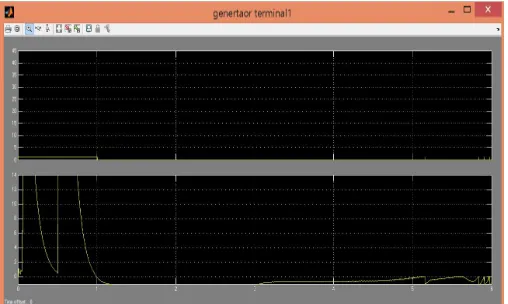
[image:3.612.181.428.503.711.2]Figure 4: Output Voltage of Wind Power
Figure 5: MATLAB Model for DC-DC Converter
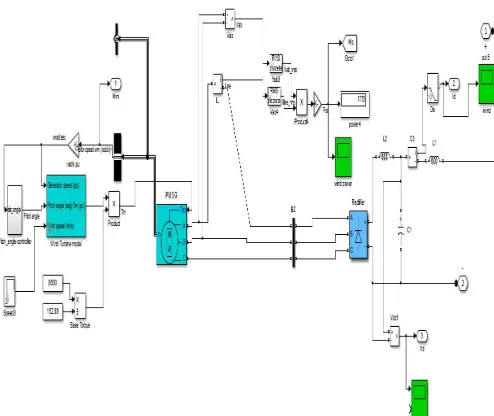
Figure 6: MATLAB Model for wind MPPT
[image:4.612.180.434.565.717.2]Figure 8: MATLAB Model for Battery and DC-DC Converter
III. SIMULATION MODEL
The proposed framework presents control procedures of a matrix associated half and half age framework with flexible power exchange. This half and half framework permits most extreme usage of openly accessible sustainable power sources like breeze and photovoltaic energies. For this, a versatile MPPT calculation alongside standard bothers and watches technique will be utilized for the framework. Likewise, this arrangement enables the two sources to supply the heap independently or all the while relying upon the accessibility of the vitality sources. The turbine rotor speed is the principle determinant of mechanical yield from wind vitality and Solar cell working voltage on account of yield control from sun based vitality. Changeless Magnet Synchronous Generator is combined with wind turbine for accomplishing wind vitality transformation framework.
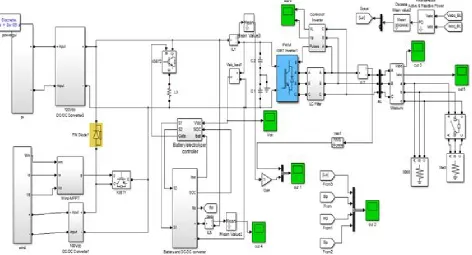
Figure 9: MATLAB Simulink Model of Hybrid Wind-Solar Energy System using MPPT Algorithm
[image:5.612.72.544.400.655.2]IV. CONCLUSION
REFRENCES
[1] Joanne Hui, Alireza Bakhshai, and Praveen K. Jain, “A Hybrid Wind-Solar Energy System: A New Rectifier Stage Topology,” IEEE Conference, February 2010.
[2] Trishan Esram, and Patrick L. Chapman, “Comparison of Photovoltaic Array Maximum Power Point Tracking Technique,” IEEE Trans. on energy conversion, vol. 22, no. 2, june 2007.
[3] [Cody A. Hill, Matthew Clayton Such, Dongmei Chen, Juan Gonzalez, and W.Mack Grady, “Battery Energy Storage for Enabling Integration of Distributed Solar Power Generation,” IEEE Transactions on smart grid, vol. 3, no. 2, June 2012.
[4] Hao Qian, Jianhui Zhang and Jih-Sheng Lai, “a grid-tie battery energy storage system,” IEEE Conference, June 2010.
[5] Sharad W. Mohod, and Mohan V. Aware, “Micro Wind Power Generator With Battery Energy Storage For Critical Load,” IEEE systems journal, vol. 6, no. 1, march 2012
[6] S.K. Kim, J.H Jeon, C.H. Cho, J.B. Ahn, and S.H. Kwon, “Dynamic Modeling and Control of a Grid-Connected Hybrid Generation System with Versatile Power Transfer,” IEEE Transactions on Industrial Electronics, vol. 55, pp. 1677-1688, April 2008.
[7] Nabil A, Ahmed and Masafumi Miyatake, “A Stand – Alone Hybrid Generation System Combining Solar Photovoltaic and Wind Turbine with Simple Maximum Power Point Tracking Control,” IEEE Conference, August 2006.
[8] S. Jain, and V. Agarwal, “An Integrated Hybrid Power Supply for Distributed Generation Applications Fed by Nonconventional Energy Sources,” IEEE Transactions on Energy Conversion, vol. 23, June 2008.
[9] Matthew Clayton Such, Cody Hill, “Battery Energy Storage and Wind Energy Integrated into the Smart Grid,” IEEE Conference, January 2012.
[10] Hao Qian, Jianhui Zhang, Jih-Sheng (Jason) Lai,Wensong Yu, “A High-Efficiency Grid-Tie Battery Energy Storage System,” IEEE transactions on power electronics, vol. 26, no. 3, march 2011
[11] Niraj Garimella and Nirmal-Kumar C. Nair, “Assessment of Battery Energy Storage Systems for Small-Scale Renewable Energy Integration,” IEEE Conference, January 2009.