Surface Modification of Mild Steel through
Microwave Cladding Process
Avinash Baghel1, Dr. VandhanaSomkuwar2
1
Department of Mechnical Engineering, National Institute of Technical Teachers’ Training and Research.
2
Department of Mechnical Engineering, Associate Professor, National Institute of Technical Teachers’ Training and Research.
Abstract: Cladding is by and large described by incomplete weakening of the substrate and henceforth development of metallurgical holding between the substrate and the stores. Laser cladding is a standout amongst the most broadly drilled surface building methods. The present work essentially centers around a novel advancement in surface building methods as microwave cladding. Clads of tungsten carbide (WC) constructed WC10Co2Ni powder in light of austenitic mellow steelwere delivered utilizing microwave half and half warming. Microwave clads were created by uncovering the preplaced, preheated powder for a length of 120 s to microwave radiation at 2.45 GHz recurrence and 900 W control in a home microwave framework. Portrayal of the clads was done as microstructural and essential sythesis examines. Examinations demonstrate break free interface uncovering great metallurgical security related with fractional weakening of the mellow steelsubstrate and full softening of WC particles. Run of the mill X-beam diffraction results affirm nearness of metallic carbides in the clad which is fundamentally in charge of altogether higher microhardness of the clad. Process instrument has been talked about
Keywords: Cladding, Microwave Cladding etc
I. INTRODUCTION
Materials nowadays need more than one property such as high hardness and ductility. Different properties however are often required in different areas of the products. Wear and corrosion resistance are the important properties which are only required at the surfaces of products for instance. Surfaces of materials are always in contact with their surroundings, various conditions of surrounding leads to degradation of the surface due to wear, erosion and corrosion.
Surface modification aims at reducing such surface degradation. Surface modification can be done by the application of a coating, by using chemical vapour deposition, plasma spraying and strip cladding. Surface modification techniques can be applied to all kinds of products to increase performance, reduce costs, and modify the surface properties independent of the bulk material. This enables the realization of products with improved functionality, at reduced use of scarce and expensive materials Surface modification is the act of modifying the surface of a material by bringing physical, chemical or biological characteristics different from the ones originally found on the surface of a material. It involves altering the properties of the Surface Phase in order to reduce the degradation over time. This is accomplished by making the surface robust to the environment in which it will be used.
This modification is usually made to solid materials, but it is possible to find examples of the modification to the surface of specific liquids.
Surface modification can be done by various processes which include:
A. Welding
B. Electrode deposition
C. Coating
D. Microwave cladding
1) Wear of Material: I Wear is commonly defined as the undesirable deterioration of a component by the removal of material from its surface. It occurs by displacement and detachment of particles from surface. The mechanical properties of steel are sharply reduced due to wear. The wear of material may be due to the friction of metals against each other, eroding effect of liquid and gaseous media, scratching of solid particles from the surface and other surface phenomena. In laboratory tests, wear are usually determined by weight loss in a material and wear resistance is characterized by the loss in weight per unit area per unit time. There are following principle types of wear as described below.
presence of abrasive particles in between, either from the environment or from an accumulation of wear particles. It occurs at a faster rate, and produces a relatively rough wear surface.
b) Adhesive Wear Or Metal To Metal Wear: Adhesive wear is a very serious form of wear characterized by high wear rates and a large unstable friction coefficient. Sliding contact can rapidly destroyed by such wear. Scuffing areas, holes & plastic shearing occurs in this wear.
c) Erosive Wear: It occurs due to relative movement between metal and liquid or gas. The impacting particles remove material from the surface due impact and repeated deformations and cutting action.
d) Corrosive Wear: It occurs due to surrounding medium’s effect on the material. It is metal degradation process. In the presence of oxygen such wear is called as oxidative wear. Such wear affects the material when there is excessive generation and removal of corrosive layer.
e) Fatigue Wear: Contacts between asperities with very high local stress are repeated a large number of times during sliding or rolling, with or without lubrication. High plastic deformation causes crack initiation, crack growth, and fracture. Cracks, pitting is general form of this wear.
II. LITERATURE REVIEW
microwave clads and gentle steel substrate were checked and the subsequent wear was thusly examined as far as wear rate, pressure– velocity– time (p-v-t) attributes, and contact coefficient. the well used surfaces of the wc-12co microwave clad and aisi 304 substrate were considered utilizing checking electron magnifying lens. wear flotsam and jetsam was dissected utilizing filtering electron microscopy and vitality dispersive x-beam spectroscopy. the created clads show critical protection from wear inferable from the microwave-incited thick microstructure and material properties. the wear rate and erosion coefficient were lessened by 67 and 56%, separately for wc-12co microwave clad contrasted with that of the aisi 304 substrate. Sharma(2014) et al.[5] The application encompass of barometrical plasma showered earthenware composites can be enlarged significantly by lessening/taking out innate surface imperfections by treating them through systems like microwave light. in microwave handling, microwave vitality is straightforwardly connected to the material. high-recurrence microwaves (> 1 ghz more often than not) enter into the main part of the material and the volumetric association of the electromagnetic fields with the material outcomes in dielectric (volumetric) warming. Hebbale(2017) et al.[6] The present work manages microstructure and slurry erosive wear investigations of cobalt based clad created through microwave vitality at a recurrence of 2.45 GHz. The checking electron magnifying instrument (SEM) and vitality dispersive X-beam spectroscopy (EDS) investigation result uncovers the nearness of cobalt and chromium rich strong arrangement in the intercellular substances. The Taguchi symmetrical exhibit was utilized to measure the components influencing the wear fundamentally. The impact of different factors, for example, speed, molecule size and impingement point on wear conduct was evaluatedby Means and ANOVA (investigation of difference). It was seen that the slurry speed essentially affected the more mass misfortune on unclad substrate. The wear component of the ragged surface was considered through a checking electronic magnifying lens. It demonstrates the blended method of disintegration through microcutting, furrowing, and cracks showed up are significant wear components. Gupta(2012) et al.[7]Evaluated distinctive morphologies of fired topcoat utilizing double laser frameworks and polymers to create porosity. Dysprosia settled zirconia was likewise incorporated into the examination alongside the best in class yttria balanced out zirocnia(YSZ). High virtue powders were utilized. Microstructure was evaluated by checking electron magnifying instrument and an in-house created picture investigation routine to describe porosity content. Laser streak procedure is utilized to gauge warm conductivity. Thermo-cyclic exhaustion testing was utilized to gauge lifetime. Limited component investigation was utilized to break down thermo-mechanical material conduct and to plan the morphology of covering. The outcomes demonstrated that huge globular pores and associated breaks acquired inside covering microstructure bring about covering with best execution. Likewise a covering with lower warm conductivity has double the lifetime contrasted with modern measures today.
III. CLADDING: A OVERIVIEW
Cladding, in general, is a widely used surface engineering technique to develop an overlay of suitable materials on substrates of desired properties by partial melting of substrate along with complete melting of the clad material.
Cladding is a process of covering one material over another. Cladding supplies a combination of desired properties such combination of properties is not possible by using a single material. A base metal can be selected for cost or structural properties, and another metal added for surface protection or some special property such as erosion resistant.
The clad developed through conventional process contain semi molten powder particles owing to which microstructural defects like porosity and cracks are comparatively more, due to this cracks the bonding strength of clad developed through conventional process is not high. Laser cladding is among one of the most widely used surfacing techniques, The laser processing has some limitations such as high distortion, porosity and interface cracking apart from these associated limitations in laser cladding process, resulting surface has non uniform microstructure owing to which clad shows anisotropy in mechanical properties. To develop surface properties of a target material a potential cladding technique has recently been explored which is Microwave cladding process method. It was claimed that the novel process possesses high potential to emerge as one of the pragmatic surfacing solutions. Reasonably higher speeds and higher degree of processing uniformity are one of the significant features of this process. The volumetric nature of heating and reverse thermal gradient is the major significance of the process owing to which the clad produced through microwave heating exhibit significantly lesser thermal distortion, and are nearly free from solidification cracks and pores. The properties achieved by microwave processing are superior to conventional processing method and it is done by domestic multimode applicator with 2.45GHzfrequency at 900W power.
environment. It is thus possible to apply surface treatment selectively to the surface of interest of a component while without compromising on other requirements of the bulk material, for example, strength and corrosion resistance of austenitic stainless steels.
Cladding is one of the most commonly used pragmatic surface treatment methods in which the properties of the target surface are changed by applying a layer of material having desired properties. Studies show that hard materials, If cladded on a soft substrate surface can effectively prevent ploughing on the rubbing surface and hence reduce wear.
Few examples of materials in which cladding are done to reduce wear is shown in figure1.1.
Figure1.1: Few examples of cladding
A. Types Of Cladding Process
There are various methods for cladding, which include
1) Shielded metal arc (SMA)
2) Metal inert gas (MIG)
3) Submerged arc (SA)
4) Tungsten inert gas (TIG)
5) High velocity oxyfuel (HVOF)
6) Laser cladding
Most of these techniques are well studied in terms of academic research and technological developments. Laser cladding, on the other hand, has been one of the most popular surfacing techniques among the widely practiced anti-wear industrial solutions. Its popularity is basically attributed to better control over dilution level as well as higher cooling rate. Faster cooling associated with laser cladding enables one to develop fine microstructure. In spite of these, laser cladding has however, some limitations including development of high thermal stress that causes clad cracking during processing and thermal distortion. Moreover, laser processing is not a very cost effective technique for cladding. Thus, it is important to investigate new processing technique(s) having potential to overcome the limitations of laser cladding while producing improved microstructures and properties
In the recent years, microwave processing of materials has emerged as one of the fastest material processing techniques. Microwave processing of materials is different from the conventional processing methods. Microwave energy heats the material at the molecular level, which leads to uniform bulk heating, while in the conventional heating systems the material gets heated from the surface to the interior with higher thermal gradient which may result in poor microstructure. Microwave heating is well characterized by the volumetric heating which reduces the possibility of developing cracks, porosity, residual stresses and thermal distortion on the target material while compared to other thermal processes.
Most of the works carried out in microwave processing is confined to the domains of sintering and joining of ceramics and ceramic composites. This is due to the fact that ceramics and ceramic composites are good absorbers of microwave radiations at elevated temperature at allowable frequencies. Therefore, microwaves couple with such materials at a faster rate. Thus, ceramics and ceramic composites can be processed at a relatively shorter time using microwaves than other conventional processing methods. Further, on many occasions, the properties achieved by microwave processing are superior to those obtained by conventional processing. Application of microwave energy in metallic material processing, however, is challenging at the 2.45 GHz frequency which is commonly used for material processing. The problems associated with microwave heating of metals arise basically due to two factors —
a) Microwave absorption coefficient for metals at 2.45 GHz radiation is very low at room temperature and
A unique characteristic of microwave heating is inverse thermal gradient in which heat flows from interior (core) to the surface of the target material body which may lead to poor microstructure at the surface. The problem can be resolved to a large extent using hybrid
heating technique, where the resultant temperature profile will be almost uniform from the surface to the material interior and it is possible to obtain unidirectional microstructure. Thus, microwave hybrid heating (MHH) technique becomes popular in which combination of conventional as well as microwave heating is used to get advantage of both the processes. In the present work, the MHH technique was employed to develop cladding of Ni based powder on austenitic mild steelsubstrate using a multimode microwave oven.
IV. MICROWAVE CLADDING PROCESS:
Microwave hybrid heating (MHH) is used to melt the preplaced powder. In MHH, both conventional as well as microwave heating modes are active to get the effective heating of the target. In this process, usually, a highly microwave absorbing material (susceptor) issued to absorb microwave initially to get heated. Consequently, the low microwave absorbing material (like metals, in fact, bulk metals reflect microwave at room temperature) gets heated up through
conventional modes of heat transfer from the susceptor beyond a threshold temperature, where it starts absorbing microwave radiations. Powder is placed manually on the substrate by maintaining an approximately uniform thickness. The experiment is conducted in domestic microwave oven with the help of Al2O3 shield (specimen enclosures) in order to avoid reflection of
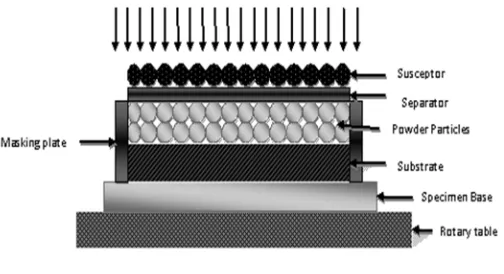
microwaves with metal. The powder approximately 2 mm thick layer is uniformly sprayed over substrate material. The developed clad thickness is maintained by the exposure of microwave radiation at frequency 2.45 GHz. The entire setup should be exposed to microwave environment for about 900s.The preplaced powder is melted by Microwave hybrid heating. In MHH, both conventional as well as microwave heating modes are active to get the effective heating of the target. In this process, usually, susceptor is used to absorb microwaves. In order to avoid possible contamination of the clad by the susceptor (charcoal powder) used in the MHH, a pure thin graphite sheet should be used as a separator between the susceptor and the powder as shown in Fig. experimental trials is conducted by maintaining a constant power of 900W and a constant thickness of preplaced powder layer is exposed with alternating time from 900 s to 1080 s in a step of 150 s. It is noted that the cladding process method majorly depends on the microwave exposure time. Accordingly, the lesser the exposure time there is better melting of the powder particles but poor bonding with substrate and it is also observed that the exposure time for 1080 s. Cladding with good metallurgical bonding is obtained with exposure time of 1080 s maintained throughout the cladding process.
Microwave consist of following parts
1) Domestic micro oven
2) Refractory Insulating Box
3) Alumina base plate
4) Substrate
5) Susceptor
V. MATERIALS USED IN EXPERIMENTATION:
For experimentation, AISI304 is used as a bulk material. For cladding purpose Cobalt, Cerium oxide & Tungsten carbide are used. All these materials are discussed below:
1) Mild Steel: It is most commonly used grade of steel used from many years. This is widely used mainly for indoor applications. AISI304 is austenitic mild steel formulated for primary forming into wrought products.304 is the AISI designation for this material. Its chemical designation is X5CrNi18-10.
Table1.1: Properties of mild steel Material property value
Young’s modulus 200GPa density 7890kg/m3 Poisons ratio 0.28
Fatigue strength 210 to 440MPa Yield tensile strength 230 to 860MPa Ultimate tensile strength 580 to 1180MPa Specific heat capacity 480J/kgk Thermal conductivity 15W/mk Melting temperature 14500C Thermal expansion 17×10-6
2) Cerium oxide: Cerium oxide, also known as ceric oxide, ceric dioxide, ceria, cerium oxide or cerium dioxide, is an oxide of the rare-earth metal cerium. It is a pale yellow-white powder with the chemical formula CeO2. It is an important commercial
product and an intermediate in the purification of the element from the ores. The distinctive property of this material is its reversible conversion to a nonstoichiometric oxide. This powder is mainly used for Chemical mechanical polishing/planarization. It is a process of smoothing surfaces with the combination of chemical and mechanical forces. It can be thought of as a hybrid of chemical etching and free abrasive polishing.
Table1.2: properties of cerium oxide powder Material property value
Chemical formula CeO2
Appearance White or pale yellow solid Density 7215Kg/m3
Melting point 2400 0C Boiling point 3500 0C Solubility in water insoluble
3) Nickel: On the basis of literature survey, it is observed that adding nickel as a cladding material in microwave cladding reduces visible interfacial cracks and porosity to a sustainable level.
4) Tungsten Carbide: on the basis of literature survey, tungstencarbide improves wear resistance.Wear resistance of coating is mainly affected by amount of powder, size, chemistry/ microstructure, morphology and degradation degree of the tungsten carbides as well as by the metal matrix selected. Other characterstics are discussed in later chapters.
VI. OBJECTIVES
The objectives of the present work include
A. To study various materials available and their effect on material if used to clad AISI304.
B. To improve the properties of material by cladding a ……. Material on AISI304 using microwave cladding.
VII. METHODOLOGY
AISI304 grade steel was used to prepare the substrate and for this cuboids were cut from AISI304 steel, than finally finished with the help emery paper of grit...Each sample is of ....mm× ....mm× ....mm in size. For SEM test sample size 15mm×15mm×5mm were prepared from rectangular sheet purchased from Nextgen steel & alloys Mumbai.
Figure 3.1: (a) Substrate (b) Cladded specimen Table3.1: samples Dimensions of the
A. Coating Powder
For Investigation Ni based powder particle size of 40 µm used and it was farther modified by tungsten carbide particle size of 45 µm 0 wt%, 12wt%. Finally four different combinations as specified in Table3.2 were used for experiments. . These powders were purchased from MECL, Jodhpur.
Table3.2: composition of coating powder used for cladding Compostition sr. number Nickel
(in wt %)
Tungstencarbide (in wt %)
Ceriumoxide (in wt %)
1 88 12 0
2 87 12 1
3 85 12 3
4 83 12 5
B. Development Of Cladding
Domestic microwave made LG having frequency 2.45 GHz at 900 W was used to deposit cladding on MS substrate. Skin depth plays important role to developed the microwave cladding and it was found that the microwave radiation cannot react with target substrate at normal temperature, because some material like metal direct reflected the microwave radiation it is direct related to skin depth. Skin depth can be increases by increasing the initial temperature up to critical temperature so in order to achieve this temperature microwave hybrid heating is apply in this work. WC having higher skin depth than Ni but depth of WC an Ni is expressively less for powder having particles size 40 micron or less.
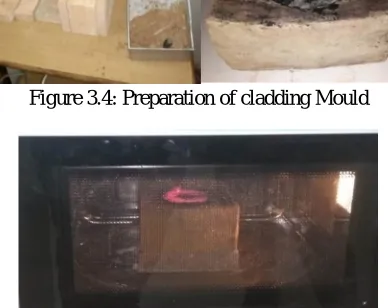
[image:7.612.182.434.569.706.2]To overcome this problem microwave hybrid heating is used with susceptor (Charcoal) which absorbs microwave radiation at normal temperature and get heated very fast manner so temperature reached at critical temperature and graphite plate was used as a separator to separate the charcoal and metal powder. Heat transfer takes place with the help convection and radiation mode initially temperature of upper layer of powder is higher than the layer which is lies below but after some time temperature of all layer becomes equal and metal powder starts defaced to each other finally temperature reaches the melding point of subtract and metal powder defused to subtract at this stage. Refractory brick was used to avoid direct contact to the incident radiation of microwave. Before cladding powder was dried on muffle furnace at 200° C to remove moisture, volatile element, 2 mm powder thickness layer maintain through all the experiment on the substrate. Than thin graphite plate was put on the powder than charcoal was put on the graphite plate. This arrangement puts inside the rectangular refractory bricks box.
Figure 3.4: Preparation of cladding Mould
Figure 3.4: Microwave Experimental setup showing cladding process
Figure 3.5: Cladded/ Coated samples (a) NI-0 WC (b) Ni-12 WC ( C) Ni-24 Table 3.2: Process parameters used for development of microwave composite cladding. Parameters Description
Applicator Multimode Maker: LG, Model: Charcoal Exposure power and Frequency 900 W and 2.45 GHz Exposure time 18 minutes
Powder Ni-0WC, Ni-12WC and Ni-25WC Preheating powder temperature 200° C
Separator 99.1% pure graphite sheet Susceptor Charcoal powder
C. SEM Test
In order to study the microstructure of cladded sample SEM test was carried out at UGC –DAE CSR Indore by using JEOLJSM-6380A analytical Scanning Electron Microscope.
Figure 3.6: JEOLJSM-6380A SEM Instrument
D. Hardness Testing
[image:9.612.138.473.442.620.2]Micro hardness: the hardness of coating and M.S. sample measured at applied load of 50 g for 30 sec. by vicker’s hardness test. Average five reading was taken at different place of cross section of coated surface.
Figure 3.7: Hardness Tester Instrument
E. XRD Test
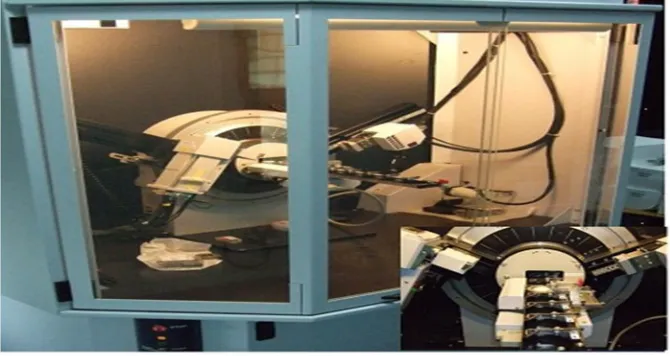
XRD test was conducted on UGC –DAE CSR, Indore on Bruker D8 Progressed XRD machine by using Cu-K? X-beam source. The model example holder of the diffractometer is a 9 test changer, making it conceivable to measure up to 9 tests in of planning. The diffractometer utilize a 1-D location touchy indicator (Lynx Eye) in light of silicon float identifier method which decreases the estimation time essentially without a lessening in the diffracted power. The most intense worldwide check rate took care of by this indicator is 108 cps. Thin film and in addition powder (or pellet) tests can be estimated utilizing this XRD machine.
Figure3.8: Bruker Advance XRD
F. Abrasive Wear Test
Abrasive wear study of unmodified and modified microwave clads was performed using pin on disc wear testing machine. Wear pins of size of diameter 12 mm were held against the disk having silicon carbide abrasive papers. The track diameter of the wear pins is 60mm weighing all samples prior to and after the wear test on an electronic weighing balance of accuracy 0.001 gm.Coated
Abrasive paper was post on rounded disc diameter 165mm and thickness 6 mm, after 250 m sliding distance abrasive paper was changed to maintain proper contact between specimen and abrasive medium. Acetone was used to clean the specimen before and after the each test. Coefficient of friction was recorded continuously for each test. Electronic balance of 0.001 accuracy was used to measure the wear loss and sample was cleaned properly to avoid foreign particles by acetone before and after of each test.
Figure3.9: Wear Tester Machine
REFERENCES
[1] Y.C. Lin, S.W. Wang, Wear behavior of ceramic powder cladding on an S50C steel surface, Tribol. Int. 36 (1) (2003) 1–9.
[2] S.W. Huang, M. Samandi, M. Brandt, Abrasive wear performance and microstructure of laser clad WC/Ni layers, Wear 256 (2004) 1095–1105.
[3] S. Zhou, X. Zeng, Q. Hu, Y. Huang, Analysis of crack behavior for Ni-based WC composite coatings by laser cladding and crack-free realization, Appl. Surf. Sci. 255 (2008) 1646–1653.
[4] A.K. Sharma, D. Gupta, A method of cladding/coating of metallic and non-metallic powders on metallic substrates by microwave irradiation, Indian 527/Del/2010.
[5] D. Gupta, A.K. Sharma, Development and microstructural characterization of microwave cladding on austenitic stainless steel, Surf. Coat. Technol. 205 (2011) 5147–5155.
[6] D. Gupta, A.K. Sharma, Investigation on sliding wear performance of WC10Co2Ni cladding developed through microwave irradiation, Wear 271 (9–10) (2011) 1642–1650.
[7] E.T. Thostenson, T.W. Chou, Microwave processing: fundamentals and applications, A 30 (1999) 1055–1071.