
Abstract — This investigation offers a synthesizing thermodynamic approach to modeling, simulation and power maximization in various energy converters, such as thermal, solar and chemical engines and fuel cells. Thermodynamic analyses lead to efficiencies in terms of propelling fluxes. Efficiency equations are applied to determine maxima of power integrals (work) in dynamical systems, which work with upgrading and downgrading of a resource medium. While optimization of static systems requires using of differential calculus and Lagrange multipliers, dynamic optimization involves variational calculus and dynamic programming. In reacting mixtures balances of mass and energy are applied to derive power yield in terms of an active part of chemical affinity. Power maximization approach is also applied for fuel cells. Maximum power data provide power limits for SOFC energy generators.
Index Terms — engines, power bounds, thermodynamics, efficiency, fuel cells.
I. INTRODUCTION
HIS research is a treatment in thermodynamic optimization, i.e. optimization which applies thermodynamic constraints and thermodynamic performance criteria. Thermodynamic synthesis, presented here, stands for combining various partial optimization models into a “synthesizing” model from which the performance of all the component units can be predicted.
Linguistically, synthesis is a combination of separate things, units, ideas, etc., into a complete whole. It also may be something as a substance or an idea, made by combining various parts. Definitions of synthesizing approaches may vary. For example, in the system’s theory, when a system’s performance is evaluated by combining separate observations, synthesis means the structure prediction following from the performance observations. The literature of synthesizing approaches is quite limited. Syntheses are usually achieved after sufficiently long research time, when separate components, models or concepts are well understood individually.
An attempt to synthesize thermal power systems propelled by heat and mass transfer is presented in our papers [1, 2],
Manuscript received October 5, 2011; revised March 22, 2012. This research was performed in the context of a grant NN208 019434 from the Polish Ministry of Science, and a grant 2011/01/B/ST8/06821from the National Centre of Science (grants Thermodynamics and Optimization of Chemical and Electrochemical Energy Generators with Applications to Fuel Cells, and Synthesis of Thermodynamic Generaction of Power and Heat in Fuel Cells and Flow Energy Systems.) S. Sieniutycz is with the Faculty of Chemical and Process Engineering at Warsaw TU, 1
whereas a summary of related computational aspects is given in [3]. Radiation engines are included [4-8]. In the present paper generalized models are applied, which involve imperfect fuel cells.
The present paper offers a thermodynamic approach to modeling and power optimization in diverse energy converters, such like thermal, solar and chemical engines. Its novelty lies not in detailed data of power yield but in its synthesizing mathematical formalism or a common thermodynamic model applicable to the thermal, radiative, chemical, and electrochemical power generators. The inclusion of imperfect fuel cells into the model, while quite simple, is beneficial to the FC works. Yet, the approach limitation manifests whenever the FC topology differs significantly from that of thermal or chemical system.
Thermodynamic principles lead to converter’s efficiency and limiting generated power. A power limit is an upper (lower) bound on power produced (consumed) in the system. Efficiency equations serve to solve problems of upgrading and downgrading of a resource medium. Real work yield is a cumulative effect obtained in a system of a resource fluid, engines, and an infinite bath. While optimization of steady systems requires using of differential calculus and Lagrange multipliers, dynamic optimization involves variational calculus and dynamic programming [9]. The primary result of the static optimization is the limiting value of power, whereas that of the dynamic optimization is a finite-rate counterpart of the classical potential of reversible work (exergy; [10]). The generalized potential depends on thermal coordinates and a dissipation index, h, i.e. the Hamiltonian of the related problem of minimum entropy production. This generalized potential implies stronger bounds on work delivered or supplied than the reversible work potential. In reacting systems [11, 12] the chemical affinity constitutes a prevailing component of the efficiency vector. Therefore, in reacting mixtures flux balances are applied to derive power yield in terms of an active part of chemical affinity. As the present paper shows, power maximization approach can also be applied for fuel cells (FC) treated as flow engines driven by fluxes of chemical reagents and electrochemical mechanism of current generation [13]. The analysis [13] tests the effect of typical design and operating parameters on the cell performance. The FC theory combines the formalism worked out for chemical machines with the Faraday’s law which determines the intensity of the electric current generation. Steady-state model of a high-temperature SOFC is considered, which refers to constant chemical potentials of
Warynskiego Street, Warszawa, 00645 Poland (phone: 00-48228256340; fax: 00-48228251440; e-mail: sieniutycz@ ichip.pw.edu.pl)..
Synthesizing Models of Power Yield in
Thermo-Electro-Chemical Systems
S. Sieniutycz
incoming hydrogen fuel and oxidant.
Dynamical limits may also be linked with use of resources in energy systems. They refer to situations when fluids are restricted in their amount or magnitude of flow, and, as such, play role of resources. A power limit is an upper (lower) bound on power produced (consumed) in the system. A resource is a valuable substance or energy used in a process; its value can be quantified by specifying its exergy, a maximum work delivered when the resource relaxes to the equilibrium. Reversible relaxation yields the classical exergy; in a dissipative relaxation generalized exergies arise, which quantify deviations of the system’s efficiencies from the perfect efficiencies.
The size limitation of our paper does not allow for inclusion of all derivations to make the paper self-contained, thus the reader may need to turn to some previous works, [1] - [5] and [11,12].
II. LIMITED RESOURCES AND POWER OPTIMIZATION
Limited amount or flow of a resource working in an engine causes a decrease of the resource potential in time (chronological or spatial). This is why studies of the resource downgrading apply the dynamical optimization methods. From the optimization viewpoint, dynamical process is every one with sequence of states, developing either in chronological time or in (spatial) holdup time. The first group refers to unsteady processes in non-stationary systems, the second group may involve steady state systems. In a process of energy production two resting reservoirs do interact through an energy generator (engine). In this process power flow is steady only when two reservoirs are infinite. When one, say, upper, reservoir is finite, its thermal potential must decrease in time, which is the consequence of the energy balance. Any finite reservoir is thus a resource reservoir. It is the resource property that leads to the dynamical behavior of the fluid and its relaxation to the equilibrium with an infinite lower reservoir (usually the environment). Alternatively, fluid at a steady flow can replace resting upper reservoir.
III. STEADY STATE THERMAL SYSTEMS
The great deal of research on power limits published to date deals with stationary systems, in which case both reservoirs are infinite. To this case refer steady-state analyses of the Chambadal-Novikov-Curzon-Ahlborn engine (CNCA engine [6]), in which energy exchange is described by Newtonian law of cooling, or the Stefan-Boltzmann engine, a system with the radiation fluids and the energy exchange governed by the Stefan-Boltzmann law [7]. Due to their stationarity (caused by the infiniteness of both reservoirs), controls maximizing power are lumped to a fixed point in the state space. In fact, for the CNCA engine, the maximum power point may be related to the optimum value of a free (unconstrained) control variable, which can be efficiency η or so-called Carnot temperature T’ [2]. In terms of the reservoirs temperatures T1 and T2 and the
internal irreversibility factor Φ one finds 12 2 1
=
′ /
) (TΦT Topt
[4]. For the Stefan-Boltzmann (radiation) engine exact expression for the optimal point cannot be determined analytically, yet, this point can be found graphically from the chart P=f(T’). Also, the method of Lagrange multipliers can successfully be applied [8]. As their elimination from a set of resulting equations is quite easy, the problem is broken down to the numerical solving of a nonlinear equation for the optimal control T’. Finally, the so-called pseudo-Newtonian model [4, 5], which uses state or temperature dependent heat exchange coefficient, α(T3), omits, to an extent, analytical difficulties associated with the Stefan-Boltzmann equation. Applying this model in the so-called symmetric case, where both reservoirs are filled up with radiation, one shows that the optimal (power maximizing) Carnot temperature of the steady radiation engine is very close to that for the CNCA engine [4].
IV. DYNAMICAL (UNSTEADY) SYSTEMS
In dynamical energy yield knowledge of an extremal path rather than an extremum point is necessary. The optimizing procedure refers to a power integral and requires the application of variational metods to handle functional extrema. For example, the use of a pseudo-Newtonian model to quantify the dynamical energy yield from radiation, gives rise to an extremum curve describing the radiation relaxation. This curve is non-exponential, the consequence of the nonlinear properties of the relaxation dynamics. Non-exponential are also other curves of the radiation relaxation, e.g. those following from exact models using the Stefan-Boltzmann equation (symmetric and hybrid, [4,5]).
Analytical difficulties associated with dynamical optimization of nonlinear systems are severe; this is why diverse models of power yield and diverse numerical approaches are applied. Optimal (e.g. power-maximizing) relaxation curve T(t) is associated with the optimal control curve T’(t); they both are components of the dynamic optimization solution to a continuous problem. In the corresponding discrete problem, formulated for numerical purposes, one searches for optimal temperature sequences {Tn} and {T’n}. Various discrete optimization methods involve: direct search, dynamic programming, discrete maximum principle, and combinations of these methods.
V. CHEMICAL SYSTEMS
Up to now (see, e.g., the previous papers [1-5]) we modeled power yield and power limits in thermal systems. As stated above, radiation engines were analyzed as nonlinear systems governed by laws of thermodynamics and transport phenomena. Temperatures T of resource media were only necessary variables to describe these systems. However, chemical engines and fuel cells (Figs. 2 and 4 in Ref. [1]) are more general systems in which both temperatures T and chemical potentials µk are essential.
Below we shall make a few basic remarks regarding chemical systems.
[11]. As opposed to thermal machines, in chemical ones generalized reservoirs are present, capable of providing both heat and substance. Whenever infinite reservoirs assure constancy of chemical potentials, problems of extremum power (maximum of power produced and minimum of power consumed) are static optimization problems. For finite reservoirs, however, amount and chemical potential of an active reactant decrease in time, and considered problems are those of dynamic optimization and variational calculus. Because of the diversity and complexity of chemical systems the area of power producing chemistries is extremely broad. The simplest model of power producing chemical engine is that with an isothermal and isomeric reaction, A1-A2=0 [11].
Power expression and efficiency formula for the chemical system follow from the entropy conservation and energy balance in the power-producing zone of the system (active part). In an “endoreversible chemical engines” total entropy flux is continuous through the active zone. In an isothermal case
n
p=(µ1'−µ2') (1) where n is an invariant molar flux of reagents. Process efficiency ζ is defined as power yield per molar flux, n, i.e.
ζ = p/n=µ1'−µ2' (2) .
For a steady engine the following function defines the chemical efficiency in terms of n and mole fraction x
+ − +
= −
−
2 1 2
1 1 1
0 ln
x ng
ng x RT ζ
ζ (3)
Figure 3 of Ref. [1] illustrates the implications of the above equation which predicts the decreasing nature of the efficiency of power production ζ with fuel flux n. Equation
(36) shows that an effective concentration of the reactant in upper reservoir x1eff = x1 – g1-1n is decreased, whereas an
effective concentration of the product in lower reservoir x2eff
= x2 + g2 -1
n is increased due to the finite mass flux. Therefore the efficiency ζ decreases with fuel flux n. When effect of resistances is ignorable or flux n is very small, reversible efficiency, ζC, is attained. The power output,
described by the product ζ(n)n, exhibits a maximum for a finite value of the fuel flux, n.
Application of Eq. (3) to an unsteady system leads to the functional of an integral work [11]
1 1 1 2
1 0
/ / ) 1 /( ln 1
1
τ τ τ
τ ζ
τ
τ
d d dX d
jdX x
d dX X X RT W
f
i
− + + +
−
=
∫
(4)
(X=x/(1-x).) Some particular properties of this functional can be deducted from the constancy of the Hamiltonian function. For low rates and large concentrations X (mole fractions x1 close to the unity) optimal relaxation rate is approximately constant. Yet, in an arbitrary situation optimal rates are state dependent so as to preserve the constancy of
the Hamiltonian H for Eq. (4).
However, getting a complete solution for the maximum of the integral (4) requires the use of numerical approaches which usually apply Bellman’s method of discrete dynamic programming [9].
The optimality condition for a discrete dynamic path is represented by Bellman’s recurrence equation
)} ) , , ~ ( ~ ~ (
) , , ~ ( { max ) ~ (
,
n n n n n n n
n n n n n
n
V
D V
n n
θ θ −
+
θ =
1 −
θ
u x f x
u x x
u (5)
with control u=dXn/dτ 1
and state ~ . The one stage profit xn Dn is the discrete representation of the integrand in Eq. (4).
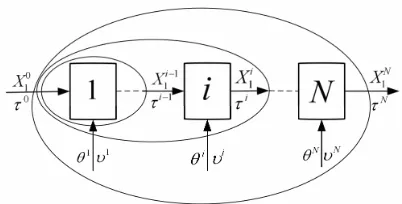
Low dimensionality assures excellent accuracy of numerical results. Numerical issues are discussed in [3]. The cascade scheme, which illustrates the principle of calculations for the optimal power output of an engine, is presented in Fig. 1. Multi-reaction extensions of Eq. (3) are available [12].
[image:3.612.322.523.289.391.2].
Fig. 1. A cascade scheme for the calculation of the dynamical engines
by Bellman’s method of dynamic programming.
VI. ELECTROCHEMICAL ENGINES:FUEL CELLS
Fuel cells (FC) are electrochemical engines propelled by fluxes of both energy and substances. The main advantage of fuel cells in comparison to other engines is that their efficiency is not a major function of device size. A fuel cell continuously transforms a part of chemical energy into electrical energy by consuming fuel and oxidant. The role of fuel cells for environmental protection is quite essential.
Basic structure of fuel cells includes electrolyte layer in contact with a porous anode and cathode on either side. Gaseous fuels are fed continuously to the anode (negative electrode) compartment and an oxidant (i.e., oxygen from air) is fed continuously to the cathode (positive electrode) compartment. Electrochemical reactions take place at the electrodes to produce electric current. Basic reaction is the electrochemical oxidation of fuel, usually hydrogen, and the reduction of the oxidant, usually oxygen. In a FC process the interaction of fuel and oxidant is propelled by diffusive and/or convective fluxes of heat and mass, transferred through some ‘conductances’ or layers.
conducting layers determine rate of power yield. Power maximization is applied here for the purpose of determining limits of imperfect cells, where power output decreases with electric current for sufficiently large currents because of prevailing effect of loss phenomena.
VII. POWER YIELD IN FUEL CELLS
Knowledge of operational voltage is required to define a cell efficiency as the ratio χ = V/E0, where E0 is the
reversible cell voltage or the equilibrium cell potential. For the power density in terms of χ one has p=iE0χ or p=χprev,
which means that this efficiency is equal to the ratio of the actual power to the maximum reversible power. This definition links the fuel cell efficiency with the second law, and stresses substantial role of the operational voltage.
Assume that all incoming streams (those with “higher” Gibbs flux Gin = G1’) represent a common phase of
“substrates” (all system’s components in the state before the chemical transformation, index 1’). All outgoing streams (those with ”lower” Gibbs flux Gout = G2’) represent the
common phase of “products” (all system components in the state after the transformation, index 2’). Power expression follows from entropy conservation and energy balance in the reversible subsystem. For an isothermal reactor
' 2 ' 2 ' 2 ' 2 ' 2 ' 2 ' 2 ' 2 ' 1 ' 1 ' 1 ' 1 ' 1 ' 1 ' 1 ' 1 .. .... ... ... 2 2 1 1 2 2 1 1 m m i i m m i i n n n n n n n n p & & & & & & & & µ µ µ µ µ µ µ µ − − − − + + + = (6)
This formula shows that, in a steady and isothermal process, power yield of an engine system is the difference between the input and output flux of the Gibb’s function [11, 12, 14, 15].
We can transform Eq, (6) to a pronouncing form of Eq. (7) below, specific to the case of the complete conversion. In this case the components are numbered such that species 1,2 …i are substrates and species i+1, i+2 …m are products. Total power yield of an isothermal multi-reaction process is
j mj m j m m j i i ij i j j R j j R j n p p & )} .. . . ... { } { ' ' ' ' ' ' ν µ ν µ ν µ ν µ ν µ ν µ 2 2 2 1 1 1 + + + + + − = = 1 − 1 − 1 + 1 + 2 2 1 1 1 = 1 =
∑
∑
(7)
Quantities n&jare molar chemical fluxes of reagents, i.e. products of the electrode surface area F and heterogeneous rates, rj. In the case of complete conversion, power yield from the unit electrode area equals the sum of products of the affinity driving forces and the reaction rates
}
~
{
}
~
{
1 1 j j R j j j R jr
F
n
p
∑
A
∑
A
= =
=
=
&
(8)Yet, the assumption about the complete transformation of substrates into products can be relaxed, and the present paper shows how this can be done for fuel cells. By considering the chemistry of systems with power production and transport phenomena one can quantitatively estimate
effects of incomplete conversions. The related formula resembles the one which describes effect of the internal entropy production within these systems [12]. For a single isothermal chemical reaction the power formula which generalizes Eq. (8) to include effect of incomplete conversions can be written in the form
eff eff e G p T g F n iA n ΞΠ Π p & & ∆ − = ∆ − = − = ) , ( ) ( 1' 2' 1'
(9)
where primed quantities refer to the inputs and outputs of the chemically active zone. Π1’ is “one-way chemical
affinity” attributed to reactants with known chemical potentials [12,14], n&1'is the (positive) chemical flux defined as the product of the heterogeneous reaction rate and the electrode area. Internal imperfection functions, Φ and Ξ, are respectively related to internal entropy production and incomplete conversion. The fraction Ξ is the reciprocity of coefficient Ψ introduced in [12]; they both characterize detrimental increase of chemical potentials of products caused by their dilution by remaining reactants. Heat effects are represented by a “total heat flux” (involving the sensible heat flux, q1’, and the sum of products of partial entropies
and fluxes of species multiplied by the temperature T), Power formula of Eq. (9) generalizes the idealized power of an “endoreversible” system (with Ξ =1) in which case difference Π1’ – Π2’ is the chemical affinity or –∆g. This is
the chemical component of power, which describes power yield caused by chemical flux n&1'. Electrochemical generation of power occurs with a non-ideal chemical efficiency ξ =Π1' − ΞΠ2’. Effectively, in the engine mode
where Ξ =<1, an imperfect system behalves as it would operate with a decreased affinity of an effective value Π1’ -
Ξ Π2'. Of course, power is decreased by this imperfection
[16, 17].
It should be underlined that the equations contained in the present section (or other ones related to it) are not standard equations of the classical thermodynamics. Even apparently classical Eqs. (6) and (7) pertain to flow systems, hence they don’t belong in standard thermodynamics. Similarly, Eq. (8) is an affinity equation in a flow system, and describes a space distributed affinity rather than the classical or standard chemical affinity which is localized in a single point of the phase space.
VIII. EFFECT OF TRANSPORT PHENOMENA ON POWER LIMITS IN THERMO-ELECTRO-CHEMICAL SYSTEMS
For brevity we limit this section to the case of a simple isomerisation reaction A1-A2 = 0. Transported energy and
components drive the process of power generation in fuel cells. Interestingly, there exists a formal link between the mathematics of thermal engines and fuel cells. This link has originally been shown for chemical engines, and we shall now show how this approach can be extended to electro-chemical generators and fuel cells.
description [20]. Within this formalism a power expression can be formulated for the case of coupled heat, mass and charge transfer in all the dissipative conductors of the system. This will lead us to a general result for power limits in linear thermo-electrochemical systems.
Let us assume that, in the electrochemical case, the active (power producing) driving forces involve: one temperature difference, single chemical affinity and an operating voltage φ1 - φ2. The related power expression is
e n e s n s
e n s
I I R I I R I I R
I R I R I R
I I
I T T
I I
I T T P
ne se
sn
ee nn ss
e n
2 s
2 1
e 2' 1' n 2' 1' s 2' 1'
) ( ) ( ) -(
) ( ) (
) (
− −
−
− − −
− + − + =
− + −
+ − =
2 2 2
2 1 1 µ φ φ µ
φ φ µ
µ
(10)
After introducing the enlarged vector of all driving potentials µ~ = (T, µ, V), the flux vector of all currents = (Is, In, Ie), and the overall resistance tensor R
~
, Eq. (10) can be written in a concise matrix-vector form
I I R
Ι µ
µ ~ ).~ ~:~~
~
( − 2 −
= 1
p (11)
Maximum power corresponds with vanishing of all partial derivatives of power with respect to all currents or the vector condition∂p/∂~Ι=0. This leads to a condition which states that at the maximum point the optimal (power-maximizing) current vector is equal to one half of the purely dissipative current vector of the Fourier-Onsager point,
~
I
F. The corresponding limit of maximum power is~
~
:
~
4
1
F F mp
p
=
R
I
I
(12)Since the power lost at the Fourier-Onsager point is
~
~
:
~
F F F
p
=
R
I
I
(13) comparison of Eqs. (12) and (13) proves that, in linear thermo-electro-chemical systems, only at most 25% of power dissipated in the natural transfer process can be transformed into the valuable form of the mechanical power. This is a general result which, probably, cannot be easily generalized to nonlinear transfer systems where significant deviations from Eq. (12) may appear depending on the nature of diverse nonlinearities.In fact, the forms of Eqs. (10) and (11) are sufficient to claim that the thermal force formula and the power formula for a thermal engine are similar to the voltage and power formulae of a fuel cell system. This proves that a link exists between the mathematics of thermal engines and fuel cells, and that a unifying theory exists for both systems.
IX. SOME EXPERIMENTAL DATA FOR FUEL CELLS
Voltage lowering in fuel cells below the reversible voltage
is a good measure of their imperfection. Yet we need to distinguish between Nernst ideal voltage E0 or and idle run voltage, E0. It is the latter quantity from which all rate
dependent losses of voltage should be subtracted. A number of approaches for calculating these polarization losses have been reviewed in literature by Zhao, Ou and Chen [16].
The details of calculations of the idle run voltage E0 are
thoroughly discussed by Wierzbicki [17] who has implemented the Aspen PlusTM software to investigate the behavior of SOFC based energy system using his own theoretical model of power yield kinetics. His calculations were compared with the experimental findings of the voltage and power in a laboratory FC system.
In some situations difference between E0 and E0 is a
current independent loss which may be described by a fraction Ξ which characterizes the detrimental increase of chemical potentials of products caused by their dilution by un-reacted substrates. With effective nonlinear resistances, operating voltage and power can be represented in terms of the departure from the idle run voltage E0
p=Vi = (E0 - Vint)i = (E0 -Vact -Vcon - Vohm) i
= E0i – i2(Ract + Rconc + Rohm) (14)
Note the analogy between this equation (which is an equation of the classical fuel cell theory) and Eq (10) above. The losses, called polarization, include three main sources: activation polarization (Vact), ohmic polarization (Vohm), and
concentration polarization (Vconc). They refer to the related
resistances: activation resistance (Ract), ohmic resistance
(Rohm), and concentration resistance (Rconc). Activation and
concentration polarization occur at both anode and cathode locations, while resistive polarization represents ohmic losses throughout the cell. Vact is neglected in the model of
ref. [17], nonetheless the power curve is typical.
As the voltage losses increase with current, the initially increasing power begins finally to decrease for sufficiently large currents, so that maxima of power versus current are observed.
Voltage-current density and power-current density characteristics of the SOFC for various temperatures were obtained in Wierzbicki’s MsD thesis, [17]. These data are shown in Fig. 2 where the continuous lines represent the Aspen PlusTM calculations testing the model versus the experiments, whereas points refer to experiments of Wierzbicki and Jewulski in Warsaw Institute of Energetics (Wierzbicki [17], and his ref. 18). These data show that the limiting power increases with temperature and fuel flux.
Błesznowski [13] has also conducted experimental investigations of SOFC’s directed towards power maxima. He obtained, in particular, lines of power density for various contents of hydrogen in the fuel. These results are presented in his efficiency chart which shows an example of the relation between the power density of a SOFC and efficiency of electrochemical reaction. A single power extremum is typical for all experiments. An excessive increase of efficiency causes a power decrease of a cell.
optimization operations are performed in a unified way, and the lost power data referring to the natural transfer process can be applied to assess the maximum of the available power.
Fig. 2. Example of Wierzbicki’s data describing voltage and power density of a SOFC in terms of the current for various temperatures [17].
X. CONCLUSIONS
The enunciation of the mathematical analogy between expressions for power production in thermal, radiative, chemical and electrochemical generators allows the construction of a synthesizing thermodynamic model (thermodynamic synthesis). For this model all optimization operations are performed in a unified, simple way. The inclusion of imperfect fuel cells into the synthesizing model, is simple and beneficial to the FC works. In fact, a link exists between the mathematics of the thermal engines and fuel cells, so that the theory of fuel cells can be synthesized with the theory of other engines. The effect of this synthesis is the common mathematical model applicable to thermal, radiative, chemical, and electrochemical power yield systems (fuel cells).
The models developed in this paper describe physical and chemical performance of thermal machines and irreversible fuel cells at various operating conditions. Lowering of thermal efficiencies is attributed to differences between the temperatures and chemical potentials in the bulks and their counterparts in the circulating fluid. Similarly, lowering of the SOFC efficiency is linked with polarizations.
Optimal power data differ for power generated and consumed, and depend on parameters of the system, e.g., current intensity, number of mass transfer units, polarizations, unit surface area, average chemical rate, etc.. These data provide bounds for the energy generators, which are more exact and informative than the classical bounds for the reversible transformation.
ACKNOWLEDGMENT
Results in Fig. 2 are found with M. Wierzbicki during the present author’s supervising of his MsD thesis. Research co-operation with dr J. Jewulski of the Warsaw Institute of Energetics is also appreciated.
REFERENCES
[1] S. Sieniutycz, “Maximizing power generation in chemical systems and fuel cells”, Proceedings of WCE: The 2011 International Conference of Applied and Engineering Mathematics, Ed. A.
Korsunsky et al., London, 6–8 July 2011,
http://www.iaeng.org/WCE2011/ICAEM2011.html
[2] S. Sieniutycz, “Carnot controls to unify traditional and work-assisted operations with heat & mass transfer”, International J. of Applied
Thermodynamics, 6, 59-67, 2003.
[3] S. Sieniutycz, “Dynamic programming and Lagrange multipliers for active relaxation of fluids in non-equilibrium systems”, Applied
Mathematical Modeling, 33, 1457-1478, 2009.
[4] S. Sieniutycz and P. Kuran, “Nonlinear models for mechanical energy production in imperfect generators driven by thermal or solar energy”, Intern. J. Heat Mass Transfer, 48, 719-730, 2005. [5] S. Sieniutycz and P. Kuran., “Modeling thermal behavior and work
flux in finite-rate systems with radiation”, Intern. J. Heat and Mass Transfer 49, 3264-3283, 2006.
[6] F.L. Curzon and B. Ahlborn, “Efficiency of Carnot engine at maximum power output”, American J. Phys. 43, 22-24, 1975 [7] A. De Vos, Endoreversible Thermodynamics of Solar Energy
Conversion, Oxford: University Press, 1994, pp. 30-41.
[8] P. Kuran, Nonlinear Models of Production of Mechanical Energy in
Non-Ideal Generators Driven by Thermal or Solar Energy, PhD
thesis, Warsaw University of Technology, 2006.
[9] R. E. Bellman, Adaptive Control Processes: a Guided Tour, Princeton, University Press, 1961, pp.1-35.
[10] J. Jeter, Maximum conversion efficiency for the utilization of direct solar radiation”, Solar Energy 26, 231-236, 1981.
[11] S. Sieniutycz, Analysis of power and entropy generation in a chemical engine,” Intern. J. of Heat and Mass Transfer 51, 5859– 5871, 2008
[12] S. Sieniutycz, “Complex chemical systems with power production driven by mass transfer”, Intern. J. of Heat and Mass Transfer, 52, 2453-2465, 2009
[13] S. Sieniutycz, Z. Szwast, P. Kuran, A. Poświata, M. Zalewski, R.
Przekop and M. Błesznowski, “Thermodynamics and optimization of chemical and electrochemical energy generators with applications to fuel cells”.Research report NN208019434 for the period16.05.2008-15.05.2011:Warsaw TU: Faculty of Chemical and Process Engineering.
[14] S. Sieniutycz and J..Jeżowski,, Energy Optimization in Process Systems. Oxford: Elsevier, 2009
[15] S. Sieniutycz, “Finite-rate thermodynamics of power production in thermal, chemical and electro-chemical systems”, Intern. Journal of
Heat and Mass Transfer, 53, 2864–2876, 2010.
[16] Y. Zhao, C.Ou and J. Chen, 2008. “A new analytical approach to model and evaluate the performance of a class of irreversible fuel cells”. International Journal of Hydrogen Energy, 33, 4161- 4170, 2008
[17] M. Wierzbicki, Optimization of SOFC based energy system using
Aspen PlusTM, Thesis (MsD) supervised by S. Sieniutycz (Faculty of
Chemical and Process Engineering, Warsaw University of Technology) and J. Jewulski (Laboratory of Fuel Cells, Institute of Energetics, Warsaw), Warsaw TU, 2009.
[18] B.R. Sundheim, “Transport properties of liquid electrolytes”, p.p. 165-254 in B.R. Sundheim, ed., Fused Salts, Mc Graw Hill, New York, 1964.
[19] A. Ekman, S. Liukkonen and K. Kontturi, “Diffusion and electric conduction in multicomponent electrolyte systems”, Electrochemica Acta 23, 243-250, 1978
![Fig. 2. Example of Wierzbicki’s data describing voltage and power density of a SOFC in terms of the current for various temperatures [17]](https://thumb-us.123doks.com/thumbv2/123dok_us/1279512.656361/6.612.65.299.109.268/example-wierzbicki-describing-voltage-density-current-various-temperatures.webp)
