Using Register-Diversified Corpora for
General Language Studies
D o u g l a s B i b e r *
N o r t h e r n Arizona University
The present study summarizes corpus-based research on linguistic characteristics from several
different structural levels, in English as well as other languages, showing that register variation
is inherent in natural language. It further argues that, due to the importance and systematicity
of the linguistic differences among registers, diversified corpora representing a broad range of
register variation are required as the basis for general language studies.
First, the extent of cross-register differences are illustrated from consideration of individual
grammatical and lexical features; these register differences are also important for probabilistic
part-of-speech taggers and syntactic parsers, because the probabilities associated with grammat-
ically ambiguous forms are often markedly different across registers. Then, corpus-based multi-
dimensional analyses of English are summarized, showing that linguistic features from several
structural levels function together as underlying dimensions of variation, with each dimension
defining a different set of linguistic relations among registers. Finally, the paper discusses how
such analyses, based on register-diversified corpora, can be used to address two current issues
in computational linguistics: the automatic classification of texts into register categories and
cross-linguistic comparisons of register variation.
1. Introduction
As the use of c o m p u t e r - b a s e d text c o r p o r a has b e c o m e increasingly i m p o r t a n t for re- search in natural language processing, lexicography, a n d descriptive linguistics, issues relating to c o r p u s design h a v e also a s s u m e d central importance. Two main considera- tions are i m p o r t a n t here: 1) the size of the c o r p u s (including the length a n d n u m b e r of text samples), a n d 2) the r a n g e of text categories (or registers) that samples are selected from. 1 Within social science, these considerations are associated with the t w o m a i n kinds of error that can threaten 'external validity' (the extent to w h i c h it is possible to generalize from a sample to a larger target population): ' r a n d o m e r r o r ' a n d 'bias error.' R a n d o m error occurs w h e n a sample is not large e n o u g h to accurately estimate the true population; bias error occurs w h e n the selection of a sample is systematically
Department of English, Northern Arizona University, P. O. Box 6032, Flagstaff, AZ 86011-6032; [email protected].
1 Corpus designs can differ along several other parameters, including: 1. bounded/static versus unbounded/dynamic;
2. richly encoded versus minimally encoded (e.g., grammatical tagging, phonological/prosodic encoding, tagging of social characteristics (of participants) and situational characteristics); 3. complete texts versus samples from texts;
Computational Linguistics Volume 19, Number 2
different from the target population it is intended to represent. Both kinds of error must be minimized to achieve a representative corpus.
Recent debates concerning the design of general purpose corpora have often di- vided into two opposing camps emphasizing one or the other source of error: those advocating large corpora versus those advocating "balanced" corpora (i.e., including a wide range of registers). For example, the ACL Data Collection Initiative (DCI) and the Linguistic Data Consortium are focusing on the rapid collection and dissemina- tion of very large corpora, with relatively little attention to the range of registers; older corpora, such as the Brown Corpus and LOB Corpus, are small b y present-day stan- dards but are explicitly structured to 'represent a wide range of styles and varieties' (Francis and Ku~era 1964 [cf. Johansson, Leech, and Goodluck 1978]). Projects such as the COBUILD Corpus, Longman/Lancaster Corpus, and British National Corpus (BNC) combine both emphases to varying extents.
Although all of these corpora could be considered "representative" of at least some varieties of English, it is important to address the question of whether the varieties represented match the intended uses of a corpus. For example, studies of a single sublanguage are legitimately based on corpora representing only that variety, such as journal articles on lipoprotein kinetics (Sager 1986), N a v y telegraphic messages (Fitzpatrick et al. 1986), weather reports (Lehrberger 1982), and aviation maintenance manuals (Kittredge 1982).
One of the main issues addressed here, though, is whether general language stud- ies must be based on a corpus that is register-diversified as well as large. Some pro- ponents of very large corpora have suggested that size can compensate for a lack of diversity--that if a corpus is large enough, it will represent the range of linguistic pat- terns in a language, even though it represents only a restricted range of registers. Given this assumption, linguistic analyses of any very large corpus could be generalized to the entire language.
In contrast, I argue here that analyses must be based on a diversified corpus rep- resenting a wide range of registers in order to be appropriately generalized to the language as a whole, as in a dictionary or grammar of English, or a general purpose tagging program for English. 2 In fact, global generalizations are often not accurate at all, because there is no adequate overall linguistic characterization of the entire lan- guage; rather, there are marked linguistic differences across registers (or sublanguages; cf. Kittredge 1982). Thus a complete description of the language often entails a com- posite analysis of features as they function in various registers. Such analyses must be based on corpora representing the range of registers.
In the following discussion, I first briefly illustrate the extent of cross-register differences from consideration of individual grammatical and lexical features. Sec- tion 2.1 focuses on the marked differences in the distribution of dependent clauses across registers. This section then shows that register differences are also important for probabilistic part-of-speech taggers and syntactic parsers, because the probabilities associated with grammatically ambiguous forms are often markedly different across registers. Section 2.2 focuses on adjectives marking 'certainty' to illustrate how lexical patterns are also distributed differently across registers.
Section 3 makes this point more strongly by describing a multidimensional anal- ysis of numerous linguistic features in a register-diversified corpus of English. The analysis shows that linguistic features from all levels function together as underly-
Douglas Biber Using Register-Diversified Corpora for General Language Studies
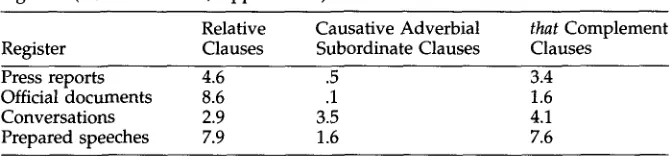
Table 1
Mean frequencies of three dependent clause types (per 1,000 words) in four registers (from Biber 1988, Appendix III).
Relative Causative Adverbial that Complement
Register Clauses Subordinate Clauses Clauses
Press reports 4.6 .5 3.4
Official documents 8.6 .1 1.6
Conversations 2.9 3.5 4.1
Prepared speeches 7.9 1.6 7.6
ing dimensions of variation, and that there are systematic and important linguistic differences among registers with respect to these dimensions. The extent of those dif- ferences clearly shows that linguistic analyses based on a restricted corpus cannot be generalized to the language as a whole.
Section 4, then, shows how multidimensional analyses of register variation can be used to address additional computational issues. First, Section 4.1 discusses the application of the multidimensional model of English to predict the register category of texts automatically with a high degree of accuracy. The predictive power of the model at three levels of abstraction is tested. In Section 4.2, then, I turn to cross- linguistic patterns of register variation, illustrating h o w multidimensional analyses of register-diversified corpora in English, Nukulaelae Tuvaluan, Korean, and Somali en- able register comparisons of a kind not otherwise possible, providing the background for more detailed investigations of particular subregisters or sublanguages.
2. Particular Grammatical and Lexical Features
The analyses in this section illustrate the fact that there are systematic and important grammatical and lexical differences among the registers of English; Section 2.1 treats grammatical features and Section 2.2 discusses lexical features.
2.1 Grammatical Issues
2.1.1 Descriptive Analyses. One of the main uses of general text corpora has been to provide grammatical descriptions of particular linguistic features, such as nominal premodification structures, relative clauses, verb and particle combinations, and clefts and pseudoclefts (see the numerous entries in the bibliography of corpus-based stud- ies compiled by Altenberg [1991]). Two findings repeatedly come out of this literature: first, individual linguistic features are distributed differently across registers, and sec- ond, the same (or similar) linguistic features can have different functions in different registers.
Computational Linguistics Volume 19, Number 2
ative clauses in official documents have W H rather than
that
relative pronouns (7.7 out of 8.6 total), while the two types are evenly split in conversation (1.6 W H relative clauses versus 1.3that
relatives). Although causative adverbial clauses are generally more frequent in spoken registers, clauses headed byas~since
occur almost exclusively in writing (although they are relatively rare in both modes); clauses headed bybecause
are much more frequent in speech (Tottie 1986).Biber (1992) uses confirmatory factor analysis, building on corpus-based frequency counts of this type, to show that discourse complexity is itself a multi-dimensional construct; different types of structural elaboration reflect different discourse functions, and different registers are complex in different ways (in addition to being more or less complex). The analysis further identifies a fundamental distinction between the discourse complexities of written and spoken registers: written registers exhibit many complexity profiles, differing widely in both the extent and the kinds of complexity, while spoken registers manifest a single major pattern differing only in extent.
2.1.2
Probabilistic Tagging and Parsing.
The differing distributions illustrated in Sec- tion 2.1.1 have important implications for probabihstic tagging and parsing techniques, which depend on accurate estimates of the relative likelihood of grammatical cate- gories in particular contexts. Two kinds of probabilistic information are commonly used in part-of-speech taggers: 1) for ambiguous lexical items, the relative probability of each grammatical category (e.g.,abstract
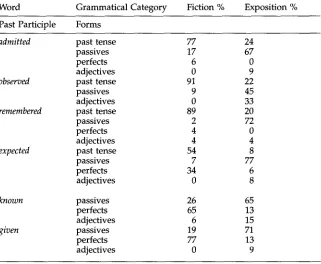
as a noun, adjective, and verb); and 2) for groups of ambiguous words, the relative probability of various tag sequences (e.g., the likelihood of a noun being followed b y a verb, adjective, or another noun).To investigate whether grammatically ambiguous words have different distribu- tions across registers, I compiled two separate on-line dictionaries from the LOB Cor- pus: one based on the expository registers, and one from the fiction registers. Table 2 presents descriptive statistics from a comparison of these two dictionaries. The first observation is that many words occurred in only one of the dictionaries. This is not surprising in the case of exposition, since there were over twice as many lexical entries in the exposition dictionary. However, it is more surprising that there were over 6000 words that occurred only in fiction. These included many common words, such as
cheek, kissed, grandpa, sofa, wallet, briefcase, intently,
andimpatiently.
A comparison of the probabilities of words occurring in both dictionaries is even more revealing. One thousand ten words had probability differences greater than 50%, while another nine hundred eighty words had probability differences greater than 30%. These words represented many lexical types. For example, the first group of words listed on Table 2 are past participle forms. There is a strong likelihood that the
-ed
forms (i.e.,admitted, observed, remembered, expected)
will function as past tense verbs in fiction (probabilities of 77%, 91%, 89%, and 54%) but as passive verbs in exposition (probabilities of 67%, 45%, 72%, and 77%). The w o r dobserved
shows a slightly different pattern in that it has a relatively high probability of occurring as an adjective in exposition (33%). In fiction, the-ed
forms never occur as adjectives, apart from the 4% likelihood forremembered.
Finally, the two true participles(known
andgiven)
are most likely to occur as perfect aspect verbs in fiction (65% and 77% likelihood), but they are similar to the-ed
forms in typically occurring as passive verbs in exposition (65% and 71%).Douglas Biber Using Register-Diversified Corpora for General Language Studies
Table 2
Comparison of the probabilities of grammatically ambiguous words in a dictionary based on Exposition versus a dictionary based on Fiction. (Both dictionaries are derived from the one million words of the LOB Corpus.) Overall Statistics:
Total lexical entries in the Fiction dictionary = 22,043 Total lexical entries in the Expository dictionary = 50,549 Total words occurring in the Fiction dictionary only: 6,204 Total words occurring in the Expository dictionary only: 31,476 Words having probability differences of > 50%: 1,010
Words having probability differences of > 30%: 980
Examples of marked differences in probabilities for common words: (Note: The probabilities for some words do not add up to 100% because minor categories are not listed.)
Word Grammatical Category Fiction % Exposition % Past Participle Forms
admitted past tense 77 24
passives 17 67
perfects 6 0
adjectives 0 9
observed past tense 91 22
passives 9 45
adjectives 0 33
remembered past tense 89 20
passives 2 72
perfects 4 0
adjectives 4 4
expected past tense 54 8
passives 7 77
perfects 34 6
adjectives 0 8
known
given
passives 26 65
perfects 65 13
adjectives 6 15
passives 19 71
perfects 77 13
adjectives 0 9
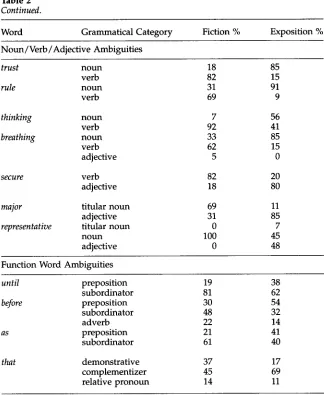
m o r e likely to occur as n o u n s in exposition (all greater t h a n 80% likelihood except for thinking), secure s h o w s a similar likelihood of h a v i n g an adjectival function in ex- position (80%), a n d the t w o n o u n / t i t u l a r n o u n / a d j e c t i v e a m b i g u i t i e s are m u c h m o r e likely to occur as adjectives in exposition t h a n fiction.
[image:5.468.68.389.262.526.2]Computational Linguistics Volume 19, Number 2
Table 2 Continued.
Word Grammatical Category Fiction % Exposition % Noun/Verb/Adjective Ambiguities
trust noun 18 85
verb 82 15
rule noun 31 91
verb 69 9
thinking noun 7 56
verb 92 41
breathing noun 33 85
verb 62 15
adjective 5 0
secure verb 82 20
adjective 18 80
major titular noun 69 11
adjective 31 85
representative titular noun 0 7
noun 100 45
adjective 0 48
Function Word Ambiguities
until preposition 19 38
subordinator 81 62
before preposition 30 54
subordinator 48 32
adverb 22 14
as preposition 21 41
subordinator 61 40
that demonstrative 37 17
complementizer 45 69
relative pronoun 14 11
w o r d that is quite c o m p l e x . It h a s r o u g h l y the s a m e likelihood of o c c u r r i n g as a relative p r o n o u n in fiction a n d exposition, b u t it is m o r e likely to occur as a d e m o n s t r a t i v e in fiction, a n d m o r e likely as a c o m p l e m e n t i z e r in exposition.
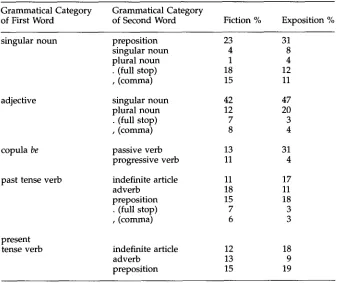
Table 3 illustrates the s a m e k i n d s of c o m p a r i s o n for tag sequences. A l t h o u g h the differences are n o t as striking, several of t h e m are large e n o u g h to b e r e l e v a n t for a u t o m a t i c tagging. For e x a m p l e , p r e p o s i t i o n s a n d n o u n s are c o n s i d e r a b l y m o r e likely to follow singular n o u n s in exposition t h a n in fiction. Similarly, n o u n s are m o r e likely to follow adjectives in exposition t h a n in fiction. Passive v e r b s are c o n s i d e r a b l y m o r e likely to follow the c o p u l a be in exposition t h a n in fiction, w h i l e p r o g r e s s i v e v e r b f o r m s are m o r e likely to follow be in fiction. O t h e r differences are n o t great, b u t t h e y are consistent across tag sequences.
[image:6.468.75.399.69.464.2]Douglas Biber Using Register-Diversified C o r p o r a for General Language Studies
Table 3
C o m p a r i s o n of probabilities for selected tag-sequences in Exposition versus Fiction (derived from analysis of tags in the LOB Corpus). (Note: The probabilities d o not a d d up to 100% because minor categories are not listed.)
Grammatical Category Grammatical Category
of First Word of Second Word Fiction % Exposition %
singular n o u n preposition 23 31
singular n o u n 4 8
plural n o u n 1 4
• (full stop) 18 12
, (comma) 15 11
adjective
copula be
p a s t tense verb
present tense verb
singular n o u n 42 47
plural n o u n 12 20
• (full stop) 7 3
, (comma) 8 4
passive verb 13 31
progressive verb 11 4
indefinite article 11 17
adverb 18 11
preposition 15 18
. (full stop) 7 3
, (comma) 6 3
indefinite article 12 18
adverb 13 9
preposition 15 19
Table 4
Average frequency counts (per 1,000 w o r d s of text) and percentages for prepositional phrases attached as n o u n modifiers and verb modifiers in Editorials versus Fiction (based on analysis of ten-text subsamples from the LOB Corpus).
Editorials Fiction
Frequency % Frequency %
Prepositions as
N o u n Modifiers 38.2 46.4% 15.2
Prepositions as
Verb Modifiers 44.1 53.6% 56.2
Total Prepositions 82.3 100.0% 71.4
21.3%
78.7%
[image:7.468.63.400.130.413.2] [image:7.468.78.387.525.642.2]Computational Linguistics Volume 19, Number 2
Table 5
Comparison of average normalized frequencies of certainty adjectives in the Longman/Lancaster English Language Corpus (written texts), London/Lund Corpus (spoken texts), and two specific text categories from the
Longman/Lancaster Corpus (Social Science and Fiction). (per 1 million words of text).
Frequency of Frequency of Frequency of
XXX + XXX + XXX +
certain sure definite
Longman/Lancaster Corpus
(Written Texts) 259.0 234.0 34.9
London/Lund Corpus
(Spoken Texts) 292.5 426.9 19.4
Selected Registers from the Longman/Lancaster Corpus
Social Science 358.7 73.8 114.2
Fiction 178.5 353.1 10.8
attachment, as a nominal versus verbal modifier, in ten-text subsamples taken from editorials and fiction. (The tex+_s are from the LOB Corpus; these counts were done by hand.) For editorials, this table shows that there is nearly a 50/50 split for preposi- tional phrases attached as nominal versus verbal modifiers, with a slight preference for nominal modifiers. In fiction, on the other hand, there is a much greater likelihood that a prepositional phrase will be attached as a verbal modifier (78.7%) rather than a nominal modifier (21.3%).
For any automated language processing that depends on probabilistic techniques, whether part-of-speech tagging or syntactic parsing, the input probabilities are crucial. The analyses in this section suggest that it might be advantageous to store separate probabilities for different major registers, rather than using a single set of probabilities for a general-purpose tool. Minimally, these analyses show that input probabilities must be based on the distribution of forms in a diversified corpus representing the major register distinctions; probabilities derived from a single register are likely to produce skewed results when applied to texts from markedly different registers. 2.2 L e x i c o g r a p h i c I s s u e s
Text corpora have proven to be invaluable resources for research on word use and meaning, as in Sinclair's pioneering work on the COBUILD Dictionary (Sinclair 1987). In fact, corpus-based research shows that our intuitions about lexical patterns are often incorrect (Sinclair 1991; 112 ff). However, similar to the patterns for grammatical structures, for m a n y words there is no general pattern of use that holds across the whole language; rather, different word senses and collocational patterns are strongly preferred in different registers.
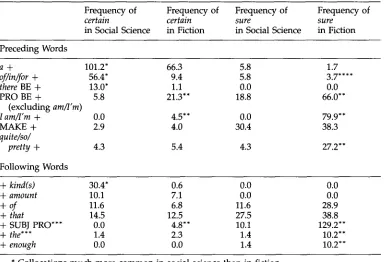
This point can be illustrated from an analysis of certainty adjectives in English (exploring in more detail some of the findings of Biber and Finegan 1989). Table 5 presents overall frequencies for three certainty adjectives--certain, sure, and de/inite--
Douglas Biber Using Register-Diversified Corpora for General Language Studies
Table 6
Comparison of frequencies of collocations for certainty adjectives in two text categories of the Longman/Lancaster English Language Corpus: Social Science and Fiction. (Counts are normalized per 1,000,000 words of text.)
Frequency of Frequency of Frequency of Frequency of
certain certain sure sure
in Social Science in Fiction in Social Science in Fiction Preceding Words
a + 101.2" 66.3 5.8 1.7
of~in~for + 56.4" 9.4 5.8 3.7 . . . .
there BE + 13.0" 1.1 0.0 0.0
PRO BE + 5.8 21.3"* 18.8 66.0"*
(excluding am~I'm)
I am~I'm + 0.0 4.5" 0.0 79.9"
MAKE + 2.9 4.0 30.4 38.3
quite~so~
pretty + 4.3 5.4 4.3 27.2"*
Following Words
+ kind(s) 30.4" 0.6 0.0 0.0
+ amount 10.1 7.1 0.0 0.0
+ of 11.6 6.8 11.6 28.9
+ that 14.5 12.5 27.5 38.8
+ SUBJ PRO*" 0.0 4.8*" 10.1 129.2"*
+ the ~ " 1.4 2.3 1.4 10.2"*
+ enough 0.0 0.0 1.4 10.2"
* Collocations much more common in social science than in fiction. ** Collocations much more common in fiction than in social science.
*** These collocations represent that complement clauses where the complementizer has been deleted.
**** These collocations are all tokens of the idiom for sure.
m a j o r text categories, a n d the L o n d o n / L u n d C o r p u s , m a d e u p of s p o k e n texts f r o m six m a j o r text categories. The overall p a t t e r n s h o w s certain a n d sure occurring w i t h a p p r o x i m a t e l y the s a m e f r e q u e n c y in the w r i t t e n ( L o n g m a n / L a n c a s t e r ) corpus. In the s p o k e n ( L o n d o n / L u n d ) corpus, sure occurs m o r e f r e q u e n t l y t h a n certain, a n d b o t h w o r d s are m o r e c o m m o n t h a n in the w r i t t e n corpus. The w o r d definite is relatively rare in b o t h corpora, a l t h o u g h it is slightly m o r e c o m m o n in the w r i t t e n corpus.
Further, there are striking differences across w r i t t e n registers in the use of these w o r d s . In social science, certain is quite c o m m o n , sure is relatively rare, a n d definite is c o m m o n relative to its f r e q u e n c y in the w h o l e w r i t t e n corpus. Fiction s h o w s the o p p o s i t e pattern: certain is relatively rare, sure is relatively c o m m o n , a n d definite is quite rare. These p a t t e r n s alone s h o w that the s e m a n t i c d o m a i n of certainty in English could n o t be a d e q u a t e l y d e s c r i b e d w i t h o u t c o n s i d e r i n g the p a t t e r n s in c o m p l e m e n t a r y registers.
[image:9.468.39.423.110.372.2]Computational Linguistics Volume 19, Number 2
in fiction. The collocational patterns (confirmed by concordance listings) identify two surprising facts about these words: 1) certain is commonly used to mark uncertainty rather than certainty; and 2) certainty is rarely expressed in social science at all. Thus, the most common collocations for certain in social science reflect a kind of vagueness, marking a referent as possibly being known (by someone) but not specified in the text (e.g., a certain kind o f . . . , in certain cases . . . . there are certain indications that... ). These collocations are relatively rare in fiction. In contrast, those collocational patterns for certain that directly state that someone or something is certain--he/she/they/you/it + BE + certain and I/we + BE + certain--are extremely rare in social science but relatively common in fiction.
Unlike the word certain, the term sure is most typically used to express certainty. This is apparently the reason w h y the overall frequency of sure is so low in social science. The difference between certain and sure, and between social science and fiction, is perhaps most striking for the collocations of pronoun + BE + certain~sure. These collocations are very common for sure in fiction; moderately common for certain in fiction; but quite rare for either sure or certain in social science.
These examples illustrate the point that a corpus restricted to only one register w o u l d enable at best a partial analysis of lexical use; and if the results were generalized to the entire language, they would be incorrect. Thus, the major registers of English must be treated on their own terms in order to provide a comprehensive analysis of either grammatical structures or lexical patterns of use.
3. Multidimensional Differences among Registers in English
The inherent nature of register variation in English is illustrated even more clearly in a series of studies using the multidimensional framework (e.g., Biber 1988, 1989, 1992). These studies have shown that there are systematic patterns of variation among registers; that these patterns can be analyzed in terms of underlying dimensions of variation; and that it is necessary to recognize the existence of a multidimensional space in order to capture the overall relations among registers.
Each dimension comprises a set of linguistic features that co-occur frequently in texts. The dimensions are identified from a quantitative analysis of the distribution of 67 linguistic features in the texts of the LOB and London-Lund Corpora. There is space here for only a brief methodological overview of this approach; interested readers are referred to Biber (1988; especially Chapters 4 and 5) for a more detailed presentation. First, texts were automatically tagged for linguistic features representing several major grammatical and functional characteristics: tense and aspect markers, place and time adverbials, pronouns and pro-verbs, nominal forms, prepositional phrases, ad- jectives, adverbs, lexical specificity, lexical classes (e.g., hedges, emphatics), modals, specialized verb classes, reduced forms and discontinuous structures, passives, stative forms, dependent clauses, coordination, and questions. All texts were post-edited b y hand to correct mis-tags.
Douglas Biber Using Register-Diversified Corpora for General Language Studies
they share u n d e r l y i n g c o m m u n i c a t i v e functions. Similarly, the patterns of variation a m o n g registers were i n t e r p r e t e d f r o m b o t h linguistic a n d functional perspectives.
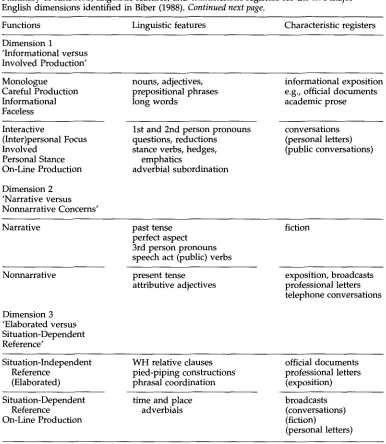
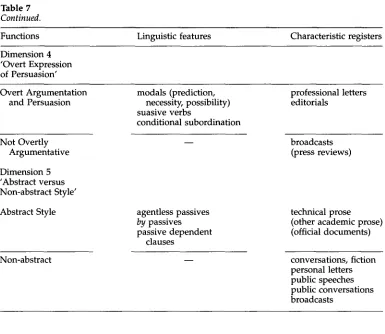
Five major dimensions are identified a n d i n t e r p r e t e d in Biber (1988; especially Chapters 6 a n d 7). 3 Each comprises a distinct set of co-occurring linguistic features; each defines a different set of similarities a n d differences a m o n g s p o k e n a n d written registers; a n d each has distinct functional u n d e r p i n n i n g s . The five d i m e n s i o n s are interpretively labeled:
1. Informational v e r s u s I n v o l v e d P r o d u c t i o n 4 2. Narrative v e r s u s N o n n a r r a t i v e Concerns
3. Elaborated versus S i t u a t i o n - D e p e n d e n t Reference 4. O v e r t Expression of Persuasion
5. Abstract versus N o n a b s t r a c t Style
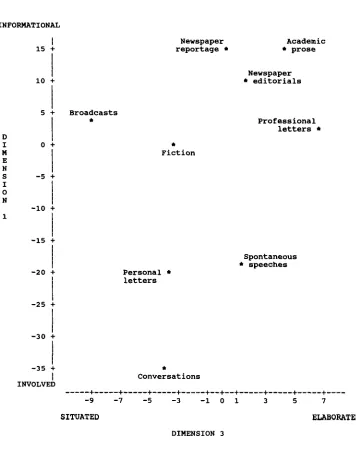
The p r i m a r y c o m m u n i c a t i v e functions, major co-occurring features, a n d charac- teristic registers associated with each d i m e n s i o n are s u m m a r i z e d in Table 7. As this table shows, registers differ systematically along each of these dimensions, relating to functional considerations such as interactiveness, i n v o l v e m e n t , p u r p o s e , a n d pro- d u c t i o n circumstances, all of w h i c h h a v e m a r k e d correlates in linguistic structure. 5 To illustrate these differences m o r e concretely, Figure 1 presents the differences a m o n g nine s p o k e n a n d written registers w i t h i n the t w o - d i m e n s i o n a l space d e f i n e d b y Di- m e n s i o n 1: ' I n v o l v e d versus Informational P r o d u c t i o n ' a n d D i m e n s i o n 3: 'Elaborated versus S i t u a t i o n - D e p e n d e n t Reference.'
The register characterizations o n Figure 1 reflect different relative frequencies of the linguistic features s u m m a r i z e d in Table 7. For example, academic p r o s e a n d news- p a p e r reportage h a v e the largest positive scores on Dimension 1, reflecting v e r y fre- q u e n t occurrences of n o u n s , adjectives, prepositional phrases, long words, etc. (the 'informational' features g r o u p e d on Dimension 1), together with m a r k e d l y i n f r e q u e n t occurrences of 1st a n d 2nd p e r s o n p r o n o u n s , questions, reductions, etc. (the ' i n v o l v e d ' features on D i m e n s i o n 1). On D i m e n s i o n 3, academic p r o s e a n d professional letters h a v e the largest positive scores, reflecting v e r y frequent occurrences of W H rela- tive clause constructions (the features associated with 'elaborated reference'), together with m a r k e d l y infrequent occurrences of time a n d place adverbials (the 'situation- d e p e n d e n t ' features). At the other extreme, conversations h a v e the largest negative score on Dimension 1, reflecting v e r y frequent occurrence of the ' i n v o l v e d ' features g r o u p e d on that d i m e n s i o n (lst a n d 2nd p e r s o n p r o n o u n s , questions, etc.) together w i t h m a r k e d l y few occurrences of the 'informational' features (nouns, adjectives, etc.). Conversations also h a v e a quite large negative score on Dimension 3, a l t h o u g h b r o a d - casts h a v e the largest negative score, reflecting v e r y frequent occurrences of time a n d place adverbials together with m a r k e d l y few W H relative clauses, etc.
3 The factorial structure was derived from a common factor analysis with a Promax rotation. A seven-factor solution was extracted as the most adequate, although only the first five factors are presented here. The first factor in the analysis accounts for 26.8% of the shared variance, while all seven factors together account for 51.9% of the shared variance. Further details are given in Biber (1988). 4 The polarity of Dimension 1 has been reversed to aid in the comparison to Dimensions 3 and 5. 5 See Biber (in press, b) for a comprehensive framework comparing registers with respect to their
Computational Linguistics Volume 19, Number 2
I N F O R M A T I O N A L
l
1 5 +
t
1 0 +
i
5 +
o
!
I 0 +
E N
S - 5 +
I i
0
N
I
- i 0 +
h
- 1 5 +
I
- 2 0 +
I
i
- 2 5 +
i
- 3 0 +
I
- 3 5 +
I
I N V O L V E D
N e w s p a p e r r e p o r t a g e *
A c a d e m i c * p r o s e
N e w s p a p e r * e d i t o r i a l s
B r o a d c a s t s Q
e F i c t i o n
P r o f e s s i o n a l l e t t e r s *
P e r s o n a l * l e t t e r s
s p o n t a n e o u s * s p e e c h e s
Q C o n v e r s a t i o n s
. . . + . . . + . . . + . . . + . . . + - - + - - + . . . + . . . + . . . + . . . . - 9 - 7 - 5 - 3 - i 0 1 3 5 7
S I T U A T E D E L A B O R A T E D
D I M E N S I O N 3
Figure 1
Linguistic characterization of nine spoken and written registers with respect to Dimension 1 ('Informational versus Involved Production') and Dimension 3 ('Elaborated versus
[image:12.468.59.415.79.536.2]Douglas Biber Using Register-Diversified Corpora for General Language Studies
Table 7
Summary of functions, linguistic features, and characteristic registers for the five major English dimensions identified in Biber (1988). Continued next page.
Functions Linguistic features Characteristic registers
Dimension 1
'Informational versus Involved Production' Monologue
Careful Production Informational Faceless Interactive
(Inter)personal Focus Involved
Personal Stance On-Line Production Dimension 2 'Narrative versus Nonnarrative Concerns'
nouns, adjectives, prepositional phrases long words
1st and 2nd person pronouns questions, reductions
stance verbs, hedges, emphatics
adverbial subordination
informational exposition e.g., official documents academic prose conversations (personal letters) (public conversations)
Narrative
Nonnarrative
Dimension 3 'Elaborated versus Situation-Dependent Reference'
past tense perfect aspect 3rd person pronouns speech act (public) verbs present tense
attributive adjectives
fiction
exposition, broadcasts professional letters telephone conversations
Situation-Independent Reference
(Elaborated)
WH relative clauses pied-piping constructions phrasal coordination
official documents professional letters (exposition)
Situation-Dependent time and place broadcasts
Reference adverbials (conversations)
On-Line Production (fiction)
(personal letters)
[image:13.468.40.426.82.526.2]Computational Linguistics Volume 19, Number 2
Table 7 Continued.
Functions Linguistic features Characteristic registers
Dimension 4 'Overt Expression of Persuasion' Overt Argumentation
and Persuasion
Not Overtly Argumentative Dimension 5 'Abstract versus Non-abstract Style' Abstract Style
Non-abstract
modals (prediction, necessity, possibility) suasive verbs
conditional subordination
agentless passives by passives passive dependent
clauses
professional letters editorials
broadcasts (press reviews)
technical prose (other academic prose) (official documents) conversations, fiction personal letters public speeches public conversations broadcasts
Table 8
F scores and correlations for dimension score differences across 23 spoken and written registers (df = 22,459).
Dimension F value Probability r2
1 111.9 p < .001 84.3%
2 32.3 p K .001 60.8%
3 31.9 p < .001 60.5%
4 4.2 p K .001 16.9%
5 28.8 p < .001 58.0%
[image:14.468.46.431.63.397.2]Douglas Biber Using Register-Diversified Corpora for General Language Studies
v a l u e s s h o w that the registers are strong p r e d i c t o r s of linguistic variability a l o n g all five d i m e n s i o n s .
Registers are d e f i n e d in t e r m s of their situational characteristics, a n d t h e y can b e a n a l y z e d at m a n y different levels of specificity. 6 H o w e v e r , there are i m p o r t a n t linguis- tic differences e v e n a m o n g m a n y closely related subregisters (Biber 1988; C h a p t e r 8). A c o m p l e m e n t a r y p e r s p e c t i v e is to a n a l y z e the total space of v a r i a t i o n w i t h i n a l a n g u a g e in t e r m s of
linguistically
w e l l - d e f i n e d text categories, ortext types
(Biber 1989). 7 G i v e n a text t y p e p e r s p e c t i v e , linguistically distinct texts w i t h i n a register r e p r e s e n t different types, while linguistically similar texts f r o m different registers r e p r e s e n t a single text type.In s u m , all of these a n a l y s e s s h o w that there are extensive differences a m o n g English registers w i t h respect to a w i d e a r r a y of linguistic features. A c o r p u s restricted to a n y one or t w o of these registers w o u l d clearly be e x c l u d i n g m u c h of the English language, linguistically as well as situationally.
4. Further Applications of Corpus-Based Analyses of Register Variation
The m u l t i d i m e n s i o n a l m o d e l of register v a r i a t i o n s u m m a r i z e d in Section 3 can be u s e d to a d d r e s s additional c o m p u t a t i o n a l issues. In this section, I focus on t w o of these: the a u t o m a t e d p r e d i c t i o n of register c a t e g o r y a n d cross-linguistic c o m p a r i s o n s .
4.1 Automated Prediction of Registers
O n e issue of c u r r e n t relevance w i t h i n c o m p u t a t i o n a l linguistics is the a u t o m a t e d pre- diction of register category, as a p r e l i m i n a r y step to w o r k in i n f o r m a t i o n retrieval, m a c h i n e translation, a n d other k i n d s of text processing. Because the m o d e l of register v a r i a t i o n s u m m a r i z e d in the last section is m u l t i d i m e n s i o n a l , w i t h each d i m e n s i o n c o m p r i s i n g a different set of linguistic features a n d r e p r e s e n t i n g a different set of relations a m o n g registers, it is well suited to this research question.
O n e statistical p r o c e d u r e c o m m o n l y u s e d for classificatory p u r p o s e s is
discrimi-
nant analysis.
This p r o c e d u r e c o m p u t e s thegeneralized squared distance
b e t w e e n a text a n d each text c a t e g o r y (or register), a n d the text is t h e n a u t o m a t i c a l l y classified as b e l o n g i n g to the closest category. 8To illustrate, Figure 2 plots the f i v e - d i m e n s i o n a l profiles of three target registers (academic prose, fiction, a n d n e w s p a p e r r e p o r t a g e ) t o g e t h e r w i t h a n unclassified text
6 Because registers can be specified at many different levels of generality, there is no "correct" set of register distinctions for a language; rather, I have argued elsewhere that registers should be seen as semi-continuous (rather than discrete) constructs varying along multiple situational parameters (Biber, in press, b). Further, since registers are defined situationally rather than on a linguistic basis, they are not equally coherent in their linguistic characteristics. Some registers have quite focused norms and therefore show little internal linguistic variation (e.g., science fiction). Registers such as popular magazine articles, on the other hand, include a wide range of purposes, and thus show extensive linguistic differences among the texts within the register (cf. the investigations in Biber 1988, Chapter 8;
Biber 1990).
7 The statistical procedure used to identify linguistically well-defined text types is called cluster analysis. This procedure identifies concentrations of texts such that the texts within each cluster, or text type, are maximally similar to one another in their linguistic characteristics, while the types are maximally distinct from one another. Biber (1989) identifies eight major text types in English, which are interpretively labeled: Intimate Interpersonal Interaction, Informational Interaction, "Scientific" Exposition, Learned Exposition, Imaginative Narrative, General Narrative Exposition, Situated Reportage, and Involved Persuasion. Biber (in press, c) compares the text type distinctions in English and Somali.
Computational Linguistics Volume 19, Number 2
O O C
.o
C
E
. - -
c~
10
8
6
4
2
0
-2
-4
-6
NX" ",
///
t i i i
Di . 1 Dim. 2 Dim. 3 Dim. 4 Dim. 5
Dimension
[image:16.468.65.423.49.297.2][ --~- Acaclemic Prose --m- Fiction x Newspaper Report ~ Unclassifed Text
]
Figure 2
Five-dimensional distance profile of unclassified text to three target registers.
(which is in fact a social science academic article). 9 With respect to Dimensions I a n d 4, the unclassified text is about equidistant to the m e a n scores for academic prose a n d n e w s p a p e r reportage, b u t along Dimensions 2, 3, a n d 5, the unclassified text is m u c h closer to the target m e a n s for academic prose. Generalizing over all five dimensions, this text has the smallest distance to academic prose a n d w o u l d be classified into that category.
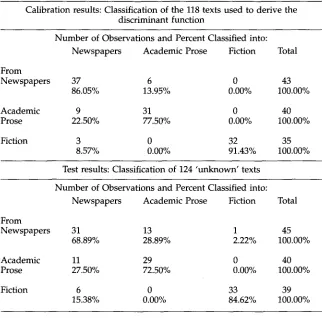
The predictive p o w e r of this five-dimensional m o d e l of variation was tested at three levels of abstraction. The first test was based on texts from three high-level reg- ister categories: n e w s p a p e r articles (including press reportage, editorials, a n d reviews), academic prose (including humanities, social science, medicine, natural science, a n d engineering), a n d fiction. Table 9 presents the discriminant analysis results for these categories. The top part of the table presents the calibration results: the m o d e l was trained on 118 texts from these three categories a n d then u s e d to classify the same
9 To aid in c o m p a r i s o n across dimensions, all d i m e n s i o n scores in Figure 2 have been converted to a c o m m o n scale of plus-or-minus 10. The scaling coefficients are:
D i m e n s i o n 1: .27
D i m e n s i o n 2:1.39
D i m e n s i o n 3:1.11
D i m e n s i o n 4:2.27
Douglas Biber Using Register-Diversified Corpora for General Language Studies
Table 9
Automatic classification of texts into three general register categories (fiction, academic prose, newspaper articles), based on a discriminant analysis using five underlying dimensions.
Calibration results: Classification of the 118 texts used to derive the discriminant function
From
Newspapers
Academic Prose Fiction
Number of Observations and Percent Classified into: Newspapers Academic Prose Fiction Total
37 6 0 43
86.05% 13.95% 0.00% 100.00%
9 31 0 40
22.50% 77.50% 0.00% 100.00%
3 0 32 35
8.57% 0.00% 91.43% 100.00%
Test results: Classification of 124 'unknown' texts
From
Newspapers
Number of Observations and Percent Classified into: Newspapers Academic Prose Fiction Total
31 13 1 45
68.89% 28.89% 2.22% 100.00%
Academic 11 29 0 40
Prose 27.50% 72.50% 0.00% 100.00%
Fiction 6 0 33 39
15.38% 0.00% 84.62% 100.00%
texts. The rates for successful p r e d i c t i o n are h i g h in all three cases. This m o d e l w a s t h e n tested on a n e w set of 124 ' u n k n o w n ' texts; the rates for successful classification are still h i g h (ranging f r o m 68.89% to 84.62%), a l t h o u g h n o t as h i g h as in the calibration data. A c a d e m i c p r o s e a n d fiction are clearly distinguished, w i t h n o misclassifications b e t w e e n these t w o groups. N e w s p a p e r texts are less s h a r p l y d i s t i n g u i s h e d f r o m the other t w o categories: 28.89% of the n e w s p a p e r texts are incorrectly classified as aca- d e m i c prose; 27.5% of the a c a d e m i c p r o s e texts are incorrectly classified as n e w s p a p e r texts; a n d 15.38% of the fiction texts are incorrectly classified as n e w s p a p e r texts. O v e r - all, t h o u g h , the large m a j o r i t y of texts in these three categories are correctly classified b y the f i v e - d i m e n s i o n a l m o d e l .
Table 10 s h o w s that r o u g h l y the s a m e success rate can be a c h i e v e d at a m o r e spe- cific level of prediction: d i s t i n g u i s h i n g a m o n g p r e s s r e p o r t a g e , editorials, a n d r e v i e w s w i t h i n n e w s p a p e r s . The calibration m o d e l s h o w s success rates r a n g i n g f r o m 69.23% to 87.5% for these three categories, a n d the test data are correctly p r e d i c t e d at c o m p a r a b l e rates (ranging f r o m 68.18% to 92.86%).
[image:17.468.65.387.110.428.2]Computational Linguistics Volume 19, Number 2
Table 10
Automatic classification of texts into three specific press registers (press reportage, press reviews, press editorials), based on a discriminant analysis using five underlying dimensions.
Calibration results: Classification of the 43 newspaper texts used to derive the discriminant function
From
Reportage
Editorials
Reviews
Number of Observations and Percent Classified into: Reportage Editorials Reviews Total
16 4 2 22
72.73% 18.18% 9.09% 100.00%
1 9 3 13
7.69% 69.23% 23.08% 100.00%
1 0 7 8
12.50% 0.00% 87.50% 100.00%
Test results: Classification of 45 'unknown' texts
From
Reportage
Number of Observations and Percent Classified into: Reportage Editorials Reviews Total
15 2 5 22
68.18% 9.09% 22.73% 100.00%
Editorials 0 13 1 14
0.00% 92.86% 7.14% 100.00%
Reviews 1 1 7 9
11.11% 11.11% 77.78% 100.00%
calibration results are r e p o r t e d because of the small sample size. The results indicate, however, a high success rate (ranging f r o m 61.54% to 85.71%), suggesting that this a p p r o a c h can be profitably u s e d for p r e d i c t i o n a m o n g closely related subregisters or sublanguages.
The predictive p o w e r of this technique is only as robust as the u n d e r l y i n g m o d e l of variation. In the present case, that m o d e l represents multiple d i m e n s i o n s of lin- guistic variation d e r i v e d f r o m analysis of a register-diversified corpus, a n d the results a c h i e v e d are generally robust for the successful p r e d i c t i o n of different kinds of text at quite different levels of abstraction.
4.2 C r o s s - L i n g u i s t i c C o m p a r i s o n s
[image:18.468.79.404.97.424.2]Douglas Biber Using Register-Diversified Corpora for General Language Studies
Table 11
Automatic classification of 34 newspaper reportage texts into four content areas (political reportage, sports reportage, spot news reportage, financial reportage), based on a discriminant analysis using five underlying dimensions.
From
Political
Sports
Spot News
Financial
Number of Observations and Percent Classified into: Political Sports Spot News Financial Total
8 2 2 1 13
61.54% 1 5 . 3 8 % 15.38% 7.69% 100.00%
0 6 0 1 7
0.00% 8 5 . 7 1 % 0.00% 14.29% 100.00%
1 0 8 1 10
10.00% 0.00% 80.00% 10.00% 100.00%
0 1 0 3 4
0.00% 2 5 . 0 0 % 0.00% 75.00% 100.00%
research in this area has achieved high levels of success by focusing on very restricted textual domains.
Kittredge (1982) adopts a variation perspective, comparing the extent of sublan- guage differences within and across languages. Some of the provocative conclusions of that study are:
"the written style of English and French tended to be more similar in specialized technical texts than in general language texts" (1982, p. 108). "parallel sublanguages of English and French are much more similar structurally than are dissimilar sublanguages of the same language. Parallel sublanguages seem to correspond more closely when the domain of reference is a technical one" (1982, p. 108).
The multidimensional framework provides a complementary approach to these issues. From a linguistic perspective, dimensions are more readily compared cross- linguistically than individual features, since structurally similar features often serve quite different functional roles across languages. Similarly, cross-linguistic comparisons of individual registers are more readily interpretable when they are situated relative to the range of other registers in each language, since the 'same' registers can serve quite different functions across languages when considered relative to their respective register systems.
[image:19.468.75.380.91.289.2]Computational Linguistics Volume 19, Number 2
Table 12
Summary of functions, linguistic features, and characteristic registers for the five major Somali dimensions identified in Biber and Hared (1992).
Functions Linguistic Features Characteristic Registers
Dimension 1 Interactive
(Inter)personal focus Involved
Personal Stance (On-Line Production) Monologue
Informational Faceless
(Careful Production) Dimension 2
main clause features questions, imperatives contractions
stance adjectives downtoners
1st and 2nd person pronouns dependent clauses
relative clauses
clefts, verb complements nouns, adjectives conversations family meetings conversational narratives written expository registers On-Line Production (Situation Dependent) Careful Production Informational Dimension 3 once-occurring words high type/token ratio nominalizations compound verbs sports broadcast (other spoken registers) editorials written political
speeches and pamphlets analytical press
Overt Argumentation Persuasion
Reported Presentation
Dimension 4
present tense, adjectives possibility modals concession conjuncts conditional clauses past tense
proper and agentive nouns future modals
family and formal meetings
general interest and analytical press (invited editorials) press reportage (folk stories)
Narrative Discourse 3rd person pronouns past tense verbs temporal clauses clefts, habitual modals
folk stories (serial stories) (general fiction)
Non-narrative compound nouns petitions
Discourse gerunds, agentive nouns announcements
m e m o s
[image:20.468.48.432.87.583.2]Douglas Biber Using Register-Diversified Corpora for General Language Studies
Table 12 Continued.
Functions Linguistic Features Characteristic Registers
Dimension 5 Interactive
Distanced and Directive Communication
Non-interactive Non-directive
optative clauses
1st and 2nd person pronouns directional particles
imperatives
personal letters (family meetings) (Quranic exposition)
press reportage and editorials written expository
registers
tion circumstances, informational focus, personal stance, and narrative purposes. There are also many similarities in the co-occurrence patterns among linguistic features. For example, first and second person pronouns, downtoners, stance features, contractions, and questions group together in both languages as markers of involvement; nouns and adjectives group together in both languages as markers of an informational fo- cus; third person pronouns and past tense verbs group together in both languages as markers of narration. In other respects, though, the multi-dimensional structure of the two languages differ. For example, Somali has two dimensions marking different kinds of interaction plus a third dimension relating to production circumstances; all of these functions are combined into a single dimension in English (Dimension 1). Con- versely, English Dimension 5 marks a passive, abstract style, which has no counterpart in Somali.
One of the surprising findings from the comparison of all four languages (includ- ing Nukulaelae Tuvaluan and Korean) is the extent of the cross-linguistic similarities (see Biber, in press, c). Thus, all four languages have multiple dimensions reflecting oral/literate differences, interactiveness, production circumstances, and an informa- tional focus; these dimensions are defined by similar kinds of linguistic features, and analogous registers have similar cross-linguistic characterizations along these dimen- sions. In addition, two functional domains that relate to purpose are marked in all four languages: personal stance (toward the content) and narration. These dimensions also have similar structural correlates across the languages.
In contrast, there are fewer major differences among these languages in their pat- terns of register variation. Dimensions relating to argumentation/persuasion are found in only some languages, and there are other dimensions particular to a single language (such as abstract style in English, and honorification in Korean). Analogous registers show some differences cross-linguistically with respect to these latter dimensions plus the purpose-related dimensions mentioned above (e.g., marking personal stance or narration).
[image:21.468.36.420.62.229.2]Computational Linguistics Volume 19, Number 2
reportage in Tok Pisin and English. The multidimensional comparisons summarized here show that even when registers are defined at a high level of generality (e.g., con- versation, fiction, academic prose), and even when comparisons are across markedly different language families and cultures, parallel registers are indeed more similar cross-linguistically than are disparate registers within a single language.
5. Conclusion
In the present paper I have presented evidence from several different structural levels, as well as different languages, showing that there are important and systematic lin- guistic differences among registers. These data are used to argue for the general point that corpora representing a broad range of register variation are required as the basis for general language studies. In fact, the extent of register differences reported here suggests that overall linguistic characterizations of a language are often inadequate (or even incorrect). That is, since overall generalizations represent a kind of averaging of the linguistic patterns in a language, they often do not accurately represent the actual patterns of any register; in fact, such generalizations can conceal the systematic pat- terns found across registers. An alternative approach is to recognize the centrality of register differences and work toward a composite linguistic description of a language in those terms.
Corpus-based analyses of register variation obviously need to be extended in sev- eral ways. Future research should be based on larger corpora and include a wider representation of linguistic features and registers. In addition, register distinctions can be made at several levels of abstraction, and the intersection of register and text type analyses needs to be further explored (see notes 6 and 7). The analyses summarized here, though, clearly show the importance of a register perspective, supporting the continuing development and analysis of large register-diversified corpora as the basis for general language studies.
Acknowledgments
Parts of this paper were presented at the First Workshop of the Consortium for Lexical Research, New Mexico State University (January 1992) and at the Pisa Workshop on Textual Corpora, University of Pisa (January 1992). I would like to thank the workshop participants, as well as two anonymous reviewers for CL, for their helpful suggestions for revision.
References
Altenberg, Bengt (1991). "A bibliography of publications relating to English computer corpora." In English Computer Corpora: Selected Papers and Research Guide, edited by S. Johansson and A.-B. Stenstr6m, 355-396. Mouton.
Besnier, Niko (1988). "The linguistic relationships of spoken and written Nukulaelae registers." Language, 64, 707-736.
Biber, Douglas (1988). Variation across Speech and Writing. Cambridge University Press. Biber, Douglas (1989). "A typology of
English texts." Linguistics, 27, 3-43. Biber, Douglas (1990). "Methodological
issues regarding corpus-based analyses of linguistic variation." Literary and Linguistic Computing, 5, 257-269.
Biber, Douglas (1992). "On the complexity of discourse complexity: A multidimensional analysis." Discourse Processes, 15, 133-163. Biber, Douglas (in press, a).
"Representativeness in corpus design." In Proceedings of the Pisa Workshop on Textual Corpora, edited by A. Zampolli.
University of Pisa.
Biber, Douglas (in press, b). "Towards a comprehensive analytical framework for register studies." In Perspectives on Register: Situating Register Variation within Sociolinguistics, edited by D. Biber and E. Finegan. Oxford University Press. Biber, Douglas (in press, c). Dimensions of
Register Variation: A Cross-Linguistic Comparison. Cambridge University Press. Biber, Douglas, and Finegan, Edward (1989).
Douglas Biber Using Register-Diversified Corpora for General Language Studies
Biber, Douglas, and Hared, Mohamed (1992). "Dimensions of register variation in Somali." Language Variation and Change,
4, 41-75.
Biber, Douglas, and Hared, Mohamed (in press). "Linguistic correlates of the transition to literacy in Somali: Language adaptation in six press registers." In
Perspectives on Register: Situating Register Variation within Sociolinguistics, edited by D. Biber and E. Finegan. Oxford University Press.
Fitzpatrick, Eileen; Bachenko, Joan; and Hindle, Don (1986). "The status of telegraphic sublanguages." In Analyzing Language in Restricted Domains: Sublanguage Description and Processing, edited by Ralph Grishman and Richard Kittredge, 39-54. Lawrence Erlbaum.
Francis, W. N., and Ku~era, H. (1964).
Manual of Information to Accompany a Standard Corpus of Present-Day Edited American English, for Use with Digital Computers. Department of Linguistics, Brown University.
Grishman, Ralph, and Kittredge, Richard, editors (1986). Analyzing Language in Restricted Domains: Sublanguage Description and Processing. Lawrence Erlbaum. Johansson, Stig; Leech, Geoffrey N.; and
Goodluck, Helen (1978). Manual of Information to Accompany the
Lancaster-Oslo/Bergen Corpus of British English, for Use with Digital Computers.
Department of English, University of Oslo.
Kim, Yong-Jin, and Biber, Douglas (in press). "A corpus-based analysis of register variation in Korean." In Perspectives on Register: Situating Register Variation within Sociolinguistics, edited by D. Biber and
E. Finegan. Oxford University Press. Kittredge, Richard (1982). "Variation and
homogeneity of sublanguages." In
Sublanguage: Studies of Language in Restricted Semantic Domains, edited by Richard Kittredge and John Lehrberger, 107-137. De Gruyter.
Kittredge, Richard, and Lehrberger, John, editors (1982). Sublanguage: Studies of Language in Restricted Semantic Domains.
De Gruyter.
Lehrberger, John (1982). "Automatic translation and the concept of
sublanguage." In Sublanguage: Studies of Language in Restricted Semantic Domains,
edited by Richard Kittredge and John Lehrberger, 81-106. De Gruyter. Romaine, Suzanne (in press). "On the
creation and expansion of registers: Sports reporting in Tok Pisin." In Perspectives on Register: Situating Register Variation within Sociolinguistics, edited by D. Biber and E. Finegan. Oxford University Press. Sager, Naomi (1986). "Sublanguage:
Linguistic phenomenon, computational tool." In Analyzing Language in Restricted Domains: Sublanguage Description and Processing, edited by Ralph Grishman and Richard Kittredge, 1-18. Lawrence Erlbaum.
Sinclair, John, editor (1987). Looking Up.
Collins.
Sinclair, John (1991). Corpus, Concordance, Collocation. Oxford University Press. Tottie, Gunnel (1986). "The importance of