Seq2seq for Morphological Reinflection: When Deep Learning Fails
Hajime Senuma University of Tokyo National Institute of Informatics
Akiko Aizawa
National Institute of Informatics University of Tokyo [email protected]
Abstract
Recent studies showed that the sequence-to-sequence (seq2seq) model is a promis-ing approach for morphological reinflec-tion. At the CoNLL-SIGMORPHON 2017 Shared Task for universal morpho-logical reinflection, we basically followed the approach with some minor variations. The results were remarkable in a certain sense. In high-resource scenarios our sys-tem achieved 91.46% accuracy (only mod-estly behind the best system by 3.85%), and in medium-resource scenarios the per-formance was 65.06% (almost the same as baseline). In low-resource settings, how-ever, the performance was only 1.58%, ranking the worst among submitted sys-tems. In this paper, we present system de-scription and error analysis for the results.
1 Introduction
Processing morphological inflection is a funda-mental task for the analysis and generation of nat-ural languages and serves as a building block for many tasks such as machine translation, text an-alytics, and question answering. Whereas En-glish is morphologically simple and abundant for resources, other languages are often morpholog-ically rich and resource-poor, resulting in severe performance degradation (Tsarfaty et al., 2010). To tackle the issue, the CoNLL-SIGMORPHON 2017 Shared Task hosted a shared task on uni-versal morphological reinflection (Cotterell et al., 2017), in which participants must solve the task for 52 languages and for high-, medium-, and low-resource settings.
Although the shared task comprised two sub-tasks, we participated only in Task 1. Each data set in Task 1 consists of three columns. The first
and second column provides a lemmaand a tar-get form, respectively. The third column lists mor-phosyntactic descriptions (MSDs), or the features for a target form, where each feature is taken from a universal set of morphological features called UniMorph (Sylak-Glassman et al., 2015). The purpose of the task is to construct a system which can estimate a target form from a lemma and its MSDs. For each of 52 languages, participants cope with the problem under varying sizes of train-ing data (10,000 for high, 1,000 for medium, and 100 for low). The use of external resources are not permitted in the main track, but allowed as a separate track.
To solve the problem, we basically followed Kann and Sch¨utze (2016a), the winner of the Shared Task in the previous year (Cotterell et al., 2016). Unfortunately, our approach experi-enced severe difficulties in low-resource settings. In high-resource settings, our system achieved 91.46% accuracy, the 12th among the 20 systems. In medium-resource setting, the performance was 65.06%, almost the same as that of the baseline (64.7%). And in low-resource setting, the system achieved only 1.58%. The cause of the problem is that if we decrease the number of examples, at some point, the accuracy of deep learning-based approach drastically drops. For our system, the point is somewhere between 110 and 150; at 150, we still retain the accuracy around 36% but at 110, the result becomes nonsensical (see Section5).
This paper is organized as follows. In Section 2, we briefly summarize related researches in this field. In Section3, we describe the system descrip-tion of our approach. In Secdescrip-tion4, we present en-vironmental settings used in our experiments and the main results of our work. In Section5, we dis-cuss the error analysis of our results.
2 Related Work
Morphological inflection has a long-tradition in natural language processing (NLP). The earli-est studies used finite-state transducers ( Kart-tunen,1983;Koskenniemi,1984;Kaplan and Kay, 1994). The advantages of the approach are that rules are often hand-crafted and thus suitable in low-resource settings and that it is relatively easy and direct to incorporate the linguistic knowledge of specialists. On the other hand, manual crafting of such rules is often expensive and usually lan-guage specialists are not easily available. General purpose open-source libraries for this approach in-clude OpenFST (Allauzen et al.,2007) and Foma (Hulden, 2009). In addition, there are several language-specific systems such as TRMorph for Turkish (C¸¨oltekin,2010) and HornMorpho for the languages of the Horn of Africa (Gasser,2011).
In this decade, machine learning for morpho-logical inflection became a hot topic. One di-rection is to exploit the paradigmatic nature of inflection (Durrett and DeNero, 2013; Ahlberg et al., 2015). For example, Durrett and DeNero (2013) proposed a multi-step supervised learning approach. The first phase tries to extract transfor-mational rules from data sets and consists of three sub-steps: the alignment of words in training data, merging spans across the resulting alignments, and rule extraction from these intermediary informa-tion. And then the second phase tries to learn the position and the type of transformation applica-tion. The advantage of this approach is that we can obtain concrete paradigms of inflection.
Another recent innovation in this field (Faruqui et al., 2016; Kann and Sch¨utze, 2016b) is the use of the sequence-to-sequence (seq2seq) model (Sutskever et al., 2014) (also known as the encoder-decoder model (Cho et al., 2014)). No-tably, Kann and Sch¨utze (2016a) applied the attention-based version of seq2seq models ( Bah-danau et al., 2015) to the SIGMORPHON 2016 Shared Task (Cotterell et al., 2016) and showed that their system can learn morphological reinflec-tion even for extremely morphologically rich lan-guages such as Maltese and became the winner of the year.
3 System Description
Our implementation is based on the system of Kann and Sch¨utze(2016a). We will release the im-plementation under a BSD lincense on the GitHub
account of the first author1.
3.1 Basic architecture 3.1.1 Seq2seq model
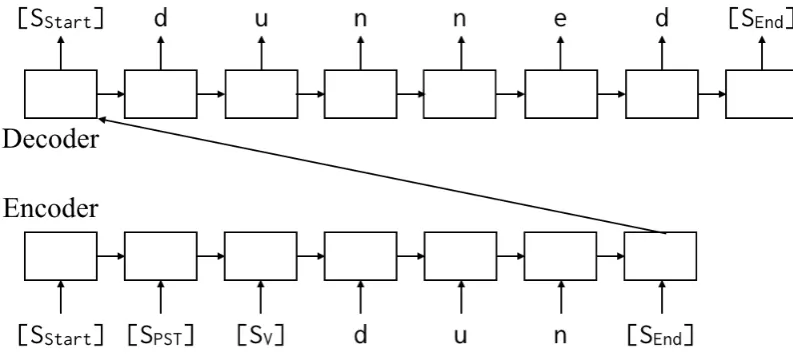
Fig. 1 shows the basic archicture of our sys-tem. The figure depicts how an input tuple(dun, V;PST)is converted to an output stringdunned. In its basic form, the seq2seq model consists of two recurrent neural networks (RNNs), the en-coder and the deen-coder. After the enen-coder is feeded with a sequence of input symbols, the hidden layer of the encoder is used as an input to the decoder, and finally the decoder emits a sequence of out-put symbols. In reality, RNNs are substituted by gated recurrent units (GRUs), inputs are encoded as bidirectional sequences, and the decoder also gets an attentional information from a context vec-tor (Bahdanau et al.,2015).
Given an input example which consists of a lemma and a set of features, a sequence of symbols for the system is represented as
{SStartf+x+SEnd | f ∈ Σϕ, x ∈ ΣL}, where
SStart andSEnd represents a start symbol and an ending symbol respectively, Σϕ a set of features, ΣLa set of symbols in a language, and+the rep-etition of one or more symbols. To improve the predictive efficiency,f+should be sorted by some
criteria (Kann and Sch¨utze, 2016a), such as lex-icographic order (in Fig. 1, V;PST is sorted as
SP STSV). Likewise, an output string is encoded as{SStartx+SEnd |f ∈x∈ΣL}.
For more details, seeBahdanau et al.(2015) and Kann and Sch¨utze(2016a).
3.1.2 Loss function
FollowingFaruqui et al.(2016), we used the neg-ative log-likelihood of the output character se-quence for our loss function.
3.2 Differences from previous studies
In this section, we describe the differences be-tween our work and previous researches.
3.2.1 Dimension
We used 300 for symbol embeddings, 200 for hid-den layers, and 200 for context (attention) vec-tors, whileKann and Sch¨utze(2016a) used 300 for symbol embeddings and 100 for hidden layers (the dimension of context vectors was not described). We increased the size of hidden layers because at
Figure 1: The basic architecture ofKann and Sch¨utze(2016a)’s seq2seq model for morphological rein-flection.
least in this task we found that 100 for hidden lay-ers was harmful to predictive performance.
3.2.2 Implementation
We implemented the attention-based version of an encoder-decoder model from scratch with Theano (The Theano Development Team, 2016), while Kann and Sch¨utze(2016a) reusedBahdanau et al. (2015)’s original implementation.
3.2.3 Initialization
We used the Glorot uniform (Glorot and Bengio, 2010) for matrix initialization, while Kann and Sch¨utze(2016a) used the identity matrix.
3.2.4 Optimization / regularization
Faruqui et al.(2016) used AdaDelta (Zeiler,2012) withL2regularization.Kann and Sch¨utze(2016a) also used the same optimizer.
We used the AdaMax optimization algorithm (Kingma and Ba,2015) with recommended hyper-parameters in the paper. The method is a combina-tion of Adam optimizacombina-tion andL∞regularization; that is, the bigger the maximum of parameters is, the bigger the penalty for the model is. The reason we used AdaMax is that the method is known for fast convergence. Furthermore, the authors pro-vided recommended hyperparameters, resulting in less hyperparameter calibration.
3.2.5 Iteration number
WhileKann and Sch¨utze(2016a) simply used 20 training iterations for any language, we continued training until they are converged: four consecutive no gains in accuracy for development data where
the maximum is 40 iterations (for some languages, we hand-tuned the number of training iterations so this number may vary).
4 Experimental Results
4.1 Environmental settings
We used Amazon Web Services (AWS) and ran our system on an Amazon EC2 p2.16xlarge
instance, Ubuntu with CUDA 8.0 and cuDNN 6.0. The instance was equipped with the eight cards of NVIDIA Tesla K80 (16 GPUs in total).
We trained our model with purely online learn-ing manner (no mini-batch). Although clock-time for training depends on language, under high-resource setting, usually it took about 7 minutes to train a model by using 10,000 examples (that is, one iteration for high-resource training dataset) with one GPU. Hence Time=30 in Table 1 implies training for the language under high-resource set-ting took about 210 minutes (using one GPU). We only participated in the main track, so we did not use any external resources.
4.2 Results
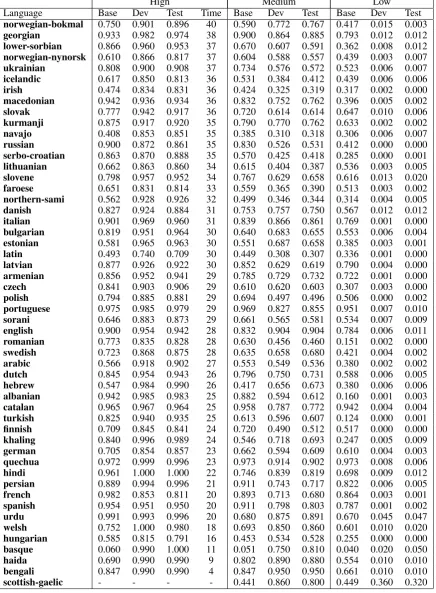
Table 1 shows the results of our system, descend-ing order of the results for test data set in high-resource setting.
High Medium Low
Language Base Dev Test Time Base Dev Test Base Dev Test
norwegian-bokmal 0.750 0.901 0.896 40 0.590 0.772 0.767 0.417 0.015 0.003
georgian 0.933 0.982 0.974 38 0.900 0.864 0.885 0.793 0.012 0.012
lower-sorbian 0.866 0.960 0.953 37 0.670 0.607 0.591 0.362 0.008 0.012
norwegian-nynorsk 0.610 0.866 0.817 37 0.604 0.588 0.557 0.439 0.003 0.007
ukrainian 0.808 0.900 0.908 37 0.734 0.576 0.572 0.523 0.006 0.007
icelandic 0.617 0.850 0.813 36 0.531 0.384 0.412 0.439 0.006 0.006
irish 0.474 0.834 0.831 36 0.424 0.325 0.319 0.317 0.002 0.000
macedonian 0.942 0.936 0.934 36 0.832 0.752 0.762 0.396 0.005 0.002
slovak 0.777 0.942 0.917 36 0.720 0.614 0.614 0.647 0.010 0.006
kurmanji 0.875 0.917 0.920 35 0.790 0.770 0.762 0.633 0.002 0.002
navajo 0.408 0.853 0.851 35 0.385 0.310 0.318 0.306 0.006 0.007
russian 0.900 0.872 0.861 35 0.830 0.526 0.531 0.412 0.000 0.000
serbo-croatian 0.863 0.870 0.888 35 0.570 0.425 0.418 0.285 0.000 0.001
lithuanian 0.662 0.863 0.860 34 0.615 0.404 0.387 0.536 0.003 0.005
slovene 0.798 0.957 0.952 34 0.767 0.629 0.658 0.616 0.013 0.020
faroese 0.651 0.831 0.814 33 0.559 0.365 0.390 0.513 0.003 0.002
northern-sami 0.562 0.928 0.926 32 0.499 0.346 0.344 0.314 0.004 0.005
danish 0.827 0.924 0.884 31 0.753 0.757 0.750 0.567 0.012 0.012
italian 0.901 0.969 0.960 31 0.839 0.866 0.861 0.769 0.001 0.000
bulgarian 0.819 0.951 0.964 30 0.640 0.683 0.655 0.553 0.006 0.004
estonian 0.581 0.965 0.963 30 0.551 0.687 0.658 0.385 0.003 0.001
latin 0.493 0.740 0.709 30 0.449 0.308 0.307 0.336 0.001 0.000
latvian 0.877 0.926 0.922 30 0.852 0.629 0.619 0.790 0.004 0.000
armenian 0.856 0.952 0.941 29 0.785 0.729 0.732 0.722 0.001 0.000
czech 0.841 0.903 0.906 29 0.610 0.620 0.603 0.307 0.003 0.000
polish 0.794 0.885 0.881 29 0.694 0.497 0.496 0.506 0.000 0.002
portuguese 0.975 0.985 0.979 29 0.969 0.827 0.855 0.951 0.007 0.010
sorani 0.646 0.883 0.873 29 0.661 0.565 0.581 0.534 0.007 0.009
english 0.900 0.954 0.942 28 0.832 0.904 0.904 0.784 0.006 0.011
romanian 0.773 0.835 0.828 28 0.630 0.456 0.460 0.151 0.002 0.000
swedish 0.723 0.868 0.875 28 0.635 0.658 0.680 0.421 0.004 0.002
arabic 0.566 0.918 0.902 27 0.553 0.549 0.536 0.380 0.002 0.002
dutch 0.845 0.954 0.943 26 0.796 0.750 0.731 0.588 0.006 0.005
hebrew 0.547 0.984 0.990 26 0.417 0.656 0.673 0.380 0.006 0.006
albanian 0.942 0.985 0.983 25 0.882 0.594 0.612 0.160 0.001 0.003
catalan 0.965 0.967 0.964 25 0.958 0.787 0.772 0.942 0.004 0.004
turkish 0.825 0.940 0.935 25 0.613 0.596 0.607 0.124 0.000 0.001
finnish 0.709 0.845 0.841 24 0.720 0.490 0.512 0.517 0.000 0.000
khaling 0.840 0.996 0.989 24 0.546 0.718 0.693 0.247 0.005 0.009
german 0.705 0.854 0.857 23 0.662 0.594 0.609 0.610 0.004 0.003
quechua 0.972 0.999 0.996 23 0.973 0.914 0.902 0.973 0.008 0.006
hindi 0.961 1.000 1.000 22 0.746 0.839 0.819 0.698 0.009 0.012
persian 0.889 0.994 0.996 21 0.911 0.743 0.717 0.822 0.006 0.005
french 0.982 0.853 0.811 20 0.893 0.713 0.680 0.864 0.003 0.001
spanish 0.954 0.951 0.950 20 0.911 0.798 0.803 0.787 0.001 0.002
urdu 0.991 0.993 0.996 20 0.680 0.875 0.891 0.670 0.045 0.047
welsh 0.752 1.000 0.980 18 0.693 0.850 0.860 0.601 0.010 0.020
hungarian 0.585 0.815 0.791 16 0.453 0.534 0.528 0.255 0.000 0.000
basque 0.060 0.990 1.000 11 0.051 0.750 0.810 0.040 0.020 0.050
haida 0.690 0.990 0.990 9 0.802 0.890 0.880 0.554 0.010 0.010
bengali 0.847 0.990 0.990 4 0.847 0.950 0.950 0.661 0.010 0.010
[image:4.595.83.520.85.679.2]scottish-gaelic - - - - 0.441 0.860 0.800 0.449 0.360 0.320
In high-resource setting, our system achieved 91.46% accuracy, the 12th among the 20 systems. In medium-resource setting, the performance was almost the same as baseline 65.06%. And in low-resource setting, the system achieved only 1.58%.
4.3 Comparison with other systems
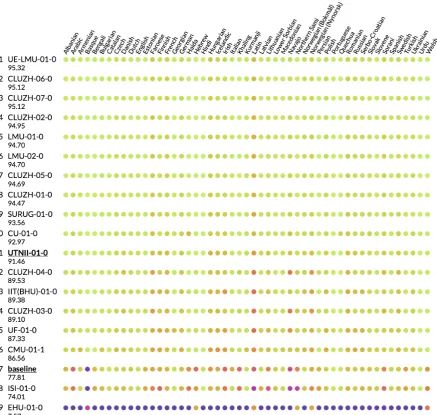
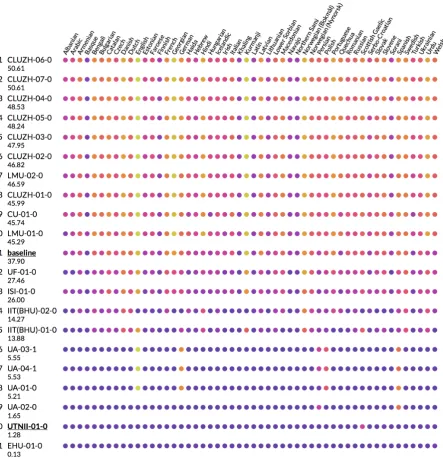
A heat map in Fig.2shows the accuracy of partic-ipants under high-resource settings, with the de-scending order of the average accuracy. Green color (light color in black-and-white) denotes high accuracy whereas red (purple at the extreme) color (dark color in black-and-white) denotes low accu-racy. Note that the ranking is slightly different from the official one, because in this figure, if a system did not participate in some languages, we treated them as zero accuracy.
As we see, it is hard to tell the difference, be-cause top systems achieved nearly 100% accuracy for almost all languages. However, if we carefully examined, almost all systems (which have higher performance than the baseline) have similar color spotting patterns, possibly because these partici-pants used similar systems, that is, the seq2seq model (Faruqui et al., 2016; Kann and Sch¨utze, 2016a; Kann et al., 2016). We also see that the color of the Latin language tends to be yellowish or reddish, which indicates that this language is very hard to process by using the seq2seq model.
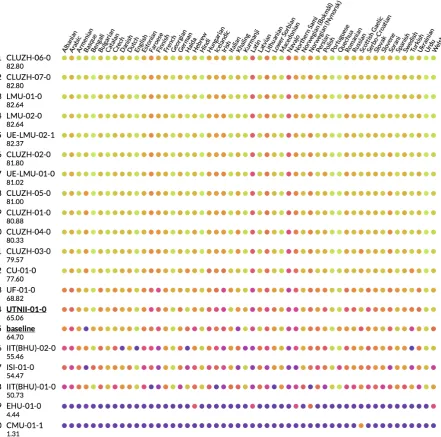
Heat maps in Fig. 3 and Fig. 4, which depict the case of medium- and low-resource settings, are also interesting to see.
Let us see the case of low-resource settings. It is easy to recognize the systems of UA took unique approaches. Other systems have simi-lar color patterns—it may indicate they used the seq2seq model—but the intensity of colors grad-ually degrades according to the ranking of these systems. Then, after crossing a certain point, the color suddenly becomes purple (nearly 0%) for al-most all languages (EHU-01-0 and our system
UTNII-01-0).
We will release these figures on the GitHub ac-count of the first author2.
2https://github.com/hajimes/ conll2017-stats
5 Discussion
5.1 Convergence speed under high-resource settings
As we see in Table 1, the number of training time for morphological reinflection significantly differs from each language. In the case of Ben-gali, only 40k (4 iteration for the data set) was sufficient to achieve the best result, whereas Nor-wegian Bokm˚al requires 400k (40 iteration). This contrasts with Kann and Sch¨utze (2016a)’s ap-proach where they simply used 20 iterations for any language.
The following table is a list of the top five lan-guages for fast convergence.
Language Base Dev Test Time
bengali 0.847 0.990 0.990 4
haida 0.690 0.990 0.990 9
basque 0.060 0.990 1.000 11
hungarian 0.585 0.815 0.791 16
welsh 0.752 1.000 0.980 18
On the other hand, training for the following five languages was slow to converge.
Language Dev Test Time
norwegian-bokmal 0.901 0.896 40
georgian 0.982 0.974 38
lower-sorbian 0.960 0.953 37
norwegian-nynorsk 0.866 0.817 37
ukrainian 0.900 0.908 37
5.2 Accuracy under low-resource settings
To test why our system gave catastrophic results under the low-resource setting, we tested more fine-grained analysis as to the size of resources.
We made several new datasets from
Figure 2: Comparison with other systems under high-resource settings. The signature of our system is
Figure 4: Comparison with other systems under low-resource settings. The signature of our system is
One possible solution to mitigate this situation is to use other regularization approaches such as dropout (Srivastava et al., 2014), where differ-ent configurations are trained simultaneously and probabilistically, although such techniques alone may not change the inherent nature of our system. We will try to find how we can lower the trench in the future.
It is interesting that our system achieved mean-ingful accuracy for Scottish-Gaelic even under low-resource settings. Although this tendency is not global, the system ofIIT(BHU)-01-0also shows relatively good performance on the lan-guage, so the robustness for processing Scottish-Gaelic may not be by pure chance. We plan to analyze the language in detail, because it will re-veal what kind of linguistic natures determine the “trench” of the required number of training exam-ples for seq2seq systems.
6 Conclusion
In this paper, we presented system description and error analysis for our system submitted to the CoNLL-SIGMORPHON 2017 Shared Task. As the reader sees in our results, pure deep learn-ing approaches have a major disadvantage, that is, their predictive performance drops steeply after crossing a certain point of the number of training examples. We also showed that the convergence speed for training the models of morphological re-inflection highly depends on the type of languages, which can be useful information to tackle the task again in the future.
Acknowledgements
This work was supported by CREST, Japan Sci-ence and Technology Agency. We are also grate-ful to two anonymous reviewers for their helpgrate-ful comments.
References
Malin Ahlberg, Markus Forsberg, and Mans Hulden. 2015.Paradigm classification in supervised learning of morphology. InProceedings of the 2015 Confer-ence of the North American Chapter of the Associ-ation for ComputAssoci-ational Linguistics: Human Lan-guage Technologies. Association for Computational Linguistics, Stroudsburg, PA, USA, pages 1024– 1029.https://doi.org/10.3115/v1/N15-1107.
Cyril Allauzen, Michael Riley, Johan Schalkwyk, Wo-jciech Skut, and Mehryar Mohri. 2007. OpenFst: A
General and Efficient Weighted Finite-State Trans-ducer Library. InProceedings of the Twelfth Inter-national Conference on Implementation and Appli-cation of Automata. pages 11–23.
Dzmitry Bahdanau, KyungHyun Cho, and Yoshua Bengio. 2015. Neural Machine Translation By Jointly Learning To Align and Translate. In Proceeding of the 3rd International Confer-ence on Learning Representations (ICLR2015). http://arxiv.org/abs/1409.0473v3.
Kyunghyun Cho, Bart van Merrienboer, Caglar Gul-cehre, Dzmitry Bahdanau, Fethi Bougares, Hol-ger Schwenk, and Yoshua Bengio. 2014. Learn-ing Phrase Representations usLearn-ing RNN EncoderDe-coder for Statistical Machine Translation. In Proceedings of the 2014 Conference on Empir-ical Methods in Natural Language Processing (EMNLP). Association for Computational Linguis-tics, Stroudsburg, PA, USA, pages 1724–1734. https://doi.org/10.3115/v1/D14-1179.
C¸a˘grı C¸¨oltekin. 2010. A Freely Available Morpho-logical Analyzer for Turkish. In Proceedings of the Seventh conference on International Language Resources and Evaluation (LREC’10). European Language Resources Association (ELRA), Valletta, Malta, pages 820–827.
Ryan Cotterell, Christo Kirov, John Sylak-Glassman, G´eraldine Walther, Ekaterina Vylomova, Patrick Xia, Manaal Faruqui, Sandra K¨ubler, David Yarowsky, Jason Eisner, and Mans Hulden. 2017. The CoNLL-SIGMORPHON 2017 Shared Task: Universal Morphological Reinflection in 52 Languages. In Proceedings of the CoNLL-SIGMORPHON 2017 Shared Task: Universal Mor-phological Reinflection.
Ryan Cotterell, Christo Kirov, John Sylak-Glassman, David Yarowsky, Jason Eisner, and Mans Hulden. 2016. The SIGMORPHON 2016 Shared Task— Morphological Reinflection. In Proceedings of the 14th Annual SIGMORPHON Work-shop on Computational Research in Phonetics,
Phonology, and Morphology. pages 10–22.
https://doi.org/10.18653/v1/W16-2002.
Greg Durrett and John DeNero. 2013. Supervised Learning of Complete Morphological Paradigms. In Proceedings of the 2013 Conference of the North American Chapter of the Association for Computa-tional Linguistics: Human Language Technologies. Association for Computational Linguistics, Atlanta, Georgia, June, pages 1185–1195.
Manaal Faruqui, Yulia Tsvetkov, Graham Neubig, and Chris Dyer. 2016. Morphological Inflection Gener-ation Using Character Sequence to Sequence Learn-ing. In Proceedings of NAACL-HLT 2016. pages 634–643. https://doi.org/10.18653/v1/N16-1077.
Tigrinya. InConference on Human Language Tech-nology for Development. Alexandria, Egypt, pages 94–99.
Xavier Glorot and Yoshua Bengio. 2010. Understand-ing the difficulty of trainUnderstand-ing deep feedforward neural networks. InProceedings of the 13th International Conference on Artificial Intelligence and Statistics (AISTATS). volume 9, pages 249–256.
Mans Hulden. 2009. Foma: a finite-state compiler and library. In Proceedings of the Demonstrations Ses-sion at EACL 2009. Association for Computational Linguistics, Athens, Greece, pages 29–32.
Katharina Kann, Ryan Cotterell, and Hinrich Sch¨utze. 2016. Neural Morphological Analysis: Encoding-Decoding Canonical Segments. InProceedings of the 2016 Conference on Empirical Methods in Nat-ural Language Processing. Association for Compu-tational Linguistics, Stroudsburg, PA, USA, pages 961–967. https://doi.org/10.18653/v1/D16-1097.
Katharina Kann and Hinrich Sch¨utze. 2016a. MED: The LMU System for the SIGMORPHON 2016 Shared Task on Morphological Reinflection. In Proceedings of the 14th Annual SIGMORPHON Workshop on Computational Research in Phonet-ics, Phonology, and Morphology. pages 62–70. https://doi.org/10.18653/v1/W16-2010.
Katharina Kann and Hinrich Sch¨utze. 2016b. Single-Model Encoder-Decoder with Explicit Morpholog-ical Representation for Reinflection. In Proceed-ings of the 54th Annual Meeting of the Asso-ciation for Computational Linguistics (Volume 2: Short Papers). Association for Computational Lin-guistics, Stroudsburg, PA, USA, pages 555–560. https://doi.org/10.18653/v1/P16-2090.
Ronald M. Kaplan and Martin Kay. 1994. Regular Models of Phonological Rule Systems. Computa-tional Linguistics20(3):331–378.
Lauri Karttunen. 1983. KIMMO: A General Morpho-logical Parser. Texas Linguistic Forum22:165–186.
Diederik P. Kingma and Jimmy Lei Ba. 2015. Adam: A Method for Stochastic Optimization. In Inter-national Conference on Learning Representations 2015.arxiv:1412.6980v8.
Kimmo Koskenniemi. 1984.A General Computational Model for Word-Form Recognition and Production. In10th International Conference on Computational Linguistics and 22nd Annual Meeting of the Asso-ciation for Computational Linguistics. pages 178– 181. http://aclweb.org/anthology/P84-1038.
Nitish Srivastava, Geoffrey Hinton, Alex Krizhevsky, Ilya Sutskever, and Ruslan Salakhutdinov. 2014. Dropout: A Simple Way to Prevent Neural Networks from Overfitting. Journal of Machine Learning Research 15:1929–1958. http://jmlr.org/papers/v15/srivastava14a.html.
Ilya Sutskever, Oriol Vinyals, and Quoc V. Le. 2014. Sequence to Sequence Learning with Neural Net-works. InAdvances in Neural Information Process-ing Systems 27 (NIPS 2014). pages 3104–3112.
John Sylak-Glassman, Christo Kirov, David Yarowsky, and Roger Que. 2015. A Language-Independent Feature Schema for Inflectional Morphology. In Proceedings of the 53rd Annual Meeting of the Association for Computational Linguistics and the 7th International Joint Conference on Nat-ural Language Processing (Volume 2: Short Papers). Association for Computational Linguis-tics, Stroudsburg, PA, USA, pages 674–680. https://doi.org/10.3115/v1/P15-2111.
The Theano Development Team. 2016.
Theano: A Python framework for fast computation of mathematical expressions https://arxiv.org/abs/1605.02688.
Reut Tsarfaty, Djam´e Seddah, Yoav Goldberg, Sandra K¨ubler, Marie Candito, Jennifer Fos-ter, Yannick Versley, Ines Rehbein, and Lamia Tounsi. 2010. Statistical Parsing of Morpho-logically Rich Languages (SPMRL) What, How and Whither. In Proceedings of the NAACL HLT 2010 First Workshop on Statistical Parsing of Morphologically-Rich Languages. pages 1–12. http://dl.acm.org/citation.cfm?id=1868772.