Preparation and Variation in Initial Viscosity of
MR Fluid
Omkar Singh Bagmel1, Vasu Garg2, Shivam Goyal3 1, 2, 3
Department of Mechanical Engineering, SRM INSTITUTE of Science and Technology Delhi NCR Campus, Ghaziabad-201204 India
Abstract: Magneto rheological (MR) Fluid is fluids, whose apparent viscosity increase with application of magnetic field. The apparent yield strength of these fluids can be changed significantly within milliseconds by the application of an external magnetic field. MR Fluids have become very popular s smart materials due to its convertible properties. A very beneficial fluid for engineers and scientist engaged in design of shock absorbers, dampers, brakes, clutches and engine mounts. A MR Fluid consists of three major components including magnetic particles, carrier liquid and additives. This research work presents the preparation of MR Fluid which can be easily prepared by mixing synthic oil as carrier liquid, grease as additives and iron powder as magnetic particles in determined proportion. An experiment is conducted which shows the variation in initial viscosity (viscosity without application of magnetic field) of MR FLUID with different content percentage of magnetic particles. The aim is to provide a basic understanding of MR Fluid preparation and variation in initial viscosity to the readers.
Keywords: Grease, Iron particles, Magneto rheological (MR) Fluid, smart material, Synthetic oil, Viscosity.
I. INTRODUCTION
Scientists and engineers have done amazing development and researches in design of electronics and machinery using standard materials. Imagine materials have the ability to change shape, size or controllable properties like viscosity and shear strength. The development would be double in sectors like automobile. This material comes under smart materials and Magneto rheological fluid is the best example of smart material. MR Fluid is developed by Jacob Rainbow at the US National Bureau of Standards in late 1940s.MR Fluid behave like Newtonic fluid in zero magnetic field .when magnetic field is applied , the magnetic particles form chain –cluster due to dipole –dipole interaction between particles that resist shear deformation or flow.
II. COMPONENTS OF MR FLUID
A. Liquid carrier
Carrier fluid serves as dispersed medium and ensures homogeneity of particles (iron) in fluid. For the maximum effect the required viscosity of the fluid under examination should be small and does not depend on temperature(Room temperature). Carrier liquid is the major component of MR Fluid (50-80% by volume). The commonly used carrier liquid are:
1) Synthetic oil
2) Silicone oil
3) Mineral oil
4) Water
5) Glycol
Synthetic oil shows some key properties like higher flash point, lower friction and high shear strength.
B. Magnetic Particles
The approximate size of magnetic particles is between 1µm to 10µm.MR Fluid may be made with larger particles but stable suspension of particles becomes increasingly more difficult as size increases, the stability of the suspension majorly depends on the particle size of the iron. The concentration of magnetic particles in MR fluid can go up to 50% of the total content. The commonly used magnetic particles are:
1) Electrolyte iron powder
2) Carbonyl iron powder
3) Iron/cobalt alloys
C. Additives
This component is used to prevent gravitational settling of the iron particle, promote stable particle in the suspension, enhance the lubricity of the base fluid and prevent the coagulation of the mixed fluid. The commonly use additives are:
1) Grease
2) Ferrous oleate
3) Arabic gum
4) Lithium stearate
III. EXPERIMENT
A. Theory
This experiment deals with the study for preparation of MR Fluid along with change in initial viscosity (viscosity without application of magnetic field) of MR Fluid by changing content percentage of magnetic particles. Here, magnetic particles are iron powder (about 100 mesh).
MR Fluid is prepared by mixing all essential components such as liquid carrier or base fluid, magnetic particles and additives. Here, synthetic oil (140ml) is used as liquid carrier, iron powder with different % for each case as magnetic particles and grease (10gm) as additive.
B. Preparation method of MR Fluid is
1) Grease is added with synthetic oil then stirrer at 500rpm in room temperature.
2) Then iron particles are dispersed in solution of synthetic oil and grease. Initial viscosity is determined for three cases
TABLE 1
Case Synthetic oil Grease Iron powder
1 140ml 10gm 10gm
2 140ml 10gm 15gm
3 140ml 10gm 20gm
C. Materials 1) Synthetic oil
2) Grease
3) Iron powder
4) Graduate cylinder
5) Marker
6) Solid sphere ( rubber ball)
7) Scale
8) Vernier caliper
9) Stop watch
10) Weighing Machine
D. Procedure
1) To gather the required materials for the experiment.
2) To calculate the density of your chosen sphere or ball in our case. The formula for density is d= m/v where d is density, m is the mass of the object, and v is the volume of the object. Measure the mass by placing the sphere on a weighting machine. Record the mass in grams (g). Determine; using the formula for the volume of a sphere V= (4/3) x π x r3, where V is volume, π is the constant 3.14, and r is the radius of the sphere. The unit for density is g/mL,
3) Determine the density of the liquid to be measured ,Using the same density formula from above:- d= m/v.
5) Record the time it takes for the ball to pass from one mark to the other mark.
6) Calculate the viscosity of the liquid
a) Calculation
=[2( − ) ] 9
Here,
= Density of sphere = Density of liquid g = acc. due to gravity a = radius of sphere v = velocity of sphere
= /
= 18gm
a = radius of sphere = 1.4cm =4/3*π = 4/3*3.14*1.4 = 11.48 = / = 18/11.48= 1.56gm/ = / = 134/140=0.952ml
i. Case 1; Synthetic oil = 140ml Grease = 10gm Iron powder = 10gm v = d/t
d = distance travelled by sphere in liquid t = time taken by sphere
v = d/ = 60cm/ 3.15= 19.04cm/s
=[2( − ) ] 9
= [2(1.56-0.95)*9.8*0.014 ]/9*.19 =1.37 pa s(Pascal Sec)
b) Case 2
Synthetic oil = 140ml Grease = 10gm Iron powder = 15gm v =d/ = 60/3.67= 16.34cm/s
=[2( − ) ] 9
= [2(1.56-0.95)*9.8*0.014 ]/9*.16 =1.62 pa s
c) Case 3;
Synthetic oil = 140ml Grease = 10gm Iron powder = 20gm
v = d/ = 60/4.04= 14.85cm/s
=[2( − ) ] 9
= [2(1.56-0.95)*9.8*0.014 ]/9*.14
IV. RESULT
[image:4.612.48.531.110.329.2]A. Variation in initial viscosity of MR Fluid by changing content percentage of iron particles of iron powder is 1.37,1.62,1.85 pa.s for 10,15and 20gm respectively. Graph for variation in initial viscosity is
Fig 1: Graph for initial viscosity vs iron particles
X axis = Iron particles (gm) Y axis = Initial viscosity (pa s)
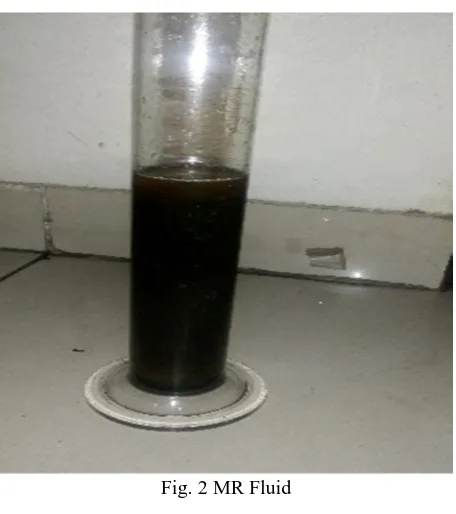
B.Prepared MR Fluid
Fig. 2 MR Fluid
V. ACKNOWLEDGEMENT
It gives us a great sense of pleasure to present the report of the Project undertaken .We owe special debt of gratitude to Mr. Shivam Goyal, Department of Mechanical Engineering, SRM Institute of Science and Technology, NCR Campus, Modinagar for his constant support and guidance throughout the course of our work. His sincerity, thoroughness and perseverance have been a constant source of inspiration for us. It is only his cognizant efforts that our endeavors have seen light of the day.
0 0.2 0.4 0.6 0.8 1 1.2 1.4 1.6 1.8 2
0 5 10 15 20 25
Y-Values
[image:4.612.193.421.396.653.2]VI. CONCLUSION
In my report of preparation and variation in initial viscosity of MR Fluid all the parameters were studied on the preparation of MR Fluid. New viscosity MR Fluid which is more cost effective and efficient using iron powder and various other components as mentioned in the report. The research paper will be of great help to people who want to study of MR Fluid and its properties the initial viscosity due to changes in percentage of iron particles were found to be 1.37,1.62,1.85 pa s for 10g, 15gand 20g iron powder respectively .
REFERENCE
[1] Jolly, M.R., Bender, J.W., and Carlson, J.D., "Properties and Applications of Commercial Magneto rheological Fluids". SPIE 5th Annual Symposium on Smart Structures and Materials; San Diego, CA; March 1998.
[2] MagnetoRheologicalFluids",onlinearticle,http://www.technologycatalysts.com/Strategic_Analysis/advmater.htm, Status of Cadillac MR suspension is mentioned.
[3] Designing with MR Fluids", Lord Corporation Engineering note, Thomas Lord Research Center, Cary, NC, December 1999.
[4] M. Kciuk, R. Turczyn“Properties and application of magneto rheological fluids”, Journal of achievement in material and manufacturing engineering, Vol.18, Issue 1-2 Sept.2006.
[5] A.G.Olabi, A.Grunwald, “Design and application of magneto-rheological fluid”, Materials and design, Vol. 28 pp. 2658-2664, 2007.
[6] Wang Y. 2014.Magnetic particles study and their applications. York: University of Yor Klingenberg DJ. 2001. Magneto rheology: Applications and challenges. AIChE Journal; 47:246- 249.
[7] Abdollah Hajalilou, Saiful Amri Mazlan, Hossein Lavvafi and Kamyar Shameli, Field Responsive Fluids as Smart Materials (Engineering Materials, Springer Singapore, 2016).
[8] DAVID CARLSON WHAT MAKES A GOOD MR FLUID? Presented at the 8th International Conference on Electrorheological (ER) Fluids and Magneto-rheological (MR) Suspensions, Nice, July 9-13, 2001.
[9] K. Kumbhar, Satyajit R. Patil A Study on Properties and Selection Criteria for Magneto Rheological (MR) Fluid Components International Journal of ChemTech Research CODEN (USA): IJCRGG ISSN: 0974-4290 Vol.6, No.6, pp 3303- 3306, Aug-Sep 2014.