The practices of decentralization in Indonesia and its
implication on local competitiveness
By: Rachmad Erland Danny Darmawan
Spv: 1. Prof. Dr. Nico Schulte Nordholt
2. Dr. Gert-Jan Hospers
Public Administration-Public Governance study
School of Management and Government
Acknowledgement
First of all, I would like to thank to Allah SWT, the Almighty God who own me and this entire world for His blessing and permission given to me to complete this thesis. I also convey my gratitude to my supervisors, Prof. Dr. Nico Schulte Nordholt and Dr. Gert-Jan Hospers for their valuable assistances, comments and help to improve this thesis. Their outstanding knowledge and experience on the subject also have made it possible for me to finish the writing in a very limited time. Secondly, I want to thank to my parents, family and my friends at home for their support and their efforts of helping me to gather and to send the data I need during the writing process. At last but not least, I also thank to the people whose I can not mention them individually but their support and guidance have encouraged me to finish my study at this great university.
At the end, I realize that this thesis is still far from being perfect, but it is a very valuable learning experience that I got most from it, especially in writing an academic report. Thus, more input, comments and even critics are welcome to improve the quality of this thesis for future works.
Enschede, July 2008
Abstract
Indonesia has been undergoing a reform process. One of its features is the introduction of new decentralization guidance in 2001 under Law 22/1999 on regional governments and Law 25/1999 on fiscal balance between the central and regional governments and in 2004, they were replaced by Law 32/2004 and Law 33/2004. This thesis scrutinizes the practices of decentralization in Indonesia, which is commonly known as ‘regional autonomy’ under this new legal framework. Besides looking at the practices, it also attempts to reveal the impacts of decentralization practices on intraregional economic competitiveness, as it is becoming one of the objectives of decentralization policy in Indonesia.
A conceptual framework is made by exploring most recent development of the concept of decentralization and intraregional competitiveness to help analyse the practices of decentralization under the new laws and their subsequent. The general analysis suggests that decentralization in Indonesia is still undermined by various problems stemming from the design of legal framework and poor implementation such as poor institutional arrangement, lack of local finance and low human resource capacity.
Furthermore, a comparative case study is arranged to reveal the impacts of decentralization to intraregional competitiveness in two cities in Indonesia, Semarang and Surabaya. Because of some technical constraints to collect primary data needed, the analysis is based on secondary sources only. The objective of the case study to reveal the factors behind the difference investment growth trends between Semarang and Surabaya, especially related to the introduction of decentralization, could not be achieved here. However, the analysis may provide tentative answers to describe the impacts of decentralization on local competitiveness.
Table of Content
Acknoledgement ... i
Abstract ... ii
Table of content ... iv
List of table and figure... vi
I. Chapter I: General approach of the thesis
I.1. Introduction... 1I.2. Problem Statement ... 4
I.3. Research questions... 5
I.4. Methodology ... 5
I.5. Case study selection ... 5
I.6. The structure of thesis ... 6
II. Chapter II: The conceptual framework of decentralization and
intraregional economic competitiveness
II.1. Introduction... 7II.2. General concept of decentralization... 7
II.2.1. Methodological problem in defining decentralization II.2.2. Form and type of decentralization II.2.3. Potential benefits of decentralization II.3. Components for successful decentralization ... 12
II.3.1. Political decentralization II.3.2. Fiscal decentralization II.3.3. Administrative decentralization II.4. Competitiveness definition ... 18
II.5. Regional competitiveness in decentralization framework... 18
II.5.1. Intraregional (local) competitiveness factors II.5.2. The analysis of possible correlations between regional competitiveness’ factors and decentralization components II.5.2.1. The government ‘competitiveness’ and the components of successful decentralization II.5.2.2. The business environment/location ‘competitiveness’ and the components of successful decentralization II.5.2.3. The firms ‘competitiveness’ and the components of successful decentralization II.6. Conclusion ... 23
III.
Chapter III: The decentralization practices in Indonesia based
on Law no 22 and 25 / 1999 and their subsequent laws
III.1. Introduction ... 24III.2. The practice of decentralization based on Law 22/1999 and 25 /1999 and their subsequent laws ... 25
IV.Chapter IV: Case study: The comparative analysis of two cities:
Surabaya and Semarang
IV.1. Introduction ... 35
IV.2. Data Issue ... 35
IV.2.1. Survey used in the analysis IV.2.2. The data problem IV.3. Factors of similarity... 37
IV.4. Factor of difference ... 39
IV.5. The impacts of decentralization on regional competitiveness ... 43
IV.5.1. Impacts on institutional factors IV.5.2. Impacts on safety, political and socio-cultural factors IV.5.3. Impacts on local economy: economic structure and potential factors IV.5.4. Impacts on manpower/labour factors IV.5.5. Impacts on physical infrastructure factors IV.6. The impacts of decentralization on Foreign Direct Investment ... 50
IV.7. The impacts of decentralization on governance indicator ... 52
IV.8. Conclusion ... 53
V. Chapter V: Conclusion, recommendations and reflection
V.1. Introduction... 55V.2. Conclusion of the analysis ... 55
V.3. Recommendations... 58
V.4. Reflection ... 59
Reference
Appendix 1: Comparison between the old and new laws
Appendix 2: Detail of the surveys
List of table dan figure
1. Figure I.1: Problem framing ... 4
2. Table II.1 Summary of the variables ... 23
3. Figure IV.1. Indonesia archipelago ... 38
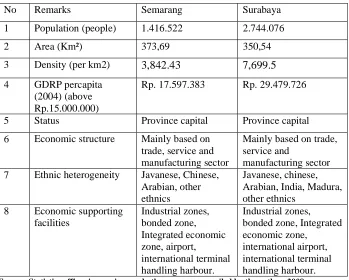
4. Table IV.1 The cities based on some similar aspects ... 39
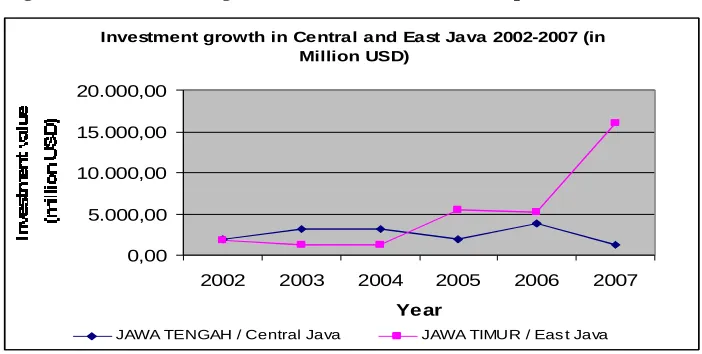
5. Figure VI.2. Investment growth in Central and East Java province 2002-2007... 40
6. Figure IV.3. Foreign Direct Investments in Semarang and Surabaya 1995-2005 (in US$ 000)... 41
7. Figure IV.4. Domestic Investments in Semarang and Surabaya 1995-2005 (in Rp. 000.000)... 41
8. Figure IV.5. The case study design ... 42
Chapter I
General approach of the thesis
I.1. Introduction
A decentralized governance as a replacement to centralistic government style has been widespread all over the world to be one of the main features of governance reform. Not only in advanced democracies such as US and the EU, decentralization in its various forms also has been the central focus of government reform in developing countries in Latin America, Africa and Asia as well.
When the centralized government everywhere has been recognized as a failure, decentralization is widely believed by its proponents to bring promising benefits. It is often suggested as a way of reducing the role of the state in general, by dispersing central authority and introducing more intergovernmental competition and checks and balances. It is viewed as a way to improve the responsiveness and efficiency of a government by taking the decision making process closer to the citizens. For example, it is believed to be easier now and more relatively efficient than before to provide public services (like electricity and water supply) in smaller market areas. In a nation with great diverse of ethnics which is a potential factor to conflicts and separatist movements, decentralization is also regarded as a way of diffusing social and political tensions and ensuring local cultural and political autonomy (Bardhan, 2002, p. 185). In most cases decentralization is often prescribed by international donors to their beneficiary countries as one of the reform requirements. Therefore, much attention and discussions are being given to investigate its impact to certain aspects of nation such as social, political and economic effects.
In most of Southeast Asian nations, decentralization has also been a central feature of fundamental transformation in the structure of government. According to White and Smoke, (2005, p.1), the initial progress of decentralization in some Asian countries is likely gone smoothly as in the case of Indonesia with the so called “regional autonomy”. Even though this may become a new progress to the decentralization development in Indonesia, it is too earlier to concluding the result.
is a unitary nation with diverse ethnics and cultures scattered in thousands islands, decentralization is considered as an appropriate governing structure to manage and to embrace the diversity of the nation. However, before the law was ready to be implemented, because many parties were hardly contested the law, it was revoked. Subsequently, seeing that decentralization could be a threat to the nation’s unity, under the late president Soeharto’s regime, decentralization was practiced in the form of deconcentration. Thus, strong centralized government was maintained, until reform took place in 1998.
In reform era, the focus of decentralization process has been moved to the district level. The establishment of Law 22 /1999 concerning regional governments and Law 25/1999 which regulates fiscal balance between central and regional governments under former president Habibie, have changed the intergovernmental relations in Indonesia. It has been said that decentralization in Indonesia has moved from strong deconcentration practice to more devolved form (Smoke, 2007, p.141).
With these laws, local governments receive large transfer of authority and decision-making discretion from central government to develop and to govern their own regions. These deep changes have wide-spread effects in the way local authorities govern their regions. For instance, regions have to set new regulation to implement those newly empowered authorities. Some developments especially in local democracy seem to be real, such as on direct elections of the head of Kabupaten (region) and Kota (municipality) in 2004. It is believed that this process has encouraged democratic process in local levels and an improved of local governments’ accountability to their constituents as a result of political decentralization (Satryo, et.all, 2005, p.8).
There are some motives behind the enactment of decentralization in Indonesia. The issues are ranging from social, political and economic motives. For example, international donors’ pressures and unsatisfactory voices from regions to previous authoritarian regime have eventually forced the incumbent government to decentralize more power to local government. In economic recovery context, decentralization is an important part of developing regional competitiveness. As laid on the Indonesian Mid-Term Development Plan 2004-2009 (RPJM), one of the purposes of decentralization in Indonesia is to empower local economy by giving the local governments a wide discretion to build and to develop their regions’ potential. According to Soesastro (2000), this can be done if the local governments have completely understood their potential competitiveness factors. By having sufficient and precise knowledge about the potential factors, it is easier for local governments to put in place sound regulations as one of the prerequisites to foster a favourable business climate in their territories (KPPOD, 2003, p.5).
process in Indonesia, which is commonly known as ‘regional autonomy’ (otonomi daerah), many argue that the rush and insufficient design and preparation of the laws - causing major flaws of the decentralization laws - were pointed out to be the major cause of the emerging problems. Amongst others, it is said that the decentralization laws did not take into account the inequality of regions’ capacity, so they can not be imposed effectively and conversely produce perverse effects, especially for poor and less developed regions. Furthermore, they have not a clear general framework which carried the goals of the reform (Alm, et. all, 2001, p.86).
However, those problems are considered as typical in a new decentralized country. The Word Bank (2005) identifies three major decentralization problems in the new decentralized countries, especially in Asia. These problems are related to 1) the design of intergovernmental structure organizations, 2) financial mechanisms for money allocation to sub-national governments and 3) the accountability of local governments and their capacity to manage the newly received authority.
From the economic perspective, based on various surveys done after the implementation of the regulations (in January 2001), businesses have begun to complain about rapid establishment of various local taxes and charges imposed by local authorities1. Those charges were reported to burden their operations and make them less competitive (Fauzi, 2003, p.7). Consequently, if this condition constantly occurs, business climate in the regions could be inhibited and eventually lowers the regional competitiveness. Thus, regional competitiveness has been becoming the centre of attention in recent years, especially as decentralization policy is effectively imposed.
Sound business climate can be associated with investment attractiveness and to the competitive advantage of respective regions (WEF, 2006, p.3). It can be said that there is a desired level of competitiveness to be created in macro-economic level (Porter, 1990, p.158). Even though it is still debatable, competitiveness in macro-economic context is frequently presented by government as a central goal of economic policy. For instance, some experts describe it as a ‘dangerous obsession’ because a state is not the same as a private firm (Krugman, 2004, in Martin, 2005, p.2-1). Although this is an important part of the discussion of competitiveness, this issue is beyond the focus of this thesis. Therefore, it should be noted that the analysis will be focused on competitiveness at local (intraregional) level.
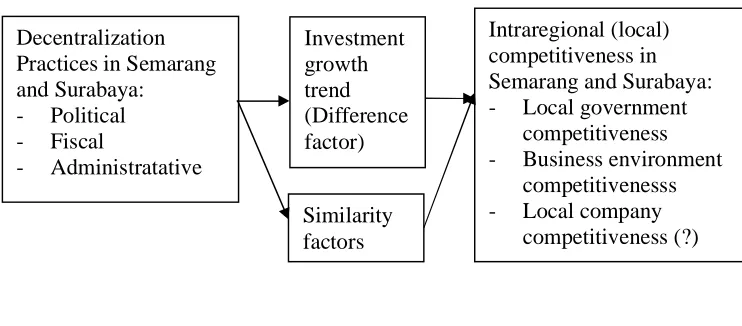
To study the competitiveness at regional level, an analysis of competitiveness within decentralization is arranged and presented in this thesis. It attempts to reveal how far the
1
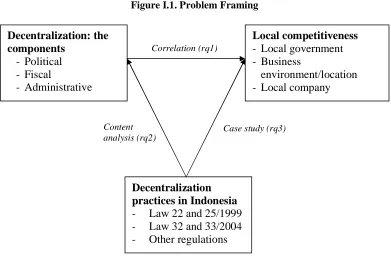
decentralization practices in Indonesia penetrate and influence the regional competitiveness system. This regional competitiveness is built by three competitiveness sub-system, namely: government competitiveness, location/business environment competitiveness, and local firms’ competitiveness. The impacts of decentralization practices is analysed by identifying how the components of decentralization influence these three sub-systems. Empirically, a comparative case study is designed to put the decentralization practices in Indonesia into the conceptual framework. In a diagram, this conception can be drawn as follows:
Figure I.1. Problem Framing
Content analysis (rq2)
Local competitiveness - Local government - Business
environment/location - Local company
Case study (rq3) Correlation (rq1)
Decentralization practices in Indonesia - Law 22 and 25/1999 - Law 32 and 33/2004 - Other regulations Decentralization: the
components - Political - Fiscal
- Administrative
I.2. Problem Statement
I.3. Research questions
Recalling the above mentioned problem, the main research question in this thesis is: What are the implications of the introduction of the decentralization laws (UU no. 22 and 25/ 1999 and their subsequent laws) on local (intraregional) economic competitiveness in Indonesia? To answer this main question, several sub-research questions can be formulated as follows: a. What are, according to the literature, the components of decentralization that will support
the intraregional economic competitiveness?
b. How are the practices of decentralization in Indonesia according to the laws ((UU no. 22 and 25/ 1999 and their subsequent laws) and, in how far do they support successful decentralization?
c. What are the impacts of the introduction of decentralization laws to the local (intraregional) competitiveness in Indonesia?
I.4. Methodology
The objective of this thesis is to explain the correlation of implementation of decentralization in Indonesia to local competitiveness level. Therefore, the research will be both descriptive and explanatory qualitative analysis. The operationalization of this approach will be done throughout several steps. First, a conceptual framework of decentralization and also its connection to local competitiveness is drawn based on existing literature. This conceptual framework will help to analyse the content of the decentralization laws in Indonesia.
Second, a content analysis of decentralization laws in Indonesia is conducted. To do this, the conceptual framework from previous chapter is being used to analyze the decentralization laws and their subsequent laws and other relevant regulations.
To generate empirical data from the field, some interviews have been tried to arrange, but without results. Therefore, for practical reason, secondary data which represents information gathered from the interviews is employed. In this case, some surveys on various issues of decentralization which had been done by several domestic and international agencies comprising NGO and donor countries, universities, think-tanks and government agencies, such as The Indonesian National Development Planning Board (BAPPENAS) (KPPOD,2003, 2005; USAID, 2001,2002; and SMERU, 2002, 2004) are used.
I.5. Case study selection
compares cities which are similar in some aspects in order to find explanations for their particular differences (Hague and Harrop, 2004, p.82).
The selection of the cities is based on some purposive criterions. First, those cities in average have similar potentials and conditions. It means that they share common basic condition, such as the population, economic growth, political, social and cultural stability, geographical size, infrastructures and factor endowments (natural resources). This criterion is needed in order to provide unbiased investment data and to avoid misperceived data. For example, we avoid using resource rich regions because the investment growth could be high in those regions and it seems to reflect positive correlation. However, if it is scrutinized closer, except the factor of natural resources attractiveness, the investment growth data is unlikely to explain the other factors why investment growth is recorded high on those cities, especially when it is linked to the local competitiveness indicators.
Second criterion, the cities should not be in a condition which tends to show bias data on investment growth. For example, there are no calamities such as ethnic conflicts or natural disasters, especially in respective year of used data. And finally, as it has addressed above, although they have similar conditions and potentials, they are differing in investment growth. This implies that one region should have higher or better investment growth against another. By this way, the use of this design is to isolate the factors responsible for the investment growth differences between them (Hague and Harrop, 2004, p.83).
I.6. Structure of the thesis
This thesis is organized as follows. This first chapter provides a general approach to the subject of this thesis. Then, the second chapter will present a conceptual framework of decentralization and local competitiveness based on literature review. This framework then will help to analyze the decentralization laws and also the possible correlation between the variables (decentralization and local competitiveness). Subsequently, the third chapter will elaborate the practice of decentralization based on the existing laws in Indonesia and how far they support successful decentralization.
Chapter II
The conceptual framework of decentralization and intraregional economic competitiveness
This chapter will answer following research question:
What are, according to the literature, the components of decentralization that will support the intraregional economic competitiveness?
II.1. Introduction
Decentralization term has been used in sloppiness and inconsistently due to the many of its applications to meet various objectives. Therefore, to solve this problem ‘it must be defined in context or as pertaining to its particular application’ (UNDP, 1999, pp.26). Moreover, as Cheema and Rondinelli (2007) argue, many of the failures of decentralization are due less to inherent weaknesses in the concept itself than to government’s ineffectiveness in implementing it (p.9). Therefore, we should be careful to define and to use the decentralization concept as it is often distorted by linguistic and conceptual problems. This is important to gain consistency on this thesis. To move further into the discussion, we arrange this section as follows: first, we briefly elaborate some methodological problems related to the definition, and then describe the forms and types of decentralization and its potential benefits, as emerged from the most recent literature. This needs to be done in order to get a common knowledge in defining and reading the ‘decentralization’ word within most recent conception every time we see it in the proceeding discussion and reduce the misconception possibility. Second, we present the components of successful decentralization. As the main part of conceptual framework in this thesis, in the third place, we elaborate the competitiveness concept and consequently, how it is being related to decentralization.
II. 2. General concept of decentralization
II.2.1. Methodological problem in defining decentralization
When first exploring the concept of decentralization from the existing literature, during the time course, it is found that there is no common definition on understanding of decentralization. Its development has taken on increasingly more diverse and varied meaning, objectives and forms. Thus, the use of decentralization term often leads to confusion especially for those who use the terms.
discourse’1. Linguistic biases could occur as it is often used in many languages other than English, such as French and Spanish. For instance, there is different definition of decentralization between Anglophone and Francophone literature. There is also a problem in confining decentralization scope within a language, such as the careless attention of French specialists to use the word ‘decentralization’ to mean only ‘devolution’.
Moreover, decentralization is also used by many people with their various objectives and preferences. As a result, those issues may eventually blur the clarity of the concept. These kinds of problem actually have been addressed by many authors of decentralization such as Diana Conyers and recently by Cohen and Peterson. They call for more studies to reduce those misconception and confusion2.
Due to the widespread of development aid from western countries, the Anglophone definition is often used by international development agencies such as the United Nation and the World Bank to conduct their projects and studies in developing countries, including Indonesia. Consequently, it makes the Anglophone literature is better developed and widely used than the Francophone one. In order to prescribe decentralization as a reform project across different countries, they should have a general approach of decentralization to gain consistency and clarity of decentralization concept. Some efforts to fulfill this intention have been carried out, as they will be mentioned briefly latter in this section.
Until the late 1980s, there was growing agreement to explain decentralization based on the conceptual terminology developed by Rondinelli, Nellis and Cheema3. They define decentralization based on the classification of decentralization by form and type. Briefly, forms of decentralization are classified on the basis of objectives: political, spatial, market and administrative. Then, each of them is divided into types. The most elaborated approach of types is found in regard to ‘administrative decentralization,’ namely: deconcentration, devolution, and delegation.
However, as the concept of governance is expanded to the broader notion, it has also influenced the rationale, objective and forms of decentralization. To capture this change, Cheema and Rondinelli (2007) update their previous works by proposing a redefined concept. They categorized the decentralization practices into four forms: administrative, political, fiscal, and economic. Along with this redefinition, some international development organizations such as the World Bank and UNDP have also produced their own approach of decentralization. For instance, UNDP (1999) already recognized the ambiguity and inconsistency of the use of decentralization term and calls for a methodological approach of
1
Conyers (1983, p.594), in Cohen and Peterson (1996, p.9) 2
Cohen and Peterson adapt the problems of linguistic biases from Diana Conyers and they indetify some major methodological obstacles to define decentralization properly.
3
defining decentralization4. There is no common definition proposed within this study. However, it suggests a methodological approach of defining decentralization based on its particular application or context (1999, p.26).
The World Bank’s decentralization briefing note (2005) has gone further to redefine general approach of decentralization. It claims that it provides ‘a broad overview to the several types of decentralization that can occur across countries and even within the same country and sector’ (p.1). There is an important progress to point out, as their studies become more critical in highlighting strengths and weaknesses of the prescribed reform approaches, such as decentralization in developing countries, instead of just blindly and carelessly force the agendas to their beneficiaries and resulted in unsatisfactory outcomes, or even in failed results5.
II.2.2. Form and type of decentralization
In general, decentralization can be defined as transfer of authority and responsibility from central government to the lower level governments or to quasi-independent government agencies such as state owned companies or to private sector (Cheema and Rondinelli, 2007). Therefore, it is principally different from a federal system. The word ‘transfer’ shows that the authority that the local governments retained is coming from the central government. It is a power that being delegated from the higher level of government (Hunter, 1977, p.3). In contrary, constitutional law in a federal system has divided the spheres of the power which each tier of government gets. In other words, the power in federalism, which the each level of governments has, including the local governments, comes from the constitutional law and therefore can not easily revoked as in decentralization in a unitary state.
The Cheema, Nellis, and Rondinelli first work divided (1983, in Cohen and Peterson, 1999,) the forms of decentralization based on the objective of decentralization, as follows:
1. Political forms of decentralization are typically used by political scientist interested in democratization and civil societies to identify the transfer of decision-making power to lower-level governmental units or to citizens or their elected representative.
2. Spatial forms of decentralization is a term used by regional planners and geographers involved in formulating policies and programs that aim at reducing excessive urban concentration in a few large cities by promoting regional growth poles that have potential to become centers of manufacturing and agricultural marketing.
4
United Nation Development Programme (UNDP). (1999). Decentralization: A sampling of definition. Working paper prepared in connection with the Joint UNDP-Government of Germany evaluation of the UNDP role in decentralization and local governance.
5
3. Market forms of decentralization are generally used by economist to analyze and promote action that facilitates the creation of conditions allowing goods and services to be provided by market mechanisms sensitive to the revealed preference individual. 4. Administrative decentralization is the focus of lawyers and public administration
professionals seeking to describe or reform hierarchical and functional distribution powers and functions between central and non-central governmental units.
In their most recent work, Cheema and Rondinelli (2007) divide decentralization into four general forms: administrative, fiscal, political and economic. It would be useful to recognize them in detail in order to become aware of their existence in a particular situation. Based on the forms of authority that are being delegated, decentralization can be divided into four forms:
1. Administrative decentralization refers to the redistribution of authority, responsibility and financial resources from central government to local or regional governments or other decentralized unit such as semi-autonomous public corporations, regional or functional authorities.
2. Political decentralization includes organizations and procedures for increasing citizen participation in selecting political representatives and in making public policy; devolution
of powers and authority to local units of government; and institutions and procedures allowing freedom of association and participation of civil society organizations in public decision-making, in providing socially beneficial services, and in mobilizing social and financial resources to influence political decision-making.
3. Fiscal decentralization includes the means and mechanisms for fiscal cooperation in sharing public revenues among all levels of government; for fiscal delegation in public revenue raising and expenditure allocation; and for fiscal autonomy for state, regional, or local governments.
4. Economic decentralization includes market liberalization, deregulation, privatization of state enterprises, and public-private partnerships. It is the shift of responsibility for functions from the public to the parties outside the governmental structure, or the private sector. This is the form that allows functions which were previously monopolized and primarily held by government to be carried out by businesses, community groups, cooperatives, private voluntary associations, and other nongovernmental organizations. Market decentralization usually takes two forms: privatization and deregulation.
Besides being divided based on the kind of authority that is transferred, decentralization can also be classified based on the degree of discretion that is transferred and to whom the authority is transferred. It can be divided into at least four types:
2. Delegation. It refers to the transfer of responsibility from central government to semi-autonomous organizations not wholly controlled by the central government but ultimately accountable to it. The example for this form is the creation of public enterprises or corporations.
3. Devolution. Devolution happens when central government transfers full authority for decision making, finance, and management to quasi-autonomous units of local government. In this type, local governments have clear and legally recognized geographical boundaries over which they exercise authority and within which they perform public functions. Further, they also have power to mobilize resources to perform their tasks.
4. Transfer of responsibilities to nongovernmental organizations. The example for this type of decentralization involves contracting out partial service provision, administrative functions, and deregulation or full privatization.
Considering the focus of this thesis, the latter type of decentralization will not be elaborated further, as it falls beyond the focus of attention. However, in practice, all countries have a combination of these types, ranging from a focus on deconcentration and delegation with limited power devolution to much more focus on devolution of political, financial, and administrative authority to directly elected local governments.
II.2.3. The potential benefits of decentralization
A lot of claimed benefits of decentralization can be found in its vast literature. Among others, the potential benefits which will be elaborated below are the most claimed by the proponents of decentralization. However, it is crucial to keep the word ‘potential’ while mentioning the benefits of decentralization as their evidence is mixed in practices. Practices over more than two decades suggest that these are not the only possible outcomes of decentralization policies6. In some cases, those benefits are likely to be real, while in the other cases; they might be not the result. The potential benefits of decentralization are as follows:
1. In the broader context of governance, decentralization can enhance the ‘fundamental principles of good governance’ which include political openness, participation, tolerance, administrative and bureaucratic capacity and efficiency. It is also seen as a way of increasing the capacity of local governments by delivering public sector modernization (Grindle, 2007, p.66).
2. It perceived as improving political representation to diverse political, ethnic, religious, and cultural groups without disrupt the state’s stability. Thus, it can be seen as a way to
6
improve the popular participation of citizens in development process and brings the policy-making process closer to citizens. This is the most important rationale, especially in a country with a high degree of social, political, and cultural diversity.
3. It enhances the creativity and innovation of all governance institutions in responding to public needs through public sector entrepreneurship7. It could help improve the equality of regional development, empower communities, and mobilize private resources for investment in infrastructure and facilities8.
4. From the economic rationale, decentralization is believed to deliver allocative-efficiency of resources that benefit the citizens. Allocative-efficiency is a condition where the limited resources in public sector are allocated at the wishes of the citizens and therefore brings the maximization of the net benefit. Allocative-efficiency can be created through the distribution of functional and expenditure responsibilities to the different levels of government. This assignment should depend on the relative competence of different levels of government to carry out a particular functional area. Thus, to assign these responsibilities, there are four considerations: 1) economies of scale, 2) the presence of externalities, 3) heterogeneity of preferences and of circumtances, and 4) emulation (Kimr, 2008, p.12).
II.3. The components for successful decentralization
There are some important components of successful decentralization (World Bank, 2005, p. 9). By considering these components in the design of decentralization framework, it is expected that decentralization would bring its potential benefits; otherwise, it may have undesirable effects. In other words, they are the components which may make decentralization framework works. This section elaborates those components based on the World Bank’s (2005) works9. It begins with the components in political decentralization and then move forward to fiscal decentralization and finally the administrative decentralization. These components will be used to analyze the decentralization laws in Indonesia and in how far they support a successful decentralization.
II.3.1. Political decentralization
Constitutional, legal and regulatory framework
Constitutional, legal and regulatory framework concerning decentralization in a country will ultimately stipulate ‘how the decentralized systems are supposed to function’ (World Bank,
7
Grindle, 2007, p.64, in: Cheema and Rondinelli, 2007. 8
Serageldin et.all. (2000) in: Cheema and Rondinelli (2007, p.7) 9
2005, p.11). There are three platforms architecture underpinning the design of decentralization constitution framework:
1. The framework should explain the broad principles of the operation of decentralization and details the rights and responsibilities of all levels of government and their roles. The constitution also serves as the basis of establishing or changing the detailed rules.
2. Defining specific parameters of the intergovernmental fiscal system and also institutional details of local government structures, procedures, accountabilities and remedies.
3. There should be a series of regulations established in order to interpret and to detail the practices and measures of the law(s) operation, including the tasks that are shared between national and sub-national governments.
Furthermore, there are some issues that should be addressed in shaping the contents within these platforms. First, whether the items placed in the platforms come from a consensus of involved stakeholders or difficult negotiations between competing interests. Second, it is necessary to keep its consistency to the other existing laws to prevent confusion and contradiction with other laws. Third, it should recognize the differences of capacity among the level of governments and matching the degree of autonomy and the privileges given to the regions’ performance. (The World Bank, 2005, p.13). Among others, the most important is that the legal and regulatory systems should have a single interpretation to minimize the discrepancy between the formal rules and actual practice. Ambiguity and complexity create openings for conflicting interpretation and confusion (World Bank, 2005, p.14).
Participation
II.3.2. Fiscal decentralization
The decentralization effort includes the expenditure and revenue assignment to local level. The most extensive discussion may come within this aspect of decentralization because it arranges the distribution of responsibility to deliver the public services among levels of government and the resources to fulfill those responsibilities.
Expenditure assignment
There are some considerations of designing the fiscal decentralization policy. It is imperative to define as clearly as possible the expenditure responsibilities to enhance accountability and reduce unproductive duplication of authority and legal challenges (World Bank, 2005, p.19). In this case, following the principle of subsidiarity, the decision-making for a particular public service should be based on the geographical area that internalizes the benefits and costs of related service. It may lead to the grouping of roughly congruent services at each level of government. However, as Kimr (2008) noted, this principle is contradicted with the residual principle applied in unitary countries, where local governments are assigned particular functions by the central government.
The local governments should be assigned with some particular services that could better deliver locally. In areas of shared responsibilities, the roles should be clarified. Generally, the central government should be involved with overall policy, setting standards, and auditing; state/province governments should have an oversight function; and local governments should be involved in the provision of infrastructure and services.
An additional important consideration is that accountability is often best promoted by establishing clear and close linkages between the costs and benefits of public services, so that the amount of expenditure responsibility assigned to a particular level of government corresponds to the amount of revenues that each level has at its potential command.
The revenue assignments
The decentralization policy should balance the distribution between expenditure and revenue. In term of revenue sources, there are three sources of revenue for local governments: local taxes, intergovernmental transfers and sometimes, local borrowing. There are some considerations to design the policy concerning each of revenue sources.
Tax is one of the main revenue sources for central and local governments. Therefore they should be designed carefully to avoid adverse effects because of improperly design of tax policy. In setting tax policy, there are several notes to be addressed:
- Tax should have sufficient proportion for each level of government corresponds to their expenditures.
- The tax policy should not have adverse effect on the efficiency of internal common market. Uncoordinated setting of tax can disrupt the movement of mobile resources such as capital and tradable goods across the regions.
- The decentralized tax policy often comes with potential increase of administrative cost for the tax collection and management activities, especially tax with multi-district bases and mobile base across jurisdictions.
- Ideally, revenue collected should be enough to fulfill revenue needs (expenditure responsibility). Thus, tax assignments should be assigned to the level of government with responsibility for the related service. However, the tax setting must not be at the expense of efficiency of tax administration and national economic. Hence, the difficulty lies here, on the one side tax instruments have to make local governments become accountable for their revenue. While on the other hand, the instruments should keep the efficiency of tax administration and avoid national economic distortions.
Intergovernmental transfer and grants
The design of intergovernmental transfers and grants is usually established to address some specific problems such as fiscal gap or vertical imbalance between expenditure and revenue at sub-national government level. Furthermore, the transfers are important to correct fiscal inequality among the sub-national governments, improve the fiscal efficiency across jurisdictions, overcome spillovers and establish fiscal harmonization. The World Bank (2005) defines several characteristics of good design of intergovernmental transfers as follows: - Transfers are determined as objectively and openly as possible, ideally by some
well-established formula.
- Transfers are relatively stable from year to year to permit rational sub-national budgeting, but at the same time they are sufficiently flexible to ensure that national stabilization objectives are not thwarted by sub-national finances.
- The formulas are transparent, are based on credible factors, and are as simple as possible.
Sub-national borrowing
to their own sources of revenues that can be pledged as collateral is also necessary to reduce possible moral hazard.
The combination of the use of information systems, access to own revenues, public legislation, bankruptcy laws, and market decentralization offers an overall institutional incentive for a hard budget constraint at all tiers of government. Eventually, this condition permits borrowing to be decentralized. Sequencing fiscal decentralization prior to allowing sub-national borrowing might become one of the policy options.
II.3.3. Administrative decentralization
Civil service reform and decentralization
Decentralization gives the governments various channels to access citizens’ preferences and to identify local conditions in order to match their activities to local needs and thus creates incentives to local politicians to be more accountable to their constituents. However, it is not an easy task to perform such issue especially in a newly decentralized country which is used to be centrally controlled. The levels of difficulties are arranged from providing sufficient level of capacity of human resource at the local level while at the same time preserving national standards of service delivery. The administrative decentralization framework should also be designed to avoid inequality of human resource distribution among regions, and at the same time reducing potential refusal of central mandates by local authorities. Hence, the design of administrative decentralization policy should deal with following issues:
Inequality of local condition to attract human resources may lead to unequal redistribution. This can hamper efficient service delivery since local governments would need competent people in order to carry out new responsibilities. Therefore, the degree of local capacity determines the kind of human resources management strategies that will be feasible and desirable. This calls for the role of central government in shaping human resource policy without curtailing local options.
The framework of administration decentralization has to provide incentives and discretion for local governments to tailor their own human resources needs to undertake their responsibilities.
allow sub-national governments the flexibility to hire civil servants that matches the community’s needs and budget constraints. Once more, this need to be synchronized with national policies.
Increased citizen control and augmented information for policymakers are two of the most commonly recognized benefits of decentralization. The challenge is to balance these bottom-up pressures with some sort of accountability to higher levels of government in order to ensure that local policies are compatible with larger-scale national efforts. Benchmarks, essentially lists of responsibilities or standards to meet, can effectively balance these bottom-up influences. Clear path for information flows are the first step in ensuring coordination between different levels of government and citizens. Clear reporting procedures are needed from lower to higher levels of government (central government, in the case of regional administrations, for example) and across government agencies at the same level.
Information and monitoring in decentralized system
Accountability is a prerequisite for improving public sector performance, and information is the key to accountability. The systematic collection, analysis, and reporting of information are critical elements of decentralization programs because information can be used to verify compliance with policy goals, to analyze alternative outcomes, and to guide future decisions. Information on financial flows (that is, budgeting and expenditure reporting) and other inputs, outputs, and outcomes is essential both at the local level—to inform local constituents and to encourage public participation in the political process—and at the central level—to monitor and supervise local activities funded (at least partially) by central sources.
To improve financial accounting and reporting, detailed fiscal data should be regularly collected and reported for sub-national governments. Ideally, these data would be derived from uniform financial and reporting systems. At a minimum, these data should be collected and processed on a regular and timely basis. The development and implementation of financial reporting and information systems often require substantial technical assistance, training, time, and resources.
Local technical and managerial capacity
The first task is to identify the specific tasks that local governments and citizens will need to carry out. The second task is to create appropriate, comprehensive indicators to measure local groups’ ability to carry out the required functions. There are several issues to consider in measuring capacity: outputs or outcomes, variable ability, people or institutions, bureaucratic and technical infrastructure, and the role of civil society.
Conventional approach to decentralization puts capacity building first before decentralizing the responsibilities or revenues, because of suspicions about irresponsible spending, local corruption, regional inequities, and service collapse as well as by many central governments’ reluctance to devolve authority. One of the arguments of decentralization is to increase local participation and hence local government leverage in gaining access to national resources and to encourage the development of public and private planning and management skill. Therefore, decentralization can be a good way to build local capacity which usually could be done through training and practice.
II.4. Competitiveness definition
In general, there are various explanations of defining competitiveness and also debates over the concept. For instance, competitiveness in its simplest definition is viewed only based on the exchange rate (Boltho, 1996). Others define it broader by focusing on structural factors which affect medium to long term economic performance (Fagerberg, 1996). The eminent work may come from Porter (1990) with his ‘competitive diamond’ concept.
Briefly, he argues that the competitiveness of a location as the productivity that companies located there can achieve. So, there are three key elements in his concept: productivity, location and company. All of them have been used to understand the drivers of sustainable economic prosperity at a given location. Thus, it should be noted that among these elements there are inter-correlations which influence each others. For example, geographical location is considered as a key determinant of company productivity. While in the same time, company’s productivity becomes the key determinant of the level of prosperity a location can sustain over time. This puts a basis for concepts and theories explaining the source of prosperity and growth differences across countries.
II.5. Regional competitiveness in decentralization framework
business environment within sub-national regions. Therefore, it is important to consider the implication of the geographical boundary, especially for policy analysis of their different roles and priority issues for competitiveness.
More over, evidence is found that cities/regions do compete with each other to obtain investments and to promote themselves as a place for business activities. For example, some cities are performing better than others as they can generate more income and employment within their boundaries than others (Begg, 1999, p.4). Thus, it is important to establish an analysis of the factors which driving the region’s competitiveness. For instance, ‘good’ policy can equip cities to adapt and to foster a dynamic economic environment; ill-judged policies can deter investment and trigger to the relative decline of such environment (Begg, 1999, p.9). There is also growing recognition to call upon governments to create an environment that supports rising productivity (Porter, 1998, p.23). This suggests that the capacity of a city to compete is shaped by interplay between the attributes of cities as locations and the strengths and weaknesses of the firms and other economic agents active in the regions, especially the local governments.
In terms of decentralization which divides government into different levels, the interaction between policies pitched at different levels and their effects will be much of the concern. Taking into account local competitiveness variable, the challenging task for decentralization policy will be to enhance the performance of individual cities, without destabilizing the national economy, but in the contrary supplement it. Thus, the key question becomes how policy for enhancing competitiveness should be assigned between tiers of government. In line with the subject of this thesis, the analysis below may partially address this question, especially on how decentralization delineates the roles of local governments in improving local competitiveness.
II.5.1. Intraregional competitiveness factors
To analyze the intraregional competitiveness factors, the analysis recognizes three sub-systems of the factors of competitiveness that build regional competitiveness as a whole. Each sub-system signifies the different role of each main actor in the intraregional competitiveness system. These levels are elaborated as follows:
indicators. In short, governments’ ‘competitiveness’ captures how efficient and effective a government can be when it serves its constituencies.
2. Business environment/location’s competitiveness sub-system: This sub-system points out to the location in which businesses operate. The development between regions at a certain level will be different, thus creating the distinction between locations. Eventually, these differences will generate the attractiveness of a region for businesses. In this context, regions will compete to get economic resources they need to achieve prosperity. Much attention being given to create a favorable business climate within the regions. Thus, it is imperative to measure the competitiveness of the regions through the business environment they offer, such as the infrastructure, regulations regime, and community building which may support a rising productivity. The business environment factors are largely influenced by the government’s performance and its civil society.
3. Firms’ competitiveness sub-system: It is undoubtedly that the basic idea of competitiveness comes from the firms’ level. Firms compete to each other in a zero sum game. Aside from the external environment in which businesses operate, the productivity of a company is also strongly influenced by the quality of its management itself– the ability of business leaders to manage their company efficiently. Thus, their competitiveness is measured through the productivity and the performance of the company’s management.
II.5.2. Possible correlations between regional competitiveness’ factors and decentralization components
The foregoing discussion points to a range of interplay between the components of successful decentralization and the three levels of competitiveness factors to explain the correlation between them. Therefore, this section provides possible correlation between both concepts. However, considering the limitation of place and time, the author realizes that the analysis presented below might not capture the whole picture of all dynamic inter-correlations between them. This will be a future work to explain.
II.5.2.1. The government ‘competitiveness’ and the components of successful decentralization
The main aim of decentralization policy is to enhance good governance practices at all levels of government. However, the level of government which is most affected by decentralization policy is the local government. The process of decentralization has brought significant new resources and power to the local decision-makers. Decentralization, in certain degree, also encourages the local governments to involve the civil society and private sector together to provide public services.
of their people. Hence, it is believed that sound regulation setting in decentralization policy, which ensure public sector accountability, efficiency, transparency and free from corruption, would enhance governments’ efficiency and thus avoiding the waste of public resources and regulatory burden, especially for the businesses sector. Thus, the ‘competitiveness’ of governments is very likely to be influenced by the practice of decentralization. However, it should be noted that these are not always positive. In this case, as an instrument of governance reform, the success and fail of decentralization policies lies on the design of its legal framework. Therefore, it calls for clarity of rights and responsibility of all levels of government and their roles as well.
Only when it is properly designed, decentralization could sharpen the need for defining the comparative advantages of each of the different actors. In the local level, local governments can specialize on the services which are specifically tailored only for their communities. This, likely, would improve the ‘competitiveness’ of local governments. However, potential threat of the negative effects still exists and can not be eliminated if it is poorly designed and implemented.
II.5.2.2. The business environment/location ‘competitiveness’ and the components of successful decentralization
To create a competitive business environment, regions are required to provide good quality of infrastructure, skilled human resources through education and trainings, ensuring healthy economic environment for competition and a supporting regulatory environment for the business sector to raise productivity. For instance, in the case of facilitating the development of specific industries, as in cluster-based program (Porter, 1990; Enright, 1998), the local investments tend to be become far more focused on the infrastructure, skills and capabilities required by the industries. Besides, the social and community development of the region also affect the conduciveness of a business climate. Above all, the level of governments’ intervention to the local markets where the companies compete also plays a crucial role in shaping the attractiveness of region for businesses.
In general, the governance and policy influence resemble the local environment as a set of factors outside the direct control of the firm. These factors exert a significant influence on the attractions of the locality as a place of business by affecting the ease with which business can be conducted (Begg, 1999, p.8). This implies that regulatory regime and institutional design influence the competitiveness of a location.
influence the business environment. Consequently, at this competitiveness’ level, there is a quite distance between decentralization and the competitiveness of local business environment. Therefore, direct link between them can not be drawn robustly.
Yet, if decentralization is seen as a part of regulatory regime’s reform, especially at local level, the relation between them will be clearer. There is evidence that demonstrates how changes on regulatory regime can produce many influences on competitiveness. This also implies that the governments’ roles in shaping competitiveness become more important, rather than leave the market mechanisms to build competitiveness alone10.
II.5.2.2. The local company ‘competitiveness’ and the components of successful decentralization
It is obvious that competitiveness is an attribute of companies. They compete in zero sum game to acquire markets and resources, measure competitiveness by looking at relative marker shares or profitability, and use competitiveness strategy to improve their performance. Hence, competitiveness of a firm can be assessed based on its capability to reach the highest productivity through resources utilization and production process efficiency. Thus, the ability of business leaders to manage their company efficiently is crucial here. While business environment is heavily weighted by public policy, company is the part of competitiveness system that public policy has only limited influence. It is important to keep in mind that, as Krugman and Porter point out, it is actually the companies who compete to each other and generate prosperity, while nations or the regions compete to offer the location conduciveness for business.
Thus, to improve the regional competitiveness in a whole, the policy should also concerns about the competitiveness at firms’ level. Only with a specific strategy, governments can improve the company’s performance. The clusters strategy is a good example. This strategy fosters a geographic concentration of firms as well as suppliers and service providers of the same sector. It has been recognized as a significant factor to improve a company’s performance. Unfortunately, if the objective of decentralization is confined only to improve
10
For example, Korean industries grew rapidly after a regulatory reform took place. This point is questioned by the author: why Porter puts the role of governments outside his ‘competitive diamond’, while the governments do have influence to shape the competitiveness of a nation not less important than the other elements of the competitive diamond. Eventhough Porter explains the interaction between the role of governments and the elements of competitive diamond, the author sees that government intervention should be included into those elements and cannot be separated from the ‘competitive diamond’.
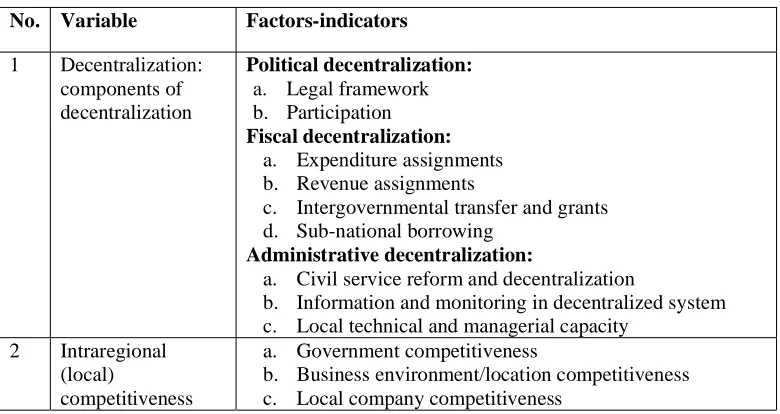
the government performance, then it would far beyond the reach of decentralization policy to capture the competitiveness of firms into its arms. The summary of both concepts are explained on following Table II.1.
Table II.1 Summary of the variables No. Variable Factors-indicators
1 Decentralization: components of decentralization
Political decentralization: a. Legal framework b. Participation Fiscal decentralization:
a. Expenditure assignments b. Revenue assignments
c. Intergovernmental transfer and grants d. Sub-national borrowing
Administrative decentralization:
a. Civil service reform and decentralization
b. Information and monitoring in decentralized system c. Local technical and managerial capacity
2 Intraregional (local)
competitiveness
a. Government competitiveness
b. Business environment/location competitiveness c. Local company competitiveness
II.6. Conclusion
Chapter III
The decentralization practice in Indonesia based on Law no 22 and 25 / 1999 and their subsequence laws
“
This chapter will answer following research question:
How are the practices of decentralization in Indonesia based on Law no 22 and 25 / 1999 and their subsequence laws and in how far they do support successful decentralization practice?”
III.1. Introduction
Decentralization is not a new policy for Indonesia. In the past, Law No.5 /1974 concerning regional government (pemerintah daerah) had orchestrated the relationship between central and regional government formally based on the principles of decentralization, deconcentration and co-administration (tugas perbantuan), however, in practice it was never realized under the New Order government and consequently, decentralization at that time was merely a deconcentration of authority and co-administration from central government to the lower levels of government1.
Along with the reform that took place in 1998, the new decentralization laws were prepared under the escalating pressures of disintegration and demands for more democratic government from the civil societies and international donors at that time. As a result, Law No. 22 /1999 on Regional Government and Law No. 25 on Fiscal balance between central and regional government were enacted on May 1999 and became effective in January 2001, given two years of preparation period for all levels of governments to fully implement the laws. Unlike their predecessors, the newest decentralization laws have different emphasize on how decentralization should be carried out. These laws are designed to devolve more powers to the district governments. Besides, as an emerging democracy country which has been engaging in a reform, this change is also accentuated by the western international donors’ involvement that tends to promote decentralization as a means of devolution of powers to improve democratization.
As predicted by many observers, preparation time that was too short and hurried formulation causing potential flaws on the laws, the decentralization processes have inevitably started to produce adverse effects. For instance, during their short implementation period, several problems are identified, such as unclear division of authorities among the tiers of government causing a struggle for authorities among them, inefficient resource allocation caused by the low capacity and demoralization of civil servants within the regional governments, widening
1
disparity among regions, and stronger primordial ties based on ethnic and religion. ( Suwondo, 2002; Seymour &Turner, 2002; Yappika, 2006). Thus, in order to improve the decentralization practices, Law No.32/ 2004 and Law No.33/2004 were established under president Megawati to replace the previous laws (Alm et.al, 2001; Fattah, 2002; Yappika, 2006)2.
In addition, to explain how these laws shaping the decentralization practices in Indonesia and how far they support successful decentralization, a content analysis of the laws is provided in this section. The analysis uses the framework of successful decentralization created in Chapter 2. This analysis is aimed to help to disentangle the complexity of decentralization in Indonesia, especially the problems which are derived from the deficiencies of decentralization framework design. A lot of points could be made in regards to the laws, however, because the limitation of place and time, the analysis may not be able to analyze all those features and the dynamic situation within this regulatory framework.
III.2. The practice of decentralization based on Law 22/1999 and 25 /1999 and their subsequent laws.
III.2.1. The constitution, regulatory and legal framework
Law No. 22/1999 and Law No. 25/ 1999 and subsequently, Law No. 32/2004 and Law No. 33/2004 constitute of ‘how the decentralized systems are supposed to function in Indonesia. So, as the constitutional, legal and regulatory framework they should clarify the broad principles of decentralization operation and detail the right and responsibilities of all levels of government and their roles. They should also specify the parameters of the intergovernmental fiscal system and also institutional details of local government structures, procedures, accountability and remedies. Moreover, the framework must provide the details and practical intepretation through the establishment of a series of regulations, especially those concerning the tasks that are shared between the tiers of the government3.
The first broad principles of decentralization is stated in Chapter I of both laws, which define the general provision of the autonomy regions and their definitions4. In the Article One, section (i) formally states that regional (provinces, districts, and municipalities) will have full autonomy to ‘govern and administer the interest of the local people’ within the boundary of the “unitary state of the Republic of Indonesia” and the decentralization practice will be
2
For more detail elaboration of the political and economic background when the laws were prepared, see appendix 1.
3
Intergovernmental fiscal system will be explained under the fiscal decentralization to avoid the redundancy of analysis.
4