Efficient and Secure Re-Encryption Data
Model for Cloud
Jangala Jeevankumar1, Dr.S.Kalaimagal2
1
M.Tech Student, 2Assoc. Prof , CSE, Vaagdevi college of Engineering, Warangal, TS
Abstract: In the computer generation number of users were increasing greatly, as the number of users increases the usage of data also increase, as the usage of data increases data storage also increases gradually. When data increase there are number of chances to theft the data. So to increase the data storage a technology is playing vital role i.e. cloud computing. In this data can be stored and data can be accessed the same. Here, the data authorized person must concern about security of the data. This work is to provide more security to the data stored in cloud. Identification Based Encryption is introduced to provide encrypted key generation related operations to key update cloud service provider for key – issuing and key update processes. An encryption is used to provide security to data, for authenticating the user; encrypting the date again called re-encryption data storage model for security. This work proposes an outsourcing computation into IBE revocation formalizes the security.
Keywords: Cloud computing, data security, Identity based encryption, KU-CSP
I. INTRODUCTION
Cloud computing is a model which empowers the clients for putting away the information and programs and getting to them effectively through a web as opposed to utilizing some equipment and programming parts in the PC. A cloud computing additionally has numerous definitions dependent on their lot of sorts of models. The cloud models are delegated the sending what's more, administration models. Cloud clients will effortlessly get to the applications and information content that put away in the cloud from anyplace in the world by the money related model called as pay-as-you-go. At whatever point the information is put away in the cloud there might be the issue of security issues and once when the information is outsourced to cloud the cloud supplier should check for the information content and the data with respect to the protection and as indicated by that gave data the supplier must give the security. With the end goal of security distinctive properties based encryption plans are utilized for encryption before outsourcing the information to the cloud server [12].With validation and approval the client can verify the information in the cloud. The information put away in cloud will be generally put away in the pool and where it endeavors to give security to that client information content. Cryptography is a technique which is utilized to store and transform the information in the specific structure with the goal that as it were the expected clients can peruse or process the information effectively. Cryptography get to control is a usually utilized strategy to secure the information on the en-trusted servers.
unique mark, voice face, console timings of the clients. The validation should likewise be possible by figure content substance. The figure content is a scrambled content where the information result will be gotten in a scrambled arrangement. The information proprietor's recognizable proof, importance and the key (ace/open) of the information proprietor’s properties will be contained in the figure class content [15].
A. Key Aggregation
At the point when information is shared over the conveyed cloud condition it very well may be verified by giving the total key. For the specific information proprietors the total key comprises of some character to locate the ideal identifier alongside the property based modules. This key is as a rule used to share the information between one another utilizing a few mysteries enters in the middle of them. Key collection approves the clients/information supplier to share information with others in a sure manner by utilizing a few little figure content extension, and this content can be given to each approved clients by giving a solitary and little total keys. These total key can be sent to the approved client through any methods for correspondence mode covertly, the correspondence mode can be through email, SMS and so on. This total key causes the other client to unscramble the information [15].
II. RELATED WORKS
The investigation of R.V. Agalya and K. Karthika Lekshmi [1] chips away at the ABE (Attribute Based Encryption) utilized store the encryption information in the cloud. It enables the client to encode and decode the information by utilizing the qualities. In ABE conspire decoding contains the costly tasks. The end of the decoding issue can be finished by the ABE framework with the re-appropriated decoding. In this the client information will be submitted to the cloud supplier with some change key and due to this key substance the cloud deciphers any ABE figure content credit to basic figure content substance. Thus in this they present an ABE encryption and with the redistributed unscrambling alongside some confirmation substance and recuperation strategies. Henceforth this method verifies the information and gets right information alongside the recuperation component and evades the hacking issue from the programmers.
J.Wei et al. [2] proposed a documentation called Revocable Capacity Identity-Based Encryption (RS-IBE) this gives a forward/in reverse security of the figure content substance by presenting the functionalities of client revocation and at the same time the updation of the figure content will be done. The execution of the proposed framework is more beneficial regarding proficiency and usefulness and it is doable for practical and information sharing framework.
J.Y.Huang et al. [3] they have focused on the personality based key administration framework for the configurable various leveled distributed computing condition. This proposed framework comprises of calculation on the encryption, verification and furthermore gives the effective key recreation in the event of PKG disappointments. Because of this office it lessens the key development cost on distributed computing server farms.
S.Qui et al. [4] they have considered the issue about the private coordinating over the re-appropriated encoded datasets in the character based cryptosystem and this can be streamlined by the authentication the executives. So they have proposed an Personality Based Private Matching Scheme (IBMP) which empowers the cloud server to play out the private coordinating tasks with no spillage of the private information content. They examined the information through the asymptotic complexities and with the test results they found that the expense of the IBPM was direct to the measure of dataset what's more, it is likewise progressively effective then the current framework which was proposed by Zheng [30]. So in this framework they attempt to incorporate two things for better coordinating they are the character based fluffy private coordinating and the identitybased multi-watchword fluffy inquiry.
Y.M.Tseng et al. [5] the creator Li.et al as proposed a revocable IBE (Identity Based Encryption) conspire with a Key Update Cloud Service Provider (KU-CSP) thus it as numerous disadvantages so the proposed framework contain another revocable IBE conspire with the Cloud Revocation Expert (CRA) to take care of two issues that is the place the execution will be improved and the CRA holds just the framework emit for every one of the clients. Also, for the security the proposed framework will give a comparative secure under the Decisional Bilinear Diffie-Hellman (DBDH) suspicion. Subsequently these proposed frameworks contain the CRA-helped validation plot for dealing with countless different cloud administrations.
each progression is called as a round. The means of substitution and transposition are performed at each round. C.Wang et al. [7] learned about the picture informational collections also, the best approach to verify the delicate information that is redistributed also, subsequently they proposed the Outsourced Image Recovery (OIRS) which focuses on a portion of the angle from the beginning of the administration stream the angle resemble verifying, ability, and plan intricacy. In the proposed framework the information proprietors not just redistribute the compacted picture substance to the cloud yet in addition recreate the pictures without edifying its subtleties from the relating tests of the picture content.
Li et al. [8] in this they deal with the guide lessen haze of ABE which helps in giving the information is re-appropriated the expense of the client will be diminished amid the encryption process. The benefit of this framework is the client will be ready to appoint the encryption content for any unique strategy content.
M.Green et al. [9] takes a shot at ABE in this they attempt to decrease the client trouble while utilizing the figure message that are put away in the cloud. In this they give a solitary change key to the clients and this key enables the cloud to decipher any sort of the ABE figure content into an El Gamal style figure content substance without the cloud can peruse the any piece of the client message content. Aside from this it additionally helps in giving the security by utilizing the security definition like the CPA and the repayable CCA security for the re-appropriated information.
Varsha S.Agme and Archana C.Lomte [10] they take a shot at upgrading the information security model which is finished utilizing the cloud administrations. The proposed framework endeavors to give security to the information utilizing the three stages they are as per the following right off the bat the information encryption will be done next the information must be unscrambled so the unscrambling is finished by utilizing the client confirmation in the wake of getting the client verification subtleties then the information will be unscrambled to those clients. Aside from this procedure it additionally gives the insurance against the dangers and formally known as DDOS assaults. This framework too gives an office to the client in which the client can ask for the data by sending a SMS and it isn't important to be in online dependably. Kiran et al. [11] thinks about about the picture preparing strategy they endeavor to take a shot at the unsharp concealing system. They give security to the information by expanding the security levels for the encoded scrambled pictures. They endeavor to utilize just a solitary key for the motivation behind encryption and decoding of those pictures. Aside from this they have additionally utilized the pressure strategy for its better pressure. At long last a few tests are directed to check whether the picture is verified in the system.
III. OVERVIEW OF THE SYSTEM
A. The process of Revocation
Revocation implies review. By open key framework and Certificate Revocation List (CRL) the revocation activity should be possible in cryptosystem. The CRL contains a rundown of declaration that is renounced. Immovably expelling the traded off keys should be possible by revocation process. In light of the information proprietor’s id the keys/information are disavowed in cloud. At the point when the ace key substance and the open key substance are reclassified then the revocation occasion will be called identified with their variable quality and later by utilizing the ace key the information will be re-encoded [15].
B. Proxy re-encryption and Identity Based Encryption (IBE)
Securing the communication process should be possible in the open key cryptography when both the sender and receiver attempts to make an encryption and mark key sets to the information content that must be verified and afterward present the authentication solicitation to the Certificate Authority (CA) along with the confirmation of personality and after that get the CA-marked testament which is utilized for approval and afterward later they trade the scrambled message. This procedure was time devouring and to out originate from this procedure the personality based encryption was presented.
IV. PROPOSED SYSTEM AND METHODOLOGY
here we as it were imagine it as a specialist co-op, and focus on the method for structuring it to secure the clients information with a trickiness KU-CSP. Further it comprises of three necessities for such model the prerequisites are as pursues:
Any of the KU-CSP must be very honest
There may be the computational complexities, so to get the impact to the revocation a genuine KU-CSP is required.
The PKG run time may be a lot littler than expected to straightforwardly act or do revocation process.
Out Sourcing Update Key
Secure Key
[image:4.612.129.500.182.423.2]Provider Update Key
Figure 1: System Architecture
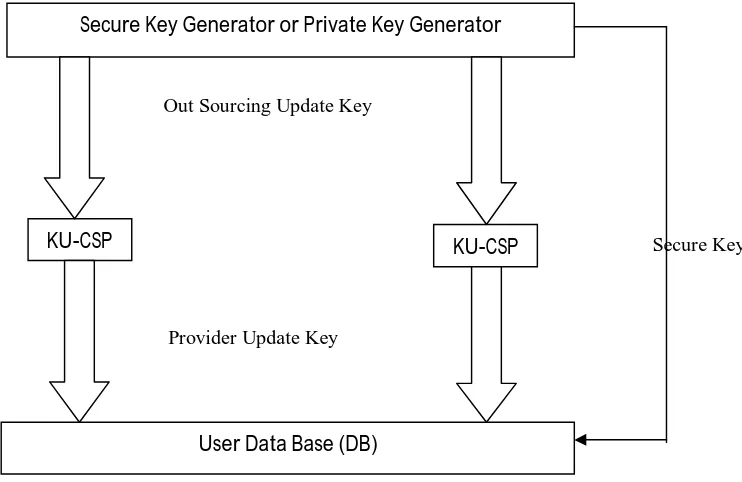
This architecture gives the data about the system alongside its related substance. It is a theoretical model and consequently this model gives data concerning conduct, working and so on. The beneath design demonstrates the errand done by the specific framework: In the above gave design it acquires the work of the proposed framework. In this design the PKG creates a private key to the client and they will be given by the private key or Secure key and the outsourcing key will be given to the KU-CSP and the KU-CSP stores the outsourcing key. At the point when the client needs for updating of keys they can refresh the keys effectively with the KU-CSP as opposed to returning to PKG.
V. MODULES
A. Admin Module
An admin gives all permission to the users here admin module is used to handle all the users. Here admin module is used to handle the registered users. This module gives acknowledgement for the users after his/her successful registration. Admin maintains the list of users database, when a user sends data to other after successful delivery of the plain text it sends an acknowledgement. Admin provides encryption and decryption options for the users to secure data.
B. Sender Module:
A user can register using user registration page. User can write a plain text message by composing a plain text. This message can be send to the other user who needs it. Then user sends a message to the receiver then immediately he will get ack. This message can be secured by selecting the encryption or secret message then compose it and send to the receiver.
C. Receiver Module
Receiver module used to receive the encrypted messages sent from the sender, he will this as the encrypted message. All his mails will be stored in the inbox, select a message to open, then he will decrypt the message with secret message using 128 bit encryption
Secure Key Generator or Private Key Generator
User Data Base (DB)
VI. CONCLUSION
Distributed computing is a conveyed framework associated with the servers where clients can share information one another. An Character based intermediary re-encryption plot has been acquainted with re-appropriate the delicate information from the fundamental client to the outer client. By the by, they can't be utilized in distributed computing. This framework will build the security by presenting the character based secure encryption and re-encryption process for the put away information. This work has focused on the character disavowal. It has utilized redistributing count in the IBE and proposed in a disavowal plot where in the disavowal activity is designated in CSP. The proposed framework accomplishes the accompanying:
It gives consistent effectiveness to figure the PKG also, size of private key at the client.
It offers comfort since the client may not contact the PKG at the season of key updation and there is no need of client validation between the client and the CSP.
REFERENCES
[1] Shawish, Ahmed, and Maria Salama. "Cloud computing: paradigms and technologies." Inter-cooperative CollectiveIntelligence: Techniques and Applications. Springer Berlin Heidelberg, 2014. 39-67.
[2] Jianghong Wei ; Wenfen Liu ; Xuexian Hu Secure Data Sharing in Cloud Computing Using Revocable-Storage Identity-Based Encryption
[3] Huang, Jyun-Yao, I-En Liao, and Chen-Kang Chiang. "Efficient identity-based key management for configurable hierarchical cloud computing environment."Parallel and Distributed Systems (ICPADS), 2011 IEEE 17th International Conference on. IEEE,2011.
[4] Qiu, Shuo, et al. "Identity-Based Private Matching over Outsourced Encrypted Datasets."
[5] Tseng, Yuh-Min, et al. "Identity-Based Encryption with Cloud Revocation Authority and Its Applications."
[6] Wang, Cong, et al. "Secure ranked keyword search over encrypted cloud data." Distributed Computing Systems (ICDCS), 2010 IEEE 30th International Conference on. IEEE, 2010.
[7] Wang, Cong, et al. "Privacy-assured outsourcing of image reconstruction service in cloud." Emerging Topics in Computing, IEEE Transactions on 1.1 (2013): 166-177.
[8] Li, Jingwei, et al. "Outsourcing encryption of attribute-based encryption with mapreduce." Information and Communications Security. Springer Berlin Heidelberg, 2012. 191-201.
[9] Green, Matthew, Susan Hohenberger, and Brent Waters. "Outsourcing the Decryption of ABE Ciphertexts." USENIX Security Symposium. Vol. 2011. No. 3. 2011.
[10] Agme, Varsha S., and Archana C. Lomte. "Security Enhancement of Outsourced Data on Cloud Using Identity Based Encryption." (2014).
[11] G. Thippanna, Dr. T. Bhaskara Reddy, Dr. S. Kiran , " Image Masking and Compression Using user Private Key Generation" , International Journal of Emerging Trends & Technology in Computer Science (IJETTCS) , Volume 3, Issue 5, September - October 2014 , pp. 262-266 , ISSN 2278-6856.
[12] Agalya, R. V., and K. Karthika Lekshmi. "A Verifiable Cloud Storage using Attribute Based Encryption and Outsourced Decryption with Recoverability." [13] Thippanna, G., T. Bhaskara Reddy, and S. Kiran. "Image Masking and Compression Using user Private Key Generation." IJETTCS ISSN: 2278-6856. [14] Swarup kshatriya and Dr.Sandip M Chaware. A Survey on Data Sharing using Encryption technique in cloud computing.
[15] R. Subbu lakshmi and R. Nirmala Survey on Imparting Data in Cloud Storage Using Key Revocation Process. [16] http://www.cloud tutorials.com.
[17] Jin Li, Jingwei Li, Xiaofeng Chen, Chunfu Jia, and Wenjing Lou Identity-Based Encryption with Outsourced Revocation in Cloud Computing. [18] Wei, Jianghong, Wenfen Liu, and Xuexian Hu. "Secure Data Sharing in Cloud Computing Using Revocable-Storage IdentityBased Encryption." [19] Geetanjali P. Rokade , Sambhaji Sarode Survey on Implementing Privacy Preserving Model for Shared Data in The Cloud.
[20] Dr.V.VENKATESA KUMAR , M.NITHYA , Mr.M.NEWLIN RAJKUMAR An Assessment on Identity Based Encryption Mechanisms in Cloud Computing [21] Cong Wang, Student Member, IEEE, Qian Wang, Student Member, IEEE, Kui Ren, Member, IEEE, “Towards Secure and Dependable Storage Services in