2079
©IJRASET: All Rights are Reserved
Social Network based Question and Answer
System
Archana M R
1,
Bharan Bopanna M S
2, Dharani D
3, M L Pushpanjali
4 1Asst. Professor, Department of Computer Science & Engineering, ATMECE2, 3, 4 8th Semester Students, Department of Computer Science & Engineering, ATMECE
Abstract:Question and Answer (Q&A) systems play a vital role in our daily life for information and knowledge sharing. Users post questions and pick questions to answer in the system. Due to the rapidly growing user population and the number of questions, it is unlikely for a user to stumble upon a question by chance that (s)he can answer. Also, altruism does not encourage all users to provide answers, not to mention high quality answers with a short answer wait time. The primary objective of the system is to improve the performance of Q&A systems by actively forwarding questions to users who are capable and willing to answer the questions.
Also improve Social Network Based Question and Answer system with security and efficiency enhancements by protecting user privacy and identifies, and retrieving answers automatically for recurrent questions.
Keywords: Question, Answer, Knowledge, Information and efficiency.
I. INTRODUCTION
The Internet is an important source of information, and the amount of data on the Internet is vast and constantly growing. Users rely on search engines to find specific information within this knowledge base. Search engines such as Google and Bing do a good job of indexing web pages and providing users with pages relevant to their search queries. These search engines use keywords provided by the users to perform searches; however, there are some specific questions that are not suited for search engines. For
example―Where is the best place to get your car fixed in Clemson? Q&A systems have been developed to address this particular class of non-factual questions.
Since their inception, Q&A systems have proved to be a valuable resource for sharing expertise and consequently are used by a large number of Internet users.
Current Q&A systems consist of hundreds of thousands of users, so the number of questions asked is also very large. Consequently, when a user intends to answer a question, he/she may be overwhelmed by the plethora of questions needing answers. Moreover, there are potentially some questions where a user has expertise and can provide a better answer than other users, but there is currently no way for him/her to locate those particular questions among the thousands of posted questions.
Also, web Q&A sites such as provide high-quality of answers (e.g. yahoo! Answer and Ask.com) to enhance Q&A sites emerging efforts have been focused on social network.
The Social-based Q&A system can be classified into two categories: Broadcasting-based and centralized server based, In Broadcasting method questions are broadcast to the user and to user’s friends, In Centralized server the social network of each user is constructed and maintained , it searches potential answer from the asker’s friends, friends of friends and so on.
For a given question, the user who is interested or has expertise in a specific topic would provide better answers than the user who possesses less knowledge of the topic.
Thus, there is a need to develop a mechanism that would forward questions.
The strategy of Social Network Based Question and Answer is created out of three segments: User Interest, Question Categorizer, and Question-User Mapper.
A. Client Curiosity Analyser connects every single client with a vector of intrigue classes.
B. Question Categorizer partners a vector of intrigue classifications to every single inquiry. At that point, in view of client intrigue and social closeness.
2080
©IJRASET: All Rights are Reserved
II. LITERATURESURVEY
A. Social Q&A: An Online Social Network Based Question and Answer System
Prateeksha Chaurasia, The essential purpose of this paper is to improve the execution of Q&A frameworks by currently sending inquiries to clients who are able and prepared to response the inquiries. To this end, we have composed and actualized Social Q&A, an on the web informal local community based mostly Q&A technique. Social Q&A use the informal local community properties of standard intrigue and frequent believe in companion relationship to acknowledge an asker through kinship who are properly on the way to response the inquiry, and improve the client security. We likewise improve Social Q&A with security and productivity upgrades by guaranteeing client safety and distinguishes, and recovering answers naturally for repetitive inquiries. The strategy of Social Network Based Question and Answer. Social Q& A is created out of three segments: User Interest, Question Categorizer, and Question-User Mapper. Client Curiosity Analyser connects every single client with a vector of intrigue classes. Question Categorizer partners a vector of intrigue classifications to every single inquiry. At that point, in view of client intrigue and social closeness. Question-User Mapper recognizes prospective answerers for every single inquiry. The outline of Social Q&A depends on two informal organization properties. In the initial area, social companions have a tendency to have comparative interests. Second, social companions have a tendency to be trustworthy and philanthropic since of the residence of “fellowship encourages collaboration”.
B. Social Q&A: An Online Social Network Based Question and Answer System
Haiying Shen, Guoxin Liu, Haoyu Wang, Nikhil Vithlani, The primary objective of this paper is to improve the performance of Q&A systems by actively forwarding questions to users who are capable and willing to answer the questions. To this end, we have designed and implemented Social Q&A, an online social network based Q&A system. Social Q&A leverages the social network properties of common-interest and mutual-trust friend relationship to identify an asker through friendship who are most likely to answer the question, and enhance the user security. We also improve Social Q&A with security and efficiency enhancements by protecting user privacy and identifies, and retrieving answers automatically for recurrent questions. Compared to previous Q&A system works, Social Q&A also leverages both the common-interest and mutual-trust social network properties to improve the QoS performance. It incorporates different algorithms to determine user interest, question interest and the question-user mapping. Unlike previous Q&A system works, it does not assume that friendship is always trustable and incorporates algorithms that avoid revealing personal information to others as little as possible. An online social network connects friends with real-life relationship and online friendship, which shares similarity to the real-life social network. It forwards a user’s questions to his/her social friends that have common interest and a close social relationship.
C. Social Based Q&A System in Cloud Environment
G. Taruni, A.P. Siva Kumar, they propose social search on cloud based Q&A system that provides the large resources to store the information. It also provides quick response to the question and sharing questions is also feasible. We also analyse the appropriate value for the Time-To-Live (TTL), that provides a satisfactory success ratio, it avoids redundant message overhead and reduces the waiting time. In this paper, we present how these Q&A system can accurately identify the best answerers who are expertise in that area. Since each user is connected to several social groups, it selects most probable answerers and forward to an answerer that can provide an answer. We can also get response from any location by accessing through internet by means of cloud server which provides storage of large resources. All the question and answers are stored in the cloud. After finding the friends with similar interest, it will select k number of best answerers among those friends. It will select the k answerers based on the feedback or performance of the users. If they have a good response feedback, then they are selected among k friends The future of Q&A system in cloud is demandable and scope full. The users who give answers are considered as best answerers only if the asker is satisfied with the answer to that question.
D. An Online Social Network Based Question and Answer System with Large User Base
2081
©IJRASET: All Rights are Reserved
user locally stores his/her own profile and interest ID, and friend list and their interest IDs and answers quality values. Web Q&A sites such as provide high-quality of answers (e.g. Yahoo! Answer and Ask.com) to enhance Q&A sites emerging efforts have been focused on social network. The Social-based Q&A system can be classified into two categories: Broadcasting-based and centralized server based. In broadcasting method questions are broadcast to the user and to user’s friends. In Centralized server we construct and maintains the social network of each user, it searches potential answer from the asker’s friends, friends of friends and so on. Cloud computing are used to meet the requirements like adaptability, scalability, availability, and self-awareness.
1) Existing System: Current Q&A systems may not meet the requirement of providing high quality answer with a short answer wait time, though users wish to receive satisfactory answers quickly. Since Social Network Based Question and Answer System is built upon social networks. The asker and answerer are social close to each other. Therefore, protecting the privacy is important and challenge.
2) Proposed System: We propose Social Network Based Question and Answer System, an online social network based Q&A system, that actively forwards questions to those users with the highest likelihood (capability and willingness) of answering them with expertise and interest in the questions’ subjects. The design of Social Q&A is based on two social network properties. First, social friends tend to share similar interests (e.g., lab members majoring in computer systems). Second, social friends tend to be trustworthy and altruistic due to the property of “friendship fosters cooperation”. The design of Social Network Based Question and Answer System. Social Network Based Question and Answer System are composed of three components: User Interest Analyser, Question Categorizer, and Question-User Mapper. User Interest Analyser associates each user with a vector of interest categories. Question Categorizer associates a vector of interest categories to each question. Then, based on user interest and social closeness, Question-User Mapper identifies potential answerers for each question.
III.IMPLEMENTATION
“Social Network Based Question and Answer System” using the web applications and Data Mining to train the system using machine learning that adapts itself to provide large resources to store the information. The web applications include 2 accounts ‘User Account’ and ‘Admin Account’.
A. The Admin have login credentials to log in to their respective accounts. The Admin adds the user after the user registers.
B. The admin also adds keywords.
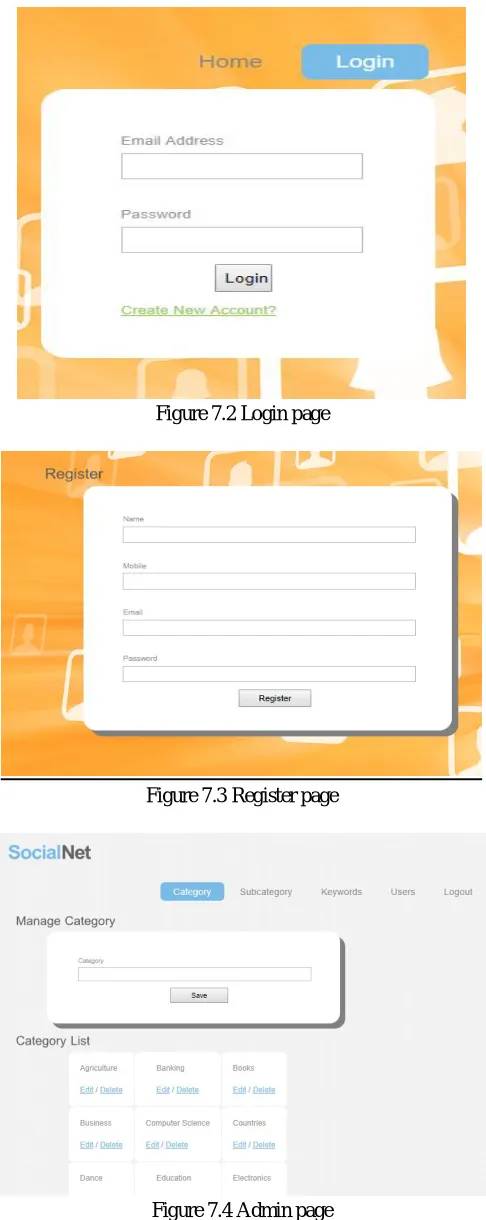
C. A new user can register in Login User page providing the details required.
D. The user can now select the categories and also sub categories and based on his knowledge he can also select the level in that particular category like beginner, intermediate or expert.
E. If the user is an expert, then he should register by uploading document for proof. This document is approved by the admin.
F. A request can be sent to the existing user in order to provide the answers and hence a social circle is formed.
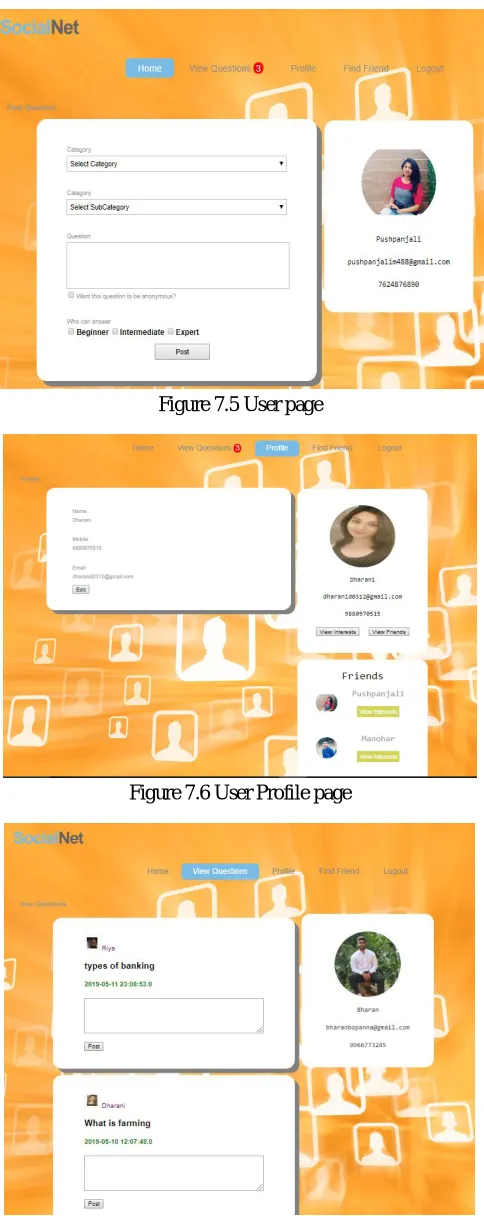
G. The user module consists of a query section in which the user can post his query by selecting a particular category and sub category.
H. When a new user registers to the website, he/she must provide their level of interest which can be bigger, intermediate or expert level in any particular field of their interest and also the users can add any number of interests. This helps in finding the best answers.
I. The best answer will found out among the multiple answers provided by different answer providers of different interest level based on the usage of keywords in the answer.
J. Since the Social Network Based Question and Answer system addresses non-factual questions, if a user is willing to ask any such question and does not want to reveal his/her identity, this could be achieved by posting an anonymous question.
K. By posting an anonymous question users privacy is protected, at the same time a best answer could also be obtained.
public ArrayList<Question> getFriendQuestions(){
publicint saveAnswer() {
introws = -1;
DAO dao = new DBImplementation();
String query = "insert into answers(questionId,userId,answer)"
+ "values("+getQuestionId()+","+getUserId()+",'"+getAnswer()+"')";
2082
©IJRASET: All Rights are Reserved
dao.closeConnection();
returnrows ; }
public Answer getBestAnswer() {
Answer answer = new Answer(); String bestanswer = "Not answered"; String ans = "Not answered";
intcount = 0;
intuserId = 0;
String anonymous = "true";
DAO dao = new DBImplementation();
String query = "select userId,answer,anonymous from answers where questionId = "+getQuestionId(); ResultSet resultSet = dao.getData(query);
try {
while(resultSet.next()) {
ans = resultSet.getString("answer");
intnewcount = getKeyWordCount(ans);
if(newcount > count) {
bestanswer = ans;
count = newcount;
userId = resultSet.getInt("userId");
anonymous = resultSet.getString("anonymous"); }
}
} catch (SQLException e) {
// TODO Auto-generated catch block
e.printStackTrace(); }
dao.closeConnection(); System.out.println(count);
answer.setAnonymous(anonymous);
answer.setAnswer(bestanswer);
answer.setUserId(userId);
returnanswer; }
IV.SNAPSHOTS
2083
©IJRASET: All Rights are Reserved
Figure 7.2 Login page
[image:5.595.177.420.107.717.2]Figure 7.3 Register page
2084
©IJRASET: All Rights are Reserved
Figure 7.5 User page
Figure 7.6 User Profile page
2085
©IJRASET: All Rights are Reserved
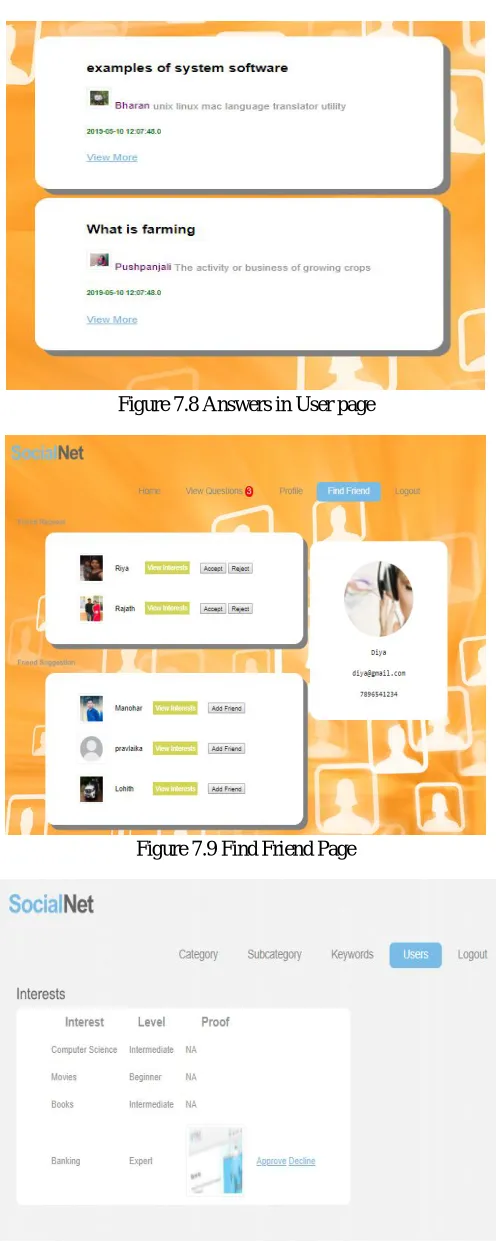
Figure 7.8 Answers in User page
Figure 7.9 Find Friend Page
2086
©IJRASET: All Rights are Reserved
V. CONCLUSION
Question and Answer systems are used by many people for purposes such as information retrieval, academic assistance, and discussion. To increase the quality of answers received and decrease the wait time for answers, an online social network based Question and Answer system is developed. It utilizes the properties of a social network to forward a question to potential answer providers, ensuring that a given question receives a high-quality answer in a short period of time. It removes the burden from answer providers by directly delivering them the questions they might be interested in, as opposed to requiring answer providers to search through a large collection of questions as in Yahoo! Answers or flooding a question to all of an asker’s friends in an online social
network. Using users interest and the level of knowledge they possess in particular category question are forwarded to the potential answer providers. Users privacy is protected by making the question anonymous and getting relevant answers to it. Each and every category and sub category consist of keywords related to that particular category which helps in finding the best answer.
REFERENCES
[1] M. R. Morris, J. Teevan, and K. Panovich. A Comparison of Information Seeking Using Search Engines and Social Networks. In In Proc. of ICWSM, 2010. [2] M. R. Morris, J. Teevan, and K. Panovich. What do People Ask Their Social Networks, and Why? A Survey Study of Status Message Q&A Behaviour. In Proc.
of CHI, 2010.
[3] Z. Gyongyi, G. Koutrika, J. Pedersen, and H. Garcia-Molina. Questioning Yahoo! Answers. In Proc. of QA Web, 2008. [4] Yahoo! Answers Team. Yahoo! Answers BLOG. http://yahooanswers.tumblr.com/, [Accessed on 10/20/2014].
[5] B. Li and I. King. Routing Questions to Appropriate Answerers in Community Question Answering Services. In Proc. of CIKM, 2010.
[6] L. A. Adamic, J. Zhang, E. Bakshy, and M. S. Ackerman. Knowledge Sharing and Yahoo Answers: Everyone Knows Something. In Proc. of WWW, 2008. [7] A. Mtibaa, M. May, C. Diot, and M. Ammar. Peoplerank: Social Opportunistic Forwarding. In Proc. of Infocom, 2010.
[8] H. Shen, Z. Li, G. Liu, and J. Li. Sos: A distributed mobile q&a system based on social networks. TPDS, 2014.
[9] A. Spagnolli and L. Gamberini. Interacting via sms: Practices of social closeness and reciprocation. British Journal of Social Psychology, 2007.
[10] M. L. Radford, C. Shah, L. Mon, and R. Gazan. Stepping Stones to Synergy: Social Q&A and Virtual Reference. Proceedings of the American Society for Information Science and Technology, 2011.
[11] M. Richardson and R. White. Supporting Synchronous Social Q&A Throughout the Question Lifecycle. In Proc. of WWW, 2011.
[12] R. W. White, M. Richardson, and Y Liu. Effects of Community Size and Contact Rate in Synchronous Social Q&A. In Proc. of SIGCHI, 2011.
[13] J. Teevan, M.R. Morris, and K Panovich. Factors Affecting Response Quantity, Quality, and Speed for Questions Asked via Social Network Status Messages. In Proc. of ICWSM, 2011.
[14] Z. Li and H. Shen. Collective Intelligence in the Online Social Network of Yahoo!Answers and Its Implications. In Proc. of CIKM, 2012. [15] X. Geng, H. Zhang, Z. Song, Y. Yang, H. Luan, and T. Chua. One of a kind: User profiling by social curation. In Proc. of Multimedia, 2014. [16] Z. Yang, J. Xue, C. Wilson, B. Y. Zhao, and Y. Dai. Uncovering user interaction dynamics in online social networks. In Proc. Of ICWSM, 2015. [17] J. Zhang, M. S. Ackerman, and L. Adamic. Expertise Networks in Online Communities: Structure and Algorithms. In Proc. of WWW, 2007.
[18] J. Bian, Y. Liu, D. Zhou, E. Agichtein, and H. Zha. Learning to Recognize Reliable Users and Content in Social Media with Coupled Mutual Reinforcement. In Proc. of WWW, 2009.
[19] M. Bouguessa, B. Dumoulin, and S. Wang. Identifying Authoritative Actors in Question-Answering Forums: the Case of Yahoo!Answers. In Proc. of KDD, 2008.
[20] L. Hong, Z. Yang, and B. D. Davison. Incorporating Participant Reputation in Community-Driven Question Answering Systems. In Proc. of CSE, 2009. [21] Y. R. Tausczik and J. W. Pennebaker. Predicting the Perceived Quality of Online Mathematics Contributions from Users’ Reputations. In Proc. of SIGCHI,
2011.