Seismic Analysis of the Effect of Different Shapes of
Structures Using ETABS
Vikas Jain
1, Prof. Hitesh Kodwani
21MTech Scholar, Sam College of Engineering and Technology, Bhopal 2Assistant Professor, Sam College of Engineering and Technology, Bhopal
Abstract: Due to the unpredictable nature of seismic action, it is necessary to design the tall structures by considering the critical effects of seismic action on the structure. Seismic force depends upon exposed area of the structure. The Earthquake drive relies on size and state of structure so it is critical to consider fluctuating part of tremor weight while planning the structure. The execution of a structure can be improved when a seismic tremor acts by improving the state of the structure by giving distinctive arrangements with the goal that the quake burden will be less. In this research work, an endeavour is done to compare different shapes of structure like T, H, E and L are considered with a G+15 story structure in seismic zone IV on ETABS software using response spectrum method.
The parameters on which the research is based are Maximum Storey Displacement, Maximum Overturning Moment and Maximum Auto Lateral Loads.
Keywords: Tall buildings, Seismic force, Seismic zone, Storey displacement, Auto lateral force, ETABS.
I. INTRODUCTION
Current propels in the improvement of high-quality materials combined with further developed
computational strategies and plan methods have prompted another age of tall structures which are thin and light. These structures are exceptionally delicate to the two basic powerful loads as wind and quakes. The Earthquake compel relies on size and state of structure so it is imperative to consider fluctuating segment of seismic tremor weight while planning the structure. The execution of a structure can be improved when a seismic tremor acts by improving the state of the structure by giving diverse designs with the goal that the quake burden will be less. For playing out the seismic examination of a structure, the real time history record of every single area is important.
However, it is beyond the realm of imagination to expect to get all records or information at every single area. Besides, the seismic examination of structures can't be done basically dependent on the pinnacle estimation of the ground increasing speed as the reaction of the structure rely on the repeat substance of ground development and its own one of a kind properties. To vanquish the above difficulties, tremor response go is the most notable instrument in the seismic examination of structures. There are computational inclinations in using the response extend system for seismic examination for desire for evacuations and part controls in essential structures.
The technique comprises of the computation of just the most extreme estimations of the relocations and part powers in every method of vibration utilizing smooth structure spectra that are the normal of a few seismic tremor movements. Response spectra are twists plotted between most extraordinary responses of SDOF system presented to decided seismic tremor ground development. Response range can be deciphered as the locus of most extraordinary response of a SDOF structure. Response run examination (RSA) is a straight ground-breaking quantifiable examination strategy.
Response extend examination is useful for plan essential initiative since it relates assistant sort assurance to dynamic execution. 1) Objective: The main objective of this work is to do the comparative study of seismic analysis of high-rise structure having
different configurations in seismic zone IV of India. The same structure is analysed by ETABS software. These are the following objectives of this work-
A. To study the Maximum Storey Displacement and Maximum Overturning Moments and Maximum Auto Lateral Loads on
high-rise structure with different Configurations
II. LITERATURE SURVEY
A. Bardia Khafaf (et al 2008) studied that high rise building with general pyramid geometry have been increasing used in new development zones. It is seen that even in high prone areas, there are many high rises building under design and construction. On the other hand, in relevant seismic codes there are no specific criteria for such type of structural systems. The structural systems in these buildings are moment resisting frames with or without bracing frames or shear walls. The structural elements are usually composed of beams and vertical columns in middle part and inclined columns in side faces of buildings. The inclined column element in this type of structure makes the structural behavior in different manner. Nevertheless, there are some special structural aspects of these building, especially due to earthquake events; one of the most important obscurity manners is extremely torsional effects structures of asymmetric pyramid building especially in lower stories. In this paper the results of numerous analytical studies performed for asymmetric, symmetric pyramid structures compared with regular structure and compare to codes requirement are shown.
B. Hamada (et al 2013) A study was conducted to assess the seismic provisions of the National Building Code of Canada (NBCC)
2005 and 2010, pertaining to the loading and analysis of irregular L-shaped buildings. The study uses a low-rise and a high-rise building as case studies.
Three-dimensional models of the two irregular buildings are developed using the commercial finite-element software package ETABS. The lateral resisting system of the high-rise building consists of a combination of shear walls and rigid frames, while the low-rise building consists of shear walls only. The code provisions are strictly followed with regard to the equivalent static and dynamic analysis procedures. According to the code provisions and based on the location of the building, dynamic analysis is not required for the low-rise building. However, a response spectrum analysis of this building reveals a significant contribution of the higher modes, which is not accounted for accurately in the equivalent static approach. The dynamic analysis of the high-rise building indicates that the base shear force estimated by the code can be significantly over estimated. Also, the study reveals that the directions of application of two perpendicular ground motions specified by the code might not be the most critical in the case of L-shaped buildings.
C. N. Jitendra Babu (2017)studied the effect and variation of wind pressure with the shape, rounding of the corners and height of the structure. Aerodynamic approach is architecture is the extreme approach in the design of tall buildings. In the present thesis, multistory buildings of 40 storey, 60 storey and 80 storey were modelled for different shapes of structures i.e. rectangular structure, Rectangular structure with rounded corners, Square structure, Square structure with rounded corners, Circular structure and Elliptical structure.
The influence of height and shapes on gust loads and its effects on the response of the structure are studied in the present case. The analysis of the building has been carried out using standard commercial software (STAAD PRO) and the estimation of wind loads is done by Indian standard code IS-875(Part-3). The effect of rounding of the corners of tall structures is studied through computational fluid dynamics (CFD) on pressure distribution on the surface of the structure. Standard software fluent is used for CFD analysis.
D. Bhumika Pashine1 (et al 2016) studied modern architecture means something abstract, irregular in geometry. Everyone wants to win the race of designing aesthetically beautiful and complex structures and with issue of scarcity of land it is today’s necessity to go higher and higher vertical and construct high rise structures. But as we go higher wind excitation becomes one of the most precarious force acting on the surface of the structure and if the plan geometry is irregular it can induce torsion which can be life-threatening to the structure, so it is essential to analyze and understand such forces during designing. In this paper behavior of high rise building against the wind force having two irregular geometry, (T shape and L shape) is studied and analyzed for different heights. Both the geometries were investigated for 15, 25 and 30 storey and observed that all the parametric coefficient increase per unit length with increase in height. Also, direction of wind plays very vital role in behavior of structure.
III. METHODOLOGY
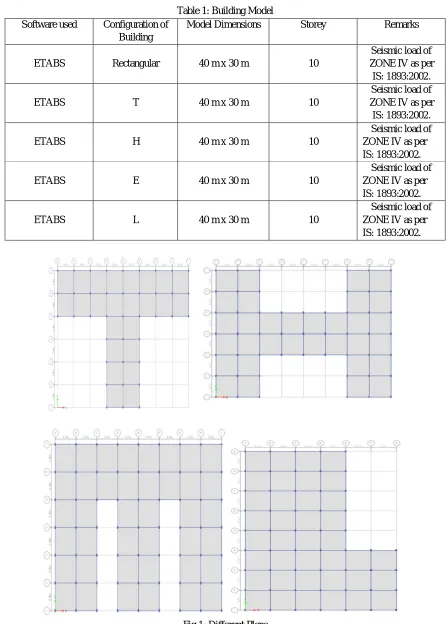
Table 1: Building Model
Software used Configuration of
Building
Model Dimensions Storey Remarks
ETABS Rectangular 40 m x 30 m 10
Seismic load of ZONE IV as per IS: 1893:2002.
ETABS T 40 m x 30 m 10
Seismic load of ZONE IV as per IS: 1893:2002.
ETABS H 40 m x 30 m 10
Seismic load of ZONE IV as per IS: 1893:2002.
ETABS E 40 m x 30 m 10
Seismic load of ZONE IV as per IS: 1893:2002.
ETABS L 40 m x 30 m 10
[image:3.595.73.521.106.730.2]Seismic load of ZONE IV as per IS: 1893:2002.
Table 2: Specifications
Specifications Data
Typical Story Height 3.5 m
Base Story Height 1.5 m
No. of Bays in X-Direction 8
No. of Bays in Y-Direction 6
Bay Length in X-Direction 5 m
Bay Length in Y-Direction 5 m
Concrete Grade M-35
Density of R.C.C. 25 kN/m3
Density of Masonry 20 kN/m3
Columns 350 mm x 500 mm
Beams 300 mm x 350 mm
Slab Thickness 120 mm
Bottom Support Conditions Fixed
Live Load- Roof Rest of the structure
1 kN/m2
2 kN/m2
Soil Conditions Medium Soil (Type II)
Damping Ratio 5%, as per IS-1893: 2002 (Part-1)
Poisson Ratio 0.2
Response Reduction Factor 3
Importance Factor 1
Zone Factor As per IS-1893: 2002 (Part-1) for different
Seismic Zones
A. Following Procedure Is Adopted For Analysis Of High-Rise Structures 1) Step1: Selection of building geometry, bays and story.
2) Step2: Select the property of frame sections for building frame 3) Step3: Select the support conditions for different loading conditions:
4) Step4: Select loading condition such as dead load, live load, Seismic loads and combination of loads. 5) Step5: Structural analysis of building frames for above loading conditions.
6) Step6: Analysis results in terms of Maximum Storey Displacement and Maximum Overturning Moments and Maximum Auto Lateral Loads.
7) Step7: Critical study of results.
B. Preferred Load Combinations
According to IS 1893 (Part 1): 2002, Clause 6.3.1.2 the following load combinations of gravity and lateral loads with approximate Partial safety factors for limit state design of reinforced concrete structures and prestressed concrete structures are-
1) 1.5 (D.L. + I.L.) 2) 1.2 (D.L. + I.L. ± E.L.) 3) 1.5 (D.L. ± E.L.) 4) 0.9 D.L. ± 1.5 E.L
IV. RESULT AND DISCUSSION
From above literature, many researchers gave his results on the seismic analysis of different configurations of structures and analyse it using seismic and wind loads. Researchers done their work on the above topic but restriction was the static method thus some conclusions are seen while reviewing such papers related to my work is:
In this work, we have made approximations on the geometrical plan of structures, which are going to be drawn on the ETABS interface. These structures are being analysed further on the basis of Seismic loads as per the provisions given in IS: 1893: 2002/05. Seismic analysis results will be evaluated on the basis of following sub-heads, i.e. the Maximum Storey Displacement and Maximum Overturning Moments and Maximum Auto Lateral Loads.
REFERENCES
[1] B. Khafaf, R. Mirghaderi, A. Imanpour, and F. Kheshavarz, “Behavior of Torsional Effects of Asymmetric Pyramid Shape High Rise Building in Seismic Zone,” Struct. Congr. 2008, vol. 41016, no. October, pp. 1–9, 2008.
[2] S. K. Jain, “Review of Indian seismic code, IS 1893 (Part 1): 2002,” Indian Concr. J., vol. 77, no. 11, pp. 1414–1422, 2003. [3] IS 456: 2000 Plain & reinforced concrete code of practice.
[4] Bureau of Indian Standards: IS-1893, part 1, Criteria for Earthquake Resistant Design of Structures: Part 1 General provisions and Buildings, New Delhi, India, 2002.