Chatbot Application for Tourists
Prof. Pooja Dhule1, Divya Rajput 2,Shreya Mangade3, Shraddha Birajdar4
2, 3, 4
UG Students, 1Department of Computer Engineering, MMCOE Engineering College, Karvenagar, Pune-52, India
Abstract: This paper includes building a chatbot by using various techniques like natural language processing(NLP),Pattern Matching and Dialogue Generation. The chatbot have the ability to learn conversation between user and machine. In this paper we are building a chatbot for tourists using artificial intelligence(AI).
The chatbot has information stored in database to identify the sentences and make a decision itself to answer a given question. For that decision making or to train a chatbot we need some algorithms. Based upon this concept we are going to implement chatbot for tourists .When tourists visits a city they have many issues related to finding affordable services like medical service, food service, apartment searching and many more. Hence by providing this information via effective method can help them a lot. This process starts from NLP and finally ends with Dialogue Generation.
Keywords: Natural Language Processing, Pattern Matching , Dialogue Generation, Chatbot
I. INTRODUCTION
Now a days Artificial Intelligence is a treading domain. The aim of artificial intelligence is to create modern technologies that allows computers and machines to interact with an intelligent manner. Chatbot is nothing but the interaction between human and machine.
This application is use as the personal assistant that to make human work easier. Artificial Intelligence plays a very important role in humans to the next level. With the rapid growth in technology and development, we can have a lot more exciting features and uses of AI in the future. Chatbot comes under. This Chatbot will provide the answer for any places related queries. So, it will be more helpful for visually impaired people in their daily life. Whereas proposed Chatbot application is made with an android platform Chatbot. They are used because it provides a quickly answer to the question. So chatbot can be use in various applications. In our system we are trying to build an application for tourists. All kind of information will be provided to the user like about particular places. Now a days ,everyone use the Google Maps for finding any location .But the Google Maps only suggest places that we want to search it .
Our concern to develop Chatbot for tourists this chatbot is responsible to give answer related places .It also give us further information related to places .This Chatbot is really use for the Visually Impaired people. Our chatbot take input as text based as well as voice based.
The proposed Chatbot gives great flexibility for the visually impaired people to learn easily without others help. The proposed android Chatbot application could provide any kind of information which included in our database and it can also provide user defined information. So it gives the ability to the user to define their own question and answer. It has the capability to get the input as text as well as speech format from the user. So user no need to type the keyboard or in build microphone in mobile for provide the input. Output of this application will be given as text and speech format. So user can able to view and hear their output. So this Chatbot will serve as new platform for a visually impaired people in their for their travelling. They can get the answer for their query or some other places.
Our chatbot also recommended some hotels and gives us comparison between them. This application can run in every android devices with internet connection. We can use the multiple method to build chatbot like natural language processing ,pattern matching and dialogue generation. Natural language also uses the naïve bayes algorithm to understand input language. After pattern matching the concept used is Dialogue Generation which is a last step. Once the pattern is matched then dialogue generation takes place.
II. SYSTEMARCHITECTURE
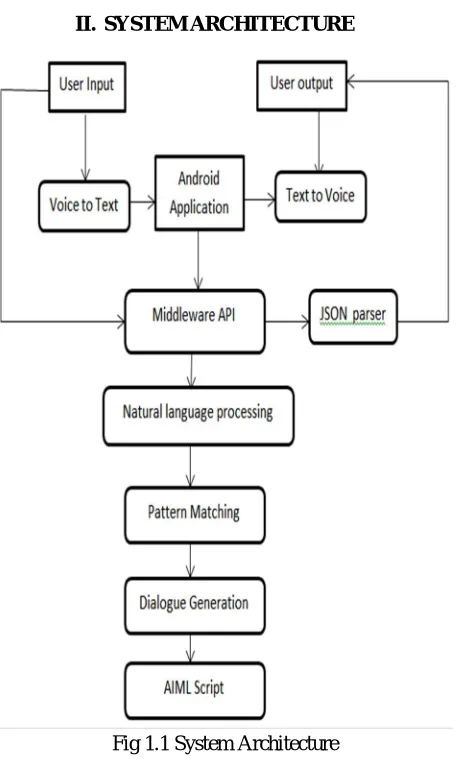
Fig 1.1 System Architecture
The user gives the input to the android application in form of text as well as voice then it goes in the API . The user input is passed to the API for the response. The voice input is first convert the voice into text before sending it into API using SpeechToText library. These library is responsible to convert with appropriate text format. Then the API is connects to the database scripts with our chatbot application . When user input is received at the API then it is passed to the Natural language processing .The NLP first understand the language after it generate the appropriate response which runs over the AIML scripts. In process, then it going to pattern matching algorithm is executed for matching of the valid response from the available in database. When pattern is matched, the corresponding result is return to the API. Then API is convert the corresponding result into the JSON format and sends the reply to the android application. After receiving the response application again convert into the JSON and gives the response to the user if is in text format. If the output is getting back into voice then using TextToSpeech library then its gives response to user in voice format.
The response generation process is carried out with two phases [2].
A. Natural Language Processing
Each input to the NLP interpreter is passed through two main phases.
1) Natural Language Understanding
2) Natural Language Generation.
B. Pattern Matching Behaviour
C. Dialogue Generation
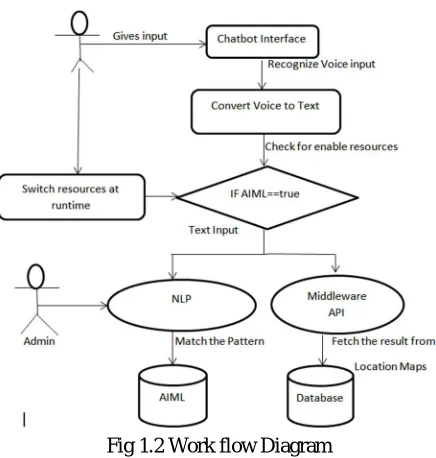
Fig 1.2 Work flow Diagram
1) Natural Language Processing: NLP is further divide into two methods that is Natural Language Understanding(NLU) and
Natural Language Generation (NLG) .In that process of NLG producing phrases, sentences and paragraphs that are meaningful from an internal representation. It is a core sub-field of Natural Language Processing and has in four phases: identifying the goals, planning on how goals maybe achieved by evaluating the situation and available communicative sources and realizing the plans as a text.
2) Pattern Matching Algorithm: Rabin karp: Rabin-Karp Algorithm is the simplest string searching algorithm. This algorithm
was developed by Michael O. Rabin and Richard M. Karp in 1987. This algorithm uses the hash function to discover the potential pattern in the input text. It is used to find the hash value of the given pattern substring and then it finds the hash value of all possible m length substring of the input text. If the hash value of the pattern equates with text substring match than it returns the value otherwise next substring value is matched to calculate the string of length. Rolling Hash Function: Hash Function is used to calculate hash values. Here Hash function must be strong enough to give least hits. It helps to predetermine whether the pattern is existing in text or not. Weak hash function will result in spurious hits.
3) Hits: When a pattern is found in text ,is called Hits Spurious Hits First the hash value of pattern is found. Then the hash value
of those many characters(equal to the length of pattern) from left to right in text is found. If hash value of pattern equals to hash value of pattern then there is probability of having pattern in text. Then after checking sequence and pattern character by character,I f they get mismatched, that is called spurious hit.
Following are the steps for Rabin Karp Algorithm
a) We are checking existance of of pattern (P) of length N in text (T) of length M
b) Build a rolling hash function h().This hash function should be complex enough.As simple hash function results in spurious
hits, it should be enough efficient to avoid spurious hits.
c) Calculate hash value of pattern P.h(P).
d) Start from the left of text T ,calculate hash value of sequence having length as same of N. If hash value of sequence equates
with hash value of pattern search for pattern.
e) Now from left compare sequence with pattern. If they are matching pattern P is found in T. If not go to next step.
f) Now start from the second character (from left) in sequence. Shift a position in right direction and repeat from step 4.
III.DIALOGUEGENERATION
Dialogue systems uses in the chatbots that are very attracting and increasing attentions from researchers .It uses the deep neural networks for text generating and natural language understanding that we see in the natural language processing it have accelerated the progresses of this field.
IV.RESULTS
V. CONCLUSION ANDFUTUREWORK
VI.ACKNOWLEDGMENT
We wish to acknowledge our guide Prof. Pooja Dhule for helping and guiding us for the project. We would wish to acknowledge the contributors for developing and maintaining the IEEE LaTeX style files which have been used in the preparation of this template
REFERENCES
[1] Yosua Alvin Adi Soetrisno Eko Handoyo, M. Arfan. Ticketing chatbot service using serverless nlp technology. 2018.
[2] Radha Shankarmani Farzeem D. Jivani, Manohar Malvankar. A voice controlled smart home solution with a centralized management framework implemented using ai and nlp. 2018.
[3] Abdulsamad Ebrahim Yahya SK Ahammad Fahad. Inectional review of deep learning on natural language processing, 2018. [4] Lay-Ki Soon Wei Yen Chong, Bhawani Selvaretnam. Natural language processing for sentiment analysis. 2014.
[5] Yixuan Chai ,School of Computer Science and Technology ,Donghua University, Shanghai, China , Utterance Censorship of Online Reinforcement Learning Chatbot, 2018 IEEE 30th International Conference on Tools with Artificial Intelligence .
[6] Sid Ahmed Selouani, Mohammed Sidi Yakoub Long Short-Term Memory Neural Networks for Artificial Dialogue Generation, 2018 42nd IEEE International Conference on Computer Software & Applications.
[7] Kyo-Joong Oh, DongKun Lee, ByungSoo Ko, Ho-Jin Choi, A Chatbot for Psychiatric Counseling in Mental Healthcare Service Based on Emotional Dialogue Analysis and Sentence Generation, 2017 IEEE 18th International Conference on Mobile Data Management.
[8] Ivo Grondman, Lucian Bus¸oniu, Gabriel A. D. Lopes, and Robert Babuˇska, A Survey of Actor-Critic Reinforcement Learning: Standard and Natural Policy Gradients, IEEE TRANSACTIONS ON SYSTEMS, MAN, AND CYBERNETICS—PART C: APPLICATIONS AND REVIEWS, VOL. 42, NO. 6, NOVEMBER 2012
[9] S. Viajyarani R janani. E cient text matching algorithm for retrieving information from desktop. 2016 (Indian Journal Of Science And Technology)