Proceedings of the Shared Task on Cross-Framework Meaning Representation Parsing at the 2019 CoNLL, pages 149–157 149
SUDA–Alibaba at MRP 2019: Graph-Based Models with BERT
Yue Zhang1, Wei Jiang2, Qingrong Xia2, Junjie Cao1, Rui Wang1, Zhenghua Li2∗, Min Zhang2 1 Alibaba Group, China
2School of Computer Science and Technology, Soochow University, China
{shiyu.zy, junjie.junjiecao, masi.wr}@alibaba-inc.com
[email protected], [email protected]
{zhli13, minzhang}@suda.edu.cn
Abstract
In this paper, we describe our participat-ing systems in the shared task on Cross-Framework Meaning Representation Parsing (MRP) at the 2019 Conference for Compu-tational Language Learning (CoNLL). The task includes five frameworks for graph-based meaning representations, i.e., DM, PSD, EDS, UCCA, and AMR. One common characteristic of our systems is that we employ graph-based methods instead of transition-based methods when predicting edges between nodes. For SDP, we jointly perform edge prediction, frame tagging, and POS tagging via multi-task learning (MTL). For UCCA, we also jointly model a constituent tree parsing and a remote edge recovery task. For both EDS and AMR, we produce nodes first and edges second in a pipeline fashion. External resources like BERT are found helpful for all frameworks except AMR. Our final submission ranks the third on the overall MRP evaluation metric, the first on EDS and the second on UCCA.
1 Introduction
Cross-Framework Meaning Representation Pars-ing (MRP) at CoNLL 2019 contains five differ-ent graph-based semantic represdiffer-entations, includ-ing DM, PSD, EDS, UCCA and AMR. The shared task releases training and testing data for all five frameworks. For different frameworks, organiz-ers design different evaluation criteria and pro-vide standard evaluation scripts. Details about the five semantic formalisms and evaluation criteria are given in the MRP shared task homepage1 and the overview paper (Oepen et al., 2019). In the following, we give a brief introduction of each framework and followed by our corresponding ap-proaches.
∗
Corresponding author
1http://mrp.nlpl.eu/index.php?page=1
Semantic Dependency Parsing (SDP) aims to parse the predicate-argument relationships for all words in the input sentence, leading to bilexical semantic dependency graphs (Oepen et al.,2014,
2015,2016). This shared task focuses on two dif-ferent formal types of SDP representations, i.e., DELPH-IN MRS Bi-Lexical Dependencies (abbr. as DM,Ivanova et al.,2012) and Prague Semantic Dependencies (abbr. as PSD, Hajiˇc et al., 2012;
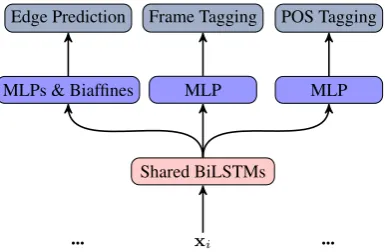
Miyao et al., 2014). They are both classified as Flavor 0 representations in the sense that every node in the graph must anchor to one and only one token unit, and vice verse. Compared with syntactic dependency trees, some nodes in an SDP graph may have no incoming edges and some may have multiple ones. Borrowing the idea ofDozat and Manning(2018), we encode the input word se-quence with BiLSTMs and predict the edges and labels between words with two MLPs. We also predict the POS tag and frame of each word jointly under the MTL framework.
Universal Conceptual Cognitive Annotation (UCCA) is a multi-layer linguistic framework (Flavor 1) firstly proposed by Abend and Rap-poport(2013). In UCCA graphs, input words are leaf (or terminal) nodes. One non-terminal node governs one or more nodes, which may be discon-tinuous; and one node can have multiple governing (parent) nodes through multiple edges, consisting of a single primary edge and other remote edges. Relationships between nodes are given by edge labels. The primary edges form a tree structure, whereas the remote edges introduce reentrancy, forming directed acyclic graphs (DAGs).2 We directly adopt the previous graph-based UCCA parser proposed by Jiang et al. (2019), treating UCCA graph parsing as constituent parsing and remote edge recovery under the MTL framework.
Elementary Dependency Structure (EDS) is a graph-structured semantic representation formal-ism (Flavor 1) proposed by Oepen and Lønning
(2006). Buys and Blunsom (2017) introduce a neural encoder-decoder transition-based model to obtain the EDS graph. They use external knowl-edge to generate nodes3. Chen et al.(2018)
intro-duce a novel SHRG (Synchronous Hyperedge Re-placement Grammar) extraction algorithm which requires a syntactic tree and alignments between conceptual edges and surface strings. Such align-ment information is not provided in the shared task and seems difficult for us to induce due to time limitation. Therefore, we divide the EDS task into two-stage task: node prediction and edge pre-diction, and treat both as sequence labeling. To tackle with the explicit, many-to-many relation-ship between nodes and sub-strings of the underly-ing sentence (via anchorunderly-ing), we introduce a sim-ilar method used in dependency SRL (semantic role labeling) to produce nodes. For the edge pre-diction, the widely-used Biaffine model is used.
Abstract meaning representation (AMR), pro-posed by Banarescu et al. (2013), is a broad-coverage sentence-level semantic formalism (Fla-vor 2) to encode the meaning of natural language sentences. AMR can be regarded as a rooted labeled directed acyclic graph. Nodes in AMR graphs represent concepts, and labeled directed edges are relations between the concepts. Due to the time limitation and the complexity of the AMR parsing problem, we directly employ the state-of-the-art parser of Lyu and Titov (2018), which treats AMR parsing as a graph prediction prob-lem.
Methodology Summarization. Our participat-ing systems can be characterized in the followparticipat-ing aspects:
• Graph-Based. All our methods for the five frameworks belong to graph-based methods in the sense that we directly predict edges among nodes, instead of using a transition system. In particular, the constituent parser for UCCA is also graph-based.
• Joint Model. We simplify our architecture and use less training steps by jointly model-ing subtasks whenever it is possible. This is achieved by sharing the encoder component
3Their knowledge sources ERG 1214 (http://svn.delph-in.net/erg/tags/1214) are not in the white list of this shared task.
under the MTL framework and it is adopted by the DM, PSD, and UCCA models. For both EDS and AMR, we first produce nodes and then predict edges in a pipeline architec-ture. We have not attempted to jointly solve multiple semantic frameworks via MTL yet.
• BERT.We observe that using BERT as our extra inputs is effective for all the models, ex-cept AMR. It is also interesting that BERT-large does not produce more improvements over BERT-base based our preliminary exper-iments.
Our final submission ranks the third on the over-all evaluation metric, the first on EDS and the sec-ond on UCCA. In the following, We introduce our methods in detail in Section2, and present the ex-perimental results in Section 3, and finally con-clude our paper in Section4.
2 Methods
2.1 SDP
We construct our SDP parser based on the ideas of
Dozat and Manning (2017) and Dozat and Man-ning (2018). Note that lemmas, POS tags and frames are also included in the MRP evaluation metrics, so our method is a bit different from
Dozat and Manning(2018).
Edge Prediction. Our basic edge prediction model is similar to theDozat and Manning(2017) andDozat and Manning(2018). The input words are first mapped into a dense vector composed by pretrained word embeddings and character-level features.
xi=ewordi ⊕echari
xi
... ...
Shared BiLSTMs
MLPs & Biaffines MLP Edge Prediction POS Tagging
[image:3.595.314.518.58.176.2]MLP Frame Tagging
Figure 1: The framework of our SDP Parser.
cross-entropy loss for labels.
`0 =`label+`edge
Lexical Taggers. This SDP task is more dif-ficult than the ealier 2014 and 2015 SDP tasks (Oepen et al., 2014, 2015), since the gold tok-enization result, lemmas, and POS tags are not available in the parser input data and the predic-tions are parts of the MRP evaluation metrics. We use automatic tokenization result and lemmas pro-vided by the datasets; while for POS and frames, we train the taggers with the edge predicter si-multaneously under the multi-task learning frame-work. Figure1shows the framework of our SDP parser. The final training loss is :
`sdp=`0 +`f rame+`pos
where `f rame and `pos are both softmax cross-entropy losses.
2.2 UCCA
We directly follow Jiang et al. (2019)’s graph-based UCCA parser. The key idea is to convert a UCCA semantic graph into a constituent tree, and mark remote edges and discontinuous nodes with extra labels for later recovery.
Graph-to-tree Conversion. In the new version of UCCA, one non-terminal node is allowed to point to another by more than one primary edges, e.g., the word “singer” represents a “process” and a “participant” in a semantic scene at the same time (Figure 2 shows the example). Therefore, we keep only one of the edges and concatenate all their tags in the alphabetical order. During the re-covery step, the edge with a mixed label is splitted according to the label’s length.
Then for the edges that point to the same node, we delete all remote edges and concatenate an ex-tra “remote” to the label of the only primary edge.
Figure 2: An example of newest version of UCCA.
To handle discontinuous node, we trace bottom-up from a discontinuous leaf node until we find the specific node whose parent is the lowest com-mon ancestor (LCA) of the discontinuous node and leaf node. Finally we move the edge to make the specific node become the child of the discon-tinuous, with “-ancestor” added behind the edge label. Please refer toJiang et al.(2019) for more conversion details.
Constituent Parsing. We directly adopt the minimal span-based parser ofStern et al.(2017). Given an input sentence X = {x0, x1,· · ·, xn}, each wordxiis mapped into a dense vectorxiand fed into bidirectional LSTM layers. The top-layer output of each position are used to represent the span as
ri,j = (fj−fi)⊕(bi−bj)
wherefiandbi are the output vectors of the top-layer forward and backward LSTMs. The span representations are then fed into MLPs to com-pute the scores of span splitting and labeling. Fi-nally, a parse tree is derived by a greedy top-down searching. In particular, We start from the span of the whole sentence, assigning it the label with maximum score and choosing the best split point where the sum of two sub-spans’ splitting scores are maximum. Then we repeat this process for the left and right sub-spans until the span can no longer be split.
[image:3.595.86.279.61.187.2]2.3 EDS
This subsection describes our models on EDS task, which are simple but effective. Since many external resources cannot be used to generate nodes in EDS graph in this shared task, we con-vert the main task into two sequence labeling sub-tasks: node prediction and edge prediction.
Node prediction. For each input sentence
X = {x0, x1,· · ·, xn}, our model needs to pre-dict nodes in EDS graphN = {n0, n1,· · ·, nm}. For each node, it contains such information: id, anchors, labels, properties and values. Taking one node as example, anchors mean the span in-dicators of characters in the input sentence, like “< a, b >”. It means this node strides across the sub string from character index a tob in the in-put sentence string. We can convert anchors from character index provided by the data to word in-dex4.
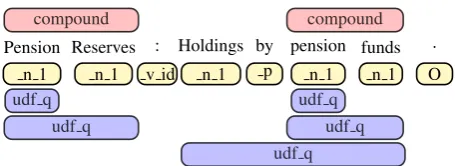
From the definition of EDS graph, there is a many-to-many relationship between words and nodes. Lots of nodes stride across more than one word of the underlying sentence according to their anchors. To simplify the alignment between words and nodes, we divide nodes in graphs into two types due to their characteristic.
The first type is those nodes whose labels be-gin with “ ” or properties are not null, e.g., “ fund n 1”. We call them the original node, labels of which usually consist of three parts: lemma, coarse part-of-speech(POS) tag and sense according to the role the word plays in the sen-tence. The second type is theappend node, e.g., “udf q”. Those nodes do not contain explicit sen-tence text and many of them stride across several words, which makes us difficult to obtain their an-chors.
We align the nodes to input words, so that we predict labels and anchors based on the input word sequence:
For original nodes, we use the lemma of each
word provided by organizers and we take POS tag and sense as a joint label and predict them with sequence labeling, like the POS tagger. To generate training data, based on our statistics and analysis, we tag words in the following ways: 1) in most cases, original nodes are aligned to
4
Index conversion makes us align nodes to words in the input sentence, so that we can simplify our task. And due to the evaluation standard of this shared task, we do not consider punctuation and we can take punctuation as common words if the task needs.
Pension Reserves : Holdings by pension funds . n 1 n 1 v id n 1 p n 1 n 1 O
compound compound
udf q udf q
udf q udf q
[image:4.595.306.534.60.143.2]udf q
Figure 3: An example for node prediction in the EDS graph. We use nodes with different color shadows to represent different kinds of EDS nodes. Nodes with yellow shadows under the input sentence areoriginal
nodes. The number of original nodes is equal to the
length of sentence. Nodes with pink shadows above the sentence are non-terminalappend nodesand purple nodes below the sentence are leaf nodes. In the ex-ample sentence, there are two non-terminal nodes and five leaf nodes. Nodes over across several words means their anchors.
words one by one and these words are tagged with their “POS sense”5; 2) for those compound nodes striding across several words (e.g., “ such+as p” means it combines “such” and “as” two words), we tag the first word with the true label and other words tagged with “A”; and 3) we tag the input words disappearing in EDS graph with “O”. Note that, when one word participates in different orig-inal nodes, we will concatenate all labels of one word together with separator “:”.
For append node, we divide it into two types,
leaf nodes and non-terminal nodes6. The differ-ence between leaf nodes and non-terminal nodes is that whether they are pointed by other nodes. Both leaf nodes and non-terminal nodes may over-lap several words and one input word may partic-ipate in differentappend nodesas Figure3shows. Therefore, we take a similar way like the predic-tion of SRL predicate and argument7. We firstly predict the begin index of eachappend node, like predicate identification in the SRL task, and then, we predict their end index and their labels, like ar-gument prediction. Given the beginning, we tag the end words of nodes with their labels and con-catenate labels with separator “:” if more than one node have same anchors. This allows us to solve
5
Sometimes, the label only contains POS information. 6We take this division originally for edge prediction and task simplification. In EDS graph, leaf nodes should partici-pate in only one edge, but our edge prediction model achieves great performance on all nodes, so we do not distinguish them in the edge prediction.
Detailed errors Modification
company abbreviation, like Corp., Co., Inc corporation, company and inc address forms, like Mr., Mrs., Dr. corresponding full name
numbers in English Arabic numerals
[image:5.595.126.476.63.145.2]country name abbreviation delete “.” in string some symbol like “%”, “#”, “$”, “&” and “:” English String
Table 1: Effective post-processing for labels and values in EDS node.
Figure 4: Architecture of our multi-layers self-attention-based model. The dotted box on the right is the detailed composition of the self-attention block.
the problem of the overlap and multi-participation of theappend nodeselegantly.
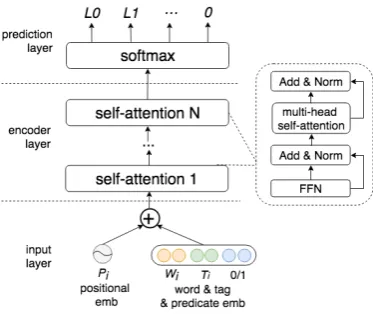
We apply a multi-head self-attention model (Tan et al., 2018) for our node prediction, which has been proved effective in SRL task. Details about the attention model please refer toTan et al.
(2018) and Vaswani et al. (2017). For original nodes and beginning of append nodes prediction, the input consists of embeddings of words and POS-tags provided by organizers; while for end of append nodes prediction, the input contains em-bedding of the beginning indicator in addition. Then we use simple softmax function to get the index or labels whose scores are the highest.
Edge prediction. Compared with the node prediction, the edge prediction model is more straightforward, which builds links between nodes and generates the final EDS graph.
Labels in edges are used to tag the relation be-tween two nodes, like “ARG1”, “BV”. If there is no edges between two nodes, we use the rela-tion “O”. Note that, we add one pseudo node like the ”ROOT” node in the dependency parsing, so that we can get the top node of the graph (which is pointed by the ”ROOT” node).
For the edge prediction model, a multi-layered BiLSTM is firstly used to encode the original in-put sentence, so that we get the representation of each word. Then we represent each node accord-ing to its anchors (begin index and end index) as formula in2.2 shows, so that each node contains information of all words in the anchors. Lastly, we compute the score of each candidate edge relation between two nodes by the biaffine mechanism, and get label whose score is the highest.
Post-processing. We convert our predicted re-sults into nodes according to the predicted begin index and the predicted label (including the end index and corresponding label). We sort them by the anchors of nodes to get the id of each node in the EDS graph. We index these nodes in the as-cendingorder by the begin index of anchors and then in thedescendingorder by the end of the an-chors.
We analysis the results of our splitted develop-ment data, and correct some common lemma er-rors by a post-processing script (Table1).
For senses, we fix some errors according to the ERG knowledge provided by the organizers. ERG, a external knowledge provided by the shared task, contains all legal sense for each lemma and POS tag. Given a joint string of lemma and POS tag, we judge whether our predicted sense is legal, and for the illegal sense, we use the first one in ERG to replace it.
For compound words containing “-”, we find that most of them should split into several parts, but limited by our model, we cannot get their lemma, POS tag and sense. Therefore, we use one split word and the predicted POS tag and sense to replace the originally predicted one after we verify sense legality8.
[image:5.595.84.271.193.350.2]2.4 AMR
Abstract meaning representation (AMR) ( Ba-narescu et al., 2013) is a semantic formalism to encode the meaning of natural language sentences, which is a broad-coverage sentence-level semantic representation. AMR can be regarded as a rooted labeled directed acyclic graph. We directly follow
Lyu and Titov (2018)’s joint modeling of align-ments, concepts and relations. In the following, we describe the details of our AMR parser and the modifications we make due to the constrains of the white list of MRP. In general, the training process employs a probability model composed of concept identification, relation identification and alignment, while the testing process only consists of the former two.
Notations. Given a sentences=w1, w2, ..., wn, where n is the sentence length. Its concepts are defined as c = (c1, c2, ..., cm), where m is the number of concepts. A relation between ci and
cj is denoted as rij ∈ R, where R is the set of all relations. If there is no relation between ci andcj, we give them aNULLlabel. We employ a = a1, a2, ..., am to denote the concepts, where
ai ∈ 1,2, ..., nis the index of a word aligned to
ci. We usehk(k∈1,2, ..., l)to denote the hidden states of BiLSTM encoders of our model compo-nents, wherelis the number of the BiLSTM lay-ers.
Concept Identification Model. The concept identification model chooses a concept c condi-tioned on the aligned word k based on the BiL-STM statehk, which is defined asPθ(c|hk, wk). For more details about the re-categorization and candidate concept, please refer to Lyu and Titov
(2018).
Relation Identification Model. The relation identification model is arc-factored as:
Pφ(R|a,c,w) = m
Y
i,j=1
P(rij|hai,ci,haj,cj)
(1) The model employs a log-linear module with bi-linear scorer to compute the probabilities ofciand
cj.
Alignment Model. The alignment model is only used in training, and thus it only depends on the BiLSTM hidden states h1,h2, ...,hn and
the concept listc1, c2, ..., cm. Given the concepts listc, the alignment model encodescwith a BiL-STM encoder, which defines the state ofci asgi,
i ∈ 1,2, ..., n. A globally-normalized alignment
model is used, which is defined asQψ(a|c,R,w), and the score of the alignmentaiis also computed via a bilinear scorer.
Pre-processing and Post-processing. Since the text format of MRP AMR is different from the original AMR, we need to convert the MRP AMR text to original AMR text, which is same as the input file of the parser (Lyu and Titov,2018). We utilize Illinois Named Entity Tagger9 (NER) to generate the NER labels for the AMR data; and we use the Part-of-Speech (PoS) tags and lemmas provided by MRP. After the parser generating the test data output, we convert the AMR form to the MRP form. For details about the pre-processing and post-processing, please refer to the original paperLyu and Titov(2018) as well.
3 Experiments
This section describes model parameters used in our models, and the overall results of all the five tasks.
3.1 Model Parameters
In both SDP and UCCA tasks, we use 100-dimensional GloVe (Pennington et al., 2014) as pretrained embedding and random initialized 50-dimensional char embedding. The char lstm out-put is 100-dimensional. We also utilize the BERT embeddings extracted from the last four trans-former layers. The final BERT representation is their normalized weighted sum, which is concate-nated with the word embeddings. The other pa-rameters are the same with the previous works (Dozat and Manning,2018;Jiang et al.,2019).
InEDStask, external resources we use are: 1) word embeddings pre-trained with GloVe ( Pen-nington et al., 2014) on the Gigaword corpus for Chinese; and 2) BERT 10 (Devlin et al., 2018), recently proposed effective deep contextualized word representation. We split the provided train-ing data into train/dev/test data, and both dev and test data contain 2500 examples respectively. We evaluate our model on the split data, and before submitting the final result, we train our model on all the data and predict the provided test data as our submission.
InAMRtask, we randomly choose the samples of the training data according to the proportion of
9
https://cogcomp.org/page/software_ view/NETagger
DM PSD UCCA EDS AMR
P R F1 P R F1 P R F1 P R F1 P R F1
Node prediction
labels 89 90 89.26 83 85 83.80 # # # 91 91 91.20 82 81 81.53 properties 90 91 90.65 83 85 84.43 # # # 89 91 89.72 77 73 74.96
anchors # # # # # # 96 94 95.02 95 95 94.86 # # #
Edge prediction
top 91 91 91.01 96 79 86.49 100 100 99.56 90 90 89.94 63 63 62.86 edges 88 90 88.69 74 75 74.41 70 65 67.74 90 90 89.66 64 60 61.78
attributes # # # # # # 54 33 40.80 # # # # # #
Overall
[image:7.595.73.524.61.185.2]all 90 92 91.26 84 86 84.81 81 76 78.43 92 92 91.85 73 70 71.72
Table 2: Experiment results on the provided test data from the shared task. We divide different evaluation criteria into two types: node-related and edge related, which agrees with our task division.
each domain, and compose them as the develop-ment data, which contain 2993 samples. We have also attempted to integrate BERT representations into the basic model input, but it did not bring significant improvements. For the model param-eters, we directly use the default settings of Lyu and Titov(2018).
3.2 Experiment Results
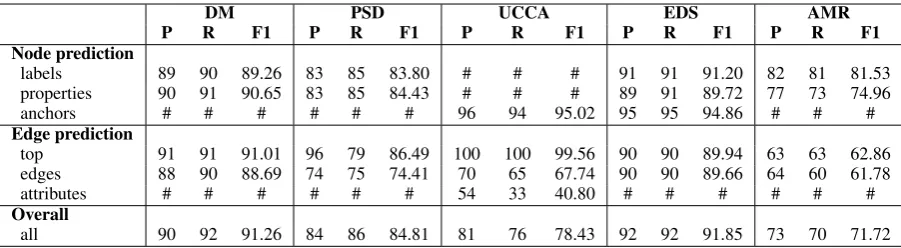
Our experiment results on the provided test data are shown in Table2.
SDP. We randomly selected 20% sentences as our development set and the rest as our training set. After tuning on the development set, we train the parser on the whole dataset from scratch and early stop at the best epoch on the development data. The MRP F1 scores of our DM and PSD deveplopment data are 93.37 and 87.89, respec-tively. After utilizing BERT embeddings, the re-sults rise to 94.06 and 88.79 respectively. As the improvements are not very significant, we will ex-plore better ways of integrating BERT in the fu-ture. We achieve 91.26 and 84.81 F1 scores on PSD and SDP test data regarding to the MRP eval-uation metrics, which rank the eighth and the ninth respectively.
UCCA. The training strategy is the same as SDP. The MRP F1 scores on our deveplopment data are 79.80 and 73.41, w/o BERT respectively. Unlike SDP, the result is significantly improved af-ter using BERT embeddings. This is consistent with Jiang et al. (2019). We achieve 78.43 F1 score on the test set which ranks the second.
EDS.For nodes prediction, our models cannot assign the labels well compared to the anchors as shown in Table 2, and properties are even worse. This trend is consistent with our model design and the evaluation strategy, since they predict anchors
first and the labels second. Another important rea-son is that provided lemmas of the words are not always correct for EDS task.
For edge prediction, on our split test/dev data, edge model can achieve much better performance based on the gold nodes than predicted nodes, up to ca. 98%. Based on such high performance, we have not considered constraints like leaf node can-not be pointed by other nodes. Edge prediction performance in Table2is not optimal mainlly due to the error propagation from node prediction.
External knowledge including BERT and pre-trained word embedding are effective; and post-processing listed in can achieve about 1% im-provement on our split dev/test data. Another interesting observation during our experiments is that the complete match score is much higher than the normal dependency parsing (ca. 75% vs. 30%), although the corresponding LAS can be as high as ca. 92%.
Finally, we obtain 91.85 F1 score on the test data, ranks the first.
AMR.We choose the best model that tuned on the development data to generate AMR graphs for the test data, which achieves 69.9 F1 smatch score on development data. Table2shows the results of the AMR test data regarding to the MRP evalua-tion metrics. We achieve 71.72 F1 score on the test data and it ranks the fifth.
Our overall result on all five tasks ranks third, and our results ranks first on EDS and second on UCCA.
4 Conclusions and Future Work
representation, including DM, PSD, EDS, UCCA, and AMR. Considering the common character-istics of the five semantic formalisms, we treat them as two-stage processing using graph-based methods: node prediction (no need for DM and PSD) and edge prediction. For different graphs, we generate nodes and edges in a joint way or in a pipeline way. BERT is also employed to boost the performance (except AMR). Our system ranked the third on the overall evaluation metrics, the first on EDS and the second on UCCA. For the future work, we plan to jointly handle multiple semantic frameworks (e.g., DM, PSD, and UCCA) at the same time via MTL, in order to facilitate mutual benefits and interactions, and make better use of the non-overlapping training data. Moreover, model ensemble may also further enhance the performance.
References
Omri Abend and Ari Rappoport. 2013. Universal Con-ceptual Cognitive Annotation (UCCA). InProc. of ACL, pages 228–238.
Laura Banarescu, Claire Bonial, Shu Cai, Madalina Georgescu, Kira Griffitt, Ulf Hermjakob, Kevin Knight, Philipp Koehn, Martha Palmer, and Nathan Schneider. 2013. Abstract meaning representation for sembanking. InProceedings of the 7th Linguis-tic Annotation Workshop and Interoperability with Discourse, pages 178–186.
Jan Buys and Phil Blunsom. 2017. Robust incremen-tal neural semantic graph parsing. InProceedings of the 55th Annual Meeting of the Association for Com-putational Linguistics (Volume 1: Long Papers), pages 1215–1226, Vancouver, Canada. Association for Computational Linguistics.
Yufei Chen, Weiwei Sun, and Xiaojun Wan. 2018. Ac-curate SHRG-based semantic parsing. In Proceed-ings of the 56th Annual Meeting of the Association for Computational Linguistics (Volume 1: Long Pa-pers), pages 408–418, Melbourne, Australia. Asso-ciation for Computational Linguistics.
Jacob Devlin, Ming-Wei Chang, Kenton Lee, and Kristina Toutanova. 2018. BERT: pre-training of deep bidirectional transformers for language under-standing.CoRR, abs/1810.04805.
Timothy Dozat and Christopher D. Manning. 2017. Deep biaffine attention for neural dependency pars-ing. InProceedings of ICLR.
Timothy Dozat and Christopher D. Manning. 2018. Simpler but more accurate semantic dependency parsing. InProceedings of the 56th Annual Meet-ing of the Association for Computational LMeet-inguistics (Volume 2: Short Papers).
Jan Hajiˇc, Eva Hajiˇcov´a, Jarmila Panevov´a, Petr Sgall, Ondˇrej Bojar, Silvie Cinkov´a, Eva Fuˇc´ıkov´a, Marie Mikulov´a, Petr Pajas, Jan Popelka, Jiˇr´ı Se-meck´y, Jana ˇSindlerov´a, Jan ˇStˇep´anek, Josef Toman, Zdeˇnka Ureˇsov´a, and Zdenˇek ˇZabokrtsk´y. 2012. Announcing prague czech-english dependency tree-bank 2.0. InProceedings of the Eight International Conference on Language Resources and Evaluation (LREC’12).
Angelina Ivanova, Stephan Oepen, Lilja Øvrelid, and Dan Flickinger. 2012. Who did what to whom? a contrastive study of syntacto-semantic dependen-cies. InProceedings of the Sixth Linguistic Annota-tion Workshop.
Wei Jiang, Zhenghua Li, Yu Zhang, and Min Zhang. 2019. Hlt@suda at semeval-2019 task 1: Ucca graph parsing as constituent tree parsing. In Pro-ceedings of the 13th International Workshop on Se-mantic Evaluation, pages 11–15.
Guillaume Lample, Miguel Ballesteros, Sandeep Sub-ramanian, Kazuya Kawakami, and Chris Dyer. 2016. Neural architectures for named entity recognition. InProceedings of the 2016 Conference of the North American Chapter of the Association for Computa-tional Linguistics: Human Language Technologies.
Chunchuan Lyu and Ivan Titov. 2018. Amr parsing as graph prediction with latent alignment. In Proceed-ings of the 56th Annual Meeting of the Association for Computational Linguistics (Volume 1: Long Pa-pers), pages 397–407.
Yusuke Miyao, Stephan Oepen, and Daniel Zeman. 2014. In-house: An ensemble of pre-existing off-the-shelf parsers. InProceedings of the 8th Interna-tional Workshop on Semantic Evaluation (SemEval 2014).
Stephan Oepen, Omri Abend, Jan Hajiˇc, Daniel Her-shcovich, Marco Kuhlmann, Tim O’Gorman, Nian-wen Xue, Jayeol Chun, Milan Straka, and Zdeˇnka Ureˇsov´a. 2019. MRP 2019: Cross-framework Meaning Representation Parsing. InProceedings of the Shared Task on Cross-Framework Meaning Rep-resentation Parsing at the 2019 Conference on Nat-ural Language Learning, pages 1 – 27, Hong Kong, China.
Stephan Oepen, Marco Kuhlmann, Yusuke Miyao, Daniel Zeman, Silvie Cinkova, Dan Flickinger, Jan Hajic, Angelina Ivanova, and Zdenka Uresova. 2016. Towards comparability of linguistic graph banks for semantic parsing. In Proceedings of the Tenth International Conference on Language Re-sources and Evaluation (LREC 2016).
Stephan Oepen, Marco Kuhlmann, Yusuke Miyao, Daniel Zeman, Dan Flickinger, Jan Hajiˇc, Angelina Ivanova, and Yi Zhang. 2014. SemEval 2014 task 8: Broad-coverage semantic dependency parsing. In Proceedings of the 8th International Workshop on Semantic Evaluation (SemEval 2014).
Stephan Oepen and Jan Tore Lønning. 2006. Discriminant-based MRS banking. InProceedings of the Fifth International Conference on Language Resources and Evaluation (LREC’06), Genoa, Italy. European Language Resources Association (ELRA).
Jeffrey Pennington, Richard Socher, and Christo-pher D. Manning. 2014. Glove: Global vectors for word representation. InEMNLP, pages 1532–1543.
Mitchell Stern, Jacob Andreas, and Dan Klein. 2017. A minimal span-based neural constituency parser. In Proc. of ACL, pages 818–827.
Zhixing Tan, Mingxuan Wang, Jun Xie, Yidong Chen, and Xiaodong Shi. 2018. Deep semantic role label-ing with self-attention. InThirty-Second AAAI Con-ference on Artificial Intelligence.