230
A Temporally Sensitive Submodularity Framework for Timeline
Summarization
Sebastian Martschat∗
Knowledge Architecture & Innovation BASF SE
67056 Ludwigshafen am Rhein, Germany [email protected]
Katja Markert
Institute of Computational Linguistics Heidelberg University
69120 Heidelberg, Germany [email protected]
Abstract
Timeline summarization (TLS) creates an overview of long-running events via dated daily summaries for the most important dates. TLS differs from standard multi-document summarization (MDS) in the importance of date selection, interdependencies between summaries of different dates and by having very short summaries compared to the num-ber of corpus documents. However, we show that MDS optimization models using submod-ular functions can be adapted to yield well-performing TLS models by designing objec-tive functions and constraints that model the temporal dimension inherent in TLS. Impor-tantly, these adaptations retain the elegance and advantages of the original MDS mod-els (clear separation of features and inference, performance guarantees and scalability, little need for supervision) that current TLS-specific models lack. An open-source implementation of the framework and all models described in this paper is available online.1
1 Introduction
There is an abundance of reports on events, crises and disasters. Timelines(see Table1) summarize and date these reports in an ordered overview. Au-tomatic Timeline Summarization(TLS) constructs such timelines from corpora that contain articles about the corresponding event.
In contrast to standard multi-document sum-marization (MDS), in TLS we need to explic-itly model the temporal dimension of the task, specifically we need to select the most important dates for a long-running event and summarize each of these dates. In addition, TLS deals with a much larger number of documents to summarize,
∗
Work conducted while the author was a researcher at the Institute of Computational Linguistics, Heidelberg Uni-versity.
1http://smartschat.de/software
2011-03-16
Security forces break up a gathering in Marjeh Square in Damascus of 150 protesters holding pictures of imprisoned relatives. Witnesses say 30 people are arrested.
2011-03-24
President Bashar al-Assad orders the formation of a com-mittee to study how to raise living standards and lift the law covering emergency rule, in place for 48 years.
2011-03-29
Government resigns.
Table 1: Excerpt from a Syrian War Reuters timeline.
enhancing scalability and redundancy problems. These differences have significant consequences for constraints, objectives, compression rates and scalability (see Section2.2).
Due to these differences, most work on TLS has been separate from the MDS community.2 In-stead, approaches to TLS start from scratch, opti-mizing task-specific heuristic criteria (Chieu and Lee, 2004;Yan et al., 2011b; Wang et al.,2016, inter alia), often with manually determined param-eters (Chieu and Lee,2004;Yan et al.,2011b) or needing supervision (Wang et al.,2016). As fea-tures and architecfea-tures are rarely reused or indeed separated from each other, it is difficult to assess reported improvements. Moreover, none of these approaches give performance guarantees for the task, which are possible in MDS models based on function optimization (McDonald, 2007;Lin and Bilmes,2011) that yield state-of-the art models for MDS (Hong et al.,2014;Hirao et al.,2017).
In this paper we take a step back from the dif-ferences between MDS and TLS and consider the following question: Can MDS optimization mod-els be expanded to yield scalable, well-performing TLS models that take into account the temporal properties of TLS, while keeping MDS advantages
2The TLS systems in (Yan et al., 2011b; Tran et al.,
such as modularity and performance guarantees?
In particular, we make the following contributions:
• We adapt the submodular function model of
Lin and Bilmes (2011) to TLS (Section 3). This framework is scalable and modular, al-lowing a “plug-and-play” approach for dif-ferent submodular functions. It needs little supervision or parameter tuning. We show that even this straightforward MDS adapta-tion equals or outperforms two strong TLS baselines on two corpora for most metrics.
• We modify the MDS-based objective func-tion by adding temporal criteria that take date selection and interdependencies between daily summaries into account (Section4).
• We then add more complex temporal con-straints, going beyond the simple cardinal-ity constraints in MDS (Section 5). These new constraints specify the uniformity of the timeline daily summaries and date distribu-tion. We also give the first performance guar-antees for TLS using these constraints.
• We propose a TLS evaluation framework, in which we study the effect of temporal objec-tive functions and constraints. We show per-formance improvements of our temporaliza-tions (Section6). We also present the first or-acle upper bounds for the problem and study the impact that timeline properties, such as compression rates, have on performance.
2 Timeline Summarization
Given a query (such asSyrian war) TLS needs to (i) extract the most important events for the query and their corresponding dates and (ii) obtain con-cise daily summaries for each selected date ( Al-lan et al.,2001;Chieu and Lee,2004;Yan et al.,
2011b;Tran et al.,2015a;Wang et al.,2016).
2.1 Task Definition and Notation
A timeline is a sequence (d1, v1), . . . ,(dk, vk) where the di are dates and the vi are summaries for the datesdi. Given are a queryq and an asso-ciated corpusC that contains documents relevant to the query. The task oftimeline summarization
is to generate a timelinetbased onC. The num-ber of dates intas well as the length of the daily summaries are typically controlled by the user.
We denote withUthe set of sentences inC. We assume that each sentence inU is dated (either by a date expression appearing in the sentence or by
the publication date of the article it appears in). For a sentenceswe writed(s)for the date ofs.
2.2 Relation to MDS
In MDS, we also need to generate a (length-limited) summary of texts in a corpusC(with an optional queryq used to retrieve the corpus). In the traditional DUC multi-document summariza-tion tasks3, most tasks are either not event-based at all or concentrate on one single event. In contrast, in TLS, the corpus describes an event that consists of several subevents that happen on different days. This difference has substantial effects. In MDS, criteria (such as coverage and diversity) and length constraints apply on a global level. In TLS, the whole summary is naturally divided into per-day summaries. Criteria and constraints apply on a global level as well as on a per-day level.
Even for the small number of DUC tasks that do focus on longer-running events, several differ-ences to TLS still hold. First, the temporal dimen-sion in the DUC gold standard summaries and sys-tem outputs is playing a minor role, with few ex-plicit datings of events and a non-temporal struc-ture of the output, leading again to the above-mentioned differences in constraints and criteria. The ROUGE evaluation measures used in MDS (Lin,2004) also do not take into account temporal-ity and do not explicitly penalize wrong datings. Second, corpora in TLS typically contain thou-sands of documents per query (Tran et al.,2013b,
2015a). This is magnitudes larger than the cor-pora usually considered for MDS (Over and Yen,
2004). This leads to a low compression rate4 and requires approaches to be scalable.
3 Casting TLS as MDS
In the introduction, we identified several issues in existing TLS research, including lack of modular-ity, insufficient separation between features and model, and the lack of performance guarantees. Global constrained optimization frameworks used in MDS (McDonald,2007;Lin and Bilmes,2011) do separate constraints, features and inference and allow for optimal solutions or solutions with per-formance guarantees. They also can be used in an unsupervised manner. We now cast TLS as MDS, employing constraints and criteria used for
stan-3
https://duc.nist.gov/
4
dard MDS (Lin and Bilmes,2011). While this ig-nores the temporal dimension of TLS, it will give us a baseline and a starting point for systematically incorporating temporal information.
3.1 Problem Statement and Inference
We can understand summarization as an optimiza-tion of an objective funcoptimiza-tion that evaluates sets of sentences over constraints. Hence, letU be a set of sentences in a corpus and letf: 2U →R≥0be
a function that measures the quality of a summary. LetI ⊆ {X |X ∈ 2U}be a set of constraints5. We then consider the optimization problem
S∗ = arg max
S⊆U,S∈I
f(S). (1)
Solving Equation1exactly does not scale well (McDonald, 2007) and is therefore inappropriate for the large-scale data used in TLS. The greedy Algorithm 1 that iteratively constructs an output solves the equation approximately (also used in
McDonald(2007) andLin and Bilmes(2011)).
Algorithm 1Greedy algorithm.
Input: A set of sentencesU, a functionf, a set of constraintsI
functionGREEDY(U,f,I) SetS=∅,K =U
whileK 6=∅do
s= arg maxt∈Kf(S∪ {t})−f(S)
ifS∪ {s} ∈ Ithen
S =S∪ {s}
K =K\ {s} Output: A summaryS
3.2 Monotonicity and Submodularity
The results obtained by GREEDYcan be arbitrarily bad. However, there are performance guarantees if the objective functionf and the constraintsI are “sufficiently nice” (Calinescu et al.,2011). Many results rely on objective functions that are mono-toneandsubmodular. A functionf is monotone if
A⊆Bimplies thatf(A)≤f(B). A functionfis submodular if it possesses a “diminishing returns property”, i.e. if forA ⊆B ⊂U andv ∈ U \B
we havef(A∪{v})−f(A)≥f(B∪{v})−f(B). From now on we assume that the function f is of the formf ≡Pm
i=1fi with monotone
submod-5An example are length constraints, which can be
ex-pressed asI={X| |X| ≤m, X∈2U}for somem.
ularfi: U →[0,1](i∈ {1, . . . , m}). We normal-ize allfi to[0,1]. By closure properties of mono-tonicity and submodularity,f is also submodular.
3.3 MDS Constraints
Constraints help to define a summary’s struc-ture, and the performance guarantee of the greedy algorithm depends on them. In MDS, typi-cal constraints are upper bounds in the num-ber of sentences or words, corresponding to car-dinality (|S| ≤ m) or knapsack constraints (P
s∈S|words(s)| ≤m) for some upper boundm. When optimizing a submodular monotone func-tion under such constraints, GREEDY has a per-formance guarantee of ≈ 0.63 and ≈ 0.39 re-spectively (Calinescu et al.,2011;Lin and Bilmes,
2011). That is, for cardinality constraints, the out-put is at least0.63as good as the optimal solution in terms of objective function value.
3.4 MDS Objective Functions
In MDS, approaches typically try to maximize coverage and diversity. In its simplest form, Lin and Bilmes(2011) model coverage as
fCov(S) = X
s∈S X
v∈U
sim(s, v), (2)
where sim: U×U →R≥0is a sentence similarity
function, e.g. cosine of word vectors.
Lin and Bilmes(2011) model diversity via
fDiv(S) = k X
i=1
s X
s∈Pi∩S
r(s) (3)
whereP1, . . . , Pkis a partition ofU(e.g. obtained by semantic clustering) andr: U →R≥0is a sin-gleton reward function. We get diminished reward for adding additional sentences from one cluster.
3.5 Application to TLS
4 Temporalizing Objective Functions
We now systematically add temporal information to the objective function by (i) temporalizing cov-erage functions, (ii) temporalizing diversity func-tions, and (iii) adding date selection functions. We prove the monotonicity and submodularity of all functions in the supplementary material.
4.1 Temporalizing Coverage
MDS coverage functions (Equation 2) ignore temporal information, computing coverage on a corpus-wide level. We temporalize them by mod-ifying the similarity computation. This is a mini-mal but fundamental modification. Previous work in TLS noted that coverage for candidate sum-maries for a day d should look mainly at the temporally local neighborhood, i.e. at sentences whose dates are close tod(Chieu and Lee,2004;
Yan et al.,2011b). We investigate two variants of this idea. The first uses a hard cutoff (Chieu and Lee,2004), restricting similarity computations to sentences that are at mostpdays apart:
simp(s, t) = (
sim(s, t) |d(s)−d(t)| ≤p
0 |d(s)−d(t)|> p (4)
The second uses a soft variant (Yan et al.,2011b). Letg: N→R>0be monotone withg(0) = 1. We
set simg(s, t) =sim(s, t)/g(|d(s)−d(t)|). Thus, all date differences are penalized, and greater date differences are penalized more.
4.2 Temporalizing Diversity
As with coverage, standard MDS diversity func-tions (Equation3) ignore temporal information. If the singleton rewardr infDiv relies on sim, as is the case with many implementations, then tempo-ralizing sim implicitly temporalizes diversity. We now go beyond such an implicit temporalization.
In TLS, we want to apply diversity on a tem-poral basis: we do not want to concentrate the summary on very few, albeit important dates, but we want date (and subevent) diversity. fDiv, how-ever, typically uses only a semantic criterion to obtain a partition, e.g. by k-means clustering of sentence vector representations (Lin and Bilmes,
2011). This may wrongly conflate events, such as two unrelated protests on different dates. We can instead employ a temporal partition. The simplest method is to partition the sentences by their date, i.e. for a temporalized diversity function
fTempDivwe have the same form as in Equation3, butPi contains all sentences with datedi, where
d1, . . . , dkare all sentence dates.
4.3 Date Selection Criteria
An important part of TLS isdate selection. Ded-icated algorithms for date selection use frequency and patterns in date referencing to determine date importance (Tran et al.,2015b). Most date impor-tance measures can be integrated into the objec-tive function to allow for joint date selection and summary generation.6 One well-performing date selection baseline is to measure for each date how many sentences refer to it. This objective can be described by the monotone submodular function
fDateRef(S) = X
d∈d(S)
|{u∈U |urefers tod}|.
4.4 Combining Criteria
We combine coverage, diversity and date impor-tance via unweighted sums for our final objective functions. An alternative would be to combine them via weighted sums learned from training data (Lin and Bilmes,2011, 2012) but since there are only few datasets available for training and testing TLS algorithms we choose the unweighted sum to estimate as few parameters as possible from data.
5 Temporalizing Constraints
The MDS knapsack/cardinality constraints are too simple for TLS as an overall sentence limit does not constrain a timeline to have daily summaries of roughly similar length or enforce other unifor-mity properties. We introduce constraints going beyond simple cardinality, and prove performance guarantees of GREEDYunder such constraints.
5.1 Definition of Constraints
Typically, we have two requirements on the time-line: the total number of days should not exceed a given number ` and the length of the daily sum-mary (in sentences) should not exceed a given number k (for every day). Let d be the func-tion that assigns each sentence its date. For a set
S⊆U, the requirements can be formalized as
|{d(s)|s∈S}| ≤` (5)
and, for alls∈S,
{s0|s0∈S, d(s0) =d(s)}
≤k. (6)
6Our framework can also be extended to accommodate
5.2 Performance Guarantees
While the constraints expressed by Equations 5
and6 are more complex than constraints used in MDS, they have a property in common: if a setS
fulfills the constraints (i.e. S ∈ I), then also any subsetT ⊆S fulfills the constraints (i.e.T ∈ I). In combinatorics, such constraints are called inde-pendence systems(Calinescu et al.,2011).
Definition 1. LetV be some set and I ⊂ 2V be
a collection of subsets of V. The tuple (V,I) is called an independence system if (i) ∅ ∈ I and (ii)B ∈ I andA⊆B impliesA∈ I.
Optimization theory shows that GREEDY also has performance guarantees when generalizing cardinality/knapsack constraints to “sufficiently nice” independence systems. Based on these re-sults, we prove Lemma1(see the suppl. material):
Lemma 1. Let I be the set of subsets ofU that fulfill Equations 5 and 6. Then GREEDY has a performance guarantee of1/(k+ 1).
The lemma implies that for smallkthat is typi-cal in TLS (e.g.k= 2), we obtain a good approxi-mation with reasonable constraints. However, our performance guarantees are still weaker than for MDS (for example, 0.33 for k = 2 compared to 0.63 in MDS). The reason for this is that our constraints are more complex, going beyond the simple well-studied cardinality and knapsack con-straints. We also observe that this is a worst-case bound: in practice the performance of the algo-rithm may approach the exact solution (asLin and Bilmes(2010) show for MDS). However, such an analysis is out of scope for our paper, since com-puting the exact solution is intractable in TLS.7
6 Experiments
We evaluate the performance of modeling TLS as MDS and the effect of various temporalizations.
6.1 Data and Preprocessing
We run experiments on timeline17 (Tran et al.,
2013b) and crisis(Tran et al., 2015a). Both data sets consist of (i) journalist-generated timelines on events such as the Syrian War as well as (ii) cor-responding corpora of news articles on the topic scraped via Google News. They are publically
7McDonald(2007) andLin and Bilmes(2010) already
re-port scalability issues for obtaining exact solutions for MDS, which is of smaller scale and has simpler constraints than our task.
Name Topics TLs Docs Sentences Total Filtered
timeline17 9 19 4,622 273,432 56,449
[image:5.595.307.529.155.237.2]crisis 4 22 18,246 689,165 121,803
Table 2: Data set statistics.
No Start End Dates Avg. Daily Summ. Length
1 2010-04-20 2010-05-02 13 4
2 2010-04-20 2012-11-15 16 2
3 2010-04-20 2010-10-15 12 2
4 2010-04-20 2010-09-19 48 2
5 2010-04-20 2011-01-06 102 3
Table 3: Properties for the BP oil spill timelines in
timeline17. The corpus contains documents for 218 dates from 2010-04-01 to 2011-01-31.
available8 and have been used in previous work
(Wang et al.,2016).9 Table2shows an overview. In the data sets, even timelines for the same topic have considerable variation. Table3 shows properties for the five BP oil spill timelines in
timeline17. There is substantial variation in range, granularity and average daily summary length.
Following previous work (Chieu and Lee,2004;
Yan et al.,2011b), we filter sentences in the cor-pus using keywords. For each topic we manually define a set of keywords. If any of the keywords appears in a sentence, the sentence is retained.
We identify temporal expressions with Heidel-Time (Str¨otgen and Gertz,2013). If a sentence s
contains a time expression that can be mapped to a daydvia HeidelTime we set the date of stod
(if there are multiple expressions we take the first one). Otherwise, we set the date ofsto the publi-cation date of the article which containss.10
6.2 Evaluation Metrics
Automatic evaluation of TLS is done by ROUGE (Lin, 2004). We report 1 and ROUGE-2 F1 scores for theconcat,agreementandalign+
m:1 metrics for TLS we presented in Martschat and Markert(2017). These metrics perform uation by concatenating all daily summaries, eval-uating only matching days and evaleval-uating aligned
8
http://www.l3s.de/˜gtran/timeline/
9The datasets used inChieu and Lee(2004) or Nguyen
et al.(2014) are not available.
10This procedure is in line with previous TLS work (Chieu
dates based on date and content similarity, respec-tively. We evaluate date selection using F1score.
6.3 Experimental Settings
TLS has no established settings. Ideally, reference and predicted timelines should be given the same compression parameters, such as overall length or number of days.11 Since there is considerable vari-ation in timeline parameters (Table3), we evaluate against each reference timeline individually, pro-viding systems with the parameters they need via extraction from the reference timeline, including range and needed length constraints. We setmto the number of sentences in the reference timeline,
`to the number of dates in the timeline, andkto the average length of the daily summaries.
Most previous work uses different or unreported settings, which makes comparison difficult. For instance, Tran et al. (2013b) do not report how they obtain timeline length. Wang et al. (2015,
2016) create a constant-length summary for each day that has an article in the corpus, thereby com-paring reference timelines with few days with pre-dicted timelines that have summaries for each day.
6.4 Baselines
Past work on crisis generated summaries from headlines (Wang et al.,2016) or only used manual evaluation (Tran et al.,2015a). Past work on time-line17evaluates with ROUGE (Tran et al.,2013b;
Wang et al., 2016) but suffers from the fact that parameters for presented systems, baselines and reference timelines differ or are not reported (see above). Therefore, we reimplement two baselines that were competitive in previous work (Yan et al.,
2011b;Wang et al.,2015,2016).
Chieu. Our first baseline is CHIEU, the unsuper-vised approach ofChieu and Lee(2004). It oper-ates in two stages. First, it ranks sentences based on similarity: for each sentence s, similarities to all sentences in a 10-day window around the date of sare summed up12. This yields a ranked list of sentences, sorted by highest to lowest summed up similarities. Using this list, a timeline contain-ing one-sentence daily summaries is constructed
11This would mirror settings in MDS, where reference and
predicted summary have the same length constraint. 12
This corresponds to the Interest ranking proposed by Chieu and Lee(2004). We do not use the more complex Burstinessmeasure sinceInterestwas found to perform at least as well in previous work when evaluated with ROUGE-based measures (Wang et al.,2015, p.c.)
as follows: iterating through the ranked sentence list, a sentence is added to the timeline depend-ing on the extent of the sentences already in the timeline. Extent of a sentencesis defined as the smallest window of days such that the total simi-larity ofsto sentences in this window reaches at least 80% of the similarity to the sentences in the full 10-day window. If the candidate sentence does not fall into the extent of any sentence already in the timeline, it is added to the timeline.
As we can see, the model and parameters such as daily summary length are intertwined in this ap-proach. We therefore reimplement CHIEUexactly instead of giving it reference timeline parameters. As we describe below, we use the same sentence similarity function asChieu and Lee(2004).
Regression. Our second baseline is REG, a su-pervised linear regression model (Tran et al.,
2013b; Wang et al., 2015). We represent each sentence with features describing its length, num-ber of named entities, unigram features, and aver-aged/summed tf-idf scores. During training, for each sentence, standard ROUGE-1 F1 w.r.t. the
reference summary of the sentence’s date is com-puted. The model is trained to predict this score.13 During prediction, sentences are selected greedily according to predicted F1score, respecting
tempo-ral constraints defined by the reference timeline.
6.5 Model Parameters
For all submodular models and for CHIEUwe use
sparse inverse-date-frequency sentence represen-tations (Chieu and Lee,2004)14. This yields a vec-tor representationvs for each sentences. We set sim(s, t) = cos(vs, vt). We did not tune any fur-ther parameters but re-used settings from previous work. For modifications to sim when temporaliz-ing coverage and diversity (Section4), we use a cutoff of 10 (asChieu and Lee(2004)), and con-siderg(x) =√x+ 1for reweighting. We choose the square root since it quickly provides strong pe-nalizations for date differences but then saturates. FollowingLin and Bilmes(2011), we set singleton reward forfDivtor(s) =Pu∈Usim(s, u)and ob-tain the partitionP1, . . . , Pkby k-means clustering withk = 0.2· |U|. We obtain a temporalization
fTempDivof diversity by considering a partition of sentences induced by their dates (see Section4).
13
We use per-topic cross-validation (Tran et al.,2013b). 14In preliminary experiments, results using such sparse
6.6 Results
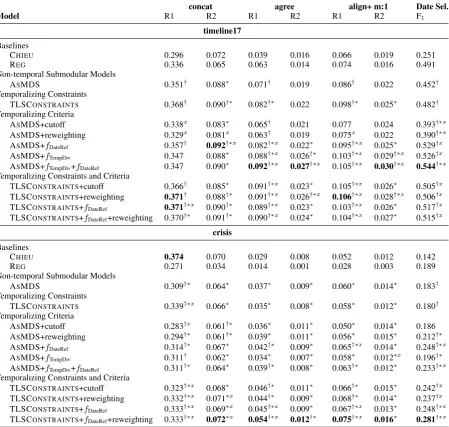
Results are displayed in Table 4. The numbers are averaged over all timelines in the respective corpus. We test for significant differences using an approximate randomization test (Noreen,1989) with ap-value of0.05.
Baselines. Overall, performance on crisis is much lower than ontimeline17. This is because (i) the corpora incrisiscontain articles for more days over a larger time span and (ii) average percentage of article publication dates for which a summary in a corresponding reference timeline exists is11%
fortimeline17 and3%forcrisis. This makes date selection more difficult. Oncrisis, CHIEU outper-forms REG except for date selection. On time-line17, REG outperforms CHIEU for four out of seven metrics. Timelines in crisis contain fewer dates and shorter daily summaries than timelines intimeline17, which aligns well with CHIEU’s re-dundancy post-processing.
TLS as MDS. The model ASMDS uses stan-dard length constraints from MDS and an ob-jective function combining non-temporalizedfCov andfDiv. It allows us to evaluate how well stan-dard MDS ports to TLS. Except for concat and
date selection on crisis, this model outperforms both baselines, while providing the advantages of modularity, non-supervision and feature/inference separation discussed throughout the paper.
Temporalizing Constraints. The model TLSCONSTRAINTSuses the temporal constraints described in Section5, but has the same objective function as ASMDS. Compared to ASMDS, there are improvements on all metrics on timeline17
and similar performance oncrisis.
Temporalizing Criteria. We temporalize ASMDS objective functions (Section 4) via modifications of the similarity function (cut-offs/reweightings), replacing diversity by tempo-ral diversity fTempDiv, and adding date selection
fDateRef. Constraints are kept non-temporal. If modifications improve over ASMDS we also check for cumulative improvements. Modifying similarity is not effective, results drop or stay roughly the same according to most metrics. The other modifications improve performance w.r.t. most metrics, especially for date selection.
Temporalizing Constraints and Criteria.
Lastly, we evaluate the joint contribution of
temporalized constraints and criteria.15 Modifi-cations to the similarity function have a positive effect, especially reweighting. fDateRef provides information about date importance not encoded in the constraints, improving results oncrisis.
Oracle Results. Previous research in MDS com-puted oracle upper bounds (e.g. Hirao et al.
(2017)). To estimate TLS difficulty and our limitations, we provide the first oracle upper bound for TLS: For each sentences, we compute ROUGE-1 F1 gs w.r.t. the reference summary for the sentence’s date. We then run GREEDY for
fOracle(S) = P
s∈Sgs, employing the same con-straints as TLSCONSTRAINTS(see Table7).
Scores of the models are most similar to oracle results for the temporally insensitiveconcat met-ric, with gaps comparable to gaps in MDS (Hirao et al.,2017). The biggest gap is indate selection
F1. This also leads to higher differences in the
scores of temporally sensitive metrics, highlight-ing the importance of temporal information.
6.7 Analysis
We now investigate where and how temporal infor-mation helps compared to ASMDS. We have al-ready identified two potential weaknesses of mod-eling TLS as MDS: the low compression rate (Sec-tion 2) and the likely case that ASMDS overrep-resents certain dates in a timeline (Section3). We now analyze the behavior of AsMDS w.r.t. these points and discuss the effect of temporal informa-tion. To avoid clutter, we restrict analysis to time-line17and report onlyalign+ m:1ROUGE-1 F1.
Effect of Compression Rate. We hypothesize that difficulty increases as compression rate de-creases. We measure compression rate in two ways. We first adopt the definition from MDS and define corpus compression rate as the num-ber of sentences in a reference timeline divided by the number of sentences in the (unfiltered) cor-responding corpus. Second, we define a TLS-specific notion called spread as the number of dates in the reference timeline divided by the max-imum possible number of dates given its start and end date. For example, the timeline from Table1
in the introduction has spread3/14. We see that timelines with lowest compression rate/spread are indeed the hardest (Table 5). Temporal informa-tion leads to improvements in all categories.
15We do not evaluate f
concat agree align+ m:1 Date Sel.
Model R1 R2 R1 R2 R1 R2 F1
timeline17
Baselines
CHIEU 0.296 0.072 0.039 0.016 0.066 0.019 0.251
REG 0.336 0.065 0.063 0.014 0.074 0.016 0.491
Non-temporal Submodular Models
ASMDS 0.351† 0.088∗ 0.071† 0.019 0.086† 0.022 0.452† Temporalizing Constraints
TLSCONSTRAINTS 0.368† 0.090†∗ 0.082†∗ 0.022 0.098†∗ 0.025∗ 0.482†
Temporalizing Criteria
ASMDS+cutoff 0.338x 0.083∗ 0.065† 0.021 0.077 0.024 0.393†∗x ASMDS+reweighting 0.329x 0.081x 0.063† 0.019 0.075x 0.022 0.390†∗x ASMDS+fDateRef 0.357† 0.092†∗x 0.082†∗x 0.022∗ 0.095†∗x 0.025∗ 0.529†x ASMDS+fTempDiv 0.347 0.088∗ 0.088†∗x 0.026†∗ 0.103†∗x 0.029†∗x 0.526†x ASMDS+fTempDiv+fDateRef 0.347 0.090∗ 0.092†∗x 0.027†∗x 0.105†∗x 0.030†∗x 0.544†∗x Temporalizing Constraints and Criteria
TLSCONSTRAINTS+cutoff 0.366† 0.085∗ 0.091†∗x 0.023∗ 0.105†∗x 0.026∗ 0.505†x TLSCONSTRAINTS+reweighting 0.371† 0.088†∗ 0.091†∗x 0.026†∗x 0.106†∗x 0.028†∗x 0.506†x TLSCONSTRAINTS+fDateRef 0.371†∗x 0.090†∗ 0.089†∗x 0.023∗ 0.103†∗x 0.026∗ 0.517†x TLSCONSTRAINTS+fDateRef+reweighting 0.370†∗ 0.091†∗ 0.090†∗x 0.024∗ 0.104†∗x 0.027∗ 0.515†x
crisis
Baselines
CHIEU 0.374 0.070 0.029 0.008 0.052 0.012 0.142
REG 0.271 0.034 0.014 0.001 0.028 0.003 0.189
Non-temporal Submodular Models
ASMDS 0.309†∗ 0.064∗ 0.037∗ 0.009∗ 0.060∗ 0.014∗ 0.183† Temporalizing Constraints
TLSCONSTRAINTS 0.339†∗x 0.066∗ 0.035∗ 0.008∗ 0.058∗ 0.012∗ 0.180†
Temporalizing Criteria
ASMDS+cutoff 0.283†x 0.061†∗ 0.036∗ 0.011∗ 0.050∗ 0.014∗ 0.186 ASMDS+reweighting 0.294†∗ 0.061†∗ 0.039∗ 0.011∗ 0.056∗ 0.015∗ 0.212†∗ ASMDS+fDateRef 0.314†∗ 0.067∗ 0.042†∗ 0.009∗ 0.065†∗x 0.014∗ 0.248†∗x ASMDS+fTempDiv 0.311† 0.062∗ 0.034∗ 0.007∗ 0.058∗ 0.012∗x 0.196†∗ ASMDS+fTempDiv+fDateRef 0.311†∗ 0.064∗ 0.039†∗ 0.008∗ 0.063†∗ 0.012∗ 0.233†∗x Temporalizing Constraints and Criteria
[image:8.595.76.526.65.492.2]TLSCONSTRAINTS+cutoff 0.323†∗x 0.068∗ 0.046†∗ 0.011∗ 0.066†∗ 0.015∗ 0.242†x TLSCONSTRAINTS+reweighting 0.332†∗x 0.071∗x 0.044†∗ 0.009∗ 0.068†∗ 0.014∗ 0.237†x TLSCONSTRAINTS+fDateRef 0.333†∗x 0.069∗x 0.045†∗x 0.009∗ 0.067†∗x 0.013∗ 0.248†∗x TLSCONSTRAINTS+fDateRef+reweighting 0.333†∗x 0.072∗x 0.054†∗x 0.012†∗ 0.075†∗x 0.016∗ 0.281†∗x
Table 4: Results. Highest values per column/dataset are boldfaced. For the submodular models,†denotes sign. difference to CHIEU,∗to REG,xto ASMDS.
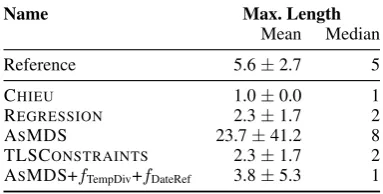
(Over)representation of Dates. We hypothe-sized that ASMDS may overrepresent certain dates. We test this hypothesis by measuring the length (in sentences) of the longest daily summary in a timeline, and computing mean and median over all timelines (Table6). The numbers confirm the hypothesis: When modeling TLS as MDS, some daily summaries tend to be very long. By construction of the constraints employed, the ef-fect does not occur or is much weaker for CHIEU, REGand TLSCONSTRAINTS. Temporal objective functions (as in ASMDS+fTempDiv+fDateRef) also weaken the effect substantially.
7 Related Work
The earliest work on TLS is Allan et al. (2001), who introduce the concepts of usefulness (concep-tually similar to coverage) and novelty (similar to diversity), using a simple multiplicative combina-tion. However, both concepts are not temporal-ized. The notion of usefulness is developed fur-ther as “interest” byChieu and Lee(2004), which we use as one of our baselines. Chieu and Lee
intro-Name Compression rater Spreads
r∈[0,0.001] r∈(0.001,0.01] r∈(0.01,0.1] s∈[0,1/3] s∈(1/3,2/3] s∈(2/3,1]
CHIEU 0.06 0.08 0.07 0.06 0.08 0.04
REG 0.04 0.09 0.07 0.05 0.11 0.11
ASMDS 0.05 0.10 0.09 0.07 0.10 0.10
TLSCONSTRAINTS 0.08 0.10 0.10 0.08 0.12 0.14
ASMDS+fTempDiv+fDateRef 0.09 0.11 0.12 0.09 0.13 0.13
Table 5: Results (align+ m:1ROUGE-1 F1) bycompression rateandspreadon timeline17.
Name Max. Length
Mean Median
Reference 5.6±2.7 5
CHIEU 1.0±0.0 1
REGRESSION 2.3±1.7 2
ASMDS 23.7±41.2 8
TLSCONSTRAINTS 2.3±1.7 2
[image:9.595.85.277.188.285.2]ASMDS+fTempDiv+fDateRef 3.8±5.3 1
Table 6: Length of longest daily summary, mean and median over all timelines ontimeline18.
concat agree align+ m:1 Date Corpus R1 R2 R1 R2 R1 R2 F1
tl17 0.50 0.18 0.30 0.14 0.30 0.14 0.87 crisis 0.49 0.16 0.34 0.14 0.35 0.14 0.95
Table 7: Oracle results optimizing per-day R1 F1.
duced by Yan et al. (2011b,a) andNguyen et al.
(2014), but their frameworks suffer from a lack of modularity or from an unclear separation of fea-tures and architecture.Wang et al.(2015) devise a local submodular model for predicting daily sum-maries in TLS, but they do not model the whole timeline generation as submodular function opti-mization under suitable constraints.
Wang et al.(2016) tackle only the task of gener-ating daily summaries without date selection using a supervised framework, greedily optimizing per-day predicted ROUGE scores, using images and text. In contrast, Kessler et al. (2012) and Tran et al.(2015b) only tackle date selection but do not generate any summaries. We consider the full task, including date selection and summary generation. TLS is related to standard MDS. We discussed differences in Section 2. Our framework is in-spired byLin and Bilmes(2011) who cast MDS as optimization of submodular functions under car-dinality and knapsack constraints. We go beyond their work by modeling temporally-sensitive ob-jective functions as well as more complex con-straints encountered in TLS.
A related task is TRECreal-time summarization
(RTS) (Lin et al.,2016).16. In contrast to TLS, this task requiresonlinesummarization by presenting the input as a stream of documents and emphasizes novelty detection and lack of latency. In addition, RTS focuses on social media and has a very fine-grained temporal granularity. TLS also has an em-phasis on date selection and dating for algorithms and evaluation which is not present in RTS as the social media messages are dated a priori.
8 Conclusions
We show that submodular optimization models for MDS can yield well-performing models for TLS, despite the differences between the tasks. Therefore we can port advantages such as mod-ularity and separation between features and in-ference, which current TLS models lack. In ad-dition, we temporalize these MDS-based mod-els to take into account TLS-specific properties, such as timeline uniformity constraints, impor-tance of date selection and temporally sensitive objectives. These temporalizations increase per-formance without losing the mentioned advan-tages. We prove that the ensuing functions are still submodular and that the more complex constraints still retain performance guarantees for a greedy al-gorithm, ensuring scalability.
Acknowledgments
We thank the anonymous reviewers and our col-league Josef Ruppenhofer for feedback on earlier drafts of this paper.
References
James Allan, Rahul Gupta, and Vikas Khandelwal. 2001. Temporal summaries of new topics. In Pro-ceedings of the 24th Annual International ACM SI-GIR Conference on Research and Development in
16Predecessors of this task were the
Information Retrieval, New Orleans, Louis., 9–12 September 2001, pages 49–56.
Javed A. Aslam, Fernando Diaz, Matthew Ekstrand-Abueg, Richard McCreadie, Virgil Pavlu, and Tes-tuya Sakai. 2015. TREC 2015 temporal summa-rization track overview. In Proceedings of the Twenty-Fourth Text REtrieval Conference, Gaithers-burg, Md., 17–20 November 2015.
Gruia Calinescu, Chandra Chekuri, Martin P´al, and Jan Vondr´ak. 2011. Maximizing a monotone submodu-lar function subject to a matroid constraint. SIAM Journal on Computing, 40(6):1740–1766.
Hai Leong Chieu and Yoong Keok Lee. 2004. Query based event extraction along a timeline. In Proceed-ings of the 27th Annual International ACM SIGIR Conference on Research and Development in Infor-mation Retrieval,New York, N.Y., 25–29 July 2004, pages 425–432.
Tsutomu Hirao, Masaaki Nishino, Jun Suzuki, and Masaaki Nagata. 2017. Enumeration of extractive oracle summaries. InProceedings of the 15th Con-ference of the European Chapter of the Association for Computational Linguistics, volume 1: Long Pa-pers, Valencia, Spain, 3–7 April 2017, pages 386– 396.
Kai Hong, John M. Conroy, Benoit Favre, Alex Kulesza, Hui Lin, and Ani Nenkova. 2014. A repos-itory of state of the art and competitive baseline sum-maries for generic news summarization. In Proceed-ings of the 9th International Conference on Lan-guage Resources and Evaluation, Reykjavik, Ice-land, 26–31 May 2014, pages 1608–1616.
Remy Kessler, Xavier Tannier, Carloine Hag`ege, V´eronique Moriceau, and Andr´e Bittar. 2012. Find-ing salient dates for buildFind-ing thematic timelines. In
Proceedings of the 50th Annual Meeting of the As-sociation for Computational Linguistics (Volume 1: Long Papers), Jeju Island, Korea, 8–14 July 2012, pages 730–739.
Chin-Yew Lin. 2004. ROUGE: A package for auto-matic evaluation of summaries. InProceedings of the Text Summarization Branches Out Workshop at ACL ’04,Barcelona, Spain, 25–26 July 2004, pages 74–81.
Hui Lin and Jeff Bilmes. 2010. Multi-document sum-marization via budgeted maximization of submodu-lar functions. InProceedings of Human Language Technologies 2010: The Conference of the North American Chapter of the Association for Compu-tational Linguistics, Los Angeles, Cal., 2–4 June 2010, pages 912–920.
Hui Lin and Jeff Bilmes. 2011. A class of submodular functions for document summarization. In Proceed-ings of the 49th Annual Meeting of the Association for Computational Linguistics (Volume 1: Long Pa-pers),Portland, Oreg., 19–24 June 2011, pages 510– 520.
Hui Lin and Jeff Bilmes. 2012. Learning mixtures of submodular shells with application to document summarization. In Proceedings of the 28th Con-ference on Uncertainty in Artificial Intelligence,
Catalina Island, CA, USA, 14–18 July 2012, pages 479–490.
Jimmy Lin, Adam Roegiest, Luchen Tan, Richard Mc-Creadie, Ellen Voorhees, and Fernando Diaz. 2016. Overview of the TREC 2016 real-time summariza-tion track. InProceedings of the Twenty-Fifth Text REtrieval Conference, 2016.
Sebastian Martschat and Katja Markert. 2017. Improv-ing ROUGE for timeline summarization. In Pro-ceedings of the 15th Conference of the European Chapter of the Association for Computational Lin-guistics, volume 2: Short Papers, Valencia, Spain, 3–7 April 2017, pages 285–290.
Ryan McDonald. 2007. A study of global inference al-gorithms in multi-document summarization. In Pro-ceedings of the European Conference on Informa-tion Retrieval, Rome, Italy, 2-5 April 2007, pages 557–564.
Kiem-Hieu Nguyen, Xavier Tannier, and V´eronique Moriceau. 2014. Ranking multidocument event de-scriptions for building thematic timelines. In Pro-ceedings of the 25th International Conference on Computational Linguistics, Dublin, Ireland, 23–29 August 2014, pages 1208–1217.
Eric W. Noreen. 1989. Computer-Intensive Methods for Testing Hypotheses. An Introduction. Wiley, New York.
Paul Over and James Yen. 2004. An introduction to DUC 2004: Intrinsic evaluation of generic news text summarization systems. In Proceedings of the 2004 Document Understanding Conference held at the Human Language Technology Conference of the North American Chapter of the Association for Computational Linguistics,Boston, Mass., 6–7 May 2004, pages 1–21.
Dragomir R. Radev, Hongyan Jing, Małgorzata Sty´s, and Daniel Tam. 2004. Centroid-based summariza-tion of multiple documents. Information Processing and Management, 40:919–938.
Jannik Str¨otgen and Michael Gertz. 2013. Multilingual and cross-domain temporal tagging. Language Re-sources and Evaluation, 47(2):269–298.
Giang Tran, Mohammad Alrifai, and Eelco Herder. 2015a. Timeline summarization from relevant head-lines. InProceedings of the 37th European Confer-ence on Information Retrieval,Vienna, Austria, 29 March – 2 April 2015, pages 245–256.
Giang Tran, Eelco Herder, and Katja Markert. 2015b. Joint graphical models for date selection in timeline summarization. InProceedings of the 53rd Annual Meeting of the Association for Computational Lin-guistics (Volume 1: Long Papers), Beijing, China, 26–31 July 2015, pages 1598–1607.
Giang Tran, Tuan Tran, Nam-Khanh Tran, Mohammad Alrifai, and Nattiya Kanhabua. 2013b. Leveraging learning to rank in an optimization framework for timeline summarization. In Proceedings of the SI-GIR 2013 Workshop on Time-aware Information Ac-cess (TAIA-13),Dubling, Ireland, 1 August 2013.
Lu Wang, Claire Cardie, and Galen Marchetti. 2015. Socially-informed timeline generation for complex events. InProceedings of the 2015 Conference of the North American Chapter of the Association for Computational Linguistics: Human Language Tech-nologies,Denver, Col., 31 May – 5 June 2015, pages 1055–1065.
William Yang Wang, Yashar Mehdad, Dragomir R. Radev, and Amanda Stent. 2016. A low-rank ap-proximation approach to learning joint embeddings of news stories and images for timeline summariza-tion. In Proceedings of the 2016 Conference of the North American Chapter of the Association for Computational Linguistics: Human Language Tech-nologies,San Diego, Cal., 12 – 17 June 2016, pages 58–68.
Rui Yan, Liang Kong, Congrui Huang, Xiajun Wan, Xiaoming Li, and Yan Zhang. 2011a. Timeline gen-eration through evolutionary trans-temporal summa-rization. InProceedings of the 2011 Conference on Empirical Methods in Natural Language Process-ing, Edinburgh, Scotland, U.K., 27–29 July 2011, pages 433–443.