Proceedings of the 23rd Conference on Computational Natural Language Learning, pages 22–32 22
Multilingual model using cross-task embedding projection
Jin Sakuma
The University of Tokyo
Naoki Yoshinaga
Institute of Industrial Science, the University of Tokyo
Abstract
We present a method for applying a neural net-work trained on one (resource-rich) language for a given task to other (resource-poor) lan-guages. We accomplish this by inducing a mapping from pre-trained cross-lingual word embeddings to the embedding layer of the neu-ral network trained on the resource-rich lan-guage. To perform element-wise cross-task embedding projection, we invent locally linear mapping which assumes and preserves the lo-cal topology across the semantic spaces before and after the projection. Experimental results on topic classification task and sentiment anal-ysis task showed that the fully task-specific multilingual model obtained using our method outperformed the existing multilingual mod-els with embedding layers fixed to pre-trained cross-lingual word embeddings.1
1 Introduction
Deep neural networks have improved the accu-racy of various natural language processing (NLP) tasks by performing representation learning with massive annotated datasets. However, the anno-tations in NLP depend on the target language as well as the task, and it is unrealistic to prepare such extensive annotated datasets for every pair of lan-guage and task. As a result, we can only obtain an accurate model for a few resource-rich languages such as English.
To overcome this problem, researchers have at-tempted to make models trained with massive an-notated datasets in a resource-rich language
(here-after, source language) applicable to a
resource-poor language (target language) that have no
an-notated datasets (Ruder et al.,2019) (§2). These methods utilize language-universal word represen-tations, namely cross-lingual word embeddings, to
1All the code is available at:https://github.com/
jyori112/task-spec
Task-specific word embeddings (embedding layer of trained model) General cross-lingual
word embeddings
terrible bad
good
wonderful
merveilleux (wonderful)
eat food
dog cat
wonderful
good
merveilleux (wonderful)
bad terrible
mauvaise(bad)
dog cat chat(cat) chen(dog)
eat food
nourriture(food)
[image:1.595.308.525.220.342.2]manger(eat)
Figure 1: Locally linear mapping for sentiment analy-sis task. The relationship between “merveilleux (won-derful)” and its neighboring English words, “wonder-ful” and “good,” are preserved after projection.
absorb the differences among languages in the vo-cabularies of neural network models; specifically,
thesemultilingual modelsare trained with
embed-ding layers fixed to pre-trained cross-lingual word embeddings. However, because those embedding layers are not optimized for the target task, the re-sulting model cannot exploit the true potential of
representation learning, as demonstrated by Kim
(2014) and our experimental results (§5.1). We propose methods of projecting pre-trained cross-lingual word embeddings to word
embed-dings of a fully task-specific neural network all
of whose parameters are optimized to the
train-ing data in a source language, to realize fully
task-specific multilingual model (§ 3). In ad-dition to naive linear projection, we present an element-wise projection method inspired by lo-cally linear embeddings used for dimension
reduc-tion (Roweis and Saul,2000). This method is built
on the assumption that local topology is preserved between the semantic spaces of word embeddings
in two NLP tasks; that is,adequately closewords
in pre-trained cross-lingual word embeddings will have similar representation even in task-specific
general cross-lingual word embedding of a word in the target language by weighted linear combina-tions of general cross-lingual word embeddings of
kneighboring words in the source language. We
then use the weights to compute a task-specific word embedding of the target word as a linear combination of task-specific word embeddings of
thekneighboring source words (§3.2).
We evaluate our method on topic classification
and sentiment analysis tasks (§4). We first obtain
a task-specific neural network using annotated cor-pora in the source language (English) and then in-duce task-specific cross-lingual word embeddings for the target languages to apply the accurate task-specific neural network to those languages. Exper-imental results demonstrate that our method has improved the classification accuracy of the
multi-lingual model (Duong et al.,2017) in most of the
task-language pairs (§5).
Our contributions are as follows:
• We establisheda method of obtaining fully
task-specific multilingual modelsby
learn-ing a cross-task embeddlearn-ing projection (§3).
• Ourcross-task projection is simple and has an analytical solutionwith one hyperparam-eter; the solution is a global optima (§3.2).
• We confirmed the limitation of the tradi-tional multilingual modelwith embedding layers fixed to pre-trained cross-lingual word embeddings (§5.1).
• Weshowed the effectiveness of our method
over the existing models (§5.2).
2 Related work
Lack of resources in resource-poor languages has been a deeply rooted problem in NLP, and there have been many pieces of researches contributed to mitigating this problem by transferring models across languages.
Multilingual models using parallel corpora
An intuitive approach to realize the cross-lingual transfer of a model is to utilize machine transla-tion by either translating the training set or the
model input (Wan,2009). Instead of translating,
Meng et al.(2012) leverage a parallel corpus of the source and target languages to obtain cross-lingual
mixture model to bridge the language gap.Xu and
Wan(2017) also utilize parallel corpus with word
alignment to train a multilingual model for
sen-timent analysis task. While some of these meth-ods do not rely on an annotated corpus in the tar-get language, they heavily rely on cross-lingual re-sources such as parallel corpora, and thus, are not applicable to the resource-poor languages.
Multilingual models with cross-lingual word embeddings Another method to obtain multilin-gual models is to fix the embedding layer of a neu-ral network to pre-trained cross-lingual word em-beddings. Many existing pieces of researches im-plemented this for various tasks in unsupervised
senario (Duong et al., 2017; Can et al., 2018)
where no annotated corpus is available in the target
language as ours and supervised scenario (Pappas
and Popescu-Belis, 2017;Upadhyay et al.,2018) where a small annotated corpus is available in the target language. Another study enhanced this method by employing language-adversarial
net-works (Chen et al.,2018). These methods do not
induce task-specific word embeddings, thereby failing to exert true potential of neural networks,
as we confirm in§5.
Multilingual models with character embed-dings Several studies utilize character level em-beddings shared across languages to obtain
mul-tilingual models (Kim et al., 2017; Yang et al.,
2017). An obvious weak point of these
meth-ods is that they do not apply to distant language
pairs with different alphabets. In contrast, our
method only relies on cross-lingual word embed-dings which are obtainable regardless of the alpha-bets of the languages (Artetxe et al.,2018).
Task-specific word embeddings Few efforts have been previously made to obtain cross-lingual
task-specific word embeddings. Gouws and
Søgaard(2015) obtain task-specific cross-lingual word embeddings by constructing a task-specific bilingual dictionary, which defines “equivalent classes” designed for the given task instead of equivalent semantics. Although they successfully obtained task-specific cross-lingual word embed-dings for POS tagging and supersense tagging tasks, the open problems are how to define a task-specific bilingual dictionary for many of other tasks, and cost of developing such resources.
3 Fully task-specific multilingual model
Our method first learns a neural network model by optimizing to the annotated corpus in the source language. It then induces a projection from the semantic space of general cross-lingual word em-beddings to the semantic space of the optimized embedding layer, to make the model applicable to languages other than the source language.
3.1 Framework
The entire framework of obtaining a fully task-specific multilingual model is as follows:
Step 1 (train task-specific neural network)
First, we train a neural network f(·;Xspec, θ) on an annotated corpus in the source language. The
embedding layer, Xspec, of the resulting neural
network consists of task-specific word
embed-dings of the source language, andθis the
collec-tion of the other parameters. At this point, this neural network is only applicable to the source lan-guage since we do not have task-specific word
em-beddingsYspec of the target language in the same
semantic space asXspec.
Step 2 (induce cross-lingual word embeddings)
Next, we obtain general cross-lingual word
em-beddings{Xgen, Ygen}in the same semantic space
from raw monolingual corpora where Xgen and
Ygen are cross-lingual word embeddings of the
source and target languages, respectively. Without
loss of generality, we assume thatXgen andXspec
are aligned so that Xigen and Xispec represent the same word. We utilize unsupervised cross-lingual
word embeddings such as (Artetxe et al., 2018)
that do not require any cross-lingual resources to maximize the applicability of our approach.
Step 3 (learn cross-task embedding projection)
Then, we induce a cross-task projection φ that
computes task-specific word embeddings of the
target language Yspec from the general
cross-lingual word embeddings {Xgen, Ygen} obtained
in Step 2 to the task-specific word embeddings of
the source languageXspecobtained in Step 1. We
explain the details of this core part in§3.2.
Step 4 (obtain task-specific multilingual model)
Finally, we replace embedding layerXspec of the
neural networkf(·;Xspec, θ)trained in Step 1 with
Yspec induced in Step 3 to obtain a task-specific
neural networkf(·;Yspec, θ)applicable to the tar-get language.
3.2 Cross-task embedding projection
Here, we explain the detailed construction of our
cross-task projectionφfor cross-lingual word
em-beddings used in Step 3 in§ 3.1. Given general
cross-lingual word embeddings,XgenandYgen, of
the source and target languages and task-specific
word embeddings Xspec of the source language,
we compute task-specific word embeddingsYspec
of the target language in the same semantic space
withXspec. In what follows, we propose two
sim-ple methods to obtain such projection: a linear projection and a locally linear mapping.
Linear projection
One naive approach is to regard general and task-specific word embeddings as embeddings of two distinct languages and to exploit a mapping method developed for cross-lingual word
embed-dings (Mikolov et al., 2013).2 Concretely, we
train a transformation matrix W that maps
gen-eral word embeddings Ygen to task-specific word
embeddingsYspecby minimizing
ˆ
W = arg min
W |VX| X
i=1
W X
gen
i −X
spec
i
2
(1)
where |VX| is the vocabulary size of the source
langauge. Then, we compute the task-specific
word embeddings of the target language,Yˆspec;
ˆ
Yispec=W Yigen. (2)
Locally linear mapping
A possible limitation of the above linear projection method is the lack of representation power. Due to the difference of topologies between the gen-eral and task-specific semantic spaces, our experi-mental results indicate that it fails to obtain precise
cross-task embedding projection (§5).
Therefore, we introduce an element-wise map-ping method inspired by locally linear
embed-dings (Roweis and Saul, 2000), a dimension
re-duction technique. Our method assumes that the local topology among nearest neighbors will be consistent between two NLP tasks (here, language modeling and the target task). In other words, syn-onyms will have a similar role across NLP tasks.
We build the cross-task projection as follows.
First, for each wordi in the target language, we
2Although orthogonal mapping (Xing et al.,2015) is
takeknearest neighbors (words) in the source
lan-guage,Nigen, in the semantic space of the general
cross-lingual word embeddings where k is a
hy-perparameter, and the cosine similarity is the met-ric. We next obtain the reconstruction weights,
ˆ
αij ∈R, that restoreYigenas a linear combination
ofXjgen∈ Nigen by optimizing
ˆ
αi = arg min αi
Yigen− X
j∈Nigen
αijXjgen
2
(3)
with constraint ofP
jαij = 1. The solution to this
optimization problem can be analytically given by using the method of Lagrange multipliers as:
ˆ
αij =
P
l(C −1
i )jl
P
j
P
l(C −1
i )jl
(4)
where
Cijl =
Yigen−Xjgen·Yigen−Xlgen (5)
(see AppendixAfor the detailed derivation). We
can thereby find the global optima by this analyti-cal solution with simple computation.
We then computeYispecusingαˆiby
Yispec= X
j∈Nigen
ˆ
αijXjspec, (6)
assuming that the local topology among Nigen is
preserved before and after the projection. The
re-sultingYspec is in the same semantic space with
Xspec. Setting a large k = |Ngen
i |in the
projec-tion, we can handle words in the target language that have no direct translations in the source lan-guage (e.g.,amiga, female friend in Spanish).
Hyperparameter search In general, we choose a hyperparameter that performs best on develop-ment data in the target task and language. How-ever, since we assume that no annotated data is available in the target language, we cannot exploit development data in the target language.
To address this issue, we apply our cross-task
projection to thesourcelanguage with various
hy-perparameterk; namely, representXigen
consider-ing k nearest neighbors Xjgen(j 6= i). We then
choose k with the best model performance with
the resulting embeddings on the development data
of the target task in the source language. In§5.2,
we report results with this language-universal, yet
Language train dev. test
English (en) 653,762 10,000 10,000
Danish (da) 6,633 1000 1000
German (de) 84,550 1000 1000
Spanish (es) 12,997 1000 1000
French (fr) 69,292 1000 1000
Italian (it) 19,594 1000 1000
Dutch (nl) 590 100 1000
Portuguese (pt) 4,263 1000 1000
[image:4.595.322.507.62.174.2]Swedish (sv) 8,383 1000 1000
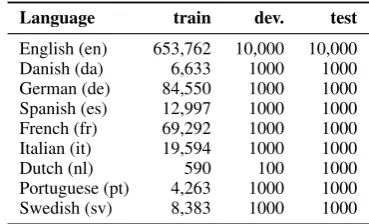
Table 1: Number of examples for topic classification.
the task-specific method of tuning. We also re-port results of a language- and task-specific tuning method assuming a minimal development data in the target language in addition to a naive method
of fixingk = 1, which is equivalent to the
word-by-word translation. Furthermore, we investigate the effect of valuekin details in§5.3.
4 Experimental setup
We conduct a series of experiments to evaluate
our fully task-specific multilingual models (§ 3)
obtained by our task projections of
cross-lingual word embeddings (§3.2). Our method is
language- and task-independent and is applicable to various tasks where existing multilingual mod-els are applicable. We adopted a topic classifica-tion task and a sentiment analysis task as the target tasks for evaluation in various languages.
Topic classification is the task of predicting the topic of a given document. For this task, we use English (en) as the source language, and Spanish (es), German (de), Danish (da), French (fr), Italian (it), Dutch (nl), Portuguese (pt), and Swedish (sv) as the target languages. We use the RCV1/RCV2 dataset (Lewis et al., 2004) for this task, follow-ing Duong et al. (2017). This dataset contains news articles in various languages with labels of four categories: Corporate/Industrial, Economics, Government/Social, and Markets.
For English dataset, we randomly chose 10,000 examples as test data, another 10,000 examples as development data, and the rest as training data. For the other languages, we randomly selected 1000 examples as test data, and another 1000 ex-amples (for Danish, 100 exex-amples) as develop-ment data, and the rest as training data. Among the development data, we randomly chose 100 sam-ples as the development data for an alternative,
language-specific tuning of k (§ 3.2). The
Sentiment analysis is a task of predicting a po-larity label of the writer’s attitude for a given text. We design this task to be a three-class classifica-tion of positive, negative, and neutral labels. We use datasets from two domains of restaurant re-view and product rere-view to conduct this exper-iment. In both domains, we consider the most resource-rich language, English (en), as the source language and other languages (Spanish (es), Dutch (nl), and Turkish (tr) for restaurant review domain, and German (de), French (fr), and Japanese (ja) for product review domain) as the target languages.
To train models in restaurant review domain, we
use Yelp Review dataset3 which consists of a set
of restaurant reviews with numerical ratings in the range of 1-5 given by the reviewers. We label the reviews with ratings of 1 or 2 as negative, those with ratings of 4 or 5 as positive, and the rest with ratings of 3 as neutral. Then, we randomly chose 100,000 examples as test data, another 100,000 ex-amples as development data, and the rest as train-ing data. For evaluation in the target languages,
we use a subset of ABSA dataset (Pontiki et al.,
2016), which consists of restaurant reviews in
En-glish, Spanish, Dutch, and Turkish with annotation of a polarity label of positive, negative, or neutral to each sentence. For each language, we randomly chose 100 sentences as development data for the
alternative, language-specific tuning of k (§ 3.2)
and the rest as test data.
For experiments in the product review domain,
we use Amazon Multilingual Review dataset4
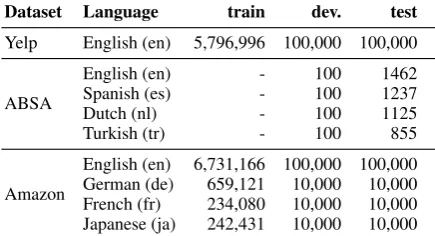
which consists of a set of product reviews in En-glish, German, French, Japanese with numerical ratings given in the same manner as the Yelp Re-view dataset. We label the reRe-views in the same manner as the Yelp Review dataset. For English dataset, we randomly sample 100,000 examples as development data, other 100,000 examples as test data, and the remaining 6,731,166 examples
as training data. For the other languages, we
randomly chose 10,000 examples as development data, another 10,000 examples as test data, and the rest as training data. Among the development data, we randomly chose 100 examples as devel-opment data for the alternative, language-specific
tuning ofk. The summary of the resulting datasets
is shown in Table2.
3
https://www.yelp.com/dataset
4https://s3.amazonaws.com/
amazon-reviews-pds/readme.html
Dataset Language train dev. test
Yelp English (en) 5,796,996 100,000 100,000
ABSA
English (en) - 100 1462
Spanish (es) - 100 1237
Dutch (nl) - 100 1125
Turkish (tr) - 100 855
Amazon
English (en) 6,731,166 100,000 100,000
German (de) 659,121 10,000 10,000
French (fr) 234,080 10,000 10,000
[image:5.595.307.525.65.183.2]Japanese (ja) 242,431 10,000 10,000
Table 2: Number of examples for sentiment analysis.
General cross-lingual word embeddings were obtained using a state-of-the-art unsupervised
method with self-learning framework (Artetxe
et al., 2018).5 This method takes monolingual word embeddings of two languages and learns a mapping between them to obtain cross-lingual
word embeddings. For monolingual word
em-beddings, we used pre-trained word embeddings
available online (Grave et al., 2018).6 They are
word embeddings with 300 dimensions obtained
by applying subword-information skip-gram (
Bo-janowski et al.,2017) to the Wikipedia corpus.
Preprocessing We use the tokenizer of Europarl
tools7to tokenize all datasets except for Japanese.
For Japanese, we use MeCab v0.9968 with IPA
dictionary v2.7.0. After tokenization, the tokens are lowercased to match vocabularies of the pre-trained word embeddings.
Models To evaluate the impact of our task-specific word embeddings on multilingual models and to compare the two methods for the cross-task
embeddings projections we proposed in § 3, we
compare the following five models.
CLWE fixed trains a bag-of-embeddings model in the target language with its embedding lay-ers fixed to the pre-trained cross-lingual word embedding. The model takes the dimension-wise average of all embeddings of input to-kens into a feedforward neural network with one hidden layer. This model is analogous to (Duong et al., 2017) except that they use
the summation weighted bytf·idf.
5https://github.com/artetxem/vecmap 6
https://fasttext.cc/docs/en/ crawl-vectors.html
7
http://www.statmt.org/europarl/
Method en-da en-de en-es en-fr en-it en-nl en-pt en-sv
CLWE fixed 0.621 0.813 0.363 0.772 0.535 0.791 0.524 0.816
CLWE fixed + NNmap 0.593 0.843 0.448 0.815 0.583 0.794 0.554 0.503
CLWE opt (LP) 0.599 0.617 0.117 0.670 0.197 0.627 0.185 0.206
CLWE opt (LLM)
k= 1 0.694 0.848 0.764 0.879 0.578 0.815 0.584 0.805
ktuned to task 0.672 0.809 0.705 0.885 0.623 0.814 0.580 0.831
ktuned to task/language 0.687 0.833 0.764 0.879 0.615 0.837 0.572 0.830
Monolingual 0.968 0.984 0.975 0.980 0.932 0.950 0.948 0.970
Table 3: Classification accuracy of topic classification task in cross-lingual settings. The underlined values indicate that, among the three trials, the worst model ofCLWE opt (LLM)outperforms the best model ofCLWE fixed.
Amazon Yelp - ABSA
Method en-de en-fr en-ja en-es en-nl en-tr
CLWE fixed 0.798 0.805 0.798 0.731 0.675 0.591
CLWE fixed + NNmap 0.798 0.803 0.784 0.748 0.665 0.556
CLWE opt (LP) 0.797 0.804 0.779 0.725 0.655 0.605
CLWE opt (LLM)
k= 1 0.813 0.811 0.764 0.731 0.680 0.569
ktuned to task 0.815 0.812 0.785 0.759 0.684 0.616
ktuned to task/language 0.815 0.810 0.777 0.766 0.719 0.617
Monolingual 0.879 0.857 0.838 - -
-Table 4: Classification accuracy of sentiment analysis task in cross-lingual settings. The underlined values indicate that, among the three trials, the worst model ofCLWE opt (LLM)outperforms the best model ofCLWE fixed.
CLWE fixed + NNmap adds two embedding-wise hidden layers to the original
feedfor-ward neural network inCLWE fixed. This is
aimed at giving the network the capability of acquiring task-specific word embeddings by enhancing the representation of the network.
CLWE opt (LP) isCLWE fixedwith embedding layer updated; we made this model cross-lingual by the linear projection (§3.2).
CLWE opt (LLM) isCLWE fixedwith the em-bedding layer updated; we made this model cross-lingual by the locally linear mapping
(§ 3.2). We report results with the three
strategies to tune the hyperparameter k for
cross-task projection.
Monolingual has the same network as CLWE fixedwith the embedding layer updated; we trained the model with datasets in the same languages as testing. We present this result to show the upper bound of model accuracy.
The dimensions of all the layers of the above five models are 300, and they are all optimized by
Adam optimizer (Kingma and Ba,2014) for
train-ing. We conduct all experiments three times with
Method Topic Class. Senti. Analysis
Amazon Yelp
Monolingual fixed 0.921 0.828 0.799
Monolingual 0.980 0.872 0.866
Table 5: Classification accuracy of monolingual mod-els in English.
different initialization of the model parameters and report the average accuracy, and hyperparameter tuning is conducted independently to each model.
5 Results
We evaluate the models in cross-lingual settings to confirm how well our method produces
task-specific cross-lingual word embeddings (Table 3
and Table 4). Prior to reporting the results, we
confirm the impact of task-specific word embed-dings in neural networks through experiments in a
monolingual setting in English (Table5).
5.1 Impact of task-specific word embeddings
General Topic class. Senti. analysis (Amazon)
excellent
excellently excellently awesome
superb exceptional perfect
good tabcorp pleased
impressive novorossiisk timeless
commendable southcorp mesmerizing
terrible
horrible frightening horrible
dreadful devastating useless
awful shocking wasted
horrendous mishaps miserably
horrific ugliness refund
economic
economy imf addition
macroeconomic trade nightstand
economies economy finances
microeconomic wto everyday
socio economist arguably
(a) English
General Topic class. Senti. analysis
(Amazon)
excellentexcellent
excellenteexcellent excellentsexcellent excellente
excellents excellente excellents
bongood excellentesexcellent excellentes
excellentes appr´eciableappreciable extraordinary
excellerto excel bons parfaite
terribleterrible
terriblesterrible terribles terribles
horriblehorrible horrible horrible
terriblementterribly meurtriewounded d´ebilestupid
´epouvantable gwynplaine horribleshorrible
effroyableterrifying ´epouvantesterrified stupidestupid
´economieeconomy
economieeconomy ´economiqueeconomic economie
´economique ´economiqueseconomic economiques
macro´economiemacroeconomy conjonctureconjuncture economiceconomic
g´eo´economiegeoeconomy fmiIMF economiqueeconomic
micro´economiemicroeconomy economiqueeconomic economieseconomies
[image:7.595.155.518.64.290.2](b) French (English translations are given as subscripts)
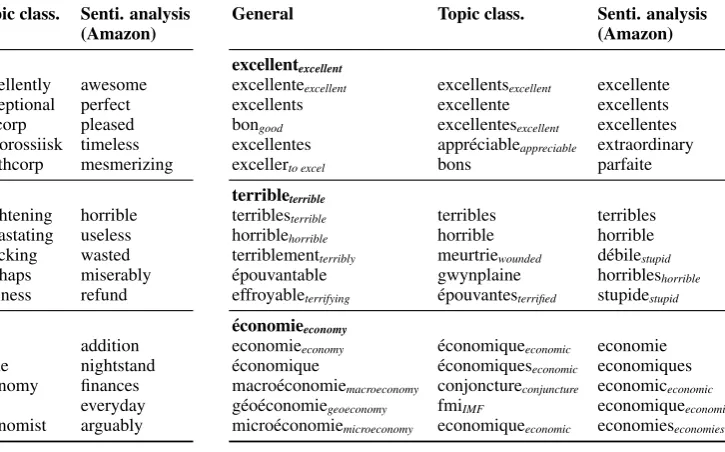
Table 6: Nearest neighbors of somewordsin the semantic space of general and task-specific word embeddings.
English by comparingMonolingualto
Monolin-gual fixed which is the same network as Mono-lingual with the embedding layer fixed to gen-eral words embeddings. We show the results of topic classification and sentiment analysis tasks
in Table 5. In both tasks, Monolingual
outper-formed Monolingual fixed with a wide margin,
which indicates that task-specific word embed-dings are indeed crucial to obtain better model per-formance. This result motivates us to learn task-specific cross-lingual word embeddings to exploit the fully task-specific neural network.
5.2 Performance of multilingual models
Table 3 and Table 4 report the classification
ac-curacy of the models on topic classification and sentiment analysis, respectively. All models are trained in English and evaluated in the target
languages. CLWE opt with hyperparameter k
tuned on the source language successfully
out-performed the two baselines, CLWE fixed and
CLWE fixed + NNmap, in all task-language pairs except for English-German in the topic classifi-cation task and English-Japanese in the sentiment analysis task. This result indicates the importance of task-specific word representation in the multi-lingual model and that our projection successfully induced task-specific cross-lingual word embed-dings. Although we gained some improvements
by tuningkto the target language using the
min-imal development set in some configurations, the
gains are smaller than the gains over the two
base-lines. This implies thatkis more sensitive to the
target task rather than the target language, which we discuss further in§5.3.
In some languages,CLWE fixed + NNmaphas
even lower classification accuracy than CLWE
fixed. We hypothesize that by having more layers, the model becomes more sensitive to the small dif-ference in word representation, which means that the noise in pre-trained cross-lingual word embed-dings affects on the model accuracy.
Comparing CLWE opt (LLM)toCLWE opt
(LP), we found that our locally linear mapping
outperforms the linear projection method for a cross-task embedding projection. For some
con-figurations, the performance ofCLWE opt (LP)
degrades significantly. These results indicate that the topology of the general and task-specific em-bedding spaces are so apart from each other that simple projection methods such as the linear pro-jection are inappropriate. We will further discuss the difference in the topologies of the general and
task-specific embedding spaces in§5.3by looking
into nearest neighbors of some target words in the semantic space of general and task-specific
cross-lingual word embeddings (Table6).
In all configurations where sufficient dataset is
available in the target languages, monolingual
da de es fr it nl pt sv
Languages
0.25 0.00 0.25 0.50 0.75 1.00 1.25 1.50
Weights
nearest words other words
(a) Topic classification (k= 2)
de fr ja es nl tr
Languages
0.25 0.00 0.25 0.50 0.75 1.00 1.25 1.50
Weights
nearest words other words
[image:8.595.78.515.64.224.2](b) Sentiment analysis (k= 3)
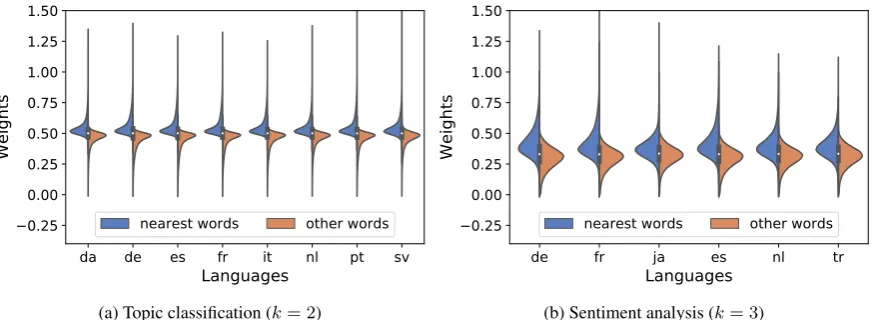
Figure 2: Distribution of the reconstruction weights αˆ for the nearest words of the target words and the other nearest neighbors.
5.3 Analysis
We conduct further investigation to gain a pro-found understanding of our method and the re-sulting task-specific cross-lingual word embed-dings. We first analyze the task-specific cross-lingual word embeddings through nearest neigh-bors of some words. We next investigate the dis-tribution of the reconstruction weights to see the
impact ofknearest neighbors other than the
near-est one. We then evaluate the sensitivity of the
model accuracy to the value ofk.
Properties of task-specific embeddings Here, we examine the properties of task-specific word embeddings obtained using our cross-task projec-tion. For this purpose, we present nearest neigh-bors of frequent words in the tasks in various em-beddings in English and French.
Table 6a shows nearest neighbors of
“excel-lent,” “terrible,” and “economic” in the general word embeddings, and the embedding layer of the models optimized for the training data in English. In the general embeddings, the words are close to words that have similar semantic or syntactic while the task-specific word embeddings show dif-ferent properties specific to the target tasks.
In the embedding layer optimized for topic classification, we found “economic” to be close to “imf (International Monetary Fund)” or “wto (World Trade Organization).” Even though they are semantically distinct, they all strongly indicate the Economy label. In contrast, the nearest neigh-bors of “excellent” and “terrible” are noisy since they do not contribute to the topic classification task.
The embedding layers optimized for sentiment
analysis exhibit different properties. While the
nearest neighbors of “excellent” and “terrible” are not semantically close, they all indicate positive and negative polarities in the respective domains. However, the nearest neighbors of “economic” are noisy as they do not contribute to the task.
Table6bshows nearest neighbors of “excellent
(excellent),” “terrible (terrible),” and “´economie (economy)” in French; the general word
embed-dings (General) and the task-specific word
em-beddings obtained using our cross-task
projec-tion (LLM).Generalembeddings exhibit similar
properties as English ones.
LLM embeddings of topic classification task
have “fmi (IMF; International Monetary Fund)”
and “conjoncture (conjuncture)” as nearest
neigh-bors of “´economie.” This indicates that our cross-task projection successfully obtains word embed-dings optimized for the task since they are strong signals of the Economy label. For sentiment anal-ysis, the word embeddings obtained by our cross-task projection of Amazon dataset captures “ex-traordinary” and “parfaite,” which strongly indi-cate positive polarity, as the nearest neighbors of “excellent” In contrast, the words strongly associ-ated with negative polarity, “d´ebile” and “stupide,” are the nearest neighbors of “terrible” in the em-bedding space. These properties suggest that our cross-task projection successfully obtains task-specific cross-lingual word embeddings.
Distribution of the reconstruction weights To see how much the nearest neighbors for the target words contribute to the projection, we investigate
1 2 3 4 5 6 7 8 9 10
k
0.3 0.4 0.5 0.6 0.7 0.8 0.9 1.0
accuracy
da
de
es
fr
it
nl
pt
sv
(a) Topic classification
1 2 3 4 5 6 7 8 9 10
k
0.3 0.4 0.5 0.6 0.7 0.8 0.9 1.0
accuracy
de
fr
ja
es
nl
tr
[image:9.595.78.516.64.247.2](b) Sentiment analysis
Figure 3: Classification accuracy as a function ofkin cross-task embedding projection.
shows the distribution of the absolute value of αˆ
for the nearest neighbors of the target word and the other nearest neighbors. For this experiment,
we usedktuned on the source language.
Even though the nearest words tend to have a
slightly higher value of αˆ compared to the other
nearest neighbor words, the difference is not so significant for most of the configuration. This
ob-servation indicates that all of thek-nearest
neigh-bors contribute to the projection.
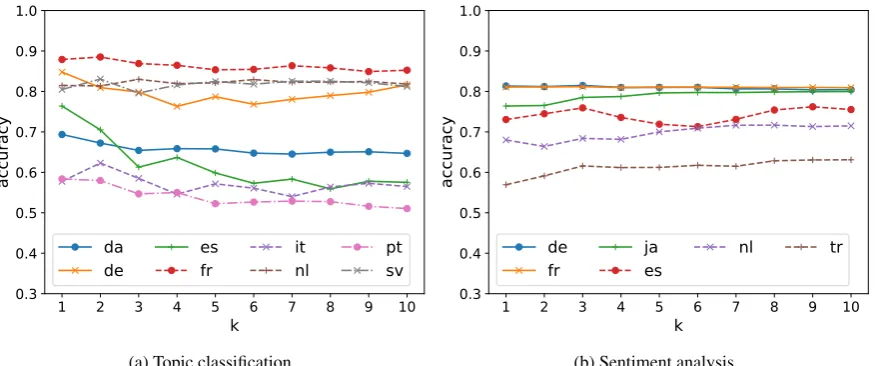
Sensitivity to hyperparameter k We proposed
three strategies to tune the hyperparameter k of
our locally linear mapping for cross-task embed-ding projection of cross-lingual word embedembed-dings: tuning on the development data in the source
lan-guage as described in§3.2, preparing small
devel-opment data (100 samples) in the target languages,
or fixing k = 1. Revisiting results in Table 3
and Table 4, for the topic classification task, the
classification accuracy of the models are
consis-tent among all of the tuning methods (Table 3),
while for the sentiment analysis task, fixingk= 1
yields lower classification acuracy (Table4). Here,
we conduct further analysis to gain a profound un-derstanding of the effect of the value ofk.
Figure 3 depicts the classification accuracy of
the models on the test set while varying k in
the topic classification task and sentiment anal-ysis task. Across languages, a smaller value of
kyields better performance for the topic
classifi-cation task, while a larger value of k yields
bet-ter performance for the sentiment analysis task.
These results indicate that the best value of k is
language-independent and thus, the tuning k for
the development set of source language suffices to achieve good results.
6 Conclusions
We proposed a method to obtain a fully task-specific multilingual model without relying on any cross-lingual resources or annotated corpora in the target language by a cross-task embedding projec-tion. Because a naive linear projection puts too strong assumption on the topologies of two em-bedding spaces, we present an effective method for the cross-task embedding projection named lo-cally linear mapping. The lolo-cally linear mapping assumes and preserves the local topology across the semantic spaces before and after the projec-tion. Experimental results demonstrated that the locally linear mapping successfully obtains task-specific word embeddings of the target language, and the resulting fully task-specific multilingual model exhibited better model accuracy than the existing multilingual model that fixes its embed-ding layer to general word embedembed-dings.
We plan to evaluate our method on various NLP tasks, languages, and neural network mod-els, and investigate the results to devise an
adap-tive method to tunekfor individual words.
Acknowledgements
References
Mikel Artetxe, Gorka Labaka, and Eneko Agirre. 2018.
A robust self-learning method for fully unsupervised cross-lingual mappings of word embeddings. In Proceedings of the 56th Annual Meeting of the Asso-ciation for Computational Linguistics (ACL), pages 789–798.
Piotr Bojanowski, Edouard Grave, Armand Joulin, and Tomas Mikolov. 2017. Enriching word vectors with subword information. Transactions of the Associa-tion for ComputaAssocia-tional Linguistics (TACL), 5:135– 146.
Ethem F. Can, Aysu Ezen-Can, and Fazli Can. 2018.
Multilingual sentiment analysis: An RNN-based framework for limited data. In ACM SIGIR 2018 Workshop on Learning from Limited or Noisy Data (LND4IR).
Xilun Chen, Yu Sun, Ben Athiwaratkun, Claire Cardie, and Kilian Weinberger. 2018. Adversarial deep av-eraging networks for cross-lingual sentiment classi-fication. Transactions of the Association for Com-putational Linguistics (TACL), 6:557–570.
Long Duong, Hiroshi Kanayama, Tengfei Ma, Steven Bird, and Trevor Cohn. 2017. Multilingual training of crosslingual word embeddings. InProceedings of the 15th Conference of the European Chapter of the Association for Computational Linguistics (EACL), pages 894–904.
Yanlin Feng and Xiaojun Wan. 2019. Learning bilin-gual sentiment-specific word embeddings without cross-lingual supervision. In Proceedings of the 2019 Conference of the North American Chapter of the Association for Computational Linguistics (NAACL-HLT), pages 420–429.
Stephan Gouws and Anders Søgaard. 2015. Sim-ple task-specific bilingual word embeddings. In Proceedings of the 2015 Conference of the North American Chapter of the Association for Computa-tional Linguistics: Human Language Technologies (NAACL-HLT), pages 1386–1390.
Edouard Grave, Piotr Bojanowski, Prakhar Gupta, Ar-mand Joulin, and Tomas Mikolov. 2018. Learn-ing word vectors for 157 languages. In Proceed-ings of the Eleventh International Conference on Language Resources and Evaluation (LREC), pages 3483–3487.
Joo-Kyung Kim, Young-Bum Kim, Ruhi Sarikaya, and Eric Fosler-Lussier. 2017. Cross-lingual transfer learning for POS tagging without cross-lingual re-sources. InProceedings of the 2017 Conference on Empirical Methods in Natural Language Processing (EMNLP), pages 2832–2838.
Yoon Kim. 2014. Convolutional neural networks for sentence classification. In Proceedings of the 2014 Conference on Empirical Methods in Natural Lan-guage Processing (EMNLP), pages 1746–1751.
Diederik Kingma and Jimmy Ba. 2014. Adam: A method for stochastic optimization. InProceedings of the third International Conference on Learning Representations (ICLR).
David D. Lewis, Yiming Yang, Tony G. Rose, and Fei Li. 2004. RCV1: A new benchmark collection for text categorization research. Journal of Machine Learning Research, 5(Apr):361–397.
Xinfan Meng, Furu Wei, Xiaohua Liu, Ming Zhou, Ge Xu, and Houfeng Wang. 2012. Cross-lingual mixture model for sentiment classification. In Pro-ceedings of the 50th Annual Meeting of the Asso-ciation for Computational Linguistics (ACL), pages 572–581.
Tomas Mikolov, Quoc V Le, and Ilya Sutskever. 2013.
Exploiting similarities among languages for ma-chine translation. Computing Research Repository, arXiv:1309.4168. Version 1.
Nikolaos Pappas and Andrei Popescu-Belis. 2017.
Multilingual hierarchical attention networks for doc-ument classification. In Proceedings of the eighth International Joint Conference on Natural Lan-guage Processing (EACL), pages 1015–1025.
Maria Pontiki, Dimitris Galanis, Haris Papageorgiou, Ion Androutsopoulos, Suresh Manandhar, Moham-mad AL-SMoham-madi, Mahmoud Al-Ayyoub, Yanyan Zhao, Bing Qin, Orphee De Clercq, Veronique Hoste, Marianna Apidianaki, Xavier Tannier, Na-talia Loukachevitch, Evgeniy Kotelnikov, N´uria Bel, Salud Mar´ıa Jim´enez-Zafra, and G¨uls¸en Eryi˘git. 2016.Semeval-2016 task 5: Aspect based sentiment analysis. In Proceedings of the 10th International Workshop on Semantic Evaluation (SemEval), pages 19–30.
Sam T. Roweis and Lawrence K. Saul. 2000. Nonlin-ear dimensionality reduction by locally linNonlin-ear em-bedding. Science, 290(5500):2323–2326.
Sebastian Ruder, Ivan Vuli´c, and Anders Søgaard. 2019. A survey of cross-lingual word embedding models. Journal of Artificial Intelligence Research (JAIR), 65:569–631.
Shyam Upadhyay, Manaal Faruqui, Gokhan Tur, Dilek Hakkani-Tur, and Larry Heck. 2018. (Almost) zero-shot cross-lingual spoken language understanding. InProceedings of the 2018 IEEE International Con-ference on Acoustics, Speech and Signal Processing (ICASSP), pages 6034–6038.
Xiaojun Wan. 2009. Co-training for cross-lingual sen-timent classification. In Proceedings of the Joint Conference of the 47th Annual Meeting of the ACL and the fourth International Joint Conference on Natural Language Processing of the AFNLP (ACL-IJCNLP), pages 235–243.
Chao Xing, Dong Wang, Chao Liu, and Yiye Lin. 2015.
Chapter of the Association for Computational Lin-guistics: Human Language Technologies (NAACL-HLT), pages 1006–1011.
Kui Xu and Xiaojun Wan. 2017. Towards a uni-versal sentiment classifier in multiple languages. In Proceedings of the 2017 Conference on Em-pirical Methods in Natural Language Processing (EMNLP), pages 511–520.
Zhilin Yang, Ruslan Salakhutdinov, and William W. Cohen. 2017. Transfer learning for sequence tag-ging with hierarchical recurrent networks. In Pro-cessing of the fifth International Conference on Learning Representations (ICLR).
A Derivation of the locally linear mapping
Recall thatXgenandYgenrepresent general
cross-lingual word embeddings of the source and target
languages, respectively. Also, for each wordiin
the target language, we denote the set of itsk
near-est neighbors in the target language in the seman-tic space of the general cross-lingual word embed-dings asNigen.
We reconstructYigenas a linear combination,
X
j∈Nigen
αijXjgen
whereαiis the weight vector which we optimize.
The reconstruction error is given as
=
Yigen− X
j∈Nigen
αijXjgen
2
=
X
j∈Nigen
αij
Yigen−Xjgen
2
= X
j∈Nigen
X
i∈Nigen
αijαilCijl
whereCi∈ Rk×kis the covariance matrix,
Cijl=
Yigen−Xjgen
Yigen−Xlgen.
We minimize this reconstruction error under
the constraint ofP
j∈Nigenαij = 1. Applying the
method of Lagrange multiplier, we have
L= X
j∈Nigen
X
i∈Nigen
αijαilCijl−λ
X
j∈Nigen
αij −1
.
We then solve ∂α∂L
ij =
∂L
∂λ = 0to obtain
ˆ
αij =
P
l(C −1
i )jl
P
j
P
l(C −1
i )jl .
The resulting value ofαˆi is then used to
com-pute the task-specific word embedding ofias
Yispec= X
j∈Nigen
ˆ
αijXjspec
whereXspecis the tast-specific word embeddings